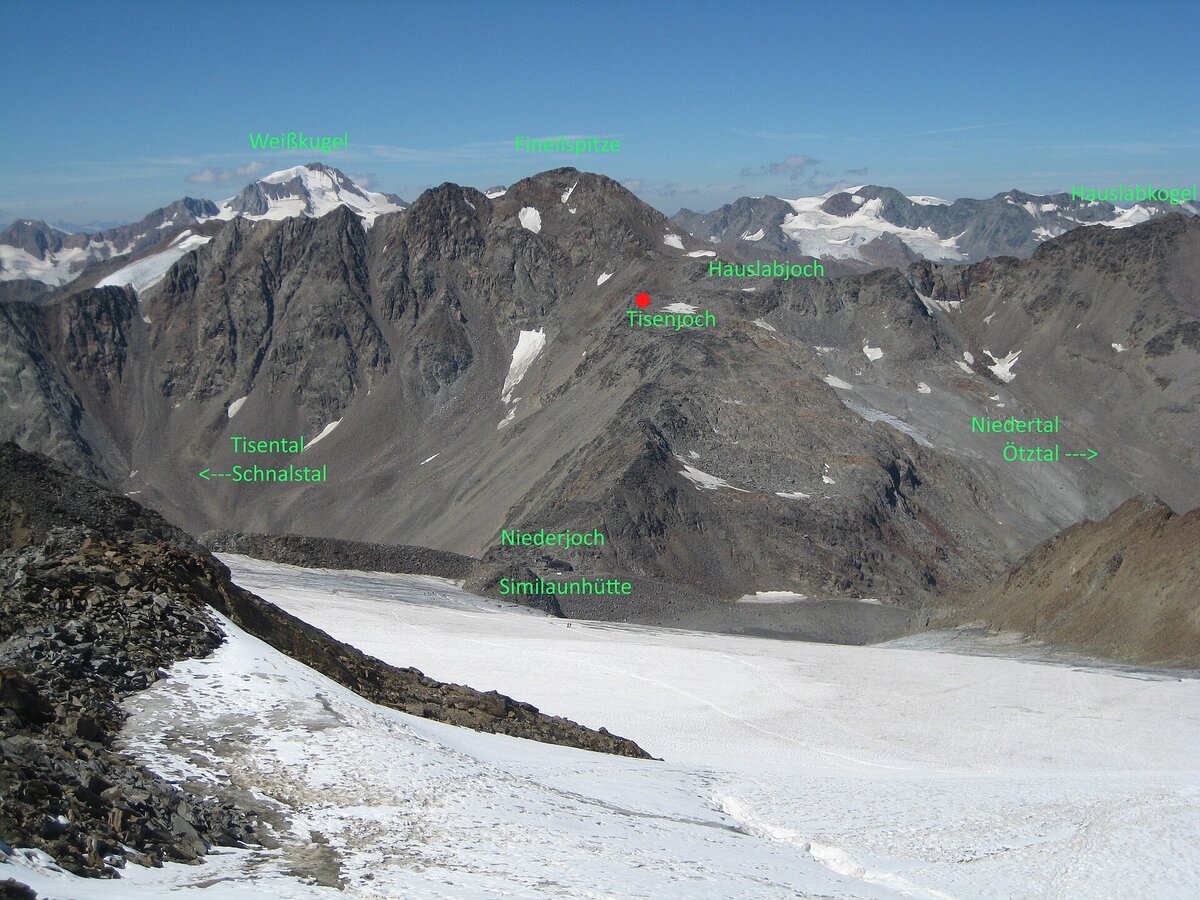
On 19 September 1991, two German hikers strayed from the marked trails of the Ötztal Alps, on the border between Austria and Italy. At an altitude of 3,210 metres, near the Hauslabjoch pass, they spotted a body half-emerging from the melting ice: a brown back, tanned shoulders, a head tilted back. They believed they had found the remains of a mountaineer killed in a recent accident. In reality, they had just uncovered the most famous mummyMummyA body preserved from decay, naturally (cold, aridity, peat) or artificially; the frozen Pazyryk kurgans yielded natural mummies with tattooed skin.→ of European prehistoryPrehistoryThe span of human history before the invention of writing, from the Palaeolithic to the Metal Ages, known mainly through material remains.→: a man who died nearly 5,300 years ago, preserved almost intact by the cold and ice of a high-mountain glacier. He would be called Ötzi, after the valley that brought him back to light; scientists prefer to speak of "the man of the Tisenjoch" or, more broadly, "the Iceman". His discovery was to open an extraordinary window onto the daily life of a European of the [1] ChalcolithicChalcolithicThe "Copper Age": a transition between the Neolithic and the Bronze AgeBronze AgeA protohistoric period following the Neolithic, defined by bronze metallurgy (a copper-tin alloy) and the rise of the first cities and states; in Egypt it corresponds to the age of the first pyramids.→, marked by the first copper objects (Ötzi's era).→, that pivotal period when metal, for the first time, entered a world still largely NeolithicNeolithicThe "New Stone Age": a period marked by farming, herding, settlement and pottery, from around 10,000 BC.→.
What sets Ötzi apart from all other discoveries in prehistory is the extraordinary completeness of the file. Where the archaeologist usually has only bones, potsherds and chipped stones, the Iceman yielded a body with its skin, its organs, its stomach contents, its clothes, its tools, its weapons, and even the pollen stuck to his garments. This is no longer an anonymous skeleton but an individual: a man of about forty, short, ill, weary, who lived precise days whose course we can reconstruct hour by hour. This feature retraces his story, his eventful discovery, the riddle of his preservation, the forensic inquiry that revealed a murder, his tattoos, his copper-and-wood equipment, and finally his genome, which makes him speak across five millennia of silence.
The very name "Iceman" has, over the decades, become a cultural touchstone, but behind the nickname lies one of the most intensively studied human bodies in the world. More than a thousand scientific publications have been devoted to him; dedicated research institutes, conferences and doctoral theses have grown up around his case. Few individuals from any period of the past have been examined with such an arsenal of methods, radiology, endoscopy, histology, isotope geochemistry, genomics, palynology, entomology. The Iceman has, in a sense, become a discipline of his own, a meeting point where the natural and historical sciences converge on a single body. To study Ötzi is to take the full measure of how far the investigation of the human past can now reach when chance preserves not a fragment but a whole life.
The 1991 discovery and the border dispute
Erika and Helmut Simon, the hiking couple from Nuremberg, reported their find as they descended. The news at once triggered a series of clumsy operations. Convinced they were dealing with a recent death, the Austrian authorities tried to free the corpse with a jackhammer and an ice axe, damaging the hip and harming the clothing. Several people trampled the site, picked up objects, lost items. For four days, curious mountaineers and rescuers came and went around the body half-trapped in the ice. Only when the archaeologist Konrad Spindler, of the University of Innsbruck, examined the equipment, notably an axe of very ancient appearance, did he grasp the improbable: this body was not a few decades old but several millennia. His verdict fell: "at least four thousand years". It would soon be raised to more than five thousand.
There then arose an imbroglio worthy of a diplomatic farce. Where, exactly, had the body lain? The Austro-Italian border, set in 1919 by the Treaty of Saint-Germain, in principle follows the watershed line of the Alpine crests. But the Hauslabjoch is a sector where this theoretical line and the actual boundary do not coincide perfectly, all the more so as glaciers move. Vienna and Rome both laid claim to the mummy. A precise topographic survey finally settled the matter in the autumn of 1991: Ötzi lay about 92 metres inside Italian territory, in the autonomous province of South Tyrol (Alto Adige), a German-speaking region of Italy. Austria, which had carried out the first treatment and analyses in Innsbruck, kept the mummy for the duration of the studies, before it was transferred in 1998 to Bolzano, where a museum was specially fitted out to house it.
This border dispute, trivial in appearance, had real consequences. Erika Simon, who claimed the status of finder of the mummy, had to wage a long legal battle to obtain, in 2003 and then on appeal, the reward provided by South Tyrolean law to the discoverers of archaeological goods. Helmut Simon himself died in the mountains in 2004, feeding the legend of an "Ötzi curse" of which we shall say more. Beyond the folklore, the episode illustrates a methodological truth: the mummy was extracted under conditions deplorable for science. Part of the contextual information, the exact position of the body, the location of each object, the stratigraphyStratigraphyThe study of the superimposed layers (strata) of an archaeological site; each layer corresponds to a phase of occupation and yields a relative chronology.→ of the ice, was irretrievably lost in the haste of the first days. The systematic archaeological excavations carried out afterwards on the site, over the following summers, fortunately recovered a wealth of fragments: remains of clothing, feathers, pieces of the backpack frame, debris of tools, fallen into the glacial hollow that had protected Ötzi.
Preservation by cold: a natural mummy
Why did the body survive fifty-three centuries without decomposing? The answer lies in a conjunction of exceptional circumstances. Ötzi is not an artificial mummy, embalmed like those of Egypt: he is a natural mummy, of the "freeze-drying" or cold-desiccation type. After his death, his body rapidly cooled and dehydrated in the dry, icy air of the high mountains, before being covered by snow and then ice. Above all, he lay at the bottom of a rocky depression, a kind of natural basin about three metres deep. This topographic configuration was decisive: it shielded the body from the grinding movement of the glacier which, above, flowed slowly downhill. Where the moving ice would have dislocated and scattered the remains, the basin kept them sheltered, as in a refrigerated strongbox.
The mummification process first dried out the tissues. The skin tanned, taking on that characteristic dark-brown hue; the eyes were preserved, as were the nails, the short hair, and even the contents of the viscera. The body mass fell by half through dehydration. Then the permanent cold of the glacier stabilised the whole for millennia. For the body to reappear in 1991, a concurrence of climatic circumstances was needed: a particularly hot summer, combined with a deposit of Saharan dust on the snow that lowered its albedo and accelerated the melt. Ötzi thus emerged thanks to the same warming that, today, is causing Alpine glaciers to retreat and regularly returns other remains trapped in the ice, a new discipline, glacial archaeology, of which he was the founding manifesto.
The mummy's preservation has, ever since, posed a permanent technical challenge. At the South Tyrol Museum of Archaeology in Bolzano, Ötzi rests in a refrigerated cell kept at −6 °C and a humidity level of 98%, conditions that reproduce those of the glacier. A thin film of ice is regularly sprayed onto the body to prevent any further desiccation. Visitors glimpse him only through a small porthole. Each scientific sampling, for a biopsy, an analysis, an imaging session, must be planned so as to limit the time of exposure to ambient temperature. The mummy has thus become both an inexhaustible object of study and a fragile patient, whose posthumous survival demands constant vigilance.
Dating: a man of the Chalcolithic
From the first weeks, [1] radiocarbonRadiocarbon (carbon-14)A dating method based on the decay of carbon-14, usable back to about 50,000 years.→ dating was undertaken in several independent laboratories, from samples of bone, tissue and material from the equipment. The results converged remarkably: Ötzi lived and died between about 3350 and 3100 BC, that is some 5,300 years ago. This range places him unambiguously in the Chalcolithic, the Copper Age, that transitional phase, in the Alps, between the closing Neolithic and the coming Bronze Age. The precision of the dating, cross-checked by several methods and several materials, makes Ötzi a chronological anchor of exceptional reliability for the whole archaeology of the Alpine arc.
What does "Chalcolithic" mean? The word, coined from the Greek khalkos (copper) and lithos (stone), denotes an era in which farming communities already master the metallurgyMetallurgyThe techniques of extracting and working metals (copper, bronze, gold); its rise in the Eneolithic and Bronze Age transformed tools, weapons and social hierarchies.→ of native and smelted copper, yet continue to make massive use of stone, bone and wood tools. It is not yet the age of metals in the full sense: copper, soft and precious, served above all for prestige objects, ornaments, ceremonial weapons. Ötzi's axe, of which we shall say more, is the perfect illustration. The Iceman lived in a world of farming and herding villages, organised around the cultivation of cereals and the keeping of flocks, dotted with early monuments, some regions of Europe were then raising their megalithsMegalithA large stone raised or assembled by humans (menhirMenhirA stone erected vertically by humans, standing alone or in rows (alignments), emblem of the Breton Neolithic megalithic tradition. From Breton men (stone) and hir (long).→, dolmenDolmenA megalithic funerary structure made of one or more capstones resting on vertical uprights, often topped by an earth tumulus. From Breton dol (table) and men (stone).→, stone circleStone circleA Neolithic or Bronze Age monument of standing stones set in a ring, often ritual or astronomical in purpose.→), typical of the Neolithic and Bronze Age.→, and already crossed by long-distance exchange networks.
To place Ötzi in time is also to measure the dizzying scale of his antiquity. He lived about two thousand years before the building of Stonehenge in its most accomplished form, and well before the pyramids of Egypt. When he climbed the slopes of the Ötztal for the last time, writingWritingA system of conventional signs used to fix language or information durably; its appearance (c. 3300 BC) marks, by convention, the end of prehistory.→ did not yet exist in Europe; the wheel was only just beginning to spread; the horse was not domesticated in the region. And yet the man we discover is in no way a crude being: he possessed sophisticated equipment, a fine knowledge of the plant pharmacopoeia, a mastery of fire and materials, membership of a structured society capable of producing and exchanging copper. Ötzi forces us to revise our images of a "primitive" prehistory.
The forensic inquiry: the arrow, the artery, the violent death
For ten years, Ötzi was thought to have died of cold and exhaustion, caught by a storm during a flight or a journey at altitude, the so-called "Alpine disaster" hypothesis. Then, in 2001, a radiological examination by computed tomography overturned the story: a flintFlintA hard, brittle siliceous rock, knapped by prehistoric people to produce blades, points and sharp tools.→ arrowhead was lodged in his left shoulder, beneath the shoulder blade, in a spot no hand could have reached by itself. Ötzi had not died of exhaustion: he had been killed. The discovery transformed the Iceman into the oldest documented crime scene in Europe, and mobilised the methods of modern forensic medicine in the service of an inquiry 5,300 years old.
The reconstruction is now fairly precise. The arrow, shot from behind and upwards, penetrated the left shoulder and severed a major artery, the subclavian artery or one of its branches. The injury caused a massive internal haemorrhage, a considerable haematoma, and death within minutes, by hypovolaemic shock. The attacker stood below, at a distance; he did not approach to recover his arrow, whose shaft was pulled out but whose stone tip remained embedded in the flesh. This detail is heavy with meaning: one does not take the risk of leaving a flint point, a valuable object, in the body of one's victim, unless one is fleeing, or wishes to erase the trace of the weapon.
The examination revealed other wounds. A deep cut to the right hand, at the base of the thumb and index finger, partly healed, testifies to a hand-to-hand fight that occurred one or two days before death: Ötzi defended himself, gripped a blade, cut himself. A trauma to the back of the skull, a fracture or violent blow, may have contributed to death or occurred in the final fall. The picture that emerges is one of violence in several acts: an initial confrontation from which he emerged wounded but alive, then a pursuit at altitude, and finally the fatal ambush at the pass, where an arrow shot from afar brought him down. On his clothes and weapons, blood analyses identified the genetic traces of at least four different individuals, including his own, a possible sign that he carried a wounded companion, or faced several adversaries.
The motive remains, by its nature, out of reach. A clan quarrel? A vendetta? A conflict over resources, a flock, a territory? A ritual? One thing strikes investigators: his valuable objects, the precious copper axe, the dagger, the bow, were not taken. This was therefore no common robbery. The presence of the last meal, copious, in his stomach, indicates that he stopped to eat shortly before dying, as if he had believed himself safe, or had paused after a long march. The Iceman carries with him the secret of his end; but thanks to forensic medicine, we now know its course with a precision no written testimony could have offered.
The forensic inquiry around Ötzi also advanced the methods themselves. For the first time, the techniques of contemporary criminalistics, analysis of a projectile's trajectory, study of bloodstains on weapons, dating of injuries by their degree of healing, reconstruction of posture at the moment of impact, were applied to a body several millennia old. Researchers were thus able to establish not only that Ötzi had been killed, but also how: the angle at which the arrow penetrated, its depth, the artery struck, the speed of death. This "autopsy of prehistory" set a precedent, and the Iceman is today a classic case study, taught in forensic medicine and palaeopathologyPalaeopathologyThe study of diseases, injuries and trauma on ancient human or animal remains.→ courses alike. He reminds us that archaeology, far from being a contemplative science, can borrow from the most modern disciplines to bring out facts that no document would ever have recorded.
The tattoos: the oldest in Europe
Ötzi's body bears some sixty dark marks: lines, crosses, groups of parallel strokes, distributed over the lower back, the legs, the ankles, the knees, the wrist and the thorax. Long counted at 57 and then more precisely recorded thanks to multispectral imaging, these motifs constitute the oldest attested body tattoos in Europe, and among the oldest in the world. Their study, published notably in the journal Archaeometry [3], made it possible to clarify the technique and to reopen the debate on their function.
Unlike modern tattoos, made with a needle, Ötzi's were not produced by puncture. The fine analysis of the marks suggests a technique of incision: the skin was cut with a sharp instrument, then a pigment, most likely soot or finely ground charcoal, was rubbed into the open wound. As it healed, the skin trapped the carbon, fixing the design permanently. This method, known as incision-and-rubbing, differs from puncture tattooing and constitutes precious data for the history of prehistoric body techniques.
But it is their meaning that fascinates. Ötzi's tattoos are not figurative: no animals, no elaborate symbols, only simple lines and crosses. Above all, their location is striking. The great majority lie on areas of the body that correspond to overworked joints and to points where examination of the mummy revealed degenerative lesions: arthritis of the lower back, wear of the knees and ankles. Several of the groups of lines coincide, strikingly, with points used in certain traditional medicines, so much so that a distant kinship with principles akin to acupuncture has been suggested. The dominant hypothesis is therefore that of therapeutic tattoos: marks applied to painful areas, perhaps in a gesture at once medical and ritual, to relieve the ailments of an ageing, weary body.
This interpretation is not certain, and other readings remain possible, social marking, membership of a group, symbolic or protective value. It may also be that several functions overlapped. What is sure is that these tattoos testify to an elaborate relationship with the body and with suffering: the Iceman, or those around him, had developed a know-how for intervening on the flesh, relieving pain, and inscribing in the skin the lasting traces of that intervention. It is one of the most human, most moving aspects of the file: behind the object of study emerges the silhouette of a man who suffered and whom someone sought to heal.
The very existence of these marks raises a broader question about the place of the body in prehistoric societies. Whatever their precise purpose, the tattoos show that the skin was not a neutral surface but a medium that could be worked, signified, and durably altered. Producing them required deliberate action, cutting the flesh, preparing a pigment, enduring the pain and the risk of infection, repeated dozens of times across the body. Such an investment implies that the result mattered, whether for the relief it was thought to bring, for what it said about the man who bore it, or for both at once. In the Iceman, the most ancient body art of Europe is not a decorative flourish but a window onto a way of inhabiting one’s own body, of confronting pain and ageing, that the dryness of the surviving evidence usually denies us.
The equipment: the copper axe, the unfinished bow, the tinder pouch
No other prehistoric discovery has yielded such complete equipment. At the moment of his death, Ötzi carried everything needed to live, hunt, make fire and repair himself in the heart of the mountains. The most extraordinary object is his axe. Its blade, about nine and a half centimetres long, is of nearly pure copper, cast in a mould then hammered and sharpened. It was fixed with birch tar and leather thongs to an L-shaped yew haft, carefully shaped. At the time of its discovery, the blade was thought to be bronze: analyses proved it was copper, and recent studies have even traced the ore's origin to deposits in Tuscany, central Italy, proof that this metal, or the axe itself, had travelled hundreds of kilometres through exchange networks.
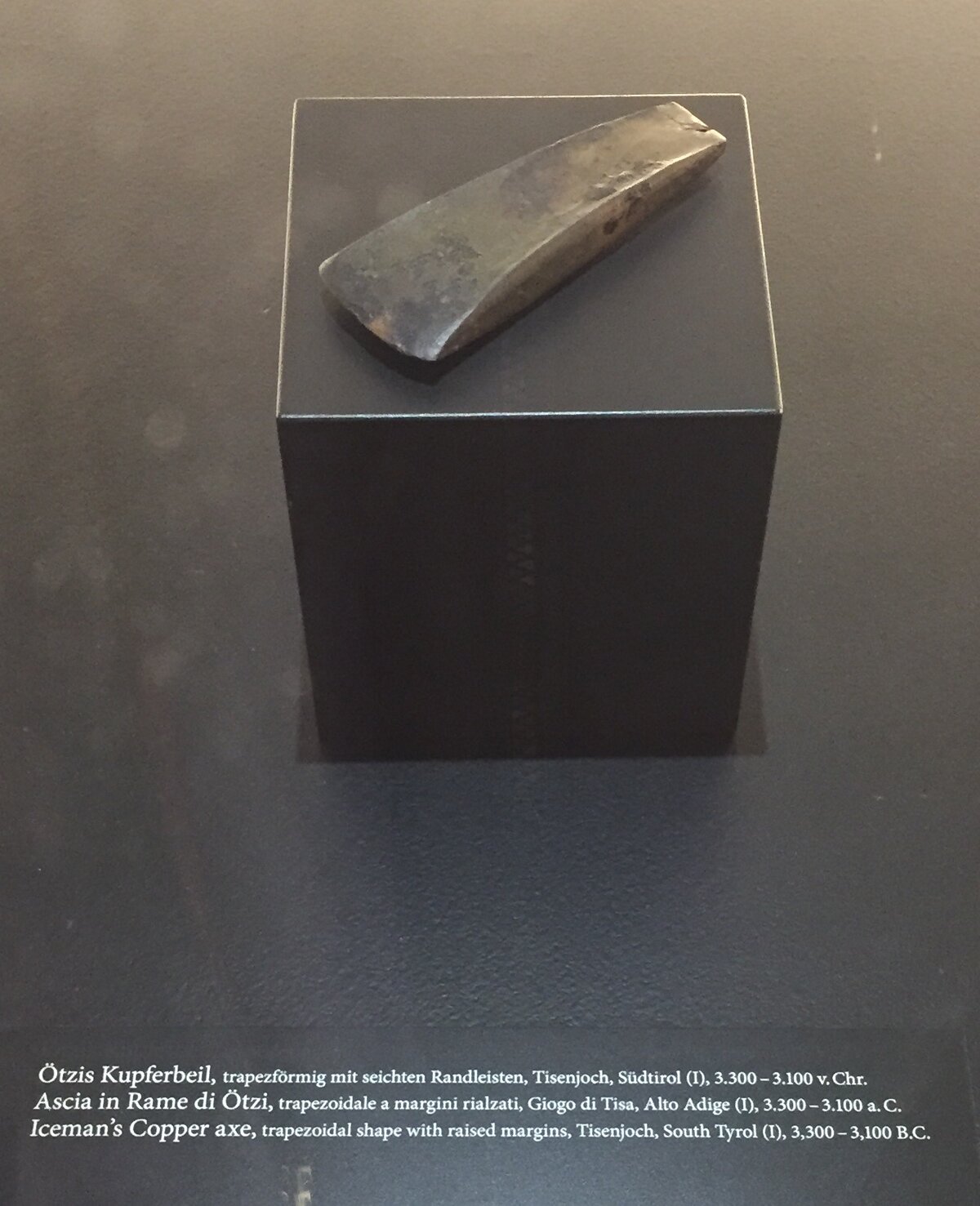
The copper axe was not a mere tool: it was a rare and costly object, a marker of social status. To own a metal blade, in the Alpine Chalcolithic, signalled a particular rank, a man of importance, perhaps a chief, a notable of his community. This datum reinforces the puzzling character of his murder: it was not an outsider who was killed, but an individual equipped with a prestige good that his murderers, notably, did not carry off.
Ötzi's bow, on the other hand, tells another story: that of unfinished work. Nearly one metre eighty long, cut from a branch of yew, the bow wood par excellence, elastic and resilient, it was not finished. Its surface still bore tool marks; it was neither polished nor strung, and so unusable as it stood. Likewise, his leather quiver held fourteen arrows with shafts of viburnum or dogwood, but only two were completed, fletched and fitted with their flint tip; the others awaited finishing. This inconsistency, setting off into the high mountains with one's main weapon out of action, has fed many hypotheses: was Ötzi fleeing in haste, repairing his gear along the way? Had he broken his previous bow and undertaken to make a new one in a rush? The unfinished bow is one of the most telling clues of a crisis situation, of a forced march during which the man tried, in haste, to rebuild his equipment.
The rest of the kit confirms a remarkable self-sufficiency. Ötzi carried a flint dagger with an ash handle, slipped into a woven sheath, and a retoucher: a lime-wood rod tipped with hardened deer antler, used to sharpen and retouch the edge of the stone blades. He carried a backpack frame of wood, which let him bear his belongings on his back. And he had a genuine fire kit, kept in a pouch: pieces of pyrite to produce sparks, and above all tinder, a flammable material drawn from a fungus, the tinder bracket, that grows on tree trunks. He also carried two cylindrical containers of birch bark, one of which held fresh leaves and wrapped embers: a way of carrying fire from one camp to another.
More surprising still, Ötzi carried two pieces of another fungus, the birch polypore, threaded on leather thongs. This fungus has recognised medicinal properties, antibacterial, haemostatic, even anthelmintic. Now analyses revealed that the Iceman was infested with whipworms, intestinal parasitic worms. The presence of this fungus in his equipment suggests he used it as a remedy, perhaps against these parasites. It is one of the oldest testimonies of self-medication in human history: a man of the final Neolithic who knew and carried his pharmacopoeia.
Clothing and diet: the last meal
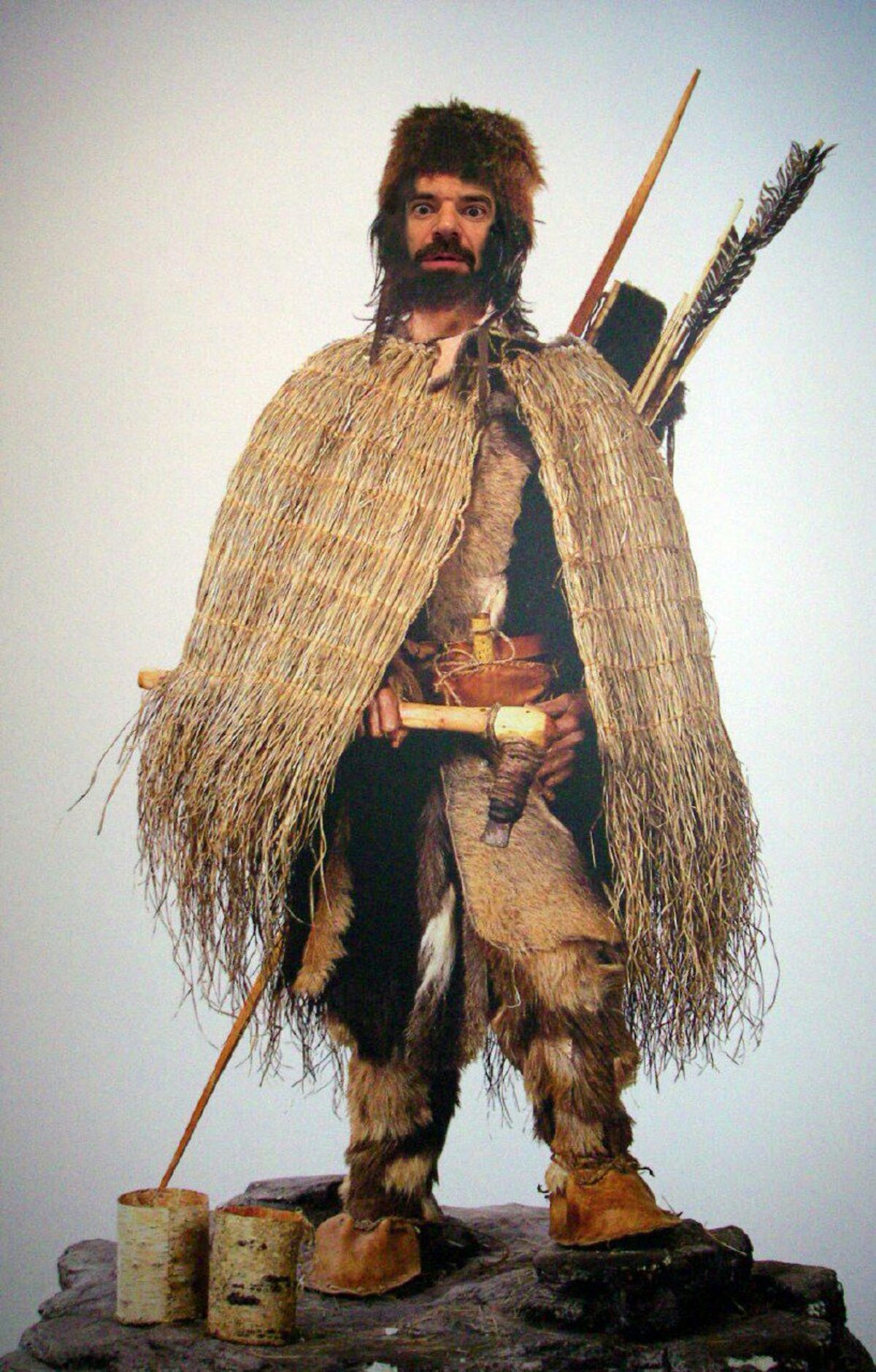
Ötzi's clothes, partly preserved, reveal a wardrobe perfectly suited to the high mountains and made with great skill. He wore a long coat made of strips of goat and sheep hide sewn alternately, creating a striped pattern; a leather belt fitted with a pouch; a loincloth; separate leggings, attached to the belt, foreshadowing trousers; a cap of brown-bear fur held by a chin strap; and a cape of woven grass, a kind of straw cloak that protected against rain and cold. His shoes, particularly ingenious, comprised a sole of bear hide, an upper of deer leather, an inner net to hold an insulating stuffing of dry grass, and laces, genuine prehistoric mountain boots, designed for walking in the snow.
The study of the raw materials of these clothes, by analysis of [2] ancient DNADNAThe molecule carrying genetic information, used to reconstruct kinship between species.→Ancient DNAGenetic material preserved in old remains, often degraded, sequenced with cutting-edge techniques.→ and proteins, showed that he used the hides of several species: domestic goat and sheep, cattle, bear, deer. The choice of leathers was not indifferent, tough bear hide for the soles, supple goat hides for the coat, testifying to precise empirical knowledge of each material's properties. Ötzi was a man of his time: a herder and a mountain dweller, clad in the products of his flocks and the hunt.
His last meal could be reconstructed in astonishing detail, thanks to the analysis of the contents of his stomach and intestines. A few hours before his death, Ötzi had eaten a rich, fatty meal: dried ibex and deer meat, fat, cereals, einkorn (a primitive variety of wheat) in the form of bread or porridge, and traces of bracken. The high proportion of fat, unusual, corresponds exactly to the energy needs of a man exerting himself in the cold of the high mountains: a caloric food, chosen to sustain a body under severe strain. The presence of food still being digested in the stomach proves that he had eaten shortly before dying, confirming the chronology of the final ambush.
The analysis of the pollen trapped in his body and clothes even made it possible to reconstruct his itinerary in the final days, and the season of his death. Pollen of hop-hornbeam, a tree that flowers only in spring, found in his digestive tract, places his death in late spring or early summer. The succession of pollens, low-altitude species, then mid-altitude, then high-mountain, betrays a rapid movement from the valleys towards the summits, perhaps a hurried round trip. To reconstruct, from microscopic grains, the calendar and geography of the final days of a man dead 5,300 years ago: such is the feat made possible by the exceptional file of the Iceman.
The genome: origins, eyes, lactose, predispositions
In 2012, the complete sequencingSequencingReading the order of the bases (A, T, G, C) of a DNA molecule; high-throughput sequencing reads millions of fragments in parallel.→ of Ötzi's genome, from a bone sample, marked a new revolution. For the first time, a complete genome of a Chalcolithic European was available, and the mummy could be made to "speak" about traits invisible in the desiccated flesh. The progress of [2] palaeogeneticsPalaeogeneticsThe study of ancient DNA extracted from remains (bones, teeth, sediments, walls) to reconstruct the past of populations.→ has since refined this portrait, a more thorough reanalysis having been published in 2023, correcting some of the initial conclusions.
Ötzi had brown eyes, not light ones, as had first been thought. He carried a genetic variant that made him lactose-intolerant: as an adult, he could not digest milk, which was the norm in his time, the persistence of lactase into adulthood having spread only later in Europe. His genome also revealed a predisposition to cardiovascular disease, consistent with the arterial calcifications observed on the mummy by scan: despite a physically active life and a diet free of modern excess, the Iceman already showed marked atherosclerosis, a reminder that these afflictions are not solely an ill of our age. There was also identified in his body the bacterium Helicobacter pylori, responsible for ulcers, and the eggs of the intestinal parasites already mentioned.
The most instructive point concerns his origins. Ötzi's genome links him to an ancestry mostly derived from the first farmers who came from the Near EastNear EastA region of western Asia (Levant, Mesopotamia, Anatolia, Iran), cradle of the Neolithic revolution, agriculture, the first cities and writing.→, who had spread agricultureAgricultureThe cultivation of plants and production of food by working the soil, which emerged in the Neolithic in the Near East and independently elsewhere; it radically transformed human societies.→ across Europe over the preceding millennia. The 2023 reanalysis showed that he carried a surprisingly high proportion of this Anatolian ancestry and a very low component of European hunter-gatherersHunter-gatherersA way of life based on hunting, fishing and gathering wild resources, without farming or herding; it dominated almost the whole of human history.→, suggesting that he belonged to a relatively isolated, little-mixed Alpine population. Notably, his genome does not yet bear the signature of the great migration of the pastoralists of the Pontic steppeSteppeA vast semi-arid, treeless grassland of Eurasia, suited to nomadic herding and the horse; a corridor for the movement of peoples and technologies in later prehistory.→ (the so-called Yamnaya populations), which was to sweep over Europe shortly after his time and profoundly transform the peopling of the continent. Ötzi thus belongs to the world before that great genetic upheaval: a witness to late Neolithic Europe, just before it tipped over.
These results illustrate the power of ancient DNA, but also its methodological fragility. The first analysis of 2012, conducted on still-limited data, had concluded that he had light skin and a kinship with present-day Sardinian populations; the 2023 reanalysis, based on higher-quality sequencing and a broadened comparative panel, revised several of these conclusions, describing a man with probably darker skin and a partly bald head. This correction is not an admission of failure: it is the very functioning of science, which refines its conclusions as its tools progress. Ötzi remains, in this respect, a permanent laboratory of the methods of palaeogenetics.
The "world of Ötzi": the Alpine Chalcolithic
What does the Iceman teach us about the society of his time? The "world of Ötzi" was that of farming and pastoral communities settled in the Alpine valleys and their foothills, practising the cultivation of cereals, einkorn, emmer, barley, the herding of goats, sheep and cattle, and the seasonal exploitation of high-altitude pastures. Ötzi's presence at over 3,000 metres, equipped for a long stay, doubtless fits into these practices of transhumance or movement between slopes, unless it stems from the dramatic circumstances of his flight.
This world was not isolated. The copper axe, whose ore comes from central Italy, attests to long-distance exchange networks, through which metals, raw materials, know-how and doubtless ideas circulated. The nascent metallurgy of copper, which characterises the Chalcolithic, presupposed a chain of specialised skills: prospecting the ore, extraction, reduction, smelting, casting, hammering. That this chain supplied metal to a man of the eastern Alps shows the region's integration into a vast economic space, in which copper played the role of a good of prestige and power.
Violence, finally, which cost Ötzi his life, sketches in negative a society where conflicts, between individuals, between clans, between communities, could be settled by arms. The bow, the arrows, the dagger are not only hunting tools: they are also instruments of war or vendetta. The Iceman, wounded in the hand in a confrontation then finished off by an arrow at altitude, testifies to a very real conflictuality within these farming societies that have sometimes been dreamt of as peaceful. The Alpine Chalcolithic was no golden age: it was a world of prosperous but unequal villages, of coveted riches, of tensions that sometimes resolved in blood. The distance separating a carefully arranged burialBurialThe intentional deposition of a body, sometimes with offerings; a marker of symbolic behaviourSymbolic behaviourA set of practices (adornment, pigments, art, burial) reflecting symbolic thought; long ascribed to Homo sapiens alone, now attested for Neanderthals too.→.→ from a body abandoned at the bottom of a glacial hollow says, on its own, much about the shadow side of this humanity.
The "curse" and the museum afterlife
No famous mummy escapes its dark legend, and Ötzi has his: the "curse of the Iceman". Several people closely associated with the discovery or study of the mummy died in the years that followed, sometimes brutally, a mountaineering accident, a car crash, a sudden illness. Helmut Simon, one of the discoverers, perished in the mountains in 2004. The forensic doctor who had examined the body, one of the archaeologists present, a guide, a journalist all feature on the list that lovers of mysteries like to draw up. The device is familiar: from a sufficiently large sample of people, dozens were in contact with Ötzi, a few deaths, statistically expected, suffice to feed the tale of a supernatural fate. Ötzi's "curse" belongs to the same folklore as that of Tutankhamun: a modern myth, seductive and unfounded, that scientists strive to dismantle.
The reality, more prosaic, is that of a scientific heritage of inestimable value, managed with extreme care. Since 1998, Ötzi has been the centrepiece of the South Tyrol Museum of Archaeology in Bolzano, which draws hundreds of thousands of visitors each year and makes the Iceman a figure of regional identity. Around the mummy has been built a vast international and multidisciplinary research programme, bringing together doctors, biologists, archaeologists, geneticists, materials specialists. Each decade brings its share of new discoveries, as analytical techniques progress: 3D imaging, next-generation sequencing, isotopic and proteomic analyses. Ötzi has thus become an object of study that continually renews itself, a mummy that has not finished yielding its secrets.
His afterlife extends beyond the scholarly sphere. The Iceman has entered popular culture, books, documentaries, exhibitions, hyperrealistic reconstructions of his face by palaeo-artists. These reconstructions, based on the morphology of the skull and the genetic data, have given him back a face: that of an old, wrinkled, bearded man with a sombre gaze, whose familiarity is unsettling. For such is, at bottom, the singularity of Ötzi: he is not an abstraction, a type, a statistic. He is someone, an individual whose diseases, pains, last meal, clothes, face and even cause of death we know. Through him, prehistory ceases to be the anonymous history of the masses to become the singular destiny of one man.
Conclusion
Ötzi, the Iceman, is far more than a spectacularly preserved mummy: he is an archival document without equal, a time capsule that restores, in its entirety, a fragment of life from the Alpine Chalcolithic. From his chaotic discovery in 1991 to the border dispute that followed, from the riddle of his preservation by cold to the dating that places him 5,300 years ago, from the forensic inquiry revealing a murder to the study of his therapeutic tattoos, from his copper-and-wood equipment to the reconstruction of his last meal, and finally to his genome that links him to the first farmers of Europe, each facet of the file opens a window onto a vanished world.
What gives Ötzi his unique value is the conjunction of the general and the particular. He informs us, on one hand, about a whole era: the nascent metallurgy of copper, the exchange networks, mountain herding, the pharmacopoeia, clothing, the violence of farming societies. He delivers to us, on the other, the singular destiny of one man, his height, his age, his diseases, his joint pains relieved by tattoos, his flight, his violent death in the hollow of an icy pass. In this, the Iceman embodies the highest ambition of archaeology: not merely to reconstruct cultures and techniques, but to recover, across the millennia, the trace of a concrete, vulnerable and singular human presence. Five thousand three hundred years after his death, Ötzi continues to speak to us, and, in doing so, he abolishes the distance that separates us from our most distant ancestors.
Un immense merci pour ces fenêtres ouvertes sur le passé le plus lointain.
Ötzi est la momie préhistorique la plus célèbre du monde et avec raison : c'est littéralement un homme du Chalcolithique parfaitement conservé dans la glace depuis 5 300 ans. Sa tenue, ses outils, sa nourriture : tout est là. Le musée de Bolzano qui lui est consacré est sur ma liste de visites à faire absolument. Cet article me donne encore plus envie d'y aller.
Ötzi est l'un des individus préhistoriques les plus étudiés au monde. Chaque nouvelle technique d'analyse appliquée à sa momie livre des informations supplémentaires : son dernier repas (bouquetin, cervidé, épeautre), ses parasites intestinaux, ses tatouages thérapeutiques. L'étude de sa mort violente par une flèche dans l'épaule reste l'aspect le plus dramatique de son histoire.