When we picture prehistoryPrehistoryThe span of human history before the invention of writing, from the Palaeolithic to the Metal Ages, known mainly through material remains.→, we almost always think of knapped stone, of the hand axes and flintFlintA hard, brittle siliceous rock, knapped by prehistoric people to produce blades, points and sharp tools.→ points that fill museum cases. This is a well-known bias among archaeologists, because stone survives the millennia unscathed, while wood rots and vanishes. Yet our distant ancestors probably spent as much time working wood as knappingknappingThe set of operations for fracturing a stone block to extract flakes or blades.→ stone. A study published in January 2026 in the journal PNAS finally gives substance to that intuition: at Marathousa 1Marathousa 1Open-air PalaeolithicPalaeolithicThe oldest and longest period of prehistory (c. 3.3 Ma–12,000 BC), defined by chipped stone tools and a hunter-gatherer way of life.→ site in the Megalopolis basin, Greece, on the shore of an ancient lake, where the oldest handheld wooden tools were found.→, in the Megalopolis basin in the heart of the Peloponnese, an international team has identified two wooden objects shaped some 430,000 years ago, now recognised as the oldest handheld wooden tools ever unearthed.1 In other words, long before our own species appeared, humans already knew how to select, cut and polish wood methodically. Genuine carpenters, in short.
The Marathousa 1 discovery: what the 2026 study says
Marathousa 1 is an open-air site set on the shore of an ancient lake, today exposed by a lignite mine. The coal and the waterlogged sediments created exceptional preservation conditions there, able to protect plant matter that would elsewhere have decayed within a few seasons. It is in these layers dated to the Middle PleistocenePleistoceneThe geological epoch of the great ice ages (c. 2.6 Ma–11,700 BP), spanning most of human prehistory.→Middle PleistoceneGeological subperiod (about 770,000 to 126,000 years ago) marked by growing behavioural complexity among hominins.→ that the researchers, led by archaeologist Annemieke Milks of the University of Reading, analysed an assemblage of wooden remains.2 After a painstaking morphological, microscopic, taphonomic and taxonomic examination, only two pieces could be identified with certainty as modified by human hands, the rest of the wood having arrived through natural processes.

The context of the find is as telling as the objects themselves. The two wooden tools were recovered among the remains of butchered elephants, small stone flakes and worked bone. This proximity shows that the inhabitants of Marathousa 1 drew on a full range of raw materials, stone, bone and wood, to meet varied technical needs. We are far from the image of a rudimentary human who would simply pick up a stick. Here, wood is part of a coherent technical system, alongside other forms of know-how.
Two objects, a thousand clues
The two pieces are unalike and tellTellAn artificial mound formed by the accumulation of successive layers of settlement remains at the same spot, typical of the Near East. Each destruction-rebuilding event adds a stratum.→ different stories. The first is a fragment of alder trunk about eighty centimetres long, bearing clear traces of working and use-wear. The authors read it as a multifunctional stick, most likely a digging stickdigging stickPointed wooden tool used to dig the ground to extract roots, tubers or small animals.→ used to dig into the mud of the lakeshore, perhaps to unearth tubers, roots or small animals. This seemingly mundane gesture reveals a planned exploitation of plant resources and a fine knowledge of the surrounding wetland environment.
The second piece is far more puzzling. It is a tiny object of willow or poplar, only 5.7 centimetres long, showing signs of deliberate shaping and possible use-wearuse-wearMicro-traces left on a tool by its use, studied through use-wear analysis to reconstruct its function.→. The researchers describe it as an entirely new type of tool, with no known equivalent in the archaeological record. Its small size suggests a precision use, perhaps as a complement to stone or bone tools for finishing another item. The choice of species is anything but casual: alder, willow and poplar are all wetland trees, available locally. This targeted selection betrays a real understanding of the properties of wood, each species having its own flexibility, density and strength.
Why wood almost always disappears
To grasp the importance of Marathousa 1, one must understand an injustice of preservation. Wood is a fragile organic material, attacked by fungi, insects, bacteria and cycles of moisture. Under normal conditions, a wooden object left in the open survives only a few years, a few decades at best. As a result, the vast majority of prehistoric wooden equipment has simply vanished, leaving a gaping hole in our knowledge of ancient techniques. Specialists sometimes speak of the missing half of the Palaeolithic toolkit.5
Only very particular environments allow wood to travel through the ages. Waterlogged settings, such as lakeshores, peatPeatA waterlogged organic soil formed by accumulated plants; it seals and remarkably preserves wood and ancient remains.→ bogs or saturated clay sediments, act as a natural preservative. By driving out oxygen, water halts the activity of the micro-organisms responsible for decay and serves as a bulking agent that helps the wood keep its shape. That is exactly what happened at Marathousa 1, but also at the other great Palaeolithic wood sites. Every recovered object therefore represents an improbable survivor, a piece saved by geological chance among millions of others lost forever. This rarity explains why the smallest find of worked wood has the impact of a scientific event.
A long line of carpenters
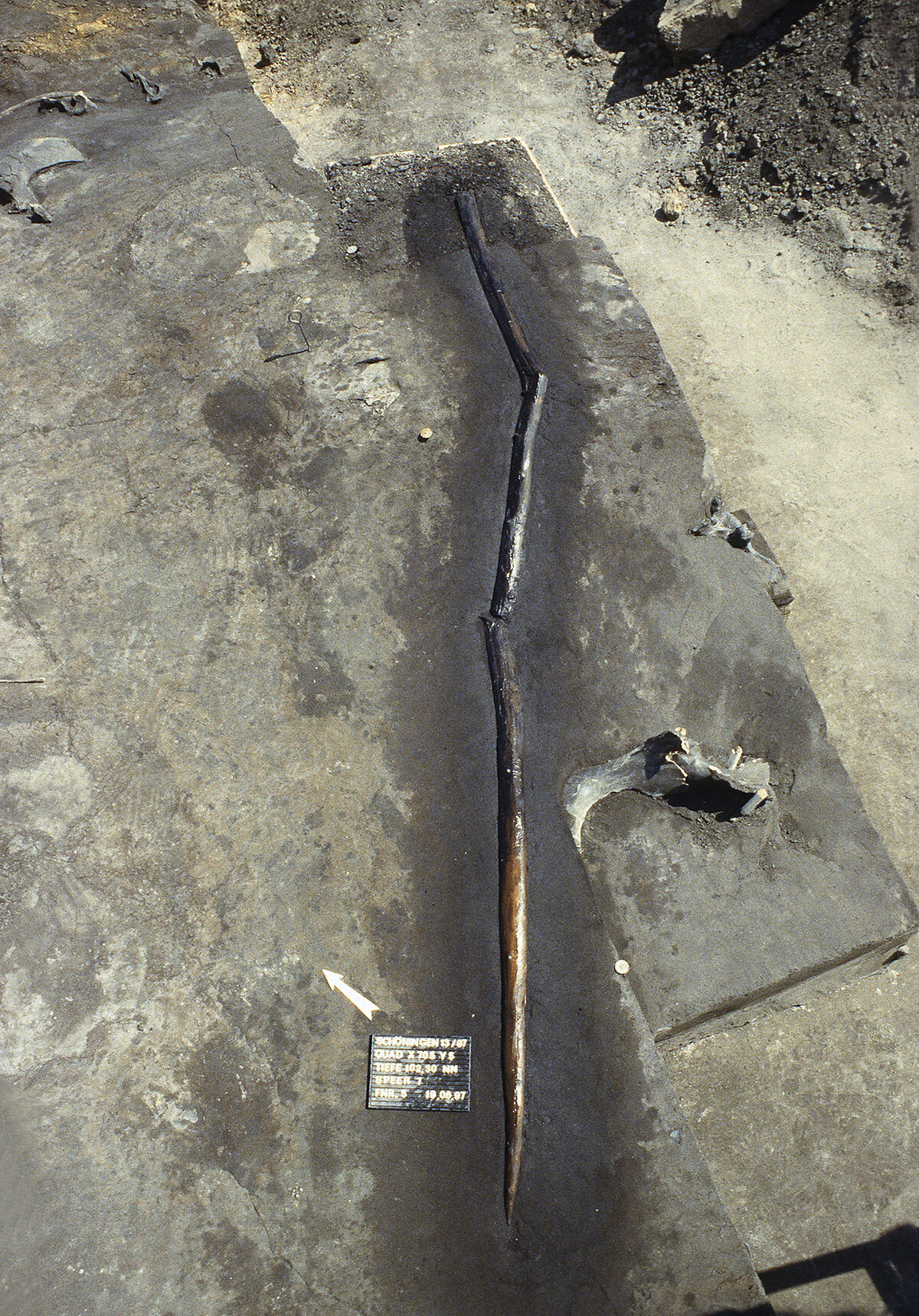
Marathousa 1 does not appear out of nowhere. The discovery belongs to a small constellation of exceptional sites which, together, sketch a long and coherent history of woodworking. The most famous is undoubtedly SchöningenSchöningenGerman site that yielded eight wooden throwing spears about 300,000 years old, among the oldest known wooden weapons.→, in Germany, where eight wooden throwing spears made of spruce were excavated from a lignite mine between 1994 and 1998.4 First dated to about 300,000 years, these remarkably balanced weapons attest to coordinated, planned and formidably effective hunting, carried out most likely by Homo heidelbergensisHomo heidelbergensisMiddle Pleistocene human species, often seen as the common ancestor of NeanderthalsNeanderthalsA fossil humanity of Eurasia, robust and cold-adapted, extinct around 40,000 years before present.→ and our own species.→ or early Neanderthals. Recent geochronology work has even proposed making these spears younger, around 200,000 years, which shows that dating remains a living field of study.
Older still, the wooden structure of Kalambo Falls, in Zambia, upended long-held certainties in 2023. Published in Nature by Larry Barham's team, it joins two Combretum logs fastened by a U-shaped notch cut into the wood, one passing perpendicularly through the other.3 Dated to at least 476,000 years by luminescence, it is the oldest known wooden assembly in the world, most probably a platform or the base of a structure. It hints at hominins capable of building, and therefore perhaps more settled than once thought. At the other end of Europe, the Clacton spear point, in England, found as early as 1911, remains one of the oldest wooden objects in Britain, about 400,000 years old, shaped from yew. Finally, at Gesher Benot Ya'aqov, in Israel, a fragment of polished plank more than 780,000 years old ranks among the very first evidence of wood reworked by human hands, in an AcheuleanAcheuleanA stone-tool industry (c. 1.7 Ma–300,000 BP) characterised by large, finely worked almond-shaped bifaces. Associated with Homo ergaster and erectus and spread from Africa to Europe and Asia.→AcheuleanLower Palaeolithic technical culture characterised by hand axes, present across three continents.→ context.
Scraping, polishing, shaping, hardening with fire
How did these humans turn a tree into a tool without metal? The answer lies in a patient and mastered operational sequenceoperational sequenceOrdered succession of technical steps leading from raw material to finished object.→. It all begins with the selection of the species and the branch, chosen for its straightness, flexibility or hardness depending on the intended use. Then comes the roughing out, carried out with stone tools: flint edges serve for coarse shaping and incising, while finer flakes allow detailed work. On the Clacton point, experiments showed that the surface had been patiently scraped with a notched flint tool, of precisely the type found at the same site.
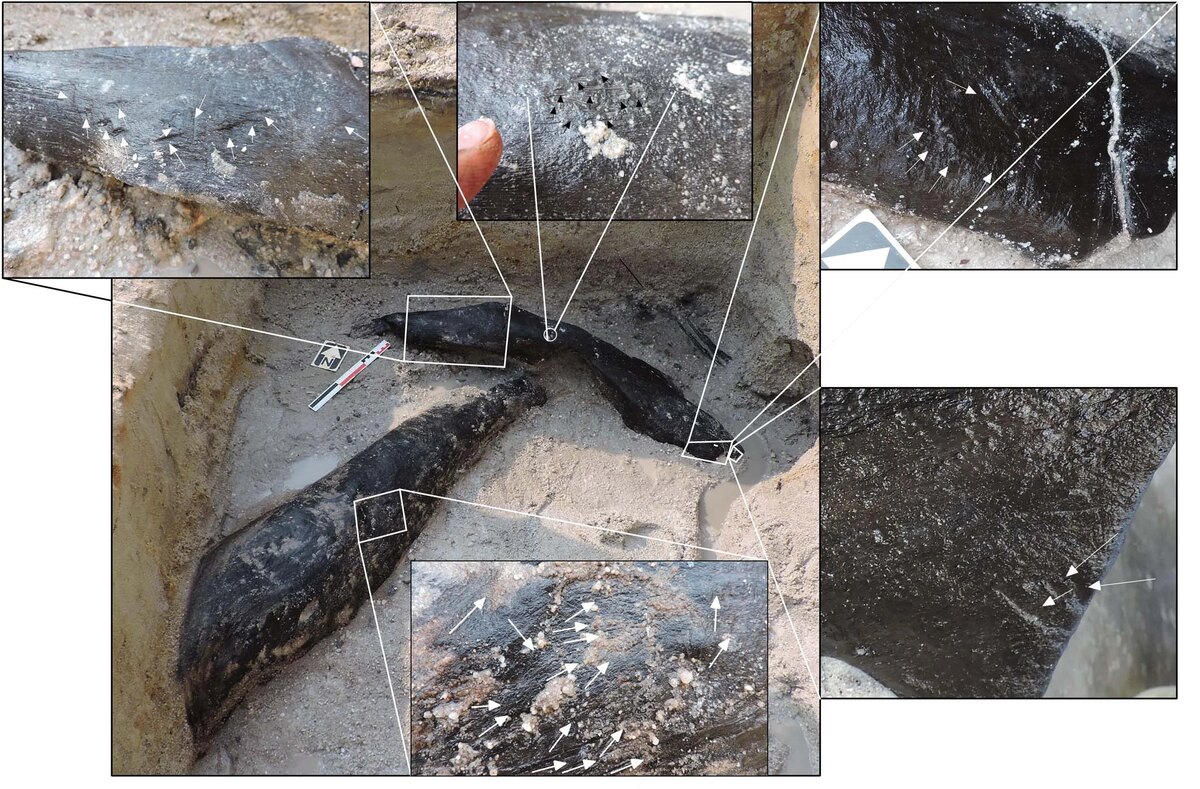
Beyond scraping, use-wear studies reveal a whole technical vocabulary. On prehistoric wooden tools, one observes deliberately polished surfaces, obtained by rubbing against abrasives such as fine-grained stones or silica-rich materials. Fire hardening, which appeared at least 400,000 years ago, allowed wood to be dried and its structure altered by lightly charring it over embers, before reshaping the point. These combined gestures, cutting, scraping, polishing, heating, presuppose a succession of anticipated steps, each conditioning the next. It is precisely this multi-stage planning that so interests prehistorians.
What this changes for our ancestors' cognition
Every recovered wooden object forces a reassessment of the mental capacities of Lower PalaeolithicLower PalaeolithicFirst and longest period of prehistory, marked by the earliest knapped stone tools and the first hominins outside AfricaAfricaThe cradle of humankind: the continent where the first hominins appeared, then Homo sapiens around 300,000 years ago, before the expansion to the rest of the world.→.→ humans. Making a digging stick, a balanced spear or an assembled platform is anything but instinctive. One must picture an object that does not yet exist, select the right material, string gestures together in the right order and sometimes pass this know-how on to others. These skills imply a developed working memory, forward-looking thought and, very probably, some form of communication within the group. They also imply the capacity to hold a mental template of the finished tool across the many minutes, or even hours, that its manufacture demanded, correcting each gesture against that inner image. Such sustained, goal-directed attention was once thought to be a hallmark of much later humans, and its presence here is quietly remarkable.
The Middle Pleistocene increasingly appears as a pivotal phase, marked by growing behavioural complexity and by the first unambiguous evidence of plant-based technologies. For a long time, for lack of preserved wood, these populations were judged through stone alone, inevitably incomplete. Marathousa 1 reminds us that wood could serve to dig, to hunt, to build and no doubt for a thousand other lost uses. Adding together Marathousa, Schöningen, Kalambo, Clacton and Gesher Benot Ya'aqov, a picture emerges: that of curious, ingenious hominins, exploiting every resource of their environment with a practical intelligence long underestimated. The word carpenter, applied to humans of nearly half a million years ago, is no exaggeration.
What the discovery proves, and what it does not
We must nonetheless carefully separate the facts established at Marathousa 1 from the general context. The facts are precise: two wooden objects, an alder fragment interpreted as a digging stick and a small piece of willow or poplar of an unprecedented type, dated to about 430,000 years, bearing traces of shaping and wear attributed to human hands. It is, to date, the oldest solidly documented handheld wooden tool, and it pushes back by at least 40,000 years the known age of this category of hand-held objects.1
By contrast, several points fall under cautious interpretation. We do not know for certain which species made these tools, since no human remains accompanied them. The most likely candidates are Homo heidelbergensis or early Neanderthals, but this is a deduction based on age and region, not direct proof. Likewise, the exact function of the small willow piece remains hypothetical, for lack of any possible comparison. Finally, Marathousa 1 provides the oldest handheld wooden tools, but not the oldest worked wood outright: the polished plank of Gesher Benot Ya'aqov and the assembled structure of Kalambo Falls are older, while belonging to other categories, plank and architecture rather than hand tool. This rigour takes nothing away from the significance of the discovery. It simply reminds us that every fragment of wood saved from decay adds a precious piece to a still largely incomplete puzzle, that of the daily life of our very distant ancestors.
La rigueur de présentation me rappelle un bon rapport d'ingénierie : hypothèse, données, conclusion.
À mon âge, je continue à apprendre. Et grâce à vous, la préhistoire n'est plus un angle mort.