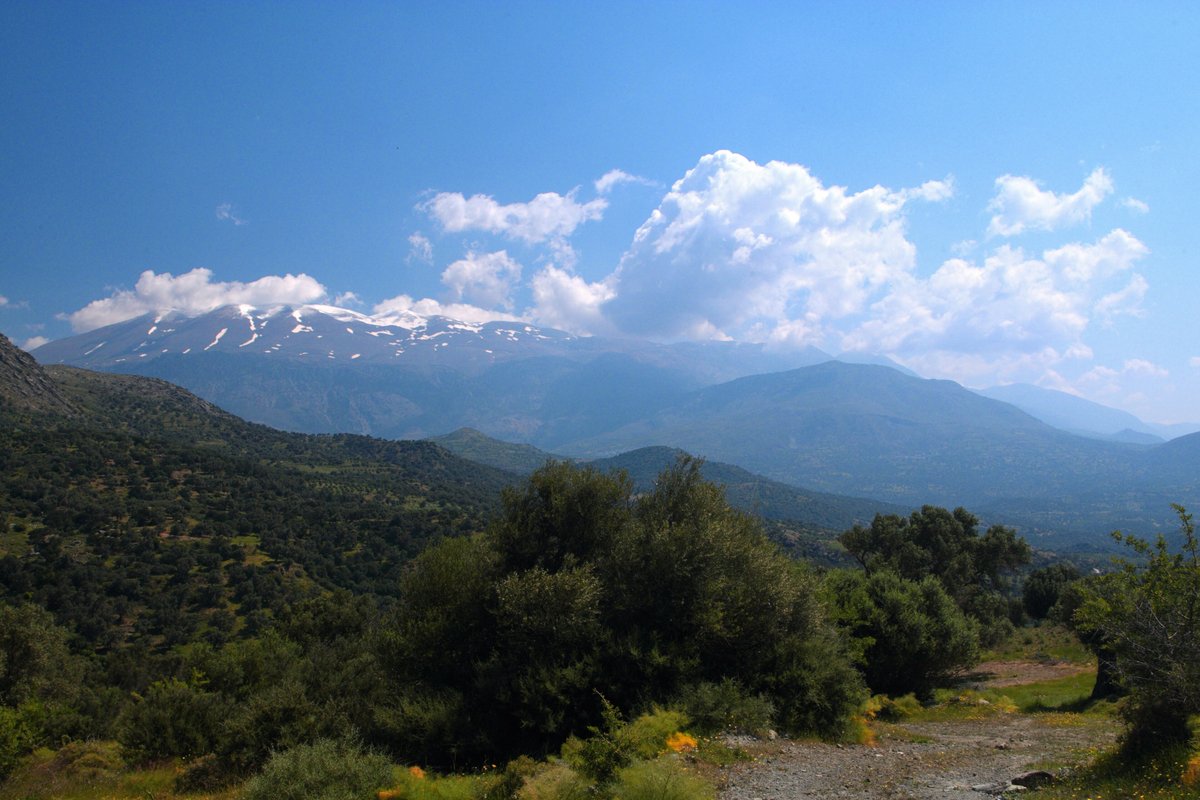
On the steep summit of Mount Papoura, an isolated mountain in central Crete rising to over 700 metres altitude, Greek archaeologists have uncovered the remains of a remarkably large circular architectural complex. Dated to around 3000 BCE -- at the dawn of the Bronze AgeBronze AgeA protohistoric period following the Neolithic, defined by bronze metallurgy (a copper-tin alloy) and the rise of the first cities and states; in Egypt it corresponds to the age of the first pyramids.→ -- this site predates the great Minoan palatial civilisations by several centuries1. Excavations conducted by the 27th Ephorate of Prehistoric and Classical Antiquities reveal a concentric plan with no known equivalent anywhere on the island. The absence of modern disturbance, owing to the summit's inaccessibility, has permitted remarkable preservation of the structures.
An exceptional site in an inhospitable landscape
Access to Mount Papoura is no easy matter. The track leading there from the villages of the Cretan hinterland requires several hours of walking across rough terrain, through dense maquis and limestone scree. It is precisely this inaccessibility that has protected the site from modern disturbance. The first systematic surveys of the area, carried out in the early 2020s, had already noted the presence of unusual dry-stone walls, but their true extent only became apparent once excavations began.
Analysis of the uncovered structures reveals a circular plan organised in several concentric rings. The outer enclosure, built from carefully fitted local limestone blocks, measures approximately 75 metres in diameter. Inside, two further circular walls delimit functionally distinct spaces2. The quality of the masonry and the logistical effort implied by construction at this altitude signal an organised community capable of mobilising considerable manpower and planning a long-term construction project.
Radiocarbon dates obtained from charcoal in several excavation contexts converge on a range between 3100 and 2850 BCE, corresponding to Early Minoan I-II in the reference chronology of Cretan prehistoryPrehistoryThe span of human history before the invention of writing, from the Palaeolithic to the Metal Ages, known mainly through material remains.→. These results place Papoura among the oldest known monumental architectural complexes on the island, predating the great centres of Myrtos, Vasiliki and Fournou Korifi.
Evidence of collective rituals and storage
The excavations have revealed two main types of activity at the site. In the outer ring, concentrations of carbonised faunal remains, associated with fragments of large drinking vessels in pre-Minoan ceramic tradition, suggest collective ritual feasting, perhaps linked to seasonal or agricultural cycles3. These assemblages recall those documented at other Aegean hilltop sites of the same period, particularly in the Cyclades where summit sanctuaries have a long tradition.
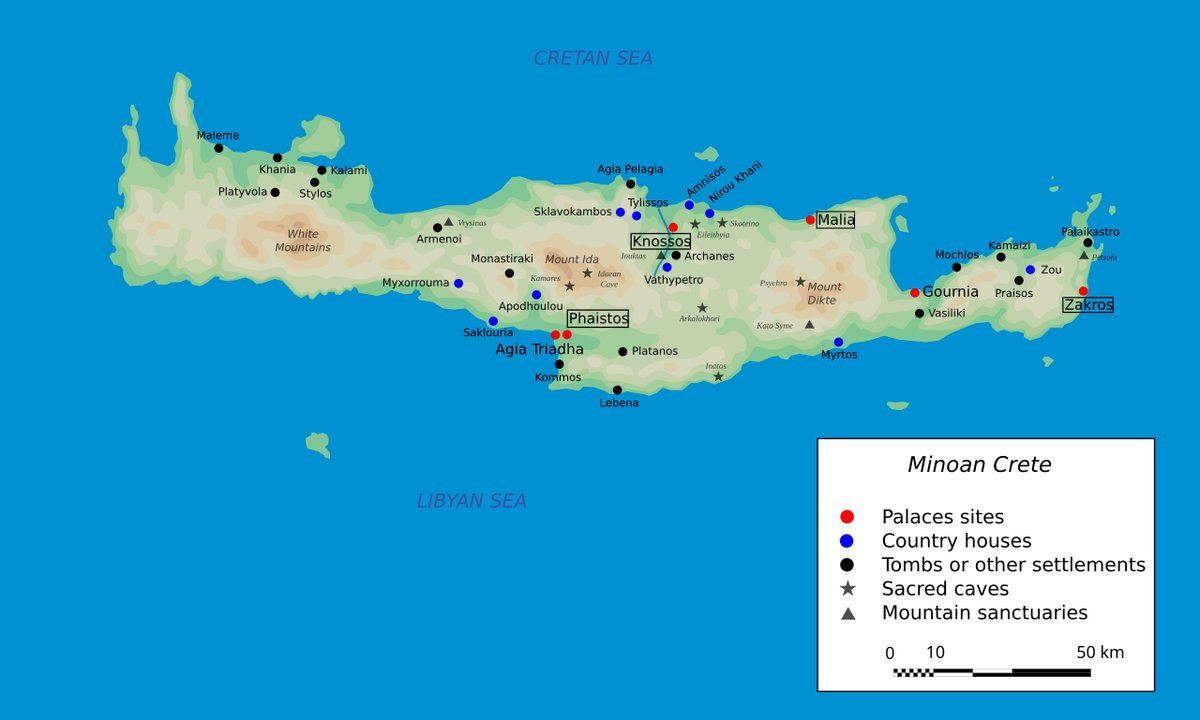
The interior space, around the geometric centre of the complex, presents a different character. Found here are several large storage amphorae buried to their necks in the ground, millstones, and tools in obsidian imported from the island of Melos. This Melian obsidian, present at the site in notable quantities, is an important economic marker: it attests to active commercial relations between Papoura and the Cyclades, more than 200 kilometres away.
The diversity of materials found on the site extends beyond obsidian. Ceramic fragments in forms distinct from local production reveal links with other regions of the eastern Mediterranean. An ivory sealSealA small engraved object (often steatite) used to stamp a mark in clay; the Indus seals, bearing animals and signs, attest to administration and trade, though their script remains undeciphered.→, possibly from Egypt or the LevantLevantA region of the eastern Mediterranean Near East (Israel, Lebanon, Syria, Jordan), a major crossroads of the first human migrations out of Africa.→, suggests that long-distance exchange networks were already crossing the Mediterranean well before the Classical Bronze Age. Such an exotic object reinforces the hypothesis of an interregional meeting place.
Crete before the Minoans
Minoan civilisation, with its monumental palaces at Knossos, Phaistos and Malia and its syllabic script, develops from around 2000 BCE. The Papoura complex therefore predates it by a full millennium. This period, which archaeologists designate as the Early Minoan era, is still poorly understood, since it left fewer spectacular remains than the palatial periods. The discoveries at Papoura bring a radically new perspective on the organisational capacities of the earliest Cretan societies.
The excavations at Papoura also allow us to reconsider the question of sedentarisation in pre-Mycenaean Crete. For a long time, the earliest Cretan populations were thought to live mainly in small dispersed communities. The permanence of the Mount Papoura structures, their solid construction, and the recurrence of archaeological deposits across several superimposed occupation levels suggest instead a regular, organised use of the site over at least several consecutive centuries.
Isotopic analyses carried out on animal bones from the ceremonial hearths confirm that the slaughtered herds came from distinct regions of the island, sometimes located tens of kilometres away. This diversity of origin of the sacrificed animals argues for gatherings in which several distinct community groups participated, coming from different catchment areas of Crete. Mount Papoura probably functioned as a periodic convergence point, similar to the panegyric fairs documented in historical Greece.
The 2025-2026 excavation campaign identified a probable funerary area at the northern periphery of the complex, to be explored in the next season. If initial observations are confirmed, Papoura may prove to be both a living ceremonial centre and a place of funerary memory, like other great Bronze Age Mediterranean complexes. The continuity between activities of the living and the cult of the dead, characteristic of many prehistoric hilltop sites, would find here a remarkable new illustration in the Aegean.
No comments yet. Be the first.