Between 2.5 and 1 million years ago, two homininHomininMember of the subtribe Hominina, comprising the human lineage (Homo, Australopithecus, Paranthropus…) but excluding orangutans and gibbons. The term progressively replaces "hominid" in its narrow sense.→ lineages coexisted in AfricaAfricaThe cradle of humankind: the continent where the first hominins appeared, then Homo sapiens around 300,000 years ago, before the expansion to the rest of the world.→. While early Homo evolved toward larger brains and sophisticated technology, the Paranthropus pursued a radically different path: extreme specialization of the masticatory apparatus, with powerful jaws, flaring cheekbones, massive molars, and a helmet-shaped sagittal crest.
Nutcracker Man: The Discovery of OH 5
On July 17, 1959, Mary Leakey found at Olduvai Gorge (Tanzania) a nearly complete skull of an unknown hominin. Nicknamed "Nutcracker Man" for its colossal molars, specimen OH 5 dated to 1.8 million years, with a brain capacity of only 530 cc but molars four times larger than modern humans1. This discovery confirmed that two different types of hominins coexisted in Africa 2 million years ago.
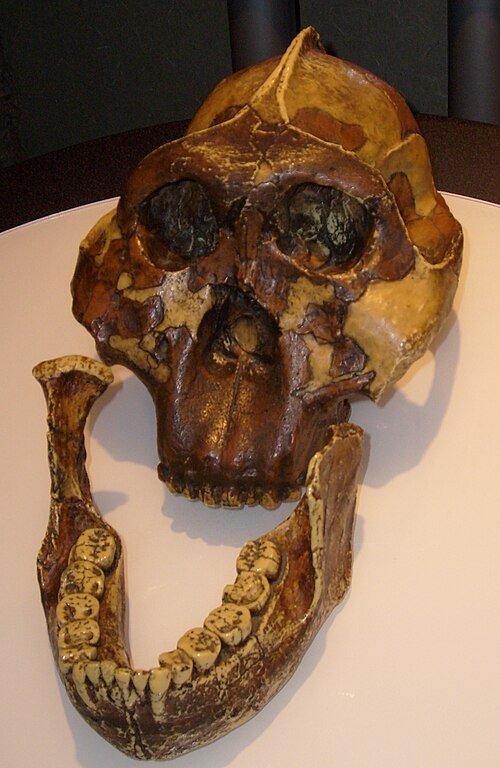
Two Species, One Strategy
Paranthropus boisei (East Africa, 2.5-1 Ma) and Paranthropus robustus (South Africa, 2.5-0.9 Ma) represent a classic case of parallel evolution: two distinct populations developing identical adaptive solutions to similar ecological pressures. A third species, P. aethiopicus (the "Black Skull," WT 17000, 2.5 Ma), is considered their common ancestor3.
What Did They Really Eat?
Isotopic analyses of P. boisei teeth revealed a surprise: their diet was dominated by C4 grasses (wild cereals, sedges, rhizomes), not hard nuts4. The giant teeth processed tough fibrous vegetation, not the nuts implied by their nickname. For P. robustus, isotopic data suggest a more omnivorous diet, and bone tools from Swartkrans may even have been made by this species.
Extinction and Legacy
Paranthropus disappeared from the fossil record around 0.9-1 million years ago, coinciding with African climateClimateThe long-term average atmospheric conditions of a region; its variations (glaciations, aridifications) shaped migrations, agriculture and the collapse of prehistoric societies.→ aridification and the rise of Homo erectus. Their hyper-specialized dentition may have prevented adaptation to changing food resources. These robust hominins remind us that human evolution was not a linear march toward sapience but a rich experiment that explored radically different evolutionary paths.
No comments yet. Be the first.