Two and a half million years ago, eastern AfricaAfricaThe cradle of humankind: the continent where the first hominins appeared, then Homo sapiens around 300,000 years ago, before the expansion to the rest of the world.→ was home to a diversity of hominins we struggle to picture. On the shores of a dried lake in the Ethiopian Afar, or in the wooded savannas of Kenya, several bipedal species shared the same landscapes, perhaps hunted the same prey, gathered the same berries — yet their evolutionary trajectories were about to diverge radically. One lineage carried the seeds of the genus Homo, which would eventually produce the species writingWritingA system of conventional signs used to fix language or information durably; its appearance (c. 3300 BC) marks, by convention, the end of prehistory.→ these words. Another would flourish for more than a million years before going extinct in the indifference of the fossil record: Paranthropus, the "robust cousin" of humanity.
Paranthropus is not an ancestor. Nor is it an anecdotal curiosity. It is a genus in its own right, which survived independently longer than Homo sapiensHomo sapiensThe present-day human species, which emerged in Africa around 300,000 years ago, the only surviving human lineage after the extinction of Neanderthals and Denisovans.→ has existed to date, occupied two continents and at least three distinct ecological niches, and whose disappearance remains one of the great unsolved puzzles of palaeoanthropologyPalaeoanthropologyThe science that studies human evolution from the fossil remains of hominins (bones, teeth, footprints) and their context, to reconstruct our biological origins.→. A 2026 discovery reporting a P. boisei jaw dated to 2.6 million years in the Ethiopian Afar has brought this genus back to the fore1.
Anatomy of a robust: the grinding machine
The most immediately striking feature of Paranthropus is its cranial morphology. Where gracile australopiths (such as A. afarensis, Lucy's kin) displayed a relatively rounded skull and moderately sized teeth, Paranthropus boasts a masticatory arsenal unmatched in the human lineage. Its sagittal crest — a bony ridge running front to back along the top of the skull — anchors powerful temporal muscles. Its widely flared zygomatic arches accommodate massive muscle bundles. Its molars are proportionally the largest in the entire human lineage, protected by thick enamel. Its premolars, also enlarged, resemble molars more than those of any living human2.
This appearance earned Paranthropus boisei the nickname "Nutcracker Man" after its discovery at Olduvai by Mary and Louis Leakey in 1959. The skull OH 5, the most complete and celebrated specimen of the species, perfectly illustrates this extreme morphology: reduced prognathism combined with a small braincase (around 550 cm³, little larger than a chimpanzee's) perched atop an imposing masticatory apparatus2.
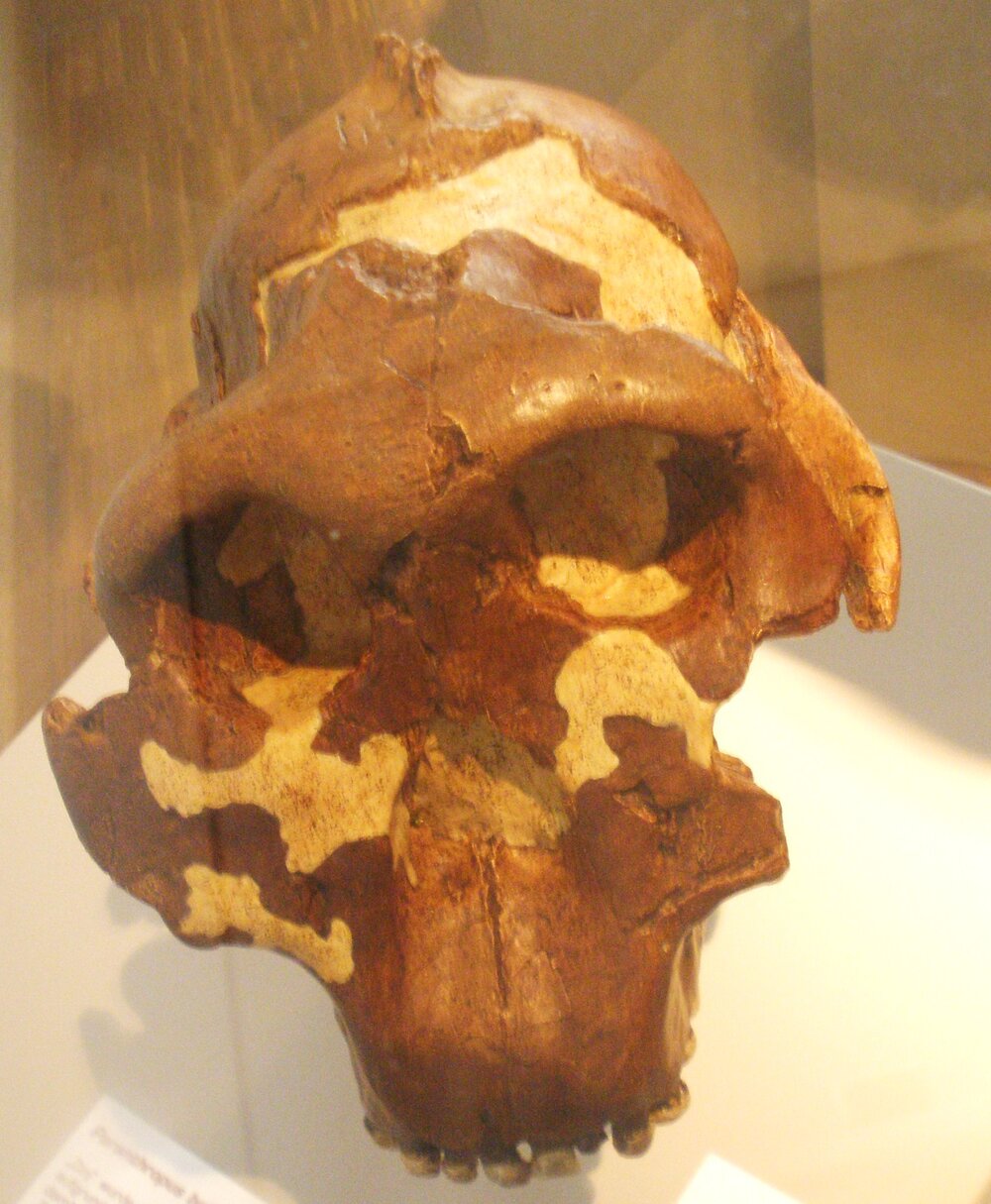
Paradoxically, isotopic analyses of P. boisei teeth have shown that its diet did not consist mainly of nuts or hard seeds, as first assumed. It consumed predominantly C4-type grasses — graminoids and savanna plants — a diet closer to a bovine's than a squirrel's. The robust morphology would therefore be an adaptation to fibrous, abrasive foods rather than hard ones, or a functional reserve for lean seasons when hard fallback foods were necessary3.
Three species, two continents
Paranthropus aethiopicus (c. 2.7–2.3 Ma) is the oldest and most primitive species of the genus, known mainly from the "Black Skull" (KNM-WT 17000) found in western Kenya in 1985. Its traits derive directly from the earliest australopiths, with an already prominent sagittal crest but marked prognathism. Its range seems limited to East Africa.
Paranthropus boisei (c. 2.3–1.2 Ma) is the best-known and most robust species, represented by dozens of specimens from Tanzania, Kenya, Ethiopia and Uganda. The 2026 discovery in the Ethiopian Afar extends its known range and pushes its origin slightly further back in time1. It is with this species that the earliest Homo habilis coexisted at Olduvai for at least 500,000 years.
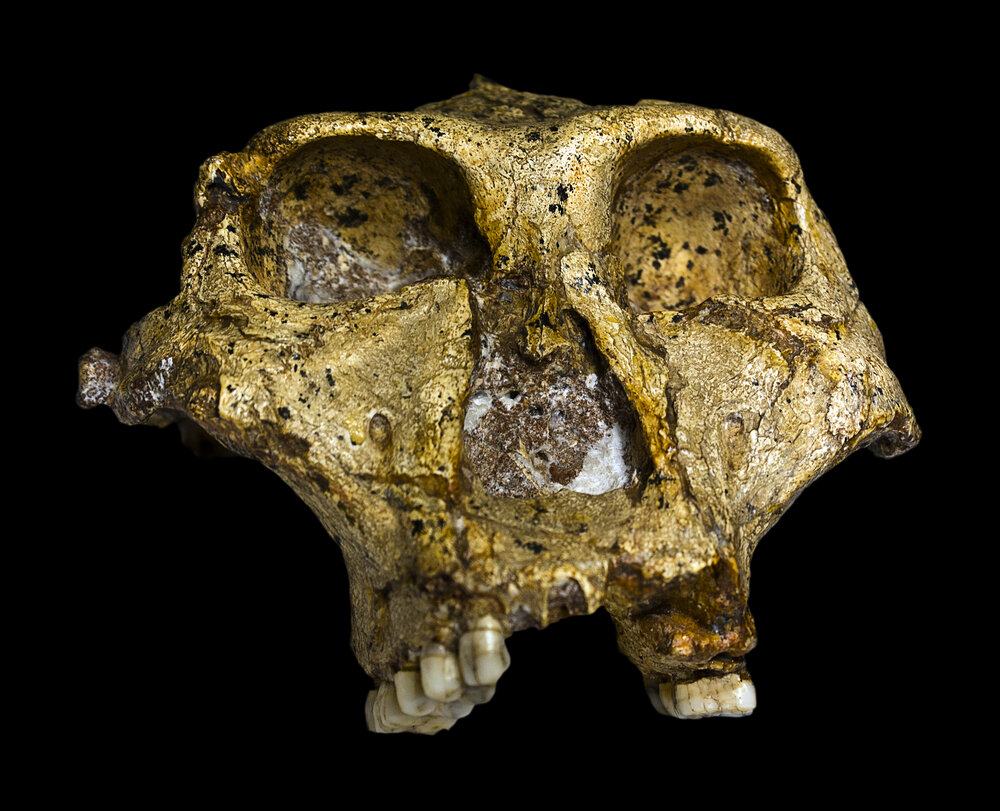
Paranthropus robustus (c. 2.0–1.0 Ma) is the southern representative, confined to South African sites including Swartkrans, Kromdraai and Drimolen in the Cradle of Humankind near Johannesburg. Slightly less extreme in its robustness than P. boisei, it coexisted with early Homo ergaster in South Africa.
Did Paranthropus make tools?
At Swartkrans in South Africa, OldowanOldowanThe oldest known stone-tool industry (c. 3.3–1.7 Ma), characterised by flaked pebbles (choppers) and basic flakes. Named after Olduvai Gorge (Tanzania).→ tools (pebble choppers) have been found in the same stratigraphic levels as P. robustus — sometimes in the absence of any Homo remains. Bone fragments from the site suggest use as digging tools to extract tubers. The hypothesis that P. robustus made and used tools — at least in bone — remains seriously entertained by several specialists2.
The Lomekwi 3 discoveries in Kenya (2015), attributing stone tools dated to 3.3 Ma to a population predating both Homo and Paranthropus, further complicate the picture: lithic technology was not an exclusive invention of our genus. In this context, it would be surprising if Paranthropus, coexisting with early tool-makers for more than a million years, had developed no technical skills of its own.
Why did Paranthropus go extinct?
The extinction of Paranthropus roughly one million years ago is one of the most debated questions in the field. Hypotheses cluster into three families.
The first is climatic: African PleistocenePleistoceneThe geological epoch of the great ice ages (c. 2.6 Ma–11,700 BP), spanning most of human prehistory.→ environments underwent progressive aridification between 1.5 and 1.0 Ma, transforming mosaic forest-savanna into extensive grasslands. Paranthropus, specialised in particular plant foods, may have been less adaptable than Homo erectus, which was generally more omnivorous and behaviourally flexible.
The second is competition with Homo: as Homo erectus mastered fire, developed more elaborate AcheuleanAcheuleanLower Palaeolithic technical culture characterised by hand axes, present across three continents.→ tools and extended its social networks, it may have progressively excluded Paranthropus from key food resources.
What is certain is that Paranthropus left no known descendants: its extinction is total2.
What Paranthropus tells us about ourselves
The story of Paranthropus is, paradoxically, a lesson about the success of Homo. For over a million years, two very different evolutionary solutions coexisted in Africa: the extreme morphological specialisation of Paranthropus, and the behavioural and cognitive flexibility of Homo. The former worked remarkably well for a long time — longer than our own species has existed. The latter eventually prevailed, not because it was "superior" in any absolute sense, but because it proved more resilient to the climatic and ecological disruptions of the Middle PleistoceneMiddle PleistoceneGeological subperiod (about 770,000 to 126,000 years ago) marked by growing behavioural complexity among hominins.→.
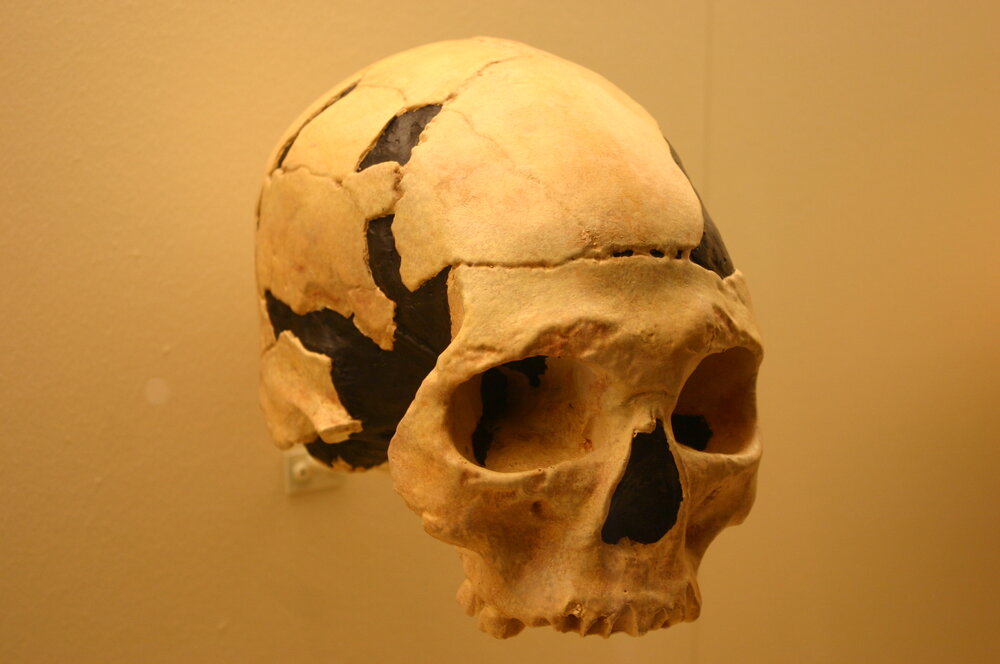
Paranthropus was not an evolutionary failure. It was a perfectly coherent response to the constraints of its environment, one that worked for hundreds of thousands of years. Its extinction reminds us that in evolution, success is always contextual, always provisional, and that the most specialised lineages are often the most vulnerable to changes they did not anticipate.
Le soin apporté à l'illustration est rare sur un site de vulgarisation scientifique. Chapeau.
Je partage régulièrement vos articles sur les réseaux. Toujours de bonnes réactions.
Paranthropus est parfait pour faire comprendre à mes élèves que l'évolution n'est pas une ligne droite vers l'homme moderne. Ce genre représente une voie évolutive distincte qui s'est développée en parallèle avec nos ancêtres directs pendant des centaines de milliers d'années avant de s'éteindre. C'est l'illustration vivante du concept d'évolution buissonnante.
Paranthropus est souvent le grand oublié des arbres généalogiques humains que l'on présente au grand public. Ces homininés robustes, avec leur crête sagittale et leurs immenses molaires, représentent pourtant une expérience évolutive parallèle qui a duré plus d'un million d'années en Afrique. Leur coexistence avec les premiers Homo pose des questions fascinantes sur la compétition ou la complémentarité entre espèces.