Somewhere in the high valleys of the Altai, more than fifteen hundred metres above sea level, where the wind scours the plateaus and winter lasts eight months, twentieth-century archaeologists opened tombs that should never have yielded what they contained. Beneath mounds of stone and earth, in timber chambers buried for almost two thousand three hundred years, they found intact bodies, the skin still covered with tattoos, brightly coloured rugs, horses harnessed in leather and felt, carved caskets, garments of silk and fur. The decay of time had been suspended. A climatic accident, a lens of ice formed at the heart of each tomb, had turned these graves into natural cold chambers. This is the story of the Pazyryk culture, those horse-riding nomads of the Iron AgeIron AgeThe last period of protohistory (from c. 1200 BC in Europe and the Near East), marked by iron metallurgy and the first kingdoms.→ who, without writingWritingA system of conventional signs used to fix language or information durably; its appearance (c. 3300 BC) marks, by convention, the end of prehistory.→ and without cities, left us one of the most striking testimonies ever unearthed about the ScythianScythiansNomadic horse peoples of the Eurasian steppes (1st millennium BC), known for animal-style art, goldwork and kurgan burials; the Pazyryk culture is an eastern expression of them.→ societies of the steppes.
The name comes from a place, the Pazyryk valley, where the first great frozen grave was excavated. But behind that word lies a whole world: that of the horse herders of the mountains of Central Asia, contemporaries of the Achaemenid Persians and the Greek city-states, linked by the trails of the steppe to China, Iran and the Near EastNear EastA region of western Asia (Levant, Mesopotamia, Anatolia, Iran), cradle of the Neolithic revolution, agriculture, the first cities and writing.→. While the Parthenon was being built, these riders buried their chiefs with a magnificence that owed nothing to settled courts. And because the ice preserved everything, we can today look upon their faces, read their tattoos and almost touch the fabric of their hangings.
The Altai and the Nomads of the Steppe
The Altai is a range of high mountains spread across four present-day countries: Russia, Kazakhstan, Mongolia and China. It is a water tower and a crossroads, a place where glaciers feed great rivers and where the high plateaus offer, in summer, some of the richest pastures in inner Asia. For peoples living off the horse and the herd, these high valleys were a precious domain, used seasonally within a life governed by transhumance. It was in this setting of snow-capped peaks and high steppesSteppeA vast semi-arid, treeless grassland of Eurasia, suited to nomadic herding and the horse; a corridor for the movement of peoples and technologies in later prehistoryPrehistoryThe span of human history before the invention of writing, from the Palaeolithic to the Metal Ages, known mainly through material remains.→.→ that the Pazyryk culture developed, between the 6th and the 3rd century BC.
One must also weigh what mobility meant in such a world. To follow the herds was to read the landscape, to know the watering points, the passes, the summer pastures and the winter shelters, and to organise around this calendar the whole life of the community. This science of the land, handed down orally, was the equal of that of the farmers of cultivated fields. The steppe nomad was not a being without ties but the holder of a geographical and ecological knowledge of rare precision, indispensable to survival in a harsh environment where error came at a high price.
The Iron Age, during which Pazyryk flourished, was also the era of the spread of mounted horsemanship and of archery on horseback, two innovations that gave the peoples of the steppe a formidable military superiority. The mounted archer, able to loose his arrows at a gallop, was long the nightmare of the infantry armies of the settled states. This warlike power, joined to mobility, explains the considerable role these peoples played in the history of Eurasia, as intermediaries, as threats and as carriers of cultures.
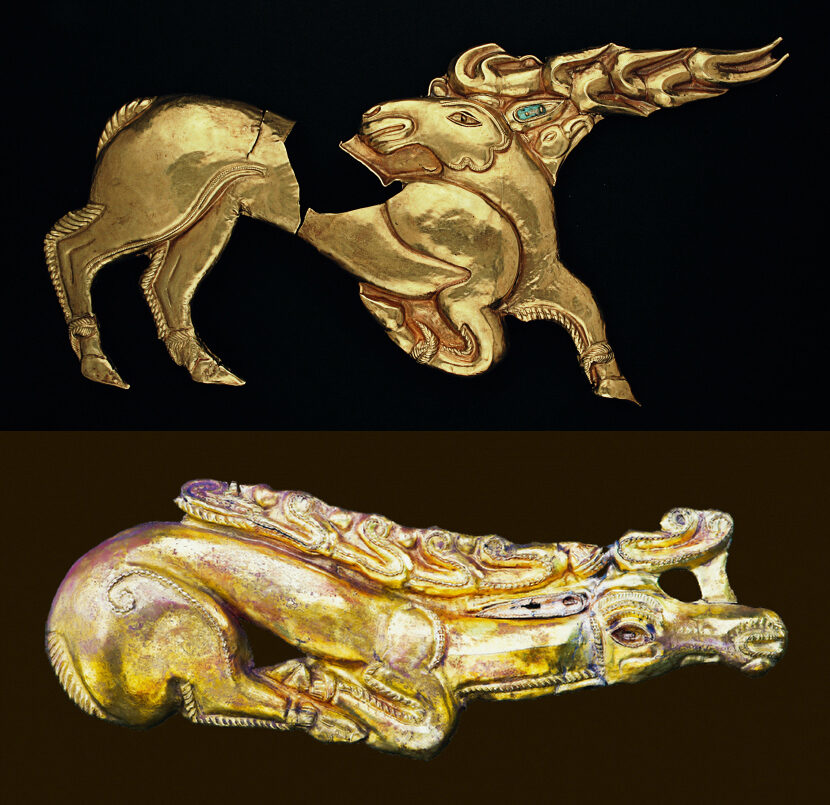
The Pazyryk people belong to the vast constellation of peoples the Greeks broadly called ScythiansScythiansNomadic horse peoples of the Eurasian steppes (1st millennium BC), known for animal-style art, goldwork and kurgan burials; the Pazyryk culture is an eastern expression of them.→, and which archaeology groups under the convenient term Scytho-Siberian cultures. These societies shared a way of life, mounted pastoral nomadismNomadRefers to human groups without fixed dwellings, moving with their herds through the seasons; pastoral nomadism shaped the societies of the Eurasian steppes.→, and a recognisable material culture founded on the famous Scythian triad: a type of weaponry, a style of harness and tack, and an artistic repertoire, animal-style art. From one end of the steppes to the other, from Ukraine to Mongolia, one finds the same themes, the same forms, the same taste for stylised beasts and deer. The Pazyryk culture is its eastern, mountain branch [[#s2]].
These nomads were not disorganised wanderers. Their societies were hierarchical, dominated by a warrior aristocracy whose monumental tombs betray its power. They mastered the working of metal, wood, leather and textile, kept considerable herds, and took part in exchange networks spanning thousands of kilometres. The horse was at the centre of everything: a means of transport, an instrument of war, a measure of wealth and a companion even into death, as the dozens of sacrificed mounts that accompanied the dead bear witness.
To understand Pazyryk is therefore first to understand the steppe: an immense, open environment, crossed by invisible roads, where mobility was not a weakness but a strategy, and where societies without cities or writing nonetheless produced works of extreme refinement. The Altai, by its position as a threshold between Siberia, Central Asia and China, occupied a strategic place there, and the richness of its tombs bears the mark of it.
The chronology of the culture, set between the 6th and the 3rd century BC, places it at the heart of the Eurasian Iron Age. This was an era of great upheaval: to the west, the Achaemenid Persian Empire dominated the Near East; in the Mediterranean, the Greek city-states shone; to the east, the China of the Warring States fragmented before its unification. The steppes were not on the margins of this moving world: they were an active component of it, crossed by peoples who fought, traded and travelled over immense distances. Pazyryk belongs fully to this connected history.
The Frozen Kurgans and the Miracle of the Permafrost
A kurganKurganA burialBurialThe intentional deposition of a body, sometimes with offerings; a marker of symbolic behaviour.→ mound of the Eurasian steppes, of earth and stone over a timber chamber holding a high-status individual and grave goods.→ is a burial mound. Beneath a carefully piled heap of stone and earth lies a deep pit, at the bottom of which a chamber of logs was built, a true little timber house meant to shelter the dead and their belongings. It is a form of burial common to all the Eurasian steppes. But in the Altai these tombs met a singular fate that made them unique in the world [[#s1]].
It is worth pausing on the scale of these monuments. The largest kurgans rise as conspicuous landmarks on the high plateaus, visible from afar, and their construction demanded the moving of considerable quantities of stone and earth. Raising such a mound was a collective undertaking, a public statement of the rank of the dead and of the cohesion of the group that buried them. The tomb was not only a resting place but a monument, a fixed point in the open immensity of the steppe, around which memory and identity could crystallise.
The mechanism rests on a sequence of accidents. After the burial, rain and meltwater seeped through the heap of stones into the funerary chamber. There, sheltered from the sun and protected by the mass of the mound, it froze and never fully thawed again. A permanent lens of ice, a local form of permafrostPermafrostPermanently frozen ground; in the Altai, water seeping into kurgans froze into ice lenses that preserved bodies, textiles and wood for millennia.→, formed inside the tomb itself, imprisoning everything it contained in constant cold. The frozen ground did what neither the sand of Egypt nor the bogs of northern Europe achieved with such completeness: it preserved the organic.
For that is the miracle of Pazyryk. On most archaeological sites, time erases everything perishable. Only stone, bone, ceramic and metal remain, and the archaeologist must guess the rest. At Pazyryk, by contrast, carved wood, leather, felt, wool, silk, human skin and even the contents of stomachs crossed the millennia. We have an almost indecent window onto the material life of an Iron Age society, as if a steppe nomad had bequeathed us intact his wardrobe, his saddlery and his body.
This freezing was, however, a double-edged sword. Already in antiquity, almost all the great tombs were looted soon after their closing, the thieves piercing the chamber in search of gold. Paradoxically, by opening a passage to cold air and water, these break-ins sometimes accelerated and stabilised the freezing, sealing for eternity what the looters had scorned: the textiles, the bodies, the wooden objects. What the gold attracted, the looting carried off; what the ice kept, it passed on to us.
The Discovery: Rudenko and the Hermitage
The scientific exploration of the frozen kurgans of the Altai is inseparable from one name, that of the Russian and later Soviet archaeologist Sergei Ivanovich Rudenko. As early as the 1920s, with his colleague Mikhail Gryaznov, he excavated the first great tombs of the region. But it was above all after the Second World War, between 1947 and 1949, that Rudenko carried out the decisive campaigns at the Pazyryk site itself, clearing a series of five great kurgans that would give their name to the whole culture [[#s2]].
The location of the Pazyryk valley, remote and difficult of access, shaped the whole history of its exploration. Reaching the site, transporting equipment and removing fragile finds across mountainous terrain demanded careful logistics. That such an effort was sustained over successive campaigns is a measure of the importance the discoveries quickly assumed in the eyes of researchers. Each season brought objects that had no equivalent elsewhere, and the reputation of the frozen tombs grew accordingly.
People long believed, wrongly, that these ancient break-ins had destroyed everything. In reality, they mainly carried off the precious metal objects, easy to melt down and resell, while leaving behind the bulk of what now makes the scientific value of the tombs. The looter sought gold; without knowing it, he trampled treasures of information. This irony lies at the heart of the archaeology of Pazyryk: what survived is not what contemporaries judged most precious, but what the chance of the ice was willing to pass on to us.
Excavating these frozen tombs was as much a technical ordeal as an adventure. The ice had to be thawed literally, with hot water poured carefully, centimetre by centimetre, to free the objects without breaking them or letting them decay once exposed to the air. The work was done in cold, mud and urgency, for each organic piece taken from the ice at once became fragile. It was at the price of this patience that masterpieces were recovered which, without the permafrost, would have left no trace.
The treasures unearthed made their way to Leningrad, today's Saint Petersburg, where they joined the collections of the Hermitage Museum. It is there that most of the Pazyryk material is now kept, the carpet, the felts, the saddles, the chariots, the wooden objects, in controlled conditions of temperature and humidity that artificially prolong the cold of the Altai. Rudenko published his results in landmark monographs that revealed to the world the existence of this frozen civilisation. The conservation of the Pazyryk collections at the Hermitage is in itself a permanent challenge. Materials that survived two thousand three hundred years in the ice become extremely vulnerable once brought back to room temperature: leather dries out, felt crumbles, colours fade. An entire body of restoration and preventive conservation had to be invented to stabilise these fragile objects and make them displayable without destroying them.
Research did not stop with Rudenko. Throughout the 20th century, other frozen tombs were brought to light across the vast territory of the culture, and the end of the century held one of the most resounding discoveries, on the Ukok plateau. But the intellectual framework laid down by Rudenko, the idea of a rich, hierarchical, refined nomadic society connected to the rest of Asia, remains the foundation of any understanding of Pazyryk.
The Tattooed Mummies
Among all that the ice preserved, nothing struck the imagination as much as the bodies. The mummiesMummyA body preserved from decay, naturally (cold, aridity, peatPeatA waterlogged organic soil formed by accumulated plants; it seals and remarkably preserves wood and ancient remains.→) or artificially; the frozen Pazyryk kurgans yielded natural mummies with tattooed skin.→ of Pazyryk owe nothing to a learned embalming like that of the Egyptians: it is the cold alone that preserved them, sometimes after the organs had been removed and the body filled with aromatic herbs, according to a funerary practice that the Greek historian Herodotus also describes among the Scythians. Beneath the ice, the skin survived, and with it one of the oldest direct traces of the art of tattooing [[#s2]].
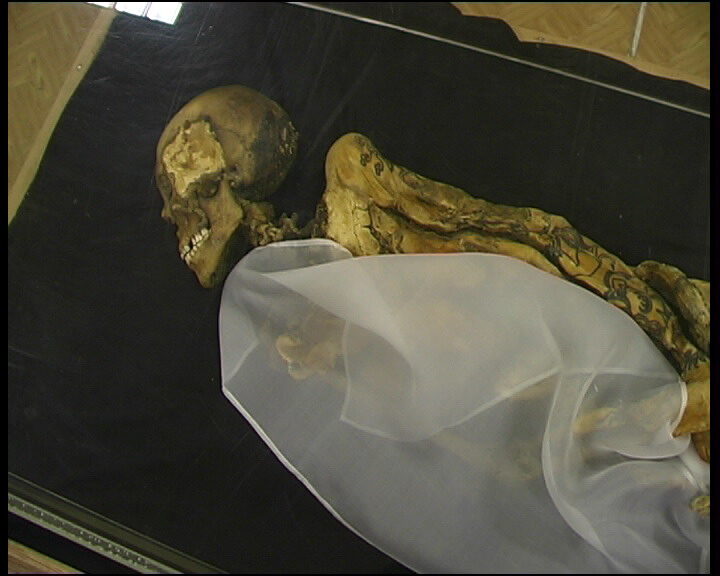
The most famous of these male bodies, unearthed by Rudenko, was that of an elderly man, no doubt a chief, whose limbs were covered with tattoos representing a veritable fantastic bestiary. One can make out deer with oversized antlers, wild beasts, composite creatures mixing the features of birds of prey and mammals, coiled and intertwined along the arms and torso. These figures are not mere ornaments: they belong to the same repertoire as the animal-style art of the objects, and it is supposed that they had a function at once aesthetic, social and perhaps protective or magical.
Herodotus, writing in the 5th century BC, describes at length the funerary customs of the Scythians, and several of his observations find a striking echo in what the Altai tombs yielded. The extraction of the viscera, the filling of the body with aromatic substances, the sacrifice of horses: all are practices the Greek text mentions and that archaeology confirms, thousands of kilometres away. This convergence between the written source and the field is one of the most fascinating aspects of the study of Pazyryk, for it links the world of the steppe to that of classical history.
The tattoo probably marked the rank, the belonging and the status of the one who bore it. Its density, its quality, the choice of motifs no doubt distinguished individuals according to their place in society. To carry on one's skin the same beasts that adorned the harnesses and the hangings was to inscribe in one's own body the collective imagination of the group, to make oneself a living support of the art of the steppes.
The preservation of the bodies allowed researchers to go far beyond the mere observation of tattoos. The anatomical and palaeopathological study of the mummies revealed diseases, traumas, traces of physical activity inscribed in the bones and tissues. The age of the deceased could be approached, their state of health, sometimes the probable cause of death. The contents of the stomachs, themselves preserved, yielded indications about the diet of the last days. Each body thus became a medical file more than two thousand years old, something archaeology almost never has at its disposal.
Infrared Imaging and Tattooing Techniques
For a long time, the tattoos of the Pazyryk mummies were only partly legible. With time, the skin darkens, wrinkles and dries, and the motifs traced in pigment almost entirely vanish to the naked eye, drowned in the dark brown of the mummified epidermis. The first records, made by eye and by drawing, remained incomplete and sometimes interpretative. This is where a recent technology changed everything.
Infrared imaging exploits a simple property: black carbon-based pigments, the very ones used to tattoo, absorb and reflect infrared light differently from the surrounding skin. By photographing the bodies under this light invisible to our eyes, researchers suddenly see the tattoos stand out with spectacular clarity, where the surface had appeared uniformly dark. Motifs once thought lost reappear, complete, on bodies excavated decades ago as on those discovered more recently.
This imaging allowed far more than better seeing: it revealed the techniques of tattooing among the steppe nomads. By examining closely the tracing of the lines, their thickness, their reworkings and their hesitations, specialists were able to reconstruct the way the tattooists worked. The pigment, probably soot or carbon black, was introduced beneath the skin by repeated punctures, by a technique of pricking rather than incision. The mastery of the gesture is manifest: the compositions are planned, the volumes of the animals rendered by flat areas and lines, with a sense of movement comparable to that of art on metal or wood.
The process is all the more precious for being non-destructive. Photographing a body under infrared light does not harm it in any way, unlike many older analyses that required a sample. The most fragile mummies can therefore be studied and restudied as techniques advance, without sacrificing the slightest patch of skin. This respect for the document, now a strong ethical requirement around ancient human remains, found in infrared imaging an ideal ally.
These analyses also show that tattooing was a learned art, carried out by experienced practitioners, and not a crude marking. The stylistic coherence between bodies from different tombs suggests the existence of a shared repertoire, a visual grammar handed down from generation to generation. Beyond the Altai, these methods have a wider reach: they apply to other ancient bodies, other cultures, wherever skin has been able to survive. The study of Pazyryk tattoos thus contributes to a fast-growing field, the history of body modification in human societies, from ritual marking to aesthetic ornament. By making legible again motifs once thought erased, infrared imaging re-inscribes these nomads in a long history of the marking of meaning on the body.
Scythian Animal-Style Art
If one had to sum up the aesthetic of the steppes in two words, they would be these: animal style. Everything, among the Pazyryk people as among the ScythiansScythiansNomadic horse peoples of the Eurasian steppes (1st millennium BC), known for animal-style art, goldwork and kurgan burials; the Pazyryk culture is an eastern expression of them.→ as a whole, is expressed through the figure of the animal. Deer with proliferating antlers, leaping beasts, raptors with sharp talons, goats and horses, hybrid creatures born of the imagination: the animal world invades every surface, from gold plaques to harnesses, from felts to tattooed bodies [[#s2]].
It is striking that this art, so coherent across thousands of kilometres, was carried not by a centralised state with official workshops but by mobile peoples linked by trails and exchange. The unity of the style is therefore the unity of a shared imagination rather than of a political authority. That a deer curled in the same posture should appear on a gold plaque in Ukraine and on a tattooed body in the Altai says much about the density of the contacts that ran through the steppe world, and about the power of images to travel where states could not follow.
This style obeys recognisable principles. The animals are often shown in full action, gathered upon themselves, their bodies twisted and contorted to fit the shape of the object they decorate. A deer folds its legs beneath it, a beast curls into a circle, a griffin sinks its talons into the flank of a herbivore. The scene of predation, the beast attacking its prey, is a central motif, no doubt charged with meaning: perhaps the expression of a worldview in which life is born of struggle and power asserts itself through mastered violence.
The stylisation is pushed far but never gratuitous. A deer's antlers turn into a series of bird heads, a beast's eye becomes a volute, a body resolves into plays of curves. This plasticity, this capacity to metamorphose one form into another, gives the art of the steppes an almost dreamlike quality that sets it apart from the figurative art of the neighbouring settled civilisations. And yet the observation of nature is everywhere present: these artists knew intimately the beasts they depicted.
One must imagine this art in its original context, which was not that of a museum but that of movement. Gold plaques glittered on the garments of a rider at full gallop; felt appliqués rippled in the wind on the hangings of a tomb; the motifs of harnesses accompanied the horse's step. Animal-style art was an art in motion, designed to be seen on living bodies, floating fabrics and moving mounts, and this dynamic dimension is no doubt one of its keys. The contortions of the animals depicted answered the real movement of the supports that bore them.
Gold holds a place of choice in this art, but it would be reductive to see in it only a taste for the precious. Among peoples for whom livestock and the horse were true wealth, animal-style art no doubt said something profound about the relationship to the living, to the hunt, to the steppe. The same motifs are found from one end of the Scythian world to the other, a sign of a cultural koine, a common language shared by peoples separated by thousands of kilometres. Pazyryk is its mountain version, particularly well preserved thanks to the ice, which shows us this art not only on metal but also on the perishable materials where it expressed itself no doubt most freely.
The Pazyryk Carpet and the Textiles
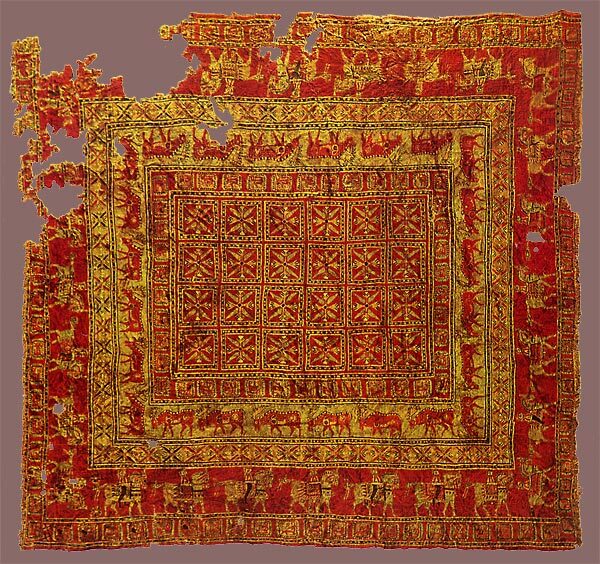
Among all the objects taken from the frozen kurgans, one has become a world icon: the Pazyryk carpet. Discovered by Rudenko in one of the great kurgans, this knotted wool rug is the oldest carpet of its kind preserved in the world. Its survival owes, here again, to the ice alone: a textile object of this nature should have disappeared without trace, and it is by a caprice of the permafrost that we can today admire it almost intact, its colours still vivid after twenty-three centuries [[#s2]].
The carpet is a marvel of technique and composition. Its central field is decorated with star-shaped geometric motifs, framed by several successive borders along which file, in a frieze, standing deer and riders sometimes mounted, sometimes leading their mounts by the bridle. The density of knotting is high, the drawing precise, the palette rich. Such an object is not the work of amateurs: it presupposes a mature technical tradition and a workshop of high level. The question of its origin, local production of the steppes or a piece imported from a neighbouring region such as the Persian world, remains debated, and testifies to the insertion of the Pazyryk people into long-distance exchange networks.
The archaeology of ancient textiles suffers almost everywhere from a fundamental handicap: fibres, whether of animal or plant origin, are among the most perishable materials there are. On the great majority of sites they have entirely disappeared, and ancient garments and fabrics are known only through indirect representations, impressions or tiny mineralised fragments. Pazyryk shatters this silence: thanks to the ice, a whole wardrobe has reached us, in its substance, its colours and its techniques, offering an invaluable point of comparison for the whole Eurasian Iron Age.
The carpet is only the most famous piece of an exceptional textile ensemble. The ice also preserved large feltFeltA non-woven fabric made by pressing and matting wool fibres; steppe nomads used it for rugs, saddles and appliqués, remarkably preserved in the frozen Pazyryk tombs.→ hangings, decorated with cut-out, sewn appliqués depicting complex scenes, among them the famous scene showing a rider approaching a seated figure, perhaps a goddess. Garments, socks, headdresses, stockings, pieces of Chinese silk and fabrics from far away were found. This abundance makes Pazyryk an absolute reference site for the history of ancient textiles, a field where material documentation is almost always lacking.
These fabrics tellTellAn artificial mound formed by the accumulation of successive layers of settlement remains at the same spot, typical of the Near East. Each destruction-rebuilding event adds a stratum.→ us a great deal about the society that produced them. They reveal a marked taste for colour and ornament, a mastery of animal fibres, of weaving, knotting and felting, and the existence of exchanges that brought Chinese silk and perhaps West Asian rugs all the way to the mountains of the Altai. Far from the image of a coarse nomadism, the textiles of Pazyryk draw the portrait of a sophisticated material culture, alive to beauty and open to the world. One should note, finally, that the richness of these hangings and colourful garments contradicts the idea of a grey, utilitarian nomadic world. The Pazyryk people lived surrounded by images, colours and motifs, in decorated felt interiors where art accompanied every everyday gesture.
Horses and Harness
The horse is the soul of Pazyryk. In each great kurgan, sacrificed mounts accompanied the deceased, sometimes more than ten, laid out in one part of the funerary chamber or the pit. The ice preserved not only their bodies but also all their equipment, which makes the tombs of the Altai the most complete documentation that exists on the saddlery and harness of the Iron Age nomads [[#s2]].
The sheer number of horses sacrificed in the great tombs also raises economic questions. To bury ten or more prized mounts with a single individual represented a considerable expenditure of wealth, a deliberate destruction of value meant to honour the dead and display the standing of the living. Such conspicuous sacrifice tells us that, in this society, prestige was asserted not only by accumulation but by the spectacular giving-up of what was most precious.
The harnesses recovered are of extreme refinement. Bridles, bits, cheek plates, frontlets, straps and saddles were decorated with cut leather, carved wood, felt and metal, all adorned with animal motifs. Some horses wore spectacular head masks transforming the animal into a fabulous creature, topped with goat horns or deer antlers, as if to make the funerary steed a supernatural mount. The saddle, made of felt cushions, was itself richly decorated with appliqués.
The horse head masks are among the most extraordinary objects of all the Pazyryk material. By crowning the horse with deer antlers or goat horns, by adding ears, false manes and ornaments, the craftsmen transformed the animal into a composite creature, half horse and half deer or half beast. The funerary steed thus became the living reflection of animal-style art, as if the imagination of the plaques and the felts took bodily form on the mount itself, to accompany the dead on a journey that was no longer entirely of this world.
The examination of the horses themselves yielded a wealth of information. Their breed, age, state of health and diet could be studied, and even the conditions of their killing reconstructed, generally a blow struck with a blunt object or a point to the nape. Some mounts were prized beasts, selected, well fed, which must have belonged to the finest stock. Their sacrifice, costly, measured the rank of the dead they accompanied into the afterlife.
The horses of Pazyryk also tell us about the breeding practices of the steppes. The selection of the animals, the care given to their feeding and the attention paid to their training reveal a tried craft, the fruit of generations of experience. To own fine horses, to know how to ride and harness them, was at once a vital necessity and a major social marker. In this world, a man's worth was measured in part by that of his mounts, and the afterlife itself seemed to be conceived on horseback.
What Pazyryk Tells Us About Nomadic Societies
The Pazyryk culture deeply changed our view of the peoples of the steppe. For a long time, the historiography of settled societies cast nomads in the role of plundering barbarians, devoid of culture of their own and condemned to revolve around the great agrarian civilisations. The frozen tombs of the Altai made this caricature untenable. They show a complex, hierarchical, wealthy society, endowed with an original art and with techniques of great mastery [[#s1]].
The figure of the Ukok plateau discovery, the so-called Ice Maiden, has come to crystallise much of this reassessment in the public mind. A young woman buried with care, her body tattooed, surrounded by horses and grave goods, she embodies a society in which women too could hold a place of distinction. Her discovery near the end of the 20th century renewed interest in the frozen tombs and reminded the wider world that the steppe nomads were not a faceless mass but individuals, with their bodies, their adornments and their stories.
This society was unequal. The size of the kurgans, the abundance of the grave goods, the number of sacrificed horses and the quality of the objects sketch considerable gaps in wealth and status. At the summit, a warrior aristocracy surrounded itself with precious objects and prized mounts; the magnificence of the tombs was a way of asserting a power, of staging it even into death. Far from being an egalitarian society of interchangeable herders, the world of Pazyryk was structured by strong hierarchies.
The debate over the origin of one object or another, the carpet in particular, goes beyond the simple question of attribution. It raises the broader question of the place of nomads in Eurasian exchange. Were they mere consumers of products from the settled civilisations, or active producers and intermediaries, capable of making luxury objects and circulating them? Everything today points to the second answer: the Pazyryk people mastered elaborate techniques, exchanged from a position of strength and took part in building the networks that structured the continent.
It was also a connected society. Chinese silk, the Persian influences perceptible in certain motifs, the debates over the origin of the carpet, all indicate that the Pazyryk people were by no means isolated in their mountains. On the contrary, they took full part in the circulations that crossed Central Asia, those roads that, a few centuries later, would form the network of the Silk Roads. The steppes were not a margin but a space of passage and exchange linking the great centres of civilisation of East and West.
Finally, Pazyryk sheds light on the world of beliefs. The funerary practices, the extraction of organs, the filling of the body with herbs, the sacrifice of horses, the deposit of rich grave goods, all testify to an elaborate conception of death and the afterlife. The deceased had to be prepared, equipped, accompanied for a journey. Animal-style art itself, omnipresent, must have carried a symbolic charge that we decipher only imperfectly. Through its tombs, a whole vision of the nomadic world surfaces, made of mobility, prestige and a singular relationship to the living.
Conclusion
The Pazyryk culture is an archaeological exception born of a climatic accident. Without the ice of the Altai kurgans, these Iron Age nomads would be for us only a handful of arrowheads, a few gold plaques and mounds of stone. The permafrost made them, on the contrary, one of the best-documented prehistoric societies in the world, to the point that we know the wardrobe and saddlery of a Pazyryk chief better than those of many of his settled contemporaries [[#s3]].
What these tombs transmit to us goes beyond the inventory of objects. They give us access to an entire civilisation, to its art, its beliefs, its relationship to the horse and to death, to the very skin of its men and women. The tattooed mummies, revealed today by infrared imaging, are in this respect overwhelming: through them, an intimate gesture, the tattoo, reaches us from the Iron Age, carrying an imagination we are only beginning to read again.
Pazyryk thus occupies a singular place in the imagination of archaeology, on the border between document and relic, between cold knowledge and raw emotion. To open one of these tombs was to find oneself suddenly face to face with a human being of the Iron Age, their face, their skin, their clothes, their mount, in a state of preservation that almost abolishes the distance of the millennia. Few sites in the world offer such closeness to men and women of the deep past, and that is why these steppe nomads continue to fascinate far beyond the circle of specialists.
There remains, finally, a responsibility, that of preserving what can still be preserved. Global warming directly threatens the permafrost that saved everything: as the frozen ground retreats, the still-intact tombs of the high steppes risk losing their organic contents forever. The frozen kurgans of the Altai, listed for their universal value, are thus at once a treasure of the past and a fragile witness of the present. To look upon them is also to take the measure of all that, elsewhere and otherwise, time has already erased [[#s1]].
Je lis tous vos articles depuis le début. Le niveau est celui d'un bon magazine culturel.
Bonne synthèse. Les sources citées sont solides — rare pour un article de vulgarisation.