Seven million years ago, our planet looked nothing like the world we know today. The continents occupied roughly the same positions they do now, but the climates, landscapes, and living creatures that inhabited them were radically different. It is within this immense interval -- from seven million years to seven hundred and eighty thousand years before the present -- that the PliocenePlioceneA geological epoch spanning roughly 5.3 to 2.6 million years ago, the last subdivision of the Neogene. It was during the Pliocene, in an East Africa undergoing cooling and forest fragmentation, that the first fully bipedal australopithecines such as Lucy (~3.2 Ma) evolved.→ and Early PleistocenePleistoceneThe geological epoch of the great ice ages (c. 2.6 Ma–11,700 BP), spanning most of human prehistory.→ unfold, a pivotal era during which Earth gradually shifted from a warm, forested world toward a colder, drier, more contrasted one. It is also, not by coincidence, the time when our homininHomininMember of the subtribe Hominina, comprising the human lineage (Homo, Australopithecus, Paranthropus…) but excluding orangutans and gibbons. The term progressively replaces "hominid" in its narrow sense.→ ancestors took their first steps, manufactured their first tools, and began their long conquest of the planet.
Understanding this vanished world means understanding the evolutionary pressures that shaped us. The Pliocene and Early Pleistocene are not simply a backdrop for prehistoryPrehistoryThe span of human history before the invention of writing, from the Palaeolithic to the Metal Ages, known mainly through material remains.→: they are the matrix in which humanity was forged. ClimateClimateThe long-term average atmospheric conditions of a region; its variations (glaciations, aridifications) shaped migrations, agriculture and the collapse of prehistoric societies.→ fluctuations, transformations of African landscapes, and the evolution of fauna and flora all exerted enormous selective pressure on our ancestors, forcing them to adapt, innovate, and cooperate. This dossier invites you to explore this lost world through the tools of contemporary science: palaeoclimatology, palynology, vertebrate palaeontology, geology of the African Rift, and palaeoenvionmental modelling.
Major chronological divisions
The Pliocene begins 5.333 million years ago, following the Messinian crisis -- an extraordinary episode during which the Mediterranean nearly dried out completely before being reinvaded by Atlantic waters. It ends 2.588 million years ago, when the great Quaternary glaciations begin to establish themselves. The Early Pleistocene follows, running until 0.781 million years ago, the date of the Brunhes-Matuyama magnetic reversal, a precise magnetostratigraphic marker recorded in the basalts of the ocean floor.
The Pliocene is subdivided into the Zanclean (5.33 to 3.60 Ma) and the Piacenzian (3.60 to 2.59 Ma). The Early Pleistocene -- sometimes called the Gelasian in its first half (2.59 to 1.80 Ma) and Calabrian in its second (1.80 to 0.78 Ma) -- is the period during which glacial-interglacial cycles progressively intensify. These subdivisions are not mere administrative conventions for geologists: they correspond to genuine climatic and biogeographic changes documented by thousands of marine cores, ice cores, and terrestrial stratigraphic sequences.
Pliocene climate: a deceptive warmth
The Pliocene is often presented as the last truly warm period before the Quaternary glaciations. This is partly true: the mid-Pliocene, between 3.3 and 3.0 million years ago, saw global average temperatures 2 to 3 degrees Celsius higher than today, with polar regions far more temperate. The Arctic then supported conifer forests where tundra reigns today. Ice sheets were far less extensive. Sea levels were 10 to 20 metres higher.
But this idyllic picture conceals a more nuanced reality. As early as 4 million years ago, the first major Arctic sea ice begins to form. Between 3.2 and 2.5 million years ago comes the great tipping point: the Gulf Stream strengthens with the closure of the Isthmus of Panama, around 3 million years ago, profoundly altering global thermohaline circulation. Atmospheric moisture increases at high latitudes, feeding the boreal ice sheets. Northern Hemisphere glaciation sets in permanently. Milankovitch cycles -- variations in Earth's orbit and axial tilt over periods of 41,000 and 100,000 years -- begin orchestrating the ballet of glaciations and interglacials.
For AfricaAfricaThe cradle of humankind: the continent where the first hominins appeared, then Homo sapiens around 300,000 years ago, before the expansion to the rest of the world.→, the cradle of our evolution, this global cooling translates above all into progressive aridification. Palaeoclimatic models and fossil pollen records converge to show that between 3.5 and 2.5 million years ago, the humid tropical forests of East and South Africa progressively gave way to wooded savannas, grass prairies, and semi-arid spaces. Rivers became more intermittent. Lakes grew less stable. This hypothesis, often summarised under the term "pulsed climate variability", suggests that it was precisely climatic instability -- not a stable hostile environment -- that provided the selective pressure necessary for the emergence of intelligence and behavioural flexibility in hominins.1
African Rift tectonics: crucible of humanity
One cannot understand the Pliocene African world without discussing the East African Great Rift, that immense fault system tearing the continent from the Afar to Mozambique over more than 3,000 kilometres. During the Pliocene and Early Pleistocene, this active tectonics had considerable consequences for landscapes, regional climates, and biogeography.
Volcanic activity along the Rift created new reliefs, new lake basins, and new geographical barriers. The Rift lakes -- Turkana, Tanganyika, Malawi -- experienced remarkable fluctuations, passing through high-level phases (deep lake, extensive shorelines) and low-level phases (dried or reduced lake). These fluctuations directly influenced the distribution of food resources for the hominins who lived on the shores and in the surrounding plains. Volcanic layers intercalated in Rift sediments, datable by precise radiometric methods such as thermoluminescence and potassium-argon dating, provide paleoanthropologists with an exceptional calendar: one can date fossils and tools found in these layers to within a few tens of thousands of years.
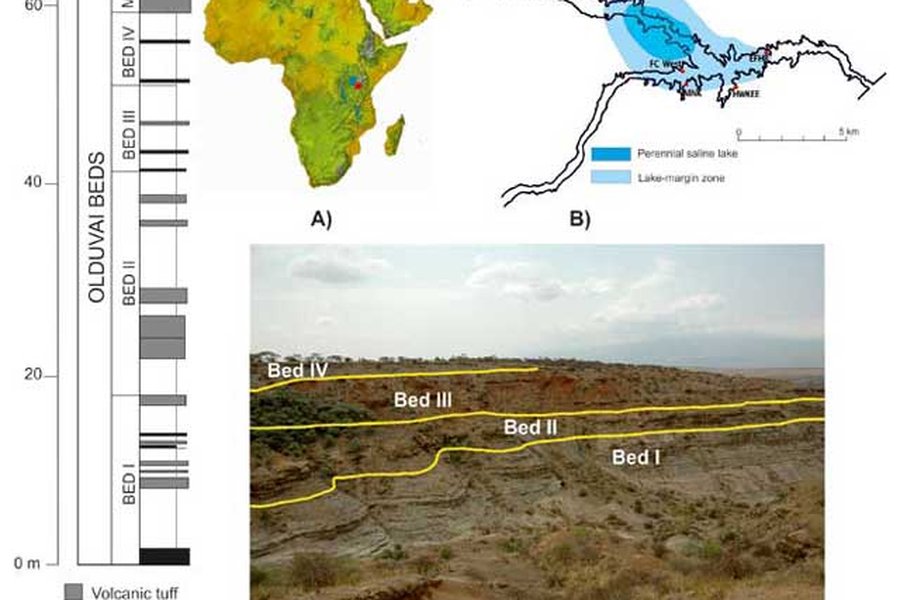
Olduvai Gorge in Tanzania is the most emblematic example of the Rift as geological and paleoanthropological archive. This canyon, 48 kilometres long, exposes a stratigraphic sequence nearly 100 metres high covering the last two million years. It was here that Mary and Louis Leakey, from the 1950s onward, uncovered a succession of hominin fossils and lithic industries that revolutionised our understanding of human evolution. Layers of volcanic tuffvolcanic tuffSoft, porous rock formed by the buildup and compaction of volcanic ash, easy to carve but hardening on contact with air.→ alternating with lacustrine, fluvial, and aeolian deposits tellTellAn artificial mound formed by the accumulation of successive layers of settlement remains at the same spot, typical of the Near East. Each destruction-rebuilding event adds a stratum.→ the story of a perpetually changing environment.
Pliocene megafaunaMegafaunaThe very large animals (mammoths, giant ground sloths, etc.) of the Pleistocene, most of which became extinct at the end of the last ice age.→: a world of giants
The Pliocene and Early Pleistocene are often described as the golden age of African -- and global -- megafauna. Never since the disappearance of non-avian dinosaurs had so many species of large mammals coexisted simultaneously on the planet. In East Africa, the Pliocene plains harboured a diversity of proboscideans, perissodactyls, artiodactyls, and carnivores now extinct, surpassing in richness and exuberance what current savannas can show us.
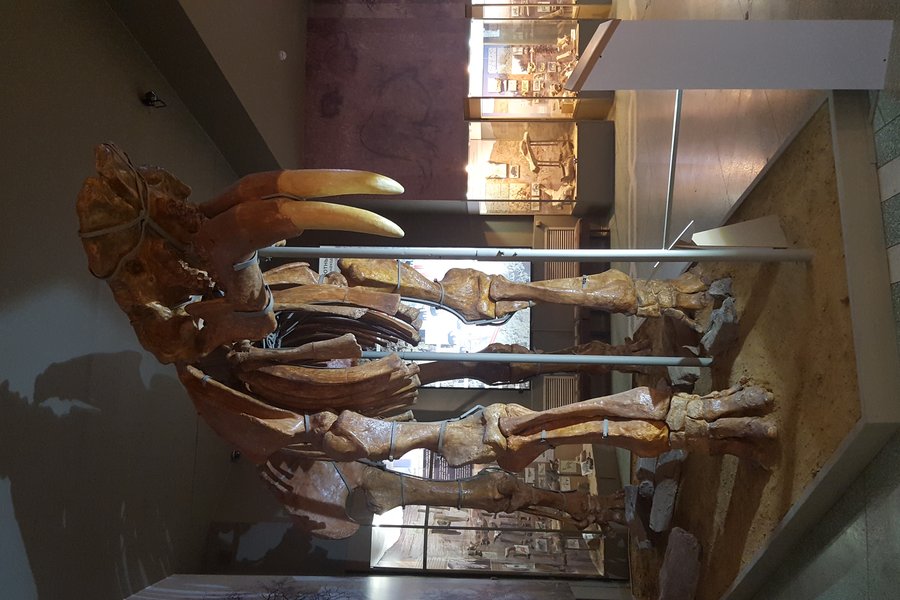
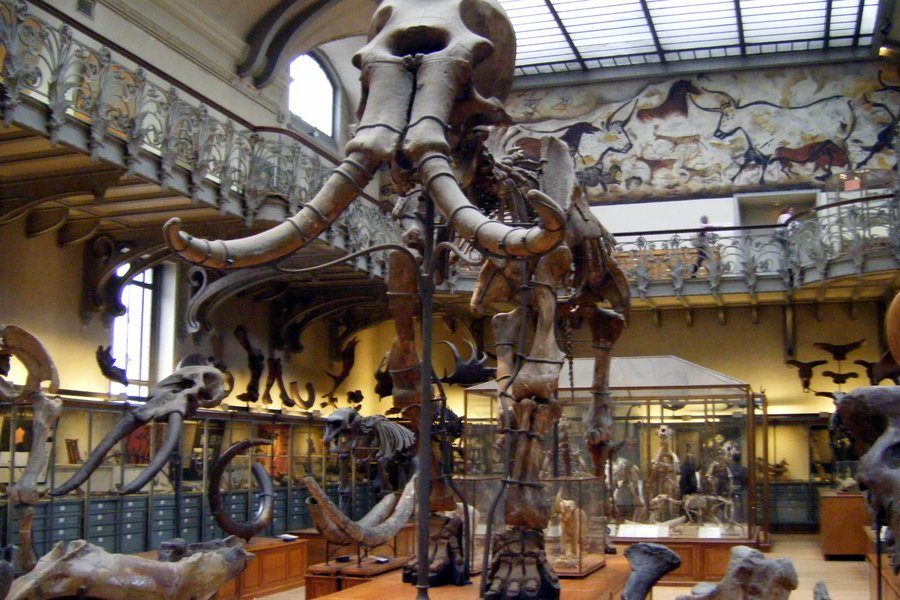
Proboscideans perfectly illustrate this abundance. During the Pliocene, Africa simultaneously hosted several genera of giant trunk-bearers. Deinotherium, whose lineage dated to the Miocene, was an imposing animal whose tusks curved downward from the lower jaw -- a unique morphology in the proboscidean order. The Mammutidae, represented by the genus Mammut (mastodons), still inhabited forests and mixed environments. The genus Elephas, ancestor of today's Asian elephants, appears in Africa from the late Pliocene onward. And Mammuthus meridionalis, the southern mammoth, is documented in Europe as early as 2.5 million years ago, bearing spiralled tusks reaching four metres in length.
The diversity of Pliocene equids is equally remarkable. Hipparion, a three-toed horse descended from the great equid radiation of the mid-Miocene, was still abundant in the early Pliocene in Africa and Eurasia. It coexisted with the first representatives of the genus Equus, the one-toed horses we still know today. This coexistence, documented in numerous Pliocene faunas, illustrates a moment of evolutionary transition: the Pliocene savanna was an evolutionary laboratory where ancient and modern forms lived side by side.
Bovids -- cattle, antelopes, gazelles -- underwent an extraordinary adaptive radiation in Africa during the Pliocene, directly correlated with the expansion of grassy savannas. Genera like Pelorovis (a gigantic buffalo with horns spanning 3 metres), Syncerus antiquus, and numerous now-extinct antelope species populated the plains. Sivatherium, a giant giraffid standing over 3 metres at the shoulder, still browsed the shrubs of wooded savannas into the Pleistocene. These herbivores represented a considerable biomass, the alimentary basis for an equally exceptional diversity of predators.
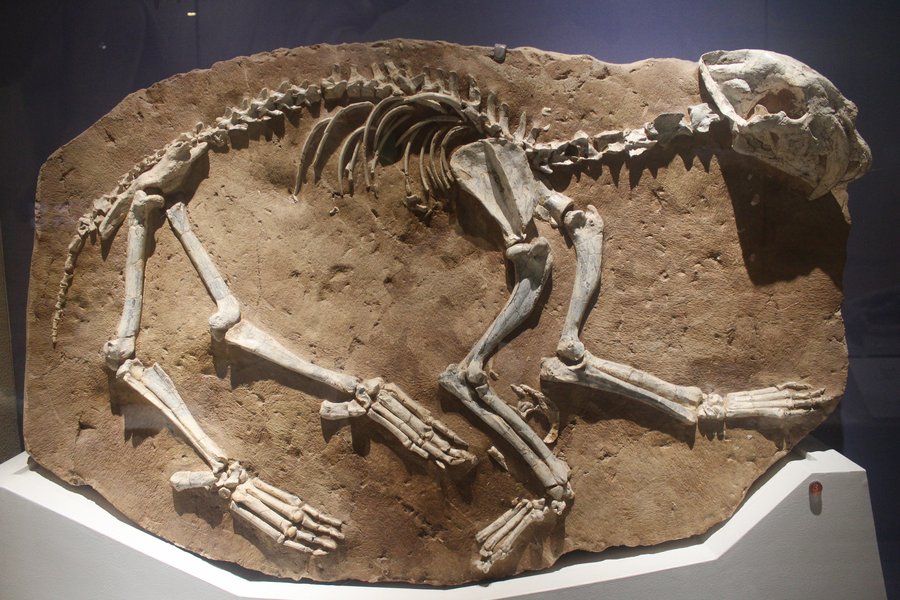
Among carnivores, the great sabre-toothed cats are the most spectacular figures of the Pliocene. Machairodus, whose upper canines could reach 15 centimetres, populated Africa and Eurasia. Megantereon, smaller but equally formidable, was present on three continents. Homotherium, the "sabre-toothed lion" of the late Pliocene and Pleistocene, hunted in groups, as suggested by accumulations of woolly mammoth calf carcasses discovered in Europe. These sabre-tooth cats were not simply "giant tigers": their particular morphology suggests specific hunting techniques, perhaps adapted to bringing down larger prey and killing them by haemorrhage rather than strangulation.
Pliocene hyenas deserve special mention. Pachycrocuta brevirostris, often nicknamed the "giant hyena", was a scavenger-predator the size of a lion. It was capable of crushing bones of adult proboscideans and accumulating enormous quantities of bones in its dens -- which paradoxically makes it a precious ally for palaeontologists, as its fossil lairs are veritable concentrations of Pliocene faunas. Sabre-toothed hyenas (Dinocrocuta) and numerous other extinct species completed this picture of a carnivore guild without equivalent in today's nature.
Pliocene flora: between forests and savannas
African Pliocene vegetation underwent, over the course of this six-million-year period, a profound transformation that literally redrew the continent's landscapes. At the beginning of the Pliocene, 5 to 4 million years ago, humid tropical forests were still far more extensive than today, covering much of East and Central Africa. Palynological analyses -- the study of fossil pollens preserved in lacustrine and peatPeatA waterlogged organic soil formed by accumulated plants; it seals and remarkably preserves wood and ancient remains.→ sediments -- reveal the widespread presence of forest taxa: Celtis, Podocarpus, Olea, species still found today in African montane forests.
But from 3.5 to 3 million years ago, grass pollens (Poaceae) begin to dominate the pollen spectra in sediment cores from Lake Malawi, Lake Tanganyika, and numerous other sites. This is the signature of savanna expansion. This expansion is not linear: it proceeds by pulses -- drying phases followed by humidification phases -- in response to Earth's orbital cycles. These oscillations exposed hominin populations to variable environments, alternating between open savannas (rich in herbivores but exposed to predators) and forest galleries (protective but less productive in ground-level food resources).
The geographic distribution of Pliocene African biomes also differed from what we observe today. The Sahara, now the world's largest hot desert, alternated during the Pliocene between hyperarid phases (similar to the present) and humid phases ("Green SaharaGreen SaharaA name for the Sahara during the "African Humid Period" (c. 14,500 to 5,000 years ago), when increased monsoon rainfall sustained lakes, rivers and savannas, making the region habitable before its gradual desiccation.→"), during which lakes, rivers, and savannas extended where sand reigns today. These humid periods played a crucial role in the dispersal of hominins out of AfricaOut of AfricaThe dispersals of Homo sapiens out of Africa, including a major expansion c. 70,000 to 60,000 years ago and earlier exits.→, opening "corridors" of vegetation toward the north and east.
The flora of coastal zones and Mediterranean regions also changed profoundly. In Europe and western Asia, the subtropical Miocene flora, with its palms and figs, progressively gave way to a more temperate, deciduous flora better adapted to marked cold seasons. The genera Quercus (oak), Fagus (beech), Pinus (pine), and Betula (birch) extended their range southward, pushing relicts of the tropical flora into Mediterranean refugia. This "pincer movement" of vegetation forced many animal and hominin species to move, adapt, or disappear.
Mammoths: indicators of global change
The evolutionary history of mammoths wonderfully illustrates the interactions between climate change, landscape transformation, and biological evolution during the Pliocene and Early Pleistocene. The genus Mammuthus originates from Africa: Mammuthus africanavus, the oldest known species, is documented in Pliocene sediments from North Africa. From there, mammoths colonised Eurasia, giving rise to a series of successive species whose sizes and dental morphologies reflect adaptation to new floras.
Mammuthus meridionalis, the southern mammoth, is the first Eurasian species. Appearing around 2.5 million years ago, it populated the forests and mixed environments of Europe and Asia until around 700,000 years ago. Its molars, still relatively low-crowned and poorly laminated, were adapted to varied vegetation including leaves and stems. As grassy steppes expanded under the effect of glaciations, mammoths evolved toward forms with higher (hypsodont) and more laminated teeth, better adapted to grazing on grasses. This dental evolution is a textbook case in evolutionary palaeontology: one can literally read the history of environmental changes in the morphology of mammoth molars.
Hominins in their environmental context
The hominins of the Pliocene and Early Pleistocene -- Australopithecus afarensis (Lucy), Paranthropus boisei, Homo habilis, and eventually the first Homo erectus -- evolved within this complex and dynamic ecosystem, not apart from it. Understanding their behaviours and adaptations requires placing them within their precise palaeoenvironmental context.
Isotopic analyses of hominin fossil teeth have revealed precious information about their diets. Carbon isotopes (the 13C/12C ratio) allow us to distinguish foods from C3 plants (forests, shrubs) from those of C4 plants (savanna grasses). South African australopiths like Australopithecus africanus showed a mixed diet including a significant proportion of savanna resources -- grasses, tubers, seeds -- far exceeding what one might expect from a being so close to forest primates. Paranthropus boisei, with its massive skull and giant molars, was specialised in processing hard foods -- perhaps bulbs, rhizomes, or seeds -- although the question remains debated.
Homo habilis and the first Homo erectus crossed a decisive threshold by becoming active scavengers and probably occasional hunters. Access to large mammal carcasses represented a considerable caloric and protein gain, but also a risk when facing dominant carnivores -- lions, giant hyenas, sabre-toothed cats. The manufacture and use of lithic tools, first documented at Lomekwi (3.3 Ma) then systematised in the OldowanOldowanThe oldest known stone-tool industry (c. 3.3–1.7 Ma), characterised by flaked pebbles (choppers) and basic flakes. Named after Olduvai Gorge (Tanzania).→ industry from 2.6 Ma, must be placed in this context of competition with a formidable carnivore guild. Tools did not merely serve to process carcasses: they may also have allowed deflecting predators or breaking bones to access marrow, a source of high-energy lipids.
Mosaic landscapes -- alternating open savannas, riverine forest galleries, lake shores, and marshes -- probably constituted the preferred habitats of early hominins. These transitional environments offered both the protection of wooded zones and access to the abundant food resources of shores and plains. The distribution of fossiliferous sites in African Rift basins -- always associated with ancient lakes or rivers -- confirms this affinity for peripheral aquatic environments.
Pliocene stratigraphyStratigraphyThe study of the superimposed layers (strata) of an archaeological site; each layer corresponds to a phase of occupation and yields a relative chronology.→: reading time in rocks
Precise dating of Pliocene and Early Pleistocene events rests on a combination of complementary methods that have been considerably refined in recent decades. Magnetostratigraphy exploits reversals of the terrestrial magnetic field, recorded in volcanic rocks as they cool: the succession of normal and reversed magnetic chrons constitutes a temporal "barcode" found in both ocean floor basalts and African Rift lacustrine sediments.
The potassium-argon (K-Ar) method and its more precise variant 40Ar/39Ar allow dating of volcanic tuffs intercalated in sedimentary sequences. It is thanks to this method that hominin fossils from Olduvai Gorge, Lake Turkana, and the Hadar site (Ethiopia, where Lucy was discovered) have been dated to within a few tens of thousands of years -- a remarkable feat for fossils several million years old. Oxygen isotope stratigraphy, applied to fossil foraminifera from marine sediment cores, provides a continuous, global record of temperatures and ice volumes, enabling correlation of continental African events with global climate history.

Non-hominin primates of the Pliocene
The evolution of hominins during the Pliocene cannot be understood without considering the broader context of primate evolution on the African continent. In Pliocene times, Africa harboured a diversity of great apesgreat apesThe family of great apes (Hominidae) comprising orangutans, gorillas, chimpanzees, bonobos and humans.→ far richer than today. Now-extinct genera like Theropithecus oswaldi, a giant baboon twice as heavy as modern baboons, populated lake shores alongside australopiths. This colossal primate, whose massive teeth betray a grass-based diet, is one of the best-documented non-hominin primates in the Pliocene African fossil record. Its disappearance during the Middle PleistoceneMiddle PleistoceneGeological subperiod (about 770,000 to 126,000 years ago) marked by growing behavioural complexity among hominins.→ coincides with the rise of larger-brained hominins, although establishing a causal relationship remains difficult.
The presence of large cercopithecines and colobines in Pliocene African faunal assemblages indicates significant arboreal diversity in forest galleries and wooded zones. These frugivorous and folivorous primates depended on sufficiently extensive forest habitats to sustain their populations. Their progressive disappearance in certain regions of East Africa during the Pliocene, reflected in changes in faunal assemblages, serves as an indirect indicator of forest habitat contraction. For bipedal hominins adapted to open environments, this forest rarefaction represented both an opportunity (less arboreal competition) and a constraint (reduced access to tree refuges from predators).
Understanding the ecological niche of Pliocene hominins also requires analysis of roosting sites and anti-predator strategies. Models based on the biology of extant primates living in similar open environments suggest that australopiths probably took refuge in trees at night, while exploring open environments during the day. BipedalismBipedalismA mode of locomotion on two hind limbs, the defining trait of the human lineage, appearing over 7 million years ago. Visible in the anatomy of the pelvis, femur and foramen magnum.→, in freeing the upper limbs and allowing an upright posture, provided better horizon-scanning capabilities in tall grass -- a decisive advantage in an environment populated by large cats and giant hyenas.
Social organisation was likely a crucial component of hominin survival strategies in the face of Pliocene predation pressure. Fossil evidence for group behaviour is indirect but suggestive: the co-occurrence of multiple individuals of the same species at single fossil sites, the absence of significant size dimorphism in some hominin lineages (suggesting reduced male-male competition and possibly more cooperative social structures), and comparisons with modern primates living in similar environments all point toward relatively large, cohesive social groups as the primary defence against Pliocene carnivores. These social pressures may have been among the key drivers of the expansion of hominin brain size during this period.
Giant birds and Pliocene avian fauna
Pliocene megafauna was not limited to mammals. Giant birds occupied important ecological roles in the ecosystems of several continents. In South America, phorusrhacids -- the "terror birds" -- were bipedal predators reaching over two metres in height, with hooked beaks capable of crushing the skulls of medium-sized prey. These giant raptors largely disappeared after the Great American Interchange, unable to compete with large placental carnivores arriving from the north. Their demise illustrates a broader pattern: when faunas long isolated from continental competition suddenly encounter a diverse suite of sophisticated competitors, the result is often rapid extinction of endemic forms that had evolved in the absence of such pressure.
In Africa, the diversity of waterbirds was exceptional in the lacustrine zones of the Rift. Flamingos, giant herons, and numerous waterfowl populated the shores of the great Pliocene lakes. The remains of these birds, often found in the same assemblages as hominin fossils, testify to the richness of food resources available at the margins of wetlands. Some researchers have proposed that lake shores and marshland zones, rich in aquatic invertebrates, amphibians, and birds, constituted privileged subsistence environments for early hominins -- safer and more productive than open savanna plains exposed to large predators. This "aquatic" or "lacustrine" hypothesis remains a minority view in the scientific community but underscores the importance of avian diversity in understanding the ecology of Pliocene hominins.
Reptiles and Pliocene ectotherm fauna
Often overshadowed by the spectacular mammalian megafauna, Pliocene reptiles deserve attention. Crocodilians in Pliocene Africa were diverse and often impressively large. Crocodylus thorbjarnarsoni, documented in Lake Turkana sediments, reached estimated lengths of seven to eight metres, making it one of the largest crocodiles known from the African fossil record. These semi-aquatic predators posed a significant threat to hominins approaching lake shores to drink or feed. Indeed, crocodilian bite marks have been identified on Pliocene hominin bones, testifying to this permanent confrontation between our ancestors and the dangerous fauna of wetland zones.
Giant monitors, including Varanus marathonensis in Eurasia, completed the guild of large predators in warm, dry environments. Giant tortoises of now-extinct genera, such as Titanochelon in Europe and giant Pelomedusa in Africa, occupied ecological niches of large, slow herbivores. These tortoises, which can weigh several hundred kilograms, are precious bio-indicators: their presence in a fossil assemblage generally indicates a warm climate without prolonged frost. Their progressive disappearance during the Pleistocene, correlated with successive cooling episodes, illustrates the sensitivity of ectotherms to climate change.
The question of hominin cognitive evolution during the Pliocene has long been debated. The appearance of the first recognisable stone tools at Lomekwi (Kenya) around 3.3 million years ago, and the systematic Oldowan industry from 2.6 Ma onward, represents a threshold in intentional material culture. But tool use alone does not capture the full range of cognitive innovations that the Pliocene witnessed. Social learning, gestural communication, improved spatial memory, enhanced planning ability -- all of these capacities are likely to have been under intense selection pressure in an environment where food resources were patchy, seasonal, and contested. Archaeologists and cognitive scientists are increasingly looking at non-tool evidence for Pliocene hominin cognition: the spatial organisation of archaeological sites, the distances from which raw materials were transported, and the evidence for sharing and division of labour at butchery sites all shed light on mental capacities that left no direct material trace.
The diversity of freshwater fish in the Pliocene Rift lakes was also remarkable. Cichlid radiation -- the explosive diversification of cichlid fish species in the African Great Lakes -- was in full swing during the Pliocene, driven by the same cycles of lake level fluctuation that influenced terrestrial faunas. The isolation of lake populations during low-water phases, followed by mixing during high-water phases, created the oscillating connectivity that drove rapid speciation. Lake Tanganyika, one of the world's oldest and deepest lakes with a history going back to the early Pliocene, harbours today over 250 cichlid species, many of them unique to a single lake or even a single bay -- a living testimony to the power of Pliocene environmental dynamics as a driver of biological diversification.
Marine fauna and the Messinian crisis
The Pliocene begins in the immediate wake of the Messinian salinity crisis, one of the most spectacular events in recent Earth geological history. Between 5.96 and 5.33 million years ago, the Mediterranean partially or completely dried out, forming one of the largest evaporite deposits known (salt, gypsum, anhydrite) and reducing Mediterranean sea level several kilometres below the global ocean level. The breach of the Iberian barrier 5.33 million years ago triggered the "Zanclean flood", a cataclysmic inundation during which Atlantic waters poured into the desiccated basin, refilling it over thousands to tens of thousands of years.
This major disturbance profoundly reshuffled Mediterranean marine faunas. The Pliocene Mediterranean, freshly reinvaded by the Atlantic, was populated by Atlantic species no longer present in the Inner Sea today: walruses, bowhead whales, more diverse sharks. Carcharodon megalodon -- the legendary "megalodon", the largest shark ever documented -- disappears precisely at the Pliocene-Pleistocene boundary, probably a victim of prey reduction (small cetaceans) linked to climate change and competition with orcas.
In the world's oceans, Pliocene fauna was dominated by diverse cetaceans, pinnipeds, and sirenians still abundant in tropical seas. The closure of the Isthmus of Panama, around 3 million years ago, cut the tropical marine fauna in two, permanently isolating Atlantic populations from their Pacific counterparts and initiating an evolutionary divergence still observable today in the marine faunas on either side of the isthmus.
Eurasia and the great faunal migrationsMigrationsLong-distance movements of populations; a major driver of human history (the exit from Africa, the peopling of continents, Neolithic and steppe expansions).→
The Pliocene and Early Pleistocene are periods of great faunal mixing between continents. The opening and closing of biological corridors -- isthmuses, land bridges, sea level drops -- allowed massive exchanges of species between Africa, Eurasia, and the Americas. These faunal migrations are so well documented that they constitute precious biostratigraphic markers, used to correlate fossiliferous sequences from different continents.
The Great American Interchange begins around 3 million years ago with the closure of the Isthmus of Panama. South American species migrate northward -- giant sloths, glyptodonts, toxodonts, opossums -- while North American species colonise South America: llamas, tapirs, bears, sabre-toothed cats. This encounter of two long-isolated faunas has dramatic consequences for endemic South American faunas, many of which disappear in the centuries and millennia following first contact with North American competitors.
In Eurasia, climate changes and sea level fluctuations created "dispersal events" allowing exchanges between Africa and Eurasia via the Levantine corridor, and between Eurasia and North America via the Bering land bridge. It was via these routes that the first Homo erectus left Africa to colonise Asia and Europe around 1.8 million years ago, in the wake of other African mammals such as elephants, roan antelopes, and suids. These human migrations were not solitary adventures: they were part of a broader movement of recomposition of Eurasian faunas.
The Early Pleistocene: toward the great glaciations
The onset of the Early Pleistocene, 2.588 million years ago, marks the beginning of a new climatic regime: glacial-interglacial cycles become increasingly marked and increasingly asymmetric (long glaciations, short interglacials). Initially, these cycles have a dominant periodicity of 41,000 years, corresponding to the cycle of variation in Earth's axial obliquity. It is only during the "mid-Pleistocene transition", between 1.25 and 0.7 million years ago, that the cycles shift to a 100,000-year periodicity, characteristic of the great glaciations we have known since Milankovitch's work.
During the Early Pleistocene, glacial episodes remain more moderate than they will later become. Ice sheets extend at times over much of northern Europe and North America, but the bottom of the glacial valley does not yet reach the depths that will characterise the recent Quaternary. For African hominins, living in a tropical and subtropical zone primarily impacted by humidity variations rather than temperature, these cycles translate into oscillations between humid and arid phases pulsing at a rhythm of 23,000 to 41,000 years.
It is in this context of increased variability that the genus Homo flourishes and diversifies. Homo erectus, appearing in Africa around 1.9 million years ago, develops more sophisticated lithic techniques (AcheuleanAcheuleanLower Palaeolithic technical culture characterised by hand axes, present across three continents.→ industry) and progressively masters fire. Its braincase, larger than its predecessors', allowed more elaborate cognitive processing of the environment. Its thermoregulatory abilities -- a body morphology adapted to heat dissipation in open, hot environments -- allowed it to hunt during the hottest hours of the day, when thick-furred predators sought shade. These physiological, cognitive, and cultural adaptations, honed across millions of years in the crucible of the Pliocene and Early Pleistocene, opened the world to our genus in a way no previous hominin had achieved.
Geological legacy and significance for contemporary science
The study of the Pliocene and Early Pleistocene is not merely a retrospective enterprise. It provides precious analogues for understanding contemporary climate change. The warm mid-Pliocene (upper Piacenzian, ~3.3-3.0 Ma), with its global temperatures 2 to 3 degrees above pre-industrial values, is now used as an "analogue" to project what Earth might look like if CO2 emissions continue along current trajectories. The PRISM programme (Pliocene Research, Interpretation and Synoptic Mappings), coordinated by the USGS, has reconstructed in detail the ocean surface temperatures, vegetation, and cryosphere of the warm Pliocene, providing a precious validation framework for climate models projecting the future.
Pliocene palaeontology is also directly relevant to current studies on megafauna extinction. Did the progressive disappearance of large mammal species during the Pleistocene -- accelerating in the middle and late Pleistocene -- have climatic causes, causes linked to hunting and predation pressure exerted by Homo, or a combination of both? The debate, decades old, remains lively in the scientific community. Early Pleistocene data, where hominins were still few and poorly impactful, allows establishing a "reference state" of faunas before human dominance.
Pliocene palaeobotany, finally, provides precious information on the evolution of African biomes and the links between vegetation and climate. Analyses of phytoliths -- microscopic siliceous structures produced by certain plants and preserved in sediments -- allow the history of African savannas to be reconstructed with fine temporal resolution. These data confirm that the expansion of C4 grasses (plants using the C4 photosynthetic pathway) occurred in several stages between 8 and 3 million years ago, with a notable acceleration toward 3.5 to 3 million years ago in East Africa. This expansion, directly linked to both aridification and declining atmospheric CO2 concentrations, transformed the landscapes in which the first bipedal hominins evolved.
The fossil record of the Pliocene and Early Pleistocene displays a remarkable feature: the coexistence, in certain deposits, of "archaicArchaicRefers to an ancient, now-extinct human population or form (Neanderthals, Denisovans, ghost lineages), as opposed to anatomically modern humans.→" and "modern" faunas. At Olduvai Gorge, for example, Early Pleistocene layers yield bones of now-extinct genera like Pelorovis alongside still-living genera like Hippopotamus or Equus. This coexistence allows tracking, layer by layer, the progressive modernisation of African faunas. The process is not linear: some "archaic" lineages persist long alongside more modern forms, while others disappear abruptly, perhaps under the effect of climatic changes or competition with new species arriving from other regions. The analysis of these transitions is an active research domain that enriches our understanding of the general rules governing extinctions and faunal replacements.
The sedimentary basins of the East African Rift are among the most precisely dated terrestrial sequences in the world, thanks to the exceptional abundance of datable volcanic intercalations. But correlating these continental sequences with the global marine record remains a methodological challenge. Marine sediment cores, with their continuous record of oxygen isotope ratios (reflecting global ice volume and temperature), provide a global climatic framework that can be matched to terrestrial sequences using magnetostratigraphy and tephrochronology. The integration of these diverse archives -- marine, lacustrine, aeolian, volcanic -- into a coherent palaeoenvironmental narrative for the Pliocene and Early Pleistocene represents one of the great success stories of late twentieth and early twenty-first century earth science. The picture that has emerged is one of extraordinary complexity: not a single, steady trend toward cooler and drier conditions, but a rich tapestry of oscillations, thresholds, and abrupt transitions that created the varied, unpredictable environments in which our genus was born.
The palaeoclimatological lessons of the Pliocene have direct policy relevance. Climate projections for the coming centuries, under high-emission scenarios, suggest global temperature increases of 3 to 5 degrees Celsius above pre-industrial levels. The warm Pliocene provides our best empirical guide to what such a warmer world might look like: higher sea levels, ice-free Arctic summers, forests extending to higher latitudes, reorganised precipitation patterns. The PRISM programme's detailed reconstructions of the warm Pliocene environment have been instrumental in testing the accuracy of the very climate models we now rely on to project future change. In this sense, the study of a world that existed over 3 million years ago is not merely an academic exercise: it is a form of planetary foresight.
Finally, Pliocene biogeography directly illuminates our understanding of current biodiversity distributions. Why is sub-Saharan African fauna so different from that of South Asia? Why are island faunas so vulnerable to continental invasive species? Why did Australian marsupials survive where their placental counterparts on other continents disappeared? The answers to these questions have their roots in the palaeogeographic and climatic events of the Pliocene and Early Pleistocene. Understanding this lost world means understanding the deep rules governing life on Earth -- and perhaps better anticipating the disruptions humanity is inflicting upon it today. In an era of rapid anthropogenic environmental change, the Pliocene is not only our evolutionary past; it is also a guide to possible futures, a period of profound environmental transformation whose ecological and evolutionary lessons we have only barely begun to absorb.
No comments yet. Be the first.