When did the first humans reach the Americas? For decades the answer seemed settled: around 13,000 years ago, hunters from Asia crossed the Bering land bridgeBering land bridgeThe strip of land (Beringia) linking Asia to America during the last Ice Age, the entry route of the first Americans.→ and rapidly colonised the entire continent. This "ClovisClovisA Palaeoindian culture of North America (c. 13,000 years ago), recognizable by its fluted stone points; long believed the oldest on the continent, no longer so.→ First" theory rested on highly distinctive lance tips discovered in New Mexico in the 1930s, which long served as the oldest evidence of human presence in North America. But in Brazil, in the national park of Serra da Capivara, troubling discoveries have been shaking that certainty for several decades.1
Serra da Capivara: a landscape out of time
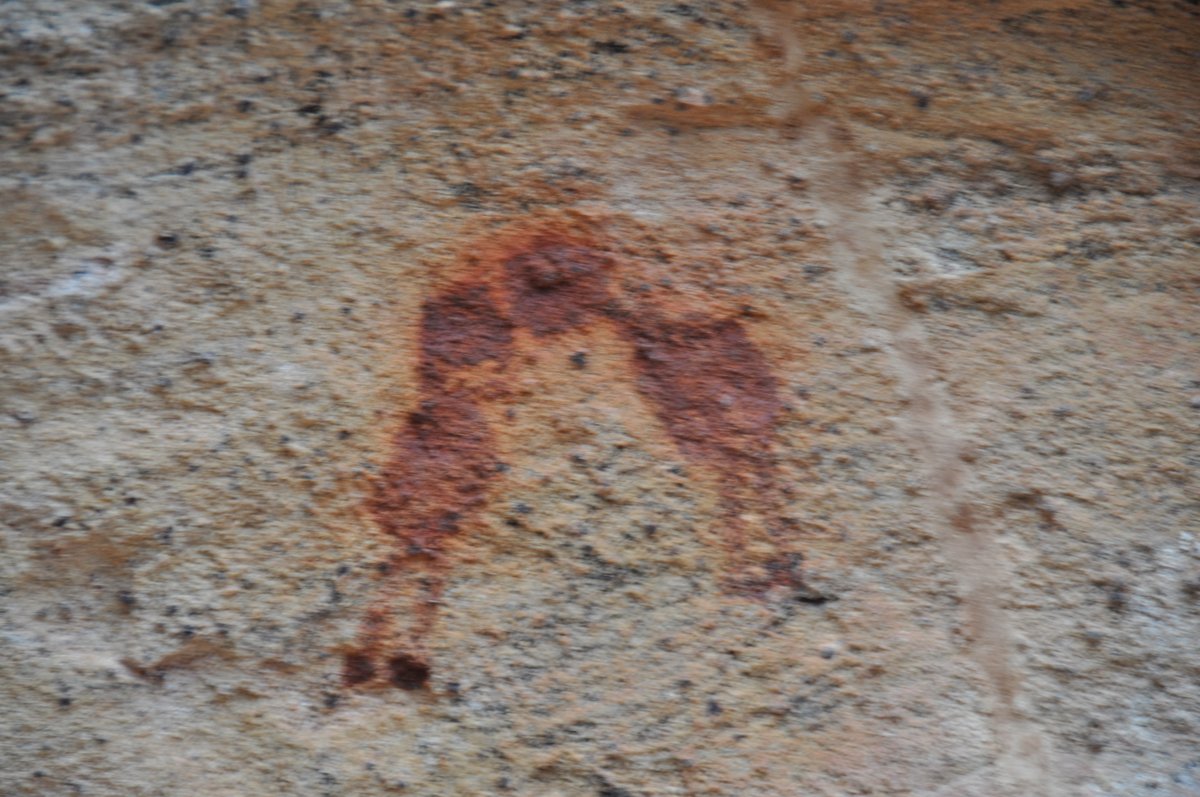
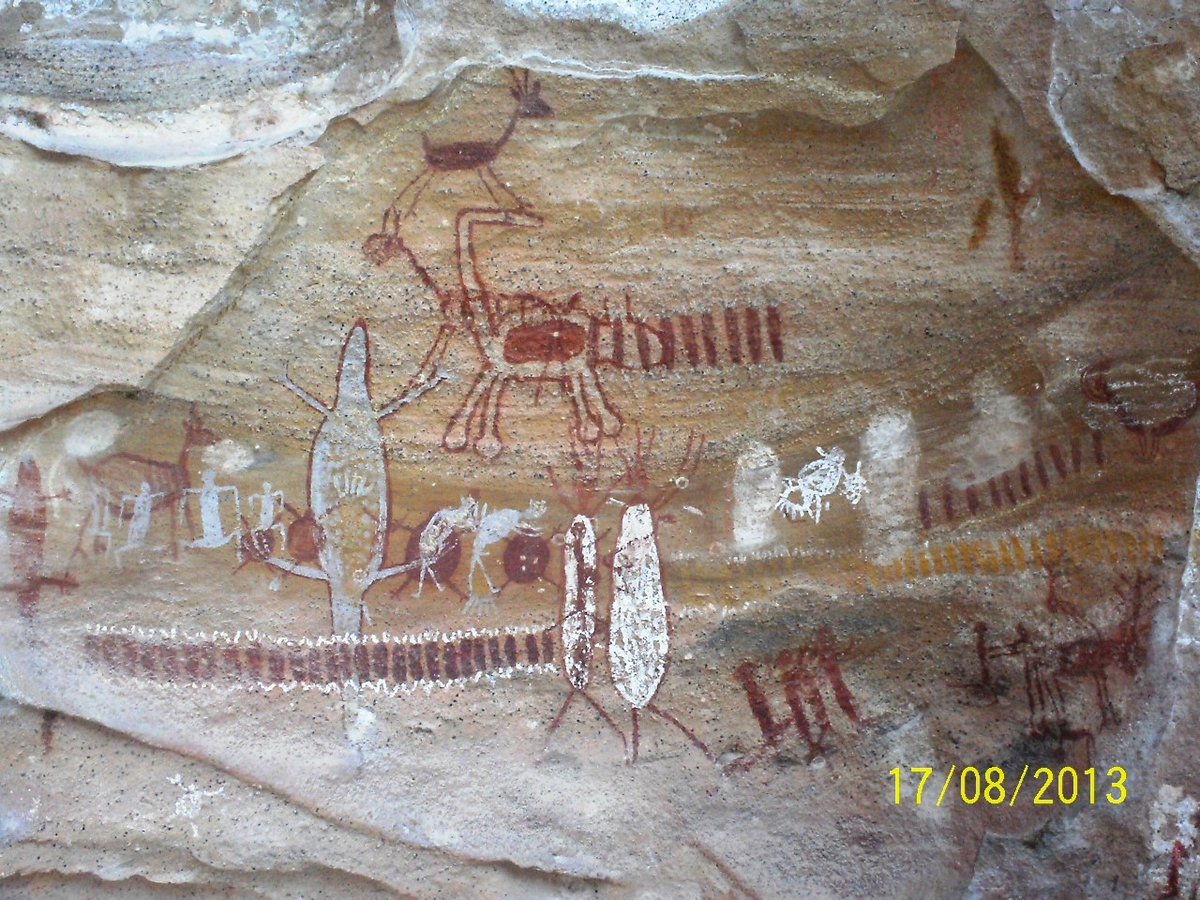
Serra da Capivara National Park lies in the state of Piaui, in north-eastern Brazil. Inscribed on the UNESCO World Heritage List in 1991, it contains one of the largest concentrations of prehistoric rock artRock artThe whole body of graphic representations (painted or engraved) made on rock walls, slabs or blocks.→ on the planet: thousands of paintings and engravings, some more than 25,000 years old, adorn the walls of caves and rock shelters carved into the red sandstone. Running deer, dance scenes, human silhouettes, negative hand prints: a colossal gallery bears witness to an intense and ancient human occupation.
It was in this striking setting that Brazilian archaeologist Niede Guidon discovered in the 1970s and 1980s occupation levels that would challenge all established certainties. At the site of Toca do Boqueirnao da Pedra Furada, she identified charcoal, ochreOchreA red or yellow mineral pigment (iron oxides), used from prehistory for adornment, funerary rites and art.→ and quartz flakes in sedimentary layers dated between 32,000 and 48,000 years before our era. The archaeological community reacted with scepticism: were these artefacts not the result of natural processes, water run-off or rockfalls?
Eric Boeda and the quartzite pebbles: a meticulous enquiry
Eric Boeda, professor at the University of Paris-Nanterre and a recognised specialist in PalaeolithicPalaeolithicThe oldest and longest period of prehistory (c. 3.3 Ma–12,000 BC), defined by chipped stone tools and a hunter-gatherer way of life.→ lithic industries, arrived at Serra da Capivara in 2003. His question was simple but demanding: are the quartzite pebbles found in layers 25,000 years old tools fashioned by human hands, or simply stones fractured by natural processes?
At first glance, nothing spectacular: broken pebbles, rough flakes, very different from the finely knapped flintFlintA hard, brittle siliceous rock, knapped by prehistoric people to produce blades, points and sharp tools.→ points of European Palaeolithic tradition. The most common critique from "Clovis First" supporters bears precisely on this point: stones fractured by repeated freezing, floods or falling blocks can be mistaken for genuine tools. Specialists call these "geofacts" - natural formations that are deceptively similar to artefacts.2
To settle the question, Boeda and his team deployed a rigorous methodological toolkit. First: experimental archaeology. By reproducing the same gestures with the same types of quartz, they compared the fracture patterns obtained experimentally with those on the excavated pieces. Certain criteria - the angle of retouch, the regularity of percussion bulbs, the sequence of removals - can only be produced by intentional human action. Second: use-wearuse-wearMicro-traces left on a tool by its use, studied through use-wear analysis to reconstruct its function.→ analysis, examining under the microscope the micro-traces of wear on the cutting edges. The results were clear: these pebbles bear traces of cutting on plant fibres and on bone, consistent with use for slicing meat and working wood.3
The dating: 25,000 years of evidence
The other pillar of the argument rests on dating. To establish the age of the layers, Boeda's team used several complementary methods: optically stimulated luminescence (OSL)Luminescence (OSL)Optically stimulated luminescence dating: measures the last exposure of sediment grains to light.→ on sediment grains, and uranium-thorium datinguranium-thorium datingDating method measuring, in calcite, the ratio of uranium to the thorium produced by its decay, effective up to nearly 500,000 years.→ on charcoal. These cross-checked measurements converge on ages of between 20,000 and 30,000 years for the layers containing the tools. The OSL technique dates the moment when sand grains were last exposed to light - that is, when they were buried - which can correspond to intentional deposition by human occupants.
A date of 25,000 years places these occupants at the height of the Last Glacial MaximumLast Glacial MaximumThe peak of the last glaciation (c. 26,000 to 19,000 years ago), with ice sheets at their greatest extent; it pushed populations towards southern refuges.→ (LGM), when ice sheets were at their greatest extent and sea levels were much lower than today. In this context, many temperate zones of Brazil remained habitable, with a diverse fauna and flora.4
Who were these first Americans?
The question of the identity and origin of these hypothetical pre-Clovis occupants is one of the most fascinating. If people really were living in Brazil 25,000 years ago, they were certainly not the direct ancestors of present-day Amerindian populations, who display very specific genetic characteristics linked to a passage through Siberia and BeringiaBeringiaA vast land bridge emergent between Siberia and Alaska during the last glaciation, at the site of today's Bering Strait; a cold steppe through which the first Americans passed.→ between 15,000 and 18,000 years ago. This discrepancy between the archaeological chronology and genetic data has fuelled scepticism: if the first Americans were so ancient, why is there no trace of them in modern genomes?
Several hypotheses have been put forward. These early occupants may have left no descendants, either because they became extinct before successive migration waves arrived, or because their genetic contribution was diluted beyond the reach of current methods. Work by Eske Willerslev and David Reich on ancient DNAAncient DNAGenetic material preserved in old remains, often degraded, sequenced with cutting-edge techniques.→ from Amerindian populations has identified what they call a "ghost lineageGhost lineageAn ancient human population known only by the trace it left in the genomes of present-day populations, without any confirming fossil.→", whose imprint in current genomes remains mysterious - a genetic signal with no known counterpart elsewhere in the world, which might testify to an archaicArchaicRefers to an ancient, now-extinct human population or form (Neanderthals, Denisovans, ghost lineages), as opposed to anatomically modern humans.→ presence predating Clovis by tens of thousands of years.5
An open debate
The scientific community remains divided on Boeda's conclusions. Some researchers, such as Gary Haynes of the University of Nevada, maintain that the quartz pieces can be explained without invoking human agency. Others, like Denis Vialou at the Natural History Museum in Paris, point out that the convergence of several independent methods - stratigraphyStratigraphyThe study of the superimposed layers (strata) of an archaeological site; each layer corresponds to a phase of occupation and yields a relative chronology.→, use-wear analysis, multi-technique dating - constitutes a robust body of evidence. The debate on the peopling of the AmericasPeopling of the AmericasThe migrations that led Homo sapiens to occupy the American continent, from Beringia; its date and routes remain debated.→ is far from closed.
This SLICE HISTOIRE documentary immerses us in this fascinating enquiry, following Eric Boeda through his excavations and laboratory analyses, and giving voice to both critics and supporters. Beyond the technical debate, it poses a vertiginous question: who were these men of whom we know almost nothing, who may have lived in Brazil 25 millennia ago, long before most of the world's continents were settled by our direct ancestors?6
No comments yet. Be the first.