Of all humanity's discoveries, none has had a more profound impact than the mastery of fire. Before the wheel, before writingWritingA system of conventional signs used to fix language or information durably; its appearance (c. 3300 BC) marks, by convention, the end of prehistory.→, before agricultureAgricultureThe cultivation of plants and production of food by working the soil, which emerged in the Neolithic in the Near East and independently elsewhere; it radically transformed human societies.→ , there was fire. A source of heat, light, protection, and above all, the transformation of food. Fire is not merely a tool: it is the mirror of our very evolution.
The Earliest Evidence: 1.8 Million Years Ago
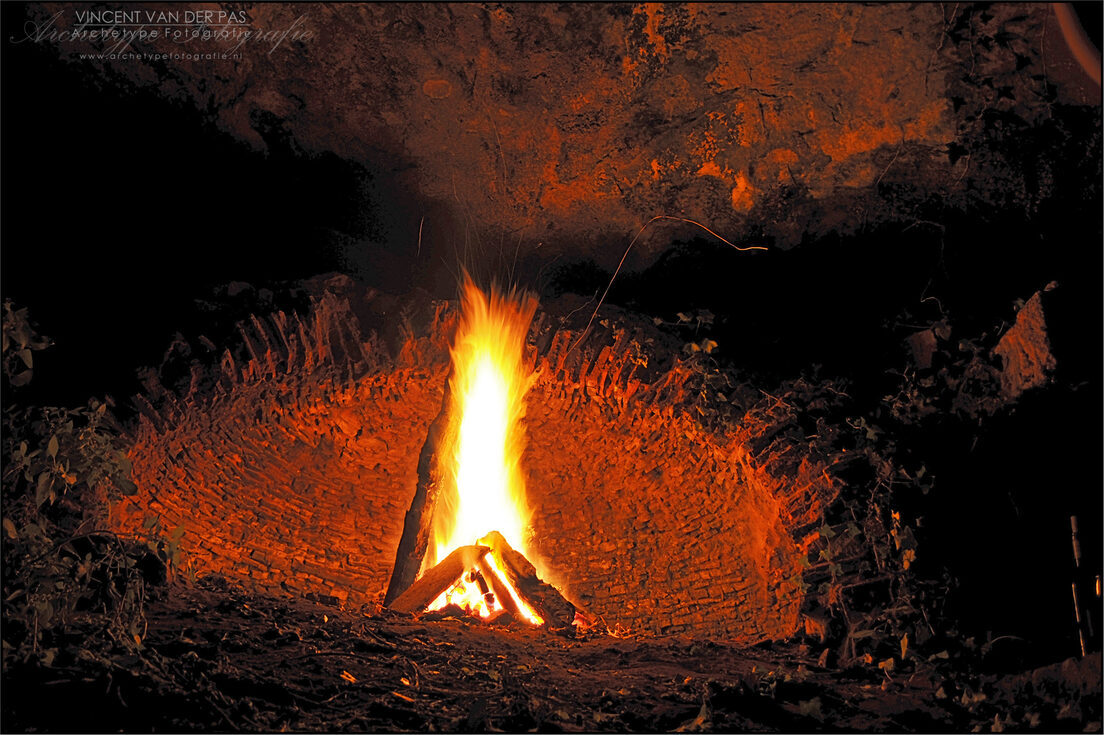
For a long time, the oldest known evidence of fire use dated to about one million years ago, from Wonderwerk Cave in South AfricaAfricaThe cradle of humankind: the continent where the first hominins appeared, then Homo sapiens around 300,000 years ago, before the expansion to the rest of the world.→ (Northern Cape Province). But in June 2026, a study published in PLoS ONE by archaeologist Michael Chazan (University of Toronto) pushed this date back to 1.7, 1.8 million years ago.
The discovery relies on a luminescence method applied to tiny burnt bones found inside owl pellets , compact balls of fur and bones regurgitated by barn owls (Tyto alba) after meals of small rodents. These pellets were charred when fires were lit on the debris-covered cave floor. The signal is clear: fires were regularly maintained deep inside the cave, far from natural wildfires. This could only have been a deliberate human act.
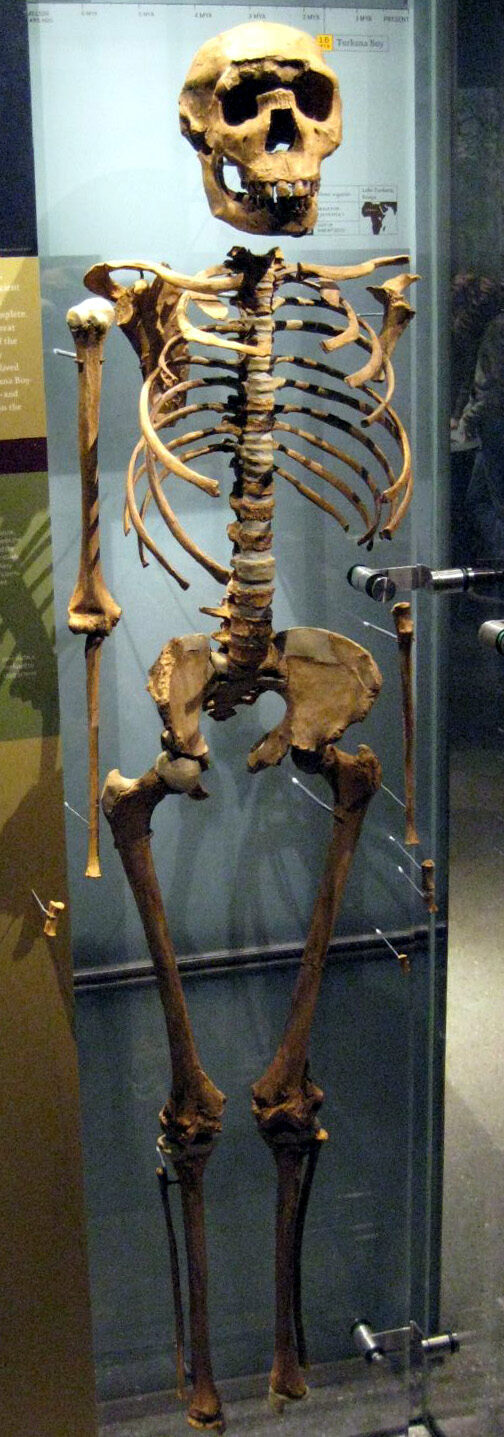
At the time, Wonderwerk Cave was occupied by groups of Homo erectus (or Homo ergaster, its African form). It thus yields the oldest evidence of intentional fire use ever discovered.
A Captured Fire, Not Yet Kindled
We must distinguish two fundamental stages in the history of fire:
Fire use , collecting a flame from a natural wildfire (lightning strike, volcanic eruption), transporting it, and maintaining it. This is what Homo erectus was doing 1.8 million years ago. Fire was precious, fragile , one could not yet recreate it from scratch.
Fire production , deliberately creating a spark, by striking flintFlintA hard, brittle siliceous rock, knapped by prehistoric people to produce blades, points and sharp tools.→ against pyrite, or by wood-on-wood friction (bow drill, fire drill). This far later revolution dates to approximately 400,000 years ago, likely achieved by Homo heidelbergensisHomo heidelbergensisMiddle Pleistocene human species, often seen as the common ancestor of Neanderthals and our own species.→. The oldest known fire-starting kit is a piece of pyrite discovered at Barnham, England, dated to 415,000 years ago.
Between these two stages stretch more than a million years during which our ancestors depended entirely on nature's whims to obtain a flame.
The Cooking Hypothesis: Did Fire Make Our Brains?
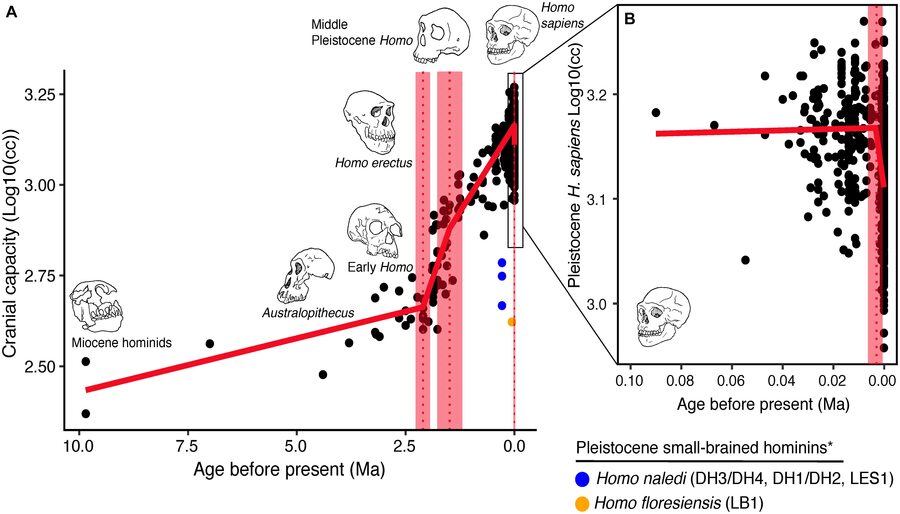
Anthropologist Richard Wrangham (Harvard University) put forward a bold hypothesis in 1999, since broadly supported by the evidence: cooking food was the primary driver of human brain expansion.
The argument: cooking dramatically increases the digestibility and caloric density of food. Cooked meat and tubers release 30, 50% more calories than the same foods eaten raw. This caloric surplus allowed the brain , an extraordinarily energy-hungry organ (consuming 20% of our total energy) , to grow far beyond what a raw diet could support.
At the same time, cooking made chewing less demanding, leading to the gradual reduction of jaws, teeth, and the digestive tract. These anatomical "savings" freed additional resources for brain expansion. The progression from Homo habilis (~600 cm³) to Homo erectus (~900 cm³) to Homo sapiensHomo sapiensThe present-day human species, which emerged in Africa around 300,000 years ago, the only surviving human lineage after the extinction of Neanderthals and Denisovans.→ (~1,400 cm³) follows a trajectory that remarkably parallels the history of fire.
Fire's Other Revolutions
Beyond cooking, fire transformed human existence at multiple levels:
Warmth and survival. Fire enabled Homo erectus to colonize cooler regions, then allowed Homo heidelbergensis and NeanderthalsNeanderthalsA fossil humanity of Eurasia, robust and cold-adapted, extinct around 40,000 years before present.→ to establish themselves in glacial Europe. Without fire, temperate and northern latitudes remained inaccessible.
Protection from predators. Great cats, giant hyenas, and saber-toothed cats ruled prehistoric nights. Fire changed this balance , flames keep predators at bay and allow safer sleep on the ground rather than in trees.
Artificial light. By pushing back the dark, fire extended the active day, creating time for new activities: toolmaking, socializing, and perhaps the first storytelling.
Social bonding. The hearth was humanity's first shared space. Researchers like Andrew Wyllie (Cambridge) suggest that gathering around a fire at night fostered the emergence of language, collective memory, and ritual. Fire is, in this sense, the cradle of human culture.
Material transformation. Ceramics, metallurgyMetallurgyThe techniques of extracting and working metals (copper, bronze, gold); its rise in the Eneolithic and Bronze Age transformed tools, weapons and social hierarchies.→, hardening wooden spear tips , all these technologies depend on mastery of fire. Without it, neither the NeolithicNeolithicThe "New Stone Age": a period marked by farming, herding, settlement and pottery, from around 10,000 BC.→ nor the Bronze AgeBronze AgeA protohistoric period following the Neolithic, defined by bronze metallurgy (a copper-tin alloy) and the rise of the first cities and states; in Egypt it corresponds to the age of the first pyramids.→ would have been possible.
The Great Fire Sites of PrehistoryPrehistoryThe span of human history before the invention of writing, from the Palaeolithic to the Metal Ages, known mainly through material remains.→
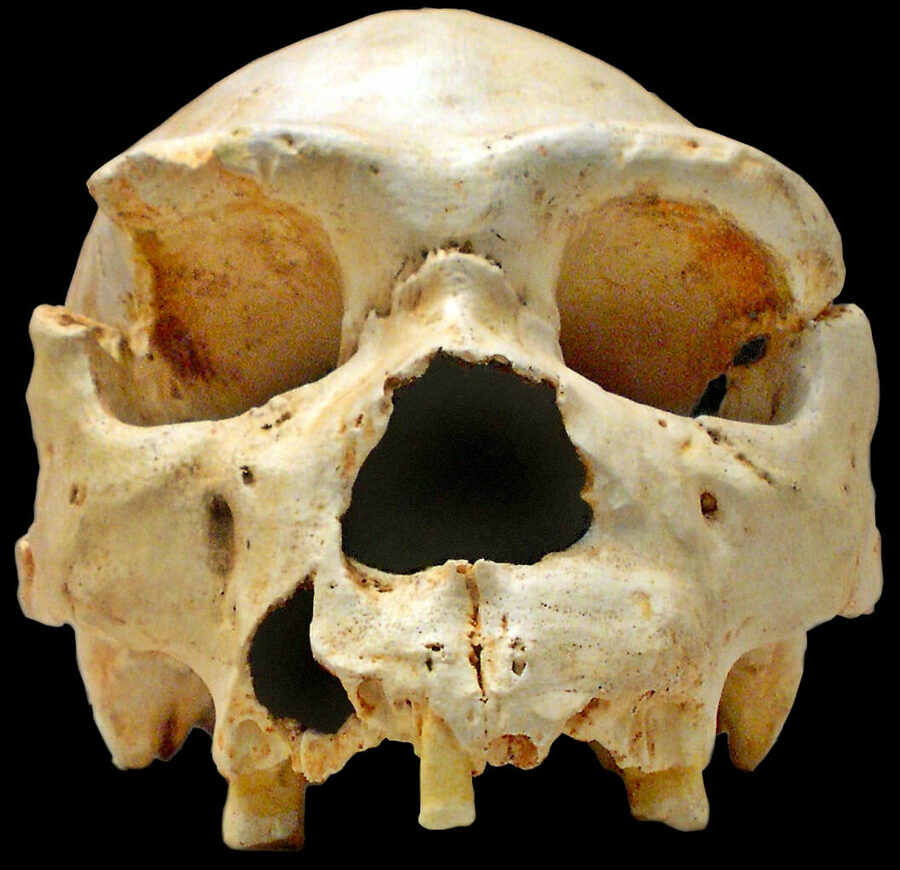
Wonderwerk Cave (South Africa): 1.7, 1.8 million years. Oldest known trace of fire use. Burnt bones in owl pellets. Occupants: Homo erectus.
Qesem Cave (Israel): 382,000, 200,000 years. Recurring, intensively used hearths. Remains of grilled meat, calcined bones. Occupants (probably an archaicArchaicRefers to an ancient, now-extinct human population or form (Neanderthals, Denisovans, ghost lineages), as opposed to anatomically modern humans.→ form of Homo sapiens) fully mastered fire.
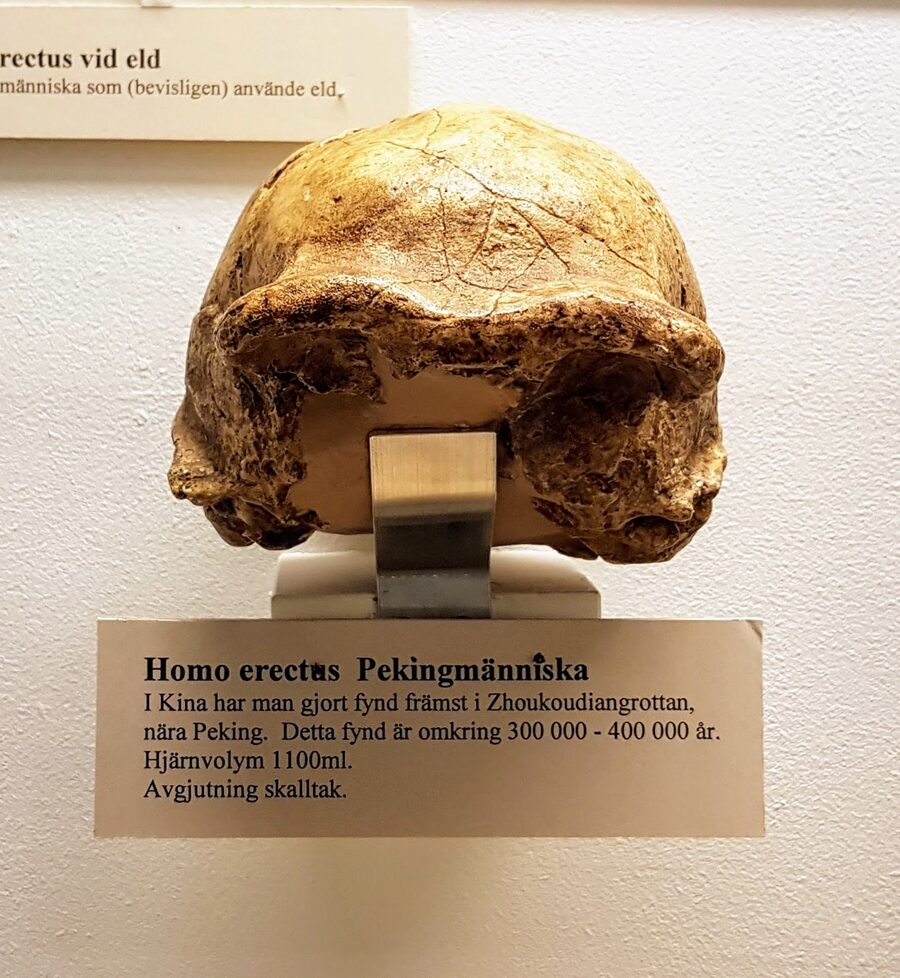
Zhoukoudian (China): 770,000, 230,000 years. Site of Peking Man (H. erectus pekinensis). Earliest evidence of regular fire use in Asia, with burnt bones and charcoal.
SchöningenSchöningenGerman site that yielded eight wooden throwing spears about 300,000 years old, among the oldest known wooden weapons.→ (Germany): ~400,000 years. Homo heidelbergensis site yielding wooden throwing spears , some fire-hardened , along with hearth traces. Among the earliest known fire-making evidence in Europe.
Grotte du Lazaret (France): ~180,000 years. Neanderthal hearth in an Alpine-Maritime cave, showing complex spatial organization around the fire.
Making Fire: A Cognitive Revolution
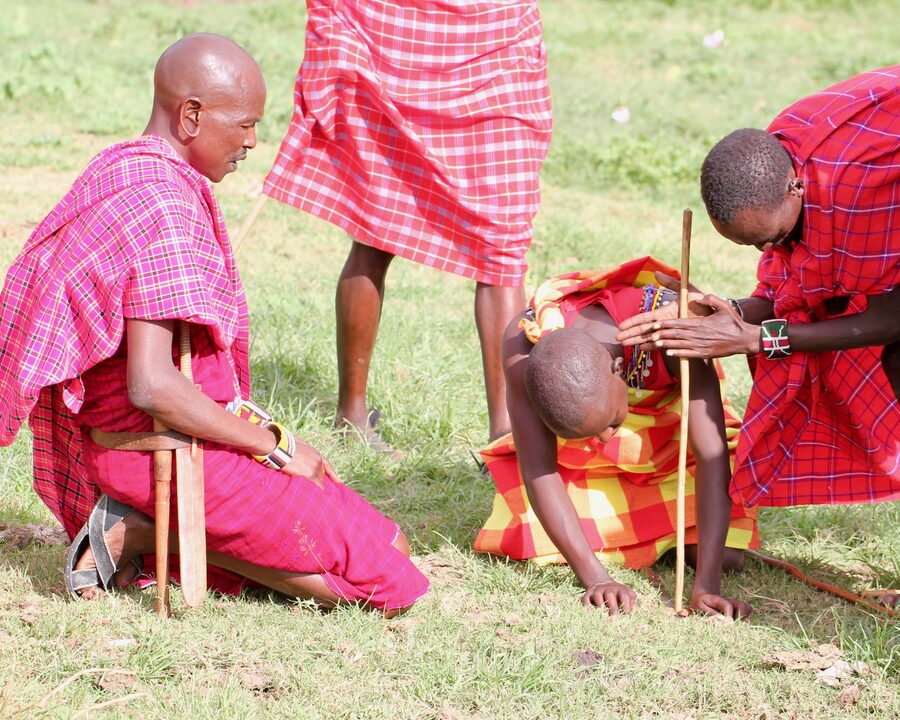
Deliberately producing fire requires a specific cognitive ability: understanding the causal chain (percussion → spark → tinder → flame), anticipating the outcome, and persisting through the process. This is a form of causal thinking and forward planning not found in other primates.
Two principal techniques were used:
Percussion: striking a flint nodule against iron pyrite (marcasite). The detached pyrite fragments produce an exothermic reaction on contact with oxygen, generating sparks that fall onto prepared tinder (dry grass, plant down, rotted wood fibers).
Friction: rapidly spinning a pointed stick in a notch cut into a softwood board until heat buildup creates an ember. More demanding, this method is still practiced by some traditional communities today.
In both cases, fire-making involves a complex operational sequenceoperational sequenceOrdered succession of technical steps leading from raw material to finished object.→, knowledge of suitable materials, and the transmission of this knowledge , that is, a form of teaching, and therefore of culture.
Fire: Mirror of Our Humanity
It is no exaggeration to say that fire made us human , or at least that it played a central role in our becoming so. Our brains grew because of it. Our bodies were transformed to accommodate it. Our societies organized themselves around it. And our universal mythologies , from the Greek Prometheus to the Japanese Kojiki , make stolen fire the very symbol of humanity torn from animality.
The Wonderwerk discovery of 2026 only pushes these boundaries further. 1.8 million years of fire. 1.8 million years of humanity in the making.
Merci pour la qualité de l'écriture. On voit que les auteurs respectent leurs lecteurs.
Le feu ou la grande histoire de l'Humanité
On a tendance à prendre le feu pour acquis mais cet article rappelle que sa maitrise représente des centaines de milliers d'années d'apprentissage et de transmission. Ce qui me touche, c'est l'image de familles préhistoriques réunies autour d'un foyer, partageant de la nourriture et peut-etre des histoires. C'est le début de la vie sociale telle qu'on la connait.
La maitrise du feu est sans doute la révolution technologique la plus fondamentale de toute l'histoire humaine. J'utilise cet article pour introduire le concept de niche écologique avec mes élèves : le feu a permis aux hominines de coloniser des environnements froids, de cuire leurs aliments et d'améliorer leur bilan énergétique. C'est un facteur clé dans l'évolution de notre cerveau.