Situated some sixty kilometres north of the Scottish coast, Orkney forms an archipelago of about seventy islands, of which the largest, Mainland, concentrates the vast majority of major prehistoric sites. The landscape is strikingly austere: close-cropped grassland, changeable skies, constant winds, and a sea that always seems present. It was in this environment that, between 3500 and 2500 BCE, NeolithicNeolithicThe "New Stone Age": a period marked by farming, herding, settlement and pottery, from around 10,000 BC.→ communities erected monuments whose sophistication and density continue to astonish researchers. In 1999, UNESCO inscribed the "Heart of Neolithic Orkney" as a World Heritage Site, recognising in this small archipelago one of the key places of European protohistoryProtohistoryThe transitional period between prehistory and history, covering societies without their own writing but known through external texts.→.
From the First Hunter-GatherersHunter-gatherersA way of life based on hunting, fishing and gathering wild resources, without farming or herding; it dominated almost the whole of human history.→ to the First Farmers
Human presence in Orkney dates back at least 8,500 years, to the end of the MesolithicMesolithicThe period between the Palaeolithic and the Neolithic (c. 10,000–6,000 BC in Europe), still based on hunting and gathering.→ period. At this time, sea levels were lower than today, and the current islands were linked to each other, and perhaps to mainland Scotland, by marshes and low-lying land. The first inhabitants, hunter-gatherers, exploited the abundant marine resources: fish, sea mammals, seabirds and shellfish.
The oldest traces of human presence in Orkney were found at Longlees on Mainland, where kitchen middens dating to around 6000 BCE were uncovered. Other Mesolithic sites have been identified on several islands, but their study is complicated by rising sea levels that have submerged part of the coastlines of that era.1
The transition to the Neolithic, with the adoption of farming and herding, occurred in Orkney around 3800-3700 BCE. This change is visible archaeologically through the appearance of new pottery, permanent stone structures, and above all funerary megaliths. The first farming communities rapidly erected imposing passage cairns, suggesting an already complex social organisation and an elaborate funerary ideology.
Orkney presents an exceptional density of Neolithic monuments relative to its area. Within a few hundred square kilometres, archaeologists have identified dozens of cairns, several stone circles, ditched enclosures and villages whose preservation is often remarkable, thanks to the ubiquity of local Devonian sandstone, which splits into regular slabs easily used in construction.
Skara Brae: The Village That Survived the Millennia
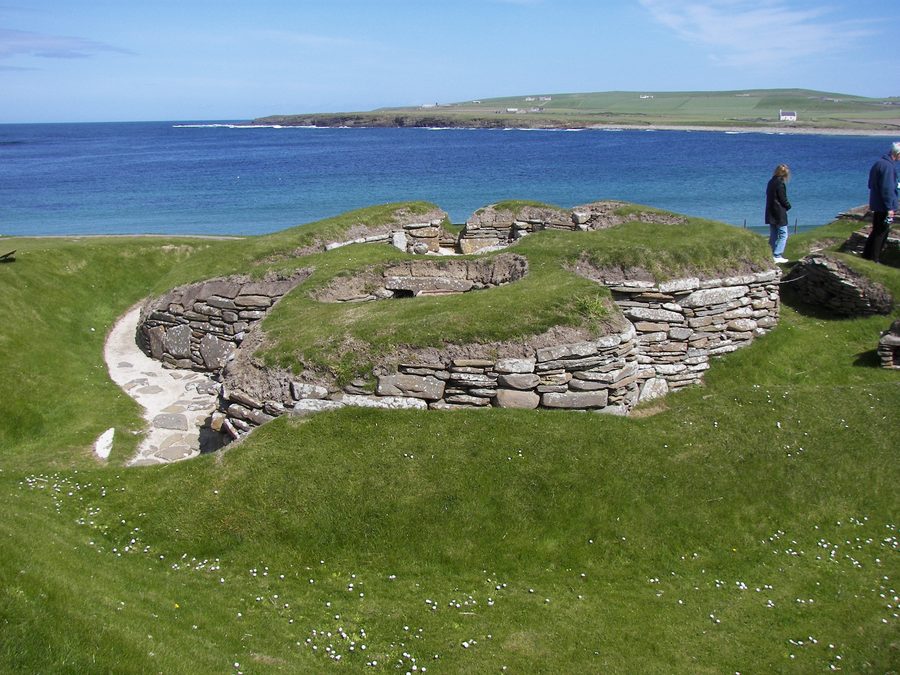
Among all Orkney's prehistoric sites, Skara Brae is perhaps the most striking. This Neolithic village, occupied between approximately 3100 and 2500 BCE, was buried under sand dunes for centuries before being revealed during a violent winter storm in 1850. The estate owner, William Watt, began excavations that would uncover one of the best-preserved prehistoric settlements in all of northern Europe.
The village comprises eight houses linked by covered passageways, a circulation system that allowed inhabitants to move from house to house without exposure to the elements. Each house follows the same basic plan: a single square room with rounded corners measuring about 6 metres across, with a central hearth and stone furniture fixed to the walls. These furnishings, including multi-shelf dressers, stone-framed beds, boxes and niches, remained in place for five thousand years.2
The inventory of objects found at Skara Brae reveals an unexpectedly rich daily life. Grooved WareGrooved WareNeolithic flat-based, straight-walled pottery decorated with incised grooves and geometric patterns, first appearing in Orkney and later spreading across Britain.→ pottery, characteristic of the late Neolithic in Britain and Ireland, is found alongside bone tools, flintFlintA hard, brittle siliceous rock, knapped by prehistoric people to produce blades, points and sharp tools.→ implements, sperm whale ivory beads and decorative objects whose function remains debated. Bones of cattle, sheep and pigs testify to animal husbandry, supplemented by fishing and shellfish gathering.
The abandonment of the village around 2500 BCE appears to have been sudden rather than planned: several precious objects were left in place, as if the inhabitants had departed in haste. A catastrophic storm? An epidemic? An external threat? Archaeologists remain cautious about the precise causes, but Skara Brae's abandonment coincides with the end of the Neolithic and the beginning of the Bronze AgeBronze AgeA protohistoric period following the Neolithic, defined by bronze metallurgy (a copper-tin alloy) and the rise of the first cities and states; in Egypt it corresponds to the age of the first pyramids.→ in Orkney, a period of profound cultural and demographic transformation.
Maeshowe: The CairnCairnA human-made mound of stones, often raised over a burial chamber (chambered cairn) or used as a marker; common across the British Isles from the Neolithic to the Iron Age.→ of the Solstices
About ten kilometres east of Skara Brae, the Maeshowe passage cairn is considered one of the most sophisticated megalithic monuments in northern Europe. Built around 2800 BCE, it presents externally as a circular mound approximately 35 metres in diameter and 7 metres high, surrounded by a ditch and bank. Its unassuming exterior gives no hint of the extraordinary construction within.
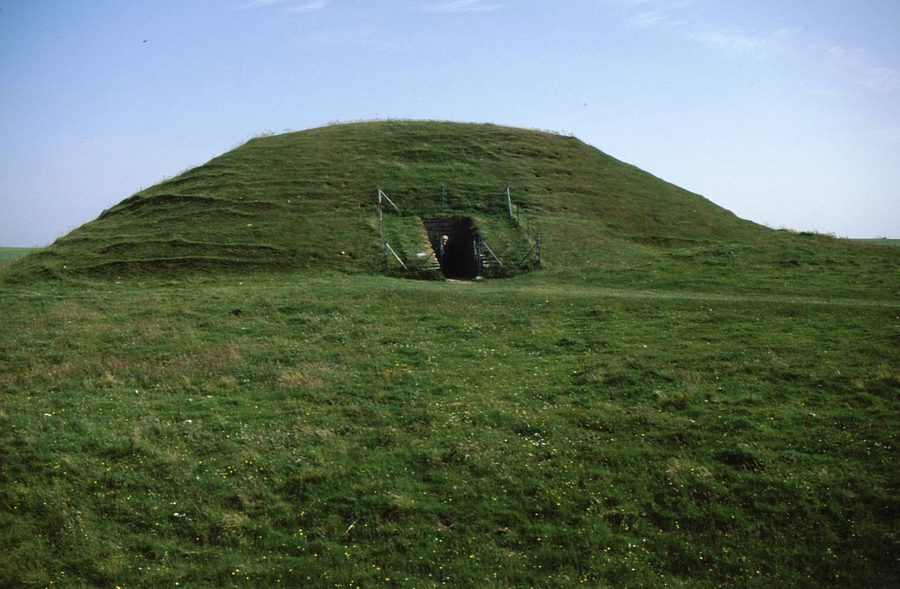
An entrance passage 11 metres long, cut through carefully assembled sandstone blocks, leads to a square central chamber approximately 4.6 metres across. Side cells open in three of the four chamber walls. The precision of the masonry, with its near-perfect joints between stones weighing several tonnes each, testifies to remarkable technical mastery.3
The alignment of Maeshowe is one of its most fascinating aspects. At the winter solstice, the setting sun shines exactly down the entrance passage, progressively illuminating the back of the chamber for several weeks around 21 December. This alignment is too precise to be accidental, and it testifies to astronomical observation and sophisticated architectural planning abilities. Whatever the exact meaning of this alignment, it is clear that the solar cycle held major importance in the beliefs of Maeshowe's builders.
Maeshowe holds another surprise, much more recent: during Viking raids in the twelfth century CE, Norsemen who had forced entry into the monument left about thirty runic inscriptions, one of the most important known collections of runes. These inscriptions, dated to around 1150 CE, mix modest affirmations of passage with tales of hidden treasure, beautiful women and warrior exploits. They remind us that Maeshowe, long before modern archaeologists, had already struck visitors from elsewhere with wonder and admiration.
The Ring of Brodgar and the Stones of Stenness: Two Circles in Dialogue
On a peninsula between two lochs, the Loch of Harray and the Loch of Stenness, stand two of the most impressive megalithic monuments in Britain. The Stones of Stenness, the older of the two, were erected around 3100 BCE. Originally, twelve stones formed a circle approximately 30 metres in diameter within a large ditched enclosure. Today only four remain standing, but at up to 5.7 metres tall they rank among the most imposing menhirs in Scotland.
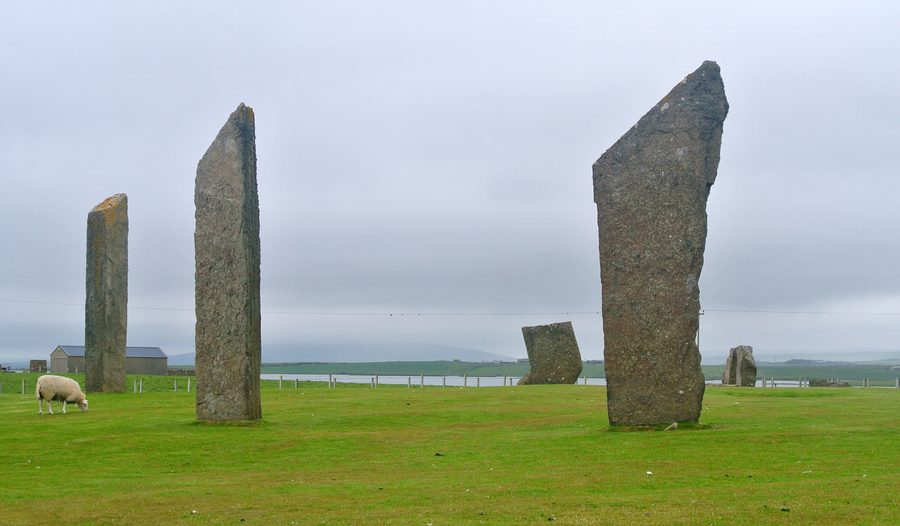
Excavations around the Stones of Stenness revealed charred deposits and animal bones testifying to ritual feasting or sacrifice. Traces of wooden structures predating the stones were also found, suggesting the place had a ceremonial function even before the megaliths were erected. The ditch surrounding the original circle measured about 44 metres in diameter and 2 metres deep; it had no obvious defensive function but delimited a sacred space.4
About a kilometre to the north, the Ring of Brodgar is the third-largest stone circleStone circleA Neolithic or Bronze Age monument of standing stones set in a ring, often ritual or astronomical in purpose.→ in the British Isles. With a diameter of approximately 104 metres, it originally comprised 60 stones, of which 36 survive today. The surrounding ditch, cut into solid rock, originally measured 10 metres wide and 3 metres deep, a colossal undertaking that required the removal of some 4,700 tonnes of rock. The Ring of Brodgar's dating is less precise than Stenness, but archaeologists generally place it between 2500 and 2000 BCE.
The relationship between these two monuments, separated by barely a kilometre and linked by the narrow Ness of Brodgar peninsula, intrigues archaeologists. Were they part of a unified ceremonial complex? Were they the sites of complementary rituals, perhaps related to the two distinct lochs that border them? The discovery, from 2004 onward, of a gigantic monumental complex precisely on the Ness of Brodgar between them would provide answers as spectacular as they were unexpected.
The Ness of Brodgar: The Revelation of the Twenty-First Century
The Ness of Brodgar is a narrow peninsula linking the two lochs and separating the two great ceremonial monuments. For decades, archaeologists had crossed it without lingering, assuming this corridor was simply a passageway. Geophysical surveys in 2002-2003 changed everything, revealing anomalies beneath the surface corresponding to vast buried masonry structures.
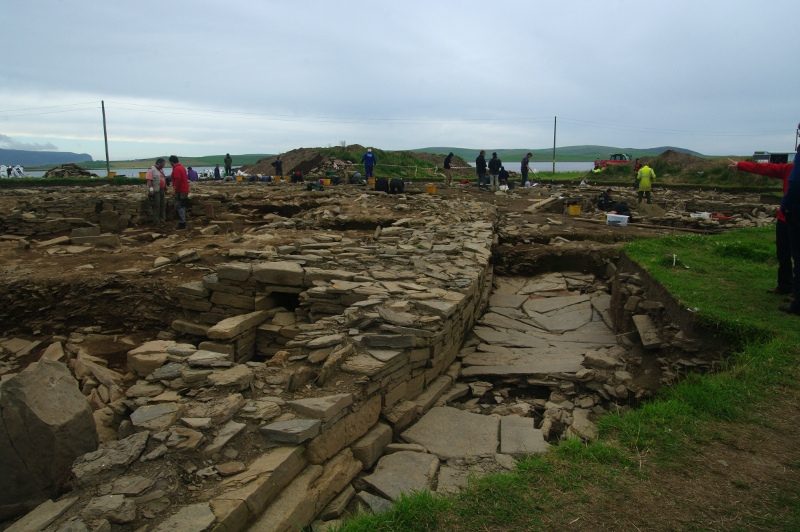
Successive excavation campaigns since 2004 have progressively revealed the exceptional scale of the site. Across barely three hectares, archaeologists have identified more than forty structures, many with walls over a metre thick. The complex was surrounded by a vast enclosure wall, the "Great Wall of Brodgar," some sections of which exceed six metres in width, a construction requiring resources and organisation far superior to what was generally attributed to Neolithic societies.5
Among the excavated buildings, "Structure 10" is the most spectacular: it covers approximately 25 metres by 20, making it one of the largest Neolithic buildings ever uncovered in northern Europe. Its walls, carefully constructed of Devonian sandstone, still bear traces of red and orange paint. These ochreOchreA red or yellow mineral pigment (iron oxides), used from prehistory for adornment, funerary rites and art.→ and haematite-based pigments reveal an interior of unsuspected chromatic richness. Combined with geometric motifs carved on certain stones, these paints transform the image we had of Neolithic ceremonial spaces, too often imagined as austere and monochrome.
The objects excavated from the Ness of Brodgar reinforce the picture of an intensely ceremonial site. Thousands of fragments of Grooved Ware pottery, bone and flint tools, polished stone axes imported from distant regions (Cumbria, Ireland, Shetland), ornaments and above all stones engraved with complex geometric motifs (spirals, lozenges, zigzags) testify to long-distance exchange and prolonged ritual activity spanning several centuries.
The End of the Neolithic and the Transition to the Bronze Age
Around 2500 BCE, Orkney's Neolithic world entered a period of profound change. Stone circles continued to be frequented, but building methods and settlement patterns shifted. The Grooved Ware pottery so characteristic of the late Neolithic gradually gave way to Beaker pottery, associated with a new cultural phenomenon of continental origin that spread throughout the British Isles.
Ancient DNAAncient DNAGenetic material preserved in old remains, often degraded, sequenced with cutting-edge techniques.→ studies on Orkney skeletons from this period reveal something striking: the Orkney population underwent significant genetic renewal around 2500-2000 BCE. Populations of "old Neolithic" type were partly replaced by groups carrying genetic markers associated with migrationsMigrationsLong-distance movements of populations; a major driver of human history (the exit from Africa, the peopling of continents, Neolithic and steppe expansions).→ from the Eurasian steppes, the same ones found in continental Beaker culture. This demographic replacement was not specific to Orkney: it appears to have affected the entire British Isles at this period.
The Bronze Age in Orkney saw the progressive abandonment of large collective monuments in favour of individual barrow burials, sometimes with bronze or gold objects. The Ness of Brodgar in particular appears to have been abandoned spectacularly: excavations uncovered a layer of debris containing the remains of at least 600 cattle, suggesting a funerary feast or closing ceremony of considerable scale before the site was definitively left behind.
The Iron AgeIron AgeThe last period of protohistory (from c. 1200 BC in Europe and the Near East), marked by iron metallurgy and the first kingdoms.→ subsequently saw the rise of a distinctive defensive architectural form characteristic of northern Scotland and the islands: the broch. These circular double-walled towers, of which several examples exist in Orkney, testify to a more conflictual society than that of the Neolithic. The Broch of Gurness, excavated in the 1930s, is one of the best-preserved. It dates from the early centuries CE and was still inhabited in the Pictish period, a reminder that Orkney's prehistoryPrehistoryThe span of human history before the invention of writing, from the Palaeolithic to the Metal Ages, known mainly through material remains.→ is not only about megaliths, but a long chain of human occupations stretching into recorded history.
Long-Distance Exchange: Orkney at the Centre of a Network
One of the most important revelations of recent Orkney archaeology is the evidence of long-distance connections, well beyond the archipelago. Far from being an isolated corner of northern Europe, Neolithic Orkney was in regular contact with other regions of the British Isles and perhaps beyond.
Grooved Ware pottery, whose earliest known forms come from Orkney, subsequently appears throughout the late Neolithic of Britain, from Cornwall to Scotland via Wales and Ireland. Some archaeologists have suggested that Orkney may have played the role of a cultural centre or innovator for this geographical ensemble. The idea of Orkney as a source of ideas and cultural practices that spread southward, which would have seemed extravagant a few decades ago, is taken seriously since the discoveries at the Ness of Brodgar.6
The raw materials found at the Ness of Brodgar confirm these connections. Polished stone axes came from Cumbria (the English Lake District), Rathlin Island in Ireland, Shetland and other distant regions. These axes were probably not simple tools but prestige objects exchanged during ceremonial gatherings. Their varied provenance suggests that the Ness of Brodgar was perhaps an interregional meeting place, where representatives of different communities gathered periodically for rituals, exchanges and negotiations.
World Heritage Status and Current Research
In 1999, UNESCO inscribed the "Heart of Neolithic Orkney" as a World Heritage Site, recognising the outstanding universal value of four sites: Skara Brae, Maeshowe, the Ring of Brodgar and the Stones of Stenness. Since then, Orkney has seen significant tourist growth, which poses challenges for management and conservation.
The Ness of Brodgar, discovered after the UNESCO inscription, has since 2004 been the most important and most widely reported excavation in Orkney. Directed by Nick Card of the University of the Highlands and Islands, it brings together dozens of volunteer and professional excavators from around the world each summer. Discoveries continue year after year, pushing the boundaries of our understanding of Neolithic Orkney and, more broadly, of northern Europe.7
New technologies are also transforming research on this site. LiDARLiDARLaser-based remote sensing (from "Light Detection And Ranging"): a sensor fires light pulses and measures the echo's return time to map a surface in three dimensions. Mounted on a plane or a drone, it slips through gaps in the canopy and reconstructs the bare-earth relief, revealing structures invisible beneath vegetation.→ surveys identify buried structures invisible to the naked eye. Analysis of sediments from the surrounding lochs reveals the archipelago's environmental history: vegetation change, farming practices, fires. Sedimentary DNADNAThe molecule carrying genetic information, used to reconstruct kinship between species.→ even allows the presence of certain plant or animal species to be tracked over millennia.
Neolithic Orkney reminds us that in the fourth millennium BCE, human communities scattered across a wind-swept archipelago at the northern edge of the Atlantic were capable of coordinating monumental construction projects, maintaining exchange networks spanning hundreds of kilometres, and producing a material and symbolic culture of remarkable richness. These Neolithic men and women, without writingWritingA system of conventional signs used to fix language or information durably; its appearance (c. 3300 BC) marks, by convention, the end of prehistory.→ or metal, left us a heritage that continues, five millennia later, to inspire admiration and wonder.
Ce site est une mine pour les joueurs de Paleo, 7 Wonders ou Tigris & Euphrates. Merci !
Je partage souvent vos articles avec mes collègues médiateurs. Celui-ci va directement dans ma boite à outils.