They emerge from the depths of time with unsettling regularity: small feminine silhouettes, carved in mammoth ivoryMammoth ivoryMammoth tusk worked by Palaeolithic craftspeople to carve figurines, beads, points and ornaments.→, limestone, serpentine or bone, whose forms exaggerate female attributes with clear intentionality. By convention, we call them "prehistoric Venuses" -- a name coined in the nineteenth century that says as much about the era of their discovery as about their actual meaning. More than 200 of these statuettes have been unearthed since 1864, spread across a vast territory stretching from the Pyrenees to Siberia. The oldest date back more than 35,000 years; the most recent are barely 11,000 years old. Together, they constitute one of the most durable and most enigmatic artistic traditions in human history.[1]
The great majority of these figurines belong to the GravettianGravettianAn Upper Palaeolithic culture (c. 33,000–21,000 BC) spanning from the Atlantic to Siberia, famous for its ivory female figurines ("Venuses") and, at Dolní Věstonice, the oldest fired ceramics.→ culture (26,000-21,000 years BP), which stretched from the Atlantic to Siberia and is characterized by backed points and remarkable cultural homogeneity. This geographic simultaneity -- stylistically similar statuettes produced at the same moment across thousands of kilometers -- suggests either human migrationsMigrationsLong-distance movements of populations; a major driver of human history (the exit from Africa, the peopling of continents, Neolithic and steppe expansions).→, intense exchange networks, or a common symbolic tradition transmitted by groups in regular contact. But some Venuses, rarer, belong to other cultures, showing that this type of artistic creation was not exclusive to a single period.
Disputed Origins: Venuses Before the Upper PalaeolithicUpper PalaeolithicThe final phase of the Palaeolithic (c. 45,000 to 10,000 years ago), marked by Homo sapiens in Europe, art, ornaments and a succession of cultures (Aurignacian, Gravettian, Solutrean, Magdalenian).→
Before entering the catalogue of uncontested Venuses, two objects whose status remains debated must be mentioned: the Venus of Berekhat Ram (Golan Plateau, Israel, ~230,000-280,000 years BP) and the Venus of Tan-Tan (Morocco, ~300,000-500,000 years BP). The first is a scoria nodule on which incisions seem to suggest a head, neck, and arms; the second is a quartzite cobble shaped similarly. Both have been interpreted by some researchers as the oldest known examples of figurative representation -- which would make them works of Homo heidelbergensisHomo heidelbergensisMiddle Pleistocene human species, often seen as the common ancestor of Neanderthals and our own species.→ or archaicArchaicRefers to an ancient, now-extinct human population or form (Neanderthals, Denisovans, ghost lineages), as opposed to anatomically modern humans.→ NeanderthalsNeanderthalsA fossil humanity of Eurasia, robust and cold-adapted, extinct around 40,000 years before present.→, not Homo sapiensHomo sapiensThe present-day human species, which emerged in Africa around 300,000 years ago, the only surviving human lineage after the extinction of Neanderthals and Denisovans.→.[2]
This interpretation remains highly controversial. Microscopic studies (notably by Francesco d'Errico and April Nowell) have concluded that the modifications observed on these objects could be natural in origin -- erosion, fracture, chemical action -- rather than intentional. To date, no scientific consensus recognizes them as deliberately carved figurines. They will therefore be excluded from the main catalogue, while remaining fascinating enigmas about the possible birth of symbolic art long before Homo sapiens.
The AurignacianAurignacianThe earliest culture of the European Upper Palaeolithic (c. 43,000–33,000 BC), tied to the arrival of Homo sapiens and the first artworks.→: The First Certainties (40,000-30,000 years BP)
It is the Aurignacian culture -- the first Upper Palaeolithic culture in Europe, carried by the first modern Homo sapiens -- that gave us the oldest uncontested Venuses. Two stand out in particular.
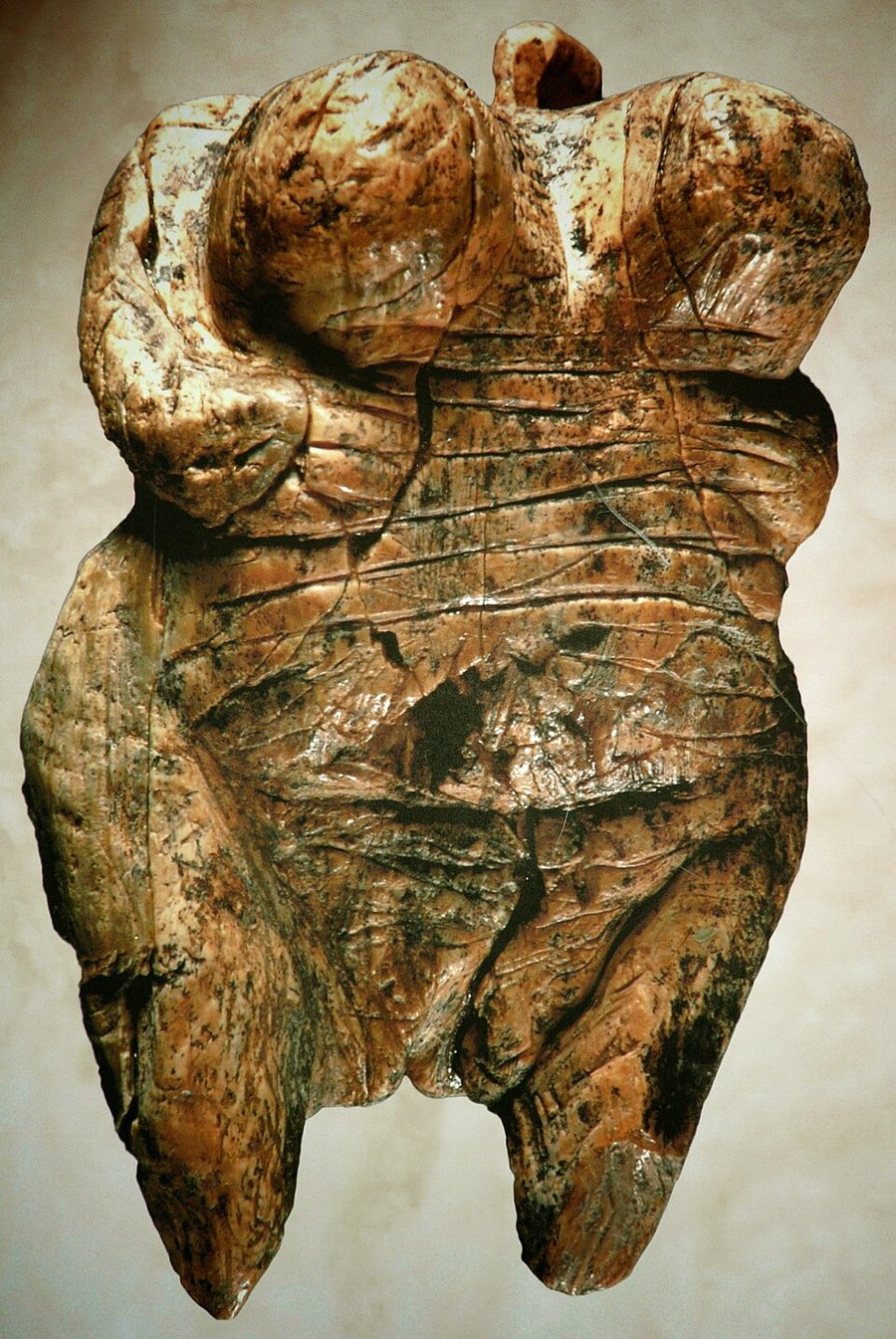
The Venus of Hohle Fels (Swabian Alb, Baden-Württemberg, Germany) is currently the oldest Venus -- and more broadly the oldest work of figurative art -- known in the world. Discovered in September 2008 by Nicholas Conard and his team from the University of Tübingen in Hohle Fels Cave, it is carved from a single fragment of mammoth ivory. It measures 6 cm and is dated by stratigraphyStratigraphyThe study of the superimposed layers (strata) of an archaeological site; each layer corresponds to a phase of occupation and yields a relative chronology.→ and AMS radiocarbon to 35,000-40,000 years BP, placing its creation in the basal Aurignacian. Its torso is robust, its breasts enormous, its belly protruding; the head is absent, replaced by a ring that probably allowed it to be worn as a pendant. The publication of its discovery in Nature in 2009 by Conard sparked intense debate about the significance of these exaggerated attributes among the earliest known artists of Europe.[3]
The Venus of Galgenberg (Lower Austria), also known as "Fanny," is a statuette in serpentinite rock measuring 7.2 cm, dated to approximately 30,000 years BP and attributed to the Aurignacian or early Gravettian. Discovered in 1988 during excavations at Stratzing (near Krems on the Danube), it is distinguished by its asymmetric posture: the silhouette appears to be in motion, as if dancing, with the left arm raised. Unlike the Gravettian Venuses, it is distinctly less "obese" and presents a more slender figure, which has led some researchers to see it as an artistic tradition distinct from the one that would dominate a thousand years later.[4]
The Gravettian Apogee: The Great European Venuses (26,000-20,000 years BP)
It is during the Gravettian that the Venus tradition reaches its apex, both in number and geographic spread. Statuettes with similar forms -- voluminous breasts and hips, small head, reduced limbs -- appear simultaneously in France, Austria, the Czech Republic, Italy, and as far away as Siberia. The most famous among them form an artistic canon that persisted across millennia.
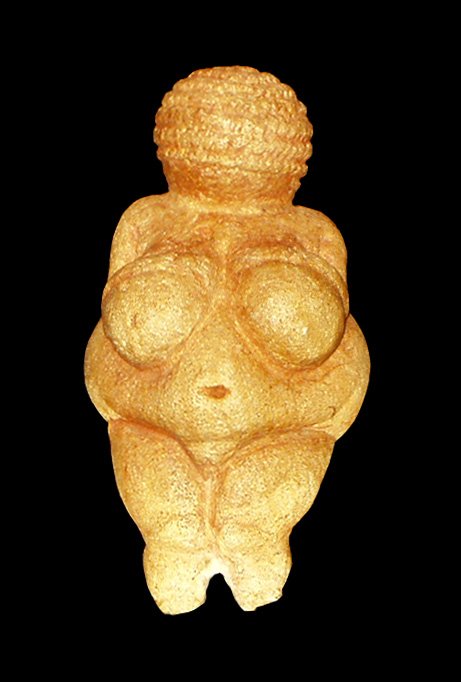
The Venus of Willendorf (Lower Austria) is undoubtedly the most famous of all. Discovered in 1908 by Josef Szombathy during excavations in a loess deposit on the banks of the Danube near the village of Willendorf, it is carved from non-local oolitic limestone -- the raw material was therefore transported at least 400 km -- and covered with a layer of red ochreOchreA red or yellow mineral pigment (iron oxides), used from prehistory for adornment, funerary rites and art.→. It measures 11.1 cm and is dated to 24,000-26,000 years BP. Its breasts, belly, and buttocks are enormous; its arms fade and rest on the chest; its head is covered with concentric circles that researchers interpret variously as braided hair, a hat, or a ritual wig. It is today held at the Naturhistorisches Museum in Vienna.[5]
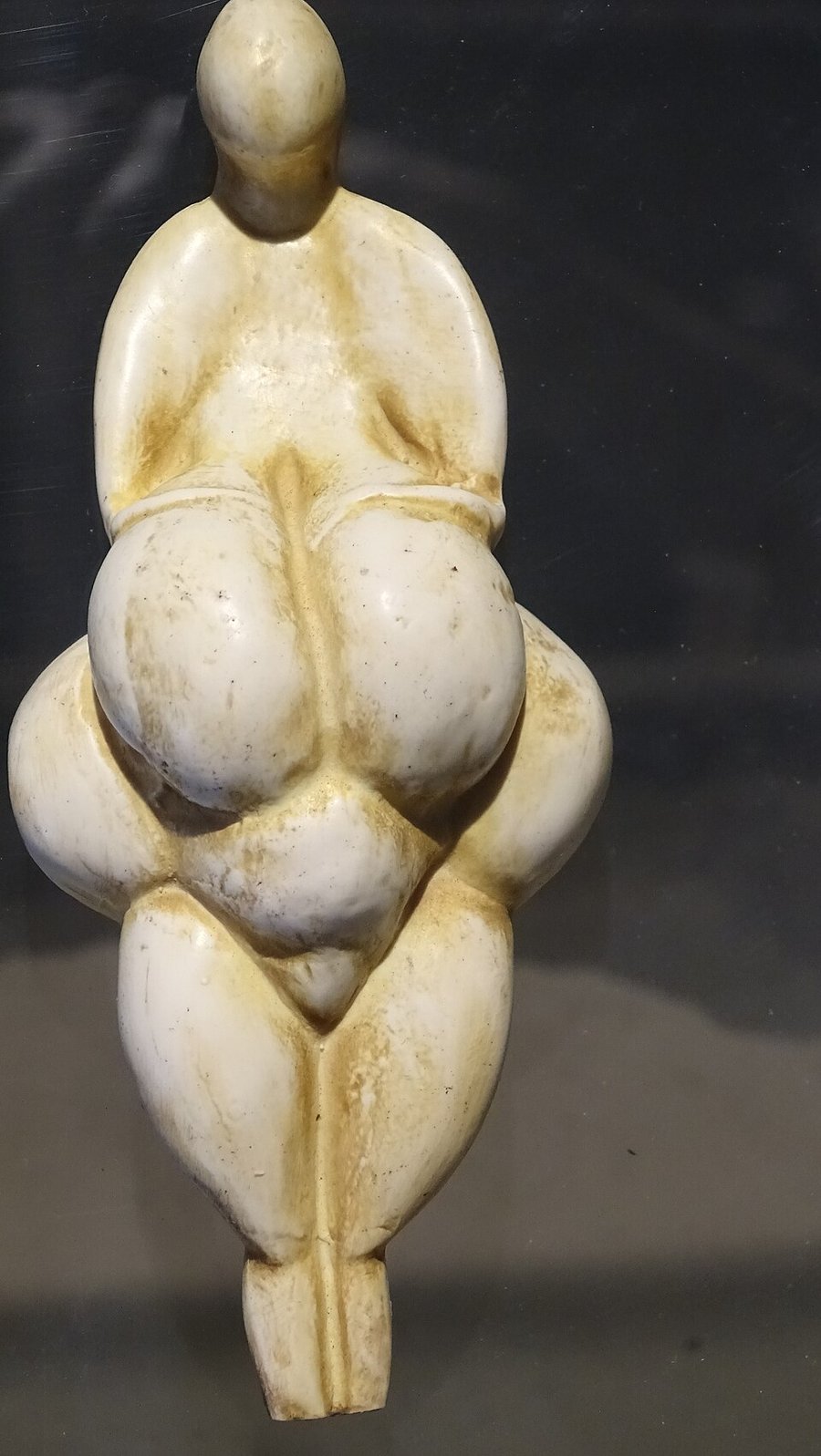
The Venus of Lespugue, discovered in 1922 in the Grotte des Rideaux at Lespugue (Haute-Garonne, Pyrenees), is a mammoth ivory statuette 14.7 cm tall, dated to approximately 24,000-26,000 years BP. Its silhouette is striking: two ovoid forms -- one for the breasts and one for the buttocks -- meet in a kind of double pear of great plastic power. Arms and head are reduced to their simplest expression. It was unfortunately damaged during extraction by excavator René de Saint-Périer; fragments broke off, and the current reconstruction is partly hypothetical. It is held at the Musée de l'Homme in Paris.[6]
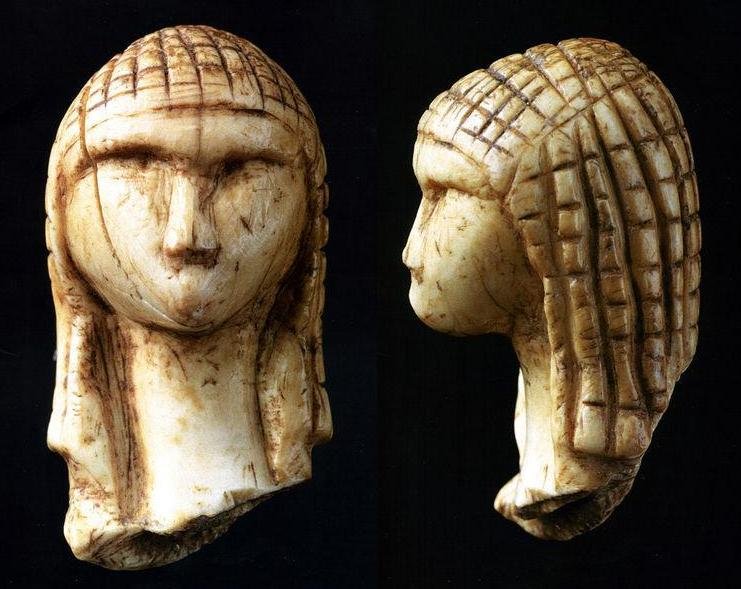
The Lady of Brassempouy (Landes, France) is unique: it is one of the earliest realistic portraits of a human face ever carved. Discovered in 1892 in the Grotte du Pape at Brassempouy by Edouard Piette, this mammoth ivory head is just 3.65 cm tall. Dated to 23,000-25,000 years BP, it depicts an oval face with a fine nose, with a crosshatch pattern engraved on the head interpreted as a hairstyle or veil. Eyes and mouth are absent -- they may never have been engraved. This fragment -- for it is only a head -- probably belonged to a statuette whose rest is lost. It is held at the Musée d'Archéologie nationale at Saint-Germain-en-Laye.[7]
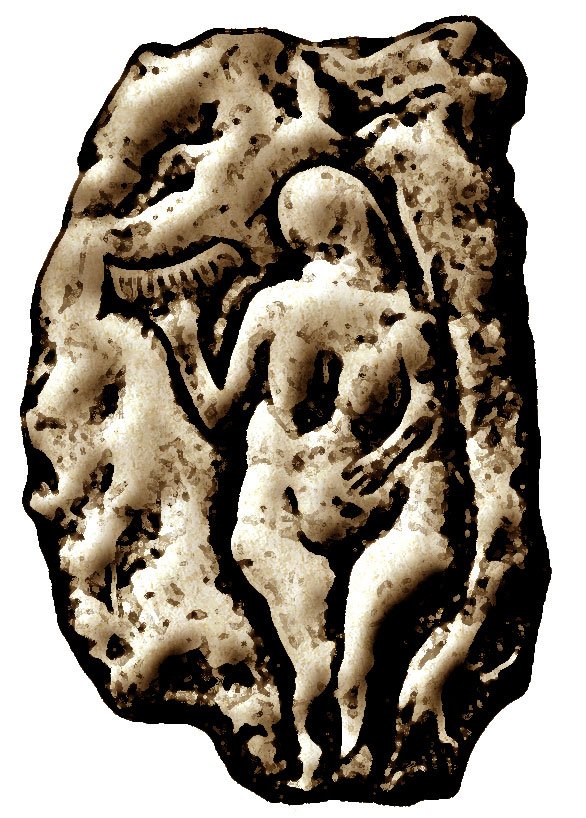
The Venus of Laussel (Dordogne, France) is not strictly a portable statuette but a rock relief: it is carved directly into the wall of a rock shelterRock shelterA shallow cavity at the foot of a cliff or under a rocky overhang, offering natural shelter; a favoured site of prehistoric habitation and rock art.→ in the Beune valley, discovered in 1911 by Dr. Lalanne. It measures 44 cm in height and is dated to approximately 25,000 years BP. What makes it exceptional is the object it holds in its raised right hand: a bison or aurochs horn on which 13 notches are visible. Some researchers see a lunar calendar (13 lunar months in a year), a ritual cup, or a symbolic attribute linked to fertility. Like the Venus of Willendorf, it bore traces of red ochre. It is held at the Musée d'Aquitaine in Bordeaux.[8]
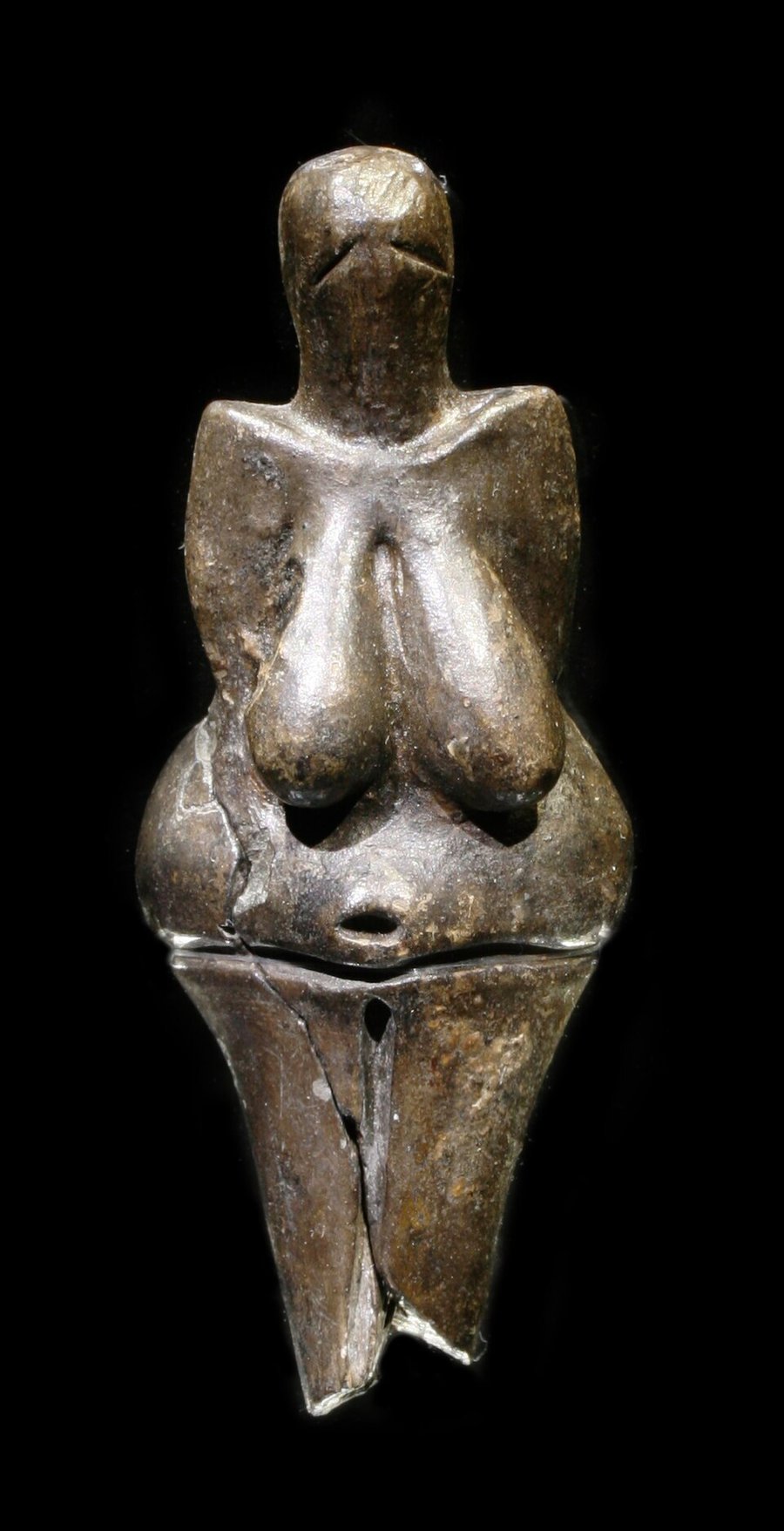
The Venus of Dolní Věstonice (South Moravia, Czech Republic) is unique for a completely different reason: it is the oldest known ceramic figurine in the world. Discovered in 1925 during excavations led by Karel Absolon, this 11.1 cm statuette is made of a mixture of local loess and animal fat, fired at between 500 and 800 degrees Celsius. It is dated to 27,000-31,000 years BP. Remarkably, it has a fracture that has been interpreted as intentional -- the statuette may have been deliberately broken during a ritual. A fingerprint is visible on its thigh, probably that of its creator. In 1989, Vandiver and co-authors published a study in Science showing that these Dolní Věstonice ceramics predate the earliest known Asian pottery by more than 15,000 years.[9]
Other less-known Gravettian Venuses deserve mention here. The Venus of Moravany (Slovakia, ~23,000 years BP), in mammoth ivory, is remarkable for its exceptional preservation and the fineness of its abdominal curve. The Venus of Mauern (Bavaria, ~27,000 years BP) is one of the rare statuettes showing a partially individualized face. The Balzi Rossi figurines (Ventimiglia, Italy) -- a set of statuettes in steatite, serpentine, and calcite dated 18,000-25,000 years BP -- complete this geographically wide panorama of the Gravettian tradition.
The Siberian Venuses: When the Tradition Crosses the Steppes
Perhaps the greatest surprise offered by the Upper Palaeolithic is the discovery of Venuses in Siberia, thousands of kilometers from European centers. The site of Mal'ta, near Irkutsk (Siberia, Russia), has yielded since 1928 a collection of more than 30 female figurines in mammoth ivory, dated to approximately 23,000 years BP. While some recall European Gravettian Venuses in their proportions, others are significantly more detailed in their rendering of clothing: what may be fur suits, hoods, and body-fitted garments can be distinguished. This led Soffer, Adovasio, and Hyland (2000) to propose that Venuses depicted textiles -- and that mastery of weaving and basketry in the Upper Palaeolithic was more developed than previously assumed.[10]
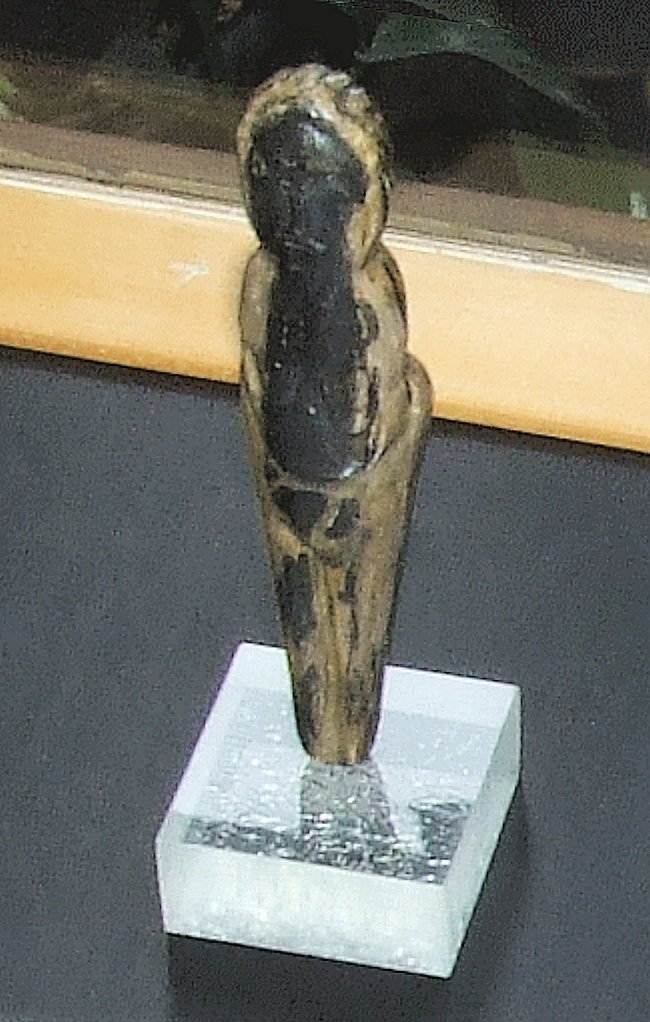
A few kilometers from Mal'ta, the site of Buret' (Irkutsk Oblast) yielded similar figurines, sometimes carved in serpentinite. The Mal'ta-Buret' complex constitutes a coherent artistic province, witnessing a cultural connection between European Gravettian populations and Siberian hunter-gatherersHunter-gatherersA way of life based on hunting, fishing and gathering wild resources, without farming or herding; it dominated almost the whole of human history.→. Recent genetic analyses have moreover shown that the Mal'ta populations are ancestral to both Western Europeans and Native Americans -- an unexpected link between these Ice Age Venuses and the first inhabitants of the Americas.[11]
Late Diversity: Beyond the Gravettian (25,000-11,000 years BP)
While the Gravettian concentrates most known Venuses, the tradition continues -- more sporadically -- in subsequent cultures.
The Venus of Savignano (Savignano sul Panaro, Emilia-Romagna, Italy) is an exceptional statuette in ophite (black serpentine) measuring 22.9 cm, discovered in 1925 by a plowman in his field. Dated to 20,000-25,000 years BP, it represents a figure with extreme proportions -- enormous breast, belly, and buttocks, with limbs and head reduced to protuberances almost phallic in shape. Some specialists see it as a deliberately ambiguous double representation of both femininity and virility. Its large size compared to other Venuses and its distinctive style make it unique in the landscape of Italian Palaeolithic art.[12]
The Venus of Petřkovice (Silesia, Czech Republic) stands out for its exceptional material: it is carved from haematite (iron ore), giving it a blood-red color and metallic sheen. Measuring 4.6 cm, dated to approximately 23,000 years BP, it is the only Czech stone Venus -- the others, like that of Dolní Věstonice, being ceramic. Its carefully polished surface suggests it was worn as jewelry or an amulet as much as a statuette.
The Venus figurines of Kostenki (Voronezh Oblast, Russia), multiple ivory statuettes dated to 20,000-25,000 years BP, belong to the exceptionally rich archaeological layers of the Kostenki-Borshchyovo site, which has yielded one of the most complete Upper Palaeolithic assemblages in Russia. Their characteristic profiles -- fused legs, head bent forward -- define a distinctive regional style.
Finally, the Venus of Monruz (Neuchâtel, Switzerland), discovered in 1991 during road construction, is the most recent known Venus: dated to approximately 11,000 years BP, it belongs to the MagdalenianMagdalenianThe last great Upper Palaeolithic culture (c. 17,000–12,000 BC), the peak of cave art (Lascaux).→ and is carved from jet (lignite). Minuscule -- 2.3 cm -- it confirms that the tradition of symbolic female representations survived the glacial maximum and the cultural revolution that followed.
Interpretations and Debates: What Do These Figurines Really Represent?
The question of these objects' meaning is probably the most debated in all of prehistory. Several major theories compete, none achieving consensus.
The fertility and mother goddess theory is the oldest. It assumes the Venuses represent a female divinity associated with reproduction, abundance, and life -- a kind of universal Mother cult. This interpretation, popular in the twentieth century, is today contested: it projects later religious categories onto the Palaeolithic and ignores the great formal variety among the figurines. No archaeological data confirms the existence of a structured "cult" at this period.[1]
The female self-portrait theory, advanced by McCoid and McDermott in 1996, suggests that these statuettes are representations of women by themselves, sculpting their own bodies as seen from above without a mirror. This theory would explain why feet and head are often reduced or absent (invisible in such a view), and why the bust and belly proportions are amplified (more visible). Appealing, it is nevertheless difficult to confirm or disprove.[13]
The climateClimateThe long-term average atmospheric conditions of a region; its variations (glaciations, aridifications) shaped migrations, agriculture and the collapse of prehistoric societies.→ theory, proposed by Johnson et al. in Obesity (2020), links the degree of "heaviness" of the Venuses to climate severity: the roundest and "fattest" figurines would come from zones closest to glacial fronts, where malnutrition was a constant threat. The "ideal" Venus would thus be a well-fed Venus, symbolizing survival and nutritional prosperity in a world of scarcity.[14]
The textile theory, defended by Soffer, Adovasio, and Hyland in Current Anthropology (2000), runs counter to the nudity interpretation. By closely examining the patterns engraved on some Venuses (hairstyles, belts, straps), the authors see representations of textiles and elaborate basketry. The "nude Venuses" would in fact be clothed women, and these figurines would constitute the oldest evidence of mastery of weaving techniques.[10]
The only certainty is that more than 200 figurines, spread across 30,000 square kilometers and 25,000 years of human history, testify to a deep and durable need to symbolically represent the female body. Whether these were ritual objects, exchange items, supports for mythic narrative, talismans, or simple aesthetic representations -- or a mixture of all these things depending on groups and eras -- these small silhouettes of stone and ivory remind us that humanity's symbolic life is as old as humanity itself.
The Map of Diffusion: A 30,000-Year Tradition
The female figurines of the Upper Palaeolithic trace, on the archaeo-geographic map of Eurasia, a distribution stretching from the Atlantic coast to the shores of Lake Baikal across nearly 10,000 kilometres. This dispersal, unique in the history of prehistoric art for its amplitude and formal coherence, raises fundamental questions about the mechanisms of long-distance cultural transmission in mobile hunter-gatherer societies. The two main focal points -- the Moravian belt in central Europe, with Dolni Vestonice, Pavlov and Predmosti, and the Kostenki-Avdeevo complex on the Russo-Ukrainian plain -- display stylistic analogies too precise to be coincidental.[7]
The Moravian density is particularly revealing of the social dynamics of these populations. Within a radius of less than 100 kilometres, several Gravettian sites have collectively yielded more than a hundred figurines and fragments, representing the highest known concentration on the planet. This abundance cannot be explained solely by the intensity of archaeological excavation in the region: it reflects a society in which the production of these objects was a valued and repeated activity. Whether this concentration indicates a locally dense population, a seasonal gathering place for dispersed groups, or a specialized production centre distributing its output to the periphery remains an open and productive question among specialists.
The Kostenki-Borshchevo corridor, on the banks of the Don in central Russia, constitutes the other major pole of the tradition. This complex of more than twenty sites strung out over some twenty kilometres of river has yielded pieces of exceptional quality and diversity: figurines in mammoth ivory, limestone and marcasite illustrating a remarkable variety of formal treatments within a single tradition. The connection between this Russian focus and the Siberian sites of Mal'ta and Buret -- more than 4,000 kilometres distant -- is one of the most compelling problems in Eurasian prehistory. The resemblances in the treatment of the female body and incised clothing plead for contact, direct or mediated, across considerable distances.[8]
The geographic distribution of known figurines displays gaps that do not necessarily reflect prehistoric reality. The absence of pieces in North AfricaAfricaThe cradle of humankind: the continent where the first hominins appeared, then Homo sapiens around 300,000 years ago, before the expansion to the rest of the world.→, the southern Iberian Peninsula or Scandinavia is partly explained by differential preservation of organic materials in these climatic contexts, and by the uneven history of archaeological research across regions. Figurines made from wood, hardened hide or other perishable materials may have existed in abundance without leaving any trace. The current diffusion map therefore reflects the history of scientific research as much as it does the reality of PleistocenePleistoceneThe geological epoch of the great ice ages (c. 2.6 Ma–11,700 BP), spanning most of human prehistory.→ societies.
The persistence of this tradition over nearly 30,000 years -- from the earliest Aurignacian pieces around 40,000 BP to the last late-glacial expressions around 11,000 BP -- is in itself a remarkable phenomenon that few human artistic traditions can match. This longevity leads some authors to propose the existence of a deep "cultural memory" associating the female body with central symbolic values -- fertility, group cohesion, clan identity -- transmitted from generation to generation far beyond the lifespan of any individual, constituting a kind of common cognitive foundation for the Upper Palaeolithic populations of Eurasia.
Materials and Techniques in Palaeolithic Sculpture
The diversity of raw materials used by Upper Palaeolithic sculptors reflects both the ecological constraints of each region and deliberate choices laden with cultural significance. Mammoth ivory is by far the most valued medium: when fresh it is relatively pliable and easy to work, and once dried and polished it acquires remarkable resistance and lustre. The statuettes from Vogelherd and Hohle Fels in south-western Germany, dated between 35,000 and 40,000 BP, illustrate the early mastery of this technique by Aurignacian artists who had already developed high-precision craftsmanship.[9]
Limestone, abundant in the karstKarstA limestone landscape shaped by rock dissolution, rich in caves and passages; its sediments can preserve bone and DNA over long timespans.→ regions of western and central Europe, was chosen for some of the most emblematic works in the tradition. The Venus of Willendorf is carved from an oolitic limestone that does not outcrop in the immediate surroundings of the Austrian site, suggesting either that the raw stone was carried several tens of kilometres, or that it was obtained through exchange with other groups. Microscopic analysis of the surface of this piece and other limestone sculptures reveals striations consistent with the use of small-module flintFlintA hard, brittle siliceous rock, knapped by prehistoric people to produce blades, points and sharp tools.→ burins, applied in a rotational motion after initial roughing-out by direct percussion, attesting to a progressive and controlled manufacturing process.
Serpentine and other greenish stones were preferred in eastern Russia and Siberia, where several figurines from Kostenki and Mal'ta display this distinctive colouration. The transport of these materials from their natural outcrops, sometimes dozens of kilometres away, suggests a selection based on deliberate aesthetic or symbolic criteria. The colour green, associated in many human cultural systems with fertility, vegetation and renewal, may have played a role in choosing these materials to represent figurines linked to reproduction.[10]
The discovery at Dolni Vestonice in Moravia revealed an unprecedented technical innovation in human history: the figurines from this site are fashioned from a mixture of clay and crushed bone ash fired at low temperature, between 400 and 600 degrees Celsius. These pieces constitute the oldest known examples of ceramics in human history, predating the first utilitarian NeolithicNeolithicThe "New Stone Age": a period marked by farming, herding, settlement and pottery, from around 10,000 BC.→ pottery by nearly 20,000 years. The fact that this clay-firing technique was invented to produce ritual figurines -- rather than storage or cooking vessels -- reveals a hierarchy of values in which symbolic investment took precedence over the utilitarian in human creativity.
Evidence of final polishing is frequent on ivory and soft-stone figurines, revealing a terminal surface-treatment stage that goes beyond mere formal necessity. On several specimens, including the Venus of Lespugue, traces of manganese oxides or red ochre suggest that these pieces were painted. While this polychromy is lost to us, it must have conferred additional visual power in the contexts where the figurines were used. The prolonged handling attested by preferential wear zones on the projecting parts of certain pieces indicates that these objects were carried, touched or manipulated repeatedly over extended periods.
Venus Figurines, Women and Upper Palaeolithic Societies
The question of the gender of Palaeolithic artists -- and more broadly of women's place in Pleistocene hunter-gatherer societies -- has established itself as one of the most productive axes of gender archaeology since the 1990s. The implicit assumption of male artists, long dominant in the discipline, reflected the biases of researchers who unconsciously projected the norms of their own era onto the past. The work of anthropologist Dean Snow on handprints in western European decorated caves suggested, through morphometric analysis of finger proportions, that women may have made a significant proportion of the prints, challenging the presumed male monopoly over Palaeolithic artistic production.[11]
Marija Gimbutas, the Lithuanian archaeologist whose work on European prehistory had considerable impact well beyond academic circles, elaborated a comprehensive interpretation of female figurines as manifestations of a Great Goddess cult in peaceful matriarchal societies predating the Indo-European invasions of the fourth millennium BC. In this reading, the Venus figurines embody a primordial female power associating fertility, death and regeneration in a universal cosmic cycle. This interpretation fuelled a large-scale contemporary spiritual movement centred on the sacred feminine, and was adopted by many feminist currents as archaeological evidence of a prehistory without male domination.
However, the scientific critiques directed at Gimbutas's interpretation are severe and largely well-founded. Ruth Tringham and Margaret Conkey demonstrated that the thesis rests on a selective reading of the data, an ignorance of the precise archaeological deposition contexts of the figurines, and a theoretical coherence that real assemblages do not support. The term "Goddess" universalises a specific and anachronistic Western cultural interpretation, and the matriarchal dimension of the societies concerned rests on no direct evidence in the archaeological record.[12]
Today's alternative interpretations are more cautious and contextual. Several researchers propose that the figurines represent not an abstract deity but real women -- individualised portraits, representations of stages in the female reproductive cycle, or pedagogical objects serving to transmit knowledge about pregnancy and childbirth in contexts where such transmission was vital. Other analyses favour a propitiatory function: ensuring human and animal fertility, guaranteeing group cohesion, or preparing for the hunt through ritual. Some authors see in these objects regional or clan identity markers signalling membership of a specific social network in a landscape of high mobility.
The quantitative asymmetry between female and male figurines in European Upper Palaeolithic assemblages -- the former being considerably more numerous -- remains one of the most robust and most difficult-to-explain facts in gender archaeology. If this asymmetry reflects a symbolic system in which the feminine is associated with reproductive and regenerative forces that the masculine does not represent in the same way, this implies a gendered organisation of cognitive representations that is difficult to apprehend from our own cultural standpoint. Any inference about gender relations in these societies remains necessarily speculative in the absence of textual or direct ethnographic sources.
Neolithic Venus Figurines: Continuities and Ruptures
The transition to the Neolithic, with its sedentarisation, agricultureAgricultureThe cultivation of plants and production of food by working the soil, which emerged in the Neolithic in the Near East and independently elsewhere; it radically transformed human societies.→ and nascent urbanism, was accompanied by a profound transformation of human figurative production. Sites such as Çatalhoyuk in central Anatolia (7500-5700 BC) have yielded hundreds of anthropomorphic figurines, a significant proportion of them female, naturally raising the question of continuity with the Palaeolithic tradition. The temptation to draw a direct line from the Venus of Willendorf to the Çatalhoyuk figurines is seductive but analytically problematic, and recent archaeology has considerably complicated the picture.[13]
Ian Hodder's excavations at Çatalhoyuk have radically nuanced the image of a Mother Goddess cult at this emblematic Neolithic site. The figurines there are deposited in extremely varied contexts -- rubbish heaps, pit fills, the immediate surroundings of buildings -- and represent a far broader range of forms than the female alone: male, animal, hybrid and ambiguous figures occupy an important place in the assemblage. Hodder concluded that the Great Goddess model was inadequate to describe these assemblages, and that the figurines most likely related to everyday domestic practices tied to individual houses rather than to a community-wide centralised cult.
In the Balkans, the Vinca culture (5700-4500 BC) produced thousands of fired-clay figurines, often masked and geometrically stylised, which depart considerably from the carnal naturalism of Gravettian Venus figurines. These productions belong to hierarchised agricultural societies with established exchange networks, and their significance remains debated between ritual, domestic and social interpretations. Formal resemblance to Palaeolithic VenusPalaeolithic VenusA small carved female figurine (stone, ivory, fired clay) of the Upper Palaeolithic, often with accentuated forms; their meaning (fertility, status, ritual) remains debated.→ figurines is thin -- only the anthropomorphic and partly female subject is partially maintained -- while the manufacturing contexts, modelling techniques and ornamental styles are profoundly different from Pleistocene traditions.
The hypothesis of radical discontinuity between Palaeolithic and Neolithic traditions is today the most solidly supported. Between the last late-glacial manifestations around 11,000 BP and the first certified Neolithic figurines around 9,000-8,000 BP, Europe presents a chronological gap during which the MesolithicMesolithicThe period between the Palaeolithic and the Neolithic (c. 10,000–6,000 BC in Europe), still based on hunting and gathering.→ has yielded very few female figurines. While shared cognitive substrates may have favoured an independent reinvention of female statuary in the Neolithic, current data do not allow us to speak of the direct transmission of an unbroken tradition stretching across 30,000 years of human history.
The Legacy of Prehistoric Venus Figurines in Modern Culture
Since their staggered discovery between the mid-nineteenth century and the present day, Palaeolithic figurines have exerted a fascination that extends far beyond scientific circles. The Venus of Willendorf, unearthed in Austria in 1908, has become one of the most reproduced images in all of world art history, appearing in school textbooks, modern art museums and international souvenir shops. Replicas in ceramic, resin and bronze circulate in dozens of countries, objects of collection as much as cultural symbols actively appropriated by multiple communities of interpretation.[14]
The twentieth-century feminist movement made Palaeolithic Venus figurines an iconic argument for a redefinition of art history. Artists such as Judy Chicago cited these figurines as evidence of an immemorial and independent female artistic tradition predating male domination in cultural production. The neo-pagan spirituality movement inspired by Gimbutas consecrated the Venus of Willendorf as an icon of the sacred feminine, reproduced on jewellery, tattoos and in contemporary ritual practices. This reappropriation illustrates the capacity of prehistoric objects to become vectors of identity and assertion in contexts far removed from their original creation.
The museums housing these pieces have sometimes faced controversies revealing contemporary tensions around nudity and representation. In 2022, the Facebook platform repeatedly censored photographs of the Venus of Willendorf, its algorithms classifying them as inappropriate nudity. The international reaction -- led by Viennese museum institutions and relayed by art historians and cultural commentators worldwide -- highlighted the paradox of a 30,000-year-old sculpture deemed obscene by twenty-first-century digital standards. This incident illustrates, in negative, the enduring power of these figurines in our collective imagination, and the complexity of the projections that each era continues to impose upon them.
Bonjour, quel bel article. En 2003 j'ai résidé sur le site des grottes préhistoriques Isturiz et Oxocelaia en Pays Basque où j'ai pu étudier des œuvres pariétales. Je suis passé du pourquoi au comment ces œuvres. Pendant cinq années j'ai étudié la préhistoire. et en tant qu'artiste et non spécialiste j'en suis ressorti avec une nouvelle thèse sur le premier dessin. ''l'Histoire du Nomade'' (https://sites.google.com/view/goiko-artiste/).
Je prépare un voyage dans cette région. Cet article m'est très utile pour comprendre ce que je vais voir.
Je partage souvent vos articles avec mes collègues médiateurs. Celui-ci va directement dans ma boite à outils.