Around one hundred thousand years ago, in the caves of Mount Carmel and lower Galilee, groups of Homo sapiensHomo sapiensThe present-day human species, which emerged in Africa around 300,000 years ago, the only surviving human lineage after the extinction of Neanderthals and Denisovans.→ dug pits, laid their dead within them, sometimes accompanied by objects, and covered them with earth. These gestures, found at the sites of QafzehQafzehA cave in Lower Galilee (Israel) yielding Homo sapiens and some of the oldest known burials outside Africa.→ and Skhul, rank among the oldest known intentional burialsBurialThe intentional deposition of a body, sometimes with offerings; a marker of symbolic behaviourSymbolic behaviourA set of practices (adornment, pigments, art, burial) reflecting symbolic thought; long ascribed to Homo sapiens alone, now attested for Neanderthals too.→.→ of our species.1 They raise a dizzying question: when did humans begin to treat death not as the mere abandonment of a corpse, but as an act charged with meaning, perhaps with belief? This dossier explores what these Near Eastern graves reveal about the birth of symbolic behaviour, long before the painted caves of Europe.
The Near EastNear EastA region of western Asia (Levant, Mesopotamia, Anatolia, Iran), cradle of the Neolithic revolution, agriculture, the first cities and writing.→, a crossroads of humanity
The Mediterranean LevantLevantA region of the eastern Mediterranean Near East (Israel, Lebanon, Syria, Jordan), a major crossroads of the first human migrations out of Africa.→ forms a narrow corridor between AfricaAfricaThe cradle of humankind: the continent where the first hominins appeared, then Homo sapiens around 300,000 years ago, before the expansion to the rest of the world.→, where our species arose, and the vast Eurasian continent. It was along this route that the first populations of Homo sapiens left Africa, taking advantage of favourable climatic phases when the region, today semi-arid, was clothed in more generous vegetation. Mount Carmel, a limestone massif overlooking the coastal plain near present-day Haifa, sheltered numerous caves and rock shelters in its flanks. Cool and dry, these cavities offered an ideal refuge and preserved, in their accumulated sediments, an exceptional archive of PalaeolithicPalaeolithicThe oldest and longest period of prehistoryPrehistoryThe span of human history before the invention of writing, from the Palaeolithic to the Metal Ages, known mainly through material remains.→ (c. 3.3 Ma–12,000 BC), defined by chipped stone tools and a hunter-gatherer way of life.→ life.
By around one hundred thousand years ago, anatomically modern homininsHomininHomininMember of the subtribe Hominina, comprising the human lineage (Homo, Australopithecus, Paranthropus…) but excluding orangutans and gibbons. The term progressively replaces "hominid" in its narrow sense.→A member of the human lineage in the broad sense, including modern humans, their ancestors and related great apesgreat apesThe family of great apes (Hominidae) comprising orangutans, gorillas, chimpanzees, bonobos and humans.→.→ occupied these places. Their toolkit belongs to the MousterianMousterianThe stone-tool industry typical of NeanderthalsNeanderthalsA fossil humanity of Eurasia, robust and cold-adapted, extinct around 40,000 years before present.→, based on the Levallois flaking technique.→, a knapped-stone industry based on the Levallois method, associated elsewhere with Neanderthals. This technical coincidence is one of the great paradoxes of the Levant: on the same territory, at close periods, Homo sapiens and Neanderthals produced comparable tools, so that a layer cannot always be attributed to one or the other by stone alone.3
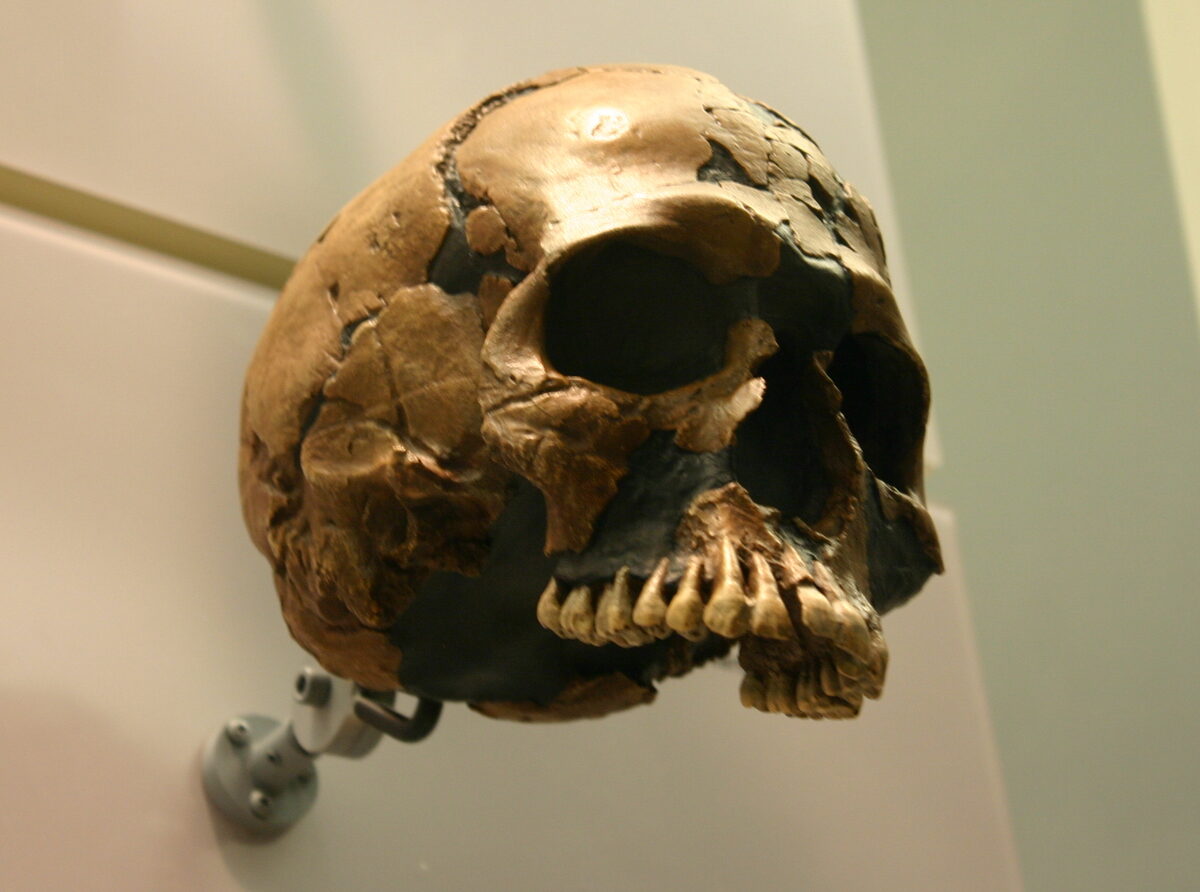
Qafzeh and Skhul: two cemeteries of the dawn
The cave of Qafzeh opens in a cliff above the wadi el-Hadj, south of Nazareth. Excavated from the 1930s and then methodically from the 1960s, it yielded the remains of at least twenty individuals, several in anatomical connection, a sign that they had not been scattered by scavengers but protected by a deliberate deposit.1 The site of Skhul, one of the Mount Carmel shelters excavated in the 1930s by Dorothy Garrod and Theodore McCown, provided about ten skeletons of archaicArchaicRefers to an ancient, now-extinct human population or form (Neanderthals, Denisovans, ghost lineages), as opposed to anatomically modern humans.→ Homo sapiens, presenting a curious blend of modern features and more robust characters.2
The dating, long uncertain, was revolutionised by physical methods. Thermoluminescence applied to the burnt flints of Qafzeh and electron spin resonance on dental enamel converged on an age of about 90,000 to 100,000 years. These figures, beyond the reach of radiocarbonRadiocarbon (carbon-14)A dating method based on the decay of carbon-14, usable back to about 50,000 years.→ dating which tops out around 50,000 years, caused a sensation: they placed Homo sapiens in the Levant long before our species reached Europe en masse, and even before some Neanderthal occupations of the same region.
Intentional burial: reading the gesture in the soil
How can we assert that a body was buried deliberately and not merely covered by chance? Prehistorians rely on a convergent body of clues. First the position of the skeleton: at Qafzeh as at Skhul, several bodies rest on their back or side, limbs folded, in an attitude that is far from natural after death. Then the pit itself, whose outlines sometimes stand out from the surrounding sediment, dug and then filled. Finally anatomical connection: a skeleton whose bones have remained in place, articulated, was not displaced by water or dismembered by predators, which implies rapid protection.
The famous burial of Qafzeh 11, a child of around twelve, illustrates this intentionality. The body had been laid in a pit, on its back, holding between its folded arms a pair of massive deer antlers.1 No natural force could have arranged the antlers thus against the chest of a deceased. This deliberate arrangement is, for many researchers, the signature of a funerary ritual.
Burial transforms the dead into the absent: they are not abandoned, they are assigned a place. This simple gesture already presupposes a representation of time, of loss, and perhaps of the afterlife.
The offerings: deer antlers and red ochreOchreA red or yellow mineral pigment (iron oxides), used from prehistory for adornment, funerary rites and art.→
The grave goods associated with the bodies are rare but all the more eloquent. The deer antlers of Qafzeh 11 are no mere kitchen refuse: their position against the skeleton marks them as a deliberate deposit, the earliest known form of funerary offering. At Skhul, the individual Skhul V held in his arms the jaw of a large wild boar, another animal object placed with intent.2 These gestures sketch a symbolic relationship between the deceased and the animal world, whose exact meaning we shall never know, but whose regularity forbids us to see it as chance.
Ochre, a natural iron oxide of deep red, also accompanies these burials. At Qafzeh, dozens of ochre fragments, some heated to intensify their colour, were found in the funerary levels, sometimes in the immediate vicinity of the bodies. Red, the colour of blood and life, is in countless cultures associated with death and rebirth. Its recurrent presence in the oldest graves suggests a use beyond mere adornment: a shared, transmitted, codified symbolism.
Pierced shells and symbolic adornment
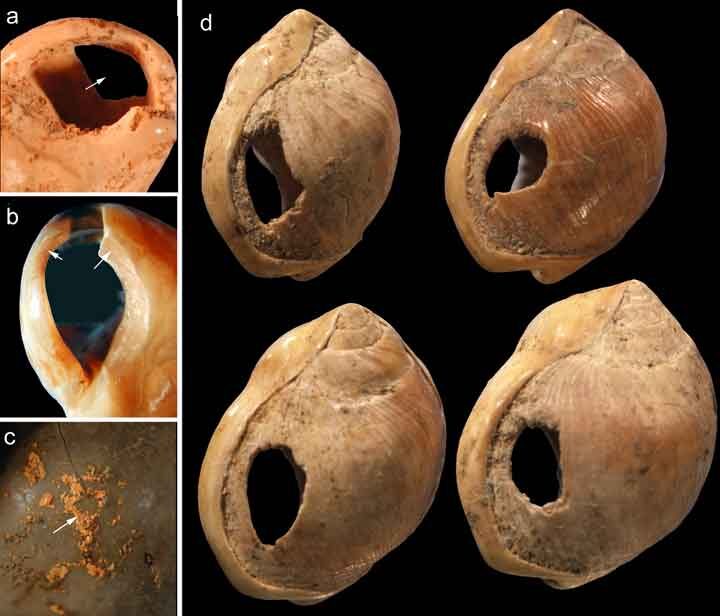
Among the most debated finds are the pierced marine shells. At Qafzeh, valves of Glycymeris, a marine mollusc whose collection meant a journey to a coast tens of kilometres away, bear perforations and traces of ochre. At Skhul, pierced Nassarius shells, dated to about 100,000 to 135,000 years, are among the oldest known ornaments of humanity.2 These small objects, threaded on a cord, formed necklaces or ornaments sewn onto clothing.
The importance of these shells lies less in their beauty than in what they imply. To pierce a shell, to dye it, to wear it, is to signal oneself to others: to display a belonging, a status, an identity. Adornment is a silent language, a symbolic communication addressed to an audience. That humans practised this language one hundred thousand years ago pushes the birth of a meaning-laden material culture far back into the past.
What does it mean to "bury"?
Burying the dead is not instinctive behaviour. No biological necessity requires digging a pit, arranging a body in a chosen posture and adding objects. Inhumation is an act costly in time and energy, with no immediate material benefit. If human groups performed it repeatedly, it is because the gesture answered a need of another order: emotional, social or spiritual.
Several readings coexist. The most cautious sees a practical and affective response: protecting a loved one's body from scavengers, marking grief, managing the disturbing presence of a corpse. The boldest discerns the beginnings of religious thought, an intuition of death as passage. Between the two, many prehistorians hold that inhumation presupposes at the very least an acute awareness of the death of another and a will to maintain a bond beyond disappearance.
The symbolic before figurative art
Symbolic thought was long confined to the artistic explosion of the European Upper PalaeolithicPalaeolithicThe oldest and longest period of prehistory (c. 3.3 Ma–12,000 BC), defined by chipped stone tools and a hunter-gatherer way of life.→, forty thousand years ago, with its painted caves and its portable artPortable artTransportable art objects (figurines, engravings on bone or ivory), such as the Palaeolithic Venuses.→. The burials of Qafzeh and Skhul, twice as old, crack this narrative. They show that symbolic behaviours, treatment of the dead, use of pigments, adornment, already existed among the first Homo sapiens, long before the first paintings.
This antecedence invites us to dissociate the symbolic from its most spectacular form, the image. Before painting animals on walls, humans already thought in symbols: a shell stood for an idea, ochre for a meaning, the grave for a relationship to time and loss. Symbolism was not born with figurative art; it preceded it by several tens of thousands of years, in more discreet but no less telling forms of a modern mind.
Comparison with the Neanderthals
The Neanderthals, who peopled Eurasia at the same time, also buried some of their dead, at La Chapelle-aux-Saints, La Ferrassie or Shanidar. The debate remains lively over the richness of their funerary gestures and the share of symbolic intent they convey. In the Levant, the coexistence of the two humanities complicates the story: at times, Neanderthals and Homo sapiens may have rubbed shoulders, even interbred, as attested by the hybridisationHybridisationCrossing between two distinct species or lineages, such as Homo sapiens and Neanderthals, leaving a trace in the genome.→ later detected in our genomes.
What distinguishes the burials of Qafzeh and Skhul is the early and recurrent association of offerings, ochre and adornment. Among the Homo sapiens of the Levant, these elements form a coherent ensemble from the outset, whereas they remain rarer and more debated in the Neanderthal world. Without settling the question of who came "first", these graves attest that symbolic thought was not the monopoly of a single human lineage.
Significance for human history
The burials of the Near East push back the horizon of symbolic behaviour by several tens of thousands of years and shift its cradle outside Europe. They belong to a cluster of discoveries, pigments from southern Africa, abstract engravings, pierced shells, that sketch a gradual, mosaic emergence of cognitive modernity, rather than a sudden revolution.
These first Homo sapiens of the Levant are not, genetically, the direct ancestors of all present-day populations: this wave out of AfricaOut of AfricaThe dispersals of Homo sapiens out of Africa, including a major expansion c. 70,000 to 60,000 years ago and earlier exits.→ seems to have partly died out or retreated. But their message endures: one hundred thousand years ago, beings already thought about death, adorned their bodies and charged objects with meaning. These are the marks of a fully human mind, recognisable as our own across the abyss of time.
Conclusion
Qafzeh and Skhul are not only fossil deposits; they are places of memory, the oldest where we can grasp the human gesture of honouring the dead. The dug pits, the deer antlers clasped against a child's chest, the red ochre and the pierced shells compose a fragmentary but moving picture of the origins of our relationship to the sacred. In crossing the threshold of these Mount Carmel caves, we touch a little of the birth of the symbolic mind, at the dawn of the Homo sapiens adventure.
A fragile archive: excavation and its traps
Reconstructing a funerary gesture one hundred thousand years old is a painstaking investigation. Excavators advance by layers a few centimetres thick, recording the position of every bone, every flintFlintA hard, brittle siliceous rock, knapped by prehistoric people to produce blades, points and sharp tools.→ flake, every grain of ochre. The slightest disturbance, a rodent burrow, a trickle of water, a wall collapse, can blur the reading and make chance pass for intention, or the reverse. This is why claims of intentional inhumation demand rigorous demonstration, and why some old discoveries, excavated with the hasty methods of the early twentieth century, remain partly unrecoverable.
At Qafzeh and Skhul, the quality of observations varies from one site to another and from one excavation period to another. Recent campaigns, conducted with modern protocols, have confirmed the deliberate character of several deposits, while older excavations leave a margin of interpretation. This methodological caution does not erase the sites' significance: it solidifies it, retaining as certain only what withstands the most exacting critical examination.
The red, the shell and the distance
One detail deserves emphasis: the raw material of the symbolic sometimes comes from afar. The marine shells of Qafzeh come from the Mediterranean, tens of kilometres from the caves. That humans transported these objects over such distances, or obtained them through exchanges between groups, says much about the value they placed on them. One does not carry a useless burden over long journeys; if these shells travelled, it is because they mattered.
Likewise, the selection and heating of ochre presuppose know-how and aesthetic intent. To heat a yellow iron oxide so that it turns red is to master a small chemistry of fire and colour. These operations, apparently trivial, betray planning, a transmission of technical gestures and a shared taste, so many markers of an already structured cultural life among these first modern humans of the Near East.
What the grave does not say
Finally we must acknowledge the limits of our knowledge. We see the bones, the pit, the ochre and the shells; we see neither the words spoken, nor the beliefs, nor the emotions. Any interpretation of the religious or spiritual meaning of these burials remains a hypothesis, projected from our own relationship to death. The prehistorian here walks a ridge line: too much caution and the evidence of a human behaviour is missed; too much boldness and the dead of Mount Carmel are lent thoughts that may be the researcher's own.
This tension is fertile. It reminds us that the archaeology of death is also an archaeology of ourselves, of our need to give meaning to disappearance. The graves of Qafzeh and Skhul hold up a mirror: in seeking to understand why these humans buried their dead, we question the deep roots of a gesture that all human societies, without exception, have continued to perform ever since.
From graves to societies: what care for the dead reveals
Beyond the buried individual alone, it is a whole group that the grave stages. Digging a pit, gathering offerings, laying down a body: these tasks mobilise several people, require coordination and collective consent. The grave is therefore also a social document. It presupposes that the community grants the deceased a place that survives their death, and that it agrees to devote time and resources to a being who no longer contributes to the group's subsistence.
This care for the dead dialogues with other forms of solidarity glimpsed in the Palaeolithic: the care of the sick, the sharing of food, the transmission of knowledge. The burials of Qafzeh and Skhul belong to this fabric of bonds, of which they are the most tangible expression to reach us. To honour a dead person is to affirm that the social bond does not break with the last breath; it is to make memory a cement of the community.
The legacy of a hundred-thousand-year-old gesture
From Qafzeh to today's cemeteries, an astonishing continuity links humans together. Forms have changed, beliefs have diversified endlessly, but the fundamental gesture, accompanying the dead, assigning them a place, marking loss, runs through the whole history of our species. In this sense, the caves of Mount Carmel are not merely a distant chapter of prehistory: they are the first link in an unbroken chain of funerary gestures that defines, perhaps better than any other trait, what it means to be human.
To study these burials is thus far more than dating bones or cataloguing shells. It is to go back to the source of an essential part of our humanity, the part that refuses to let death have the last word. At a hundred thousand years' distance, the humans of Qafzeh and Skhul send us a silent but limpid message: we were already, fully, beings of memory and meaning.
An open chapter of research
Far from being closed, the file of the first burials remains under active investigation. New dating techniques, refined excavation methods and the re-examination of old collections regularly reshape the picture. Each generation of researchers reinterprets Qafzeh and Skhul in the light of fresh discoveries made elsewhere in Africa, the Levant and beyond, so that these caves remain reference points against which other early symbolic finds are measured and tested.
What makes them so durable as landmarks is the convergence of their evidence: not a single isolated clue, but burials, offerings, pigments and ornaments brought together at the same places and the same time. It is this accumulation that lends the Near Eastern sites their exceptional weight, and that ensures Qafzeh and Skhul will keep their place at the heart of any account of how, and when, our species began to think in symbols and to honour its dead.
A history of the excavations: Garrod, McCown, Vallois, Vandermeersch
The scientific adventure of the Mount Carmel caves begins in the late 1920s, when the British prehistorian Dorothy Garrod took charge of excavations at Wadi el-Mughara, in Mandatory Palestine. Between 1929 and 1934, twelve field seasons explored a series of cavities, Mugharet el-Wad, Mugharet et-Tabun and Mugharet es-Skhul, within a joint project of the American School of Prehistoric Research and the British School of Archaeology in Jerusalem. Garrod, who would become the first woman to hold a professorship at the University of Cambridge, oversaw all the sites and, working closely with the palaeontologist Dorothea Bate, established a long stratigraphic sequence running from the Lower PalaeolithicPalaeolithicThe oldest and longest period of prehistory (c. 3.3 Ma–12,000 BC), defined by chipped stone tools and a hunter-gatherer way of life.→ to the Epipalaeolithic. This chronological framework remains a reference for the prehistory of the Levant to this day.
Skhul Cave was excavated in 1931 and 1932 by the American Theodore McCown, then a young researcher. It was he who, in the spring of 1932, uncovered the famous Skhul V skeleton, whose chest bore the mandible of a wild boar. In Garrod's absence, detained elsewhere, McCown carried out these delicate clearances and revealed a set of human remains of exceptional richness. The anatomical study of these fossils was then conducted with the great anatomist Arthur Keith, and the resulting publication made Mount Carmel one of the high places of world palaeoanthropologyPalaeoanthropologyThe science that studies human evolution from the fossil remains of hominins (bones, teeth, footprints) and their context, to reconstruct our biological origins.→.
Qafzeh Cave, near Nazareth, followed a parallel path. Early soundings had already yielded bones there, but it was under the direction of the French anthropologist Bernard Vandermeersch, in the 1960s and 1970s, that excavation reached its full scope. Vandermeersch uncovered several burialsBurialThe intentional deposition of a body, sometimes with offerings; a marker of symbolic behaviour.→, including that of the child Qafzeh 11, and methodically demonstrated the intentional character of several deposits. Before him, the anatomist Henri Vallois had contributed, from Paris, to the study of these Near Eastern hominidsHomininA member of the human lineage in the broad sense, including modern humans, their ancestors and related great apes.→ and their place in the human family tree. From Garrod to Vandermeersch, several generations of researchers, British, American, French and Israeli, patiently exhumed and interpreted these archives of death.
Measuring deep time: thermoluminescence and electron spin resonance
For decades, dating the levels of Qafzeh and Skhul remained a puzzle. Too old for radiocarbonRadiocarbon (carbon-14)A dating method based on the decay of carbon-14, usable back to about 50,000 years.→, which scarcely reaches beyond forty to fifty thousand years, these sites escaped the classic methods. Their association with a MousterianMousterianThe stone-tool industry typical of Neanderthals, based on the Levallois flaking technique.→ industry, generally attributed to Neanderthals in Europe, had even led some prehistorians to suppose them relatively recent, which made their modern morphology all the more baffling. It took the rise of luminescence and paramagnetic resonance dating methods, in the 1980s, to settle the matter.
Thermoluminescence rests on an elegant principle: certain minerals, such as heated flint, accumulate over time an energy trapped within their crystal lattice under the effect of ambient radioactivity. By heating in the laboratory a flint flake once burnt in a hearth, one releases this energy as light, whose intensity measures the time elapsed since the last heating. Applied by Hélène Valladas and her team to the burnt flints of Qafzeh, the method yielded, in 1988, an age of roughly ninety to one hundred thousand years. This result was a thunderclap: it made the sapiens of Qafzeh contemporaries of, or even predecessors to, the Neanderthals of the Levant.
Electron spin resonance, or ESR, works on a related logic but applies to tooth enamel. The electrons trapped in the apatite crystal of teeth, under the effect of natural irradiation, can be counted by spectrometry, again providing a geological clock. In 1989, the team of Chris Stringer and Christopher Schwarcz dated bovid teeth from Skhul by ESR, obtaining ages on the order of eighty thousand to one hundred thousand years, in agreement with the thermoluminescence of burnt flints, estimated at around one hundred and nineteen thousand years. The convergence of these two independent methods carried conviction: the modern humans of the Levant do indeed date back more than ninety thousand years. This chronological revolution upended the narrative of origins, by showing that modern anatomy had largely preceded, outside Africa, what was once called the Upper PalaeolithicUpper PalaeolithicThe final phase of the Palaeolithic (c. 45,000 to 10,000 years ago), marked by Homo sapiens in Europe, art, ornaments and a succession of cultures (Aurignacian, Gravettian, Solutrean, Magdalenian).→ revolution.
The anatomical mosaic of archaic sapiens
The fossils of Skhul and Qafzeh are not exact copies of present-day humans. They display a genuine mosaic of traits, in which fully modern features coexist with archaisms inherited from older populations. The Skhul V cranium illustrates this duality wonderfully: it combines a high, broad and rounded, almost globular vault, and a vertical forehead, two typically modern markers, with marked and continuous brow ridges, a broad face and particularly robust limb bones, which recall older morphologies. A bony, protruding and well-defined chin nonetheless signals membership in our species.
This combination long embarrassed anatomists. The term proto-Cro-Magnon was used to stress that these populations foreshadowed the modern humans of Europe while retaining a robust build. The cranial capacity of the combined Skhul-Qafzeh sample proves high, sometimes comparable to that of archaic humans, while the general shape of the braincase, high and rounded, appears resolutely modern. Recent cladistic analyses place these hominidsHomininA member of the human lineage in the broad sense, including modern humans, their ancestors and related great apes.→ within the branch of Homo sapiens, on account of shared derived traits such as increased neurocranial globularity and reduced facial prognathism.
This mosaic is no anomaly: it is the very signature of evolution in motion. Far from springing forth fully formed, modern anatomy assembled itself in successive touches, at different rhythms across regions of the skeleton. The sapiens of the Levant offer us a snapshot of this unfinished construction, in which the modernity of the skull precedes that of the limbs. They remind us that the boundary between archaic and modern is less a sharp line than a transition zone, peopled with intermediate forms of whom we are the distant heirs.
An early exit from Africa and its enigma
The dating of Qafzeh and Skhul placed these sites at the heart of a major debate: that of the first exits of Homo sapiens from Africa. For a long time, it was believed that our species had decisively left its African cradle only about sixty thousand years ago. The Levantine fossils, ninety to one hundred and twenty thousand years old, forced this horizon back. More recently still, the discovery at Misliya Cave, also in Israel, of a maxilla and its teeth dated to one hundred and seventy-seven to one hundred and ninety-four thousand years, showed that members of the sapiens branch had crossed the gates of Africa far earlier than imagined.
But this early expansion poses an enigma. Genetically, present-day populations do not, for the most part, descend from these Levantine pioneers. Everything indicates that this incursion was a localised and short-lived episode, confined to the Near East, followed by a retreat. From about seventy thousand years before present, it is once again Neanderthals who occupy the caves of the region, at Kebara, Tabun, Amud and Shanidar. The sapiens of Qafzeh and Skhul thus seem to represent an aborted wave, an attempt at dispersal that died out or fell back, perhaps under the effect of the climatic fluctuations that periodically turned the Levant into a verdant corridor or an arid barrier.
This story of flux and reflux paints a far more complex picture than a linear and triumphant migration. The Near East appears as a crossroads, a contact zone where modern humans and Neanderthals succeeded, crossed and perhaps mingled with one another according to the oscillations of the climateClimateThe long-term average atmospheric conditions of a region; its variations (glaciations, aridifications) shaped migrations, agriculture and the collapse of prehistoric societies.→. The burials of Mount Carmel bear witness not to the first step of an unbroken march toward the conquest of the globe, but to one attempt among others, rich in meaning despite its outcome. Their value lies not in a direct descent, but in what they reveal of the already fully human capacities of their authors.
The child of Qafzeh and the deer antlers
Among all the burials of the Levant, that of the child Qafzeh 11 holds a place apart. It is an adolescent of some twelve or thirteen years, laid carefully in a hollow shaped in the rocky floor, the body placed in a flexed position, curled upon itself. But it is the offering accompanying it that makes this grave so moving: the branching antlers of a fallow deer or large cervid, carefully detached from the animal's skull, had been laid across the chest and hands of the child, as though clasped in a gesture of embrace.
The precise position of the antlers, against the hands and torso, argues for a deliberate deposit and not a fortuitous inclusion. One can hardly imagine chance placing antlers exactly in the arms of a buried child. This association forms one of the oldest known examples of a funerary offering, an object charged with meaning accompanying the dead into the pit. What did it signify? We do not know. A mark of status, a symbol of strength or renewal, the deer sheds and regrows its antlers each year, a viaticum for some imagined afterlife: the interpretation remains open. But the gesture itself is plain.
The grave of Qafzeh 11 thus condenses all that gives these sites their reach: a child's body treated with regard, a dug pit, an offering laid down with intention. It speaks to us of a world in which the death of a young one called for a ritual, in which it was judged proper not to let the deceased depart empty-handed. Through these antlers clasped against an adolescent's chest, it is the emergence of symbolic thought that we touch, at a hundred thousand years' distance.
Red ochre: ritual, tanning, pigment
Red ochre is one of the guiding threads of this prehistory of the symbolic. It is a clay pigmented by hematite, an iron oxide that gives it its blood-red colour. At Qafzeh, pieces of ochre, sometimes heated, accompany the human deposits, and some bear the traces of a deliberate transformation: yellow ochre, rich in goethite, was heated to turn it bright red, an operation that presupposes an aesthetic intention and a mastery of fire. The study conducted by Erella Hovers and her colleagues made Qafzeh one of the oldest attested cases of colour symbolism, the use of red there preceding by far the cave art of the Upper Palaeolithic.
But ochre was not only a ritual pigment. Its uses, in the Palaeolithic, were many and often prosaic. It was employed as an additive in the composite glues used to haft stone points onto their wooden shafts, the iron oxide strengthening the adhesion and hold of plant resin. It was also used, it seems, in the treatment and tanning of hides, and even as an insect repellent. This versatility complicates interpretation: the presence of ochre at a site does not, on its own, prove a symbolic intention.
It is the context that makes meaning. At Qafzeh, the ochre is found associated with the burials and the perforated shells, in a configuration where the utilitarian hypothesis alone no longer suffices. Red, the colour of blood and life, seems to have been invested there with a particular value, cast over the bodies of the dead as if to ward off the pallor of disappearance. Without our being able to reconstruct its precise meaning, the ochre of Qafzeh testifies to a relationship with colour that goes beyond the useful and touches the sacred, or at least the symbolic. It inscribes these first Homo sapiens within a long human tradition that has made red, everywhere and always, a colour charged with meaning.
Nassarius shells, the world's oldest ornaments
The second great marker of behavioural modernity, at Qafzeh as elsewhere, is shell ornamentation. In the Mousterian levels of the cave were collected marine shells, some of which bear perforations and traces of ochre. These objects, which had no dietary use, the shells being empty, were brought from the Mediterranean coast, several dozen kilometres away. Their only interest was therefore to be worn, suspended, displayed: they are, together with a few other contemporary finds from North and southern Africa, among the oldest known ornaments of humankind.
Scientific debate has focused on the exact nature of these objects. The Glycymeris-type shells of Qafzeh, naturally perforated by marine wear, have been interpreted sometimes as strung beads, sometimes as mere pigment containers. But other sites have yielded shells of the genus Nassarius, intentionally pierced, at Blombos in South Africa as at Grotte des Pigeons in Morocco, where beads eighty-two thousand years old bear unambiguous traces of wear and ochre. The whole sketches a common horizon: on two continents, at the same period, Homo sapiens were making and wearing ornaments.
The significance of these shells far exceeds their modest appearance. To wear an ornament is to send a message, about one's belonging, status, group, identity. It presupposes a recipient capable of decoding this signal, hence a system of shared conventions. The ornament is thus a powerful indicator of symbolic communication and structured social life. That these shells travelled over long distances, by direct transport or by exchange between groups, adds further to their meaning: one does not burden oneself with a useless load without reason. If these shells mattered enough to be carried, pierced and tinted, it is because they said something about those who wore them.
Sapiens burials and Neanderthal burials: a comparison
One cannot grasp the import of Qafzeh and Skhul without confronting them with the Neanderthal burials that are contemporary with, or a little more recent than, theirs. The Neanderthals of Eurasia also laid some of their dead in pits, at La Chapelle-aux-Saints and La Ferrassie in France, at Shanidar in Iraq. At La Ferrassie, several individuals were found in pits whose regular shape, straight walls, flat bottom, argues strongly for an intentional digging, since a natural depression would not have such contours. The reality of deliberate Neanderthal burials is scarcely contested today.
The case of Shanidar illustrates the pitfalls of interpretation. When Ralph Solecki excavated there, in 1960, the burial known as Shanidar 4, the discovery of clumps of pollen led him to imagine a deceased laid on a bed of flowers, a romantic hypothesis that broke with the image of the brutish Neanderthal. This flower burial travelled the world. But recent work has shown that these pollens could result from the activity of burrowing bees, whose galleries accumulated the grains near the grave. The fine floral arrangement partly collapsed, without however calling into question the deliberate character of the inhumation itself. This episode recalls how tenuous the boundary is, in funerary archaeology, between the observed fact and the story one makes it tellTellAn artificial mound formed by the accumulation of successive layers of settlement remains at the same spot, typical of the Near East. Each destruction-rebuilding event adds a stratum.→.
What distinguishes the graves of Qafzeh and Skhul is the early and recurrent association, in a single place, of offerings, ochre and ornament. Among the Homo sapiens of the Levant, these elements form a coherent bundle from the outset, where they remain rarer, more debated and more scattered in the Neanderthal world. Yet it would be imprudent to draw a sharp hierarchy between the two humanities. The Neanderthals buried their dead, used ochre, perhaps fashioned ornaments of eagle talons. Symbolic thought was therefore not the monopoly of a single lineage, and the coexistence of the two humanities in the Levant, attested later by the hybridisationHybridisationCrossing between two distinct species or lineages, such as Homo sapiens and Neanderthals, leaving a trace in the genome.→ detected in our genomes, forbids any simplistic reading.
Symbolic cognition, language and awareness of death
What do these funerary gestures teach us about the minds of their authors? To bury a dead person, to adorn them with ochre, to lay down an offering: these acts presuppose a chain of sophisticated cognitive capacities. One must first represent death as a lasting and irreversible state, distinct from sleep. One must then attribute to the deceased some form of persistence, a place worth marking. One must finally share these representations with others, transmit and ritualise them. Yet none of this is conceivable without an articulate language, capable of carrying abstract concepts and circulating them between minds.
The burials of the Levant thus constitute an indirect but powerful testimony to the existence of a fully developed symbolic thought a hundred thousand years ago. Shell ornamentation in particular presupposes a system of signs: a worn object that means something to others has sense only within a community sharing conventions. Likewise, the use of red as a colour invested with value implies a capacity to charge matter with meanings that exceed it. These behaviours sketch the contours of a mind that no longer merely manipulates the concrete world but doubles it with a universe of symbols.
Awareness of death, in particular, holds a singular place. Of all species, the human is perhaps the only one to know that it will die, and to organise its social life around this knowledge. The graves of Qafzeh and Skhul mark a moment when this knowledge takes shape in gestures: refusing the abandonment of the body, assigning it a place, accompanying the passage. One may see here the birth of a form of spirituality, or at least of a metaphysical disquiet, that trouble before disappearance which has haunted all human societies ever since. In this sense, these burials do not merely date modern anatomy: they date the modern mind.
The contribution of palaeogenetics
The bones of Qafzeh and Skhul are too old and too degraded by the warm climate of the Levant to have yielded usable ancient DNADNAThe molecule carrying genetic information, used to reconstruct kinship between species.→Ancient DNAGenetic material preserved in old remains, often degraded, sequenced with cutting-edge techniques.→. PalaeogeneticsPalaeogeneticsThe study of ancient DNA extracted from remains (bones, teeth, sediments, walls) to reconstruct the past of populations.→ cannot therefore, to date, read their hereditary heritage directly. But it illuminates their history indirectly, by reconstructing the broad lines of human settlement from better-preserved genomes, notably those of Neanderthals and present-day populations.
The great lesson of this discipline, since the sequencingSequencingReading the order of the bases (A, T, G, C) of a DNA molecule; high-throughput sequencing reads millions of fragments in parallel.→ of the Neanderthal genome, is that our species did not develop in a closed vessel. Non-African humans carry in their chromosomes a small fraction of Neanderthal DNA, the fruit of crossings that occurred during encounters between the two humanities, somewhere in the Near East or thereabouts. The Levant, a crossroads where sapiens and Neanderthals succeeded and rubbed shoulders for tens of millennia, was doubtless one of the theatres of these exchanges. The humans of Qafzeh, even if they left no direct descent among us, belonged to this world of contacts and admixtures.
Palaeogenetics also confirms the aborted character of the early Levantine dispersal. Analyses suggest that the great migration that peopled Eurasia, Asia and beyond proceeds from a later wave, after sixty thousand years. The pioneers of Qafzeh and Skhul formed a lateral branch, an attempt without demographic sequel. This lesson, far from diminishing their interest, shifts it: what matters in them is not their biological posterity, but what they tell us of the cognitive and cultural capacities already acquired by our species at that remote date. They were fully human, whether or not they passed on their genes.
Issues of interpretation and criticism
None of the conclusions drawn from these burials is immune to doubt, and critical caution is an integral part of the scientific approach. Several recurrent objections deserve to be taken seriously. The first bears on intentionality: how can one be certain that a pit was dug for the dead, and not that the body was simply covered by natural sediments? Only the fine analysis of the geometry of the pit, the position of the skeleton and the arrangement of the objects can answer, and not all older discoveries offer this quality of observation.
The second criticism targets the offerings. An object found near a skeleton is not necessarily an offering: it may be an element of the sedimentary fill, arrived there by chance. To speak of a funerary offering, one must establish a close and improbable spatial relationship, like the deer antlers wedged against the hands of the Qafzeh child. The third criticism, more profound, concerns meaning: even supposing the gesture is intentional, nothing guarantees that it was religious or spiritual in the sense we understand. Projecting our own categories onto minds a hundred thousand years old is a permanent risk.
These reservations are not destructive objections but safeguards. They oblige us to distinguish what is firmly established, the existence of intentional deposits, the use of ochre and ornament, from what belongs to interpretation, the precise meaning of these gestures. The most prudent claims retain only what resists the most exacting examination. It is at this price that the burials of the Levant keep their authority: not because everything is attributed to them, but because the little affirmed about them with certainty already suffices to overturn the narrative of origins.
What death tells us about the human
There is, in the care given to the dead, something that touches the heart of the human condition. All known human societies, without exception, accompany their dead with a ritual: this is perhaps the most universal of cultural traits. By going back to the caves of Mount Carmel, one grasps the origin of this invariant, the moment when the gesture appears in the archaeological record. Refusing to leave the body abandoned, digging it a place, marking the loss: these acts express a conviction that runs through our whole history, that the bond to others does not break with the last breath.
The grave is also a total social fact. To dig a pit, to gather offerings, to lay down a body mobilises several people and presupposes a collective consent. The community grants the deceased a place that survives their disappearance, and agrees to devote time and resources to a being who no longer contributes to the group's subsistence. This care dialogues with other forms of solidarity glimpsed in the Palaeolithic: the care of the sick and infirm, the sharing of food, the patient transmission of knowledge. The grave is the most tangible expression of this fabric of bonds.
In the end, to study the burials of Qafzeh and Skhul is far more than to date bones or catalogue shells. It is to go back to the source of an essential part of our humanity, the part that refuses to let death have the last word and that makes memory a cement of the community. From these caves to today's cemeteries, an astonishing continuity links humans to one another across the abyss of time. Forms have changed endlessly, beliefs have diversified without end, but the fundamental gesture remains. At a hundred thousand years' distance, the humans of Mount Carmel send us a silent but limpid message: we were already, fully, beings of memory and meaning.
Parfait pour éveiller la curiosité des enfants sans trop simplifier. Je partage avec l'école.
J'ai visité ce type de site lors d'une excursion. Votre article m'aide à mieux comprendre ce que j'ai vu.
L'archéologie funéraire est l'un des domaines les plus riches pour comprendre les systèmes de représentation des sociétés anciennes. Les premières sépultures, même les plus simples, témoignent d'une distinction entre la mort et le vivant qui présuppose une conceptualisation du temps et de l'identité personnelle. C'est un saut cognitif fondamental dans l'histoire humaine.
La question des premières sépultures est intimement liée à celle de la conscience de la mort et de l'émergence du comportement symbolique. Les sites de Qafzeh et Es-Skhul en Israel, avec leurs enterrements d'Homo sapiens datés de 90 000 à 120 000 ans, sont les plus anciens contextes sépulcraux bien documentés. Mais des indices de comportements funéraires possibles existent aussi pour les Néandertaliens.