In the long history of humankind there lies a zone of half-light that historians call protohistoryProtohistoryThe transitional period between prehistory and history, covering societies without their own writing but known through external texts.→. It is no longer quite prehistoryPrehistoryThe span of human history before the invention of writing, from the Palaeolithic to the Metal Ages, known mainly through material remains.→, for here peoples are named, described, sometimes quoted in narratives; nor is it yet full history, for these peoples do not write themselves, or barely do. Protohistory is the moment when a society that has no writingWritingA system of conventional signs used to fix language or information durably; its appearance (c. 3300 BC) marks, by convention, the end of prehistory.→ nevertheless enters the field of vision of another, literate society, which records what it sees. For temperate Europe this moment carries a name and a metal: the Iron AgeIron AgeThe last period of protohistory (from c. 1200 BC in Europe and the Near East), marked by iron metallurgy and the first kingdoms.→, and one people serves as its face, the CeltsCeltsA set of Iron Age peoples sharing related languages and cultures, spread from central Europe to the Atlantic.→. From the early metallurgyMetallurgyThe techniques of extracting and working metals (copper, bronze, gold); its rise in the Eneolithic and Bronze Age transformed tools, weapons and social hierarchies.→ of the Danubian plains to Caesar's legions treading Gaulish soil, an entire civilisation passes, in a few centuries, from archaeological shadow into the light of the written word.
This article sets out to travel through that decisive sequence. We will start from the first communities of the Iron Age, those of the Hallstatt culture, follow the flowering of the Celtic civilisation of La TèneLa TèneThe European second Iron Age (c. 450-50 BC), named after a Swiss site; the Celtic apogee, curvilinear art, oppida and coinage.→, observe Celtic society and its three orders, walk through the first towns of temperate Europe that were the oppida, admire an art of striking originality, gauge the intensity of exchanges with the Mediterranean world, and finally witness the Celts entering written history, under the pens of Greek and Roman authors, down to the shock of conquest. Running beneath it all is one question: what does the word "prehistory" mean on the scale of a continent where some peoples had written for millennia while others still had no chronicle of their own?
What is protohistory?
Prehistory, in the strict sense, denotes the age of societies without writing, known to us only through their material remains: tools, hearths, burials, paintings. History begins, by convention, with the first written documents. Between the two lies an uncertain margin: peoples who do not write, but whom literate neighbours mention. It is precisely this margin that the word protohistory covers. The Celts of the Iron Age are its European example par excellence: they left almost no text of their own hand, yet Greeks and Romans speak of them from the sixth century BC onward.
The Iron Age opens this sequence. Around 1200 BC in the Near EastNear EastA region of western Asia (Levant, Mesopotamia, Anatolia, Iran), cradle of the Neolithic revolution, agriculture, the first cities and writing.→, somewhat later in Europe, iron metallurgy spread and succeeded bronze. Iron offered a decisive advantage: its ore was widespread, available almost everywhere, where bronze had required tin, rare and remote. The generalisation of iron tools and weapons transformed agricultureAgricultureThe cultivation of plants and production of food by working the soil, which emerged in the Neolithic in the Near East and independently elsewhere; it radically transformed human societies.→, war and craft. In central and western Europe this period is classically divided into two great cultural ensembles that archaeology named after two eponymous sites: Hallstatt for the first Iron Age, La Tène for the second [s1].
Hallstatt, the first Iron Age
The name comes from a village in the Austrian Alps, Hallstatt, famous for its salt mines and for a vast necropolisNecropolisA large organised burial ground, a "city of the dead", often spanning several periods.→ excavated in the nineteenth century, which yielded thousands of graves of unexpected richness. By extension, "Hallstatt culture" denotes the whole of the European first Iron Age communities, roughly between 800 and 450 BC, spread from east to west across a broad arc running from Austria and Bohemia to Burgundy and southern Germany. It is in this crucible, north of the Alps, that most scholars place the cradle of the Celtic world [s1].
Salt made Hallstatt's fortune. Mined in the mountain through galleries where the dry climateClimateThe long-term average atmospheric conditions of a region; its variations (glaciations, aridifications) shaped migrations, agriculture and the collapse of prehistoric societies.→ preserved even clothing and wooden tools, it was exchanged for goods coming from afar. This wealth can be read in the graves: alongside simple burials stand so-called princely tombs, beneath great tumuli, where the deceased rests surrounded by weapons, ornaments, bronze vessels and, a sign of eminent status, a four-wheeled wagon. These "wagon graves" sketch a society already strongly hierarchical, dominated by an aristocracy that controlled the trade routes and displayed its rank in death as in life.
The final phase of Hallstatt saw the appearance of true fortified princely residences, perched on heights, such as the Heuneburg on the upper Danube, fitted at one point in its history with a rampart of mud brick in the Mediterranean fashion. At the foot of these sites, the most spectacular tombs, such as that of the "lady of Vix" in Burgundy, reveal the scale of contacts with the south. It is in this context that the famous Vix krater belongs, an immense bronze vessel of Greek origin, which we shall meet again later. Hallstatt was thus no closed world: it was an Iron Age society already connected, through trade, to the civilising centres of the Mediterranean.
La Tène and the Celtic civilisation
Around 450 BC a shift occurs. The centre of gravity moves, the old Hallstatt princely residences decline, and a new cultural ensemble emerges, named La Tène after a lakeside site on Lake Neuchâtel in Switzerland, where thousands of iron objects were recovered in the nineteenth century, admirably preserved in the mud: swords, scabbards, brooches, spearheads. The civilisation of La Tène covers the second Iron Age, broadly from 450 to 50 BC, and corresponds to the height of the Celtic world [s2].
This is the era of the great Celtic expansions. Warrior groups set themselves in motion and extended the Celtic sphere far beyond its initial homeland. At the start of the fourth century, Celts crossed the Alps, settled in the Po plain and marched on Rome, which they sacked around 390 BC, an episode that durably marked the Roman memory. In the third century, other bands pushed toward the Balkans, attacked the Greek sanctuary of Delphi, then crossed into Asia Minor where they founded Galatia. At its greatest extent, the La Tène cultural world stretched from Ireland to Anatolia, from the British Isles to the middle Danube. This was not an empire, there was never a unified Celtic state, but a vast community of cultures sharing a related language, techniques, an art and beliefs.
The Celts formed neither a nation nor an empire, but a constellation of peoples bound by a kinship of language, technique and imagination, from the Atlantic to the gates of the East.
Celtic society: warriors, artisans, druids
The ancient authors, in particular following the Greek Poseidonios of Apamea who travelled in Gaul around 90 BC, describe a Celtic society organised around three great orders. At the summit, a warrior aristocracy whose worth was measured by exploits, clients and cattle. Beside it, a priestly and learned class, the druids. And, supporting the whole, the mass of producers: farmers, herders and artisans, who fed and equipped the society [s2].
The Celtic warrior fascinated the Mediterranean peoples. Fighting often on foot or from a chariot, wielding the long iron sword, sometimes naked, the body adorned with a gold torc at the neck, he embodied for Greeks and Romans an impetuous, almost wild bravery. War was a mode of social affirmation as much as a necessity; booty, horses and renown founded rank. This aristocracy maintained a clientele of men bound by loyalty, a structure which, in the absence of a centralised state, organised power at the scale of peoples and confederations.
The druids constitute the most enigmatic figure. Their name, which the Ancients connected to the idea of very great knowledge, denotes a class of specialists of the sacred and of learning. Caesar presents them as the holders of worship, sacrifice, law and teaching, enjoying considerable authority, exempt from tax and military service. Their training, he says, could last up to twenty years, during which they memorised a knowledge transmitted orally, for they forbade themselves to commit their doctrine to writing. This deliberate orality is one of the reasons the Celts elude us: their intellectual elite knowingly refused writing for its most precious knowledge, leaving us dependent on the outside gaze of the Mediterraneans.
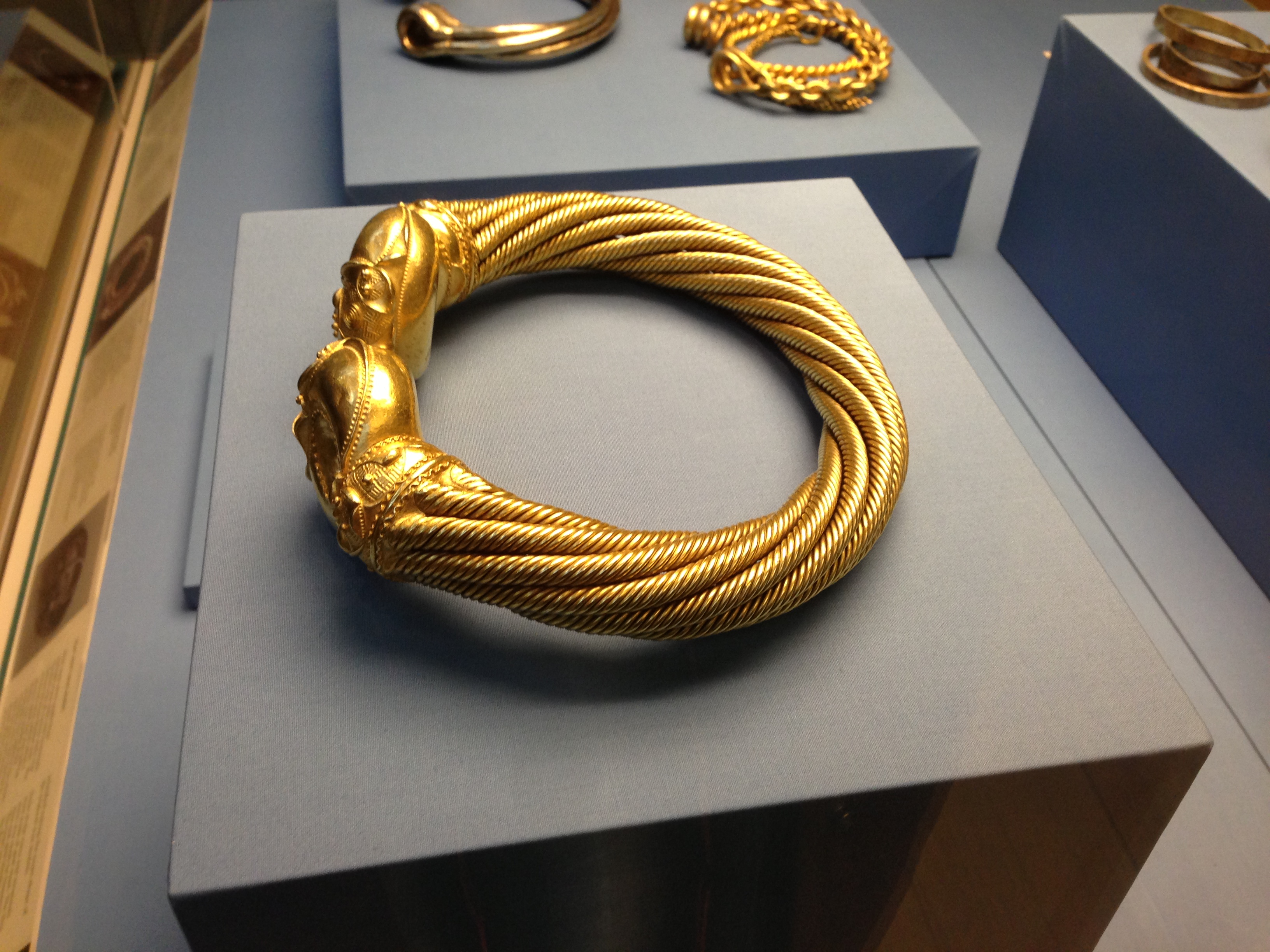
The third order, that of the producers, is paradoxically the best documented by archaeology, for it is its works that have survived. Celtic artisans were metallurgists of the first rank. Their smiths mastered steel, produced supple and resistant swords, effective agricultural tools, objects of bronze and gold of great refinement. We also owe them innovations diffused throughout the ancient world: chain mail, the hooped wooden barrel, enamelling techniques, iron-rimmed wheels. Far from the cliché of the primitive barbarian, Celtic society rested on a craft of remarkable technical sophistication.
The oppida, first towns of temperate Europe
From the second century BC, the Celtic landscape changed face with the appearance of the oppida. The term is Latin, Caesar uses it abundantly in his narratives, and denotes vast fortified settlements, generally perched on heights and girded by impressive ramparts. From Gaul to Bohemia, several hundred of these sites developed within a few generations. They represent a profound mutation: for the first time north of the Mediterranean, temperate Europe acquired something resembling towns [s2].
An oppidumOppidumA large fortified settlement of late Iron Age Celtic Europe, set on high ground and walled; the first form of town north of the Mediterranean.→ is not merely a fortress. It is a centre of power, craft, trade and sometimes cult, where thousands of inhabitants could live. Excavation has revealed artisans' quarters, workshops for forging, coin minting, glass and bone working, storehouses, public spaces. The ramparts themselves bear witness to considerable collective organisation. Caesar describes with admiring precision the murus gallicus, that wall of stone, earth and interlaced wooden beams, fixed by long iron nails, which combined solidity, elasticity against battering rams and resistance to fire.
The most famous of these sites is Bibracte, capital of the Aedui people, set on Mont Beuvray in Burgundy. It was there that the Gaulish assemblies met, there that Vercingetorix was, according to Caesar, proclaimed leader of the Gaulish coalition in 52 BC, and there again that the Roman proconsul wrote part of his Commentaries during the following winter. Now a major European archaeological research centre, Bibracte makes it possible to gauge concretely what these first towns were: a rampart several kilometres long, monumental gates, blocks of dwellings and workshops, and soon the first stone buildings in the Roman manner, a sign of a Romanisation already under way even before the end of independence [s3].
Celtic art: torcs, coins and the Vix krater
If the civilisation of La Tène needed a signature, it would be its art. Breaking with the geometric rigour of Hallstatt, La Tène Celtic art deploys a vocabulary of curves, spirals, stylised palmettes, vegetal volutes and animal motifs fused into the ornament. It borrows elements from Greek and Etruscan repertoires, but reinterprets them freely to the point of creating an entirely original style, made of fleeting symmetries and visual ambiguities in which the eye never quite knows whether it is looking at a leaf, a face or an animal [s2].
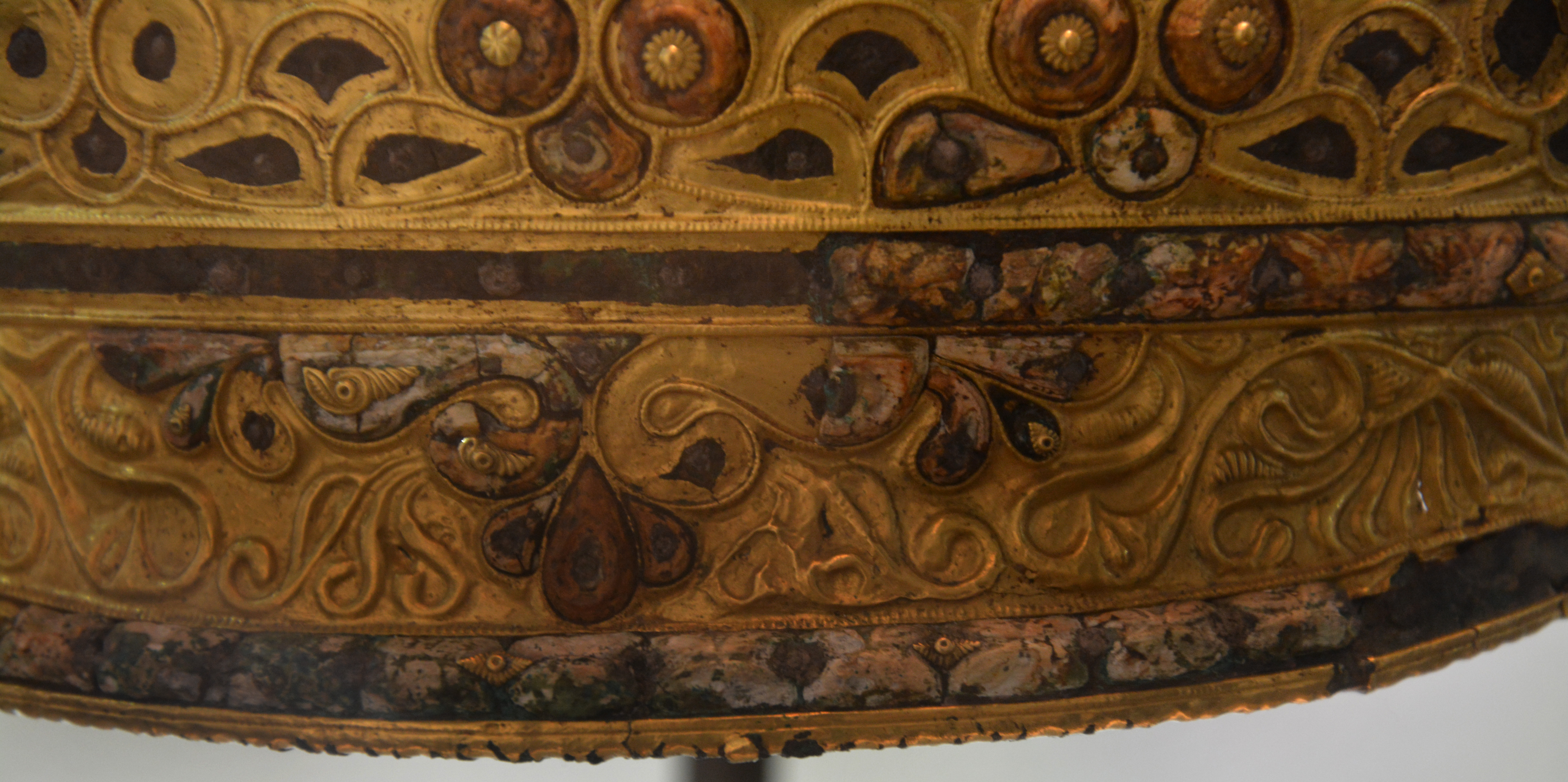
This art expressed itself on privileged supports. The torc, a rigid neck ring often of gold, is its emblem: worn by warriors and deities, it concentrates the goldsmith's labour and social prestige. Engraved sword scabbards, brooches, cauldrons, parade helmets show the same taste for detail and line. The Agris helmet, in the Charente, covered with gold leaf and adorned with palmette motifs and coral, is one of the masterpieces of this luxury craft, an object of display rather than of combat, meant to dazzle.
Celtic art also invested an unexpected support: coinage. From the third century BC, Celtic peoples began to strike coins of gold, silver and bronze, at first imitating Greek models, notably the staters of Philip of Macedon, then breaking away from them. Under the burin of Celtic engravers, the head of Apollo and the chariot of the Greek obverse break apart, reorganise, stylise into abstract compositions of great beauty, where fragmented horses and volutes float in a reinvented space. These coins, beyond their artistic value, signal the existence of issuing political authorities and of an economy already partly monetised.
There remains the Vix krater, which crowns this dossier as it crowned the tomb of a Hallstatt princess. This monumental bronze vessel, over a metre and a half tall and weighing more than two hundred kilos, was made in a Greek workshop, probably in Magna Graecia, then transported across the Alps to Burgundy to be offered or exchanged. Deposited around 500 BC in the burialBurialThe intentional deposition of a body, sometimes with offerings; a marker of symbolic behaviour.→ of a woman of very high rank, it bears witness both to the refinement of the Celtic elite and to the intensity of its links with the Greek world. It is not, strictly speaking, of Celtic make, but it belongs fully to Celtic history, because it tells what that aristocracy desired, sought and could acquire.
Exchanges with the Mediterranean world
The Vix krater illustrates an essential truth: the Celtic world never lived in isolation. From the end of Hallstatt, the princely residences north of the Alps imported wine, bronze vessels and fine pottery from the south, coming from the Greek colonies of the western Mediterranean, Marseille first and foremost, founded around 600 BC by Greeks of Phocaea, and from the Etruscan world of Italy. In return, the Celts exported raw materials and prized products: salt, metals, hides, amber carried from the Baltic, and probably slaves.
Wine played a leading role in these exchanges. Celtic aristocrats developed a marked taste for Mediterranean wine, imported in great quantities in amphorae whose fragments are found by the thousand on Iron Age sites. The ancient authors mocked this thirst, noting that the Celts drank it neat, without cutting it with water as the Greeks did. Beyond the anecdote, this wine trade wove a network of routes and relations that durably drew the Celtic world closer to the Mediterranean and prepared, in its own way, the convergence that would result in Romanisation.
These exchanges were not only material. Along with the objects circulated techniques, images, fashions. Celtic art, as we have seen, fed on reinterpreted Mediterranean motifs; coinage proceeds from the imitation of Greek pieces; certain forms of oppida urbanism may owe something to southern models. The Celtic world was a zone of active reception, which transformed what it received. This porosity also explains why the Mediterraneans knew their northern neighbours so well: they traded with them, mingled with them, feared them at times, and ended by writing about them.
Entering history: Caesar, Strabo and the Roman conquest
It is through Greco-Roman texts that the Celts cross the threshold of written history. The Greeks named them Keltoi from the sixth century BC; the Hellenistic geographers and historians, following Poseidonios, gave ethnographic descriptions of them. Later, the geographer Strabo, writing at the turn of our era, devoted precious pages to the Celts and to Gaul: he describes the peoples, their customs, their resources, their towns, and cites for instance the Aedui and their stronghold. Strabo writes after the conquest, at a moment when Gaul is already tipping into the Roman orbit, and his testimony mingles observation with the inheritance of earlier authors.
But the decisive text is that of Julius Caesar. His Commentaries on the Gallic War, written to relate and justify the conquest carried out between 58 and 51 BC, are at once a military narrative, an ethnographic document and an enterprise of political propaganda. To Caesar we owe the essence of our direct knowledge of Gaulish institutions: the peoples and their assemblies, the role of the druids, the organisation of clientship, the oppida and their ramparts. His pen is interested, he writes as victor and for his glory, but it brings Celtic Gaul, abruptly and forever, into the written memory of the West.
With Caesar's Gallic War, a world without archives tips all at once into history: it is the conqueror's words that, for want of others, fix forever the image of the vanquished.
The conquest was a drama of great violence. Caesar subdued in a few years a mosaic of peoples, exploiting their divisions, alliances and rivalries. Resistance found its hero in Vercingetorix, the Arverni chief who federated part of the GaulsGaulsCeltic peoples settled in Gaul (France, Belgium and neighbouring regions) during the second Iron Age, before their integration into the Roman Empire.→ in 52 BC, won the victory of Gergovia, then was besieged and defeated at Alesia before being handed over to Rome. With his surrender ended Gaulish independence. The figures, no doubt exaggerated by the ancient sources, speak of hundreds of thousands dead and as many enslaved. Celtic Gaul entered the Roman Empire, and with it opened a long period of Romanisation that would recompose the language, religion, settlement and art of these regions.
What "prehistory" means on the scale of Europe
The trajectory of the Celts throws a singular light on the very notion of prehistory. For the boundary between prehistory and history is not a single line drawn at a fixed date for all humankind: it shifts according to regions and peoples. In Mesopotamia and Egypt, history begins around 3300 BC with the first writing systems. In China, in Mesoamerica, elsewhere again, it begins at other moments. In temperate Europe it truly opens only with the irruption of Greco-Roman texts, that is to say very late, even though these societies were technically advanced, urbanised, monetised and linked to the Mediterranean.
This is the paradox that protohistory sums up. A society can be complex, hierarchical, artistically refined, endowed with towns and coinage, and yet remain "prehistoric" in the strict sense simply because it does not write, or refuses to write its knowledge. The Celtic druids, capable of memorising twenty years of doctrine, were no cultureless primitives: they were making a choice. To say of the Celts that they belong to prehistory therefore in no way means that they were backward; it means only that we know them first through their remains and through the gaze of others, and not through their own voice.
This relativity of the boundary calls for caution and humility. Writing is a powerful spotlight, but it always illuminates from a point of view. For the Celts, that point of view was almost exclusively that of their adversaries and their Mediterranean trading partners. To restore the Celtic civilisation in its richness therefore requires crossing these partial texts with the silent but abundant testimony of archaeology, the oppida, the tombs, the torcs, the coins, which comes directly from the Celts themselves.
Conclusion
From Hallstatt to Alesia, the European Iron Age tells the story of a great civilisation that did not write its own. The Celts built towns, struck coins, forged steel, created an art among the most inventive of antiquity, and wove with the Mediterranean ties so close that they received from it wine, images and, finally, the legions. They entered history by breaking and entering, under the pens of those who conquered them or lived alongside them, and that very entry sealed the end of their independence.
European protohistory thus teaches us a precious lesson about the way we carve up the past. Prehistory is not an age of childhood preceding historical maturity: it is a documentary condition, that of societies we must reconstruct through their gestures rather than through their narratives. The threshold of our era, for temperate Europe, marks not the passage from barbarism to civilisation, but that of a world which had been silent to a world whose name people, at last, began to write. And behind the gold torcs and the ramparts of the oppida, it is that world, dense and lost, that archaeology patiently continues to make speak.
The threshold of protohistory: a question of historiography
The word protohistory is recent. It entered scholarly vocabulary during the nineteenth century, as archaeology took shape as an autonomous discipline with its own methods of excavation, classification and dating. Before then, societies without writing belonged indistinctly to an undefined "before," peopled by barbarians and legends. The birth of the "three ages", stone, bronze, iron, proposed by the Dane Christian Jürgensen Thomsen to order the collections of the Copenhagen museum, provided the first rigorous framework for structuring this silent past. It is in the wake of this conceptual revolution that the word protohistory found its purpose: it designates precisely the pivotal moment when societies previously known only through their remains begin to be named by literate outside observers.
This documentary definition, rather than a chronological one, is essential. Protohistory is not an epoch that could be dated universally, the way one dates a reign or a battle. It is a relative situation, which depends as much on the gaze cast upon a society as on that society itself. A single people may be prehistoric for us as long as no text mentions it, then slip into protohistory the day a literate neighbour writes down its name. The Celts of the Iron Age embody this paradox: technically masters of metal, organised into complex societies, builders of towns, they remain "protohistoric" not through any backwardness of civilisation, but because they did not commit their own memory to writing. The boundary separating them from history is not a boundary of development; it is a boundary of sources.
Contemporary historians stress the fragility of this division. For a long time, an evolutionist reading made prehistory the childhood of humanity, protohistory its adolescence and history its adulthood, as if writing marked access to full humanity. That implicit hierarchy is now largely abandoned. Societies without writing produced monumental architecture, refined religious systems, continent-wide exchange networks and works of art that nothing distinguishes, in complexity, from those of literate civilisations. The absence of text is not an absence of thought; it is merely an absence of archive. To understand protohistory is therefore to learn to read a civilisation through its material gestures, the shape of a sword, the layout of a tomb, the line of a rampart, rather than through its own words, which it did not leave behind.
From the Bronze AgeBronze AgeA protohistoric period following the Neolithic, defined by bronze metallurgy (a copper-tin alloy) and the rise of the first cities and states; in Egypt it corresponds to the age of the first pyramids.→ to the Iron Age: the Urnfield transition
The European Iron Age did not arise from nothing: it prolonged and transformed an already dense, mobile and richly organised Bronze Age world. During the second millennium before our era, temperate Europe witnessed an intense circulation of metals. Bronze, an alloy of copper and tin, imposed considerable trade routes, for tin was rare and concentrated in a few deposits, Cornwall, the Iberian Peninsula, the central European massifs. To possess bronze was to depend on long-distance networks; control of those routes nourished warrior and merchant elites whose deposits of weapons and ornaments dot the entire continent.
The major turning point of the Late Bronze AgeLate Bronze AgeThe final phase of the Bronze Age in the Near East (c. 1550 to 1200 BCE), an age of great empires and international diplomacy, ended by a general collapse.→, around 1300 before our era, bears an evocative name: the Urnfield culture. The term designates a vast cultural area of central and western Europe characterised by a decisive change in funerary practice. Inhumation gives way to cremation: the dead are burned, their ashes gathered in ceramic urns, and these urns deposited by the hundred in large flat cemeteries, the "urnfields" that give the whole its name. This standardisation of rite, from the Hungarian plains to the Paris Basin, testifies to a circulation of ideas and models on a continental scale, long before any writing. The necropolises of this period, by their extent and regularity, reveal numerous, hierarchical communities deeply attached to a collective memory of their dead.
It is upon this foundation that iron metallurgy spread, around 800 before our era in temperate Europe. The passage from bronze to iron was not an abrupt rupture but a slow substitution, the two techniques long coexisting. The advantage of iron lay less in its intrinsic qualities, a well-worked bronze could rival a mediocre iron, than in the availability of the ore, present almost everywhere, which freed communities from dependence on the distant tin routes. By democratising access to metal, iron transformed agricultural tools, multiplied weapons and upset the balance of power inherited from the Bronze Age. The burials of the early Iron Age, in which the first iron swords appear alongside ornaments and prestige vessels, mark the advent of a new social order that archaeology calls the Hallstatt culture.
Hallstatt: salt, princes and chariot tombs
If one object were to sum up Hallstatt prosperity, it would be a grain of salt. The eponymous necropolis of Hallstatt, in the Austrian Alps, owes its wealth to the salt mines exploited from the Bronze Age and intensively during the Iron Age. Salt was a strategic resource: it preserved meat, seasoned food, and was traded over long distances. The galleries of Hallstatt, where salt has mummified wood, leather and textile, have yielded archaeologists an extraordinary snapshot of Iron Age mining life, wooden tools, leather bags, the remains of meals, and explain the opulence of the thousands of neighbouring graves, in which weapons, bronze ornaments and imports accumulate.
But it is further west, in Burgundy, southern Germany and Bohemia, that the so-called "princely residences" phenomenon manifests with the greatest brilliance. In the sixth century before our era, certain fortified heights, the Heuneburg on the Danube, Mont Lassois in Burgundy, concentrated wealth and power in the hands of an aristocracy that controlled exchanges with the Mediterranean world. The Heuneburg, at one point in its history endowed with a wall of mud brick in the Greek manner, may have housed several thousand inhabitants: some researchers see in it one of the first urban-type settlements north of the Alps, well before the oppida.
At the foot of these residences rise the chariot tombs, monumental burials under tumuli in which high-ranking individuals are interred with a ceremonial chariot, a drinking service and objects from afar. The most famous is the tomb of Vix, discovered in 1953 at the foot of Mont Lassois. It contained a woman of about fifty, adorned with a gold torc, buried around 470 before our era on the body of a chariot whose wheels had been dismantled. Beside her stood an astonishing object: an immense bronze krater with a capacity of around eleven hundred litres, the largest metal vessel that antiquity has bequeathed to us, produced around 530 before our era in a Greek workshop of Magna Graecia. The "Lady of Vix" embodies in herself the nature of Hallstatt power: an elite enriched by control of the tin and salt routes, able to draw to the heart of Gaul the most prestigious products of the Greek world, and to place a woman at the summit of the funerary hierarchy.
La Tène: art, weaponry and Celtic expansion
Around 450 before our era, the Hallstatt world unravels. The princely residences decline, Mediterranean imports grow scarce on certain sites, and a new culture emerges, which archaeology names La Tène, after a site on Lake Neuchâtel where thousands of iron objects, admirably preserved in the mud, were recovered. The La Tène civilisation, which covers the second Iron Age, corresponds to the apogee of the Celtic world and to its greatest geographical extent.
This period is first of all one of a revolution in weaponry. The La Tène smith reached a remarkable mastery of iron: he produced long slashing swords with cutting edges, decorated scabbards, spearheads, shield bosses. This metallurgical excellence is not merely technical, it is political: it armed the warrior bands whose movements would mark the history of the Mediterranean. The famous Celtic sword, the helmet, the oblong shield, became the emblems of a military culture that inspired both fear and admiration in Greek and Roman observers.
It is also at La Tène that an art of striking originality crystallised, the first great non-figurative style of Europe north of the Alps. Breaking with the geometric rigour of Hallstatt, La Tène art deploys a repertoire of curves, spirals, palmettes and plant motifs in which faces and animals are concealed. It borrows elements from Greek and Etruscan art but transforms them beyond recognition, creating a visual language of elusive symmetries and calculated ambiguities. This art accompanies Celtic expansion: from Gaul to Bohemia, from Spain to Anatolia, one finds the same brooches, the same torcs, the same ornamental vocabulary, the sign of a vast cultural and linguistic community that the Ancients called Celts or Galatians.
Celtic society: orders, druids, women and religion
Reconstructing Celtic society is a delicate exercise, for we know it chiefly through the gaze of outside observers. Following the Greek Poseidonios of Apamea, who travelled in Gaul around 90 before our era, the ancient authors describe a society articulated around three great orders. At the summit sits a warrior aristocracy, whose worth is measured by deeds accomplished, by the number of clients and dependents, by the size of the herds. Beside it stands a learned and priestly class, the druids. And supporting the whole, the mass of producers, peasants, herders, artisans, who feed and equip the society.
The druids occupy a singular place. According to Caesar, they presided over worship, judged disputes, transmitted a considerable body of knowledge but forbade its being written down, preferring memory to archive. This prohibition of writing for sacred matters partly explains the documentary silence of the Celts: their intellectual elite deliberately cultivated orality. The training of a druid could, it is said, demand twenty years of learning by heart. To this priestly class were added bards, keepers of poetry and genealogical memory, and seers. Celtic religion, polytheistic, venerated deities linked to nature, war and fertility, and gave great importance to sanctuaries, to votive deposits in the waters and to funerary practices.
The place of women in this society has long been underestimated, but archaeology is reassessing it. The tomb of Vix, with its deceased adorned with a gold torc and surrounded by princely grave goods, shows that a woman could occupy the summit of the funerary, and therefore, in all likelihood, the social and political, hierarchy. The ancient texts themselves, despite their biases, evoke warrior queens and women taking part in decisions. Without over-interpreting these clues, one may affirm that Celtic society left women margins of authority and prestige greater than those of the contemporary Greek cities. The funerary rite, here again, speaks more clearly than words: the richness of a female burial tells of the importance accorded to the one who rests within it.
The Celtic economy: agriculture, metallurgy and coinage
Behind the warrior image that the ancient texts imposed lies an economic reality of great richness. Agriculture formed its base. The Celts mastered advanced techniques: ard with an iron share, scythe, crop rotation, manuring, buried storage silos. Pliny the Elder even attributes to the Gauls the invention of a mechanical harvester, the vallus, drawn and pushed across the fields. This agricultural productivity sustained numerous populations and generated surpluses that fed exchanges and nourished the nascent towns.
Metallurgy was the other pillar. The working of iron reached a level of excellence recognised even by the Romans, who adopted several Gaulish innovations, notably in chain mail and certain tools. Beyond iron, the Celts excelled in goldsmithing and silversmithing, in bronze work and in the production of coloured glass, as the blue bracelets of certain oppida attest. This artisanal excellence was accompanied by a genuine division of labour, evidenced by quarters specialised in the settlements.
The most revealing economic fact of the maturity of the Celtic world is doubtless the appearance of coinage. From the third century before our era, Celtic peoples struck their own coins, at first imitating Greek currency, notably the gold staters of Philip II of Macedon, whose effigy and chariot gradually deform until they become abstract, typically Celtic compositions. Then appear silver, bronze and potin coins suited to local exchanges. This monetisation, still partial, signals an economy that goes beyond mere barter and organises itself around markets, perhaps taxes, and structured trade. It constitutes one of the surest indications that temperate Europe, on the eve of the Roman conquest, had entered a pre-urban and proto-state phase.
The oppida: Bibracte, Manching, Gergovia, first towns
From the second century before our era, the Celtic landscape changes its face with the appearance of the oppida. The term is Latin, Caesar uses it abundantly, and designates vast fortified settlements, generally perched and girdled by imposing ramparts. From Gaul to Bohemia, several hundred of these sites developed within a few generations. They mark a profound mutation: for the first time north of the Mediterranean, temperate Europe acquired something resembling towns, with their concentration of population, their specialised crafts, their seats of power and their religious functions.
Bibracte, capital of the Aedui people on Mont Beuvray in Burgundy, offers the most studied example. It was there that Gaulish assemblies were held, there that Vercingetorix was, according to Caesar, proclaimed leader of the Gaulish coalition in 52 before our era, and there again that the proconsul drafted part of his Commentaries during the following winter. The site, girdled by a long rampart pierced by monumental gates, housed blocks of dwelling and craft, and soon the first stone constructions in the Roman manner, a sign of a Romanisation already under way even before the end of independence.
In Bavaria, the oppidum of Manching offers another face of this urbanisation. At its apogee, in the second half of the second century before our era, it occupied some three hundred and eighty hectares protected by a rampart of more than seven kilometres and housed a population estimated between five thousand and ten thousand inhabitants. Manching was a craft and trade centre of the first order: there iron extracted in the Danube valley was worked, glass beads and bracelets were produced, and its own coinage was struck for local trade. It is, to this day, the most important economic centre of the La Tène period brought to light north of the Alps. Gergovia, finally, capital of the Arverni, remained famous for the defeat that Vercingetorix inflicted there on Caesar in 52 before our era, on its fortified heights of Auvergne, proof, if any were needed, that these towns were also formidable fortresses.
Celtic art: torcs, brooches, coins and the Gundestrup cauldron
The Celtic art of La Tène ranks among the most inventive of antiquity. Its originality lies in its refusal of servile copying: it assimilates Mediterranean motifs, palmettes, scrolls, lotus, but dissolves them into a play of curves and symmetries that belongs to it alone. The torc, that rigid open collar worn around the neck, is its emblem: a symbol of rank and protection, it ranges from the simple bronze ring to the splendid gold torc of the Lady of Vix. The brooch, a clasp used to fasten garments, offers another privileged support for this ornamental virtuosity, declined into countless regional variants that today help archaeologists date and locate sites.
Celtic coins constitute in themselves a chapter in the history of art. Setting out from precise Greek models, they move away from them by stages until abstraction: the face of Apollo fragments into autonomous locks, the chariot and its horse decompose into floating lines, until producing dreamlike compositions in which the original figure is no more than a pretext. Far from clumsiness, this process reveals a deliberate aesthetic, attentive to rhythm and balance rather than to resemblance.
The most spectacular masterpiece of this universe is doubtless the Gundestrup cauldron, discovered in 1891 in a peatPeatA waterlogged organic soil formed by accumulated plants; it seals and remarkably preserves wood and ancient remains.→ bog of Danish Jutland. Composed of thirteen plates of almost pure silver, richly decorated in repoussé and partly gilded, this large ceremonial vessel, forty-two centimetres high, nearly seventy in diameter, deploys a teeming iconographic programme: a horned god seated cross-legged, often identified with Cernunnos, a figure plunging warriors into a cauldron to resurrect them, fantastic animals and processions of fighters. Dated to the end of the Iron Age, perhaps manufactured outside the strict Celtic area but steeped in Celtic imagery, the Gundestrup cauldron remains an enigma: it condenses, in silver and gold, all the richness of a mythology that the Celts never set down in writing, and which we can now read only in images.
Greeks and Etruscans: wine, images and great commerce
The Celtic world did not develop in isolation. From the sixth century before our era, it maintained with the Mediterranean world exchanges of growing intensity, of which the Hallstatt princely tombs bear the trace. The founding of Massalia, present-day Marseille, by Greek colonists from Phocaea around 600 before our era, opened a decisive door. Up the Rhône valley, Mediterranean products travelled toward the interior of the Gauls, and foremost among them, wine.
Wine played a considerable economic and social role. The Celtic elites were passionate about it, and its trade, attested by countless amphorae found on Gaulish sites, structured a large part of the exchanges. Diodorus of Sicily reports that Italian merchants exchanged an amphora of wine for a slave, a proportion no doubt exaggerated, but revealing of the imbalance in the terms of trade. With wine came drinking services, bronze vessels, kraters like that of Vix, and a whole culture of the aristocratic banquet that the Celts adapted to their own usages.
The Etruscans played a parallel role, notably in northern Italy and the Alps. Their bronze vessels, their spouted jugs, their animal art irrigated the nascent Celtic repertoire. This intense commerce was not one-way: the Mediterranean received in return slaves, metals, agricultural products, mercenaries. But the cultural balance tilted clearly toward the Mediterranean: by drinking Greek and Etruscan wine, by imitating their images, the Celts forged with the south ties so close that they finally received, after the amphorae and the coins, the legions.
The great Celtic migrationsMigrationsLong-distance movements of populations; a major driver of human history (the exit from Africa, the peopling of continents, Neolithic and steppe expansions).→: Rome, Delphi and Galatia
The fourth and third centuries before our era are the age of the great Celtic migrations, which hurled warrior bands to the four cornersFour CornersRegion of the American Southwest where Colorado, Utah, Arizona and New Mexico meet, the cradle of Ancestral Puebloan culture.→ of the ancient world and brought the Celts, with a crash, into the memory of the Mediterranean peoples. The first resounding shock is the sack of Rome. Around 390 or 387 before our era, Celts led by a chief whom tradition names Brennus crushed the Roman army on the Allia, took the city and spared only the Capitol, saved, legend says, by the cries of Juno's sacred geese. This trauma durably marked the Roman imagination, which retained from the Gauls the ancestral fear of the metus gallicus.
A century later, the movement resumed toward the east. Between 280 and 278 before our era, Celtic armies poured over the Balkans, Macedonia and Greece. Another chief named Brennus pushed as far as the sanctuary of Delphi, the religious heart of the Greek world, which he attempted to plunder in 279, an assault repelled, according to the Greek sources, by a concurrence of storms, earthquakes and the fierce defence of the Greeks. This episode, however embellished, fixed the image of the Celt as a destructive force surging from the north, and its failure was celebrated as a victory of Hellenic civilisation over barbarism.
Yet from this eastern reflux was born a lasting settlement. A part of the Celts, the Tolistobogii, the Tectosages and the Trocmi, crossed the Bosphorus and settled in the heart of Asia Minor. Around 275 before our era, the Seleucid king Antiochus I granted them a territory that took the name of Galatia, in present-day central Turkey. These Galatians preserved for centuries their Celtic language and identity in the midst of a Hellenised East, until the apostle Paul addressed to them, much later, his Epistle to the Galatians. At the edges of Anatolia, thousands of kilometres from the Danube, there thus lived a fragment of the Celtic world, striking proof of the scale of an expansion that, in two centuries, had carried the La Tène culture from one end of the continent to the other.
Entering history: Polybius, Poseidonios, Caesar and their biases
The Celts enter written history by breaking and entering, under the pens of those who fought or observed them. It is Greeks and Romans who first fix their name, describe their customs and recount their wars. Polybius, a Greek historian of the second century before our era, relates the clashes between Rome and the Gauls of Italy with the concern of a lucid witness. Poseidonios of Apamea, philosopher and traveller, delivered around 90 before our era an ethnography of the Gauls that would irrigate the whole later tradition: to him we owe most of what the Ancients report about the druids, the banquets and the three orders of Celtic society.
But the most abundant source remains the Gallic War of Julius Caesar, an account of his campaigns between 58 and 51 before our era. This text of admirable clarity is also the most treacherous. Caesar is no disinterested ethnographer: he is a general on campaign, a politician in search of glory and justification. His description of the Gauls serves his project of conquest; he magnifies the perils, glorifies his victories, presents his war as a defensive necessity where it was a deliberate aggression. The figures he advances, populations, numbers, losses, are open to doubt. To read Caesar is therefore to read a victor recounting his own victory.
This observation imposes a method. The Greco-Roman texts on the Celts are precious but partial: written from the outside, by literate foreigners to the culture they describe, often for audiences hungry for exoticism or political arguments, they project onto the Celts the categories and prejudices of the Mediterranean world. The "barbarian" they depict, brave but impulsive, generous but drunken, valiant but incapable of lasting discipline, is as much a mirror of Greco-Roman anxieties as a faithful portrait. This is why the historian must systematically cross-check these accounts with the mute but direct testimony of archaeology: the oppida, the tombs, the torcs, the coins, which come from the Celts themselves and correct the distortions of the foreign gaze.
The Roman conquest and the end of independence
The Celts' entry into history tragically coincides with the end of their independence. At the very moment when Rome writes down their name, it undertakes to subdue them. From the third century before our era, the Gauls of Italy are absorbed; the south of Gaul becomes a Roman province, Narbonensis, at the end of the second century. Then comes the great conquest: between 58 and 51 before our era, Caesar subjugates the whole of long-haired Gaul at the end of a fierce war.
The culminating point of this resistance was the uprising of 52 before our era, under the leadership of the Arvernian Vercingetorix, capable for the first time of federating Gaulish peoples usually divided. After his success at Gergovia, he was finally besieged and defeated at Alesia, where the Roman lines of circumvallation enclosed his army and shattered the last Gaulish hope. The surrender of Vercingetorix sealed the end of Celtic independence in Gaul. The other Celtic worlds followed: insular Britain was partly conquered in the first century of our era, while the unromanised zones of the north and west pursued a distinct history.
The conquest did not make the Celts disappear; it integrated them. Roman Gaul, prosperous and urbanised, long preserved a Celtic substratum in its language, its cults and its techniques. But writing, from then on, was Latin, and the memory we keep of these peoples passes through the filter of their conquerors. Celtic protohistory thus ends on a paradox: it was by losing their political autonomy that the Celts gained full access to history, and it was the voice of Rome that, in subduing them, gave them a lasting name in the memory of the West.
"Prehistory": a notion of variable geometry across the regions of the world
The Celtic sequence illuminates a more general truth: the boundary between prehistory, protohistory and history is in no way universal. It shifts in time and space according to a single criterion, the appearance of writing, whether one's own or borrowed. In the Near East, in Mesopotamia and Egypt, history begins as early as the fourth millennium before our era, with the first tablets and hieroglyphs. In China, it begins with the oracular inscriptions of the second millennium. In temperate Europe, it opens only at the turn of our era, under the pens of the Romans. And in certain regions of the world, writing appeared only with the arrival of explorers or colonisers, in the modern period.
This relativity has a major consequence: one and the same moment of universal time may be "historical" at one point of the globe and "prehistoric" at another. While Egyptian scribes recorded the floods of the Nile, NeolithicNeolithicThe "New Stone Age": a period marked by farming, herding, settlement and pottery, from around 10,000 BC.→ Europe was raising its megaliths without leaving the slightest text. While Rome was drafting its annals, whole peoples, elsewhere, remained outside the field of writing. Prehistory is therefore not a bygone age of humanity: it is a documentary condition that concerned different regions at different epochs, and which sometimes persisted until a recent date.
Recognising this variable geometry invites prudence and respect. The societies we call "prehistoric" or "protohistoric" were neither less intelligent, nor less organised, nor less creative than the contemporary literate societies. Sedentarisation, agriculture, monumental architecture, art, structured religion, long-distance exchange networks, all of this existed, and often shone, in worlds without writing. To measure a civilisation by the yardstick of the written word is to confuse the richness of a society with the richness of its archives. Celtic protohistory reminds us that one can be a great civilisation and have written almost nothing of oneself.
Epilogue: making a silent world speak
From Hallstatt to Alesia, the European Iron Age tells the story of a great civilisation that did not write its own. The Celts built towns, struck coins, forged steels, created an art among the most inventive of antiquity and wove with the Mediterranean ties so close that they received from it wine, images and, finally, the legions. They entered history by breaking and entering, under the pens of those who conquered them, and that very entry sealed the end of their independence.
Reconstructing this world demands tirelessly cross-checking two irreducible types of source: on one side, the rare Greco-Roman texts, illuminating but partial, which give us names, narratives and images; on the other, the immense archaeological documentation, tombs, ramparts, ornaments, coins, workshops, which comes directly from the Celts and corrects the distortions of the outside gaze. It is from the patient confrontation of these testimonies that there gradually emerges a juster, denser and more human image of European protohistory.
At the end of this journey, one conviction remains. Prehistory is not a childhood of humanity that history would come to crown: it is a condition of documentation, that of societies we must reconstruct through their gestures rather than through their narratives. The threshold of our era, for temperate Europe, marks not the passage from barbarism to civilisation, but that of a world which had been silent to a world whose name people, at last, began to write. And behind the gold torcs and the ramparts of the oppida, it is that world, dense and lost, that archaeology patiently continues to make speak.
Super article, j'aurais aimé avoir ça pour mes partiels du S1. Je le garde pour le S2.
La protohistoire est ma période de prédilection dans les fouilles préventives car elle est à la fois bien documentée et riche en surprises. Les habitats de l'Age du Fer, avec leurs fosses à déchets, leurs greniers et leurs puits, livrent des instantanés de la vie quotidienne d'une fidélité remarquable. Le territoire français est particulièrement riche pour cette période grâce à l'archéologie préventive.
La protohistoire européenne, entre le Néolithique final et l'Antiquité classique, est une période riche et encore partiellement méconnue. Les cultures de l'Age du Bronze (Hallstatt) et du Fer (La Tène) ont produit des objets d'une sophistication remarquable et établi des réseaux d'échanges qui couvraient l'ensemble du continent. L'archéologie de cette période bénéficie aujourd'hui des analyses ADN et isotopiques qui révèlent des mobilités humaines insoupçonnées.