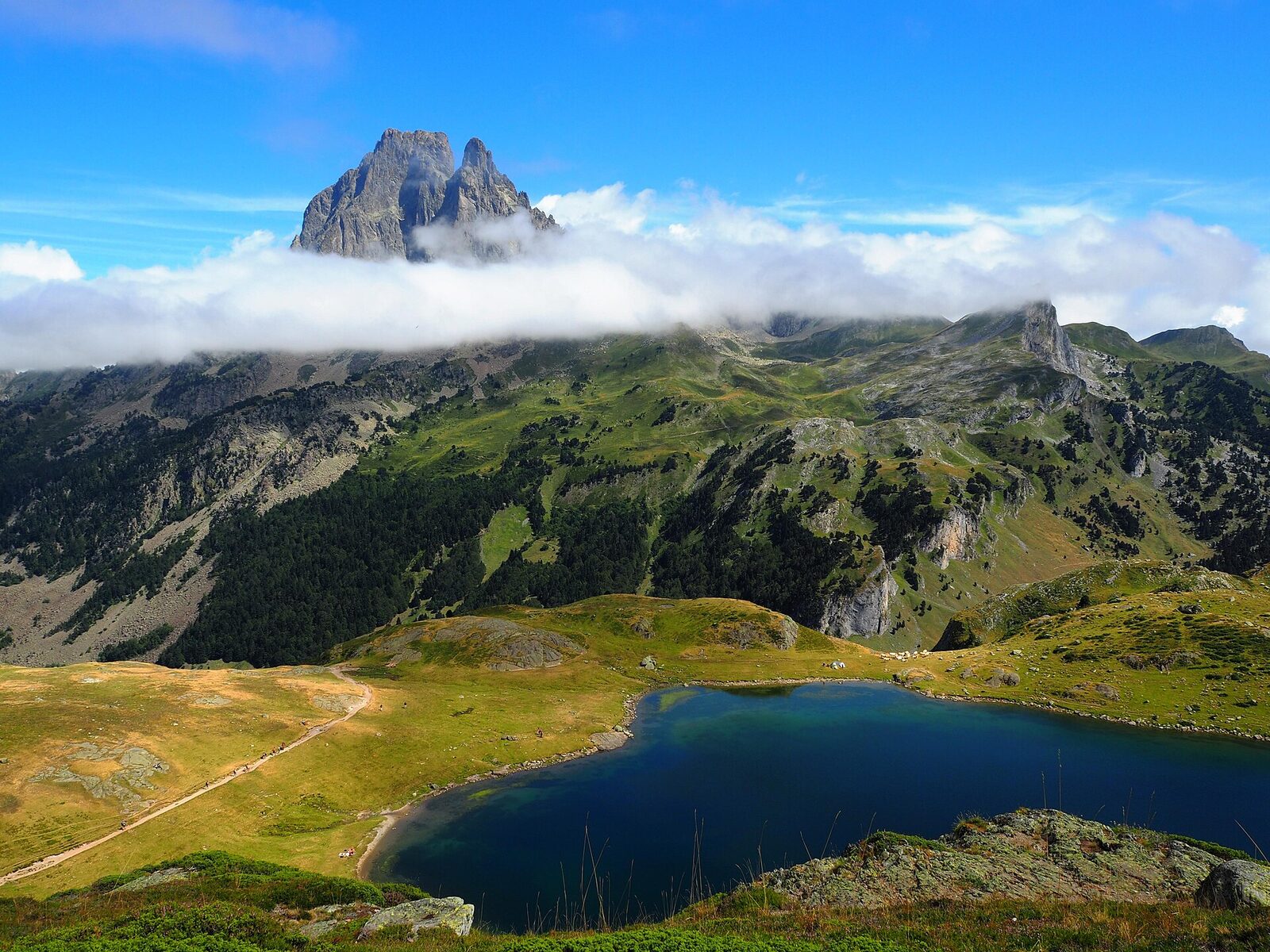
When we picture the first humans of European prehistoryPrehistoryThe span of human history before the invention of writing, from the Palaeolithic to the Metal Ages, known mainly through material remains.→, we readily place them in a temperate valley, beside a game-rich river, sheltered beneath a painted rock overhang. The high mountains, by contrast, seem reserved for the modern mountaineer, the weekend herder or the Gore-Tex-clad hiker. We imagine them too cold, too poor, too dangerous to have sheltered anything more than furtive crossings. Yet the Pyrenees tellTellAn artificial mound formed by the accumulation of successive layers of settlement remains at the same spot, typical of the Near East. Each destruction-rebuilding event adds a stratum.→ a very different story. Over the past twenty years or so, systematic campaigns of survey and radiocarbon dating have revealed that the ridges, passes and high pastures of the range were visited, exploited and inhabited almost without interruption for around ten thousand years. Beneath the summer pastures that look so pristine, beneath the peatPeatA waterlogged organic soil formed by accumulated plants; it seals and remarkably preserves wood and ancient remains.→ and the scree, lies a human archive of unsuspected density.
This continuity is one of the major lessons of high-mountain archaeology. It overturns the received idea of an upland world that stayed apart from the human adventure until recent times. The Pyrenean summits did not wait for the medieval shepherds or the nineteenth-century peak-baggers: as soon as the last glaciation ended, groups of hunter-gatherersHunter-gatherersA way of life based on hunting, fishing and gathering wild resources, without farming or herding; it dominated almost the whole of human history.→ were climbing there with the rhythm of the seasons, following the wild herds and the fleeting resources of the warm months. Then, with the agro-pastoral revolution, herders came to drive goats, sheep and cattle up the slopes, building huts, raising enclosures, erecting circles of stone. This article retraces that long presence, the way it was brought to light, and what it tells us about the mobility, adaptation and ingenuity of our ancestors in the face of an extreme environment.
The stakes go beyond mere scholarly curiosity. To understand that the high mountains were inhabited from the very dawn of the HoloceneHoloceneThe current geological epoch, begun about 11,700 years ago at the end of the last ice age; the setting of all post-glacial history.→ is to revise our mental map of prehistory, long drawn at valley level. It means accepting that our ancestors occupied every tier of the landscape, from the shores to the crests, and that no accessible environment remained foreign to them. It also means measuring how deeply the landscapes we believe to be natural carry, even in their apparent solitude, the ancient and continuous imprint of human societies.
A stubborn prejudice: the hostile, empty mountain
The idea that the high mountains were a human desert until historical times is rooted in several misunderstandings. The first is sensory: for a contemporary city dweller, altitude evokes cold, scarcity, danger. You can barely breathe, you get lost, you freeze to death. How could a PalaeolithicPalaeolithicThe oldest and longest period of prehistory (c. 3.3 Ma–12,000 BC), defined by chipped stone tools and a hunter-gatherer way of life.→ group, without down jacket or crampons, ever have made a living up there? This reasoning projects our own frailties onto societies whose endurance, intimate knowledge of the terrain and mastery of fire and hide owed nothing to ours.
The second misunderstanding is methodological. For a long time, prehistoric archaeology focused on the most spectacular and most rewarding sites: painted caves, rock shelters with thick stratigraphies, open-air deposits in the great valleys. The high mountains, by contrast, offer discreet, scattered remains, often reduced to a few blackened stones or a thin charcoal layer. Excavating at two thousand metres is expensive, demands heavy logistics and offers only short weather windows. Failing to look, one failed to find; and failing to find, one concluded there was nothing. The silence of the sources was taken for a silence of the past.
The third misunderstanding stems from a fixed view of the landscape. We readily assume that today's summer pasture resembles yesterday's, that the mountain scenery is an unchanging backdrop. This is an illusion. The plant cover, the upper tree line, the extent of the glaciers, the composition of the grasslands: all of this has changed, and often because of humans themselves. The vast close-cropped pastures that lend the high Pyrenees their charm are not a gift of nature, but largely the product of several millennia of clearance, grazing and pastoral fires. The "empty" mountain is in reality a deeply humanised landscape, whose very bareness bears the signature of human societies.
Recognising this prejudice is the first step. For as long as the mountain is held to be hostile and barren, nothing is sought there, and an entire swathe of human history is missed. The archaeology of altitude has consisted precisely in reversing this stance: starting from the hypothesis that the heights were frequented, and giving itself the means to recover the traces.
The method: surveying the heights, dating the carbon
How does one recover the mark of a camp many millennia old on a wind-battered slope? The approach combines several patient, complementary methods. The first is systematic foot survey. Teams cross, metre by metre, the flat terraces, the shores of high-altitude lakes, the passes, the cliff bases that might have offered shelter. They spot anomalies: an alignment of blocks too regular to be natural, a grassy mound of suspect shape, a flintFlintA hard, brittle siliceous rock, knapped by prehistoric people to produce blades, points and sharp tools.→ flake protruding from an erosion cut, a concentration of fire-reddened stones. Each clue is geo-located, photographed, mapped.
Next comes the test pit. Where survey has spotted a promising structure, a small excavation square is opened to read the stratigraphyStratigraphyThe study of the superimposed layers (strata) of an archaeological site; each layer corresponds to a phase of occupation and yields a relative chronology.→. Beneath the turf, sharp charcoal layers sometimes appear, the remains of hearths, or built floors, or the foundations of a wall. It is in these layers that the dating is decided. The reigning method remains radiocarbon, which measures the decay of carbon 14 in organic matter: a fragment of charcoal from a hearth, a burnt bone, a carbonised seed. By multiplying datings on a single site and across many sites in the same valley, one reconstructs a rhythm of occupation, phases of intensity and abandonment, a genuine chronology of the human presence at altitude.
The Pyrenean studies proceeded in exactly this way, accumulating hundreds of dates from hearths and pastoral structures spread up the slopes, from the valley floor to the crests #s1. This mass of dates, treated statistically, draws a curve of frequentation: in it we see the mountain populated from the start of the Holocene, then occupation growing denser and more organised over the millennia. The strength of the method lies in its cumulative character: an isolated date proves only a passage, but hundreds of coherent dates attest to a genuine tradition of using the high mountains.
To these tools are added spatial analysis, which places each site within a network of paths, pastures and water points, and the study of materials: the nature of the worked rocks reveals circulations that were sometimes distant, proof that the upland groups were not isolated but linked to the lowlands by regular exchanges and movements. The high mountains are not a dead end: they are a seasonal crossroads.
This network of movement also explains why a single isolated find means little, while a regional pattern means a great deal. A flint flake on a pass might be a chance loss; but when the same kinds of stone recur across many sites, when hearths cluster along the same routes, and when the dates fall consistently within the warm season, a coherent system of upland use emerges. Reading the high mountains is therefore less about any one spectacular discovery than about assembling a multitude of modest clues into a single, legible whole.
One must stress the patience this archaeology demands. A field season at altitude is counted in weeks, sometimes in days, squeezed between the late melting of the snowfields and the first autumn snows. Equipment must be carried on foot or flown in by helicopter, water and shelter are scarce, a storm can halt everything. In these conditions, opening a few square metres of test pit and extracting a datable charcoal sample is already a small victory. Multiplying these victories across dozens of valleys and over decades of research is what made it possible to build, point by point, the great picture of the inhabited mountain. Behind every date on a frequentation curve there is a team soaked by rain, bent over a stratigraphic section at two thousand metres.
The dating itself calls for caution. A charcoal may come from old wood burnt late, distorting the true age of a hearth by a few centuries; a layer may be reworked by frost, runoff or the trampling of livestock. Researchers therefore cross-check the clues: stratigraphic position, the nature of the sample, the coherence of the dates with one another, comparison with neighbouring pollen data. It is this cross-checked rigour that turns an accumulation of measurements into a reliable narrative. The strength of altitude archaeology lies in this constant dialogue between the isolated fragment and the regional whole, between the charcoal of a hearth and the great breathing of the landscapes.
Ten thousand years of almost continuous occupation
The most striking result of this research is the temporal depth of the human presence. The oldest dates from the high Pyrenean pastures go back to the very start of the Holocene, some ten thousand years ago, when the glaciers of the last great ice age had just retreated from the valleys and vegetation was reconquering the slopes #s2. From that moment, hearths were being lit at altitude. And step by step, century after century, the traces follow one another almost without interruption down to historical times.
"Almost" without interruption, for continuity is not a flat line. There are phases of intensification, when sites multiply and durable building appears, and quieter phases, when frequentation grows lighter. These fluctuations answer to several intertwined factors: variations in climateClimateThe long-term average atmospheric conditions of a region; its variations (glaciations, aridifications) shaped migrations, agriculture and the collapse of prehistoric societies.→, which make the pastures more or less accessible and productive; the economic transformations of lowland societies, which decide whether or not to invest in the mountain; demographic dynamics. But the essential point remains: over ten millennia, the high Pyrenean mountains were never durably deserted. Nearly every generation left its mark of ash and stone there.
This permanence carries considerable weight. It means that knowledge of the upland environment, the routes, the good pastures, the safe shelters, the water points, the pass crossings, was transmitted without major rupture, from group to group, over hundreds of generations. It also means that the mountain was, very early on, integrated into the subsistence strategies of human societies, and not perceived as an inhospitable margin. Far from being conquered late, the high mountains have been part, since the start of the Holocene, of the lived territory of the populations who peopled the foothills and the valleys.
From MesolithicMesolithicThe period between the Palaeolithic and the Neolithic (c. 10,000–6,000 BC in Europe), still based on hunting and gathering.→ hunter to NeolithicNeolithicThe "New Stone Age": a period marked by farming, herding, settlement and pottery, from around 10,000 BC.→ herder
The long history of upland occupation divides into two great economic chapters. The first is that of the Mesolithic hunter-gatherers. At the start of the Holocene, Europe emerges from the last glaciation. Warming transforms the landscapes: forests gain ground, the great cold steppeSteppeA vast semi-arid, treeless grassland of Eurasia, suited to nomadic herding and the horse; a corridor for the movement of peoples and technologies in later prehistory.→ fauna retreats, replaced by forest and mountain animals, red deer, roe deer, wild boar, ibex, chamois. Human groups, still wholly dependent on hunting, fishing and gathering, adapt their mobility to this new world.
For them, the high mountains represent a precious seasonal resource. In summer, when the snow frees the high pastures, mountain game abounds there and edible plants flourish. To climb to altitude in the warm season is to exploit a larder accessible only a few months a year. Mesolithic hunters therefore establish temporary camps near the passes and lakes, from which they range out to stalk chamois and ibex, gather berries, and perhaps collect mineral raw materials. The hearths they left behind, dated to the eighth and seventh millennia BC, are the oldest witnesses of this summer frequentation.
It would be wrong to imagine these hunters as isolated adventurers. Their climb to the heights was part of a mastered annual cycle, which led them from the valleys in spring up to the crests in high summer, then brought them back to lower shelters as the cold approached. Each stage of this cycle had its function: lowland fishing and hunting here, fruit gathering there, the pursuit of mountain game higher up. The high-altitude camps were merely one link in a vast territory crossed on foot, where knowledge of the seasons and the resources counted for more than anything. The Pyrenean Mesolithic thus traces a vertical geography of time, where each month corresponds to a tier of the landscape.
The second chapter opens with the Neolithic and the agro-pastoral revolution. From about seven thousand years ago, the societies of the plains and foothills adopt farming and herding. This change transforms the relationship to the mountain. Henceforth it is no longer only hunters who climb to follow the game, but herders who drive domestic flocks up to the high pastures. High-altitude pastoralismPastoralismA way of life based on herding livestock (cattle, sheep, goats), often mobile, which spread across the Green Sahara and, in that region, preceded farming proper.→ is born. The summer pastures, those immense meadows above the forest, become spaces of production: animals are led there to graze through the warm season, cheeses are perhaps already made there, and people return year after year.
This passage from hunter to herder did not happen all at once nor everywhere at the same pace. There were surely long periods of coexistence, when hunting and herding combined, when the same groups practised both. But over the long term it was herding that durably shaped the high mountains, even redrawing their landscapes. The Neolithic herder is the direct heir of the Mesolithic hunter: he frequents the same heights, no doubt takes the same paths, benefits from the same accumulated knowledge of the terrain. The continuity of occupation revealed by the datings thus overlies a profound transformation in the ways of inhabiting the mountain.
Pastoral structures: huts, enclosures, cromlechs
With Neolithic pastoralism appear the first durable constructions of the high mountains. The Mesolithic hunter left above all hearths and thin occupation layers; the herder, by contrast, builds. He needs shelters to spend the cool nights at altitude, walls to pen the animals, structures to organise the life of the summer pasture. A whole heritage of dry stone is then set in place, whose remains still stud the high Pyrenean slopes.
Pastoral huts are the most numerous. Often small, built of stacked local stone without mortar, sometimes set against a large block or a rock face to gain a ready-made wall, they offered a rudimentary but effective refuge against wind, rain and the night cold. Many were reoccupied, remodelled, rebuilt over the centuries, so that a single spot may bear the traces of several phases of use spread over millennia. Beneath these apparently recent ruins, excavation sometimes reveals far older occupation layers, proof that the Neolithic herder had chosen the same sheltered terrace as his medieval successor.
Enclosures form the second great category. These are spaces bounded by low stone walls or earthen banks, intended to gather and contain the flocks: for milking, for the night, to protect them from predators. Their presence at altitude is the very signature of herding: one does not build enclosures for wild animals. Their study allows the size of the flocks and the organisation of the pastoral space to be estimated, often distinguishing the zones of grazing, of resting and of dwelling.
The analysis of these structures reveals a genuine planning of the mountain space. Herders did not settle at random: they chose flat terraces sheltered from the prevailing wind, close to a spring or a lake, within reasonable reach of the best pastures. Around the dwelling were organised the enclosures, the milking areas, sometimes storage zones. This repetition of the same choices of location, across sites several valleys apart, betrays a shared knowledge, a grammar of the summer pasture transmitted and held in common. Here too the continuity leaps to the eye: the spots judged good in the Neolithic were still good in the Bronze AgeBronze AgeA protohistoric period following the Neolithic, defined by bronze metallurgy (a copper-tin alloy) and the rise of the first cities and states; in Egypt it corresponds to the age of the first pyramids.→, in the Iron AgeIron AgeThe last period of protohistory (from c. 1200 BC in Europe and the Near East), marked by iron metallurgy and the first kingdoms.→, and right up to the recent shepherds' huts that often cap them.
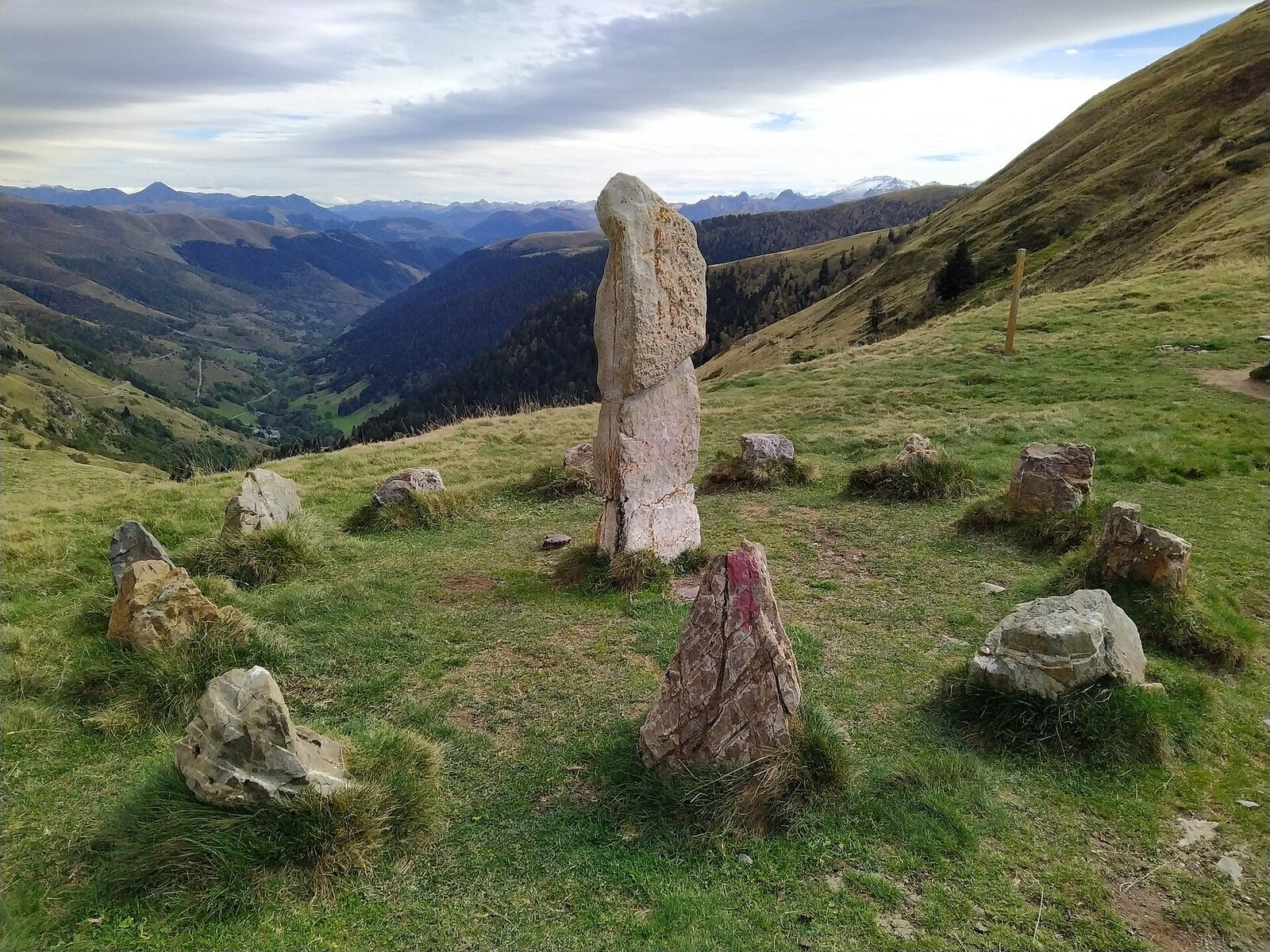
Finally, cromlechs or stone circles are among the most enigmatic monuments of the Pyrenean heights. These circular arrangements, made of standing or laid blocks bounding a space, appear above all at the end of the Neolithic and in the Bronze Age, frequently on the passes and crests, where the transhumance paths run. Many have a funerary or commemorative function; they may mark territories, line out routes, sacralise places of passage. Their siting, precisely on the herders' circulation axes, suggests an intimate link between the world of the dead and that of pastoral mobility. On the heights, the standing stone accompanies the flock.
These monuments raise a fascinating question: why so much effort devoted to raising stones in places so harsh and so far from permanent settlements? The answer no doubt lies in the particular role the high mountains held in the imagination of these societies. A place of passage between the valleys, a frontier between worlds, a space frequented only in the warm season, altitude lent itself to a powerful symbolic charge. To bury one's dead there, to erect circles of stone there, was perhaps to assert a right over the pastures, to honour the ancestors who had opened the paths, to mark the threshold between the familiar and the unknown. The prehistoric mountain was not only a larder or a pasture: it was also a sacred landscape, strewn with memorial markers that the living crossed at each transhumance.
Seasonal mobility and early transhumance
At the heart of this history lies a simple principle: the high mountains are not lived year-round, they are lived by seasons. The harshness of the upland winter, snow, cold, isolation, makes permanent occupation impossible or very difficult. But in summer, the high pastures offer abundant grass and accessible game. The whole prehistoric occupation of the heights is organised around this annual pulse: one climbs in the warm season, one descends before the snows. It is seasonal mobility, already present among the Mesolithic hunters, that later structures all of pastoralism.
This summer ascent of the flocks to the high pastures has a name: transhumance. It is often thought typical of historical times, of the great medieval and modern networks of drove roads. Yet altitude archaeology shows that its roots reach much further back. As early as the Neolithic, herders were driving their animals from the valleys and foothills up to the summer pastures, in a seasonal back-and-forth that prefigures historical transhumance. The dating of the high-altitude huts and hearths, keyed to the warm season, and the circulation of materials between plain and mountain, draw this system of complementarity between tiers: the plain for winter, the mountain for summer.
This mobility presupposes an elaborate social organisation. It must be decided who climbs, with which animals, by which paths; agreement must be reached on the use of the pastures, the flocks of several families or communities must be managed, the experience of routes and dangers must be transmitted. Transhumance is not a simple movement of animals: it is an institution, a collective knowledge, a shared calendar. By recognising its antiquity, archaeology reveals that the prehistoric societies of the mountain already possessed a remarkable capacity for coordination and planning across an extended territory.
One can glimpse, behind this system, the first seeds of questions that will run through the whole history of pastoral societies: to whom do the high pastures belong? How is a seasonal resource to be shared among several communities? Who has the right to climb, and when? These tensions, which historical mountain societies would settle through customs, charters and sometimes conflict, must already have arisen, in one form or another, for the Neolithic herders. The cromlechs of the passes, the boundaries traced in the landscape, the repeated attachment to the same locations could well be the material traces of these ancient arrangements. Transhumance is not only a technique: it is a social pact inscribed in the mountain.
It also presupposes a strong link between spaces that seem in every way separate: the cultivated lowlands inhabited all year, and the heights frequented for a few months. These two worlds are not watertight; they form a single economic system, in which each plays its part. The high mountains are not a marginal elsewhere, but the indispensable complement of the plain, the vertical extension of a territory inhabited in all its depth.
What the mountain preserves: peat bogs, pollen, palaeoenvironment
The archaeology of the high mountains does not feed on stones and charcoal alone. It also draws on the natural archives that the upland environment preserves with exceptional fidelity. Peat bogs, those wetlands where organic matter accumulates without fully decomposing, are treasures in this respect. Layer after layer, year after year, they trap pollen, micro-charcoal, the remains of plants and insects. By coring a peat bog and dating its levels, one reads a continuous history of vegetation and climate over thousands of years.
Pollen analysis is decisive here. Each plant species produces a recognisable pollen; by counting the grains trapped in each layer of peat, one reconstructs the plant cover of the past. The signature of humans then appears. The retreat of trees, the spread of pasture grasses, the appearance of plants linked to the trampling of flocks or to open ground, the presence of spores of dung-loving fungi that grow on animal droppings: all are clues of pastoral activity. When, in an upland peat bog, the forest abruptly retreats in favour of grasslands and the grazing markers multiply, it is the prehistoric herder speaking through the pollen.
These archives confirm and complete the archaeological data. Where hearths and huts attest a punctual presence, the pollen reveals its diffuse and lasting impact on the landscape. One then understands that the vast upland grasslands, that landscape so characteristic of the high Pyrenees, are largely a human creation. Pastoral fire, clearance and repeated grazing opened the forest cover, pushed the tree line downward, and shaped the summer pastures as we know them. The bareness of the heights is not an original state: it is the imprint of millennia of herding.
The micro-charcoal trapped in the peat tells another facet of this history: that of fire. The charcoal peaks, dated and correlated with the phases of occupation, signal the episodes when humans burnt the vegetation, no doubt to maintain and extend the pastures. The prehistoric mountain was also a mountain of fire, shaped by deliberate burning as surely as by the teeth of the livestock. By linking archaeology, palynology and the study of charcoal, researchers reconstruct a genuine narrative of the palaeoenvironment, in which nature and culture are inextricably intertwined.
This narrative compels us to rethink the very notion of "wild" nature. When a hiker today contemplates a summer pasture flecked with flowers, they believe they are seeing a fragment of an intact world, prior to humankind. Yet this meadow is the fruit of a co-evolution lasting several millennia between the flocks, pastoral fire and climate. Remove the grazing, and the forest climbs back, the broom invades, the landscape closes up: what seemed eternal proves to be maintained. The high Pyrenean mountains are thus one of the vastest and oldest cultural landscapes in Europe, an involuntary garden that hundreds of generations of herders sculpted without being aware of it. Recognising this imprint changes our gaze: to protect these environments is also to preserve a human work, and not only a virgin nature.
A comparison with the Alps: the lesson of Ötzi
The Pyrenees are not an isolated case. The Alps tell a parallel story, and one cannot evoke the archaeology of the high mountains without citing the most famous of its witnesses: Ötzi, the iceman. Discovered in 1991 in a Tyrolean glacier, at more than three thousand metres, this body mummified by the cold was dated to about five thousand three hundred years ago, in the heart of the Neolithic #s3. His exceptional preservation, skin, organs, clothing, equipment, stomach contents, makes him an incomparable window onto the life of a man of the prehistoric high mountains.
Ötzi was neither lost nor a tourist of his time. Everything in his equipment testifies to an intimacy with altitude: shoes designed for snow, a coat of woven grasses, a copper axe, a bow and arrows, a fire-making kit, provisions. He was crossing a high pass when death overtook him, struck by an arrow. His presence at that altitude, in that period, confirms in striking fashion what Pyrenean archaeology establishes by other means: the Neolithic high mountains were a space crossed, exploited, integrated into human movements.
The comparison between the two ranges is illuminating. In both cases, we observe an occupation reaching back to the start of the Holocene, a transition from hunter to herder, a development of high-altitude pastoralism, a structured seasonal mobility. But the Alps offer, thanks to their glaciers, a mode of preservation that the Pyrenees, less glaciated, scarcely possess: the ice that mummifies and freezes organic objects. Where the Pyrenees yield mostly stones, charcoal and pollen, the Alps can return, as they melt, bodies, fabrics, intact wooden tools. The two ranges complement each other: one demonstrates the density and continuity of the occupation, the other sometimes restores its very flesh.
The contents of Ötzi's stomach, his equipment, the pollen stuck to his clothing made it possible to reconstruct his last days, his last meals, the altitude of his final movements. No Pyrenean deposit will ever yield so intimate a testimony. But this difference does not stemstemThe narrowed base of a point, used to haft it onto a shaft or handle.→ from any lesser occupation of the Pyrenees: it stems from the chance of preservation. The Pyrenees, lower and less glaciated, long ago let melt the ice that might have mummified their own travellers. What the iceman brings to the Pyrenees is proof by example: he embodies, in flesh and hide, the kind of human who also haunted the high Pyrenean passes, and of whom here we find only the extinguished hearths and the collapsed walls.
This juxtaposition is a reminder that the prehistoric occupation of the high mountains is not a local curiosity, but a phenomenon on the scale of the great European ranges. Wherever summer-accessible pastures bordered inhabited plains, human societies knew how to climb, exploit and inhabit the heights. The verticality of the territory, far from being an obstacle, was a resource that prehistory knew how to seize.
Today's stakes: climate and glacial archaeology
The archaeology of the high mountains is today at a crossroads, both carried and threatened by climate change. Current warming is making the glaciers retreat and the permanent snowfields melt at an unprecedented rate. Yet ice, as we saw with Ötzi, is a formidable preserver. For millennia it sealed and protected organic objects, wood, leather, textiles, human and animal remains, that any other environment would have made vanish. Its melting reopens these frozen strongboxes and offers archaeologists unhoped-for discoveries.
This is the object of a fast-growing discipline: glacial archaeology. On the high passes and the margins of glaciers, researchers now scrutinise the retreating ice, on the lookout for objects that the melt releases. Arrows lost by hunters, abandoned equipment, the remains of animals: these relics emerge at the edge of the snowfields, often in an astonishing state of preservation. But this window is fleeting and cruel. Once exposed to air, water and frost, these organic objects degrade within a few seasons. They must be gathered quickly, before they rot. Glacial archaeology is a race against the clock, in which every melt season brings its harvest of finds and its harvest of losses.
Climate change also threatens, more broadly, the whole set of upland archives. Peat bogs dry out, soils destabilise, erosion accelerates on weakened slopes. The stone structures themselves, long protected by their isolation, are exposed to new uses and new damage. Safeguarding this heritage requires inventorying it quickly, dating it, understanding it before it disappears. The high mountains, long neglected by archaeology, thus become a terrain of urgency.
There is a deep irony here. It is the same warming that, by melting the ice, reveals prehistoric treasures and destroys the archives that would allow them to be understood. To study the ancient occupation of the summits is also to measure the fragility of an environment and the depth of the link between human societies and their surroundings. The Neolithic herders who climbed to the summer pastures already lived in a changing climate, which set the rhythm of the pastures' accessibility. In reading their history, we also read, as in a mirror, our own.
Glacial archaeology, finally, imposes a new organisation of research. It is no longer enough to schedule excavations in advance: the glacier fronts must be monitored continuously, observers must be trained, and one must sometimes rely on the hikers and guides who report a find at the edge of a snowfield. This science of urgency combines systematic survey, opportunistic watch and extreme-precaution conservation, for a wooden or leather object thousands of years old, suddenly exposed, can disintegrate in a single season if it is not immediately stabilised. The melt that reveals the past is also the one that condemns it; between the two, there remains a narrow window that researchers strive to seize.
Conclusion: the mountain, a territory of the long term
At the end of this journey, the image of the "empty" high mountain collapses for good. Far from having been a human desert reserved for the bold of modern times, the Pyrenean heights were visited, exploited and inhabited almost continuously for around ten thousand years. From the hearths of the Mesolithic hunters to the huts of the Neolithic herders, from the enclosures to the cromlechs raised on the passes, from the pollen-laden peat bogs to the radiocarbon dates that line the slopes, everything converges on a single conclusion: the mountain has been part, since the start of the Holocene, of the lived world of human societies.
This history is first of all one of adaptation. Faced with a demanding environment, human groups knew how to invent a way of inhabiting it by seasons, of turning its harshness into a resource, of weaving a lasting link between the plains and the summits. From the hunter following the chamois to the herder driving his flock up to the summer pasture, it is the same intelligence of the terrain that is transmitted, generation after generation, beyond the economic revolutions. Transhumance, thought to be medieval, sinks its roots into the Neolithic; high-altitude pastoralism, which shaped the landscapes we admire, is a millennia-old invention.
This history is also one of a landscape. The close-cropped pastures, the open grasslands, the bare heights that make the beauty of the Pyrenees are not an intact natural backdrop: they bear the signature of millennia of grazing, fire and clearance. The "wild" mountain is in reality one of the oldest and vastest collective works of European humanity, a landscape shaped as much by the teeth of the flocks as by the hand of humans.
Finally, this history is a warning. The archives that revealed it to us, ice, peat bogs, upland soils, are today melting and crumbling under the effect of warming. The same heat that yields the frozen arrows of prehistoric hunters erases the pages that remained to be read. To study the long human presence on the high summits is to measure how ancient, deep and fragile our link to the mountain is. Beneath the close-cropped grass of the summer pastures, ten thousand years of fires, flocks and standing stones still wait for us to learn how to hear them.
Ce qui me touche, c'est de voir que le geste technique existe depuis si longtemps. La main qui travaille, c'est universel.
Mes enfants et moi avons visité la grotte de Niaux en Ariège il y a deux ans et c'est une expérience inoubliable. Voir les bisons peints dans le salon noir à la lumière d'une lampe frontale, comme les artistes paléolithiques devaient les voir à la lueur d'une torche, c'est un moment magique. Je recommande vivement à toute famille de faire cette expérience.
Les Pyrénées sont une région extraordinaire pour la préhistoire, avec des dizaines de grottes ornées dont certaines sont encore inédites. La concentration de sites du Magdalénien dans cette zone, comme Niaux, Le Mas-d'Azil ou Gargas, en fait l'une des régions les plus riches du monde pour l'art paléolithique. Un voyage préhistorique dans les Pyrénées devrait etre obligatoire pour tout amateur.