In the heart of the Haryana plain, about a hundred and fifty kilometres north-west of Delhi, a series of ochreOchreA red or yellow mineral pigment (iron oxides), used from prehistory for adornment, funerary rites and art.→ mounds rises above the cultivated fields. Beneath these mounds lies one of the largest sites of the Indus CivilisationIndus CivilisationA major Bronze AgeBronze AgeA protohistoric period following the Neolithic, defined by bronze metallurgy (a copper-tin alloy) and the rise of the first cities and states; in Egypt it corresponds to the age of the first pyramids.→ urban civilisation (c. 2600-1900 BC) across present-day Pakistan and north-west India: planned cities (HarappaHarappaA major city of the Indus Civilization, in the Pakistani Punjab, the first site excavated and the one that gave the Harappan culture its name.→, Mohenjo-daroMohenjo-daroOne of the largest cities of the Indus Civilization (Sindh, Pakistan), famed for its Great Bath and grid layout; a World Heritage site.→), standardised bricks, undeciphered script, no monumental palaces.→, in its broadest estimates as vast as the emblematic cities of Mohenjo-daro and Harappa on the other side of the present India-Pakistan border. The site bears the name of the modern villages that partly cover it: Rakhigarhi. Long overshadowed by the great Harappan metropolises of the Indus basin, it became, in the late 2010s, the stage for a discovery of international resonance: the first complete ancient genome ever obtained for an individual of this civilisation.
In 2019, an international team led by the archaeologist Vasant Shinde and the geneticist Vagheesh Narasimhan published in the journal Cell the analysis of the ancient DNADNAThe molecule carrying genetic information, used to reconstruct kinship between species.→Ancient DNAGenetic material preserved in old remains, often degraded, sequenced with cutting-edge techniques.→ extracted from the skeleton of a woman buried at Rakhigarhi some four to five thousand years ago1. The result, announced in the very title of the paper, was striking: this genome carried no detectable trace of steppeSteppeA vast semi-arid, treeless grassland of Eurasia, suited to nomadic herding and the horse; a corridor for the movement of peoples and technologies in later prehistory.→ ancestrySteppe ancestryA genetic component derived from the pastoralists of the Pontic steppes (Yamnaya and related cultures) spreading across Europe and Asia in the Bronze Age; its absence in the Harappan individual from Rakhigarhi reopened debates on South Asian peopling.→, nor the genetic signature of Anatolian farmers in the sense understood for Europe. Instead, it combined two major components: a lineage related to the ancient hunter-gatherersHunter-gatherersA way of life based on hunting, fishing and gathering wild resources, without farming or herding; it dominated almost the whole of human history.→ of South Asia and a lineage linked to ancient Iran. To understand why this seemingly technical result triggered such a heated debate, one must place it in its archaeological, genetic and political context. That is the aim of this dossier, which strives to distinguish what the study establishes, what it suggests, and what it does not say. This caution is not mere formality: on such charged ground, nuance is the first of all requirements.
Rakhigarhi, giant of the Indus
Rakhigarhi lies in the district of Hisar, in Haryana, north-western India. The site occupies a particular position: it stands not on the Indus itself but on the Ghaggar-Hakra plain, a now largely dried-up river system that some researchers identify with the Sarasvati river of ancient texts, an identification that remains debated. This eastern location, well away from the great cities of the Indus basin proper, makes Rakhigarhi an essential witness to the geographical extension of the Indus CivilisationIndus CivilisationA major Bronze Age urban civilisation (c. 2600-1900 BC) across present-day Pakistan and north-west India: planned cities (Harappa, Mohenjo-daro), standardised bricks, undeciphered script, no monumental palaces.→ eastward, into regions that are today Indian.
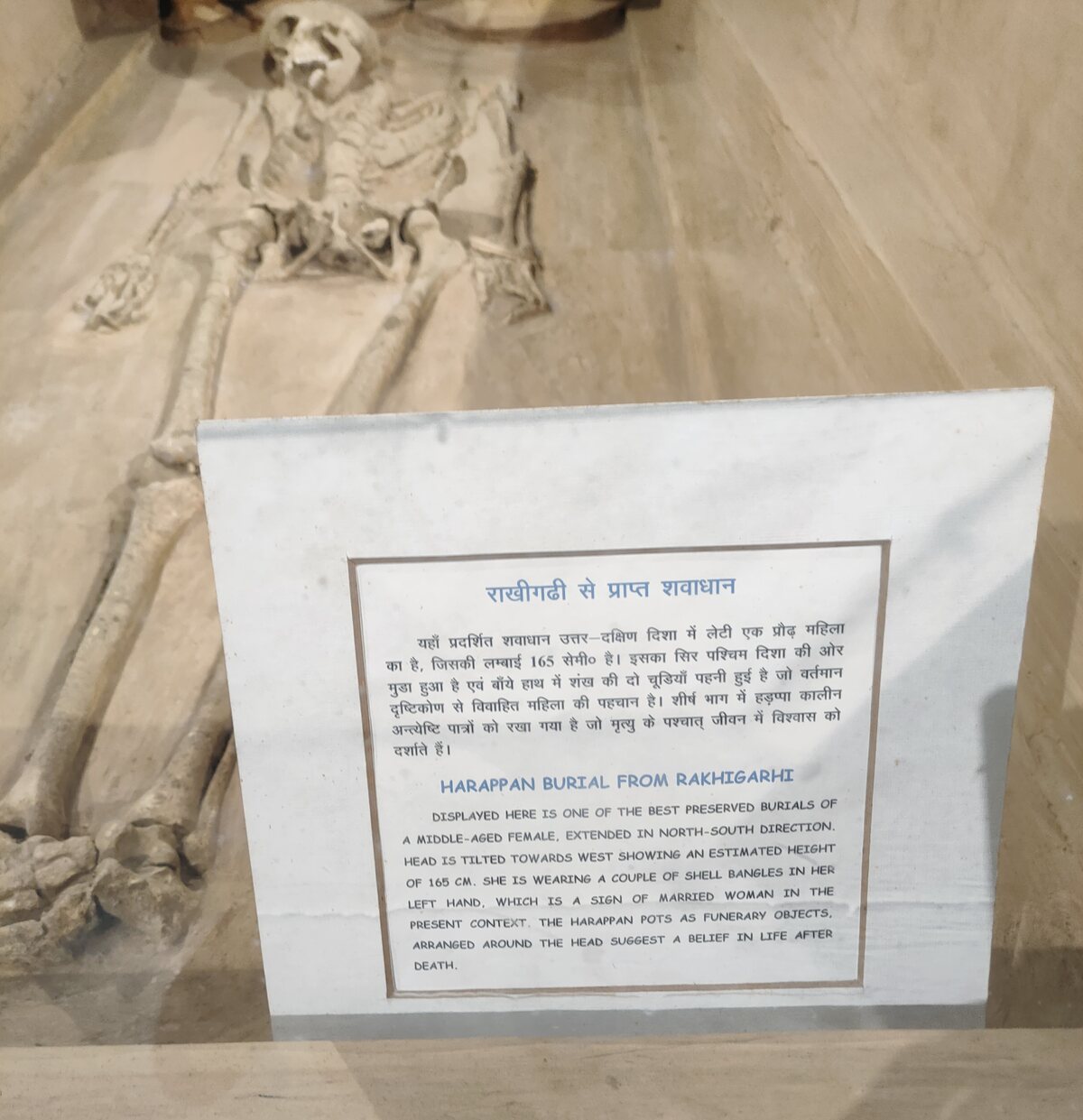
Excavations, conducted notably by the Archaeological Survey of India and then by Indian university teams, have revealed a vast settlement organised into several mounds, designated by letters. They have brought to light streets, structures of mud and fired brick, drainage systems, workshops, abundant pottery, ornaments, seals and a cemetery. The exact extent of the site remains debated: estimates vary depending on whether all the mounds and the peripheral occupation zones are counted together. According to the most generous assessments, Rakhigarhi would rank among the largest known Harappan settlements2. This scale, and the presence of a scientifically excavated cemetery, explain why the site was chosen for the search for ancient DNAAncient DNAGenetic material preserved in old remains, often degraded, sequenced with cutting-edge techniques.→.
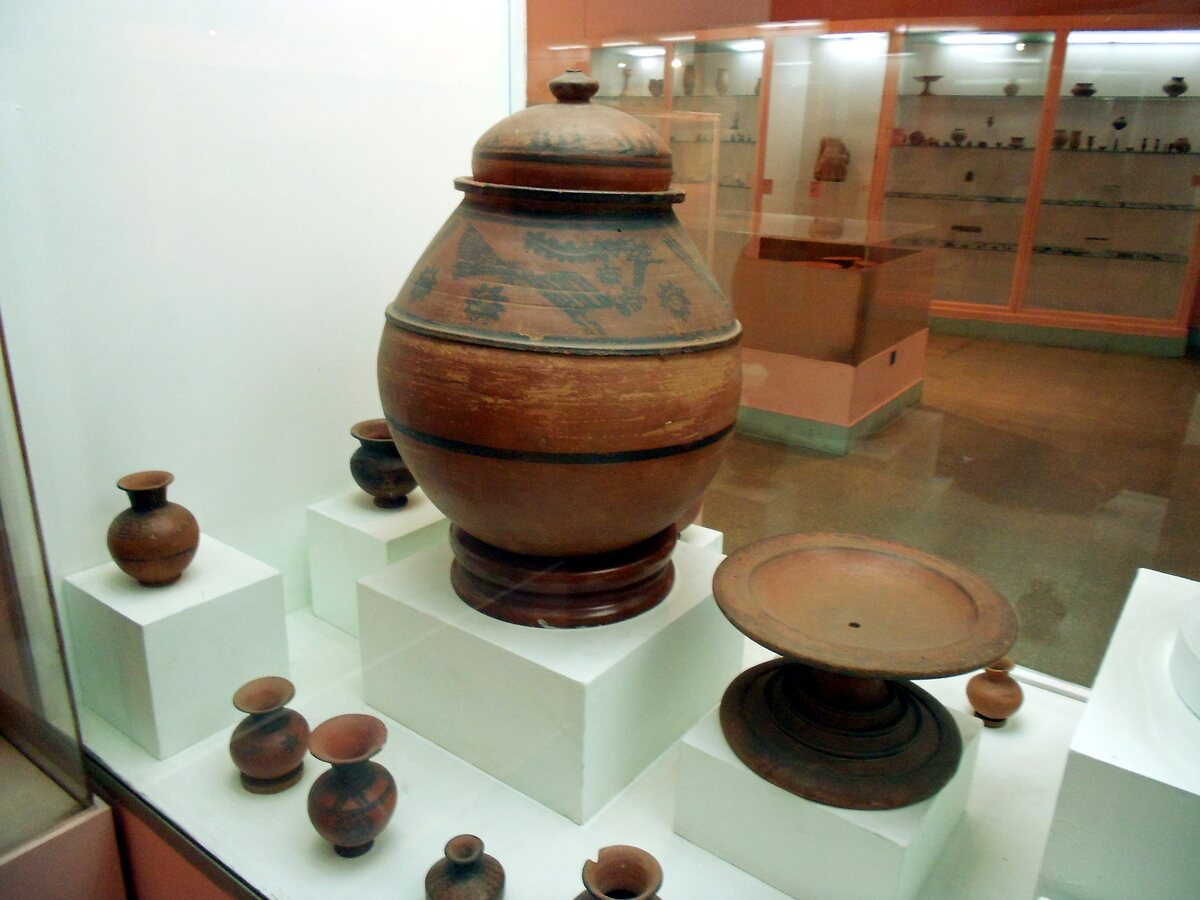
The material culture uncovered at Rakhigarhi confirms the site's full belonging to the Harappan world: painted pottery with characteristic motifs, engraved seals, carnelian and steatite beads, terracottaTerracottaClay shaped and then hardened by firing; the material of pottery, bricks and figurines, ubiquitous since the Neolithic.→ figurines, traces of craft activities. These objects, comparable to those of the other great Indus sites, attest to integration into the trade networks and shared aesthetic codes common to the whole civilisation. This relative homogeneity of material culture, across a nonetheless immense territory, is one of the most remarkable features of the Harappan world, and it gives full meaning to the study of an individual from Rakhigarhi: this person did belong to the same cultural sphere as the inhabitants of Mohenjo-daro or Harappa, even though nothing guarantees a priori a genetic homogeneity as clear as the material one. A shared style of pottery or a common system of weights tells us about networks of exchange and communication; it does not, in itself, tellTellAn artificial mound formed by the accumulation of successive layers of settlement remains at the same spot, typical of the Near East. Each destruction-rebuilding event adds a stratum.→ us whether the people using these objects were biologically uniform. Keeping material and biological homogeneity distinct is one of the elementary precautions that the Rakhigarhi case makes concrete.
The occupation of Rakhigarhi is, moreover, ancient: it is thought to begin as early as the so-called pre-Harappan phase, before the urban flowering, and to continue through the mature phase of the civilisation. The site thus offers a stratigraphic sequence spanning several centuries, a precious asset for linking material remains to a chronology. The cemetery in particular has yielded burials whose orientation, grave goods and funerary gestures inform us about the community's practices. It is in this setting that the grave from which the 2019 genome derives was uncovered, giving it a solid archaeological anchoring, an indispensable condition for rigorous interpretation.
It should be stressed that Rakhigarhi remains, in part, a living site: modern villages occupy a portion of the mounds, which complicates excavation and forces trade-offs between scientific research and the daily life of the inhabitants. This coexistence, common at the great sites of the subcontinent, reminds us that archaeology does not unfold in virgin territory but in inhabited landscapes, where past and present intertwine. It also explains why a significant part of the site remains unexplored, and why our knowledge, while advancing, stays partial.
The history of research at Rakhigarhi is itself instructive. Identified during the twentieth century, the site was the object of large-scale excavation only late, and intermittently, which long limited its visibility in the international literature, to the benefit of the Pakistani sites explored from the 1920s. More recent campaigns, supported by Indian institutions, changed this by placing Rakhigarhi in the foreground, notably for research in palaeogeneticsPalaeogeneticsThe study of ancient DNA extracted from remains (bones, teeth, sediments, walls) to reconstruct the past of populations.→. This trajectory shows how the geography of research, as much as the geography of sites, shapes what one believes one knows about a civilisation: a major site can remain understudied for decades for reasons that owe more to resources and priorities than to its actual importance.
The Indus Civilisation in brief
The Indus CivilisationIndus CivilisationA major Bronze Age urban civilisation (c. 2600-1900 BC) across present-day Pakistan and north-west India: planned cities (Harappa, Mohenjo-daro), standardised bricks, undeciphered script, no monumental palaces.→, also called the Harappan Civilisation after the site of Harappa where it was first recognised in the 1920s, is one of the three great urban civilisations of the Bronze Age Old World, alongside Mesopotamia and Egypt. Its mature phase is generally dated to roughly 2600 to 1900 BC. It extended over an immense territory, covering present-day Pakistan and a large part of north-western India, which makes it, by area, the largest of the three.
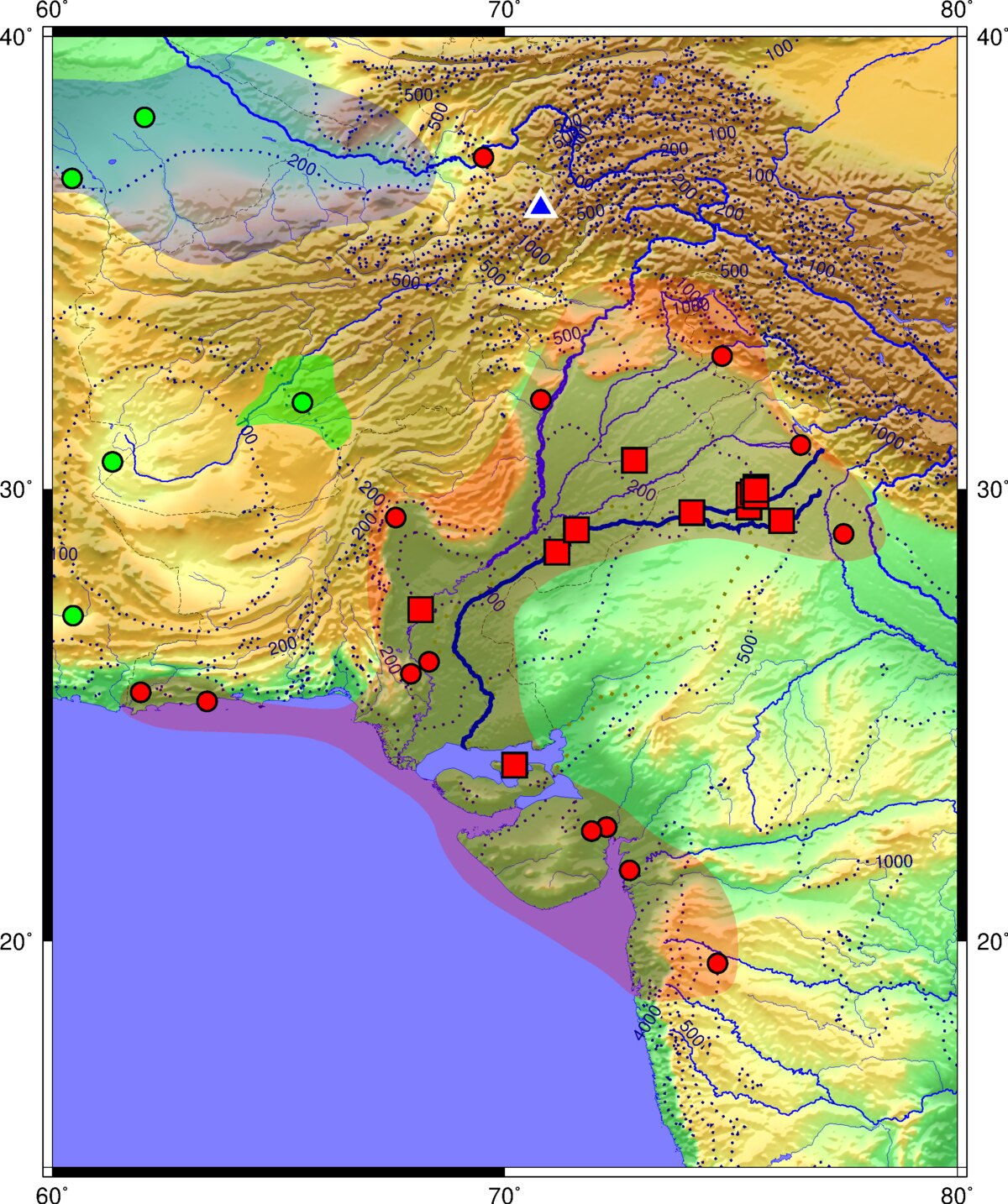
Several features distinguish this civilisation. Its cities, such as Mohenjo-daro, Harappa, Dholavira and Rakhigarhi, display planned urbanism, with oriented streets, drainage networks and systems of weights and measures standardised over vast distances. The HarappansHarappanPertaining to the Indus Civilisation, named after its first excavated site, Harappa (Pakistani Punjab); refers to the material culture, script and people of that civilisation.→ practised diversified agricultureAgricultureThe cultivation of plants and production of food by working the soil, which emerged in the Neolithic in the Near East and independently elsewhere; it radically transformed human societies.→, animal husbandry, the crafting of pottery and ornaments, and maintained long-distance trade, as far as Mesopotamia, where objects of Indus origin have been found. They left a script, engraved notably on seals, which remains to this day undeciphered, depriving researchers of direct access to their language and texts.
The absence of monumental palaces, of clearly identified temples, or of representations of rulers has long fed hypotheses about a political and social organisation that was less centralised, or differently structured, than that of their Mesopotamian and Egyptian contemporaries. Lacking a deciphered script, these hypotheses remain largely dependent on the interpretation of material remains. The decline of the civilisation, around 1900 BC, is likewise debated: climateClimateThe long-term average atmospheric conditions of a region; its variations (glaciations, aridifications) shaped migrations, agriculture and the collapse of prehistoric societies.→ change, shifts in river regimes, the reorganisation of exchange networks and population movements are variously invoked, without any single factor commanding consensus. Nor did the civilisation collapse abruptly; it went through a so-called post-urban phase, marked by the dispersal of settlement and the transformation of ways of life.
What is striking, in the study of this civilisation, is the contrast between the richness of its material culture and our ignorance of its deeper organisation. We know its weights, its seals, its drainage systems, the regularity of its bricks, but we do not know the names of its rulers, the content of its texts, the exact nature of its beliefs. This asymmetry is no detail: it conditions how the contributions of genetics fit in. Unable to read the Harappans in their own words, one is tempted to seek in their genes answers to questions that those genes, by their very nature, cannot settle. PalaeogeneticsPalaeogeneticsThe study of ancient DNA extracted from remains (bones, teeth, sediments, walls) to reconstruct the past of populations.→ illuminates the history of populations, their composition and their admixtures; it restores neither the languages, nor the institutions, nor the narratives that these populations told about themselves.
It is against this rich but fragmentary backdrop that the contribution of palaeogeneticsPalaeogeneticsThe study of ancient DNA extracted from remains (bones, teeth, sediments, walls) to reconstruct the past of populations.→ arrives. Where the mute seals and silent ruins leave vast areas of shadow, the study of ancient genomes promises to illuminate a hitherto inaccessible dimension: the biological composition of the populations that built these cities. But this promise, as we shall see, comes with strong methodological constraints, and the Indus Civilisation was long a blind spot of the discipline, for want of usable material.
The stakes of an ancient genome
Since the mid-2010s, ancient DNAAncient DNAGenetic material preserved in old remains, often degraded, sequenced with cutting-edge techniques.→ has transformed the study of the peopling of South Asia. Large syntheses, based on hundreds of individuals sampled from Europe to Central Asia and the Indian subcontinent, have proposed a model in which present-day South Asian populations result from the mixture of several ancestral sources. But these reconstructions long rested on indirect data: genomes of neighbouring populations, modern individuals, or remains located outside the Harappan heartland. A central piece was missing: the DNA of an inhabitant of the Indus CivilisationIndus CivilisationA major Bronze Age urban civilisation (c. 2600-1900 BC) across present-day Pakistan and north-west India: planned cities (Harappa, Mohenjo-daro), standardised bricks, undeciphered script, no monumental palaces.→ itself.
This gap is no trivial matter. The hot climates of South Asia are especially unfavourable to the preservation of DNA, which degrades all the faster as temperature rises. Extracting a usable genome from a skeleton several millennia old, buried in a hot plain, is a technical feat. It is precisely this challenge that the Rakhigarhi team met, at the cost of a considerable effort of sampling and sequencingSequencingReading the order of the bases (A, T, G, C) of a DNA molecule; high-throughput sequencing reads millions of fragments in parallel.→. Obtaining the genome of an unquestionably HarappanHarappanPertaining to the Indus Civilisation, named after its first excavated site, Harappa (Pakistani Punjab); refers to the material culture, script and people of that civilisation.→ individual, dated and contextualised by archaeology, made it possible for the first time to confront genetic models directly with the populations of the Indus, rather than only with their presumed neighbours or descendants.
The stakes went beyond mere scientific curiosity. The origins of South Asian populations, the question of where the languages spoken in the subcontinent came from, and the way agricultureAgricultureThe cultivation of plants and production of food by working the soil, which emerged in the Neolithic in the Near East and independently elsewhere; it radically transformed human societies.→ appeared there, touch on ancient and sensitive identity-related and political narratives. A Harappan genome was awaited as a possible arbiter, sometimes with an impatience that said much about the stakes. Caution, however, requires recalling from the outset a major limitation, to which we shall return: a genome is the story of one individual, not of an entire people. No expectation, however strong, can dispense with this elementary precaution.
The expectation of a Harappan genome was also part of a broader scientific dynamic. The 2010s saw ancient DNA overturn the understanding of the peopling of Europe, revealing successive waves of migrationsMigrationsLong-distance movements of populations; a major driver of human history (the exit from AfricaAfricaThe cradle of humankind: the continent where the first hominins appeared, then Homo sapiens around 300,000 years ago, before the expansion to the rest of the world.→, the peopling of continents, Neolithic and steppe expansions).→, notably from the steppe. It was natural to seek to apply the same grid to the Indian subcontinent, whose genetic history remained comparatively poorly documented. But transposing a framework forged elsewhere carries risks: each region has its own demographic history, and the categories relevant for Europe are not necessarily so for South Asia. The value of the Rakhigarhi genome is precisely to offer a local calibration point, anchored in the very heart of the civilisation, rather than a reasoning by analogy with other regions.
This is also why the result was awaited with such attention well beyond specialist circles. A direct genome from the Indus heartland promised to replace inference with observation, conjecture with measurement. Yet the lesson of Rakhigarhi is, in part, that even a long-awaited observation does not abolish uncertainty: it reshapes it, displaces it, and opens new questions in place of the old. That, far from being a disappointment, is exactly how a healthy field of inquiry is supposed to behave.
The 2019 study: method and the limits of the sample
The study published in Cell in 20191 rests on the analysis of the ancient DNAAncient DNAGenetic material preserved in old remains, often degraded, sequenced with cutting-edge techniques.→ extracted from the remains of a woman buried in the cemetery of Rakhigarhi. The authors took numerous samples, in particular from the petrous bone, the part of the skull surrounding the inner ear, known to preserve DNA better than other tissues. Out of a large number of attempts, only one yielded authentic ancient DNA in sufficient quantity to be analysed, which concretely illustrates the difficulty of preservation noted above.
The genetic material recovered was degraded and present in small quantity, as is typically the case for ancient DNAAncient DNAGenetic material preserved in old remains, often degraded, sequenced with cutting-edge techniques.→. The researchers therefore worked on a genome of modest coverage, applying the standard controls of palaeogeneticsPalaeogeneticsThe study of ancient DNA extracted from remains (bones, teeth, sediments, walls) to reconstruct the past of populations.→ to verify the authenticity of the signal and rule out modern contamination: examination of the chemical damage characteristic of ancient DNA, which accumulates at the ends of fragments, estimation of contamination rates, comparison with databases of ancient and present-day populations. These safeguards are essential: modern DNA, ubiquitous in the excavation and laboratory environment, can easily contaminate a sample and distort conclusions.
Once the authenticity of the signal has been verified, the analysis of origins relies on statistical tools that compare the studied individual with a broad panel of ancient and present-day populations. These methods do not "read" an origin directly: they assess to what extent the observed genome can be reconstructed as a mixture of reference sources, and in what proportions. The result therefore depends closely on the populations chosen as references and on the quality of their own genomes. When the authors conclude that there is a mixture of two components, they assert that such a model suffices to account for the data, without a third source being required; they do not absolutely exclude every other history, they retain the most parsimonious one given the available evidence. Understanding this logic is indispensable for gauging both the strength and the limits of the conclusion. It also explains why two competent teams, working on the same genome but with different reference panels or assumptions, might reach slightly different estimates without either being mistaken: the result is not a single fixed number but a range constrained by the model. This inherent flexibility is not a weakness to be hidden; it is the ordinary condition of a young and rapidly advancing discipline, and acknowledging it openly is itself a mark of scientific honesty.
To reinforce their interpretations, the authors compared this genome with that of contemporary individuals from sites located on the periphery of the Harappan world, in eastern Iran and Central Asia, who displayed a comparable genetic profile. These individuals, found far from the Indus heartland, were interpreted as migrants or descendants of migrants linked to the Indus Civilisation, which suggested that the profile identified at Rakhigarhi was not isolated but shared by at least part of the Harappan population. This indirect argument strengthens the reach of the study, without however lifting its fundamental limitation.
For one must state clearly the principal limitation, which the authors themselves stress: the conclusions rest, for the Harappan heartland, on a single individual. However careful the analysis, a single genome cannot, by itself, represent the genetic diversity of a civilisation that extended over hundreds of thousands of square kilometres and several centuries. This is why the tone of the paper, like that of this dossier, is meant to be measured: one describes a profile, one does not decree the identity of a people. This restraint does not weaken the result; it sets its exact perimeter.
What the genome says
The central result of the study can be put in a single formula: the genome of the Rakhigarhi individual is modelled as a mixture of two major sources, without it being necessary to invoke a third component to account for the data1. The first source is a lineage related to the ancient hunter-gatherers of South Asia, sometimes referred to in the literature as an ancient indigenous ancestry of the subcontinent. The second is a lineage linked to ancient Iran, more precisely to populations of Iran that separated very early from other West Asian groups.
Two absences give this profile its full significance. On the one hand, the genome shows no detectable steppe ancestrySteppe ancestryA genetic component derived from the pastoralists of the Pontic steppes (Yamnaya and related cultures) spreading across Europe and Asia in the Bronze Age; its absence in the Harappan individual from Rakhigarhi reopened debates on South Asian peopling.→, that is, none of the genetic component associated with the pastoralists of the Pontic and Caspian steppes, whose spread towards Europe and South Asia in the Bronze Age is otherwise well documented by other studies. On the other hand, and this is more subtle, the component linked to Iran appears to have separated from western Iranian lineages before the advent of agricultureAgricultureThe cultivation of plants and production of food by working the soil, which emerged in the Neolithic in the Near East and independently elsewhere; it radically transformed human societies.→ in that region. In other words, according to the authors' interpretation, this Iranian ancestry would not be that of farmers who brought agricultural techniques with them, but that of a population that had diverged earlier.
This point is delicate and deserves to be handled with care. It does not mean that there was no link between Iran and South Asia, quite the contrary: the Iranian component is precisely one of the two building blocks of the genome. It rather suggests that the timing and nature of this link differ from what one might have assumed. PalaeogeneticsPalaeogeneticsThe study of ancient DNA extracted from remains (bones, teeth, sediments, walls) to reconstruct the past of populations.→ does not measure nationalities or cultures: it compares statistical profiles of genetic variation and estimates, under certain models, proportions of mixture and dates of divergence.
It is worth pausing on the notion of a lineage "linked to ancient Iran". This expression does not mean that the woman of Rakhigarhi "came from Iran", nor that her ancestors had recently left the Iranian plateau. It designates a genetic kinship with a set of West Asian populations, some of which lived in present-day Iran, a kinship that may go back to very ancient times. Modern borders and nations have no relevance at these timescales: to speak of "ancient Iran" is a convenience of language referring to a region and a genetic stock, not to a state or a people in the contemporary sense. This lexical clarification, far from being pedantic, prevents a frequent misreading that consists in projecting present-day geopolitical categories onto the deep past.
The conclusions therefore depend on the available reference populations and on the assumptions of the models, which invites us to receive them as revisable estimates rather than as definitive truths. Should new ancient genomes, from Iran, Central Asia or the subcontinent, come to enrich the set of comparisons, the estimated proportions and divergence dates could be adjusted. Such is the nature of this science: its results are photographs taken with the instruments of the moment, bound to gain in sharpness as data accumulate. The robustness of the Rakhigarhi result lies less in a precise figure than in the overall coherence of the two-component model, which accounts for the data without resorting to steppe ancestry.
What it does NOT say
The media echo of the study has at times led to shortcuts that it is important to correct. First, and this point can never be repeated too often, the results concern one individual. To assert that the HarappansHarappanPertaining to the Indus Civilisation, named after its first excavated site, Harappa (Pakistani Punjab); refers to the material culture, script and people of that civilisation.→, as a people, had no steppe ancestry on the sole basis of this genome would be an imprudent extrapolation. The study establishes that one individual from Rakhigarhi, at a given period, displayed this profile; it does not close off the possibility of genetic diversity within the Indus CivilisationIndus CivilisationA major Bronze Age urban civilisation (c. 2600-1900 BC) across present-day Pakistan and north-west India: planned cities (Harappa, Mohenjo-daro), standardised bricks, undeciphered script, no monumental palaces.→, nor of changes over its many centuries of existence.
Next, the absence of a steppe signal in this individual says nothing, in itself, about when such steppe ancestrySteppe ancestryA genetic component derived from the pastoralists of the Pontic steppes (Yamnaya and related cultures) spreading across Europe and Asia in the Bronze Age; its absence in the Harappan individual from Rakhigarhi reopened debates on South Asian peopling.→ appeared in South Asia. Other work, based on samples located elsewhere and at other periods, generally places the arrival of the steppe component in the subcontinent after the decline of the urban phase of the Indus, that is, after the time of the Rakhigarhi individual. The Harappan genome is therefore consistent with this timeline, but it does not demonstrate it on its own: it constitutes one anchoring point among others, to be articulated with the whole body of regional data.
Moreover, this genome says nothing about the language spoken by this woman, nor about her physical appearance, nor about her social status. Genetics does not read languages: no mechanical correspondence exists between a genetic profile and a language family, as countless historical examples of populations changing language without major biological renewal illustrate. Likewise, the result neither validates nor invalidates directly any particular contemporary identity narrative.
Rigour consists in carefully separating what the analysis measures from the historical, linguistic or political interpretations one might be tempted to attach to it. A genome provides estimated proportions of mixture and dates of divergence; it does not provide a narrative of belonging. It is precisely because the subject is sensitive that this methodological discipline is necessary. Otherwise, a precious scientific datum risks being enlisted in the service of causes foreign to it, and distorted in the process.
One should add that this genome says nothing either about the continuity or discontinuity between the Harappans and the present-day populations of the subcontinent. Establishing such a link requires comparing many genomes, ancient and modern, and modelling centuries of intermediate admixture. Yet present-day South Asian populations result, according to the available models, from complex combinations of several ancestral sources, of which the components highlighted at Rakhigarhi are only a part. To draw, from this single genome, conclusions about the direct ancestry of one or another contemporary group would, again, exceed what the data permit one to affirm.
Agriculture: the spread of ideas rather than genes?
One of the most discussed implications of the study concerns the origin of agricultureAgricultureThe cultivation of plants and production of food by working the soil, which emerged in the Neolithic in the Near East and independently elsewhere; it radically transformed human societies.→ in South Asia. For a long time, two major models opposed each other in explaining the spread of the NeolithicNeolithicThe "New Stone Age": a period marked by farming, herding, settlement and pottery, from around 10,000 BC.→ beyond the Fertile CrescentFertile CrescentAn arc-shaped region of the Near East (Levant, Mesopotamia) where farming and herding first emerged.→. According to the first, it was mainly populations of farmers who moved, carrying with them both their genes and their know-how, in a process of demographic colonisation. According to the second, it was above all techniques, plants and animals that circulated from place to place, adopted by local populations without massive population replacement.
If one follows the interpretation of the authors of the Rakhigarhi study, the Iranian component of the Harappan genome would have diverged before the appearance of agriculture in the region of the Near EastNear EastA region of western Asia (LevantLevantA region of the eastern Mediterranean Near East (Israel, Lebanon, Syria, Jordan), a major crossroads of the first human migrations out of Africa.→, Mesopotamia, Anatolia, Iran), cradle of the Neolithic revolutionNeolithic revolutionThe shift from hunter-gatherer societies to farming and settled life (c. 10,000 BCE in the Near East), giving rise to villages and then cities.→, agriculture, the first cities and writingWritingA system of conventional signs used to fix language or information durably; its appearance (c. 3300 BC) marks, by convention, the end of prehistory.→.→. This would weaken the idea of a spread of agriculture driven mainly by a migrationMigrationsLong-distance movements of populations; a major driver of human history (the exit from Africa, the peopling of continents, Neolithic and steppe expansions).→ of farmers coming from the west into the Indus valley. The picture that emerges would rather be one of local adoption of agricultural practices, or of partly autonomous development, by populations whose Iranian ancestry was ancient and not tied to a recent wave of farmers bearing the Neolithic package.
This reading accords with a current of archaeology that emphasises, for South Asia, the role of local processes in the emergence of production economies. Sites such as Mehrgarh, in Baluchistan, document an early and partly original Neolithisation, which cannot be reduced to a simple transplantation of Near Eastern models. The Rakhigarhi genome would lend biological support to this idea of a specific regional trajectory.
It is important to specify what the notion of the spread of agriculture covers in practice. The shift to a production economy, in the NeolithicNeolithicThe "New Stone Age": a period marked by farming, herding, settlement and pottery, from around 10,000 BC.→, is not a single event but a set of transformations spread over centuries: the domestication of plants and animals, sedentismSedentismThe shift from a nomadic life to lasting settlement in one place, a precondition for the rise of villages.→, storage, new forms of social organisation. Each of these elements may have spread at its own pace and through distinct channels. To reduce the question to a clear-cut alternative between "migration of genes" and "circulation of ideas" therefore amounts to simplifying a process that is in reality composite. The genetic profile of an individual, however informative, illuminates only one facet of this picture, that of the biological composition of populations, and leaves in shadow the properly cultural and technical dimension of Neolithisation.
It nonetheless remains an interpretation, dependent on a single Harappan genome and on the precision of the divergence models. Other teams call for caution and stress that the distinction between the spread of genes and the spread of ideas is rarely clear-cut: the two phenomena may have coexisted to varying degrees according to regions and periods, and the overly sharp opposition between the two models is no doubt a simplification. The question remains open, and new ancient genomes, sampled across several sites and several phases, will be needed to refine it. As things stand, caution requires presenting this implication as a plausible and stimulating hypothesis, not as an established conclusion.
The debate over the Indo-Aryan languages
No aspect of this dossier calls for as much caution as the question of languages. A large part of South Asia today speaks so-called Indo-Aryan languages, the eastern branch of the vast Indo-European family. The origin and mode of spread of these languages are the subject of long-standing debates, in which linguistics, archaeology, genetics and, inevitably, identity-related considerations are intertwined. This debate extends far beyond the frame of a single site or a single genome.
Many linguists relate the expansion of the Indo-European languages, over the long term, to population movements originating in the Eurasian steppes. Within this framework, the spread of the steppe ancestrySteppe ancestryA genetic component derived from the pastoralists of the Pontic steppes (Yamnaya and related cultures) spreading across Europe and Asia in the Bronze Age; its absence in the Harappan individual from Rakhigarhi reopened debates on South Asian peopling.→ highlighted by ancient DNAAncient DNAGenetic material preserved in old remains, often degraded, sequenced with cutting-edge techniques.→ is sometimes invoked as one material argument among others. The Rakhigarhi genome enters this debate indirectly: to show that a Harappan individual did not carry this component, at a time when the urban phase of the Indus was still alive, is compatible with the idea that the steppe component arrived later in the subcontinent, after the mature phase of the civilisation.
One must, however, hammer home a caveat. Genetics does not demonstrate the history of languages: a population can change language without changing genes, and vice versa, and history offers many examples of such decouplings. To derive firm linguistic conclusions from a single genome would be a clear methodological error. The spread of a language depends on social, political and cultural factors that genetics does not capture.
Furthermore, this terrain is, in South Asia as elsewhere, heavy with political and identity-related stakes, certain narratives seeking to root contemporary belongings in a reconstructed past. The soundest position consists in setting out the hypotheses in play, indicating what the data support and what they do not settle, and refraining from any categorical conclusion. The Rakhigarhi genome contributes a piece to a vast puzzle; it does not solve it, and to claim otherwise would betray the caution that the authors themselves observed.
One will keep in mind, finally, that the terms used in these debates, "Indo-Aryan", "steppe", "indigenous", are first of all technical tools, whose meaning in the mouth of a linguist or a geneticist does not necessarily coincide with the one they take on in public discourse. A significant part of the misunderstandings arises from this shift of vocabulary, when a term defined precisely in a scientific paper is taken up, out of context, with an identity-related charge it did not have. Vigilance over words is, here, inseparable from vigilance over facts. It is in this spirit that this dossier approaches the question.
Science and the politics of history
The reception of the Rakhigarhi study illustrates a difficulty proper to archaeology and palaeogeneticsPalaeogeneticsThe study of ancient DNA extracted from remains (bones, teeth, sediments, walls) to reconstruct the past of populations.→ when they touch on the origins of peoples: their results are immediately seized upon by public debates that go beyond them. In South Asia, the questions of population and language origins are part of long-standing controversies, sometimes instrumentalised for political ends. The same scientific result can then be read, by opposing camps, as confirming contrary theses, which says much about the share of projection attached to these subjects.
This context imposes on journalist and researcher alike a strict ethics. It consists in separating facts from interpretations, in presenting uncertainties, in not over-interpreting a single sample, and in being wary of formulations that turn a statistical estimate into a definitive verdict on the identity of a people. The authors of the 2019 study themselves took care to formulate their conclusions in measured terms, and several commentaries in the scientific and general press recalled the need not to extrapolate beyond what a single genome permits3.
The best response to the political uses of prehistoryPrehistoryThe span of human history before the invention of writing, from the Palaeolithic to the Metal Ages, known mainly through material remains.→ is not silence but methodological clarity. Explaining how ancient DNAAncient DNAGenetic material preserved in old remains, often degraded, sequenced with cutting-edge techniques.→ is obtained, what it really measures, why a single individual cannot represent an entire civilisation, and how much the models depend on the available data, arms the reader against simplifying narratives. Giving the public the means to understand the limits of a study also makes it more resistant to partisan readings that thrive on misunderstanding.
Science advances by accumulation and revision: each new ancient genome refines, completes or corrects the picture, without ever fixing it. Rakhigarhi is, in this respect, a milestone, not an endpoint. Far from closing the debate, the 2019 study above all showed that it was now possible to bring new data to it, directly from the heart of the Indus Civilisation, and opened the way to future analytical campaigns. This is perhaps its most lasting legacy: to have proved that Harappan ancient DNAAncient DNAGenetic material preserved in old remains, often degraded, sequenced with cutting-edge techniques.→, long deemed out of reach, could be read.
Conclusion
The 2019 analysis of the genome of a HarappanHarappanPertaining to the Indus Civilisation, named after its first excavated site, Harappa (Pakistani Punjab); refers to the material culture, script and people of that civilisation.→ woman from Rakhigarhi will remain an important stage in South Asian archaeology: for the first time, the ancient DNAAncient DNAGenetic material preserved in old remains, often degraded, sequenced with cutting-edge techniques.→ of an inhabitant of the Indus CivilisationIndus CivilisationA major Bronze Age urban civilisation (c. 2600-1900 BC) across present-day Pakistan and north-west India: planned cities (Harappa, Mohenjo-daro), standardised bricks, undeciphered script, no monumental palaces.→ was directly sequenced and confronted with the models of regional peopling. The profile obtained, a mixture of a lineage of ancient South Asian hunter-gatherers and a lineage linked to ancient Iran, with no detectable steppe ancestrySteppe ancestryA genetic component derived from the pastoralists of the Pontic steppes (Yamnaya and related cultures) spreading across Europe and Asia in the Bronze Age; its absence in the Harappan individual from Rakhigarhi reopened debates on South Asian peopling.→ in this individual, revived discussions about the origins of South Asian populations, about the way agricultureAgricultureThe cultivation of plants and production of food by working the soil, which emerged in the Neolithic in the Near East and independently elsewhere; it radically transformed human societies.→ spread there, and about the chronology of the great population movements of the Bronze Age.
But the most lasting contribution of this study lies perhaps as much in its limits as in its results. A genome is one individual; a civilisation is a diversity that only numerous samples can reveal. The conclusions drawn from Rakhigarhi are estimates, suspended on models and reference populations bound to be enriched. They invite curiosity, not certainty, and resist by construction the narratives that would freeze them into identity-related truths.
As other remains yield their ancient DNAAncient DNAGenetic material preserved in old remains, often degraded, sequenced with cutting-edge techniques.→, and as methods grow sharper, the account of the peopling of South Asia will gain in nuance and depth. The mound of Rakhigarhi, a discreet giant of the Haryana plain, has surely not finished nourishing this demanding dialogue between bones, genes and history, a dialogue that progresses only on condition of respecting, at every step, the critical distance between what the data show and what one would like to make them say. The history of a population is not a flag, and the genome of a single woman buried four thousand years ago in the Haryana plain is neither a banner nor a verdict, but a fragment of evidence to be read with patience and humility. It is at this price, and at this price alone, that prehistory remains a science and not the mirror of our contemporary preferences.
Le ton est idéal pour de la médiation : ni trop universitaire, ni trop simplifié.
En parallèle de la lecture, j'ai ouvert la carte interactive. Tout s'emboite parfaitement.
Depuis ce site, je l'utilise comme référence pour ce que doit être un bon article de fond.