Irish archaeologists announced in 2025 a discovery that overturns understanding of the Late Bronze AgeLate Bronze AgeThe final phase of the Bronze Age in the Near East (c. 1550 to 1200 BCE), an age of great empires and international diplomacy, ended by a general collapse.→ in Ireland. The site of Ringhill, in County Down in Northern Ireland, has revealed during extensive excavations the remains of a settlement of unprecedented scale for this period: more than 200 circular structures spread across at least 25 hectares, occupied between approximately 1210 and 780 BCE1. This is not a hamlet, nor a village: it is a proto-town, the largest known centre of Bronze AgeBronze AgeA protohistoric period following the Neolithic, defined by bronze metallurgy (a copper-tin alloy) and the rise of the first cities and states; in Egypt it corresponds to the age of the first pyramids.→ occupation in Ireland.
A discovery born from aerial survey
The story of the discovery of Ringhill begins in the air. In 2021, a LiDARLiDARLaser-based remote sensing (from "Light Detection And Ranging"): a sensor fires light pulses and measures the echo's return time to map a surface in three dimensions. Mounted on a plane or a drone, it slips through gaps in the canopy and reconstructs the bare-earth relief, revealing structures invisible beneath vegetation.→ (Light Detection and Ranging) survey commissioned as part of a programme to map the archaeological heritage of Northern Ireland revealed a striking anomaly in the agricultural fields of County Down: regular circular forms showed up beneath the crops, invisible from the ground. The Ulster Archaeology team, alerted by this data, launched a ground-based geophysical surveyGeophysical surveyTechniques (magnetometry, radar) detecting buried structures underground without digging, by measuring physical anomalies.→ campaign that confirmed the existence of dozens of buried structures across several tens of hectares.
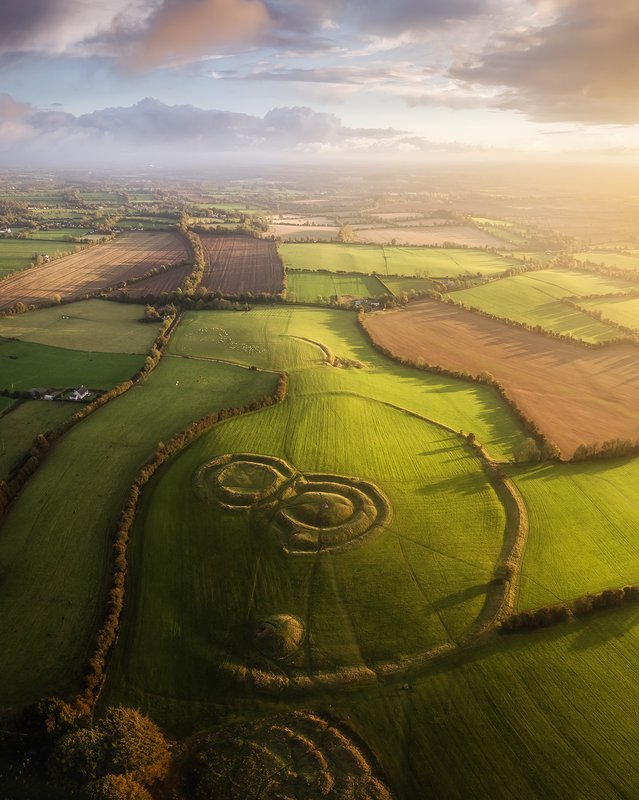
Excavations led since 2022 by a joint team from the University of Ulster and the Historic Environment Division of the Northern Ireland Department for Communities have gradually revealed the true extent of the site2. The 200 circular structures identified to date include dwelling houses of various sizes, storehouses, cattle enclosures, and open spaces interpreted as communal areas. The density of structures in some sectors is remarkable: buildings are sometimes separated by just a few metres.
A hierarchical society with Atlantic connections
The architectural variety at Ringhill is one of the most revealing elements of the social complexity that existed there. The largest buildings, concentrated in the central part of the site, measure up to 15 metres in diameter and show careful construction with regularly spaced load-bearing posts3. These structures are interpreted as the residences of a local elite, distinct from the more modest dwellings at the site's periphery.
The archaeological finds discovered at Ringhill testify to the site's role as a crossroads in the commercial networks of the Atlantic Bronze Age. Alongside local pottery in the Late Bronze Age Irish ceramic tradition, the excavators uncovered imported bronze objects, Baltic amber beads, and fragments of casting moulds indicating metalworking activity on site. This combination of local production and long-distance imports is characteristic of exchange centres of the Atlantic Bronze Age, which connected communities from Ireland to the Iberian Peninsula.
Carbonised cereal remains, mainly barley and wheat, attest to intensive agricultureAgricultureThe cultivation of plants and production of food by working the soil, which emerged in the Neolithic in the Near East and independently elsewhere; it radically transformed human societies.→ in the lands surrounding the site. Analysis of faunal remains reveals a mixed economy combining cattle and sheep raising, with evidence of seasonal slaughter suggesting periodic gatherings on a larger scale than the simple daily subsistence of a permanent community.
Ringhill in the Late Bronze Age landscape
The discovery of Ringhill forms part of a profound revision of our understanding of the Irish Late Bronze Age. For a long time, Ireland in this period was considered a society of dispersed farmers living in small family groups, without urban organisation comparable to contemporary continental European cultures. Sites like Haughey's Fort in Armagh or Lismullin in Meath had already begun to nuance this picture by revealing large enclosures, but none had the residential density of Ringhill.
The excavators point out that Ringhill is not an isolated phenomenon in the County Down landscape4. Several other, smaller sites lie within a 10-15 kilometre radius, suggesting that Ringhill functioned as a dominant regional centre within a hierarchy of settlements. This model, with a large centre surrounded by smaller satellite sites, recalls the organisation of Bronze Age chiefdoms documented elsewhere in Atlantic Europe, such as Wessex in Britain or the Loire basin in France.
The chronology of occupations reveals at least three major phases of site development over approximately 430 years. The first phase, around 1210-1100 BCE, saw the creation of the first buildings and the installation of the peripheral defensive structure. The second phase, around 1000-900 BCE, corresponds to a notable expansion of the site and the construction of the most elaborate buildings at the centre. The third phase, around 900-780 BCE, precedes the progressive abandonment of the site, perhaps linked to climatic changes documented across Atlantic Europe at this time.
The abandonment of Ringhill around 780 BCE coincides with the beginning of the Iron AgeIron AgeThe last period of protohistory (from c. 1200 BC in Europe and the Near East), marked by iron metallurgy and the first kingdoms.→ in Ireland, a period that sees the introduction of iron-working techniques, the gradual arrival of Celtic-speaking populations, and a reorganisation of social structures. The excavations at Ringhill thus shed essential light on the societies that preceded and perhaps contributed to the formation of historical Celtic Ireland.
No comments yet. Be the first.