Tickle the neck of a baby orangutan and it will produce a burst of staccato panting, mouth open, eyes crinkled. Do the same to a chimpanzee, a gorilla, a bonobo or a human infant, and you will hear something oddly familiar. These sounds are not mere grunts of pleasure, they are genuinely laughter. That is the conclusion of a landmark study published in 2009 in the journal Current Biology by primatologist Marina Davila-Ross and her colleagues at the University of Portsmouth1. By analysing the acoustic structure of tickle-induced vocalisations in five species of great apesgreat apesThe family of great apes (Hominidae) comprising orangutans, gorillas, chimpanzees, bonobos and humans.→, her team showed that our laughter is not a recent, purely human invention, but the outcome of a long shared evolutionary history. The fit of giggles you had yesterday reaches back into a past that is 10 to 16 million years deep.
A fit of laughter fifteen million years old
The idea that animals might laugh long looked like anthropomorphism, the tendency to project human feelings onto beasts. Yet Charles Darwin himself, as early as 1872 in his book on the expression of emotions, had noted that young chimpanzees being tickled made a sound resembling laughter. It took until the twenty-first century, and the tools of modern phylogeneticsphylogeneticsThe study of evolutionary kinship among species, often represented as a branching tree.→, to turn that intuition into rigorous proof. The Davila-Ross study concludes flatly that it is not inappropriate to use the word laughter for the vocalisations that tickling produces in the great apes.
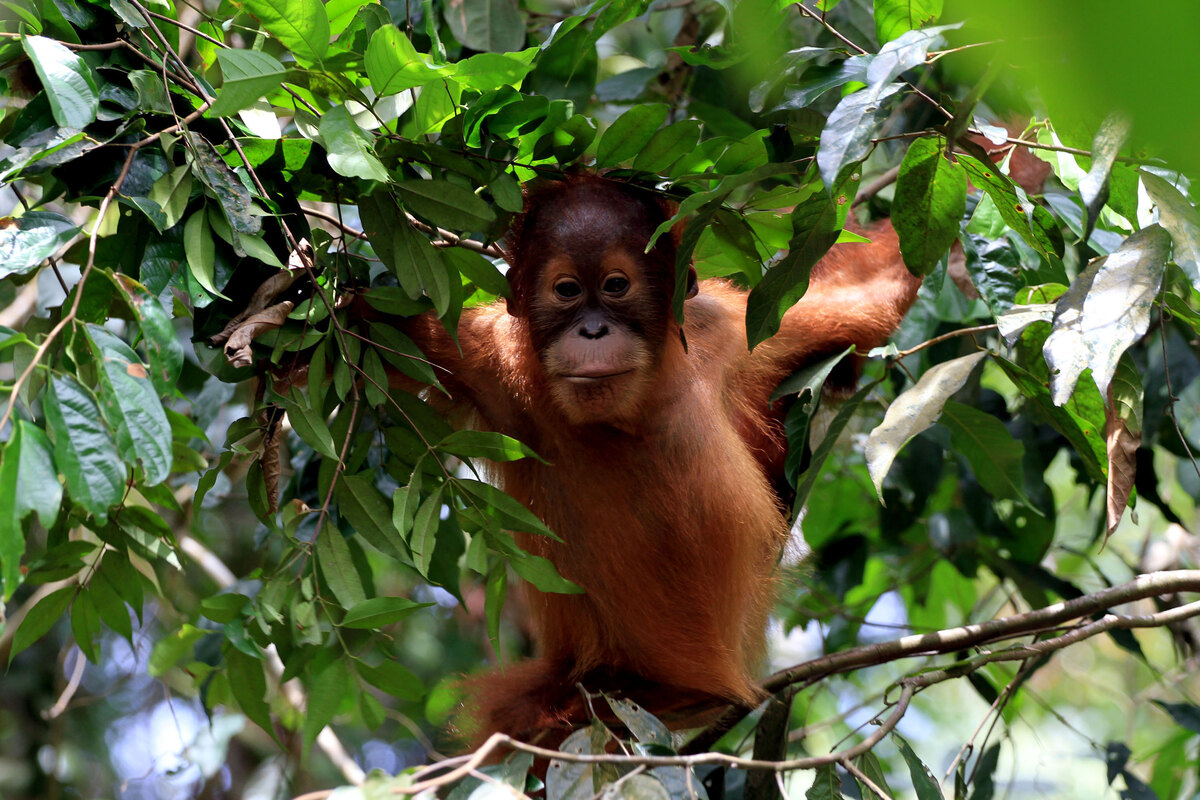
The dating rests on the family tree of the great apes. Our lineage split from that of orangutans roughly 15 to 16 million years ago, then from that of gorillas about ten million years ago, before the human branch diverged from that of chimpanzees and bonobos some 4.5 to 6 million years ago. Since all of these species laugh when tickled, the behaviour must already have existed in their last common ancestor. Laughter would therefore be older than the genus Homo, older than upright walking, older even than the split between gorillas and humans. A comparison with the siamang lineage, a smaller and more distant ape, suggests its roots may run deeper still.
Tickling, the laboratory of emotion
Why tickling, specifically? Because it is one of the few universal and reliable triggers of laughter, in children and great apes alike. The neuroscientist Robert Provine, a pioneer of the scientific study of laughter, or gelotologygelotologyThe scientific study of laughter and its physiological and social mechanisms.→, long stressed how deeply social this stimulus is3. You cannot tickle yourself. The act requires a distinction between self and other, which makes it, in his view, the most primitive social scenario we know. Tickling is a tactile channel of communication between the not yet speaking infant and its mother, and later between friends, family and lovers.
In the chimpanzee, laughter occurs almost exclusively during physical contact or the threat of it, during chasing games, wrestling matches or tickling bouts. In other words, animal laughter is inseparable from play. It is its soundtrack. This link between laughter and contact play, the famous rough-and-tumble of young mammals, reappears unchanged in our own playgrounds. Laughter is not, at first, a reaction to a joke or a witticism, capacities that came much later, but a bodily response to a playful physical interaction.
Marina Davila-Ross's experiment
The Portsmouth team's protocol had the simplicity of the best ideas. The researchers recorded the vocalisations of young great apes as familiar keepers tickled them on the neck, under the arms, on the belly and under the feet, in their usual surroundings. The sample brought together twenty-one individuals, orangutans, gorillas, chimpanzees and bonobos, plus three human infants tickled in the same way, and one siamang. Each recording was then broken down into a host of measurable acoustic parameters, sound duration, rhythm, the presence or absence of voicingvoicingThe production of sound through vibration of the vocal cords, a marked feature of human laughter.→, and the direction of the airflow.
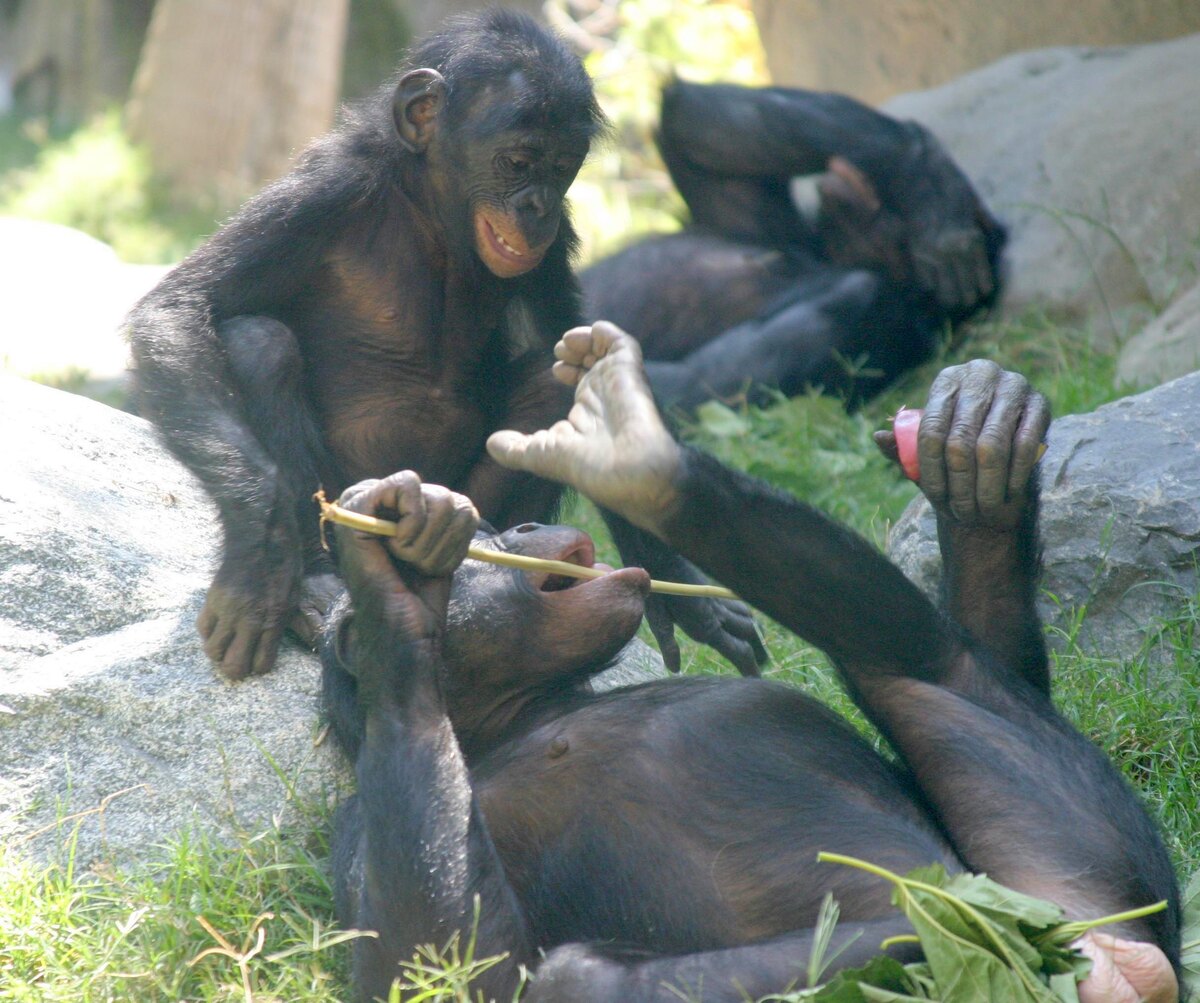
These data were treated not as mere descriptions but as characters, the way a biologist codes the anatomical traits of a fossil to reconstruct kinship. Davila-Ross noted that this was the first phylogenetic test of the evolutionary continuity of a human emotional expression. The gamble was bold, to make the sounds of laughter speak the way genes or bones do, and to see whether they told the same story of relatedness among the species.
A tree of laughter that mirrors genetics
The result was striking. When the researchers built the most probable evolutionary tree from the acoustic features of laughter alone, that tree lined up almost perfectly with the family tree long established by comparative genetics. Human laughter turns out to be acoustically closest to that of bonobos and chimpanzees, a little more distant from that of gorillas, and most distinct from that of orangutans and the siamang. Exactly the order of branching that DNADNAThe molecule carrying genetic information, used to reconstruct kinship between species.→ draws.
This match is strong evidence of homologyhomologyA similarity between two traits that descend from the same character present in a common ancestor.→. In evolutionary biology, two traits are homologous when they descend from a character present in a common ancestor, like the human arm and the bat's wing. If the laughter of the various species were only a chance convergence, there would be no reason for its sound structure to faithfully reproduce the order of genetic splits. The principle of maximum parsimonymaximum parsimonyA methodological principle favouring the explanation that requires the fewest assumptions.→, which favours the explanation requiring the fewest assumptions, then forces a clear conclusion, the laughter of great apes and our own descend from a single ancestral behaviour. Follow-up work from the same team showed that chimpanzees who laugh activate the same facial muscles as laughing humans, and that their open play mouth is homologous with our laughing face.
Play panting, ancestor of the ha ha ha
What does a great ape's laugh sound like? Nothing like a human belly laugh. It is closer to rapid panting, a run of short breaths pushed out on both the inhale and the exhale, a little like a breathless dog after a chase. To an untrained ear it might pass for wheezing or coughing rather than mirth, and yet the acoustic measurements place it firmly on the same branch as our own giggle. Specialists call it play panting. Robert Provine sees in it the key to the origin of laughter, which he argues was born from the labored, panting breathing that accompanies intense physical play3. The chimpanzee's pant-pant and our ha-ha-ha would both betray this rowdy origin, the soundtrack of shared effort in the rough-and-tumble.
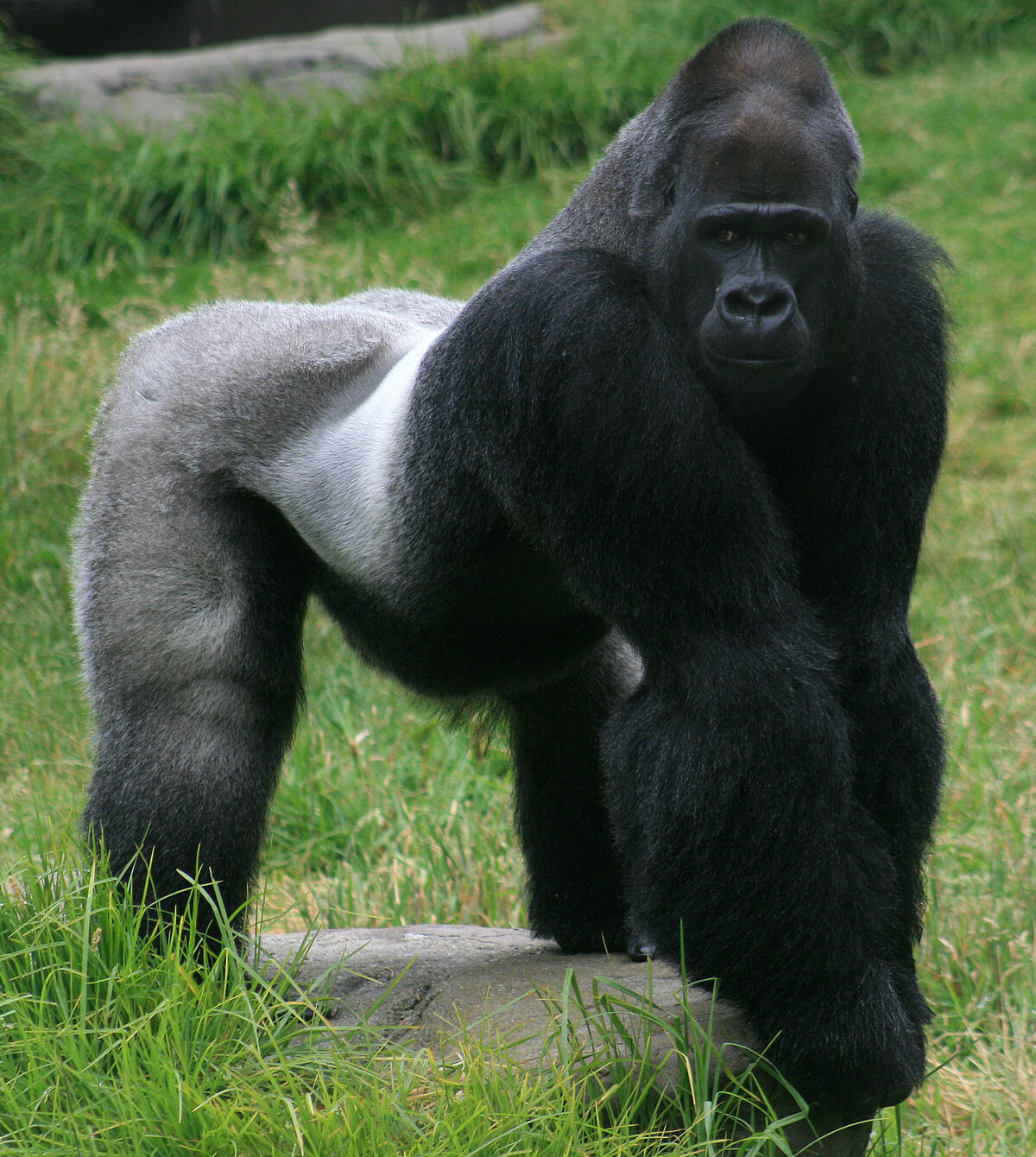
Human laughter, for its part, has exaggerated and reshaped this inheritance. We laugh mostly on the exhale, in a regular series of voiced sounds produced by the vibration of our vocal cords, the familiar ha ha ha. Great apes, by contrast, often alternate the airflow and produce unvoiced sounds, pants and huffs. According to the Portsmouth study, the distinctive features of human laughter were shaped after the split from chimpanzees and bonobos, 4.5 to 6 million years ago, through selection and amplification of pre-existing traits. One finding surprised the researchers, gorillas and bonobos can sustain an exhalation three to four times longer than a normal breathing cycle during their vocalisations, a degree of breath control previously judged typically human and tied to speech.
What is laughter for? The social function
If laughter has been conserved for millions of years across so many species, it must render a valuable service. Its primary function is to signal that play is play. A play fight looks a great deal like a real fight, restrained bites, softened blows, headlong chases. Laughter, paired with the relaxed open mouth of the play face, acts as a ritualised signal that says out loud, this is not aggression, let us stay in the game. It helps prevent escalation into a genuine conflict, a crucial matter when the partners are unequal in strength or unfamiliar with one another.
This marker of non-seriousness makes close physical interaction possible without misunderstanding and tightens the bonds of the group. It reassures a weaker partner that no harm is intended and restrains a stronger one from going too far, so that rough games can continue rather than collapse into fear or fighting. In humans, laughter adds a powerful contagious dimension. Provine observed that laughter erupts mainly in company, very rarely in solitude, and that it spreads from one individual to another like a wave. This contagion synchronises emotional states, welds the group together and cements alliances. Recent work places human laughter on a continuum running from the social grooming of primates to modern forms of intimacy, a social lubricant inherited from our cousins and refined by our species4.
From ape laughter to human speech
Beyond emotion, laughter opens an unexpected window onto the origin of language. Robert Provine argues that the fine control of breath, indispensable for speaking, first revealed itself in laughter. In the great apes, vocalisation remains tightly coupled to the breathing cycle. In humans, upright posture freed the rib cage from its supporting role in four-legged locomotion, an evolution that would have allowed breathing to be uncoupled from movement and the flexible breath control needed both for our characteristic laugh and for speech to be acquired. The fact that gorillas and bonobos already stretch their exhalations well beyond the normal cycle shows that this control began to sharpen very early.
A study published in 2026 extends this reading by analysing the rhythm of laughter. All great ape species produce laughter with evenly spaced intervals, a shared rhythmic pattern that would likewise trace back to a common ancestor around fifteen million years ago. Human laughter keeps this rhythm, but in a faster, more variable and more context-controlled form, a sign of progressively enhanced vocal control. Laughter, older than speech and still shared by all living great apes, would thus offer a rare window onto the vocal transformations that paved the way for articulate language2.
There is something dizzying in the thought that the fit of giggles of a tickled child, the chuckle of two close friends or the nervous laugh that defuses tension are distant echoes of a behaviour born in a vanished great apegreat apesThe family of great apes (Hominidae) comprising orangutans, gorillas, chimpanzees, bonobos and humans.→, somewhere in the tropical forests, fifteen million years before us. Laughter is not what separates us from other animals, it is on the contrary one of the most stubborn threads that binds us to them. We laugh because our ancestors played, and because playing together, without getting hurt, was well worth inventing a signal to say so.
Ce site est exactement ce que je cherchais pour partager la culture historique en famille.
Je reviens pour la cohérence entre contenu éditorial et données géolocalisées. Beau travail.
Toujours utile d'avoir des sources récentes quand on enseigne. Cet article s'y prête vraiment.