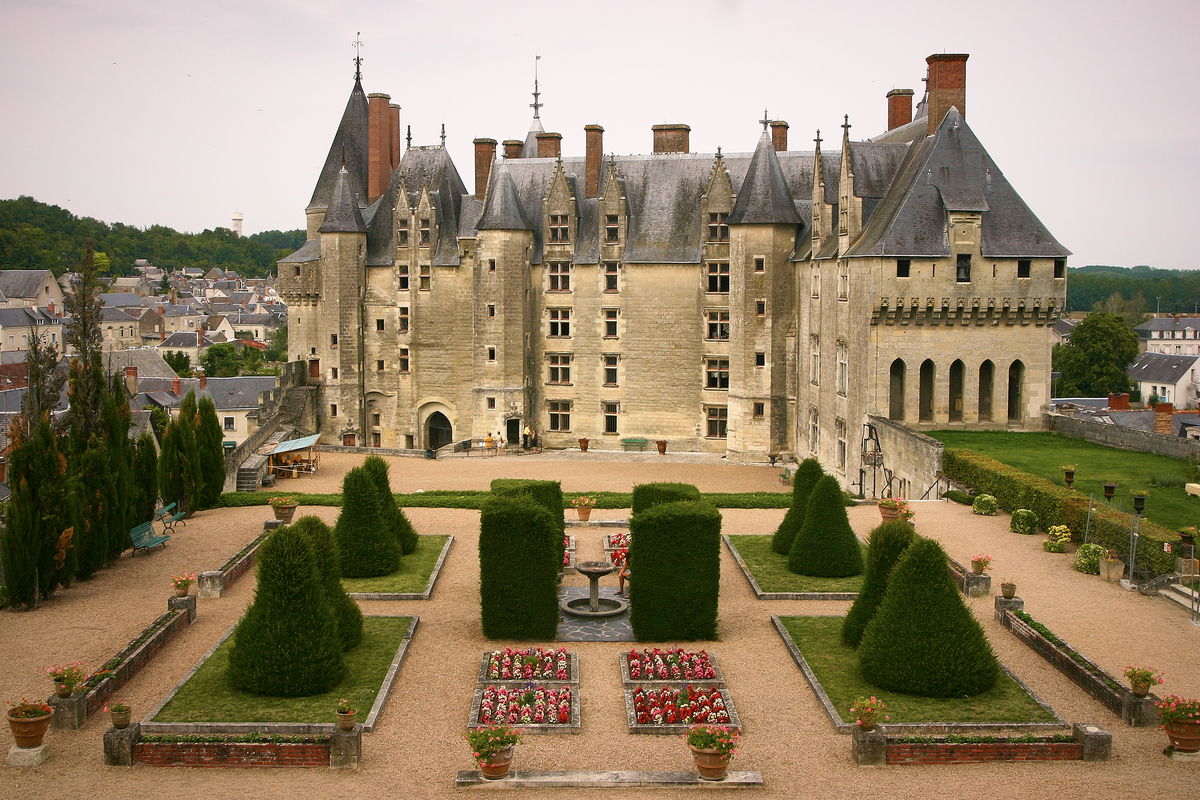
On the right bank of the Loire, at Langeais in the Indre-et-Loire department of France, a modest rocky porch opens into the hillside, a few metres above the river. Nothing about its discretion hints that it holds one of the most debated files in European prehistoryPrehistoryThe span of human history before the invention of writing, from the Palaeolithic to the Metal Ages, known mainly through material remains.→. In June 2023, a team led by prehistorian Jean-Claude Marquet published in the journal PLOS One a long-matured demonstration: the non-figurative marks running across the walls of the La Roche-Cotard cave are intentional engravings, made by NeanderthalsNeanderthalsA fossil humanity of Eurasia, robust and cold-adapted, extinct around 40,000 years before present.→ over 57,000 years ago, and perhaps much earlier.1 This verdict makes the site the oldest decorated place in France, and probably in Europe. It revives a question that has stirred researchers for more than a century: did our vanished cousins also know the gesture of tracing signs for something other than the useful? This feature retraces the cave's history, the scientific inquiry that led to this result, and what it tells us about the Neanderthal mind.
A forgotten cave on the banks of the Loire
The La Roche-Cotard cave was spotted in January 1912, during sand-extraction work at the foot of the cliff. It nestles at the back of a small, south-facing rocky cirque, rising just above the river's present-day bank. The underground complex consists of a narrow gallery, a tunnel some ten metres long, and three wider chambers, extending around forty metres in all.2 This is no vast cavern in the manner of Lascaux or Chauvet, but an intimate, almost confidential cavity, whose interest lies precisely in its singular geological history.
The distinctive feature of La Roche-Cotard, the one that gives the site its whole value, is that its entrance was obstructed very early, and then lastingly, by inflowing sediment. Over the millennia, the Loire's repeated floods piled layers of silt and sand in front of the porch, which eventually sealed the cavity completely. Protected from the outside world, the cave stayed closed until the nineteenth century, when quarrying and earthworks finally reopened the access. This natural infilling acted as a time capsule: it sheltered the walls and floors for tens of thousands of years, barring any later visit and, above all, any intervention by Homo sapiensHomo sapiensThe present-day human species, which emerged in Africa around 300,000 years ago, the only surviving human lineage after the extinction of Neanderthals and Denisovans.→. It is this early sealing which, once dated, will become the keystone of the engravings' attribution.
From the early twentieth century, the first excavations yielded a stone industry characteristic of the Middle PalaeolithicPalaeolithicThe oldest and longest period of prehistory (c. 3.3 Ma–12,000 BC), defined by chipped stone tools and a hunter-gatherer way of life.→Middle PalaeolithicA Palaeolithic period (c. 300,000 to 40,000 years ago) associated mainly with Neanderthals and early Homo sapiens, marked by Levallois tools.→, attributed to the MousterianMousterianThe stone-tool industry typical of Neanderthals, based on the Levallois flaking technique.→, the material culture associated in western Europe with Neanderthals. For decades, however, the site remained marginal in the research landscape, overshadowed by the great decorated sanctuaries of the Périgord and the Ardèche. It would take the systematic resumption of work, at the dawn of the twenty-first century, for La Roche-Cotard to reveal the scale of what it preserves on its walls.
Jean-Claude Marquet and the resumption of excavations
The site owes its scientific rebirth to the prehistorian Jean-Claude Marquet, of the University of Tours. The modern campaigns, resumed from 2008 and continued for some fifteen years, made it possible to explore methodically the various sectors of the cavity and the outer slope. The sedimentary fill, several metres thick, was read layer by layer, yielding a detailed stratigraphyStratigraphyThe study of the superimposed layers (strata) of an archaeological site; each layer corresponds to a phase of occupation and yields a relative chronology.→ in which the successive human occupations and natural deposits are ordered.3
The archaeological material confirms and refines the old intuitions. All the stone tools recovered inside the cave belong to the Mousterian: scrapers, retouched flakes, pieces obtained by Levallois knappingknappingThe set of operations for fracturing a stone block to extract flakes or blades.→, that sophisticated technique of flake prediction which marks the skill of Middle Palaeolithic knappers. To this are added animal bones, some bearing butchery marks, and the remains of hearths. None of this material relates to the Upper PalaeolithicUpper PalaeolithicThe final phase of the Palaeolithic (c. 45,000 to 10,000 years ago), marked by Homo sapiens in Europe, art, ornaments and a succession of cultures (Aurignacian, Gravettian, Solutrean, Magdalenian).→ industries, those that Homo sapiens would bring later. In other words, the only humans whose presence is attested in the cave are Neanderthals.
This cultural coherence is crucial for the rest of the argument. In many decorated caves, the difficulty comes from the superposition of occupations belonging to different species and periods, which makes it tricky to attribute a given mark to one author or another. At La Roche-Cotard, the early sealing and the Mousterian homogeneity of the material rule out this blurring. It remained to be shown that the marks on the walls really were the work of a human hand, and not the product of chance, an animal, or a natural phenomenon. This is the subject of the inquiry published in 2023.
Eight panels, hundreds of finger marks
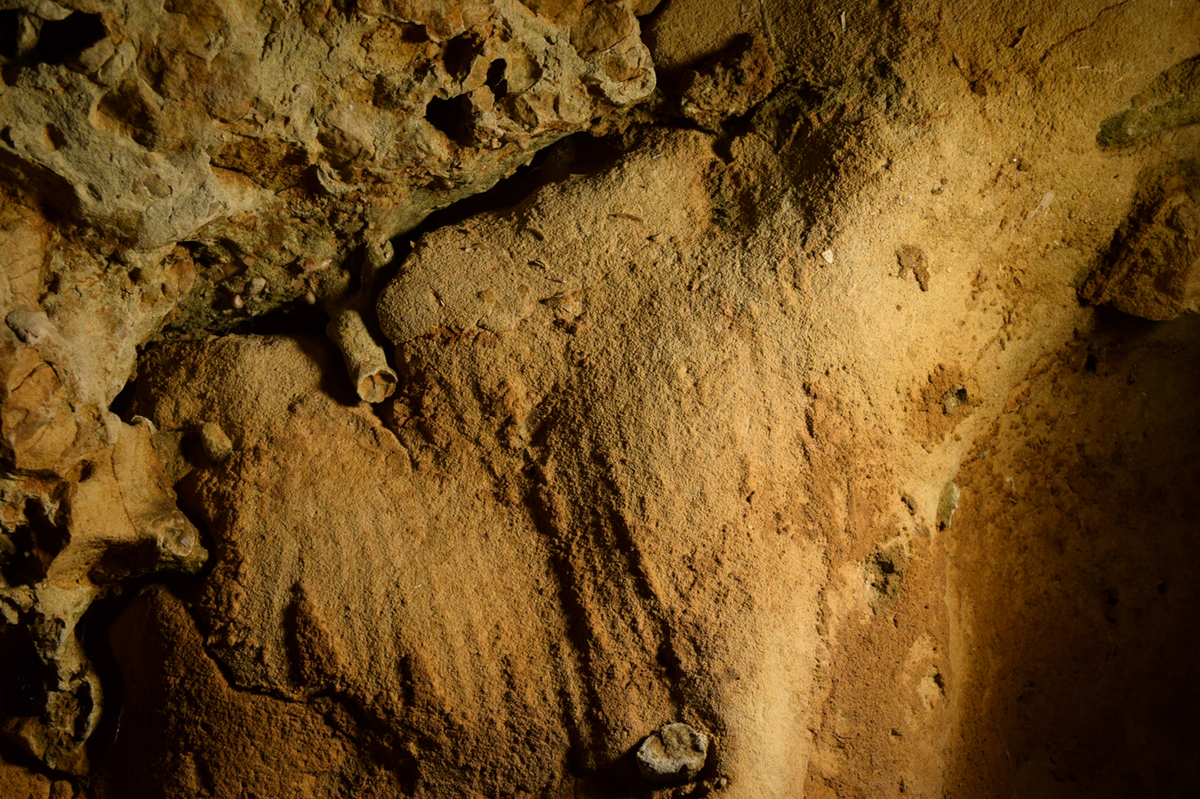
The walls of La Roche-Cotard bear a remarkable set of marks spread across at least eight panels. The 2023 study counts several hundred of them, on the order of four hundred, produced by drawing the fingers across the soft surface of the rock. Specialists call these marks finger flutingsfinger flutingsGrooves left by fingers drawn across a soft film coating the rock surface.→: grooves left when a hand slides over a soft film, ductile enough to retain the imprint of the fingers.1
The arrangement of these marks is anything but random. Several panels lie at human height, between one metre fifty and one metre seventy above the floor, where the gesture of a standing adult falls naturally. The researchers distinguish coherent sets to which they gave descriptive names: a circular panel, whose curved marks meet at the centre to form an ogive shape, a wavy panel where the grooves undulate in parallel, a triangular panel, a dotted panel. The motifs combine lines, bundles of parallel strokes, and punctuations, that is, dots pressed into the wall. The whole obeys a logic of organisation, repetition, and spacing that evokes intent, not mere scribbling.
Another clue argues for the deliberate gesture: the removal of material. The marks do not merely graze the surface, they strip away a thin layer of the soft weathering film that coats the rock, creating a visual contrast between the groove and the surrounding wall. This controlled, regular removal implies measured pressure and a will to mark the support durably. The whole question, then, was whether these marks could result from an agent other than the human hand, bear claws, water flow, natural flaking of the rock, and whether, conversely, the intentional gesture could be proven.
The scientific inquiry: experiment and photogrammetry
To settle the matter, Jean-Claude Marquet's team pursued a two-strand approach, experimental and digital, of methodical rigour. The first strand consists in reproducing the marks. The researchers made trial marks on a comparable surface, systematically varying the instruments: bare fingers, but also tools of bone, wood, flintFlintA hard, brittle siliceous rock, knapped by prehistoric people to produce blades, points and sharp tools.→, and metal points. Each type of instrument leaves its own signature, recognisable by the shape of the groove, its cross-section profile, the way the material is pushed to the edges.1
The second strand rests on three-dimensional imaging. Using photogrammetryphotogrammetryTechnique reconstructing a 3D relief model of an object from many photographs taken at varying angles.→, a technique that reconstructs a relief model from numerous photographs taken at different angles, the researchers produced very precise 3D models of both the wall marks and the experimental ones. They then carried out a comparative analysis, measuring the width, depth, and morphology of the grooves, and matching the ancient marks against the reference collection obtained in the workshop. This objective, reproducible method frees the study from the subjective impressions that long fuelled the controversies over Neanderthal art.
The result is clear: the marks of La Roche-Cotard correspond to marks made with fingers, not with tools, nor by the action of an animal or a natural process. The morphology of the grooves, their grouping in bundles matching the spacing of the fingers of a hand, and their spatial organisation all converge on a single conclusion. The authors describe these productions as deliberate, organised, and intentional shapes, fashioned by human hands. Some of the marks were made with the fingers laid flat, a few others with the edge of a finger, reflecting a varied but controlled gesture. The demonstration, cautious in its wording, is all the more solid for not claiming to read a meaning into these signs: it establishes only, but firmly, that they are the fruit of a deliberate human action.
Dating the undatable: optical luminescence
Showing that the marks are intentional is not enough: one still needs to know when they were traced, and by whom. Yet a non-figurative engraving, devoid of organic pigment, cannot be dated directly by radiocarbon. The researchers therefore sidestepped the obstacle by dating not the marks themselves, but the sediments that eventually sealed the cave. The reasoning is limpid: if we know when the entrance was definitively blocked, we obtain a minimum age for everything already inside, engravings included.4

The method used is optically stimulated luminescenceLuminescence (OSL)Optically stimulated luminescence datingLuminescence datingA method dating the last heating or light exposure of sediments and minerals by measuring energy trapped in the crystal.→: measures the last exposure of sediment grains to light.→ (OSL). Its principle: the grains of quartz or feldspar contained in a sediment accumulate, over time, energy under the effect of the surrounding natural radioactivity. This energy is released as light when the grains are exposed to daylight. Buried away from light, they begin to re-accumulate energy, like a clock restarting. By measuring in the laboratory the amount of energy trapped in a sample taken in the dark, one calculates the time elapsed since its last burialBurialThe intentional deposition of a body, sometimes with offerings; a marker of symbolic behaviour.→, that is, since the sediment was deposited.
Applied to the fill layers of La Roche-Cotard, OSL indicates that the cave became sealed by the accumulation of sediment at least 57,000 years ago. The engravings, necessarily earlier than this blockage, are therefore more than 57,000 years old. Better still: the stratigraphic analysis, which orders the layers by their deposition, suggests that the obstruction may have begun much earlier, pushing the probable age of the marks back toward 75,000 years. This range, from 57,000 to about 75,000 years, places the decorated use of the cave unambiguously at the heart of the Middle Palaeolithic, long before the arrival of modern humans in the region. The authors sum up the stakes: fifteen years after the resumption of excavations, the engravings are dated to over 57,000 years ago and probably to around 75,000 years ago, making La Roche-Cotard the oldest decorated cave in France, if not in Europe.
Who engraved these walls? The Neanderthal case
The core of the demonstration rests on a chronological argument of great simplicity. Homo sapiens is not attested in France before about 54,000 years ago. The major discovery at the Mandrin cave, in the Rhône Valley, did indeed upset the certainties by revealing an early incursion of modern humans around 54,000 years ago, much earlier than had been thought, in a context where Neanderthals still occupied Europe.5 But even this milestone, the oldest known, remains later than the sealing of La Roche-Cotard, and even more so than the 75,000-year hypothesis. At the time the marks were made, no Homo sapiens had yet set foot on the soil of present-day France.
Neanderthals, for their part, have been present in the territory for at least 300,000 years. Over millennia they developed there the Middle Palaeolithic traditions of which the Mousterian is the most accomplished expression. The convergence of clues is therefore total: a site sealed before the arrival of modern humans, an exclusively Mousterian assemblage, a coherent luminescence dating, and marks whose intentionality is established. By elimination as by direct proof of context, the authors of the engravings can only be Neanderthals.
This rigour in building the proof explains the deliberately cautious subtitle of the scientific article, which speaks of the earliest unambiguous Neanderthal engravings on cave walls. The word unambiguous is not trivial: it answers the recurring criticisms that, for decades, have contested the attribution of symbolic productions to Neanderthals, either by doubting their intentionality or by suspecting contamination by more recent occupations. At La Roche-Cotard, the sedimentary sealSealA small engraved object (often steatite) used to stamp a mark in clay; the Indus seals, bearing animals and signs, attest to administration and trade, though their script remains undeciphered.→ and the cultural homogeneity shut the door on these objections. This is precisely what gives the site its status as a reference.
The Mask of La Roche-Cotard
The cave was not on its first enigma. As early as 1975, during the digging of a trench on the outer terrace, the excavators brought to light, in a Mousterian layer rich in butchered bones and marked by a hearthhearthA combustion structure set on the ground, evidence of the mastery of fire and a marker of how a prehistoric dwelling was organised.→, a disconcerting object that came to be nicknamed the Mask of La Roche-Cotard. It is a flint block about ten centimetres across, pierced right through by a natural hole into which is lodged a bone splinter some seven centimetres long, held in place by small fragments of stone. Seen from the front, the whole irresistibly evokes a face: the bony bar figures the eyes or the nose, the reliefs of the flint compose a physiognomy.6

The researchers who studied it, notably Jean-Claude Marquet and the art prehistorian Michel Lorblanchet, see it as a proto-figurineFigurineA small modelled statuette, here in clay, most often depicting a female human figure in the Cucuteni-Trypillia world.→, an object worked by human hands to heighten its resemblance to a face. Flake removals around the hole are said to testify to a deliberate intervention aimed at wedging the bone and perfecting the face effect. If the interpretation is correct, the object would constitute an early testimony of symbolic thought, a gaze cast on a natural form and adjusted to turn it into an image. It would join the great family of objects which, from prehistory to our day, exploit the chance of forms to recognise a presence in them, a phenomenon psychologists call pareidolia.
The object does not escape controversy, as with any Neanderthal symbolic remains. Some specialists doubt that it really represents a face, or suggest a practical rather than an aesthetic function; others point out that the very antiquity of the context, now tied by luminescence to an age on the order of 75,000 years for the relevant layer, makes the human intent hard to prove beyond all doubt. But, placed back in the context of the wall engravings, the mask takes on new relief. Far from being an isolated curiosity, it belongs to a coherent set of non-utilitarian behaviours attested in one and the same Mousterian cavity. The Langeais cave thus appears as a place where, on several occasions, Neanderthals handled matter for something other than strict subsistence.
Neanderthal the artist: a convergence of clues
La Roche-Cotard does not arise in isolation. It adds to a series of discoveries that, over the past twenty years, have profoundly revised the image of the Neanderthal. Long described as a brute incapable of abstraction, our cousin now appears as a human of complex cognition, capable of symbolic behaviours. Several sites, across several regions of Europe, sketch this converging picture.7

At Gibraltar, in Gorham's Cave, a cross-hatched engraving incised on a rock ledge was uncovered beneath a Neanderthal occupation layer, and dated to more than 39,000 years ago. Geochemical analysis of the coating overlying it and experimental reproduction of the grooves showed that the lines had been cut by the repeated passage of a stone point, dozens of times, in a deliberate gesture. Its discoverer, Clive Finlayson, describes it as a clear abstract design, while acknowledging the uncertainty that remains over calling it art.7
In Spain, the caves of Cueva de los Aviones and Cueva Antón yielded perforated marine shells coated with ochreOchreA red or yellow mineral pigment (iron oxides), used from prehistory for adornment, funerary rites and art.→, as well as red and yellow colorants and pigment containers with complex mixtures. Uranium-series dating of the flowstone sealing the deposits places these remains at 115,000, even 120,000 years old, well before any presence of Homo sapiens in Europe. Comparable dates, obtained by the same method, have been proposed for pigments applied to the walls of the Ardales cave, in Andalusia, even though the interpretation of these red stains is still debated, some seeing them as natural deposits rather than a human intervention.
This convergence of clues, ornamented shells, use of pigments, abstract engravings, fashioned objects, does not sketch a figurative art comparable to the bison of Lascaux. It reveals instead a symbolic register of its own, made of marks, colours, and non-figurative signs, tens of thousands of years earlier than the artistic explosion of the Upper Palaeolithic. La Roche-Cotard, through the robustness of its demonstration and the antiquity of its marks, brings to this set a piece of unprecedented solidity. It does not prove that the Neanderthal painted animals, but that, long before Homo sapiens, he feltFeltA non-woven fabric made by pressing and matting wool fibres; steppe nomads used it for rugs, saddles and appliqués, remarkably preserved in the frozen Pazyryk tombs.→ the need to mark the rock intentionally.
Art, symbol, cognition: what La Roche-Cotard changes
What should we conclude from these finger-made grooves in a Touraine cave? Caution is called for first on the question of meaning. The marks of La Roche-Cotard are non-figurative: they represent neither an animal nor a recognisable figure, and their significance escapes us. To speak of art, in the sense we understand it, would be to project our categories onto a gesture whose mental and social context is wholly unknown to us. The authors of the study keep to the word engraving and insist on intentionality, not on intention. This is an essential distinction: one can show that a gesture is deliberate without thereby grasping its purpose.
This reservation takes nothing away from the reach of the discovery. For more than a century, the emergence of the symbol, of the image, of abstract thought has been presented as the hallmark of Homo sapiens, the trait that supposedly made our species the only truly human one in the full sense. La Roche-Cotard, together with Gorham, the Aviones, or Ardales, cracks this narrative. It suggests that the capacity to produce intentional marks, to transform a surface for reasons that are not of pure survival, was not the preserve of a single lineage. At least two humanities knew this gesture, independently or through a common heritage from their ancestors.
The debate is not closed for all that, and it is to the credit of the discipline that it keeps it open. The boundary between abstract and figurative, between functional mark and symbolic sign, remains shifting. Rigorous criticisms, such as those formulated by the archaeologist Harold Dibble about other sites, remind us that it takes more than a few scratches, deliberate or not, to establish the existence of symbolic behaviourSymbolic behaviourA set of practices (adornment, pigments, art, burial) reflecting symbolic thought; long ascribed to Homo sapiens alone, now attested for Neanderthals too.→. The strength of La Roche-Cotard is precisely to have anticipated these objections: through the sedimentary sealing that excludes Homo sapiens, through the Mousterian homogeneity of the material, through the experimental method and the photogrammetry that make the human gesture objective. Rarely will a Neanderthal attribution have rested on so tightly locked a file.
What remains is the emotion, hard to contain before these panels. More than fifty thousand years ago, perhaps seventy-five thousand, in the half-light of a cave by the Loire, men and women of a species other than ours ran their fingers over the soft wall, again and again, tracing ogives, undulations, dots. Then the river sealed the cavity, and their gestures waited, intact, for modern hands to come and read them. They do not tellTellAn artificial mound formed by the accumulation of successive layers of settlement remains at the same spot, typical of the Near East. Each destruction-rebuilding event adds a stratum.→ us what they meant. But they tell us that they meant something, and that is perhaps the essential point: the boundary we had drawn between them and us was, itself, an illusion.
J'avais des doutes sur des infos lues ailleurs. Votre article clarifie tout parfaitement.
J'envoie régulièrement vos articles à mes petits-enfants. Une belle façon d'apprendre ensemble.