It took going back to 1924 and a dig in the Dordogne conducted by a team from the American School of Prehistoric Research to unearth the object. A small translucent scraper, knapped from rock crystal, discovered at the Abri des Merveilles near Sergeac, in the heart of the Vezere valley. Held at the Musee d'Archeologie nationale ever since, this tool, dated between 45,000 and 80,000 years before our era, has recently received renewed attention: the museum designated it "Object of the Month" in September 2025, recalling the significance of the find and the bold conclusions put forward as early as 1931 by its discoverer.1
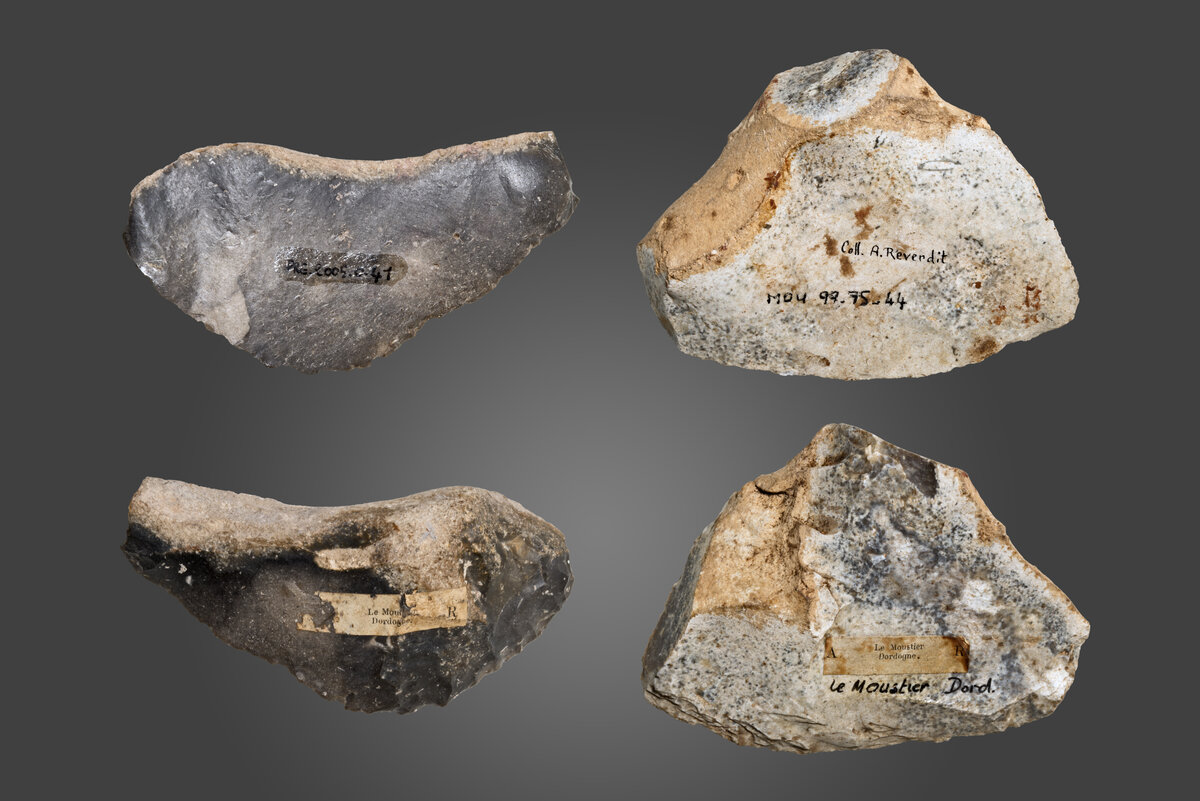
Most Neanderthal tools found at European sites are made from flint or chert, siliceous rocks that are easy to flake and sharpen into fearsome cutting edges. Rock crystal, or hyaline quartz, is by contrast extremely rare in Mousterian assemblages. Its transparency and lustre make it visually distinctive, but it is also harder to knap than flint, producing less predictable flakes. Choosing this material therefore implied a deliberate decision, one not driven by technical efficiency alone.
American archaeologist George MacCurdy, who directed the excavations, was not wrong in sensing its importance. In his report published in the Proceedings of the National Academy of Sciences in November 1931, he noted that seven rock crystal tools had been found at the site, accompanied by numerous small flakes of the same material, indicating that knappingknappingThe set of operations for fracturing a stone block to extract flakes or blades.→ took place directly in the shelter. The raw blocks probably came from the nearby Vezere river alluvium or outcrops in the surrounding limestone.2
MacCurdy was the first to articulate what genetic analyses and subsequent discoveries would confirm nearly a century later: Neanderthals were not the brutish, aesthetically oblivious creatures described by Marcellin Boule after his biased study of the La Chapelle-aux-Saints skeleton in 1909. "Neanderthal man had a sense of the beauty of form and colour, as shown by the mere fact that he chose to use rock crystal," he wrote, adding that this people "deserves to be credited with the capacity to appreciate beauty and quality of material used in the manufacture of his tools."
These conclusions, bold for their time, find echoes today in many other discoveries: the perforated eagle talons of Krapina (Croatia, approximately 130,000 years ago), the dyed shells of Cueva de los Aviones (Spain, approximately 115,000 years ago), the red dot paintings of Ardales (Spain, approximately 65,000 years ago), and the systematic use of ochreOchreA red or yellow mineral pigment (iron oxides), used from prehistory for adornment, funerary rites and art.→ and manganese pigments across dozens of European sites. The rock crystal scraper from the Abri des Merveilles is part of a broader picture of a species endowed with a far more developed sensibility than the nineteenth century was willing to grant it.3
No comments yet. Be the first.