It looks like a steering wheel, a propeller, a wheel hubcap. Yet it was carved almost 5,000 years ago, at the very dawn of pharaonic history. The Sabu disk, unearthed from a Saqqara tomb, is one of ancient Egypt’s most baffling objects — and one of the most hijacked by mystery enthusiasts.
A unique object from a First Dynasty tomb
In January 1936, the Egyptologist Walter Bryan Emery uncovered at Saqqara the tomb of a dignitary named Sabu, a contemporary of King Anedjib (First Dynasty, around 3000 BCE). Among the grave goods, one stone object stood out at once: a disk with three curved lobes, without any known parallel in the entire Egyptian corpus.
A masterpiece carved in a fragile stone
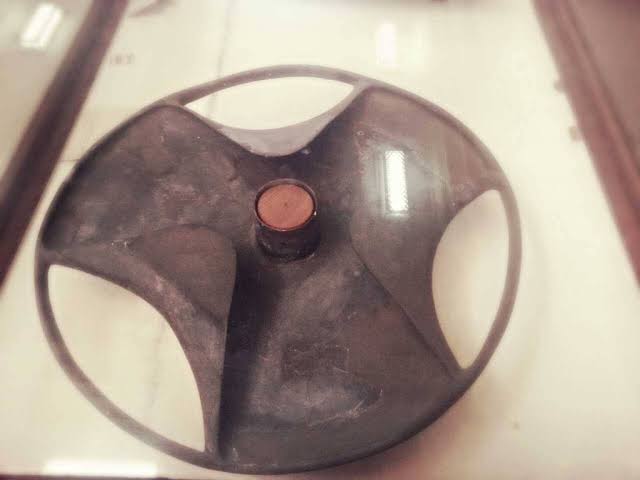
The disk is about 61 cm across. Some 10.5 cm thick at its centre, it thins to just 1 or 2 mm at the rim. It is carved from a foliated metamorphic schist of extreme fragility — impossible to use as a working mechanical part. The feat is the stoneworker’s: achieving such a thin, regular shape in a material that shatters at the slightest knock.
What was it really for?
No function is established with certainty. The serious hypotheses tie it to banquet or cult furnishings: a stand for a lamp or incense burner, a ceremonial bowl, or a stone copy of a basketry or metal object now lost. The Egyptians of the PredynasticPredynasticThe period of Egypt before unification (c. 3100 BCE) and the First Dynasty, marked by the Naqada cultures and the gradual emergence of the state.→ and Old KingdomOld KingdomThe first great period of unified pharaonic Egypt (c. 2700-2200 BC, 3rd-6th Dynasties), the golden age of the great pyramids and of a strongly centralised state.→ were virtuosos of stone, producing thousands of vessels in daring shapes. The Sabu disk belongs to that tradition — only more spectacular.
No propeller, no lost technology
Its resemblance to a modern part has fed all kinds of theories — water pump, flywheel, alien reactor. They run into one stubborn fact: schist is far too brittle to bear any mechanical stress. The Sabu disk proves no forgotten science; it simply testifies to the extraordinary stone-carving mastery of the earliest Egyptians, whose most mysterious masterpiece it remains.
No comments yet. Be the first.