Around seven thousand years ago, while the great valleys of the Near EastNear EastA region of western Asia (Levant, Mesopotamia, Anatolia, Iran), cradle of the Neolithic revolution, agriculture, the first cities and writing.→ were already dotted with the villages of the first farmers, another humanity lived in the heart of what is today one of the most hostile deserts on the planet. Where the central Sahara now stretches, in the southwest of present-day Libya, savannas once opened up, roamed by herds and studded with lakes and seasonal rivers. Two women were buried there beneath a rock shelterRock shelterA shallow cavity at the foot of a cliff or under a rocky overhang, offering natural shelter; a favoured site of prehistoric habitation and rock art.→, at Takarkori, in the Tadrart Acacus massif. The extreme aridity that followed preserved them remarkably well, to the point of allowing, millennia later, a feat few researchers still believed possible in such a region: reading their DNADNAThe molecule carrying genetic information, used to reconstruct kinship between species.→. Published in the journal Nature in 2025, this study led by teams from the Max Planck Institute and Sapienza University of Rome opens an unprecedented window onto the peopling of North Africa. It reveals a deeply rooted human lineage, long kept apart from the great genetic mixings, and today almost entirely vanished in its unadmixed formPalaeogeneticsThe study of ancient DNA extracted from remains (bones, teeth, sediments, walls) to reconstruct the past of populations.→ [2].
The finding is not only genetic. It touches on the very way we tellTellAn artificial mound formed by the accumulation of successive layers of settlement remains at the same spot, typical of the Near East. Each destruction-rebuilding event adds a stratum.→ the history of human societies: by which paths do techniques, domestic animals and ways of life travel. For a long time, the Green Sahara was imagined as a vast migration corridor linking sub-Saharan AfricaSub-Saharan AfricaThe part of Africa south of the Sahara; cradle of Homo sapiens, long thought hostile to ancient-DNA preservation because of heat.→ to the Mediterranean basin. The Takarkori genomes suggest a more nuanced reality, in which ideas and know-how travelled far further than genes. It must be said from the outset, and with caution: this conclusion rests, for now, on only two individuals. That is little, and the authors themselves call for restraint. But in a region where ancient DNA was reputed impossible to recover, two genomes amount to something close to a methodological revolution [3].
This article proposes to follow, step by step, what these two genomes reveal and what they do not. We will first see what the verdant Sahara that sheltered these women looked like, then descend into the Takarkori shelter and the stratigraphyStratigraphyThe study of the superimposed layers (strata) of an archaeological site; each layer corresponds to a phase of occupation and yields a relative chronology.→ that made it famous. We will then address the often underestimated technical question of recovering DNA in an environment so hostile to its preservation. The results proper will follow: the deep North African ancestry, the link with Taforalt, the faint Neanderthal imprint, and their implications for the spread of pastoralism. We will end with an honest examination of the study's limits, for a discovery is only worth as much as our awareness of what it does not yet allow us to assert.
The Green Sahara, a forgotten savanna
The desert we know is a recent image on the scale of prehistoryPrehistoryThe span of human history before the invention of writing, from the Palaeolithic to the Metal Ages, known mainly through material remains.→. Between roughly 14,500 and 5,000 years ago, North Africa passed through what specialists call the African Humid PeriodGreen SaharaA name for the Sahara during the "African Humid Period" (c. 14,500 to 5,000 years ago), when increased monsoon rainfall sustained lakes, rivers and savannas, making the region habitable before its gradual desiccation.→. A slight shift in the Earth's orbit and axial tilt strengthened the African monsoon, pushing the rains far further north than today. Where the largest hot desert on the planet now lies, there were then grasslands, gallery forests along the watercourses, and vast shallow lakes. Fish, crocodiles, hippopotamuses, elephants, giraffes and countless antelopes populated these landscapes. For human communities, it was a land of plenty, open and traversable [3].
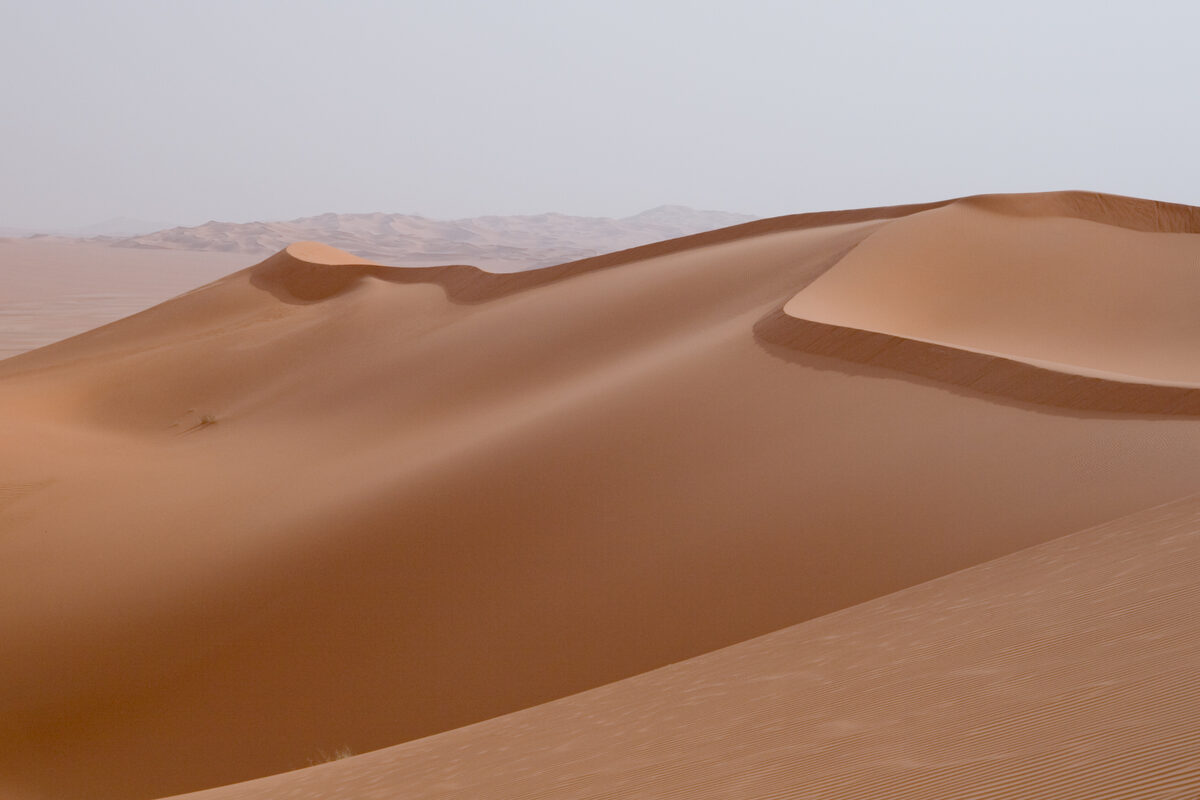
This green phase was no long, tranquil river. Palaeoclimatic data show oscillations, drier episodes interrupting the humid periods, and above all a final desiccation that, far from being abrupt everywhere, unfolded over centuries. From about 5,000 years ago, the monsoon retreated, the lakes evaporated, the soils were stripped bare. The populations who lived there had to adapt, fall back on permanent water sources, migrate, or vanish locally. The Sahara as we see it today is the product of this slow closing of a world. To understand the Green Sahara is therefore to understand not an exotic parenthesis but an entire chapter of the human adventure, with its innovations and its ruptures.
It is also in this context that one of the great enigmas of the African NeolithicNeolithicThe "New Stone Age": a period marked by farming, herding, settlement and pottery, from around 10,000 BC.→ arises. During the humid period, cattle herding appears in the Sahara, followed by goats and sheep. These animals are not native to the region: domestic cattle, goats and sheep have Near Eastern ancestors or emerged from complex domestication processes. How did these beasts, and the art of managing them, reach the heart of the Sahara? Through which intermediaries? The answer long seemed obvious: through people who moved in large numbers, bringing their herds and their genes with them. The Takarkori study directly questions this assumption.
Archaeologists have long reconstructed, in broad strokes, the ecological richness of this vanished Sahara. Cores taken from ancient lake beds, fossil pollen, and the bones of aquatic animals found far from any present-day water all tell the same story: that of a living, watered, inhabited territory. Human groups fished with harpoons, hunted large game, and gathered the seeds of wild grasses. The rock art of the Tadrart Acacus and the Tassili preserves the memory of this fauna: giraffes, elephants, rhinoceroses, ostriches and cattle can all be recognised there. These images are not mere decoration. For prehistorians, they constitute first-hand documentation of the environment and of the economic and symbolic life of the communities who painted them.
The question of who peopled this Green Sahara is therefore especially pressing. Who were these people? Where did they come from? Did they form a single population or a mosaic of groups of diverse origins? Until recently, in the absence of ancient DNA, one could only answer by relying on stone tools, pottery, artistic styles and the morphology of the rare skeletons. These clues remain valuable, but they are indirect: two communities may share the same techniques without sharing the same biological ancestry, and vice versa. It is precisely this knot that genetics promises to untie, by bringing information of a different order, that of descent.
The stakes of this question reach well beyond the Sahara. North Africa sits at a crossroads between three worlds, and understanding who lived there, and how they related to their neighbours, bears on the whole story of how our species spread and diversified. For decades, the scarcity of ancient genetic data from the region left this chapter largely blank, filled in by inference from material culture alone. The Takarkori genomes begin to write it in a different ink, one that records descent rather than style, and in doing so they test long-standing assumptions that had never before been confronted with direct evidence from the bodies themselves.
Takarkori and the Tadrart Acacus
The Takarkori site nestles in the Tadrart Acacus massif, a range of sandstone reliefs in southwestern Libya, a continuation of the neighbouring Tassili n'Ajjer plateau on the Algerian side. The region is inscribed on the UNESCO World Heritage list for the exceptional density and quality of its rock art. Thousands of paintings and engravings cover the walls: hunting scenes, dancing human figures, and above all countless depictions of cattle, direct witnesses to the pastoral life that unfolded there during the HoloceneHoloceneThe current geological epoch, begun about 11,700 years ago at the end of the last ice age; the setting of all post-glacial history.→. These images are among the most eloquent archives of the Green Sahara, a visual record of the animals and gestures of these populations [3].
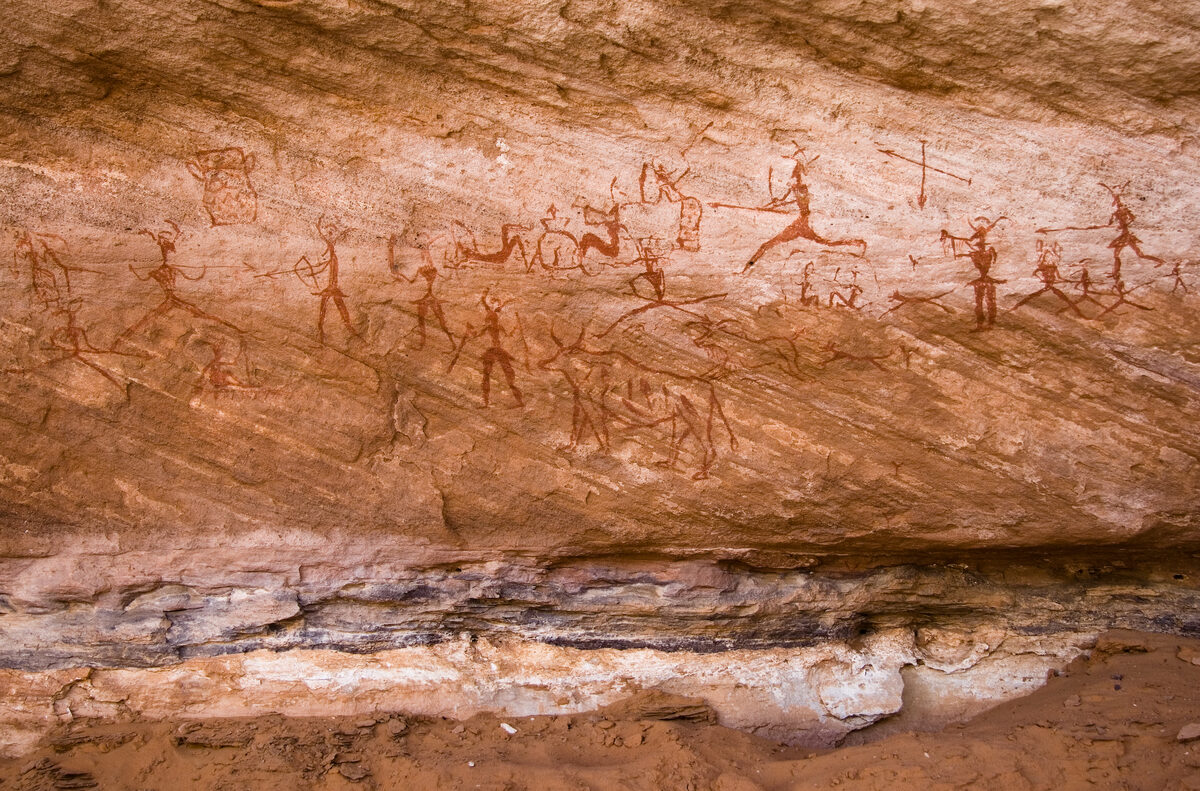
The Takarkori rock shelter has been the subject of methodical excavations conducted since the 2000s by the Archaeological Mission in the Sahara of Sapienza University of Rome, under the direction of Savino di Lernia. Occupied recurrently over several millennia, the site has yielded a rich stratigraphy: hearths, food remains, botanical remains, bones of wild and domestic animals, pottery, basketry and human burials. It thus constitutes a privileged vantage point onto the transition, over the long term, from hunter-gatherer groups to communities of herders. Few sites in the Sahara offer such well-documented continuity of occupation.
The botanical remains of Takarkori have in particular fed an important debate on the origins of the exploitation of wild cereals in Africa. The site has yielded tens of thousands of seed remains, some from plants that would later be cultivated elsewhere, testifying to an intimate and ancient relationship between these communities and the plant world. Traces suggesting the processing of milk have also been identified, which, if confirmed, would make the region one of the ancient cradles of dairying. All this makes Takarkori far more than a mere deposit of skeletons: a true laboratory for understanding the emergence of food-producing economies in the Sahara.
The context in which this research takes place must also be recalled. Libya has, in recent years, experienced instability that has made fieldwork difficult and at times impossible. Part of the analysis therefore concerns material excavated during earlier campaigns, patiently studied in the laboratory far from the field. This situation lends particular value to each available sample and underlines the importance of preserving the region's archaeological heritage, exposed to political hazards as well as to looting. The genetic data drawn from the Takarkori mummies form part of this effort to safeguard and give value to a fragile inheritance.
Among the most striking discoveries are human remains of exceptional preservation. The arid climateClimateThe long-term average atmospheric conditions of a region; its variations (glaciations, aridifications) shaped migrations, agriculture and the collapse of prehistoric societies.→ that eventually came to reign over the region, combined with the shelter offered by the rock, allowed certain bodies to cross the millennia in an astonishing state of preservation. It is from two of these individuals, two women, that the DNA at the centre of the study published in Nature could be extracted. The very name Takarkori thus passed, in a few years, from the narrow circle of Sahara specialists to the broader one of global palaeogenetics [1].
Two 7,000-year-old natural mummies
The two women of Takarkori were not embalmed. No human hand prepared their bodies for preservation: it was nature alone, through natural mummificationNatural mummificationThe preservation of a body without deliberate human embalming, brought about by ambient conditions such as extreme dryness, cold or lack of oxygen that slow the decay of soft tissues.→, that did this work. The extreme dryness of the air and sediment, the shelter from the elements, and the stability of conditions inside the rock cavity slowed the decay of tissues to the point of preserving soft parts and, more precious still to researchers, usable biological material. These natural mummies date to around seven thousand years ago, a period corresponding to the pastoral phase of the Green Sahara [1].

Natural mummification is a phenomenon known elsewhere in the world, from the Atacama deserts to the peatPeatA waterlogged organic soil formed by accumulated plants; it seals and remarkably preserves wood and ancient remains.→ bogs of northern Europe, by way of the Alpine glaciers that yielded the Iceman. Each time, it is exceptional ambient conditions that suspend the normal course of decomposition. In the Sahara, it was dryness that played this role. The very climate that made the region almost unlivable for the living offered the dead a form of chemical immortality, drying out tissues and cells before the bacteria and enzymes of putrefaction had time to destroy everything.
An important distinction must nonetheless be kept in mind. These mummies do not stemstemThe narrowed base of a point, used to haft it onto a shaft or handle.→ from a deliberate funerary practice comparable to Egyptian embalming, which came several millennia later and rested on elaborate techniques. Nothing indicates that the communities of Takarkori sought to mummify their dead. The preservation of the bodies here is a happy accident of geography and climate, not the result of a craft. This nuance matters: it reminds us that prehistory reaches us through the filter of what local conditions happened to spare, and that these conditions are anything but uniform.
This exceptional preservation has value beyond the genetic. It offers archaeologists rare access to the funerary gestures of these communities: the position of the bodies, any objects deposited, the arrangement of the graves. At Takarkori, the burials belong to a prolonged use of the shelter, where the living and the dead seem to have coexisted across the generations. Mummification, even involuntary, froze part of this information in time. Each mummyMummyA body preserved from decay, naturally (cold, aridity, peat) or artificially; the frozen Pazyryk kurgans yielded natural mummies with tattooed skin.→ is thus a capsule of history, carrying at once a genome, a diet inscribed in the bones and teeth, and sometimes traces of illness or trauma that tell of an individual life.
It is worth pausing on the sheer improbability of what survived here. Soft tissue rarely endures across seven millennia, and where it does, the biological molecules it once held are usually long gone. That the Takarkori bodies retained recoverable genetic material is a reminder of how much of prehistory is decided not by the importance of what happened, but by the accidents of what was preserved. Whole populations may have lived and died in the Green Sahara without leaving a single readable genome, simply because their resting places lacked the peculiar conditions that spared these two women. The record we read is always, in part, a record of chance, and every surviving genome is therefore doubly precious to those who study the deep past.
Extracting DNA in a desert environment, a challenge
For a palaeogeneticist, the Sahara long remained an almost forbidden land. Ancient DNAAncient DNAGenetic material preserved in old remains, often degraded, sequenced with cutting-edge techniques.→ is a fragile molecule. After death, it immediately begins to fragment into ever shorter pieces, to alter chemically, and to become contaminated by the DNA of micro-organisms and of the people who handle the samples. Two enemies destroy it above all: water and heat. And the desert, dry as it is, experiences extreme surface temperatures. The preservation of DNA in ancient bones there is reputed to be poor, which explains the rarity, until this study, of ancient genomes from the central Sahara [3].
This is what makes the Takarkori result so notable on a technical level. The researchers managed to recover, from the two mummies, enough material to reconstruct usable genomes. This requires a chain of extremely meticulous operations: sampling carried out under very high cleanliness conditions, in clean rooms where the air, surfaces and gestures are controlled to avoid any modern contamination; chemical extraction of the residual DNA; construction of genetic "libraries"; high-throughput sequencingSequencingReading the order of the bases (A, T, G, C) of a DNA molecule; high-throughput sequencing reads millions of fragments in parallel.→; then a long bioinformatic effort to sort the authentically ancient fragments from all the background noise. Each step must contend with the tiny quantity and the advanced degradation of the starting material.
Palaeogeneticists today have valuable safeguards for distinguishing genuinely ancient DNA from recent contamination. Authentic material carries characteristic chemical signatures: short fragments and typical modifications at the ends of the strands, produced by degradation over time. These criteria make it possible to validate the data and to set aside, as far as possible, parasitic DNA. In the case of Takarkori, it is the combination of these cutting-edge methods and the exceptional preservation offered by the desert climate that made the impossible conceivable. The lesson extends beyond this single site: it hints that other arid regions, long neglected by palaeogeneticsPalaeogeneticsThe study of ancient DNA extracted from remains (bones, teeth, sediments, walls) to reconstruct the past of populations.→, might one day yield their genetic archives.
One should measure the road this discipline has travelled in a few decades. In the early days of ancient DNA study, in the 1980s and 1990s, results were often marred by contamination and gave rise to spectacular announcements that were quickly refuted. The revolution came from high-throughput sequencing and draconian laboratory protocols, capable of reading billions of short fragments and reconstructing, by cross-referencing, entire genomes from scraps. The Nobel Prize in Medicine awarded in 2022 to Svante Pääbo, a pioneer of the discipline and long a Max Planck figure, crowned this scientific maturity. It is in this rigorous tradition that the Takarkori study belongs.
The Saharan challenge nonetheless remains of a particular nature. Elsewhere, in the cool caves of Europe or in the Siberian permafrostPermafrostPermanently frozen ground; in the Altai, water seeping into kurgans froze into ice lenses that preserved bodies, textiles and wood for millennia.→, cold acted as a preservative. In the Sahara, everything rested on dryness alone, a less reliable ally than frost for preserving long DNA molecules. That two mummies nonetheless yielded usable genomes is thus owed to a favourable conjunction: the protection of the rock shelter, the relative thermal stability of the cavity, and no doubt a measure of luck. This success invites a re-examination of other ancient collections from arid environments, long judged sterile for genetic analysis, and the application to them of the most recent techniques.
An isolated North African lineage
The heart of the discovery lies in the very nature of the ancestry revealed by the two genomes. The DNA of the Takarkori women derives mainly from a North African lineage hitherto unknown in this form, which is thought to have separated from sub-Saharan populations at roughly the same time as the Homo sapiensHomo sapiensThe present-day human species, which emerged in Africa around 300,000 years ago, the only surviving human lineage after the extinction of Neanderthals and Denisovans.→ lineages that went on to people the rest of the world left Africa, some fifty thousand years ago. In other words, this North African branch has a considerable temporal depth, comparable to that of the great divergences of global peopling [2].
The most striking feature is the isolation of this lineage. Once formed, it is thought to have remained largely apart from other populations for tens of thousands of years, revealing deep genetic continuity in North Africa at the end of the last Ice Age. It neither merged massively with the neighbouring sub-Saharan populations nor was diluted by inflows from elsewhere. This finding contradicts the image of a North Africa perpetually crossed and reshaped by migrations. It suggests, on the contrary, the long-term existence of a relatively stable North African genetic reservoir, rooted in the territory.
This lineage no longer exists today in a "pure", unadmixed form. Subsequent mixings, over the millennia, recombined it everywhere with other ancestries. But it has not disappeared for all that: it remains a central genetic component of present-day North African populations, a deep heritage that contributes to their distinctiveness. Researchers stress this point with caution. It is not a matter of drawing a simple identity-based continuity between the Takarkori women and any given contemporary population, but of noting that part of the ancient ancestry of North Africa has its roots in this long-isolated stock [2].
The depth of this divergence deserves a pause. To place the separation of the North African lineage at the very moment when other Homo sapiens were leaving Africa, some fifty thousand years ago, is to grant it a very great antiquity. This places the ancestors of the Takarkori women among the ancient branches of the human bush, contemporary with the great dispersals that would people Eurasia and, later, the rest of the globe. That this branch could maintain itself in relative isolation for tens of millennia, without merging with its neighbours, is in itself a remarkable fact, perhaps testifying to lasting geographical and ecological barriers within the African continent.
The link with Taforalt and the Iberomaurusian
To situate this lineage, the authors compare it with other ancient genomes from North Africa. The most important anchor point is the site of Taforalt, a cave in northeastern Morocco that has yielded the remains of hunter-gatherersHunter-gatherersA way of life based on hunting, fishing and gathering wild resources, without farming or herding; it dominated almost the whole of human history.→ about fifteen thousand years old. These individuals are associated with the IberomaurusianIberomaurusianA Late PalaeolithicPalaeolithicThe oldest and longest period of prehistory (c. 3.3 Ma–12,000 BC), defined by chipped stone tools and a hunter-gatherer way of life.→ hunter-gatherer culture of north-western Africa (c. 25,000 to 11,000 years ago), best known from Taforalt (Morocco) and for a stone industry of small retouched bladelets.→, a North African Upper PalaeolithicUpper PalaeolithicThe final phase of the Palaeolithic (c. 45,000 to 10,000 years ago), marked by Homo sapiens in Europe, art, ornaments and a succession of cultures (Aurignacian, Gravettian, Solutrean, Magdalenian).→ culture predating the humid period that greened the Sahara. And the Takarkori women share close genetic affinities with these ancient people of Taforalt [2].
This link is crucial. It means that the lineage brought to light at Takarkori does not emerge from nowhere: it prolongs an ancestry already present in northwestern Africa several millennia earlier, at the end of the Ice Age. Between the Iberomaurusian hunter-gatherers of Taforalt and the herders of Takarkori, despite the geographical distance separating Morocco from Libya and despite the millennia that had elapsed, there is a continuous genetic thread. This reinforces the idea of a North African population with remarkable stability, able to pass through major climatic and cultural transformations while retaining its underlying genetic identity.
A statistical detail further illuminates the picture. The Taforalt and Takarkori groups turn out to be equally distant from sub-Saharan lineages. In plain terms, despite the greening of the Sahara that could, in theory, have favoured contact between the north and south of the continent, these North African populations bear no notable trace of a massive sub-Saharan genetic contribution. The Green Sahara, open and traversable, did not for all that function as the great mixer one might have imagined. This is one of the most counter-intuitive lessons of the study, and one of those that compel us to rethink the geography of exchange in prehistoric Africa.
The site of Taforalt itself holds a place of honour in the history of African prehistory. Excavated for a long time, the Grotte des Pigeons at Taforalt has yielded one of the oldest known cemeteries in the world, with numerous carefully arranged burials. The Iberomaurusians who frequented it were skilled hunter-gatherers, makers of fine stone bladelets, whose material culture testifies to genuine sophistication. To find a genetic echo of these populations among the herders of Takarkori, several thousand years and several thousand kilometres away, weaves a striking link between two worlds one might have believed unrelated.
Little Neanderthal DNA, and what that says
Another instructive result: the proportion of Neanderthal DNA contained in the Takarkori genomes. All human populations living outside Africa today carry a small fraction of Neanderthal ancestry, inherited from the interbreedingInterbreedingGenetic mixing between human populations or species; between Neanderthals and Homo sapiens it left 1 to 2% of Neanderthal DNA in non-Africans.→ that occurred in the Near East when the first Homo sapiens out of AfricaOut of AfricaThe dispersals of Homo sapiens out of Africa, including a major expansion c. 70,000 to 60,000 years ago and earlier exits.→ met the NeanderthalsNeanderthalsA fossil humanity of Eurasia, robust and cold-adapted, extinct around 40,000 years before present.→, several tens of thousands of years ago. Sub-Saharan Africans, for their part, carry very little, or barely measurable traces. The Takarkori women occupy a singular intermediate position [2].
Their genomes contain about ten times less Neanderthal DNA than those of populations living outside Africa, but markedly more than those of contemporary sub-Saharan Africans. This intermediate signature is consistent with the portrait of a largely isolated but not entirely closed population. As Johannes Krause, one of the study's senior authors, sums it up, these early North African populations were for the most part turned in on themselves, while receiving traces of Neanderthal DNA thanks to gene flow from outside the continent. A thin trickle of contact was enough to leave this imprint, without breaking the overall isolation of the lineage.
This dosage of Neanderthal DNA thus functions as a marker of past connections. Too weak to betray intense mixing with non-African populations, too high to suggest total isolation, it sketches the profile of a group in tenuous but real contact with the outside world. Genetics offers here, indirectly, a measure of the porosity of prehistoric boundaries. It confirms that North Africa was never an entirely closed world, but that it long filtered external contributions in small doses, without being overwhelmed. It is a subtle balance between openness and closure that the measured hybridisationHybridisationCrossing between two distinct species or lineages, such as Homo sapiens and Neanderthals, leaving a trace in the genome.→ reveals.
This result also sheds light, in negative, on how Neanderthal DNA spread through the human species. We now know that interbreeding between Homo sapiens and Neanderthals occurred mainly outside Africa, in the Near East, several tens of thousands of years ago. Populations that remained in Africa, or that received little in return from outside, therefore carry much less. That the Takarkori lineage shows a trace of it, faint but real, indicates that a flow, however modest, connected North Africa to the rest of the world at some moment in its history. The geography of North Africa, facing the Mediterranean and the Nile corridor, makes such contact plausible.
Pastoralism, ideas rather than genes
The broadest consequence of these results concerns the way herding spread across the Sahara. PastoralismPastoralismA way of life based on herding livestock (cattle, sheep, goats), often mobile, which spread across the Green Sahara and, in that region, preceded farming proper.→, as we have said, rests on animals that are not native to the region. For a long time, the dominant hypothesis held that populations from elsewhere, notably from the Near East or the North African margins, brought these herds by migrating in large numbers, replacing or absorbing the local groups. Such a spread "by people" should have left a clear genetic trace in the inhabitants of the Green Sahara [3].
Yet the Takarkori genomes do not carry the signature expected of such a migratory wave. The two women belong to a local, deeply rooted North African lineage, and not to a population of external origin recently settled. Herding could therefore have spread, in this part of the Sahara, without a major population replacement, mainly through mechanisms of cultural exchange: the transmission of know-how, the circulation of animals, contacts between neighbours, the adoption of new practices by communities that remained genetically themselves. As Nada Salem, the study's first author, puts it, the discovery sheds light on how pastoralism spread across the Green Sahara, probably through cultural exchange rather than large-scale migration.
This reading fits into a broader movement in recent research which, in several regions of the world, tends to reassess the respective share of population migrationsMigrationsLong-distance movements of populations; a major driver of human history (the exit from Africa, the peopling of continents, Neolithic and steppeSteppeA vast semi-arid, treeless grassland of Eurasia, suited to nomadic herding and the horse; a corridor for the movement of peoples and technologies in later prehistory.→ expansions).→ and cultural transfers in the spread of innovations. The contribution of palaeogeneticsPalaeogeneticsThe study of ancient DNA extracted from remains (bones, teeth, sediments, walls) to reconstruct the past of populations.→ is decisive here: by giving access to the real ancestry of individuals, it makes it possible to test hypotheses that were long impossible to demonstrate. In the case of Takarkori, it does not say that people never moved, but that the spread of herding did not necessarily require vast population replacements. Ideas, at times, travel faster and further than genes.
This spread through cultural exchange is in no way implausible on an anthropological level. Human history abounds in examples where techniques, plants or domestic animals spread from one place to the next, from community to community, without major population movement. Neighbours observe, adopt, adapt. A herd is passed on, lent, negotiated; pastoral know-how is told and demonstrated. In a Sahara then traversable, where human groups must have crossed paths around water points and grazing zones, such contacts had every opportunity to form. The circulation of ideas does not require the substitution of peoples.
It would nonetheless be wrong to caricature the opposition between migrations and cultural exchange. In reality, the two processes almost always combine to varying degrees. That the Takarkori genomes do not bear the mark of a great migratory wave does not mean that no individual ever moved; it means that the local population remained, on the whole, biologically continuous while changing its way of life. It is this biological continuity beneath a cultural transformation that constitutes the striking result. Saharan pastoralism thus appears as an adaptation adopted by rooted communities, rather than the work of invaders bearing a new economy.
Limits of the study and caution
However important it may be, this study calls for a measured reading, and its authors are the first to stress this. The first limit is numerical: the conclusions rest on only two individuals, two women from a single site. That is extraordinarily little to characterise a population, still more to draw from it assertions about the whole of the Sahara or North Africa. Two genomes open a door; they do not yet map the entire landscape that lies behind it [2].
The second limit concerns geographical representativeness. Takarkori is one site, in one massif, in one region of the central Sahara. Nothing guarantees that the lineage identified there was uniformly widespread across the whole of the vast and diverse Green Sahara. Other populations, carrying other ancestries, may have lived elsewhere, in areas where ancient DNA has not been preserved and therefore remains, for now, silent. The emerging picture is necessarily partial, dependent on the capricious geography of molecular preservation. One must resist the temptation to generalise to an entire continent what two bodies from a single shelter reveal.
There is a further limit inherent in any reconstruction based on ancient DNA: the dating and interpretation of divergences rest on statistical models and calibration assumptions that carry a margin of uncertainty. The ages of separation between lineages are not dates carved in marble, but estimates accompanied by intervals. Likewise, comparison with reference populations depends on the available samples, still patchy for vast regions of Africa. As new ancient genomes are published, the framework may shift. Caution therefore commands that we retain the general, robust structure of the result without fixating on each precise figure.
A third and essential caution concerns identity-based interpretation. To note that an ancient genetic component persists among present-day North Africans says nothing about the identities, languages or cultural belongings of today, which are matters of history, society and human choices, not of DNA. Genetics traces lineages of biological transmission, not "peoples" in the cultural or political sense of the term. To confuse the two planes leads to misleading and sometimes dangerous shortcuts. The Takarkori study must be read for what it is: a contribution to knowledge of the ancient peopling of North AfricaAfricaThe cradle of humankind: the continent where the first hominins appeared, then Homo sapiens around 300,000 years ago, before the expansion to the rest of the world.→, and not an argument in contemporary debates on identity. Future progress, with new sites and new genomes, will refine, nuance, and perhaps correct these first results.
Conclusion
The story of the two Takarkori women is that of an improbable double feat: a preservation the desert seemed to forbid, and a genetic reading the heat of the Sahara made almost impossible. From this meeting between an extreme climate and cutting-edge laboratory techniques came a discovery that reshapes our understanding of the peopling of North Africa. A deeply rooted, long-isolated human lineage, related to the hunter-gatherers of Taforalt, distant from sub-Saharan populations despite the greening of the Sahara, discreetly marked by a distant Neanderthal contact: such is the portrait, still sketched in broad strokes, that these two genomes draw [1].
Beyond the figures and the lineages, the most stimulating lesson perhaps lies in the idea that the pastoralism of the Green Sahara spread more through the circulation of knowledge than through that of bodies. A cultural revolution without a great demographic revolution, carried by communities that remained themselves while adopting new ways of living with animals. It is a salutary reminder of the complexity of the paths by which humanity invented its modes of subsistence. Other mummies, other genomes, other sites will be needed to confirm and refine this account. But two women of the Tadrart Acacus, seven thousand years after their death, have just added an essential page to the long and complex history of Africa [3].
This page also invites us to change how we look at prehistoric North Africa. Too often regarded as a mere transit zone between Europe, the Near East and sub-Saharan Africa, it appears here as a heartland in its own right, endowed with a deep and relatively autonomous genetic history. Far from being a corridor crossed by all, the ancient Sahara may have sheltered rooted populations, filtering external contributions rather than dissolving into them. It is an invitation to write the history of the continent from its own internal dynamics, and not only through the prism of its relations with the rest of the world.
Finally, the technical success of this study carries a promise. If the DNA of mummies seven thousand years old could be read in one of the environments most unfavourable to its preservation, then many other genetic archives may still lie sleeping in the sands, the caves and the museum collections. Each new ancient genome refines the portrait, corrects a hypothesis, opens a fresh question one would not even have known how to formulate before, and reminds us how much our knowledge of the past remains an open worksite. The two women of Takarkori do not close the file on the peopling of North Africa: they open it, more widely than ever, by showing that even lands reputed to be silent still have much to tell us.
Je ne savais rien de ce sujet avant cet article. Maintenant j'ai envie d'aller encore plus loin.
La taille du silex, la fabrication d'outils, les premières constructions... directement lié à mon métier.
Je cherchais un site sérieux sur ce sujet depuis longtemps. Bien mieux que certaines vidéos YouTube.