Around sixty-five thousand years ago, while Europe remained the domain of the NeanderthalsNeanderthalsA fossil humanity of Eurasia, robust and cold-adapted, extinct around 40,000 years before present.→ and the figurative art revolution of the Upper PalaeolithicPalaeolithicThe oldest and longest period of prehistoryPrehistoryThe span of human history before the invention of writing, from the Palaeolithic to the Metal Ages, known mainly through material remains.→ (c. 3.3 Ma–12,000 BC), defined by chipped stone tools and a hunter-gatherer way of life.→ had not yet flowered on the walls of Chauvet, anatomically modern human groups were accomplishing, at the far end of the Old World, a feat whose significance still escapes many: they crossed the sea to reach a continent no homininHomininMember of the subtribe Hominina, comprising the human lineage (Homo, Australopithecus, Paranthropus…) but excluding orangutans and gibbons. The term progressively replaces "hominid" in its narrow sense.→ had ever set foot upon. Prehistorians call this continent SahulSahulThe continent formed during the ice ages by the union of Australia, New Guinea and Tasmania when sea levels were low.→, the landmass that, during the ice age, united Australia, New Guinea and Tasmania into a single emerged block. Reaching it meant traversing deep sea channels, never dry even at the lowest stands of the ocean, and therefore navigating deliberately, out of sight of any coast, toward a horizon that gave no guarantee of concealing land.1
This crossing is no footnote in the grand history of our species. It constitutes, with a probability that archaeological data reinforce year after year, the oldest indisputable evidence of human maritime navigation. It pushes the marker of the planet's peopling far beyond what was imagined a generation ago, and it makes the Aboriginal peoples of Australia the keepers of the longest documented cultural continuity on a single territory. At the heart of this demonstration lies a rock shelterRock shelterA shallow cavity at the foot of a cliff or under a rocky overhang, offering natural shelter; a favoured site of prehistoric habitation and rock art.→ in tropical northern Australia, Madjedbebe, whose excavations have yielded dates that overturned the accepted chronology. This article aims to retrace, in the light of the most recent research, the singular geography that made this odyssey possible, the material evidence that attests to it, the models that attempt to reconstruct it, and the legacy, ecological, cultural and genetic, that it left behind.
Sahul and Sunda: two continents born of retreating seas
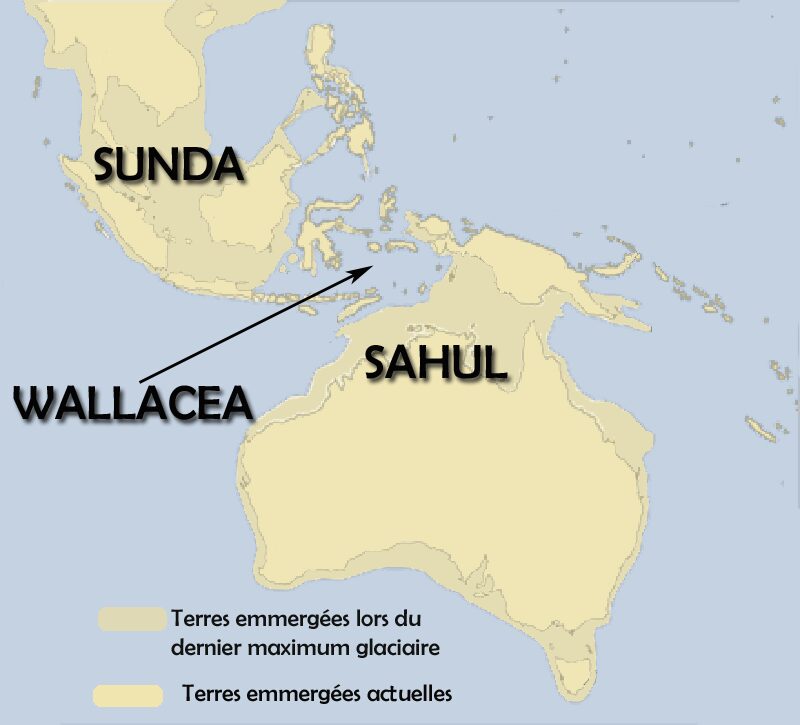
To understand the crossing to Australia, one must first set aside the modern map. For most of the PleistocenePleistoceneThe geological epoch of the great ice ages (c. 2.6 Ma–11,700 BP), spanning most of human prehistory.→, and especially during glacial phases, vast volumes of water were locked in the ice caps of the northern hemisphere. Global sea level then fell by one hundred to one hundred and thirty metres below its present value. This drop exposed the shallow continental shelves and radically redrew the coastlines of insular Southeast Asia. To the west, the Sunda shelf welded the Malay Peninsula, Sumatra, Java and Borneo to the Asian mainland into a vast plain. To the east, the Sahul shelf likewise united New Guinea, Australia and Tasmania.
Between these two continental masses stretched a zone that neither Sunda nor Sahul ever engulfed, even at the lowest seas: the Wallacea archipelago, a string of islands separated by deep oceanic trenches. It was there, in this insular gap, that the fate of Australia's peopling was decided. For while one could walk dry-shod from southern China to the eastern shores of Sunda, one could in no way reach Sahul without a vessel. The depths that isolated Wallacea were never filled by the eustatic lowering; they imposed obligatory sea crossings, whose number and length varied according to the routes considered.
The retreat of the glacial seas turned Southeast Asia into a chessboard of emerged land and impassable straits: one could walk to the gates of Wallacea, but one had to sail to leave it for Sahul.
This configuration explains why the most famous biogeographical boundary in the living world runs precisely there. The faunas of Sunda, of Asian affinity, tigers, rhinoceroses, catarrhine primates, never crossed these straits by their own means. The faunas of Sahul, dominated by marsupials and monotremes, remained confined to the east. Between the two, Wallacea forms an impoverished transition zone, where only species capable of crossing arms of sea, a few rodents, bats, and of course humans, were able to establish themselves. The very fact that Australia preserved an endemic marsupial megafaunaMegafaunaThe very large animals (mammoths, giant ground sloths, etc.) of the Pleistocene, most of which became extinct at the end of the last ice age.→ until a recent date testifies to the effectiveness of this maritime barrier, and makes the arrival of a large bipedal placental mammal from the west all the more remarkable.
The Wallace Line and the ordeal of the open sea
The line that the naturalist Alfred Russel Wallace drew in the nineteenth century between Bali and Lombok, then between Borneo and Sulawesi, marks the threshold beyond which the Asian fauna fades away. What Wallace had identified as a zoological discontinuity, prehistorians have reread as an oceanographic frontier: the first great maritime barrier that humans had to cross to reach Australia. But this line was no mere hedge to step over. Beyond Wallace opened a succession of islands, each of which had to be reached by a distinct crossing, and some of which required losing sight of all land for hours, perhaps days.
Two major hypothetical routes have been modelled. The northern route departed from Borneo or Sulawesi to reach New Guinea via the Moluccas; the southern route descended the arc of the Lesser Sunda Islands, from Java toward Timor, to arrive at the north Australian continental shelf. In both cases, the minimum number of sea crossings is counted in tens of kilometres for the widest channels. Above all, some of these crossings meant that the target land was invisible from the departure shore. It is this precise point that turns the matter into a major cognitive and technical problem: navigating toward a visible target is coasting; setting a course toward an empty horizon while wagering that land lies beyond is intentional deep-sea navigation.
Researchers have long debated the part of chance in this crossing. Could a raft swept away by a storm, an uprooted mangrove drifting on the currents, have accidentally deposited a few castaways on a Sahul coast? The passive drift hypothesis is appealing in its simplicity, but it runs into a decisive demographic objection. To found a viable population, it is not enough for an isolated individual to survive: a sufficient number of men and women of reproductive age must arrive grouped closely enough to engender offspring. Accidental arrivals, rare and dispersed in time, struggle to constitute such a founding nucleus. Recent modelling therefore argues for deliberate, repeated and organised crossings, rather than a series of happy accidents.1
Madjedbebe: the shelter that aged the peopling
If we know a date today for the arrival of humans in Sahul, we owe it above all to a rock shelter located at the foot of the Arnhem Land escarpment, in Australia's Northern Territory, on the edge of Kakadu National Park: Madjedbebe, formerly known as Malakunanja II. Excavated from the 1970s and 1980s, then again with considerably refined methods in 2012 and 2015, this site yielded a stratigraphic sequence of exceptional richness, anchored in sand and protected by the scree of the cliff.2
The campaigns led by Chris Clarkson and his team uncovered, in the deepest levels, several thousand artefacts. The lithic industry there is abundant and diverse: retouched flakes, cores, pieces shaped on raw materials sometimes brought from notable distances. But what struck prehistorians went beyond stone-knappingknappingThe set of operations for fracturing a stone block to extract flakes or blades.→ alone. Fragments of ochreOchreA red or yellow mineral pigment (iron oxides), used from prehistory for adornment, funerary rites and art.→ were found, some bearing facets worn by rubbing, a sign of pigmentary use; ochre "crayons"; and above all the remains of ground-edge axes, that is, tools whose cutting edge had been regularised by abrasion. Ground-edge axes rank, on a global scale, among the oldest ever documented: their presence in these levels suggests advanced technical know-how from the very arrival of the first occupants.2
It is not only the date of Madjedbebe that surprises, but the assemblage that accompanies it: worked ochre, ground-edge axes, management of raw materials. The first Sahulians did not arrive empty-handed; they carried an already constituted technical and symbolic repertoire.
The dating of these levels rested mainly on optically stimulated luminescence, or OSLLuminescence (OSL)Optically stimulated luminescence datingLuminescence datingA method dating the last heating or light exposure of sediments and minerals by measuring energy trapped in the crystal.→: measures the last exposure of sediment grains to light.→, a method that measures the time elapsed since quartz or feldspar grains were last exposed to daylight, in other words, since their burialBurialThe intentional deposition of a body, sometimes with offerings; a marker of symbolic behaviour.→. At Madjedbebe, dozens of OSL measurements converged on an age of about sixty-five thousand years for the first traces of human occupation, with a margin of uncertainty the authors consider controlled. This date, published in the journal Nature in 2017, immediately provoked intense debate, for it pushed back by more than ten thousand years the threshold hitherto accepted for the arrival of humans in Australia.2
The strength of Madjedbebe lies in the conjunction of several lines of evidence. The density of artefacts in the dated levels, their coherent association with combustion features and material concentrations, the regularity of the luminescence measurements, all combine to support the antiquity of the occupation. The excavators also paid meticulous attention to the formation processes of the deposit, in order to rule out the hypothesis that recent artefacts had migrated downward through the sand. It is precisely on this ground, the possibility of vertical displacement of objects in a loose sediment, that the criticisms concentrated, to which we shall return.
The oldest navigation of humankind
Let us accept the date of sixty-five thousand years. Its most spectacular consequence is this: since Sahul was never linked to Sunda by continuous land, and since humans are attested there at that time, then intentional maritime navigation already existed. No other interpretation is physically possible. One does not cross tens of kilometres of open sea accidentally, and certainly not in founding numbers. The human presence at Madjedbebe therefore constitutes, indirectly but necessarily, the signature of the oldest documented navigation of our species.
This conclusion has considerable implications for our understanding of the cognitive capacities of the first modern humans. Building a vessel capable of carrying a group on the open sea presupposes a complex chain of operations: selecting and assembling floating materials, bamboo, logs, bark, binding them, devising a means of propulsion, anticipating buoyancy and stability. It also presupposes a social organisation: gathering passengers, coordinating departure, sharing a collective intention directed toward a deferred and uncertain goal. Finally, it presupposes a form of geographical reasoning: inferring the probable existence of land beyond the horizon, perhaps from indirect clues such as bird flights, cloud fronts stationary above islands, or the colour of the water.
No vessel of such antiquity has been found, and it is likely that none ever will be: wood, bark and plant fibres do not survive over such durations, and the departure and arrival shores now lie beneath several dozen metres of water, drowned by the rising seas of the HoloceneHoloceneThe current geological epoch, begun about 11,700 years ago at the end of the last ice age; the setting of all post-glacial history.→. The proof of navigation is therefore necessarily indirect: it is read in the very presence of humans where only the sea could have carried them. It is reasoning by absence, but of implacable logical rigour. Where archaeology cannot exhibit the object, it exhibits its inescapable consequence.
It is worth dwelling on the sheer improbability of the achievement when set against the backdrop of what hominins had done before. For more than two million years, members of our genus had expanded across the Old World by land, following game, river valleys and coastlines that remained continuously walkable. Even the crossing of formidable mountain ranges and deserts had never required abandoning the solid ground beneath one's feet. The passage to Sahul broke decisively with this terrestrial logic. It demanded, for the first time in the documented record, that humans commit themselves and their families to a medium that offered no foothold, no landmark, and no certainty of return. That such a threshold was crossed not by a lone adventurer but by a viable founding community marks a qualitative leap in the relationship between humankind and the planet it was steadily claiming. In this respect, the shores of Sahul represent far more than a new continent added to the human range: they mark the moment when our ancestors learned to treat the open sea itself as a path rather than a wall.
Crossing models and the demographic threshold
How could a handful of navigators give rise to a population that would, within a few millennia, occupy an entire continent? This question has been the subject of advanced demographic simulations that combine population biology, the modelling of maritime routes and palaeoenvironmental constraints. The central problem is that of the viability threshold: below a certain founding number, a population is doomed to extinction through the play of random fluctuations, genetic drift and demographic hazards.
The most recent work suggests that a viable founding of Sahul probably required the arrival of several hundred individuals, a figure that resolutely excludes the scenario of an isolated accidental drift. According to the models, it would have taken either a single large-scale wave or, more plausibly, a series of crossings staggered over a few generations, regularly bringing new migrants. This second hypothesis has the merit of being more logistically realistic: it is hard to imagine hundreds of people embarked simultaneously on primitive rafts. A colonisation by repeated influxes, on the other hand, presupposes mastered and reproducible crossings, which further reinforces the idea of intentional navigation rather than a single accident.1
These simulations also shed light on the choice of routes. The southern route, via Timor, offered longer crossings but sometimes larger targets; the northern route, via the Moluccas toward New Guinea, multiplied short stages between intervisible islands. Modellers have sought to weigh these options according to the visibility of target lands, current regimes and the seasonality of winds. None imposes itself definitively, and it is plausible that several routes were used, perhaps at different times. What emerges uniformly from the models is the requirement of an intentionality and a repetition incompatible with pure chance.
Founding a continent's population is not done with a stray raft. The models converge on hundreds of founders, hence on planned, repeated and socially coordinated crossings, the signature of a genuine maritime strategy.
A lightning-fast expansion across a continent
Once they had gained a foothold on the northern shores of Sahul, the first occupants did not remain confined to their point of arrival. The picture drawn by archaeology is one of remarkably rapid expansion, which carried humans to the four cornersFour CornersRegion of the American Southwest where Colorado, Utah, Arizona and New Mexico meet, the cradle of Ancestral Puebloan culture.→ of the continent within only a few millennia. Sites distributed from the tropical north to the arid central regions, from the eastern coasts to the southern reaches and as far as Tasmania, yield occupations whose antiquity, measured by radiocarbonRadiocarbon (carbon-14)A dating method based on the decay of carbon-14, usable back to about 50,000 years.→ or by luminescence, traces an accelerated diffusion on the scale of prehistoric time.
This speed of peopling is in itself a matter of astonishment. Sahul was no uniform territory: deserts had to be crossed, massifs skirted, contrasting biomes adapted to, from humid tropical forest to semi-arid steppeSteppeA vast semi-arid, treeless grassland of Eurasia, suited to nomadic herding and the horse; a corridor for the movement of peoples and technologies in later prehistory.→. That human groups managed, within a few dozen generations, to colonise such diverse environments testifies to considerable behavioural plasticity and sustained capacity for technical innovation. The first Sahulians had to recognise and exploit entirely new resources, identify useful plants, learn the behaviour of an unfamiliar fauna, and develop hydrological knowledge to survive in the driest zones.
Expansion toward the south also meant crossing other internal barriers. Tasmania, for example, was linked to the rest of Sahul only by a land bridge, the exposed Bass Strait, that was passable only during periods of low sea level. Humans reached it and remained there, so that the rising seas of the Holocene isolated them from the continent for thousands of years, creating one of the most prolonged situations of human isolation known. This detail reminds us that the geography of Sahul was shifting, and that sea-level fluctuations continually redistributed accessible territories throughout the peopling.
The Australian megafauna and the question of its extinction
When the first humans landed in Sahul, they discovered an astonishing bestiary, shaped by tens of millions of years of isolated evolution. The continent then sheltered a marsupial and avian megafauna without equivalent anywhere else: the Diprotodon, a herbivorous marsupial the size of a rhinoceros, the largest marsupial that ever existed; giant short-faced kangaroos; the Thylacoleo, or "marsupial lion", a predator with powerful jaws; terrestrial monitor lizards of monstrous size; and Genyornis, a flightless running bird more massive than an ostrich.
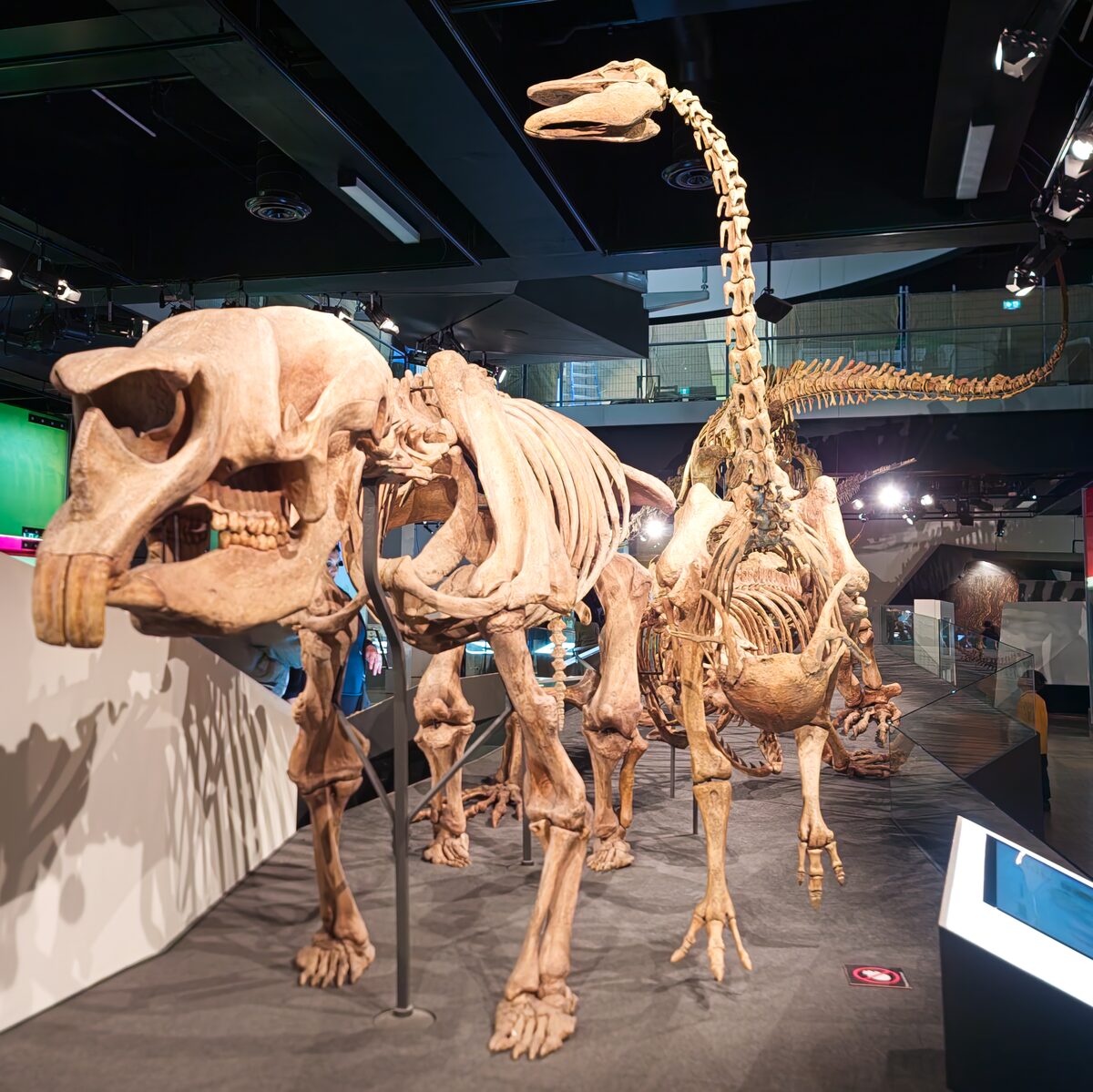
Most of these giants vanished during the Late Pleistocene, in a temporal window that overlaps human arrival and expansion. This coincidence has fuelled one of the liveliest debates in palaeoecologyPalaeoecologyThe study of past ecosystems and their relations with the environment, reconstructed from fossils, DNA and sediments.→: was humankind responsible, directly or indirectly, for this extinction? Three major hypotheses contend. The first implicates hunting and direct predation: naive prey, never having co-evolved with an intelligent bipedal predator, would have been vulnerable to even moderate exploitation, especially since large, slow-breeding animals resist sustained harvesting poorly. The second invokes the transformation of landscapes by fire, humans having been able to deeply modify vegetation through repeated burning, depriving the megafauna of its resources. The third emphasises the climatic upheavals of the end of the Pleistocene, independent of any human action.
The reality was no doubt a bundle of causes. The growing aridification of the continent may have weakened populations already under pressure, while the arrival of a new predator and of fire-based land management practices dealt additional blows. The case of Genyornis is emblematic: eggshells bearing burn marks interpreted as of human origin have fed the hypothesis of direct exploitation, although the attribution of some of these fragments remains debated. In any case, the extinction of the Sahul megafauna remains a textbook case for studying the early ecological footprint of our species, and a reminder that modern humans transformed the ecosystems they colonised well before agricultureAgricultureThe cultivation of plants and production of food by working the soil, which emerged in the Neolithic in the Near East and independently elsewhere; it radically transformed human societies.→.
Rock art and Aboriginal cultural continuity
Nowhere is the temporal depth of Sahul's peopling so vividly displayed as in the rock art of northern Australia. The escarpments of Arnhem Land and the shelters of Kakadu, a few steps from Madjedbebe, preserve thousands of painted figures superimposed in dizzying palimpsests: fish, turtles, snakes, composite beings, hunting scenes, stylised human silhouettes. This parietal artCave (parietal) artArt made on the walls of caves and shelters (paintings, engravings), as opposed to portable artPortable artTransportable art objects (figurines, engravings on bone or ivory), such as the Palaeolithic Venuses.→.→ spans an immense duration and testifies to a graphic tradition of exceptional continuity, linking the oldest paintings to the still-living practices of contemporary Aboriginal communities.
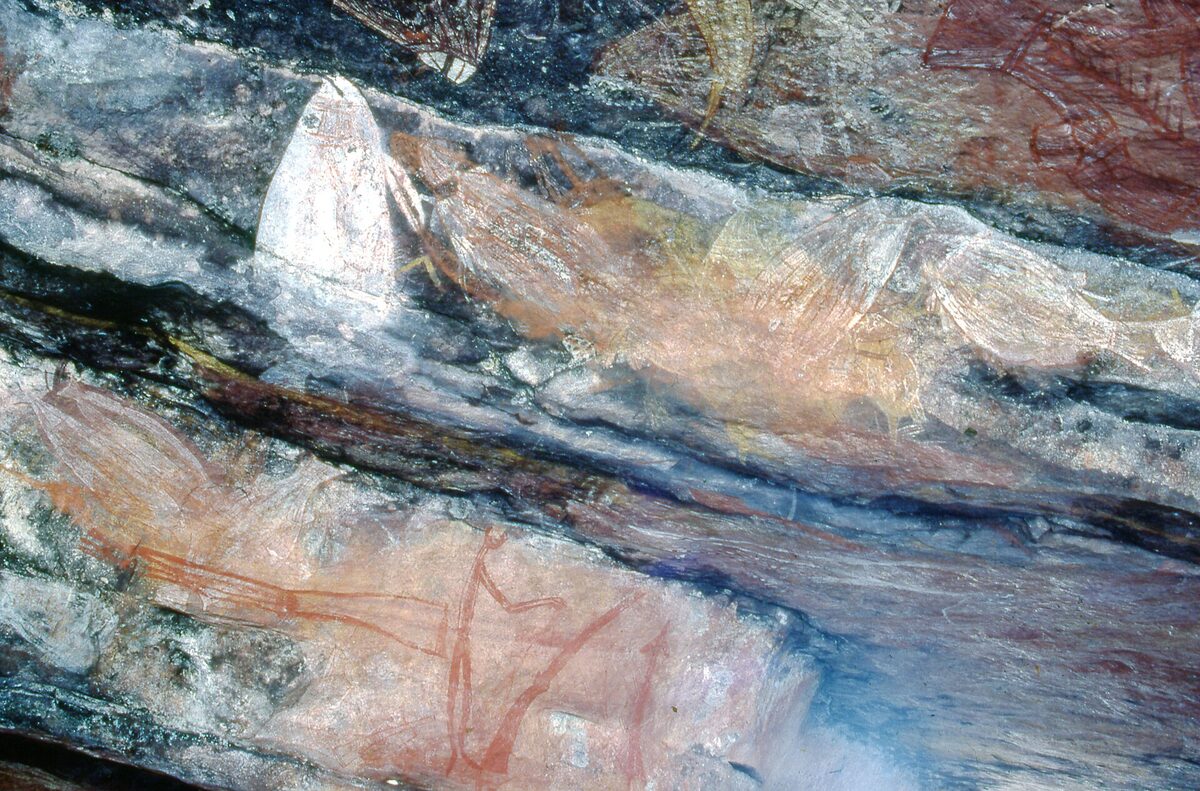
The presence of worked ochre in the oldest levels of Madjedbebe establishes a material link between the first occupants and this tradition. Ochre is not merely a decorative pigment: throughout the Palaeolithic world it is a marker of symbolic behaviourSymbolic behaviourA set of practices (adornment, pigments, art, burial) reflecting symbolic thought; long ascribed to Homo sapiens alone, now attested for Neanderthals too.→. Its extraction, preparation and application presuppose an intention that goes beyond the strict necessity of subsistence. That the first Sahulians transported and worked ochre from their arrival indicates that they already possessed an elaborate symbolic life, of which the later rock art would be the lasting flowering.
This cultural continuity grants the Aboriginal peoples of Australia a singular status in the history of humankind: that of the heirs of the longest uninterrupted occupation of a single territory. The knowledge transmitted orally, the "Dreaming" narratives that map the landscape and recount its genesis, the techniques of fire and water management, constitute an intangible heritage of unequalled historical depth. Some Aboriginal narratives even appear to preserve the memory of ancient geological events, such as the submersion of coastal territories by the postglacial rise of waters, a possible echo, transmitted over hundreds of generations, of the transformations that drowned the shores of Sahul.
From fragments of ochre in the earliest levels of Madjedbebe to the living paintings of Kakadu, a single symbolic thread unfolds over tens of millennia: the longest cultural continuity documented on the surface of the Earth.
The Denisovan genetic legacy
Population genetics has brought an unexpected dimension to the history of Sahul. The analysis of the genomes of Aboriginal Australians and Papuans of New Guinea has revealed that they carry, in their hereditary heritage, a notable proportion of DNADNAThe molecule carrying genetic information, used to reconstruct kinship between species.→ inherited from another homininHomininA member of the human lineage in the broad sense, including modern humans, their ancestors and related great apesgreat apesThe family of great apes (Hominidae) comprising orangutans, gorillas, chimpanzees, bonobos and humans.→.→: the DenisovansDenisovanAn extinct human population, cousin of the Neanderthals, identified in 2010 from the DNA of remains in Denisova Cave (Siberia).→. This archaicArchaicRefers to an ancient, now-extinct human population or form (Neanderthals, Denisovans, ghost lineages), as opposed to anatomically modern humans.→ human group, identified for the first time from a bone fragment discovered in Denisova Cave in Siberia, is known only from a few fossil remains and from the genetic trace it left in present-day populations.
This trace is particularly strong in Oceania. The peoples of Sahul are among those whose genome contains the greatest share of Denisovan ancestry in the world, a sign that their ancestors met and mingled with these hominins somewhere along the migratory route, most likely in insular Southeast Asia, before or during the crossing to Sahul. This hybridisationHybridisationCrossing between two distinct species or lineages, such as Homo sapiensHomo sapiensThe present-day human species, which emerged in Africa around 300,000 years ago, the only surviving human lineage after the extinction of Neanderthals and Denisovans.→ and Neanderthals, leaving a trace in the genome.→ is no anecdotal detail: it indicates that the Denisovans occupied a far vaster area than Siberia alone, and that they were present as far as the margins of Wallacea when modern humans passed through.
Recent research even suggests the existence of several distinct episodes of admixture with differentiated Denisovan populations, which sketches a complex geography of encounters between human lineages at the threshold of Australia. Some segments of Denisovan DNA preserved in Oceanian populations may have conferred adaptive advantages, for example in immune response or adaptation to tropical environments. Far from being a neutral inheritance, this archaic genetic legacy contributes to the biological singularity of the peoples of Sahul and testifies to the depth of interactions between the different forms of humanity in the Pleistocene.
This Denisovan contribution also illuminates the chronology. For the ancestors of the Sahulians to have been able to mix with Denisovans in Southeast Asia, modern humans must have reached that region early enough. An arrival in Sahul around sixty-five thousand years ago fits with an early dispersal of our species out of AfricaOut of AfricaThe dispersals of Homo sapiens out of Africa, including a major expansion c. 70,000 to 60,000 years ago and earlier exits.→ and across southern Asia, and with archaic contacts staggered along that route. Genetics and archaeology thus converge on a single picture: that of an ancient expansion, punctuated by encounters with other humanities, of which the crossing to Australia constitutes the most spectacular culmination.
The dating debates: caution and controversy
The date of sixty-five thousand years has not been unanimously accepted, and it would be dishonest to present it as an uncontested fact. Several specialists have expressed reservations, bearing essentially on the stratigraphic integrity of Madjedbebe. The sediment containing the oldest artefacts is a sand, that is, a loose material in which objects can, in theory, migrate vertically under the effect of trampling, burrowing by fauna, or percolation. If more recent artefacts had been able to descend into the levels dated by OSL, the association between the dates and the tools would be falsified, and the true age of the occupation would be overestimated.
Defenders of the dating respond that the precautions taken during the excavation, fine analysis of the spatial distribution of objects, examination of refits between flakes, micromorphological study of the sediment, make a massive displacement improbable. They emphasise the internal coherence of the sequence and the concentration of artefacts in well-defined horizons. The debate nevertheless remains open, and it illustrates a general difficulty of deep prehistory: the further back one goes in time, the wider the margins of uncertainty of the dating methods, and the more decisive the reading of site formation processes becomes.
It must also be recalled that the methods themselves have their domains of validity. Radiocarbon, long the king of prehistoric dating, reaches its practical limit around fifty thousand years, beyond which the quantity of residual carbon-14 becomes too small to be measured reliably. This is precisely why optical luminescence, which can cover longer durations, becomes indispensable for the oldest occupations of Sahul. But OSL has its own requirements: it presupposes that the dated grains were indeed reset by light at the moment of deposition, a condition not always perfectly met. The confrontation of the two families of methods, where they overlap, remains the best safeguard.
Beyond the technical quarrel, this debate has one virtue: it reminds us that prehistoric science progresses through contradictory confrontation, and that the oldest dates must be examined with the most demanding rigour. Whether one retains sixty-five thousand years or a slightly more recent range, the central fact remains: humans reached Sahul by sea, at a date that makes it one of the oldest testimonies of navigation and one of the major milestones in our species' conquest of the planet.
What the possible vessels teach us
In the absence of a preserved wreck, prehistorians have sought to reconstruct, through experimentation and analogy, the types of vessels that could have crossed the straits of Wallacea. Three major technical families are conceivable with the resources of tropical Southeast Asia. The first is the bamboo raft: the hollow, light stemstemThe narrowed base of a point, used to haft it onto a shaft or handle.→ of this giant grass, abundant throughout the region, offers remarkable buoyancy and binds easily into bundles. A properly assembled bamboo raft can carry several passengers and withstand a moderate swell. The second is the log raft, heavier but robust, made of assembled driftwood. The third is the bark or reed craft, more fragile but manoeuvrable. None of these options exceeds the technical capacities otherwise attested for modern humans of the Pleistocene; all, however, presuppose mastery of the knot, of assembly and of propulsion by paddle or pole.
Experimental navigation trials conducted in the region have shown that crossings of several dozen kilometres remained feasible with such craft, provided one took advantage of favourable weather windows and carrying current regimes. These reconstructions do not, of course, prove that this or that vessel was actually used sixty-five thousand years ago; they merely establish the physical plausibility of the feat. But this plausibility is precious: it dispels the objection that the crossing would have exceeded the technical means of the time. Combined with the demographic argument, it supports the scenario of a deliberate and technically prepared maritime colonisation.
Sahul in the great dispersal of humankind
The conquest of Sahul cannot be isolated from the broader fabric of the dispersal of modern humans out of Africa. Our species, which appeared in AfricaAfricaThe cradle of humankind: the continent where the first hominins appeared, then Homo sapiens around 300,000 years ago, before the expansion to the rest of the world.→, spread across Asia during the Late Pleistocene, probably skirting the coasts of the Indian Ocean and the shores of southern Asia. In this vast movement, the arrival in Australia occupies a particular place: it marks the extreme eastern limit reached by humans before the peopling of the AmericasPeopling of the AmericasThe migrations that led Homo sapiens to occupy the American continent, from Beringia; its date and routes remain debated.→, and it stands out for the maritime obstacle it entailed. Where walking sufficed to reach Europe or inner Asia, for Sahul one had to invent the sea as a route of migration.
This dispersal was not a single continuous front, but a mosaic of movements, advances and retreats, punctuated by climatic oscillations. Periods of low sea level facilitated certain passages while lengthening others; fluctuations in aridity opened or closed corridors inland. Sahul fits into this dynamic: its peopling is not an isolated point on the map, but the culmination of a long chain of movements and adaptations that, step by step, led modern humans to the southern reaches of the inhabited world.
Placed in this perspective, the crossing to Australia ceases to be a regional curiosity and becomes a revealer of the general capacities of our species. It shows that, from a very ancient time, modern humans possessed the cognitive, technical and social baggage necessary to solve unprecedented problems, including the dizzying one of crossing an expanse of water whose far shore remained invisible. It is this aptitude to imagine and reach the unknown that makes the odyssey of Sahul a founding event, not only for Australia, but for the understanding of what distinguishes our humanity.
Reading an empty horizon: the navigator's cognition
One of the most fascinating aspects of the crossing to Sahul lies in the question of intention. How could a human group decide to set course on an apparently endless sea? The answer is sought on the side of an expert reading of the environment. Traditional seafaring peoples, in the Pacific as elsewhere, know how to infer the presence of invisible land from a host of indirect clues: the trajectory of seabirds returning to their nests at dusk, the cloud mass that hangs above an island and sometimes reflects the green tint of its vegetation, the swell reflected by a distant coast, the plant debris that drifts offshore. Nothing forbids us from thinking that the first Sahulians already possessed such a perceptual repertoire.
This hypothesis changes the very nature of the event. It would not be a blind leap into the unknown, but a reasoned wager, founded on an accumulation of observations and on a confidence in the ability to read the sea. The crossing to Sahul would then become the testimony of a sophisticated ecological intelligence, capable of transforming faint signals into a collective decision engaging the survival of a group. Such a reading joins what is otherwise known of the cognitive richness of Pleistocene modern humans, attested by their art, their diverse toolkit and their capacity to adapt to contrasting environments.
One must finally underline the properly social dimension of the enterprise. Organising a crossing is not the affair of an individual: one must convince, gather, distribute roles, accept leaving a known territory for an uncertain promise. This capacity to coordinate a collective action stretched toward a distant and risky goal is one of the signatures of behavioural modernity. The conquest of Sahul, in this sense, illuminates not only technical feats: it lights up the social structure and psychology of the first explorers of our species.
A laboratory for world prehistory
At the end of this journey, Sahul appears as a true laboratory for the whole of prehistory. Because it was peopled late relative to Africa and Eurasia, and because its maritime isolation preserved original dynamics, it offers a case study of rare clarity. One can observe there, almost experimentally, the effects of human arrival on a virgin fauna, the speed of colonisation of a continent by a founding population, and the establishment of a cultural tradition whose continuity defies time. Few regions of the world bring together so many major questions in a single dossier.
This density explains the intensity of the research devoted to Sahul, and the importance accorded to sites such as Madjedbebe. Each advance in dating methods, each progress in palaeogeneticsPalaeogeneticsThe study of ancient DNA extracted from remains (bones, teeth, sediments, walls) to reconstruct the past of populations.→, each new excavation refines the picture and feeds the debate. Far from being closed, the dossier remains in full effervescence, and it is likely that the coming decades will hold further surprises, as underwater archaeology explores the now-drowned landscapes where the first Sahulians set foot. For it is there, beneath the waters of the continental shelf, that perhaps the most direct traces of the great crossing lie sleeping.
Conclusion: a founding odyssey
The arrival of humans in Sahul condenses, in a single event, several of the greatest questions of prehistory: the cognitive capacities of the first modern humans, the mastery of unsuspected navigation techniques, the encounter with other human lineages, the ecological impact of our species on virgin faunas, and the emergence of a cultural continuity that extends to the present day. Madjedbebe, through the richness of its assemblage and the antiquity of its dates, has become the anchor point of this narrative, and the place where both certainties and controversies crystallise.
What the crossing to Australia ultimately reveals is that the people of the PalaeolithicPalaeolithicThe oldest and longest period of prehistory (c. 3.3 Ma–12,000 BC), defined by chipped stone tools and a hunter-gatherer way of life.→ were not the passive hunter-gatherersHunter-gatherersA way of life based on hunting, fishing and gathering wild resources, without farming or herding; it dominated almost the whole of human history.→ of an outdated imagination, but explorers capable of planning, navigating and colonising unknown worlds. Sixty-five thousand years before the first cities rose, anonymous navigators set course toward an empty horizon and found a continent there. Their descendants keep its memory, in their genes inherited from Pleistocene encounters, and in a living tradition that makes them the oldest uninterrupted occupants of a land. The odyssey of Sahul is no marginal episode of our history: it is one of its summits.
J'ai lu cet article avec mes enfants. Ils ont adoré ! Même le plus petit posait des questions.
Ce qui me plaît, c'est la rigueur chronologique. On sait exactement de quand date quoi, et pourquoi.
Je n'ai pas de formation historique mais j'aime apprendre. Ce site est parfait pour moi.
Je ne savais pas que les Aborigènes australiens sont l'une des plus anciennes populations en place du monde, avec une continuité génétique sur 50 000 ans dans le meme territoire. C'est vertigineux. Cet article m'a donné envie d'en savoir plus sur leur culture et leur rapport à la terre qui remonte à des dizaines de millénaires. Une richesse culturelle unique au monde.
Le peuplement du Sahul (l'Australie et la Nouvelle-Guinée réunies pendant les périodes glaciaires) est l'une des aventures migratoires les plus audacieuses de l'histoire humaine. Ces populations ont traversé des détroits maritimes il y a au moins 50 000 ans, sans aucune technologie de navigation avancée connue. Cette colonisation reste l'une des prouesses les plus impressionnantes d'Homo sapiens.