Nearly four thousand seven hundred years ago, in the desert overlooking ancient Memphis, thousands of workers raised their eyes toward a shape no one had ever seen: a giant staircase of white stone climbing toward the sky. That monument, the step pyramidStep pyramidEgypt's first great stone monument, raised for King Djoser at Saqqara by Imhotep (Third Dynasty), by stacking diminishing mastabas.→ of King Djoser, is not merely the oldest pyramid in Egypt. It is the oldest large cut-stone building in all of human history, the starting point of an architectural adventure that would lead, a century later, to the smooth-sided pyramids of Giza. Behind this boldness stands a single name: Imhotep, the first architect whose memory history has kept, and probably the first technician ever raised to the rank of a god.1
A staircase to the stars
On the plateau of Saqqara, some twenty kilometres south of modern Cairo, the pyramid of DjoserAncient EgyptA civilisation that developed along the Nile for almost three millennia, from unification around 3100 BC to the Greco-Roman era; it bequeathed the pyramids, temples and hieroglyphic writingWritingA system of conventional signs used to fix language or information durably; its appearance (c. 3300 BC) marks, by convention, the end of prehistory.→.→ still dominates a landscape of sand, ruins and tombs. Roughly sixty metres high on a rectangular base of about 121 by 109 metres, it is made of six uneven tiers that shrink as they rise, like the layers of a stone cake.2 That stepped outline gives it its modern name, the step pyramid. It was built during the Third Dynasty, at the very beginning of the Old KingdomOld KingdomThe first great period of unified pharaonic Egypt (c. 2700-2200 BC, 3rd-6th Dynasties), the golden age of the great pyramids and of a strongly centralised state.→, to serve as the tomb of King Netjerikhet, whom posterity has remembered as Djoser.
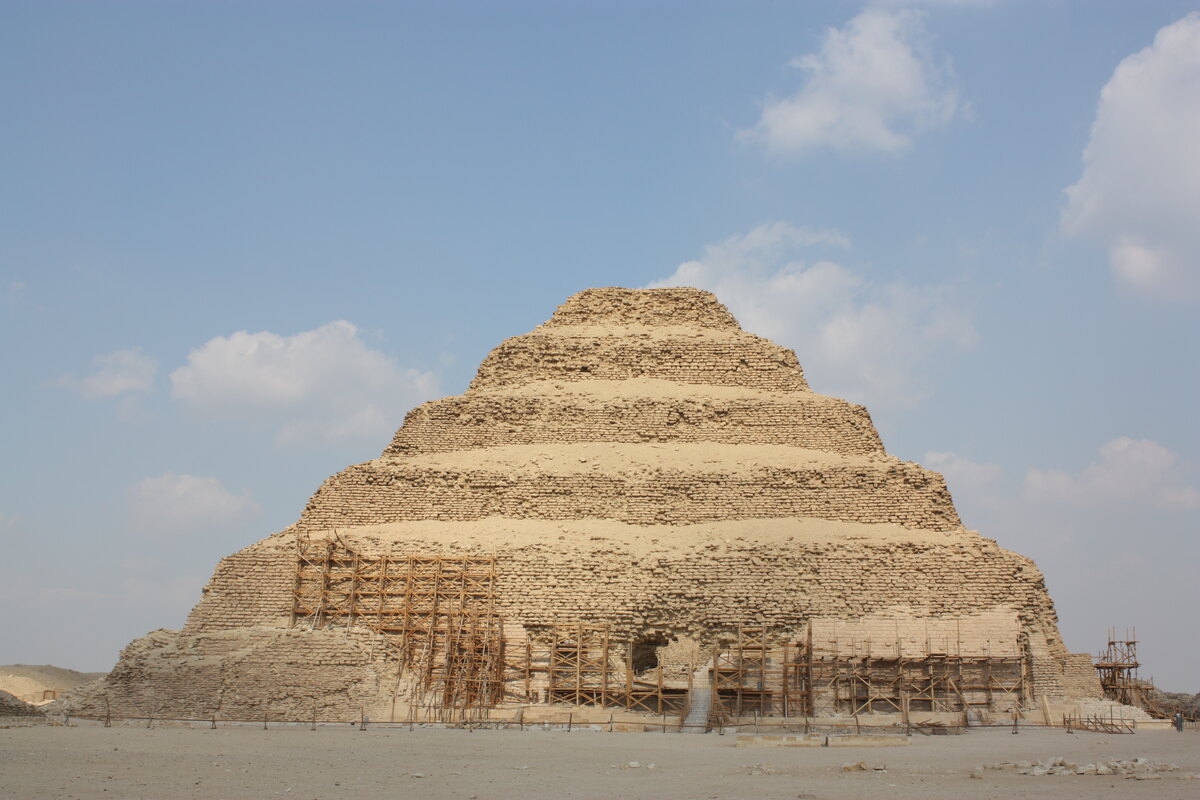
For the Egyptians of the time, nothing like it existed. Earlier kings rested beneath simple mounds of mud brick. By turning the tomb into an artificial mountain, visible for kilometres around, Imhotep invented a new monumental language, that of royal power carved into stone for eternity. The choice of limestone, quarried on site and nearby, was not only a matter of looks: it guaranteed that the name and memory of the sovereign would outlast the collapse of any brick building.
The site was anything but random. Saqqara already served as the necropolisNecropolisA large organised burial ground, a "city of the dead", often spanning several periods.→ of the high officials of Memphis, the capital founded at the hinge of Upper and Lower Egypt. To build here, on the desert cliff overlooking the fertile valley, was to set the royal tomb in a sacred landscape, on the symbolic border between the world of the living and that of the dead. When the sun rose over the Nile, its rays struck the white pyramid full on, turning it into a dazzling beacon for the whole region. Nothing in earlier architecture foreshadowed such excess: Djoser and his architect literally changed the scale of what people believed they could build.
From mastaba to pyramid: an invention in progress
The pyramid of Djoser did not spring from a single plan. Excavations have shown that it is the result of at least five or six successive building phases, a genuinely experimental project in which the idea grew clearer over the years.3 At the beginning stands a mastabaMastabaAn early Egyptian flat-roofed tomb with sloping sides, the architectural ancestor of the pyramid.→, the low bench-shaped tomb with sloping walls that had been standard for the elite since the earliest dynasties. But instead of the usual rectangular form, Imhotep designed a square one, then enlarged it several times.
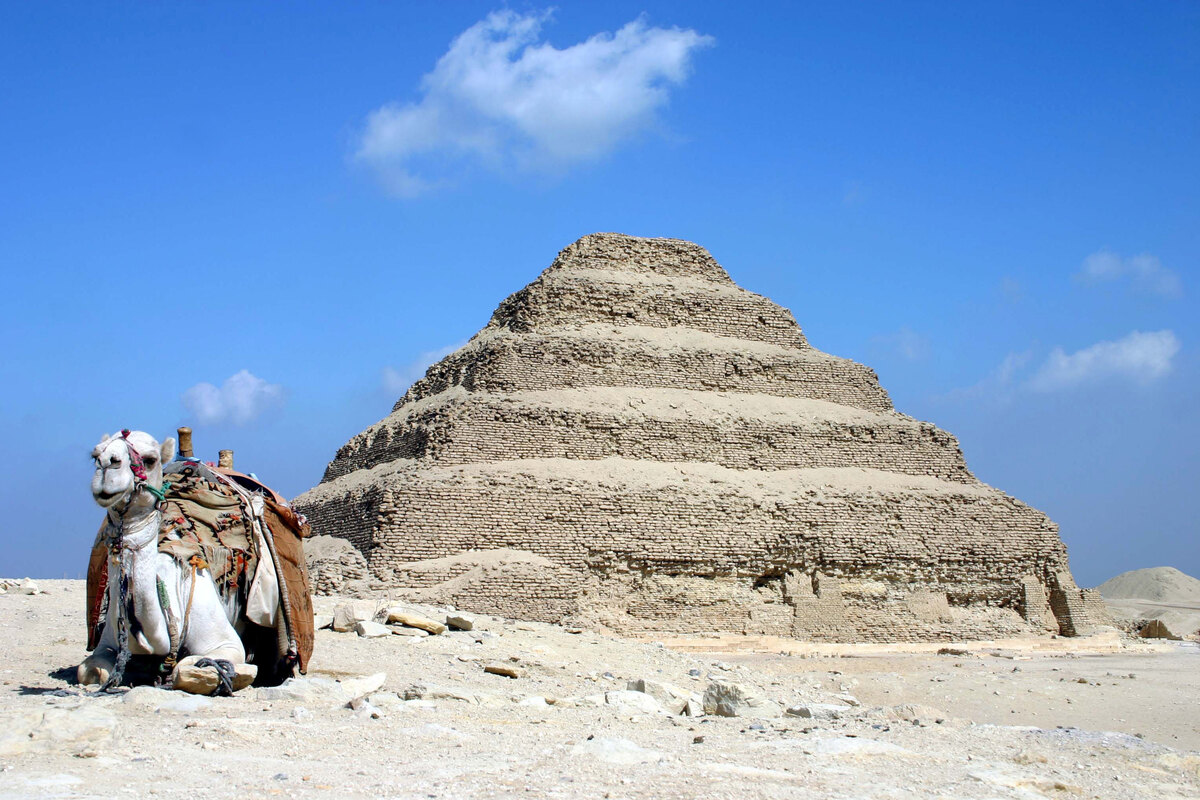
Then came the stroke of genius. On this enlarged mastaba the builders stacked further ones, each smaller than the last, forming first a four-stepped pyramid, then, in a final extension, the six-stepped version we admire today.2 The exact reasons for this change of scale are still debated. A wish to assert a more powerful kingship? A solar or stellar symbolism? The sources of the time are silent, and it is largely archaeology that has reconstructed this growth through successive stacking. Beneath the monument, a shaft about twenty-eight metres deep leads to the granite burialBurialThe intentional deposition of a body, sometimes with offerings; a marker of symbolic behaviour.→ chamber, at the heart of a labyrinth of underground galleries that ran for several kilometres and also housed tens of thousands of stone vessels.
Imhotep, the architect who became a god
Few names cross forty centuries. That of ImhotepImhotepVizierVizierThe highest official of the Egyptian state after the pharaoh (Egyptian "tjaty"): effectively a prime minister directing administration, justice, the treasury and public works in the king's name.→ and master builder of King Djoser, presumed designer of the step pyramid, later deified as a god of medicine.→ has. Vizier, counsellor and almost certainly the master builder of Djoser, he is traditionally credited with the design of the step pyramid.4 His historical existence is firmly attested: his name and titles are carved on the base of a statue of Djoser found at Saqqara, an extremely rare honour for a man who was not of royal blood.
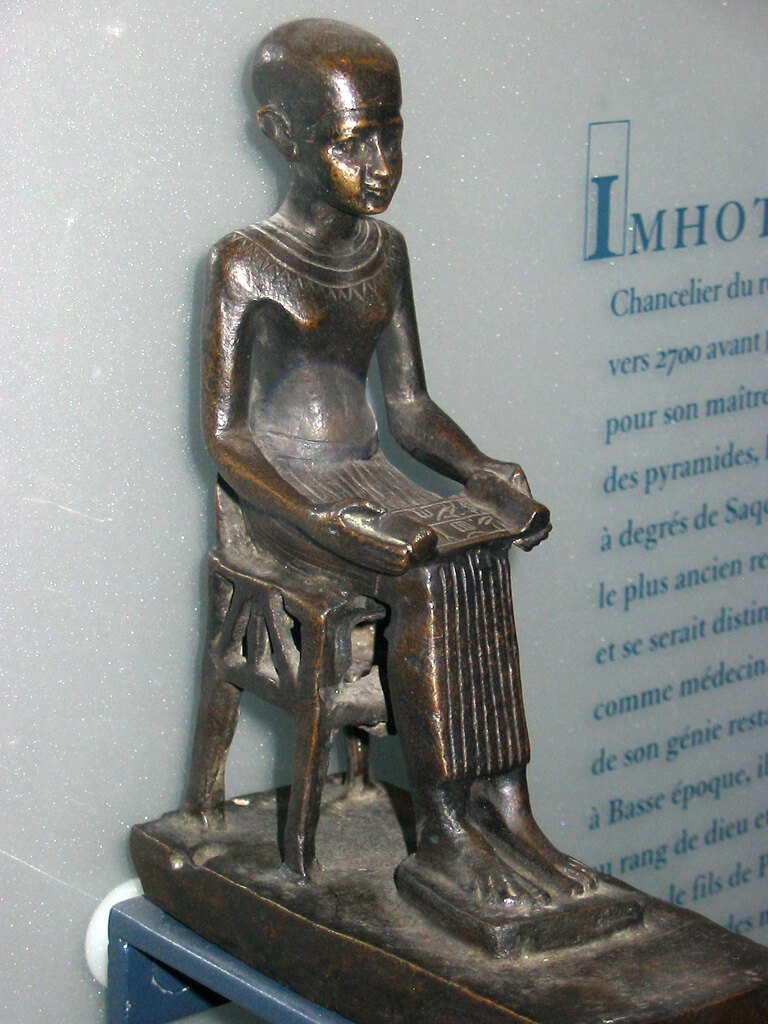
Over time the man turned into legend. Nearly two millennia after his death, Imhotep was deified and worshipped as a god of medicine and healing, associated with the god Thoth, patron of scribes and scholars. The Greeks later identified him with their own healing god, Asclepius. The legend does call for some caution: the Egyptians themselves, in ancient texts, never explicitly credited him with the design of the pyramid, and the tradition that makes him the inventor of stone building simplifies a more gradual reality. Even so, his name remains forever attached to the first stone masterpiece in history.
This posthumous fate is unique. While architects in ancient Egypt usually remained anonymous, Imhotep became an intercessor to whom the sick addressed their prayers, and chapels were dedicated to him at Saqqara itself, near the work of his life. Scribes, before setting to write, would pour out in his honour a few drops of water from their palette. Forty centuries later, he still embodies the figure of the universal genius, at once scholar, physician, poet and builder, whose memory triumphed over the oblivion that time usually reserves for the servants of kings.
The funerary complex: a city for eternity
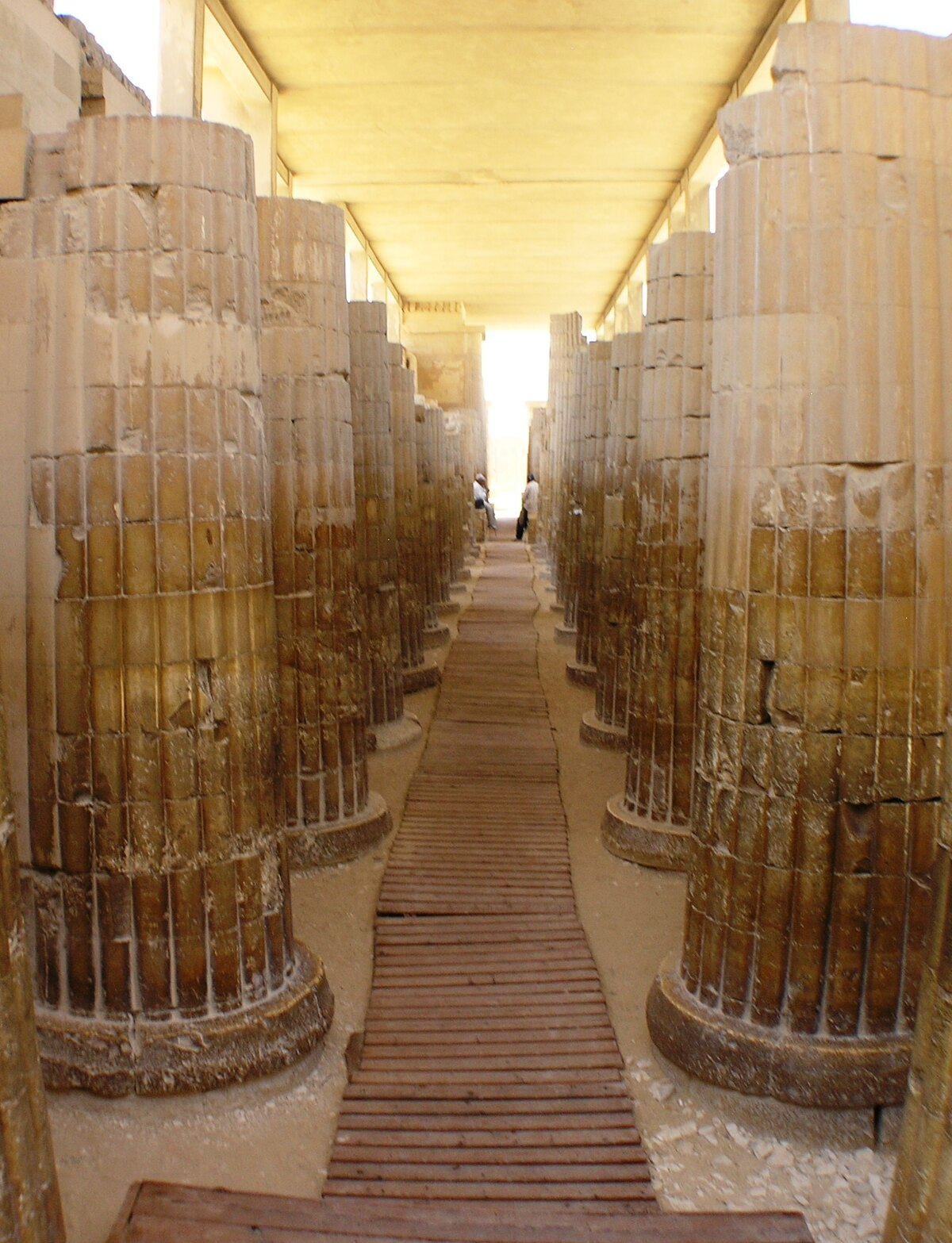
To reduce Saqqara to its pyramid alone would be a mistake. The monument is only the heart of a vast funerary complex ringed by a white limestone enclosure wall about ten metres high, tracing a rectangle of some 544 by 277 metres.3 This wall, articulated with bastions and false doors, offered only a single real entrance, in its south-eastern corner, through which one passed into a colonnade of fluted columns of rare elegance.
Inside unfolded a petrified ritual stage. The great court of the heb-sed festivalHeb-SedA royal jubilee festival meant to renew the pharaohPharaohThe title of the ruler of ancient Egypt, regarded as a living god guaranteeing cosmic order (Maat), supreme head of state, army and worship.→'s power, re-enacted for eternity in the court of the Djoser complex.→ was lined with chapels meant to let the king re-enact forever, in the afterlife, the jubilee ceremony that renewed his reign. Strikingly, most of these chapels are dummies: solid masses of stone with no interior space, theatre facades frozen for eternity. Against the northern flank of the pyramid nestled the serdab, a small sealed chamber that housed a life-sized statue of Djoser seated. Two holes pierced in the wall allowed the statue, and so the king's ka, to watch the rituals and breathe in the offerings. The whole thing reproduced in durable stone the brick, wood and reed buildings of the royal palace, giving the deceased a complete domain in which to live out his eternity.
The technical revolution of cut stone
The feat of Saqqara is first of all a technical one. Before Djoser, stone served mostly as an accessory, for a threshold, a pavement or an isolated element. With the pyramid, it became for the first time the main material of an entire monumental building.1 The blocks used remain small, however, close in size to the mud bricks they imitate, because the builders were transposing into stone the know-how inherited from brick and timber architecture.
You can see it everywhere in the complex: columns imitating bundled reeds, fluted half-columns engaged in the walls, ceilings carved as palm logs, stone doors frozen in the open position. The first architects did not yet dare let a column bear a roof on its own, so they always attached it to a wall. That caution tells a story: of a civilisation learning, in real time, to think and carve stone on a grand scale. The lessons of Saqqara, passed from site to site, would in less than a century allow the move to the smooth pyramid, and then to the colossi of Giza.
The organisation of the worksite also commands admiration. Quarries had to be opened, blocks shaped with copper chisels and mallets, hauled on sledges, then fitted to one another without load-bearing mortar. All of this without iron, without pulleys, without wheels for heavy transport: only rope, lever, ramp and a vast, perfectly coordinated workforce. The step pyramid thus represents the first great logistical challenge in monumental history, a dress rehearsal before the titanic projects of the Fourth Dynasty. Every solution found at Saqqara, every mistake corrected, would feed the accumulated experience of the Egyptian builders.
Climbing to the sky: the symbolic charge
Why a staircase? The stepped form is not only an engineer's solution. For the Egyptians, the dead king had to join the realm of the gods, in particular the imperishable stars of the north or the sun. Many Egyptologists see in the tiers a symbolic ramp, a monumental stairway by which the soul of the sovereign climbed the heavens.2
The pyramid thus becomes a machine for resurrecting the king, a bridge of stone between earth and sky. Its colossal mass, its dazzling whiteness under the desert sun, its visibility for kilometres: everything worked to proclaim that the pharaoh, even in death, remained the guarantor of cosmic order. This alliance of the religious and the political, of the sacred and the display of power, would ground the model of the Egyptian royal tomb for a thousand years. Even when the pyramid became smooth, it would keep this vocation: to link the dead sovereign to the world of the gods and to inscribe his name in eternity.
The serdab and its statue carry this logic further. By sealing in an effigy of the king able to see outside, the Egyptians made sure the ka, that immortal part of a being, always had a material support to inhabit and offerings to feed on. The funerary cult rendered to the sovereign could thus be kept up indefinitely, long after his death. The pyramid was therefore not a mere tomb closed in on itself, but the living centre of a carefully conceived religious device, in which every building, every court, every statue played a precise role in the king's eternal survival.
The Old Kingdom, the age of builders
The pyramid of Djoser did not appear from nowhere. It opens the Old Kingdom, that period of prosperity and centralisation running roughly from the twenty-seventh to the twenty-second century BC, rightly nicknamed the age of the pyramids.5 The capital, Memphis, then concentrated the power of a state able to mobilise considerable human and material resources.
Such a project indeed implies a well-oiled administration: counting and feeding the workers, organising the quarrying and transport of the blocks, coordinating years of labour. Far from the image of whipped slaves, modern research instead depicts teams of supervised workers, often peasants mobilised outside the farming seasons, housed and supplied by the state. The pyramid of Saqqara is thus the witness of a profound shift: the emergence of a royal power strong enough and well enough organised to turn an architectural idea into a mountain of stone. It opened the way to the pyramids of Sneferu at Dahshur, and then to those of Khufu, Khafre and Menkaure on the Giza plateau.
Djoser's reign itself remains partly an enigma. The king lists and the ancient historian Manetho credit him with a reign of roughly nineteen to twenty-nine years, long enough to see such a project through. Later tradition also links his name to a great seven-year famine, said to have been overcome through the intervention of the gods and the knowledge of Imhotep. Whether historical or legendary, this memory speaks to the exceptional place Djoser kept in the Egyptian imagination: that of a builder king whose stone monument crossed, its silhouette intact, almost the entire span of pharaonic history.
Lauer, the restorations and the monument's rebirth
No modern name is as bound to Saqqara as that of the French architect Jean-Philippe Lauer. Arriving on the site in 1926, he would devote nearly seventy-five years of his life to it, until his death in 2001, re-erecting block by block the collapsed walls of the Djoser complex and giving shape again to the enclosure and the chapels buried under the sand.6 His patient work remains the reference for understanding the monument, and his method of reassembling fallen blocks in their original position set a standard for the conservation of ancient stone architecture. Few scholars have ever devoted so much of a single lifetime to one site, and the modern face of the Djoser complex owes almost everything to his persistence.
The pyramid itself went through a long convalescence. Weakened by an earthquake in 1992 and threatened with interior collapse, it became from 2006 the object of a vast consolidation project that kept it closed for nearly fourteen years. The teams shored up the galleries, filled the gaps between the blocks, reinforced underground walls and ceilings, cleared the corridors and restored the king's imposing granite sarcophagussarcophagusA stone coffin, often carved, meant to hold the body of a high-ranking deceased person.→. The project, not without controversy over the methods used, finally received the approval of international experts, and the pyramid reopened to the public in March 2020.7 Listed since 1979 as a UNESCO World Heritage Site within the ensemble of Memphis and its Necropolis, it remains the oldest large stone monument standing on Earth, a limestone staircase that, forty-seven centuries later, still climbs toward the sky.
Le complexe funéraire de Djoser à Saqqarah est l'un des sites que je reve de documenter. La restauration en cours depuis des années pose des questions éthiques et esthétiques complexes : jusqu'où restaurer sans trahir l'original ? Le travail de Jean-Philippe Lauer qui a consacré sa vie à reconstituer ce complexe est une aventure humaine extraordinaire.
La pyramide à degrés de Djoser à Saqqarah est l'une des premières grandes constructions en pierre de l'histoire humaine. L'architecte Imhotep, qui l'a conçue vers 2650 avant notre ère, est l'un des premiers génies de l'ingénierie dont nous connaissons le nom. Son génie a été reconnu par les Egyptiens eux-memes qui l'ont divinisé après sa mort.