Around 2700 BCE, a visionary architect named Imhotep raised a structure from the desert at Saqqara that had never been seen before: Egypt's first pyramid. Built for PharaohPharaohThe title of the ruler of ancient Egypt, regarded as a living god guaranteeing cosmic order (Maat), supreme head of state, army and worship.→ Djoser of the Third Dynasty, this stepped monument was more than a tomb - it launched an architectural revolution that would define Egyptian civilization for millennia.1
Before Imhotep, Egypt's elite were buried in mastabas - low rectangular structures of mud-brick or limestone. Imhotep's brilliant innovation was to stack six mastabas of decreasing size on top of one another, creating a stepped silhouette rising 62 meters high. For the first time in history, a building constructed entirely of cut stone stood in the Egyptian landscape.2
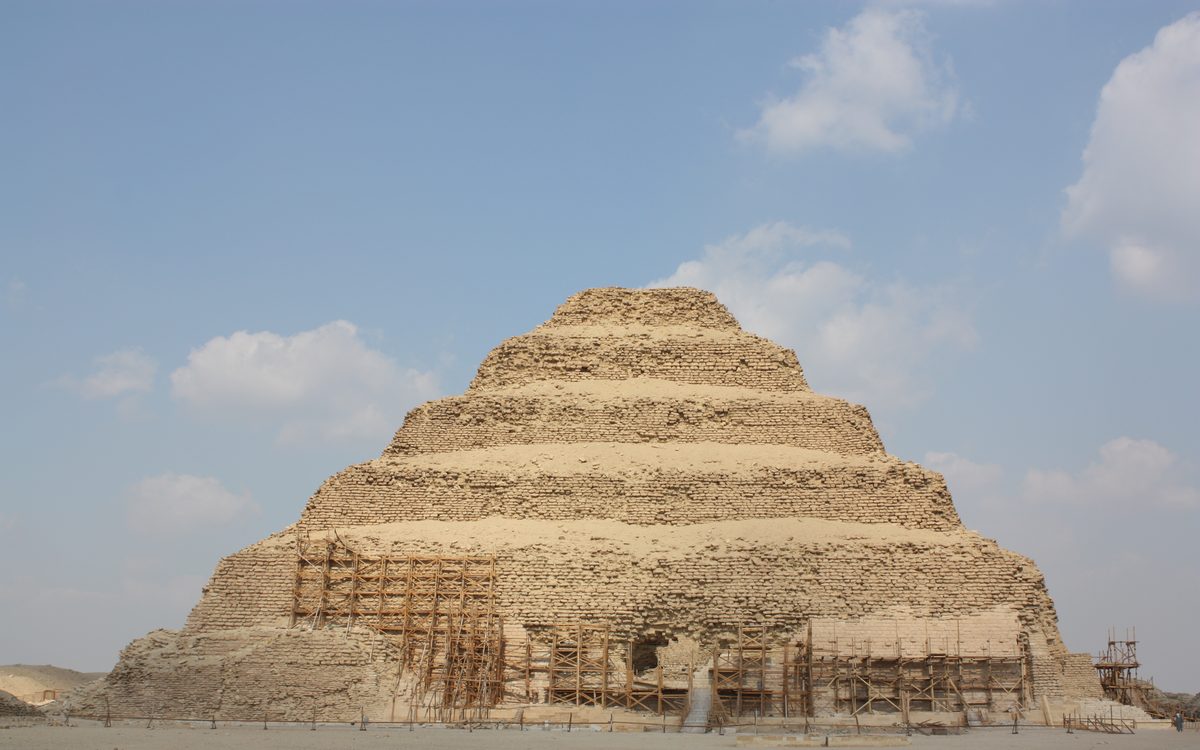
The pyramid is only the most visible element of a vast 15-hectare complex. Imhotep designed a sequence of courtyards, chapels, and buildings adorned with fluted columns - the earliest known example of architectural order in history. A 10.5-meter-high enclosure wall, nearly 1.6 kilometers long with 211 bastions, surrounds the entire complex and reproduces in stone the appearance of the royal palace at Memphis.3
Beneath the pyramid, a labyrinth of galleries descends 28 meters into the bedrock. The granite burialBurialThe intentional deposition of a body, sometimes with offerings; a marker of symbolic behaviour.→ chamber was sealed with a 3.5-ton plug. Nearly 40,000 vessels of alabaster, diorite, and schist were recovered from these galleries - a royal treasure accumulated over several generations, testifying to the wealth and organization of early dynastic Egypt.
Imhotep was venerated as a god for centuries after his death, later assimilated to Thoth and then to Asclepius by the Greeks. At Saqqara, excavations continue to yield surprises: in 2020, a French-Egyptian mission uncovered a remarkable dismembered sarcophagus in a newly discovered tomb. This SLICE Histoire documentary traces the founding architectural revolution and the recent discoveries still shedding light on the birth of the pyramids.4
No comments yet. Be the first.