Nearly twenty-five centuries ago, in the comfortable houses of late Babylonia, young trainee scribesscribeA professional man of letters tasked with writingWritingA system of conventional signs used to fix language or information durably; its appearance (c. 3300 BC) marks, by convention, the end of prehistory.→, copying and managing texts, trained over many years in the mastery of cuneiform.→ spent years copying, reciting and memorising the names of close to two thousand deities. Yet no religion class appeared on their timetable, and no holy book served as the foundation of their belief. For these children of well-off families, knowledge of the gods was not a subject apart but a thread running through the whole training designed to produce the country's literate elite.1
In a study published in 2026 in the journal Iraq, the assyriologist Shana Zaia, of the Vrije Universiteit Amsterdam, sets out to reconstruct this forgotten curriculum from the only evidence available, the written homework on clay that has crossed the millennia. The task is a piece of detective work, for almost nothing survives of Babylonian teaching except these tablets covered with clumsy or careful signs, which are compared from one city to another to recover the logic of a shared course.1
A school with no religion class and no holy book
The first surprise, for a modern reader, lies in the absence of any structure we would recognise. There was no public school, no catechism, no single founding text around which to organise instruction. Teaching took place in private houses, under the direction of a professional of knowledge, often a father who taught his sons alongside the boys of other wealthy families. What one learned there, first and foremost, was to write cuneiformCuneiformThe oldest known writing, born at Uruk; its signs, impressed into clay with a reed stylus, are wedge-shaped (from Latin cuneus).→, that wedge-shaped script pressed into fresh clay with a reed stylus.1
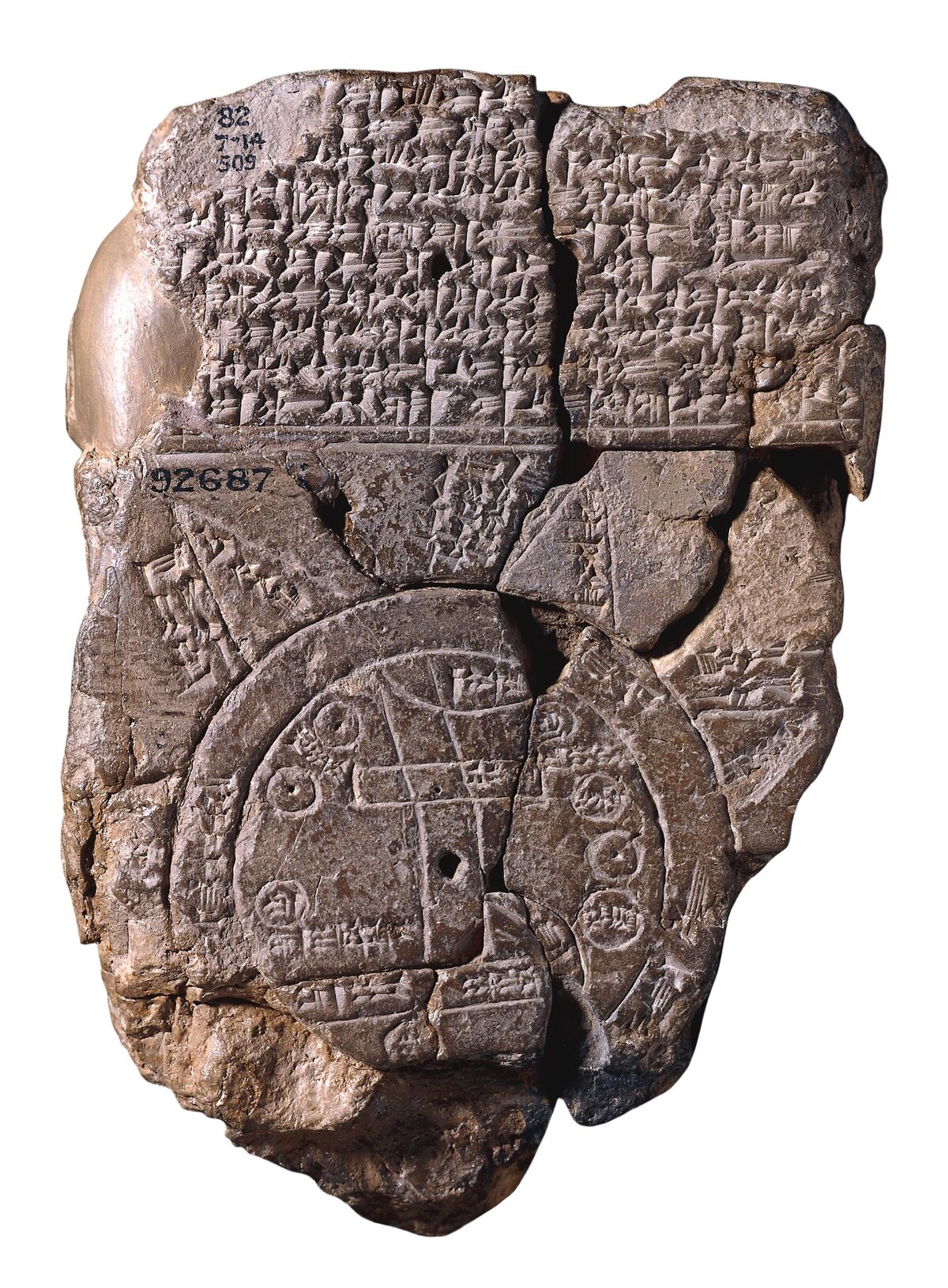
In Babylonia, however, learning to write meant almost inevitably learning the gods. The very first exercises consisted of lining up the names of deities, since those names offered a convenient store of signs to master. Religion thus seeped into the earliest lessons, not as doctrinal teaching but as the very material on which the pupil's hand was trained. The lists, prayers, hymns and myths copied next were not reserved for future priests, they made up the common stock shared by all those who, as adults, would work as scribesscribeA professional man of letters tasked with writing, copying and managing texts, trained over many years in the mastery of cuneiform.→, administrators, exorcists or diviners.1
Zaia stresses that this unity of the curriculum had a deep consequence. One and the same foundation of religious knowledge circulated among professions we would today keep apart, the temple accountant and the healer, the drafter of contracts and the specialist in omens. All had been trained on the same texts, all shared a familiarity with the pantheon and its hierarchies. The school did not manufacture believers in the sense we understand, it manufactured literate men for whom knowledge of the gods was a professional skill as much as a culture.1
Training stretched over several years and followed a demanding progression, from the simple tracing of elementary signs to the copying of complex literary compositions. The pupil advanced by reproducing models, by wiping the still-damp clay to begin again, by learning through repetition what no theoretical manual ever spelled out. This patient, concrete pedagogy of imitation made religious knowledge a matter that one handled physically, stylus in hand, long before grasping it as a system of beliefs. The master, who often practised a learned profession of his own, thus passed on not merely a technique but a whole way of relating to the world.1
The encyclopaedia of gods, from the An list to An = Anum
At the heart of this divine education lay the god lists, genuine catalogues that the pupil copied in order to fix the names in memory and in hand. One began with a relatively modest list, known to specialists as An, which held more than two hundred entries. Clearing that stage prepared the way for the most ambitious work of the genre, the great scholarly list called An = Anum.2
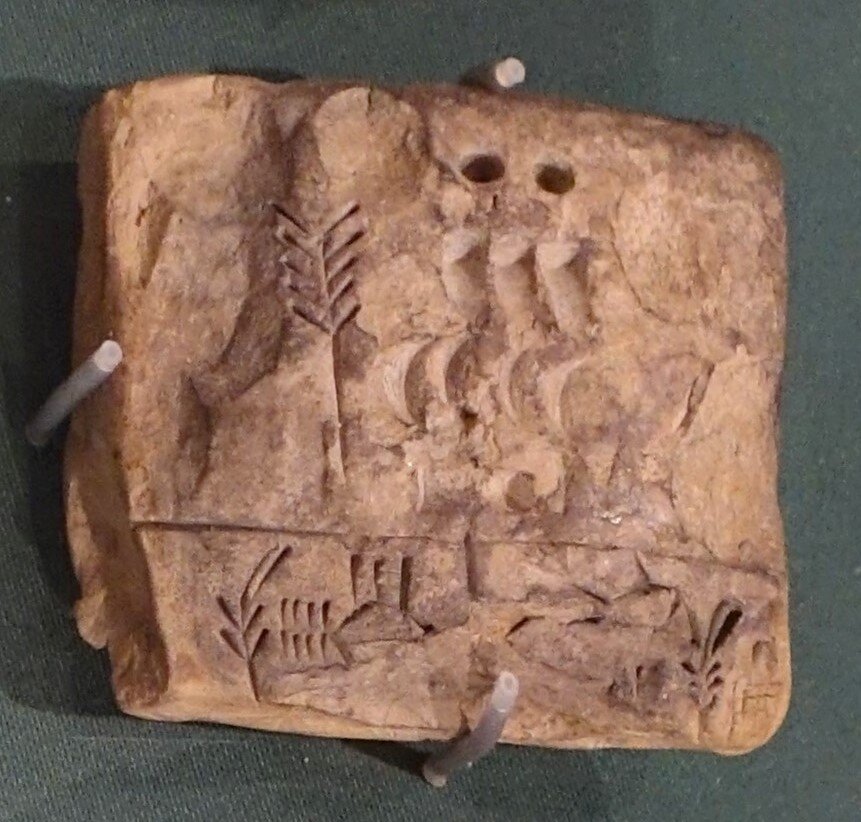
An = Anum gathered close to two thousand divine names spread across seven tabletstabletA clay writing support, shaped and then inscribed with a stylus, on which contracts, lists, exercises and literary texts were recorded.→, setting the SumerianSumerianThe language of southern Mesopotamia, the earliest written in cuneiform, long preserved as a scholarly and religious language.→ designations against their AkkadianAkkadianA Semitic language of ancient Mesopotamia, spoken notably at Babylon and in Assyria, written in cuneiform.→ equivalents and sometimes specifying the titles of the deities or the relationships that bound them. The sheer scale of this repertoire is striking. Many of the gods it recorded were no longer the object of any living cult, their sanctuaries had vanished, their festivals had long since died out. Keeping them in the list was an encyclopaedic undertaking, bent on completeness, rather than an act of devotion.2
The pupil therefore memorised a divine universe far wider than that of his own city, a patrimonial knowledge that went well beyond the needs of daily practice. Alongside these great lists circulated repertoires of personal names, those compound names that invoked a deity such as Marduk, Nabû or Šamaš, offering further occasions to practise writing while becoming acquainted with the major figures of the pantheon. Last came the prayers, hymns and myths, which gave flesh to the names by telling of the powers of the gods and their place in the order of the world.1
The very structure of An = Anum reveals a mind bent on classification. The deities were ordered by families and entourages, a major god followed by his wife, his children, his servants and his deified emblems. To copy this list was to absorb not only names but a genuine sociology of the heavens, a map of the relationships that structured the divine world. The constant passage from SumerianSumerianThe language of southern Mesopotamia, the earliest written in cuneiform, long preserved as a scholarly and religious language.→ to AkkadianAkkadianA Semitic language of ancient Mesopotamia, spoken notably at Babylon and in Assyria, written in cuneiform.→ trained the pupil in the learned bilingualism that defined the Babylonian scholar, able to handle a language dead for centuries yet still the tongue of prestige and of the sacred.2
The Marduk program and the schools of the South
If a common foundation united the Babylonian schools, the curriculum was not identical from one region to the next. In the north of the country, teaching gave an overwhelming place to MardukMardukThe city god of Babylon, raised to sovereign of the gods in the Enūma eliš poem and placed at the heart of the northern Babylonian curriculum.→, the city god of Babylon, so much so that Zaia speaks of a genuine Marduk program. There the pupils copied the seven tablets of the Enūma elišEnūma elišThe great Babylonian creation poem, in seven tablets, telling of Marduk's victory over Tiāmat and his rise to divine kingship.→, the great poem of creation in which Marduk vanquishes the primordial goddess Tiāmat before rising to kingship over the other gods.4
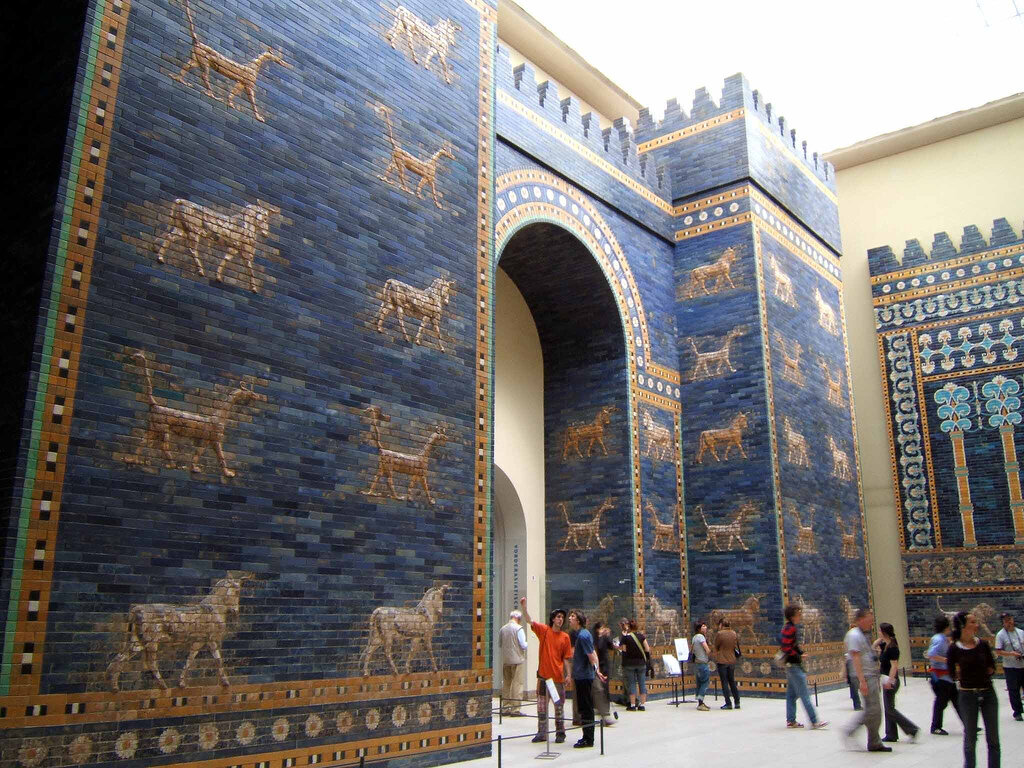
To this celebration of the god was added that of his city. The schoolchildren studied the text known as Tintir, a composition that listed the ceremonial names of Babylon, its temples, its shrines, its gates and its streets, and presented the city as a religious centre par excellence. To learn Babylon was to learn a sacred geography as much as a theology, to inscribe in the pupil's memory the pre-eminence of the capital and its god.1
The contrast with the South is all the more telling. At Nippur, an ancient religious city of southern Babylonia, this Marduk program was absent. There the pupils copied other narratives, in particular the myths devoted to Ninurta, and carried on local traditions anchored in a more distant past. This divergence shows that the school, far from imposing the same orthodoxy everywhere, could also preserve and transmit regional religious identities, each city tending the memory of its own gods.1
The Enūma elišEnūma elišThe great Babylonian creation poem, in seven tablets, telling of Marduk's victory over Tiāmat and his rise to divine kingship.→ was no ordinary schoolroom text. Recited during the great Babylonian New Year festival, it sealed each year the sovereignty of MardukMardukThe city god of Babylon, raised to sovereign of the gods in the Enūma eliš poem and placed at the heart of the northern Babylonian curriculum.→ and, by extension, that of the city and its king. In copying it onto their tablets, the pupils took on a genuine political theology, a narrative in which the order of the cosmos and the order of the earth echoed one another. To learn how Marduk had defeated chaos and received the destinies was to internalise the idea that Babylon held a central place in the economy of the world, willed by the gods themselves.4
From the classroom to the sanctuary
Zaia's study brings to light one gesture especially revealing of the link between learning and religion, the deposit of school tablets in temples. Some of these tablets bear an exercise on one face and a prayer on the other, often addressed to Nabû, the patron god of writing and knowledge. Once finished, they were offered to the sanctuary as a votive gift.1
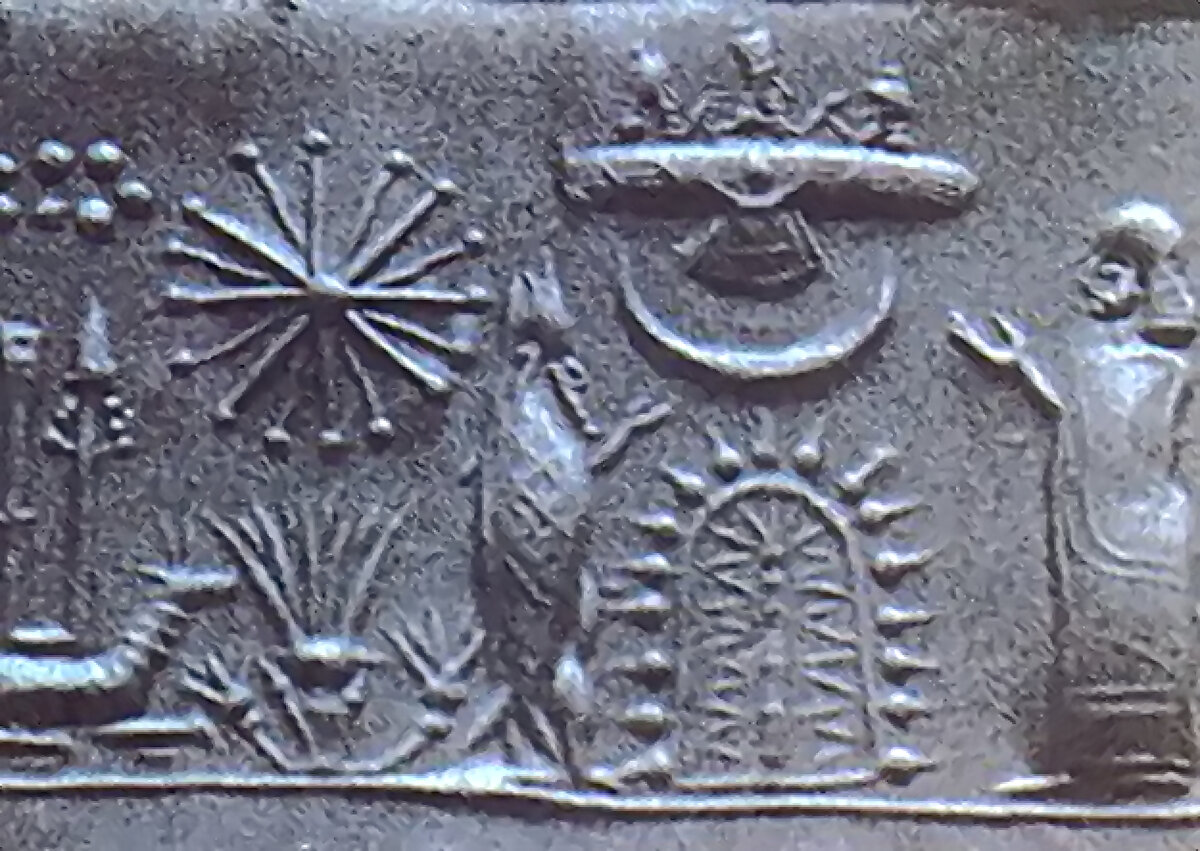
Thousands of fragments of this kind have been unearthed in a temple of Nabû at Babylon, witnesses to a practice in which the pupil's work turned into an act of piety. The deposit no doubt marked an important stage of the journey, a way of placing one's learning under the protection of the deity and of thanking the one who presided over the art of signs. Writing and worship thus remained tightly knotted in the culture of the Babylonian elite.1
The care given to the very material of schoolwork is equally striking. The gathering of the clay could be ritualised, as shown by the case of a pupil named Šamaš-riḫtu-uṣur, who carried his modelling earth from a sacred source, at times accompanied by incantations. Preparing the tablet was then a small liturgy, before the first sign was even traced.1 Wisdom texts, finally, rounded out this moral and religious education. The Counsels of Wisdom urged prayer, offerings and reverence for the gods, while warning against excessive drinking, slander and idleness. The Ludlul bēl nēmeqi, the poem of the Righteous Sufferer, told of the ordeal of a man struck by misfortune after losing divine favour, before being raised up by the intervention of Marduk. For future exorcists, that same text also offered a catalogue of symptoms to recognise and to treat.5
These wisdom works reveal a vision in which moral conduct, bodily health and the favour of the gods formed a single fabric. Misfortune was read there as the sign of a broken relationship with the divine, and recovery as a reconciliation. For the trainee exorcist, knowing how to recognise the symptoms of such an imbalance and knowing the prayers able to remedy it belonged to one and the same science, at once religious and therapeutic. The school did not separate what we distinguish, care, morality and cult were taught there in a single movement.5
Reshaping tradition, the school as conservatory
Mastery of this knowledge did not merely make pupils the passive heirs of a tradition, it gave them the means to reshape it. Zaia recalls the remarkable case of Uruk, where priestly families raised the god Anu to the summit of the pantheon by relying precisely on the god lists learned at school. By unearthing ancient hierarchies recorded in those catalogues, the literate could present a bold theological innovation as a mere return to sources, a restoration of the true order of the gods.2
This power of the scribes sheds light on the surprising longevity of certain traditions. Loyalty to Marduk far outlasted the disappearance of the independent Babylonian kings. The Tintir text went on being copied under the Achaemenid Persians and then under the Seleucids, and one copy is known dated to 61 before our era, along with another transcribed into Greek characters. Even when Babylon was no longer a sovereign capital, its schools perpetuated the cult of its god and the memory of its greatness.1
This persistence looks like a defensive assertion, the reflex of a religious identity that feels threatened and falls back on its texts to hold on. The school then became a conservatory, a place where names, narratives and hierarchies no longer supported by the outside world were kept alive. In tirelessly copying the gods, the Babylonian trainees did not only learn to write, they transmitted, from one generation to the next, a way of inhabiting the world and of binding it to the heavens. What the school tablets let us glimpse, beyond their clumsiness and their crossings-out, is the stubborn persistence of a civilisation in telling itself, sign after sign, god after god.1
No comments yet. Be the first.