The Senegal River valley and the Sine-Saloum plains hold two of West AfricaAfricaThe cradle of humankind: the continent where the first hominins appeared, then Homo sapiens around 300,000 years ago, before the expansion to the rest of the world.→'s most fascinating prehistoric secrets. The first lies buried in the red laterite of eastern Senegal: a quartz-knappingknappingThe set of operations for fracturing a stone block to extract flakes or blades.→ workshop nearly 9,000 years old, where humans were already crafting precision microlithic tools adapted to the savanna. The second stands visible from dusty roads: over 1,000 stone circles raised along 350 km of the Gambia River, forming the largest known concentration of megalithic monuments in the world. Together, these two legacies trace a remarkable continuum of human history in Senegal, from the MesolithicMesolithicThe period between the Palaeolithic and the Neolithic (c. 10,000–6,000 BC in Europe), still based on hunting and gathering.→ through the medieval era.
This is also the history of an Africa often absent from major prehistoric narratives. While the Maghreb, the LevantLevantA region of the eastern Mediterranean Near East (Israel, Lebanon, Syria, Jordan), a major crossroads of the first human migrations out of Africa.→, and Europe concentrate most of the popular literature, Senegal holds remains of comparable richness -- from the earliest villages to the Iron AgeIron AgeThe last period of protohistory (from c. 1200 BC in Europe and the Near East), marked by iron metallurgy and the first kingdoms.→, and including monumental funerary traditions whose sophistication still puzzles archaeologists.
Ravin Blanc X: A Quartz Workshop in the Savanna
At the far eastern end of Senegal, in the wooded hills separating the Gambia and Faleme river basins, researchers have identified several Late Stone Age sites. Among them, Ravin Blanc X stands out for its age and for the lithic industry found there: quartz microliths -- blades, bladelets, scrapers, burins -- worked with remarkable care approximately 9,000 years ago, during the period corresponding to the end of the Epipalaeolithic and the beginning of the Mesolithic in West Africa.[1]
The choice of quartz as raw material is characteristic of West African industries during the late PleistocenePleistoceneThe geological epoch of the great ice ages (c. 2.6 Ma–11,700 BP), spanning most of human prehistory.→ and early HoloceneHoloceneThe current geological epoch, begun about 11,700 years ago at the end of the last ice age; the setting of all post-glacial history.→. Unlike flintFlintA hard, brittle siliceous rock, knapped by prehistoric people to produce blades, points and sharp tools.→ or obsidian, quartz is unpredictable during knapping: its crystalline fracture planes resist precise control. Yet the occupants of Ravin Blanc X managed to exploit local stream cobbles to produce sharp-edged tools, likely used for hunting, butchery, and hide-working -- activities suggested by research at other contemporary West African sites.
The presence of such an open-air site confirms that the Faleme valley was intensively frequented during the early Holocene, when the Sahara was still drying out and the animal and plant resources of the Sudano-Sahelian zone attracted mobile hunter-gatherer groups. These populations left virtually no written records -- they produced none -- but their quartz tools still speak, nine millennia later.
The Megalithic Age: When Senegal Carved Laterite
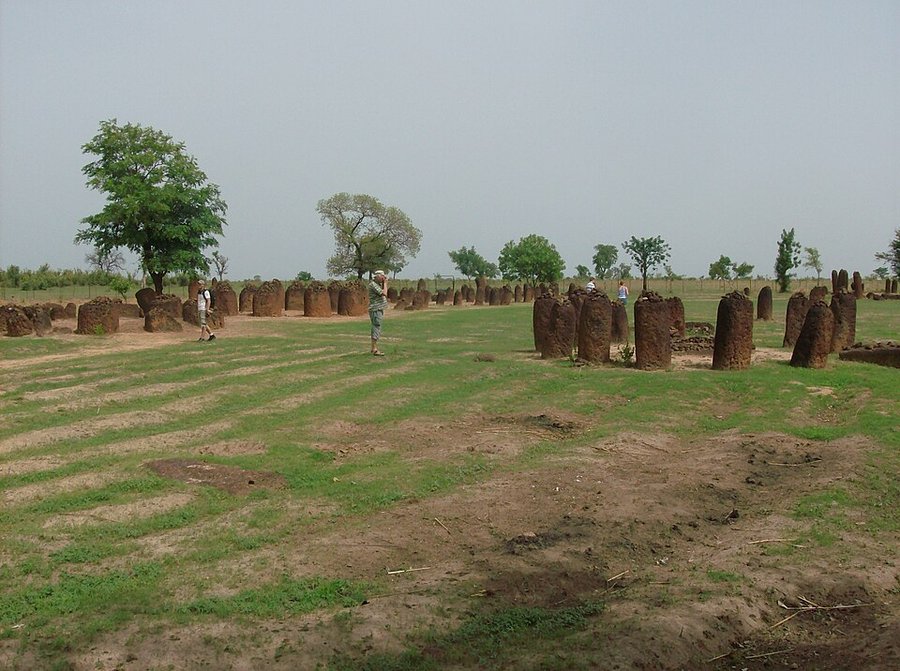
Centuries later -- many centuries later -- a wholly different form of grandeur appeared in the valleys of the Sine and the Saloum. Between the 3rd century BCE and the 16th century CE, West African populations erected nearly 1,000 stone circles and numerous funerary tumuli along a 350 km x 100 km corridor shared today between Senegal and Gambia. Together they form the largest known concentration of megalithic monuments in the world.
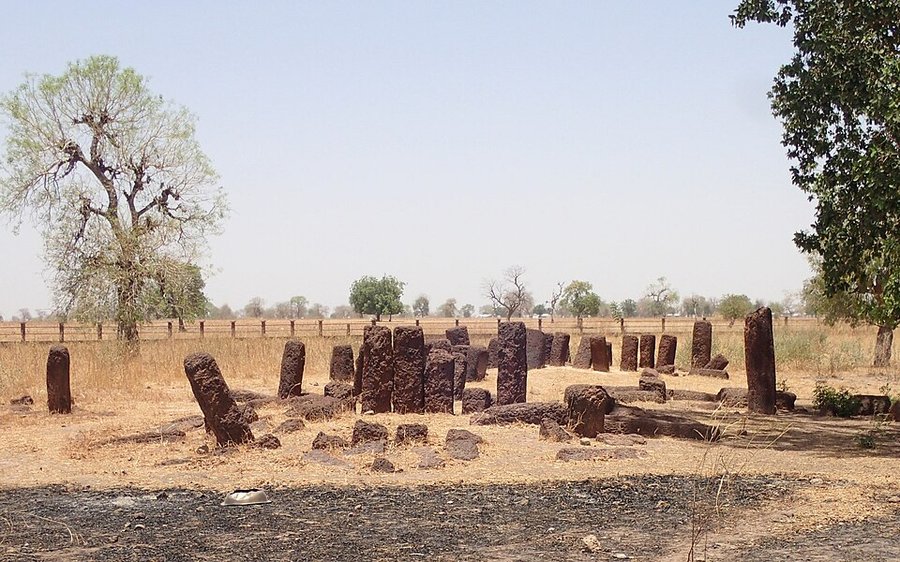
The stones forming these circles are laterite monoliths -- the iron-rich rock abundant in tropical soils -- extracted from nearby quarries using iron tools and carefully worked into cylindrical or polygonal columns about 2 meters tall, weighing up to 7 tons. Each circle holds between 8 and 14 standing stones with a diameter of 4 to 6 meters. All are associated with funerary tumuli -- earthen mounds covering burials -- that are the purpose of these monuments: they marked the graves of important individuals and structured a collective sacred landscape.[2]
Sine Ngayene and Wanar: The Senegalese Jewels
The two Senegalese sites -- Sine Ngayene and Wanar -- each have distinctive features that set them apart within the Senegambian megalithic complex. Sine Ngayene, located just northwest of the Sine-Saloum, is the largest of all: 52 circles, one double circle, and 1,102 carved stones. Excavations since the 1970s have identified four successive cycles of use between 700 and 1,350 AD, each corresponding to slightly different funerary practices -- simple pits at first, then collective burials, then votive deposits.[2]
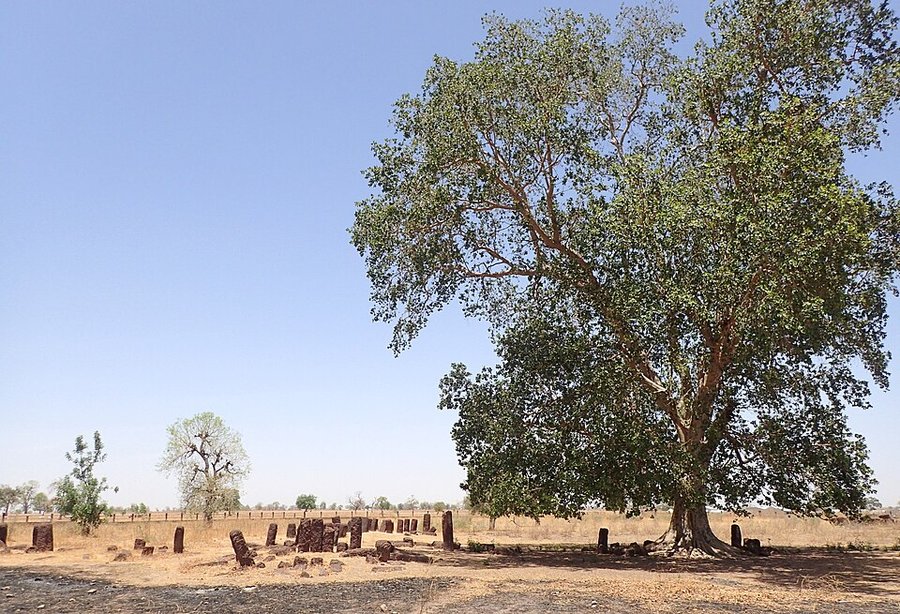
Wanar, in the Kaffrine department, contains 21 circles including one double circle, and is distinguished by 9 so-called "lyre stones" -- bifid monoliths split into two branches connected by a crosspiece, unique to this site. The 2008 excavations uncovered two types of burialBurialThe intentional deposition of a body, sometimes with offerings; a marker of symbolic behaviour.→: large pits sealed with a tumulusTumulusA mound of earth or stones covering one or more burials; it often capped a dolmen's chamber in the Neolithic.→, and deeper narrow-mouthed graves associated with remains of brick-and-plaster funerary houses. The existence of these ephemeral constructions, lost to the pressure of centuries, suggests the landscape around Wanar was far denser and more structured than it appears today.
Who Built These Monuments?
The identity of the builders remains an open question. No text, no directly transmitted oral tradition names the builders of these circles. Candidates proposed by researchers include the ancestors of the Jola, the Wolof, or the Serer -- the latter being favored by the argument that the Serer still use funerary houses similar to those found at Wanar. But this interpretation remains speculative, and the absence of a direct genealogy makes any ethnic attribution fragile.[3]
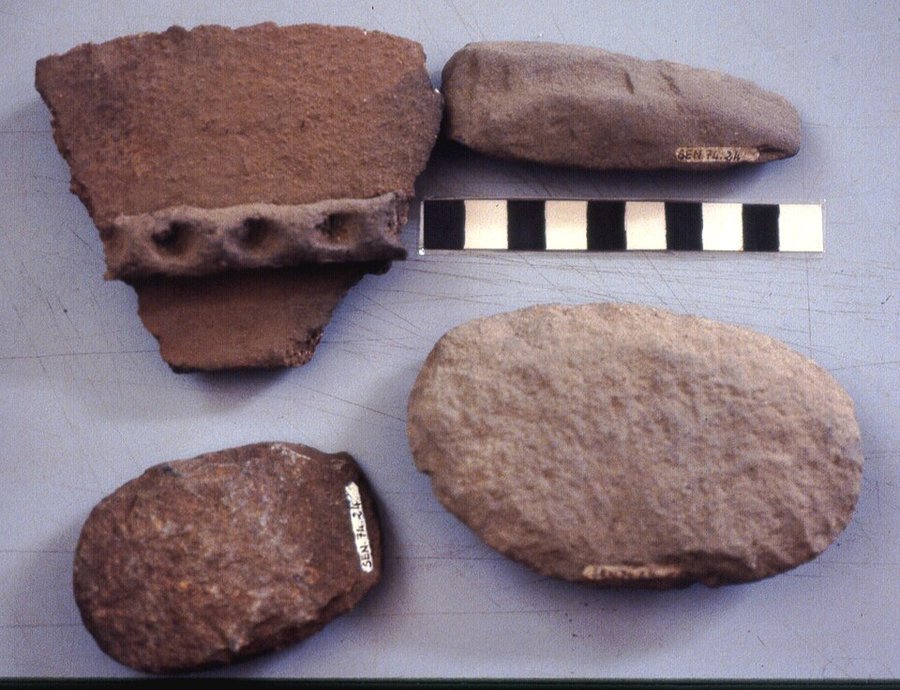
What excavations have clearly established is the wealth of the societies that built these monuments: tombs contain iron spearheads, copper bracelets, turquoise beads, and finely worked ceramics. Turquoise -- a mineral not found in West Africa -- testifies to long-distance exchange, perhaps with the Maghreb or via trans-Saharan routes. These societies mastered iron metallurgyMetallurgyThe techniques of extracting and working metals (copper, bronze, gold); its rise in the Eneolithic and Bronze Age transformed tools, weapons and social hierarchies.→ (the laterite quarries were worked with iron tools), practiced agricultureAgricultureThe cultivation of plants and production of food by working the soil, which emerged in the Neolithic in the Near East and independently elsewhere; it radically transformed human societies.→, and possessed political structures organized enough to mobilize the human and material resources required to erect these colossal monuments.
World Heritage, Fragile Protection
In 2006, the four Senegambian sites -- Sine Ngayene and Wanar in Senegal, Wassu and Kerbatch in Gambia -- were jointly inscribed on the UNESCO World Heritage List under criteria (i) and (iii): a masterpiece of human creative genius and an exceptional testimony to funerary practices and monumental construction persisting over more than a millennium.[2]
The Senegalese sites benefit from legal protection under Law No. 71-12 of January 25, 1971. Permanent custodians are employed there, fences have been installed, and an interpretation centre has opened at Sine Ngayene. However, land pressure, unregulated tourism, and climatic changes -- which accelerate tumuli erosion -- threaten the integrity of some complexes. Archaeological research continues, with international teams still excavating and dating these sites, whose funerary and symbolic secrets have not all yet been uncovered.
From the quartz-knapped hills of the Faleme to the laterite columns of the Sine-Saloum, Senegal's prehistoryPrehistoryThe span of human history before the invention of writing, from the Palaeolithic to the Metal Ages, known mainly through material remains.→ offers a frescoFrescoA term used by extension for large painted compositions on the walls of decorated caves, although the technique differs from the classical mural fresco.→ spanning several millennia. It reminds us that West Africa was not a periphery of human history, but one of its essential stages -- a space of creation, exchange, and builders whose works endure, majestic and silent, in the middle of the savannas.
The Economy of the Builders: Agriculture, Livestock and Long-Distance Trade
The societies that erected the Senegambian stone circles were not simple communities of nomadic pastoralists: they formed part of a diversified and dynamic economic system whose complexity archaeobotanical and zooarchaeological analyses are beginning to reveal. Residue analyses on ceramics associated with funerary sites and studies of carbonised seeds from adjacent occupation levels attest to the cultivation of pearl millet (Pennisetum glaucum) and sorghum (Sorghum bicolor) as the basis of the vegetable diet. These cereals, domesticated in sub-Saharan AfricaSub-Saharan AfricaThe part of Africa south of the Sahara; cradle of Homo sapiens, long thought hostile to ancient-DNA preservation because of heat.→ independently of the Near Eastern agricultural revolution, constituted the nutritional foundation of the Senegambian economy of the first millennium CE.[6]
Cattle-herding played a central role, as attested by bone remains found in funerary and associated domestic contexts. The presence of cattle in significant quantities in funerary deposits -- sometimes complete, sometimes represented only by their horns or mandibles -- suggests that domestic animals had a symbolic and social value that exceeded their mere nutritional utility. In many contemporary or recent African pastoral societies, cattle constitute the measure of wealth, the medium of marriage alliances and the support of ritual obligations: it is plausible that analogous functions existed among the builders of Senegambian megaliths.
The iron tools found in the tombs -- axes, adzes, knife blades -- attest to an early and deep integration of iron metallurgy into the agricultural and pastoral economy. These instruments allowed more efficient land clearing, better soil preparation and potentially more productive agriculture. The spatial correlation between the distribution of megaliths and the ferralitic soil zones favourable to millet cultivation in the Gambia valley and its tributaries is probably not coincidental: it suggests that the builders of the stone circles were sedentary or semi-sedentary farmers exploiting the most fertile lands in the region.
The presence of cowries (Cypraea moneta) in the tombs is particularly significant of an economy oriented towards long-distance exchange. These shells, originating from the Indian Ocean, circulated in West Africa as a medium of exchange and prestige object for centuries before the arrival of Europeans. Their presence in Senegambia implies trans-Saharan or trans-continental commercial networks linking this region to the Indian Ocean zone, either directly or through successive relays. Objects in copper alloys, whose origin may be North African or Sahelo-Saharan, complete this picture of a Senegambian economy connected to the great exchange circuits of medieval Africa.
The totality of these economic data paints a portrait of Senegambian societies of the first to second millennia CE that combined cereal agriculture, cattle-herding, iron metallurgy and participation in regional and trans-regional exchange networks. Far from being isolated communities erecting monuments in a closed world, the builders of the megaliths participated in an open economic system in which the production of prestige goods -- including probably the stone circles themselves as territorial and socio-political markers -- articulated with the logics of exchange, alliance and inter-group competition.
Iron Metallurgy: Pillar of the Senegambian Megalithic Civilisation
The chronological coincidence between the development of Senegambian megalithic traditions and the spread of iron metallurgy in sub-Saharan West Africa is not a simple coincidence: the two phenomena are deeply articulated within the social and economic organisation of the region's societies. Iron smelting furnaces discovered near several megalithic sites -- notably in the Sine-Saloum region and the Gambia basin -- attest to local mastery of the reduction of iron ore by the direct process, a technology that spread in sub-Saharan Africa from the first millennium BCE.[7]
Iron-working occupied an ambivalent and powerful social and symbolic position in these societies. Blacksmiths -- masters of the transformative fire, capable of passing matter from the mineral to the metallic state -- were in many West African cultures ritual specialists as much as craftsmen, holders of esoteric knowledge and a power that could be perceived as beneficial or dangerous depending on context. This dual nature of the blacksmith -- essential artisan and potentially formidable figure -- recurs in the oral traditions of many contemporary ethnic groups in the Senegambian region, and it is legitimate, with caution, to project this backward into the megalithic past.
The iron objects found in megalithic tombs are not distributed randomly across the funerary population. Analyses of funerary assemblages show a concentration of metallic objects -- axes, lances, knives, iron jewellery -- in a subset of presumed elite tombs, characterised by the overall richness of their grave goods. This unequal distribution of iron among individuals buried beneath stone circles constitutes a robust social indicator: the metal, a transformed product requiring specialised know-how and fuel resources, was a valuable good whose possession or distribution marked high social status.
The role of iron metallurgy in the expansion and consolidation of proto-state political entities in medieval West Africa is well established by contemporary historiography. The same processes that fuelled the rise of Ghana, Mali and Songhai probably played a role in structuring the Senegambian societies that built the megaliths: mastery of iron confers military advantages (superior weapons) and agricultural advantages (more efficient tools) that allow groups possessing this technology to extend their influence and consolidate their authority over surrounding communities.[7]
The most recent research efforts aim to reconstruct the complete operational chains of medieval Senegambian metallurgical production -- from ore extraction to finished objects -- by combining chemical analysis of iron objects, study of smelting slag and ethnoarchaeological documentation of forging practices still alive in certain communities in the region. This work promises to considerably refine our understanding of the role of metallurgy in the economic and social organisation of the societies that erected the megaliths of Senegambia.
Funerary Rites in Detail: Tombs, Offerings and Ritual Practices
Detailed analysis of the funerary contexts of Senegambian megaliths, conducted from the first systematic excavations of the 1930s to the most recent research, reveals considerable variability in inhumation practices that probably reflects the diversity of social statuses, cultural affiliations and chronological periods represented at these sites. Individual inhumations -- a single deceased deposited beneath or near a stone circle -- coexist with collective tombs that received several individuals deposited successively, suggesting funerary use of the site over several generations or even centuries.[2]
The orientation of bodies in Senegambian tombs is not random: a marked preference for east-west orientation has been observed in several funerary assemblages, an orientation linking the deceased to the solar cycles of rising and setting, one of the most universal funerary symbolisms in human religions. This orientation is not, however, systematic, and north-south variants and other intermediate orientations have been documented, suggesting either a chronological evolution of practices or a plurality of coexisting traditions within the populations that built the megaliths.
Red ochreOchreA red or yellow mineral pigment (iron oxides), used from prehistory for adornment, funerary rites and art.→ deposits in several tombs constitute one of the most significant and ancient ritual practices documented in sub-Saharan Africa. Ochre, a reddish-coloured ferruginous mineral, is associated in many human cultures worldwide with blood, life and regeneration: its deposition in tombs may symbolise the protection of the deceased, preparation for an afterlife, or a ritual connection between the living and the dead. Its presence in Senegambian megalithic funerary contexts inscribes these practices within a long African history of the symbolic use of ochre, documented from the earliest sites on the continent.
Ceramic grave goods are ubiquitous in Senegambian tombs. Fired-clay vessels -- generally globular jars with incised or stamped decoration -- accompany the deceased in the majority of excavated contexts. These containers may have held food or drink destined for the soul's journey to the afterlife, or constituted valued objects exchanged and accumulated during the deceased's lifetime. The diversity of ceramic types within a single site sometimes suggests different cultural affiliations between interred individuals, which could reflect alliance policies through marriage or the incorporation of external groups into the local community.
Tombs presumed to contain elite individuals are distinguished by the co-presence of several categories of rare goods: iron objects (weapons and tools), ornaments in copper alloys (bracelets, ankle rings), imported glass beads and possibly gold objects in the latest contexts. This prestige assemblage, comparable in its logic to what is observed in other proto-state African societies such as those of medieval Zimbabwe or Ethiopia, confirms the hypothesis of a marked social hierarchy within Senegambian populations of the megalithic period, with certain individuals enjoying preferential access to rare goods from long-distance exchange networks.
Global Comparisons: Senegambia Among the Great Megalithic Traditions
The Senegambian megalithic tradition is part of a global panorama in which large standing-stone constructions constitute one of the most frequent and universally distributed archaeological phenomena. From the dolmens and menhirs of Carnac and Stonehenge, dating from the European NeolithicNeolithicThe "New Stone Age": a period marked by farming, herding, settlement and pottery, from around 10,000 BC.→ (4000-2000 BC), to the funerary stelae of Tiya in medieval Ethiopia (9th-12th centuries CE), via the alignments of Madagascar and the stone circles of the Caucasus, humanity has erected stone monuments in extremely varied cultural, chronological and geographical contexts.[8]
Comparison between Senegambian megaliths and the European tradition reveals superficial similarities -- use of laterite or sandstone blocks, organisation into circles or alignments, association with funerary practices -- but also fundamental differences. European Neolithic megaliths are generally at least three millennia older, used by societies in the process of sedentarisation in the context of a recent Neolithic settlement. The Senegambian monuments, by contrast, are more recent and belong to societies of the first millennium CE that had already developed iron metallurgy and forms of proto-state organisation, which gives the comparison a considerable chronological and cultural asymmetry.
The stelae of Tiya in Ethiopia (inscribed on the World Heritage List in 1980) perhaps offer the most pertinent African comparison. These funerary monuments, erected between the 11th and 12th centuries CE by populations whose identity remains debated, feature symbolic engravings of iconographic richness absent from the Senegambian megaliths, but share with them a funerary function, collective investment in construction and association with an elaborate social hierarchy. The stylistic divergence between the two traditions confirms their independence, each arising from cultural dynamics specific to its own region.
The megaliths of Madagascar -- notably the aloalo, sculpted wooden funerary stelae that extend an ancient tradition of stone monuments in certain parts of the island -- illustrate how megalithic practice can persist and transform over centuries, adapting to local resources and cultural developments. This persistence contrasts with the discontinuity observed in Senegambia, where the tradition appears to die out progressively between the 14th and 17th centuries without leaving direct successors in the current funerary practices of the region's populations.
The specificity of the Senegambian tradition in this global panorama lies in its unique combination of density (more than 1,000 sites recorded in a relatively limited area), duration (at least a millennium of active construction), standardisation (circles of laterite cylinders constitute a very recognisable architectural type) and exclusive funerary dimension. No other megalithic tradition in the world combines these four characteristics to the same degree, making Senegambia a unique case study for understanding processes of monumental construction in prehistoric and protohistoric African societies.
Recent Archaeological Research: Excavations, Datings and New Questions
The last two decades have seen a notable revival of archaeological research on Senegambian megaliths, after a long period of relative stagnation following the major excavation campaigns of the 1970s-1980s. Cheikh Anta Diop University in Dakar, in partnership with European and North American institutions, has launched research programmes integrating the most recent methods of archaeological analysis. Series of AMS radiocarbon dates (accelerator mass spectrometry) on charcoals and human bones from stratified funerary contexts have considerably refined the chronology of the sites, confirming a main construction range between the 3rd and 17th centuries CE, with significant regional variations.[9]
LiDARLiDARLaser-based remote sensing (from "Light Detection And Ranging"): a sensor fires light pulses and measures the echo's return time to map a surface in three dimensions. Mounted on a plane or a drone, it slips through gaps in the canopy and reconstructs the bare-earth relief, revealing structures invisible beneath vegetation.→ (Light Detection And Ranging) surveys of the region have constituted a major methodological advance for the inventory of Senegambian megalithic heritage. This laser telemetry technique, applied from aircraft, makes it possible to detect under dense vegetation archaeological structures invisible to the naked eye from the ground. The first LiDAR campaigns conducted in areas that had remained little prospected have revealed dozens of previously unknown sites, suggesting that the total number of stone circles in Senegambia is probably higher than the 1,000 sites recorded by traditional prospection methods.
The Wanar research project, launched in 2019 and still ongoing in 2024, constitutes one of the most ambitious initiatives of recent research. This project combines stratigraphic excavations in areas never previously excavated, paleoecological analyses (fossil pollen, phytoliths) for the reconstruction of ancient vegetation landscapes, and anthropological studies of human bones including ancient DNAAncient DNAGenetic material preserved in old remains, often degraded, sequenced with cutting-edge techniques.→ analyses. The first results suggest greater variability in funerary practices between neighbouring sites than previous studies had foreshadowed, which could reflect a plurality of distinct cultural groups having shared the megalithic practice.
The questions currently at the heart of research concern the ethnic and linguistic identity of the megalithMegalithA large stone raised or assembled by humans (menhir, dolmen, stone circle), typical of the Neolithic and Bronze Age.→ builders, the nature of their political organisation (chieftainships, proto-state kingdoms, village confederacies?), and the mechanisms of the disappearance of the megalithic tradition between the 15th and 17th centuries. Confronting archaeological data with the oral traditions of the region's current populations -- Mandinka, Jola, Serer -- and with Arabic and Portuguese historical sources from the 14th-16th centuries constitutes one of the most promising avenues for answering these fundamental questions about the identity of the builders.
Je l'ai projeté en cours et les élèves ont posé beaucoup de questions. Très bon support.
Voilà l'angle qui fonctionne avec les familles : concret, humain, surprenant.