The Silk Road is traditionally dated to Emperor Han Wudi's dispatch of Zhang Qian to Central Asia around 130 BCE. This founding narrative credits Han-dynasty China with opening the transcontinental trade routes that would carry silk to Roman markets. But silk itself is far older than these routes. Recent archaeological discoveries and genomic analyses of domestic silkworms reveal that sericultureAgricultureThe cultivation of plants and production of food by working the soil, which emerged in the Neolithic in the Near EastNear EastA region of western Asia (Levant, Mesopotamia, Anatolia, Iran), cradle of the Neolithic revolution, agriculture, the first cities and writing.→ and independently elsewhere; it radically transformed human societies.→ - the cultivation of silkworms and production of silk thread - dates back at least 7,500 years, placing its origin in Chinese NeolithicNeolithicThe "New Stone Age": a period marked by farming, herding, settlement and pottery, from around 10,000 BC.→ times, several millennia before the establishment of any formalized commercial network.1
Silk is one of the most extraordinary raw materials ever produced by human civilization. Each thread comes from a single cocoon spun by a single Bombyx mori larva: a continuous thread that can reach 1,500 meters. Silk's strength, lightness, and luster gave it unrivaled symbolic and economic value in antiquity. For centuries, the secret of its production was jealously guarded by Chinese dynasties, on pain of death for anyone who tried to divulge it.
The Earliest Archaeological Evidence
The oldest traces of silk were found at Jiahu, in Henan province, on a site dating to approximately 6,000 BCE. Chemical analyses of funerary objects revealed the presence of silk proteins (fibroin and sericin), indicating that raw or semi-processed silk was already known 8,000 years ago. These analyses cannot confirm developed sericulture at this time, but demonstrate that NeolithicNeolithicThe "New Stone Age": a period marked by farming, herding, settlement and pottery, from around 10,000 BC.→ populations of the Yellow River valley had at least identified and used the cocoon of the wild silkworm.2
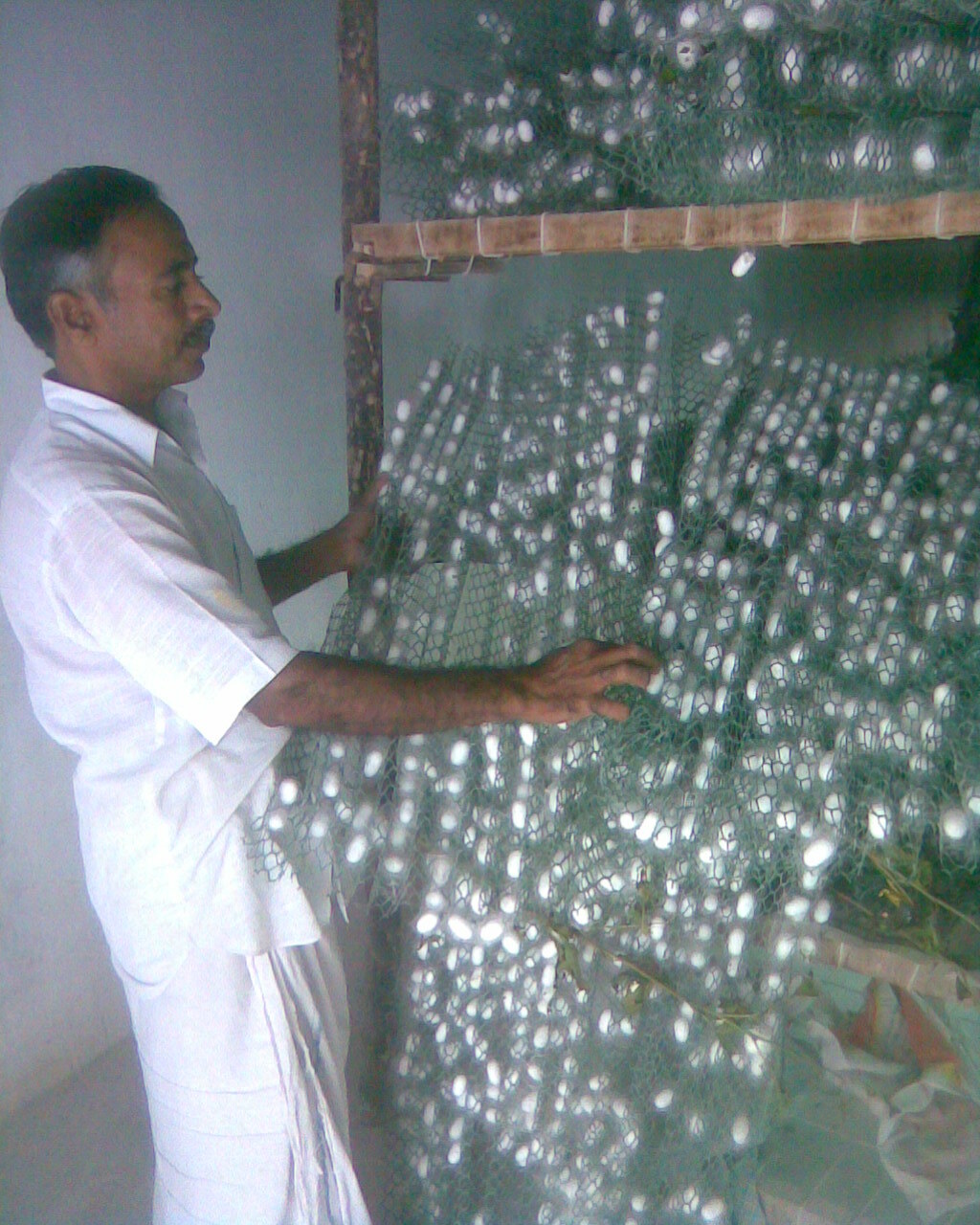
Textile fibers more clearly identified as silk have been found in contexts of the Yangshao culture (5,000-3,000 BCE) and the Liangzhu culture (3,300-2,200 BCE), both in the lower Yangtze region. At Qianshanyang (Zhejiang), woven silk fragments dated to approximately 3,000 BCE show an already sophisticated twill weaving technique, with regularly twisted threads - a skill acquired over multiple generations.
These discoveries show that sericulture, far from being a sudden invention, is the product of an accumulation of technical knowledge over several millennia. Knowledge of the cocoon preceded mastery of reeling, which preceded spinning, which preceded weaving. This process of progressive innovation unfolded over at least two to three millennia before silk became the luxury product that merchants would one day export westward.
Silkworm Domestication: A Biological Revolution
Bombyx mori, the domestic silkworm, is so thoroughly domesticated it can no longer survive without human intervention. It cannot fly - its wings are atrophied. It cannot feed itself without the mulberry leaves provided by its breeders. It is biologically distinct from its wild ancestor, Bombyx mandarina, still present in China, Korea, and Japan. This dissociation is the result of intense artificial selection over millennia.3

A genomic study published in 2023 in Science Advances reconstructed the evolutionary history of Bombyx mori by comparing the genomes of more than 1,000 individuals from the domestic strain and its wild ancestor. Results indicate a single domestication event, occurring approximately 7,500 years ago in the middle Yangtze valley (central China). From this single founding event, all modern domestic silkworms descend directly - a situation analogous to the domestication of the dog from the wolf, or the cat from the North African wildcat.
Silkworm domestication involves not only genetic selection but also the domestication of a tree: the white mulberry (Morus alba), the exclusive food of the larvae. This co-domestication - insect and tree together - is rare in human history and testifies to a sophisticated understanding of species ecology by NeolithicNeolithicThe "New Stone Age": a period marked by farming, herding, settlement and pottery, from around 10,000 BC.→ Chinese breeders.
Silk Before the Silk Road: A Millennial Trade
Although the formalized Silk Road dates to the second century BCE, silk fibers have been found outside China in much earlier contexts. Silks have been identified in Egyptian mummies from the Ramesside period (around 1,000 BCE), in Bronze AgeBronze AgeA protohistoric period following the Neolithic, defined by bronze metallurgy (a copper-tin alloy) and the rise of the first cities and states; in Egypt it corresponds to the age of the first pyramids.→ burials in Germany and Austria, and in steppeSteppeA vast semi-arid, treeless grassland of Eurasia, suited to nomadic herding and the horse; a corridor for the movement of peoples and technologies in later prehistory.→ nomadNomadRefers to human groups without fixed dwellings, moving with their herds through the seasons; pastoral nomadism shaped the societies of the Eurasian steppes.→ tombs in southern Russia dating from 3,000 to 2,000 BCE. These discoveries prove the existence of transcontinental exchange networks well before Zhang Qian.4
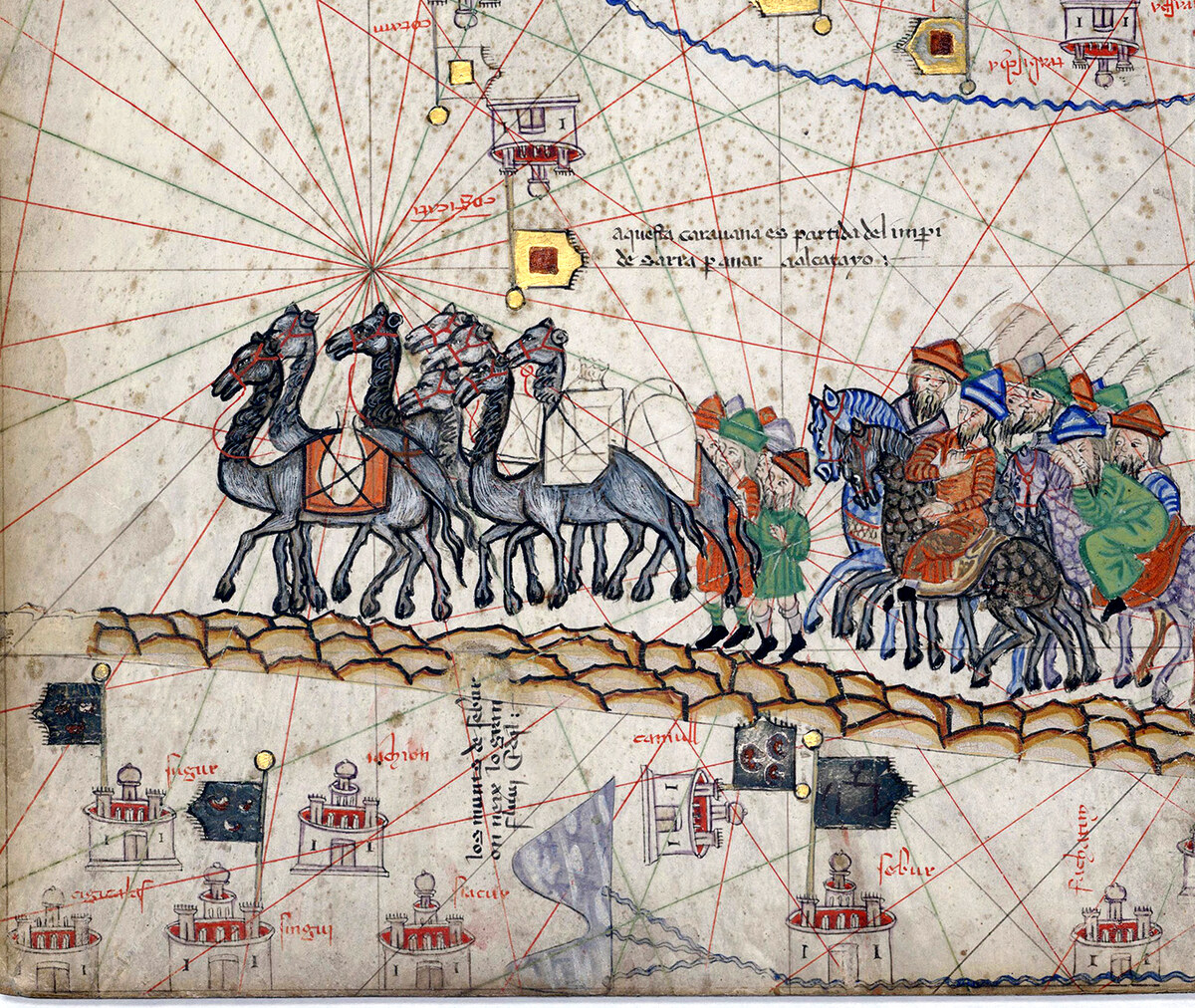
How did silk reach such considerable distances before the establishment of organized trade routes? Hypotheses abound. It may have circulated as a prestige good in matrimonial alliances between elites, passing from hand to hand without any single merchant covering the entire journey. It may also have been exchanged at seasonal gatherings of steppe nomadic peoples, who played the role of intermediaries between Sinicized spheres and the Mediterranean and Mesopotamian worlds.
The discovery of silk in such ancient and distant contexts transforms our understanding of Eurasian protohistoryProtohistoryThe transitional period between prehistory and history, covering societies without their own writing but known through external texts.→. It reveals the existence, from the NeolithicNeolithicThe "New Stone Age": a period marked by farming, herding, settlement and pottery, from around 10,000 BC.→ and Bronze Age onward, of long-distance exchange networks of unsuspected sophistication. The Han-period Silk Road is not the beginning of these exchanges: it is their late formalization, the commercial ordering of a geopolitical reality that had begun to weave itself millennia earlier, thread by thread, cocoon by cocoon.
No comments yet. Be the first.