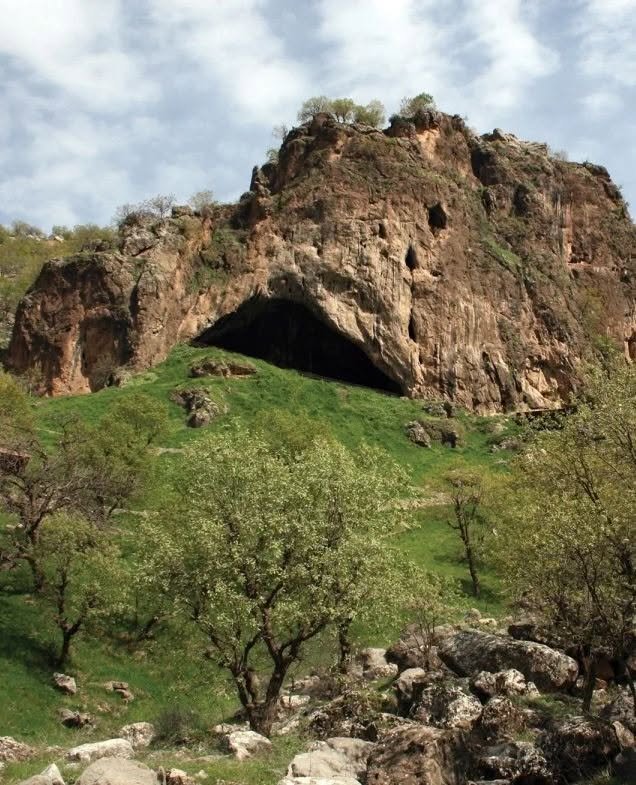
Since Ralph Solecki's discoveries in the 1950s and 1960s, Shanidar Cave in Iraqi Kurdistan has been at the heart of debates about Neanderthal funerary behaviour. It was here that ten individuals were unearthed, including the famous Shanidar IV, associated with pollen concentrations that led Solecki to propose a "flower burialBurialThe intentional deposition of a body, sometimes with offerings; a marker of symbolic behaviour.→" -- a rite that would make NeanderthalsNeanderthalsA fossil humanity of Eurasia, robust and cold-adapted, extinct around 40,000 years before present.→ the first to honour their dead with plant offerings. Decades of controversy followed, with some researchers attributing the pollen to a burrowing rodent. Today, renewed excavations by the University of Cambridge have brought decisive new evidence with the discovery of Shanidar Z, a Neanderthal woman who died around 75,000 years ago, whose face has now been reconstructed for the first time.1
A discovery after more than fifty years of silence
In 2018, the team led by Dr Emma Pomeroy and Professor Graeme Barker of the University of Cambridge resumed excavations at Shanidar Cave using modern methods. Supported by the Leakey Foundation, these new investigations apply meticulous excavation protocols unavailable to the 1950s expeditions: systematic sediment sampling for palynological and micromorphological analysis, 3D documentation of remains in situ, and radiocarbon dating on carefully selected samples. During their very first campaign, they identified a bone concentration that subsequent analyses attributed to a new individual: Shanidar Z.2
Shanidar Z's skull had been crushed flat by the pressure of sediment accumulated over 75 millennia. Rebuilt from several hundred bone fragments by a team of archaeologists and conservators at Cambridge, it belongs to an adult female Neanderthal whose cranial morphology matches the well-established characteristics of the species: developed brow ridges, an occipital bun, and a face projecting forward.
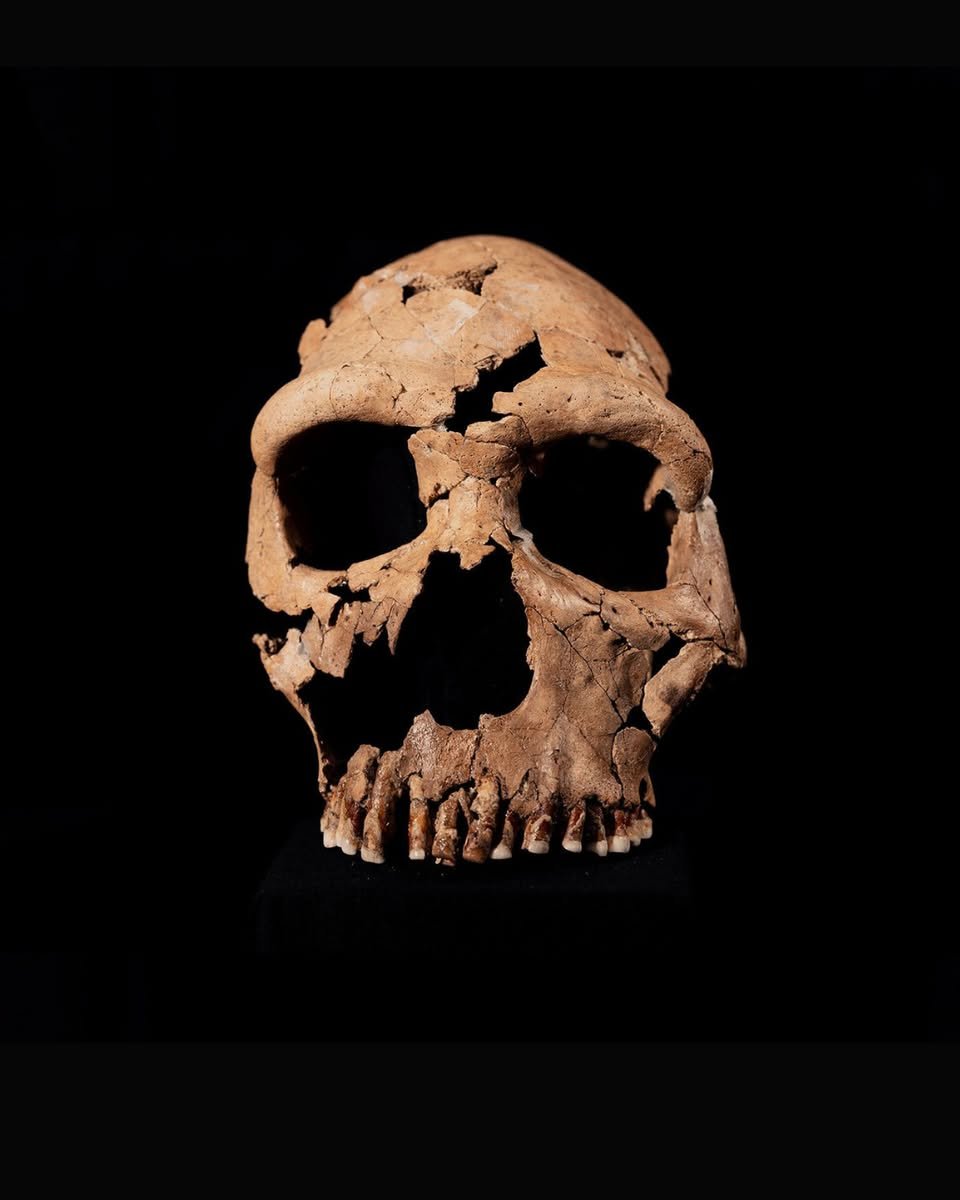
Radiocarbon dating places Shanidar Z's death approximately 75,000 years ago, during the Middle PalaeolithicMiddle PalaeolithicA Palaeolithic period (c. 300,000 to 40,000 years ago) associated mainly with Neanderthals and early Homo sapiens, marked by Levallois tools.→, when Neanderthals occupied all of western Eurasia from the Atlantic to Central Asia. She is thus the first Neanderthal to be recovered from Shanidar Cave in more than fifty years, and the best documented of the ten known individuals from the site.
A deliberate burial in a hollow shaped by water and by hand
One of the most significant scientific contributions of this discovery concerns the depositional context of the body. Geomorphological analysis of the surrounding sediment and the structure in which Shanidar Z lay reveals that she was placed in a natural channel formed by former water flow, whose walls had been manually widened and smoothed to receive the body. This observation is crucial: it implies a deliberate act of preparing the resting place, an additional step that goes beyond simple burial and suggests organised intent.
The position of the body and the in-situ analysis of the skeletal remains support the hypothesis of intentional interment rather than accidental or post-mortem deposition. The stratigraphyStratigraphyThe study of the superimposed layers (strata) of an archaeological site; each layer corresponds to a phase of occupation and yields a relative chronology.→ of the sector places this deposition within the same archaeological horizon as previously identified individuals, including Shanidar IV, reinforcing the idea that Shanidar Cave served as a recurrent burial site for this Neanderthal group.
The face of Shanidar Z: a unique reconstruction
The facial reconstruction of Shanidar Z was carried out by the Kennis Brothers, Dutch sculptors who specialise in lifelike volumetric reconstructions of ancient humans. Their method combines forensic and palaeontological anatomy: starting from the reconstructed skull, muscles and soft tissues are modelled layer by layer according to established proportions for Neanderthals, before skin, hair and colouration are added. Skin colour, eye shape and hair shade inevitably involve a degree of interpretation, but the facial proportions are grounded in documented bone morphology.
The face that emerges from this process is that of a woman with deep-set eyes, broad cheekbones and a robust but recognisably human jaw. It is this closeness that strikes most forcefully: neither the otherness of an australopithecineAustralopithecineA genus of bipedal hominins from Africa (c. 4.2–1.9 Ma) with a brain still close to that of great apes (400–550 cm³) but walking upright. Lucy (<em>Au. afarensis</em>) is the most famous specimen.→ nor the complete familiarity of a modern Homo sapiensHomo sapiensThe present-day human species, which emerged in Africa around 300,000 years ago, the only surviving human lineage after the extinction of Neanderthals and Denisovans.→, but something in between -- a close cousin who disappeared 40,000 years ago yet shares between 1 and 4 per cent of our genome.3
The reconstruction of Shanidar Z was brought to public attention by a documentary produced jointly by the BBC and Netflix, which followed the excavations, the skull restoration and the facial reconstruction process in real time. Far from sacrificing scientific rigour, this kind of public engagement has helped renew interest in Neanderthals and spread the image of a related humanity rather than an inferior or brutish homininHomininMember of the subtribe Hominina, comprising the human lineage (Homo, Australopithecus, Paranthropus…) but excluding orangutans and gibbons. The term progressively replaces "hominid" in its narrow sense.→.
Shanidar and the question of Neanderthal burials
Whether Neanderthals deliberately buried their dead has been one of the most debated questions in palaeoanthropologyPalaeoanthropologyThe science that studies human evolution from the fossil remains of hominins (bones, teeth, footprints) and their context, to reconstruct our biological origins.→ for sixty years. Those who argue for symbolic behaviourSymbolic behaviourA set of practices (adornment, pigments, art, burial) reflecting symbolic thought; long ascribed to Homo sapiens alone, now attested for Neanderthals too.→ in Neanderthals point to several sites where human bones in coherent positions, in pits or niches, appear to attest intentional burial: La Chapelle-aux-Saints, La Ferrassie, Kebara, Amud, Roc de Marsal. Detractors counter that natural processes (sediment accumulation, burrowing animals, hydraulic circulation) can produce similar configurations without human intervention.
Shanidar Z does not provide a definitive answer to this debate, but it substantially enriches the dossier. The presence of a manually prepared channel to receive the body is a strong argument for intentionality, difficult to reproduce by natural processes. Modern-protocol pollen analyses of sediments immediately adjacent to the body have also identified pollen concentrations near the remains -- an echo of the famous Shanidar IV pollen -- whose interpretation is ongoing but keeps open the possibility of floral offerings.4
What Shanidar Z confirms forcefully is that Shanidar Cave was not a site of accidental deposition but a chosen, revisited and organised place over generations. The co-occurrence of multiple individuals in the same area of the cave, with coherent anatomical configurations, constitutes a strong signal of intentionality that the Cambridge team's ongoing excavations continue to substantiate.
Neanderthals and us
The discovery of Shanidar Z is part of a broader renewal of Neanderthal studies, transformed by advances in palaeogeneticsPalaeogeneticsThe study of ancient DNA extracted from remains (bones, teeth, sediments, walls) to reconstruct the past of populations.→ since the publication of the first complete Neanderthal genome by Svante Paabo and his Max Planck Institute team in 2010. We now know that Homo sapiens leaving AfricaAfricaThe cradle of humankind: the continent where the first hominins appeared, then Homo sapiens around 300,000 years ago, before the expansion to the rest of the world.→ encountered Neanderthals and had children with them: virtually all non-African humans carry between 1 and 4 per cent Neanderthal DNADNAThe molecule carrying genetic information, used to reconstruct kinship between species.→ in their genome. Some of these genetic sequences still play active roles in our immune system, our susceptibility to certain diseases and perhaps our brain physiology.
Neanderthals used ochreOchreA red or yellow mineral pigment (iron oxides), used from prehistory for adornment, funerary rites and art.→ and other pigments, probably wore ornaments of feathers and shells, made bone tools, controlled fire, cared for their injured, and, as Shanidar Z suggests, treated their dead with consideration. The reconstructed face of this woman who died 75,000 years ago in a cave in what is now Iraqi Kurdistan is that of a being both foreign and familiar to us. That may be the deepest lesson of this exceptional discovery.
No comments yet. Be the first.