When we think of cave art, we instinctively picture the great mammoths of Lascaux, the bison of Altamira or the rhinoceroses of Chauvet cave. Yet another category of representation, far less spectacular in appearance, occupies an equally important place in PalaeolithicPalaeolithicThe oldest and longest period of prehistory (c. 3.3 Ma–12,000 BC), defined by chipped stone tools and a hunter-gatherer way of life.→ caves worldwide: abstract and geometric signs. Dots, lines, crosses, triangles, spirals, grids, zigzags - these symbols, traced by human hands tens of thousands of years ago, may constitute our species' first symbolic system.1
Thirty-Two Signs for All of Humanity
Canadian palaeontologist Genevieve von Petzinger has most systematically studied these signs in her doctoral thesis and in her 2016 book "The First Signs." After visiting dozens of sites across Europe, AfricaAfricaThe cradle of humankind: the continent where the first hominins appeared, then Homo sapiens around 300,000 years ago, before the expansion to the rest of the world.→, Asia and the Americas, she identified 32 recurring geometric forms used by prehistoric humans over a period spanning from 40,000 to 10,000 years BCE. This figure is remarkable: over such an immense stretch of time and such a vast geographical area, these same forms recur again and again.
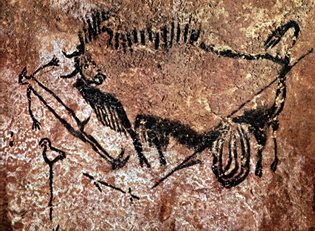
These 32 signs include: the isolated or serial dot, the straight line, the scaliform (ladder shape), the claviform (club shape), the tectiformTectiformA geometric sign of Palaeolithic cave art resembling a roofed structure (a "roof" or hut), made of lines and parallel strokes. At La Mouthe this motif was long interpreted as the depiction of a dwelling.→ (roof shape), the quadrilateral, the circle, the spiral, the zigzag, the triangle, the grid and the negative hand. Each of these forms may appear in isolation or in combination with others, sometimes combined with figurative representations of animals or human bodies. The recurrence of these motifs across different continents suggests they are not random but respond to a symbolic logic shared beyond individual cultures.
The Debate Over Their Meaning
The interpretation of these signs has fuelled scientific debate for over a century. Several hypotheses compete. The first, championed by palaeoanthropologist David Lewis-Williams, sees in these signs entoptics - phosphenes, the visual forms perceived in states of trance, fever or under the influence of psychotropic substances. This theory suggests that Palaeolithic artists were shamans representing their spiritual visions on cave walls.
A second hypothesis views them as the beginnings of a proto-graphic system, a kind of symbolic notation predating writingWritingA system of conventional signs used to fix language or information durably; its appearance (c. 3300 BC) marks, by convention, the end of prehistory.→ by tens of millennia. Some researchers, such as Francesco d'Errico, have documented regular engravings on bones and ochreOchreA red or yellow mineral pigment (iron oxides), used from prehistory for adornment, funerary rites and art.→ over 70,000 years old in South Africa (Blombos Cave), suggesting that symbolic notation is even older than previously thought.2
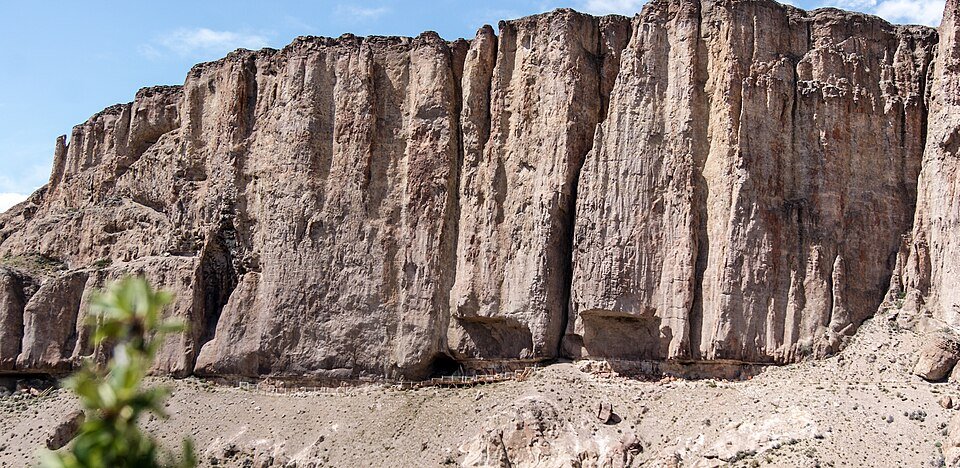
A third, more cautious reading considers these signs as territorial or identity markers, similar to totems or emblems of distinct human groups. In this view, finding the same forms on multiple continents would simply mean that these basic geometric shapes are accessible to any human brain, regardless of culture.
From Cave Wall to Tablet: Toward Writing?
What is remarkable about von Petzinger's thesis is that it establishes a continuity between these first abstract notations and the writing systems that appeared much later. If parietal signs did not constitute writing in the strict sense, they may have possessed its cognitive ingredients: the capacity to associate a graphic sign with an abstract meaning, to reproduce this sign in a standardised way and to share it within a group.
Cosquer Cave, near Marseille, offers a particularly interesting example: among its representations dated to around 27,000 years ago, one finds both recognisable animals and a profusion of geometric signs - grid signs, red dots, negative hands - some of which appear to be ordered in a non-random manner.3
Today, new documentation technologies (3D photogrammetry, multispectral imaging) are revealing signs almost invisible to the naked eye, sometimes radically altering our understanding of sites studied for a century. The exploration of the world's caves is far from over, and each new discovery risks overturning our conceptions of prehistoric human cognition.
No comments yet. Be the first.