In the vast grassland that stretches south of the Ural Mountains, where Russia meets Kazakhstan, the ground keeps the memory of a forgotten world. For some three centuries, towards the end of the third millennium BC, Bronze AgeBronze AgeA protohistoric period following the NeolithicNeolithicThe "New Stone Age": a period marked by farming, herding, settlement and pottery, from around 10,000 BC.→, defined by bronze metallurgy (a copper-tin alloy) and the rise of the first cities and states; in Egypt it corresponds to the age of the first pyramids.→ communities built circular fortresses of astonishing geometry there, forged copper and bronze in nearly every house, buried their dead with sacrificed horses and, above all, invented a machine that would change the face of ancient warfare: the spoke-wheeled chariot. This civilisation is named after two of its eponymous sites, Sintashta and Petrovka. Its most famous monument, discovered almost by chance in 1987, is called Arkaim. Long confined to Russian scholarly literature, the Sintashta-Petrovka culture is today recognised as one of the great centres of innovation in Eurasian prehistoryPrehistoryThe span of human history before the invention of writingWritingA system of conventional signs used to fix language or information durably; its appearance (c. 3300 BC) marks, by convention, the end of prehistory.→, from the PalaeolithicPalaeolithicThe oldest and longest period of prehistory (c. 3.3 Ma–12,000 BC), defined by chipped stone tools and a hunter-gatherer way of life.→ to the Metal Ages, known mainly through material remains.→, and as a possible link in one of the greatest enigmas of human history: the expansion of the Indo-Iranian and Indo-European languages.1
This feature explores that vanished world in all its aspects: the natural setting of the steppe and its climateClimateThe long-term average atmospheric conditions of a region; its variations (glaciations, aridifications) shaped migrations, agriculture and the collapse of prehistoric societies.→, the spectacular discovery of Arkaim and the rescue of the site, the circular architecture of the fortresses, the revolutionary invention of the spoke-wheeled chariot, the central role of the horse and the burialBurialThe intentional deposition of a body, sometimes with offerings; a marker of symbolic behaviour.→ rites, the early mastery of metallurgy, the warrior and hierarchical organisation of this society, and finally the famous question of Indo-European origins that places Sintashta at the heart of one of the greatest debates in prehistory. We shall see that behind the established certainties many grey areas remain, and that it is precisely this balance between solid facts and bold hypotheses that makes this culture so captivating.
The Ural steppes in the Bronze Age
To understand Sintashta, one must first picture the setting: the Eurasian steppeSteppeA vast semi-arid, treeless grassland of Eurasia, suited to nomadic herding and the horse; a corridor for the movement of peoples and technologies in later prehistory.→, that almost unbroken ribbon of grass running from the Hungarian plain to the borders of Mongolia, over more than eight thousand kilometres. At the heart of this corridor, the eastern flank of the southern Urals offers a landscape of rolling meadows crossed by slow rivers fringed with reeds, exposed to harsh winters and hot, dry summers. It is a land without forests, without easily quarried stone, but rich in grass, in water and, decisively, in copper ores outcropping in the mountain foothills.
At the turn of the third and second millennia BC, these steppes were no human desert. For more than a thousand years already, pastoral populations had grazed cattle, sheep and horses there. The great culture that precedes Sintashta in the region, that of Poltavka, itself extended the tradition of mobile herders descended from the Yamnaya culture, which had spread, in the fourth millennium, the use of the ox cart, the solid wheel and an extensive pastoralismPastoralismA way of life based on herding livestock (cattle, sheep, goats), often mobile, which spread across the Green Sahara and, in that region, preceded farming proper.→ across the whole steppe corridor. The domestication of the horse, attested further west as early as the fourth millennium, had gradually transformed the mobility of steppe societies. Sintashta thus inherits a world already deeply marked by herding, mobility and the nascent mastery of metal.1
But something changes radically around 2200 BC. Communities cease to be scattered and weakly structured and gather into compact, heavily defended settlements, established along the rivers at regular intervals, separated from one another by some thirty to sixty kilometres. About twenty of these fortified settlements have been recorded in a strip of steppe roughly four hundred kilometres by one hundred and fifty, what Russian researchers have nicknamed the “Country of Towns”, in Russian Strana gorodov. Several hypotheses have been put forward to explain this sudden concentration: a deterioration of the climate driving populations to gather around water points, demographic pressure, or the need to protect resources that had become precious, foremost among them the herds and the metallurgical workshops. Whatever the cause, the result is one of the most remarkable experiments in urbanism in European and Asian prehistory.
The climate of this period deserves particular attention. Palaeoenvironmental reconstructions suggest that around 2000 BC the Ural steppe experienced a drier and more continental episode, marked by harsher winters and more contrasted summers. For pastoral societies wholly dependent on the quality of their pastures, such a variation could carry heavy consequences: scarcer grass, displacement of the herds, increased competition for the best land. The gathering of populations into fortified towns, in the immediate vicinity of rivers and springs, perhaps answers in part this ecological constraint, by securing access to water and concentrating human and material resources where they could best be protected and exploited.
It is also worth stressing the deep originality of Sintashta compared with the rest of the contemporary steppe world. Elsewhere in the great grass corridor, the dominant way of life remained that of light, mobile, weakly structured camps, where communities followed their herds with the seasons. Sintashta breaks with this pattern by settling, at least partly, a portion of its population in permanent and heavily built establishments. This tension between sedentismSedentismThe shift from a nomadic life to lasting settlement in one place, a precondition for the rise of villages.→ and mobility, between the colossal investment made in building fortresses and the propensity to abandon them after a few generations, is one of the most baffling and stimulating traits of this culture for researchers.
It should also be remembered how recent our knowledge of this culture is. Whereas the great civilisations of Mesopotamia and Egypt have been studied for nearly two centuries, the Sintashta world remained almost unknown outside specialist Russian circles until the closing decades of the twentieth century. The political opening of the post-Soviet period, the development of international collaborations and the arrival of new analytical methods have, in just a few decades, transformed Sintashta from an obscure regional phenomenon into a subject of global importance. Much of what we can say about it today rests on research that is still very young, which explains both the wealth of recent discoveries and the persistence of major uncertainties.
The discovery of Arkaim (1987)
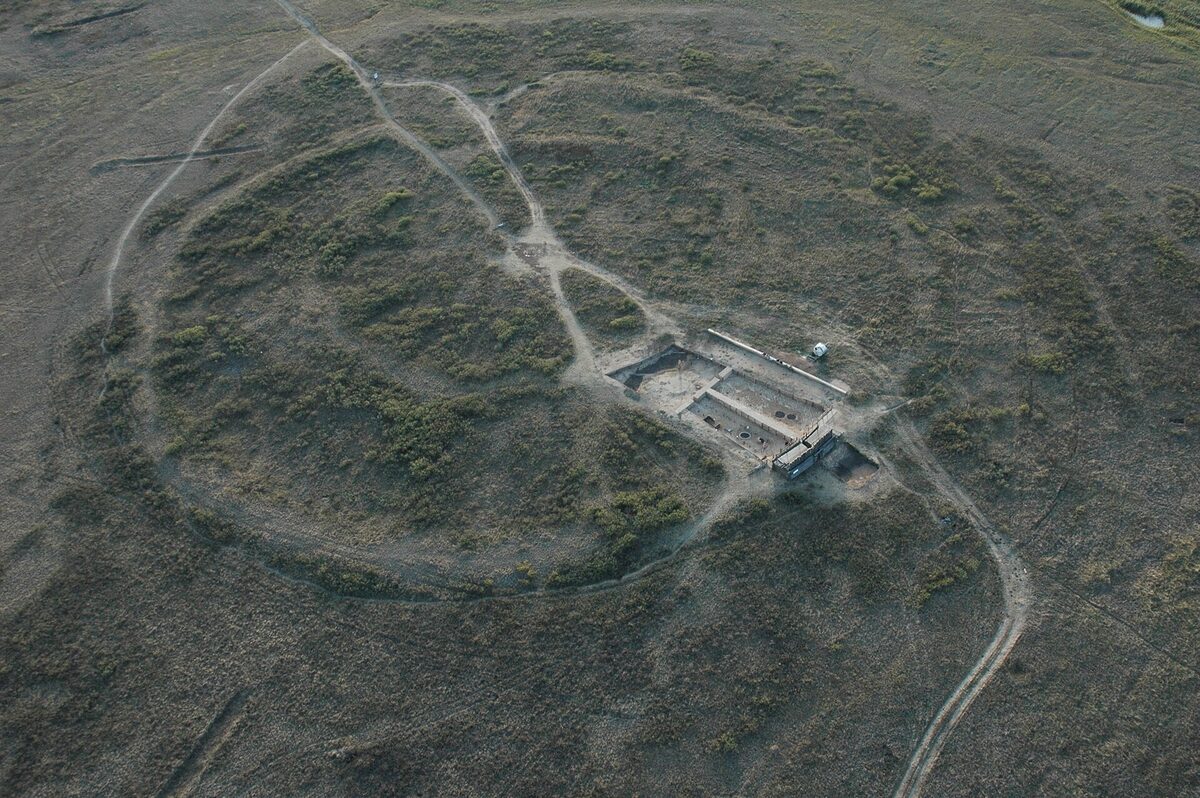
The story of the rediscovery of Arkaim is almost one of a last-minute rescue. In 1987, in the Chelyabinsk region, the Soviet authorities planned to flood a valley of the Bolshaya Karaganka river beneath a reservoir intended to irrigate the steppe. A team of archaeologists led by Gennady Zdanovich was dispatched to assess quickly what the works threatened to destroy. What they discovered from the air left them astounded: two clearly drawn concentric rings in the ground, of such regularity that one might think them traced with a compass.2
The site, named Arkaim after a nearby hill, proved to be a circular fortified settlement dating from about 2000 BC, the very period when the first Minoan palaces were rising on Crete and Egypt was entering its Middle Kingdom. A vast mobilisation campaign then began: petitions from scientists, mobilisation of public opinion, intervention by public figures. Extraordinarily for the dying Soviet Union, the dam project was abandoned and the site preserved. Arkaim soon became an emblematic place, both for archaeological research and, more problematically, for a certain national and esoteric imagination that would make it, in post-Soviet Russia, a centre of mystical pilgrimage. The archaeologists, for their part, realised that they held the centrepiece of a hitherto poorly defined cultural complex.
Arkaim is indeed not isolated. Its discovery led to the recognition, or reinterpretation, of a whole series of related sites identified as early as the 1970s on the Sintashta river, a little further south. The eponymous Sintashta site had already yielded spectacular burials at that time, but ones partly eroded by the river. Arkaim, exceptionally well preserved, suddenly offered a coherent overview: there was now a culture, with its urbanism, its architecture, its techniques and its funerary rites. The Sintashta-Petrovka culture, named after this site and another settlement located in northern Kazakhstan, then fully entered the history of archaeology.3
The excavation method used at Arkaim and at the related sites itself contributed to the exceptional quality of the results. The preservation of the ground plans, made possible by the collapse and sometimes the burning of the earth and timber structures, allowed archaeologists to reconstruct with great fidelity the layout of the houses, the location of hearths, wells and furnaces, and the internal circulation. Where other Bronze Age sites yield only fragmentary remains, Arkaim offers an almost complete image of a settlement, frozen at the moment of its abandonment. It is this integrity that has made it a reference site for the whole Sintashta-Petrovka culture.
The fortified circular architecture
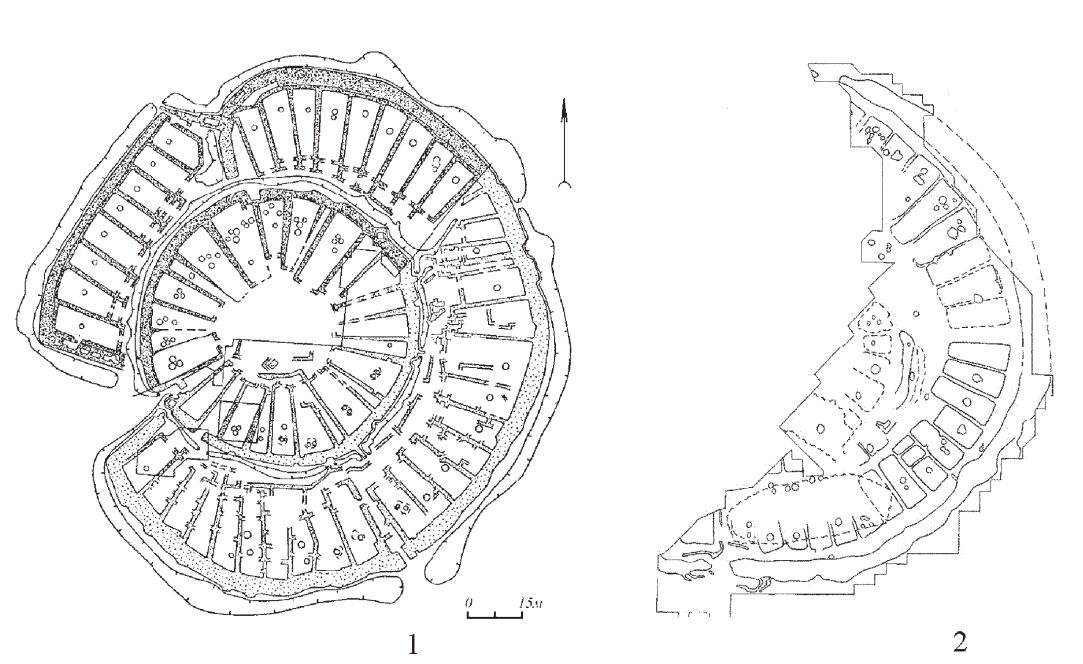
What strikes one immediately at Arkaim is the geometric rigour of the plan. The town draws two concentric circles of ramparts in earth and timber, the outer diameter reaching about one hundred and fifty metres. The walls, made of raw earth blocks reinforced with beams and wattle, rose several metres high and were doubled by ditches. Inside, the dwellings were arranged radially, like the spokes of a wheel, backing onto one another and onto the rampart, their entrances opening onto a circular street or onto the central square.2
The internal organisation testifies to an overall planning, conceived as a single whole rather than by spontaneous growth. About sixty houses have been counted at Arkaim, distributed between the outer ring and the inner ring, each measuring between one hundred and two hundred square metres. Each dwelling housed a hearth, a well, storage facilities and, in many cases, a metallurgical furnace. The central square, kept clear, could serve for community gatherings or ceremonies. An ingenious system of gutters and drains carried rainwater towards the outer ditches, a sign of remarkable technical mastery of water management.
This architecture raises a still-debated question: was Arkaim a town in the full sense, a refuge fortress, a ceremonial centre, or all three at once? Its capacity, estimated at between one thousand five hundred and two thousand people, makes it more a large fortified village than a city comparable to those of Mesopotamia. The presence of a furnace in nearly every house suggests an intense productive function, perhaps almost industrial in nature for the period. As for the concentric circular form, it has fuelled countless speculations, some seeing in it an astronomical observatory, others a symbolic representation of the cosmos. Archaeologists remain cautious: the defensive priority and the efficiency of a compact organisation amply suffice to explain this plan, without any need to invoke an elaborate cosmology.
The other remarkable trait is the brevity of the occupation. Most of these settlements lasted only a few generations, sometimes one or two centuries, before being deliberately abandoned, and some intentionally set on fire at the moment of departure. This final burning, which helped to fossilise the plan of the houses, remains poorly explained: a closing rite, purification, or simple destruction during a collective relocation. The ephemeral character of these towns contrasts with the colossal energy their construction demanded, and it points to a mobile society, capable of moving as a block to found an identical settlement elsewhere.
Comparisons with other settlements of the “Country of Towns” further enrich the picture. Not all are circular: some adopt an oval plan, others a rectangular plan with rounded corners, but all share the same fundamental principles, namely a fortified enclosure, party-walled houses arranged in a crown and a planned internal organisation. This diversity within unity shows that the builders of Sintashta possessed a coherent architectural repertoire that they adapted to the constraints of the terrain. The standardisation of house dimensions, the regularity of their arrangement and the recurrence of the same domestic equipment from one site to another suggest the existence of shared norms, transmitted and applied over a vast geographical area.
The construction itself represented a considerable communal effort. Enormous quantities of earth had to be extracted and shaped, the timber needed for the framework of walls and roofs had to be felled and transported, the ditches dug, the wells and drainage systems built. Such an undertaking presupposes collective coordination, prior planning and probably an authority capable of mobilising and organising the work of hundreds of people. The fortress is not only a shelter: it is also the product and the symbol of a strong social cohesion, the result of a common project carried out by a community united around its leaders.
The invention of the spoke-wheeled chariot
If a single contribution of the Sintashta culture to world history were to be singled out, it would be this: it is in its tombs that the oldest known spoke-wheeled war chariotsWar chariotA light two-wheeled spoke-wheeled vehicle drawn by horses, built for combat or prestige; the oldest attested (c. 2000 BC) come from Sintashta graves in the Ural steppe.→ have been unearthed, dated to about 2000 BC. This discovery overturned received ideas, for the invention of the chariot was traditionally attributed to the civilisations of the Near EastNear EastA region of western Asia (Levant, Mesopotamia, Anatolia, Iran), cradle of the Neolithic revolution, agriculture, the first cities and writing.→. The chariots of Sintashta predate the Egyptian and Mesopotamian depictions of light war chariots.1
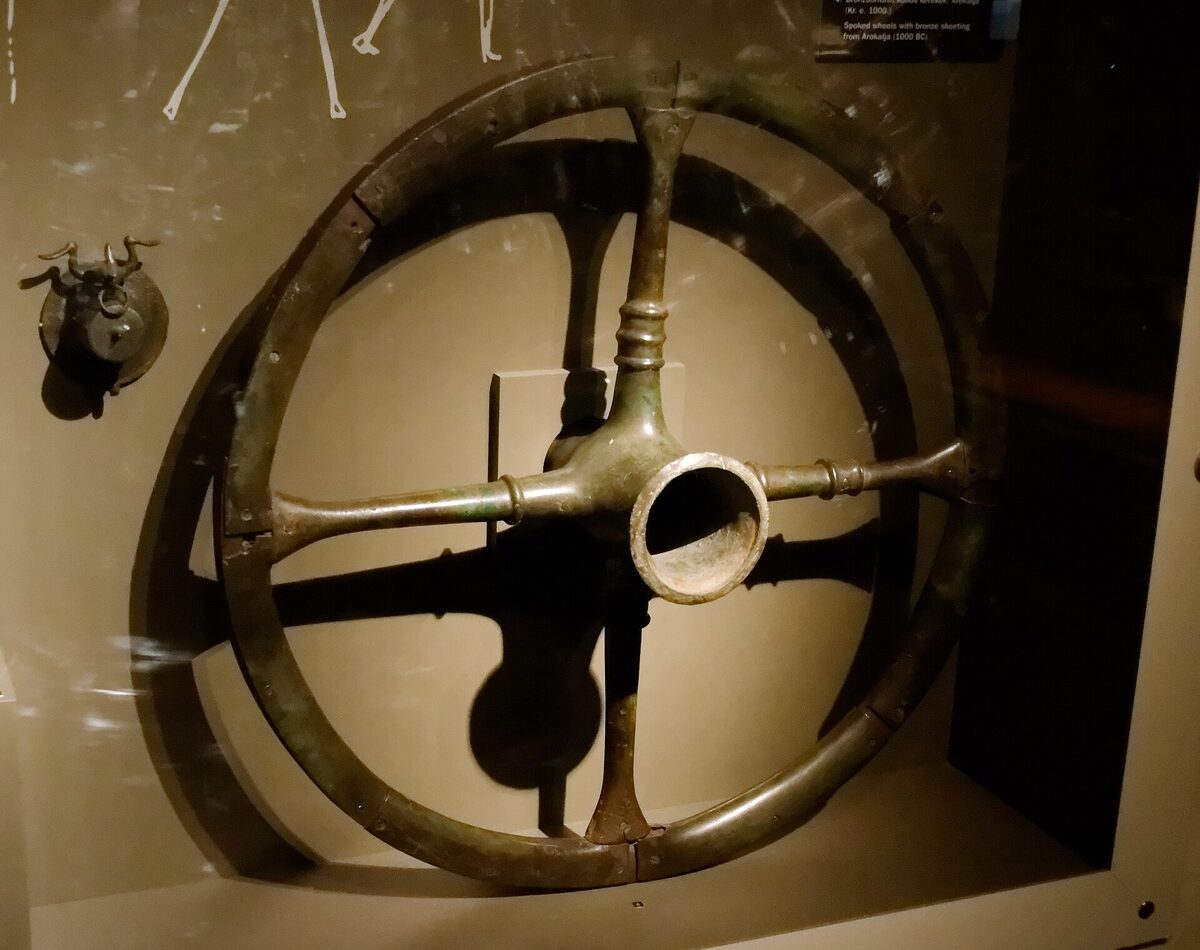
The difference between the solid wheel, already known since the fourth millennium, and the spoked wheel is crucial. The solid wheel, cut from assembled wooden planks, is heavy, slow and suited to transport carts drawn by cattle. The spoked wheel, by contrast, radically lightens the vehicle by keeping only the hub, the rim and slender spokes stretched between them. The chariot then becomes a light, fast machine, able to turn and accelerate, drawn by a pair of horses. The imprints left in the bottom of the tombs by the wheels, of which one can sometimes distinguish up to ten or twelve spokes, leave no doubt: these were indeed two-wheeled vehicles with a narrow body, designed to carry a driver, and not mere funerary carts.
A lively controversy remains among specialists: were these chariots already true engines of war, or vehicles of prestige, racing and display? Some researchers stress that the narrow body and the rough terrain of the steppe were ill-suited to combat as later imagined in the Near East, where archers shot from chariots launched at the gallop. Others reply that the systematic presence of weapons in the same tombs, spearheads, axes, and later bows and arrows, argues for a martial function, or at least for a close link between the chariot and warrior status. In any case, the joint invention of the spoked wheel and the harnessing of fast horses provided the ancient world with one of its most enduring instruments of domination. In the centuries that follow, the war chariot spreads from India to Egypt, until it becomes the queen of arms in the great battles of the Bronze Age, such as that of Kadesh.
Sintashta's precedence over the Near East has considerable implications for the history of technology. For a long time, a diffusion of innovations was imagined from the southern urban centres, supposedly more advanced, towards the so-called barbarian peripheries. The Sintashta chariot reverses this scheme: here is a decisive invention arising in the heart of the steppes, in a society without writing or great cities, which then spreads towards the southern civilisations. This invites a reconsideration of the role of mobile pastoral societies, too often relegated to the rank of mere recipients, as genuine laboratories of innovation, capable of conceiving and perfecting cutting-edge techniques that the great empires would subsequently adopt and adapt.
Horses and burials
The chariot would be nothing without the horse, and the Sintashta culture maintained with this animal a relationship of exceptional intensity, which can be read above all in its funerary practices. The necropolisesNecropolisA large organised burial ground, a "city of the dead", often spanning several periods.→ of Sintashta are among the richest and most spectacular funerary complexes of the steppe Bronze Age. Beneath mounds, high-ranking deceased were buried in deep pits, accompanied by sacrificed horses, sometimes arranged in pairs as if ready to be harnessed.3
The most striking rite is that of the harnessed-horse burials. In several tombs, the remains of two horses placed on either side of the location of the draught pole have been found, together with the harness pieces and, in the most complete cases, the remains of the chariot itself imprinted in the ground. The oldest known cheekpieces have even been identified there, these lateral pieces of the bit, here cut from bone or horn and bristling with points, which served to transmit the driver's orders to the animal. These objects attest to a highly advanced mastery of harnessed driving, well before the appearance of mounted cavalry proper.
Animal sacrifices were not limited to horses. Cattle, sheep and dogs also accompanied the dead, in sometimes considerable offerings. Some tombs contained the remains of several dozen animals, testifying to a veritable ostentatious squandering of pastoral wealth at the funerals of important figures. This profusion of sacrifices, combined with the presence of weapons and chariots, paints the portrait of a warrior elite that asserted its rank even in death. The vessels deposited in large numbers, the fine pottery adorned with incised geometric motifs, completed this funerary furniture intended to accompany the deceased into the afterlife.
For linguists and historians of religion, these rites irresistibly evoke certain practices described much later in the sacred texts of ancient India and Iran. The horse sacrifice, in particular, occupies a central place in Vedic religion, under the name ashvamedha. The concordance between the archaeological rites of Sintashta and the rituals mentioned in the oldest Indo-Iranian texts has strongly fuelled the hypothesis of a direct link between this steppe culture and the peoples who would later speak these languages.
The archaeozoological study of the horse remains has yielded valuable information about these animals. They were horses of modest size by our standards, robust and hardy, suited to drawing light chariots rather than to carrying an armed rider, which fits well with a period in which harnessed driving precedes the rise of mounted cavalry. The wear marks observed on some teeth confirm the use of the bit and therefore the control of the animal by the reins. Far from being mere beasts of burden, these horses were partners of prestige, carefully selected and trained, whose possession and sacrifice signalled the rank of their owner in the social hierarchy.
Metallurgy and exchange networks
Sintashta is not only the culture of the chariot and the horse: it is also one of the great metallurgical centres of the Eurasian Bronze Age. In nearly every house at Arkaim and the related sites, archaeologists have found the remains of copper and bronze metallurgyMetallurgyThe techniques of extracting and working metals (copper, bronze, gold); its rise in the EneolithicEneolithicThe "Stone-and-Copper Age": a transition between the Neolithic and the Bronze Age (c. 5000–3000 BC in south-eastern Europe), marked by the first copper objects, large farming settlements and, in places, the rise of fortified sites. Broadly synonymous with Chalcolithic.→ and Bronze Age transformed tools, weapons and social hierarchies.→: furnaces, slag, crucibles, moulds, ore remains. This omnipresence of metal production in the domestic dwelling is a remarkable peculiarity, which distinguishes Sintashta from many other cultures where metallurgy was a specialised and separate activity.1
The southern Urals are rich in copper deposits, and the Sintashta communities knew how to exploit them on a large scale. They produced objects in arsenical copper, then gradually mastered the more resistant bronze alloys. The range of products is wide: spear and arrow points, axes, knives, awls, punches, fish hooks, ornaments, as well as the harness pieces already mentioned. This production far exceeded local needs, which suggests that metal was also an item of exchange, exported towards the neighbouring communities of the steppe and the forest-steppe.
This intense activity is part of the long-distance exchange networks that then irrigated the whole steppe corridor. Sintashta lies at the heart of what specialists call the Eurasian metallurgical complex, a vast system of circulation of metals, techniques and know-how linking the Urals, Kazakhstan, Central Asia and, further away, the urban civilisations of the south. Towards the south precisely, contacts with the Oxus civilisation, or Bactria-Margiana archaeological complex, may have played a role in the diffusion of certain techniques and goods. The metal of the Urals fed exchange currents which, step by step, brought very distant worlds into relation.
The mastery of fire and high temperatures required by metallurgy presupposes a social organisation able to mobilise fuel, labour and knowledge transmitted from generation to generation. That this competence was distributed across nearly all the houses of Arkaim, rather than concentrated in the hands of a few specialists, says much about the nature of this society: a community of warrior producers, in which metalworking, herding and the art of war were intimately linked.
The analysis of the metal objects also reveals the degree of specialisation attained by the Sintashta craftsmen. The manufacture of a spearhead, an axe or a bit required knowledge of melting temperatures, alloy proportions, casting and hammering techniques, as well as careful control of each stage. That this knowledge was widely distributed in the community rather than jealously guarded by a caste of craftsmen takes nothing away from its sophistication. On the contrary, it testifies to an efficient transmission of technical skills from one generation to the next, and to a culture in which metalworking was an integral part of collective identity, just as much as herding or the handling of weapons.
The quest for copper and tin, the latter necessary for the production of quality bronze, may moreover have played a driving role in the extension of the exchange networks. Tin is a rare and unevenly distributed resource, and its acquisition required long-distance contacts. The need to procure this strategic metal no doubt stimulated movements, expeditions and relations between distant communities, helping to weave the web of connections that characterises the Bronze Age world. Metal was therefore not only a product: it was also a powerful factor of integration and of the linking of steppe societies.
A hierarchical warrior society
Everything, in the world of Sintashta, speaks of hierarchy, prestige and war. The massive fortifications, the concentration of populations, the abundance of weapons, the differentiated wealth of the tombs, all converge towards the image of a stratified society, dominated by an elite of warrior chiefs who controlled the herds, the metallurgical workshops and the chariots. This elite displayed its status through the accumulation of goods and through sumptuous funerals, in which the sacrifice of horses and the deposit of weapons proclaimed the rank of the deceased.3
War, or at least the threat of war, seems to have been a structuring reality. One does not build earth and timber ramparts several metres high, doubled by ditches, without a serious reason. Rivalries between communities for control of the pastures, the water points, the copper deposits and the exchange routes may have generated chronic insecurity. In this context, the possession of fast horses, chariots and bronze weapons conferred a decisive advantage, and the mounted or harnessed warrior no doubt became a central figure of social prestige.
Nevertheless, one must not imagine a society devoted solely to violence. The economy rested on a prosperous herding of cattle, sheep and horses, supplemented by a little agricultureAgricultureThe cultivation of plants and production of food by working the soil, which emerged in the Neolithic in the Near East and independently elsewhere; it radically transformed human societies.→ and by fishing in the rivers. The communities produced their food, their pottery, their textiles and their metal. The density of the dwelling, the planning of the towns and the sophistication of the techniques reveal an efficient collective organisation, capable of great works and of a diversified production. Sintashta thus appears as a complex society, at once pastoral, artisanal and warlike, which knew how to draw on the resources of a harsh environment to reach a remarkable level of development.
The collapse, or rather the transformation of this world, occurs around 1800 BC. The fortified towns are abandoned, and their legacy continues in more dispersed cultures, grouped under the name of Andronovo, which would cover an immense area of the steppe and Central Asia during the second millennium. The innovations of Sintashta, the chariot, the harnessed horse, bronze metallurgy, do not disappear: on the contrary they spread widely, carried by mobile populations, until they reach regions very far from their place of origin.
Sintashta and the Indo-European question
It is here that the Sintashta culture ceases to be a mere regional archaeological curiosity and becomes a major stake in human history. Many researchers see in Sintashta-Petrovka the probable homeland, or one of the decisive stages, of the Indo-Iranian branch of the great family of Indo-EuropeanIndo-EuropeansA set of populations linked by a language family (Indo-European) from which most languages of Europe and part of Asia derive; their spread is associated with Bronze Age steppe societies.→ languages. This family, reconstructed by linguists from systematic resemblances between Sanskrit, Persian, Greek, Latin, the Celtic, Germanic, Slavic and many other languages, sinks its roots into a mother tongue, Proto-Indo-European, spoken somewhere in the steppes in the fourth millennium.1
The reasoning that links Sintashta to the Indo-Iranians rests on a bundle of converging clues. First, chronology and geography: Sintashta lies in the right place and at the right time to precede the diffusion of the Indo-Iranian languages towards Central Asia, Iran and the Indian subcontinent. Then the ritual correspondences: the horse sacrifice, the cult of the chariot, the importance of fire and certain funerary practices find striking echoes in the oldest Indo-Iranian texts, the Indian Rigveda and the Iranian Avesta. Finally, more recently, the data of the genetics of ancient populations have shown that the steppe ancestrySteppe ancestryA genetic component derived from the pastoralists of the Pontic steppes (Yamnaya and related cultures) spreading across Europe and Asia in the Bronze Age; its absence in the Harappan individual from Rakhigarhi reopened debates on South Asian peopling.→ linked to cultures like Sintashta did indeed spread towards South Asia during the second millennium, bringing a biological argument to the linguistic scenario.
According to the most widely held model today, the so-called steppe model, the speakers of Proto-Indo-European would have come from the herders of the Yamnaya culture, in the fourth millennium, in the Pontic steppes north of the Black Sea. From this homeland, branches would have broken off and spread in all directions. The branch that would give the Indo-Iranian languages would have passed through the cultures of the eastern steppe, of which Sintashta-Petrovka constitutes a crucial milestone, before swarming towards the south. The spoke-wheeled chariot and the harnessed horse would have been not only technical innovations but also vectors of this expansion, by conferring on their holders a considerable mobility and military advantage.
These conclusions must however be handled with caution. The equation between an archaeological culture, identified by objects and rites, and a linguistic community, which leaves no direct material trace, is always hazardous. A pot or a chariot does not speak. Languages spread through many channels, which do not necessarily correspond to massive migrationsMigrationsLong-distance movements of populations; a major driver of human history (the exit from Africa, the peopling of continents, Neolithic and steppe expansions).→ of populations. Nevertheless, the convergence of archaeological, linguistic and now genetic arguments makes Sintashta one of the most serious candidates to embody, in the materiality of the soil, a stage of this linguistic adventure that has shaped a large part of the ancient and modern world.
The recent contributions of palaeogeneticsPalaeogeneticsThe study of ancient DNA extracted from remains (bones, teeth, sediments, walls) to reconstruct the past of populations.→ have profoundly renewed this old debate. The analysis of ancient DNAAncient DNAGenetic material preserved in old remains, often degraded, sequenced with cutting-edge techniques.→ taken from steppe skeletons has made it possible to retrace population movements with unprecedented precision. It has confirmed that a genetic component characteristic of the steppe herders spread widely, towards Europe on the one hand and towards South Asia on the other, during the third and second millennia. This steppe signature, present in the populations associated with Sintashta, is then found among groups settled further south, which agrees remarkably with the hypothesis of a diffusion of the Indo-Iranian languages from this homeland. Genetics alone does not prove linguistic identity, but it brings additional coherence to the scenario.
Debates and limits
None of the great questions raised by Sintashta is definitively settled, and that is precisely what makes it such a fascinating field of research. The exact military role of the first chariots, the true function of the circular towns, the causes of their sudden foundation and abandonment, the precise nature of the links with the southern civilisations, all this remains the object of vigorous debate. To these archaeological uncertainties is added the weight of the ideological appropriations of which Arkaim has been the object.2
For the fate of Arkaim in Russian popular culture is singular. After its preservation, the site became a focus of attraction for nationalist, neo-pagan and esoteric movements, which saw in it, in turn, the cradle of the Aryan race, the homeland of Zoroaster, or an energy centre with mystical virtues. These interpretations, devoid of any scientific foundation, have sometimes blurred the perception of the site and complicated the work of serious researchers. It is important to distinguish clearly the soundly established archaeological facts from the speculations grafted onto them. The very notion of Aryan, distorted by the racist ideologies of the twentieth century, has no place in scientific analysis, where one speaks more accurately of populations speaking Indo-Iranian languages.
On the methodological level, the successive radiocarbon datings have sometimes given slightly different ranges, placing the core of the Sintashta culture between 2200 and 1800 BC depending on the calibrations and the sites. Recent research, combining archaeology, archaeozoology, metallography and palaeogenetics, continually refines our understanding. Far from being a closed file, Sintashta remains an open worksite, where each new excavation, each new analysis, comes to nuance or enrich the picture. It is this openness that makes its scientific fruitfulness.
Finally, one must guard against too heroic or too linear a vision. Sintashta is not the unique starting point of all Indo-European history, nor an isolated civilisation arisen from nowhere. It is the product of a long evolution of steppe societies, in constant interaction with its neighbours, and it is part of a network of exchanges and influences that extends well beyond the southern Urals. Its greatness owes less to a supposed pure origin than to its capacity for innovation and synthesis, which makes it a crossroads of Eurasian prehistory.
It is also worth recalling the broader human meaning of these discoveries. Behind the ground plans, the bronze artefacts and the horse bones stood living communities, with their leaders and their craftsmen, their hopes and their fears, their festivals and their funerals. The sheer effort invested in raising fortresses, in breeding and training horses, in mastering fire and metal, speaks of people determined to shape their world rather than merely endure it. To study Sintashta is therefore not only to map the spread of a technology or the migration of a language, but to come closer to the lives of men and women who, four thousand years ago, on a windswept plain at the edge of two continents, achieved something that still commands our admiration.
Conclusion
The Sintashta-Petrovka culture and its emblematic site of Arkaim offer us an exceptional window onto a pivotal moment of Eurasian prehistory. In the space of a few centuries, in the harsh steppe of the southern Urals, pastoral communities built fortresses of perfect geometry, transformed copper and bronze in nearly every household, sacrificed their most precious horses to accompany their dead, and above all invented the spoke-wheeled chariot, that machine which would race, for more than a millennium, across all the battlefields of the Old World. All this well before these innovations appeared in the great urban civilisations of the Near East.
The legacy of Andronovo, which extends that of Sintashta during the second millennium, finally deserves attention. This vast and composite cultural complex covered an immense area, from the southern Urals to the borders of western China, spreading over thousands of kilometres the achievements of Sintashta: cattle, the horse, the chariot, bronze metallurgy and, very probably, related languages and beliefs. It is through this relay that the innovations of the Ural fortresses were able to radiate as far as the gates of the great civilisations of Asia. Sintashta is therefore not a parenthesis closed upon itself, but the starting point of a long-term dynamic, whose waves spread far beyond its place of origin and its time.
Beyond its technical feats, Sintashta speaks to us of a warlike and inventive society, hierarchical and mobile, capable of remarkable collective achievements in a difficult environment. And it speaks to us perhaps, between the lines, of the origin of an immense part of humanity's linguistic heritage, since it is from these steppes that the languages would have set out which, from the Atlantic to the Ganges, are today spoken by billions of people. Between the rigour of facts and the breadth of hypotheses, the Sintashta-Petrovka culture remains one of the most fascinating enigmas the land of the steppes has delivered to archaeologists, a vanished world whose wheels, horses and words still resonate in our own.
Exactement le type de synthèse dont j'ai besoin pour réviser. Merci !
Super article, je l'ai partagé sur mon feed. Le ratio contenu/longueur est parfait.