Between 22,000 and 17,000 years ago, a remarkable Paleolithic culture flourished across western Europe, leaving behind the most refined flintFlintA hard, brittle siliceous rock, knapped by prehistoric people to produce blades, points and sharp tools.→ points ever produced by prehistoric humanity. The solutreanSolutreanA European Upper Palaeolithic culture (c. 22,000–17,000 BC), remarkable for its leaf-shaped lithic points worked with flat retouch. Contemporary with the second art phase of Cosquer Cave.→ takes its name from the site of Solutré in Saône-et-Loire, discovered in 1866 at the foot of a limestone cliff littered with horse bones. This lithic industry redefined the limits of what was achievable in stone knappingknappingThe set of operations for fracturing a stone block to extract flakes or blades.→.
An Extreme Climatic Context
The Solutrean coincides with the Last Glacial MaximumLast Glacial MaximumThe peak of the last glaciation (c. 26,000 to 19,000 years ago), with ice sheets at their greatest extent; it pushed populations towards southern refuges.→, the coldest phase of the recent PleistocenePleistoceneThe geological epoch of the great ice ages (c. 2.6 Ma–11,700 BP), spanning most of human prehistoryPrehistoryThe span of human history before the invention of writing, from the Palaeolithic to the Metal Ages, known mainly through material remains.→.→. Average temperatures in western Europe were 10 to 12 degrees Celsius below present levels. The Scandinavian ice sheet extended across the plains of northern Germany, and tundra replaced forest across most of the continent. In this hostile world, human groups had to move frequently to follow great herds of mammoths, reindeer, horses, and bison.
It was in this severe context that Solutrean craftspeople developed their exceptional knapping techniques. The need for reliable, effective hunting weapons capable of penetrating the thick fur of large herbivores drove technical innovation to a level unmatched in European Paleolithic culture.
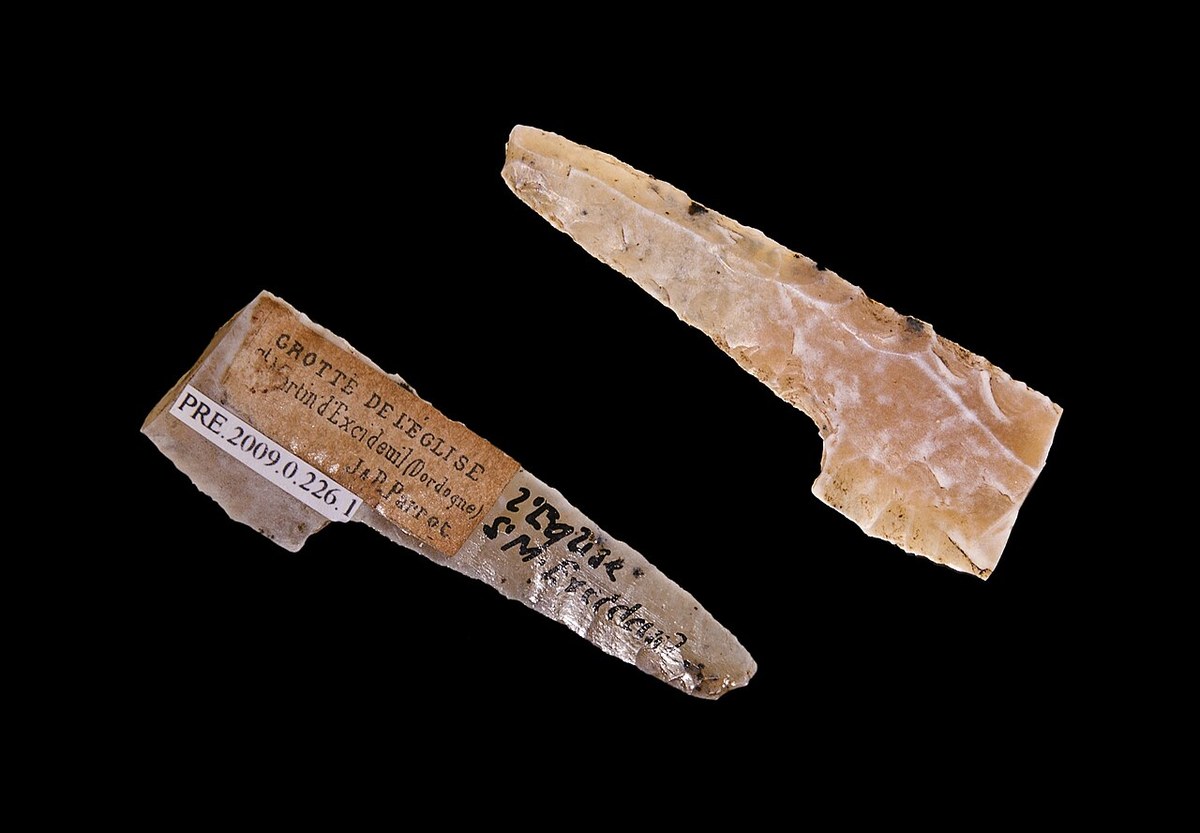
Pressure Flakingpressure flakingA finishing technique that detaches thin flakes by pressing with a tool, without percussion.→: A Technical Revolution
What fundamentally distinguishes the Solutrean from earlier Paleolithic cultures is mastery of pressure flaking. Unlike direct or indirect percussion, this technique involves applying controlled pressure to the edge of a flint flake using a bone or antler punch. This method allows the removal of thin, regular flakes, producing forms of astonishing precision and fineness.1
The famous Solutrean laurel-leaf points represent the most accomplished expression of this art. These bifacially retouched foliate points sometimes reach 30 centimeters in length while only a few millimeters thick. The translucency of some pieces -- made from golden flint from the Grand-Pressigny region -- is such that they transmit light. The regularity of their invasive retouch suggests total gestural mastery over the material.2
Archaeologists debate the exact function of the largest, thinnest pieces. While some clearly served as projectile points, others were too fragile for practical use. They likely represented prestige goods exchanged between groups or deposited in ritual contexts.
Geography and Regional Diversity
The Solutrean is primarily documented in France and Spain, with a distribution extending from the Iberian Peninsula to the Paris Basin. Spanish sites such as Parpalló (Valencia) and Cueva de Nerja (Malaga) show regional variants while sharing the same fundamental technical characteristics. In France, the Dordogne, Charente, and Lot concentrate numerous major sites.
Solutrean craftspeople were not limited to flint. They also worked bone, antler, and ivory, notably producing the earliest known eyed needles -- an innovation that enabled the sewing of fitted clothing essential for surviving glacial cold.3
Solutrean Art
Although less famous than the magdalenianMagdalenianThe last great Upper Palaeolithic culture (c. 17,000–12,000 BC), the peak of cave art (Lascaux).→ art that succeeded it, Solutrean art has its own characteristics. The bas-relief sculptures of the Roc de Sers cave (Charente) date to the Solutrean and depict a frieze of animals of striking realism. Certain sectors of Pech-Merle and Lascaux may also contain Solutrean elements.
Mineral colorants -- red ochreOchreA red or yellow mineral pigment (iron oxides), used from prehistory for adornment, funerary rites and art.→, manganese oxide -- are used abundantly. Shell beads and pierced teeth testify to sophisticated body ornamentation. A notable interest in fish representations, particularly salmon, is a characteristic feature of this culture.
Disappearance and Legacy
The Solutrean disappears around 17,000 years ago, gradually replaced by the magdalenian. The reasons for this cultural transition remain debated. Progressive climateClimateThe long-term average atmospheric conditions of a region; its variations (glaciations, aridifications) shaped migrations, agriculture and the collapse of prehistoric societies.→ warming, bringing changes in available resources, appears to have played a role.
A controversial hypothesis, known as the "Atlantic bridge" theory, suggests that Solutrean populations crossed the North Atlantic via sea ice to reach the Americas, contributing to the origin of ClovisClovisA PalaeoindianPalaeoindianRefers to the earliest human cultures of the Americas at the end of the Pleistocene, big-game hunters, including Clovis and Folsom.→ culture of North America (c. 13,000 years ago), recognizable by its fluted stone points; long believed the oldest on the continent, no longer so.→ culture. While the resemblance between certain Solutrean and Clovisien tools is real, the scientific community remains highly skeptical: available genetic data do not support such a migration, and the chronology presents significant problems.4
The legacy of the Solutrean lies above all in its demonstration of human capacity for technical innovation under adverse conditions. These anonymous stone knappers, who worked by the light of grease lamps through glacial winters, produced works that remain, even today, extremely difficult to replicate with modern tools.
No comments yet. Be the first.