Some monuments resist the exhaustion of the gaze. Stonehenge is one of them. After two centuries of archaeology, dozens of excavations and thousands of publications, each new research season brings its share of surprises. In 2024, a study published in Nature revealed that the Altar Stone , the central block of grey-green sandstone long believed to be Welsh , actually comes from Scotland, more than 700 kilometres away. In 2025 and 2026, further studies have refuted the glacial theory, confirmed human logistics, refined chronologies and shed light on prehistoric networks of unsuspected reach. This dossier takes stock of everything we know , and what we still do not.
Five Thousand Years of History in Four Major Phases
Stonehenge was not born of a single gesture. It is the result of a building programme spanning more than fifteen centuries, relaunched and reconfigured by successive generations whose motivations we barely understand.
Phase 1 (c. 3000 BCE): it begins with a circular ditch and internal bank roughly 100 metres in diameter, dug into the chalk of Salisbury Plain. Inside, a ring of 56 pits , the Aubrey Holes , originally contained, according to recent excavations, cremation urns. Stonehenge was first a cemetery, the largest in NeolithicNeolithicThe "New Stone Age": a period marked by farming, herding, settlement and pottery, from around 10,000 BC.→ Europe for its time: the cremated remains of at least 150 individuals have been found there. The Heel Stone, an unworked sarsenSarsenA block of very hard silicified sandstone, the remnant of a Cenozoic sedimentary cover scattered across the chalk of southern England. The largest Stonehenge stones are sarsens from West Woods, in Wiltshire.→ block, was erected at this phase outside the ditch, aligned on the summer solstice sunrise.
Phase 2 (c. 2900, 2600 BCE): the first standing stones arrive. These are the bluestones , blocks of dolerite, rhyolite and other volcanic rocks from the Preseli Hills in Wales, more than 220 kilometres away. Their transport is a colossal logistical challenge for people without wheels or heavy draught animals. They are arranged in an arc inside the ditch, oriented along the solar axis. An avenue 3 kilometres long connects Stonehenge to the River Avon.
Phase 3a (c. 2500 BCE): the great transformation. Eighty-three sarsen sandstone blocks, quarried from West Woods in Wiltshire some 20, 25 kilometres to the north, are transported on site. Shaped, adjusted, mortised, they form the outer ring of 30 pillars topped by lintels , a technical achievement without equal in Neolithic Europe. Inside, five trilithons (pairs of pillars capped by a lintel) form a horseshoe open toward the summer solstice. The Altar Stone, a 6-tonne sandstone slab, is laid at the centre.
Phases 3b to 3f (c. 2400, 1600 BCE): the bluestones are moved, rearranged, partly replaced. The monument is regularly reconfigured, suggesting its use was evolving. The last known interventions date to the early Bronze AgeBronze AgeA protohistoric period following the Neolithic, defined by bronze metallurgy (a copper-tin alloy) and the rise of the first cities and states; in Egypt it corresponds to the age of the first pyramids.→, around 1600 BCE, with the carving of axes onto the sarsen pillars.
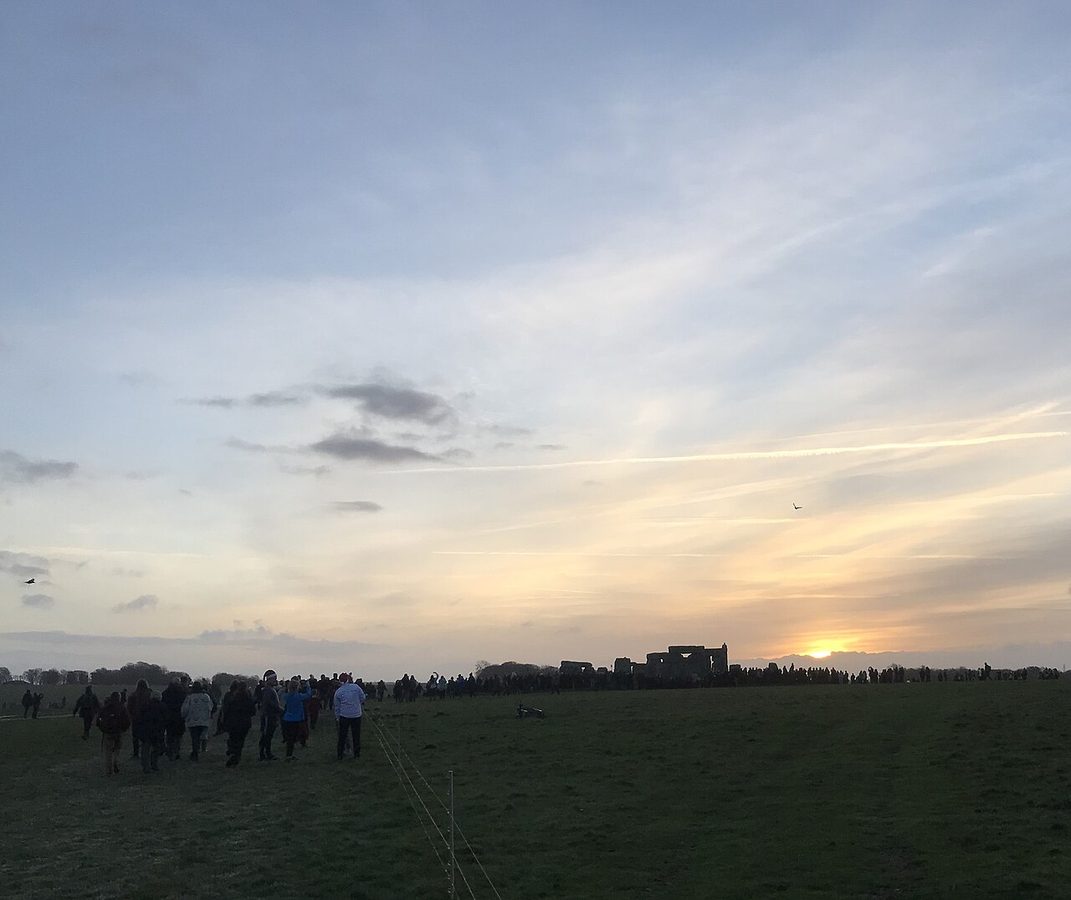
Stonehenge is not isolated in the landscape. Three kilometres to the north-east lie Durrington Walls and Woodhenge , two large timber monuments, the first being one of the largest henges ever excavated, with a diameter of 500 metres. Thousands of people could gather there. Isotopic analysis of animal bones found on site shows that participants came from across Britain , and perhaps Ireland. Stonehenge was the ceremonial centre of an immense territory.
The Bluestones: 220 km from Wales
The 44 bluestones of Stonehenge represent one of European prehistoryPrehistoryThe span of human history before the invention of writing, from the Palaeolithic to the Metal Ages, known mainly through material remains.→'s most enduring mysteries. How were blocks weighing up to 4 tonnes transported from the Preseli Hills in Welsh Pembrokeshire, more than 220 kilometres as the crow flies? And above all: why these stones, and not others closer to hand?
The answer to the first question is now clear: humans transported them, deliberately, overland and perhaps by river. This is the conclusion of a series of studies published between 2025 and 2026. A mineralogical analysis of the "Newall boulder" , a rhyolite fragment excavated in 1924 , showed in July 2025 in the Journal of Archaeological Science that the rock bears no trace of glacial erosion: no striations, no polishing characteristic of ice transport. In 2026, a study from Curtin University published in Communications Earth & Environment analysed more than 500 zircon and apatite grains from local river sediments: no mineral signature of glacial origin from the north or west. Glaciers did not carry the bluestones. Humans did.
The answer to the second question is more complex. Mike Parker Pearson and his team's excavations at Waun Mawn in the Preseli Hills revealed in 2021 the remains of a stone circleStone circleA Neolithic or Bronze Age monument of standing stones set in a ring, often ritual or astronomical in purpose.→ 110 metres in diameter , dismantled around 3000 BCE, just before the first bluestones appeared at Stonehenge. Several stoneholes at Waun Mawn match the exact dimensions of Stonehenge bluestones. The hypothesis: Stonehenge may be a reconstruction of an older Welsh monument, transported stone by stone to Wiltshire. A transfer of a sacred place, not just of materials.
The quarries of origin have been identified precisely. Spotted dolerite , the most common bluestone type at Stonehenge , comes from Carn Goedog and Craig Rhos-y-felin in the Preseli Hills. Pollen analyses conducted in October 2025 in Environmental Archaeology show these hills were inhabited and farmed from 3000 BCE onwards, well after bluestone extraction , evidence of continuous human presence in the source region.
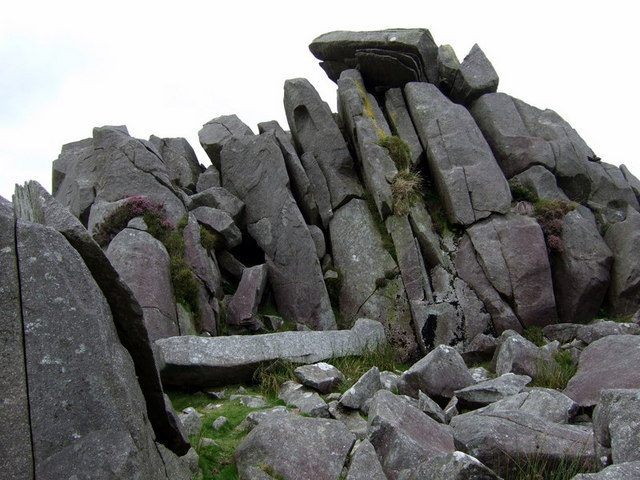
An ox from Wales confirmed these routes. A Bos taurus tooth from Stonehenge's south entrance, dated to around 2995, 2900 BCE, was analysed for strontium and lead isotopes in 2025: the animal was born in western Britain, probably Wales, and was brought to Stonehenge , possibly to haul stones. A single tooth, but direct testimony to late Neolithic networks.
The Sarsens: 30 Tonnes from West Woods
The great standing stones , the sarsens , are of a different nature. They are blocks of extremely hard silicified sandstone, weighing up to 30 tonnes for the largest. Their origin was long mysterious. In 2020, a study by David Nash in Science Advances used geochemistry to trace them to the West Woods deposits in Wiltshire, only 20, 25 kilometres north of Stonehenge. A short distance on a human scale, but a considerable feat across undulating terrain.
Sarsen blocks found on the banks of the Avon , the "Cuckoo Stone" and the "Tor Stone", analysed in 2025 in the Proceedings of the Prehistoric Society , show that sarsens were already being moved as early as 2940, 2750 BCE, even before the main construction phase. These stones placed near the river may have marked a ceremonial "gateway" to Stonehenge, incorporating architectural influences from Orkney.
The Altar Stone Comes from Scotland: the 2024 Revelation
Among all the recent discoveries, this may be the most astonishing. The Altar Stone , the 6.6-tonne grey-green sandstone slab at the centre of Stonehenge, long assumed to come from south Wales , actually comes from Scotland. From very far in Scotland: zircon analyses published in Nature in August 2024 by Anthony Clarke and colleagues at Curtin University identified its geological origin in the Orcadian Basin, at the very north-eastern tip of Scotland, more than 700 kilometres from Stonehenge.
This result sent shockwaves through the scientific community. If the bluestones from Wales already represented a considerable logistical feat, the Altar Stone implies a journey twice as long. How was it transported? The glacial theory , that glaciers could have carried the stone part of the way from Scotland during the Last Glacial MaximumLast Glacial MaximumThe peak of the last glaciation (c. 26,000 to 19,000 years ago), with ice sheets at their greatest extent; it pushed populations towards southern refuges.→ , was immediately proposed, notably by Welsh researchers. But studies in 2025 and 2026 have methodically refuted it. A 2026 publication in Communications Earth & Environment demonstrated that Salisbury Plain was not glaciated during the period that would have been required for transport. A complementary study found no Scottish mineral signatures in local river sediments. The Altar Stone was carried by human beings over more than 700 kilometres , most likely by sea, following the east coast of England before moving inland via the river network.
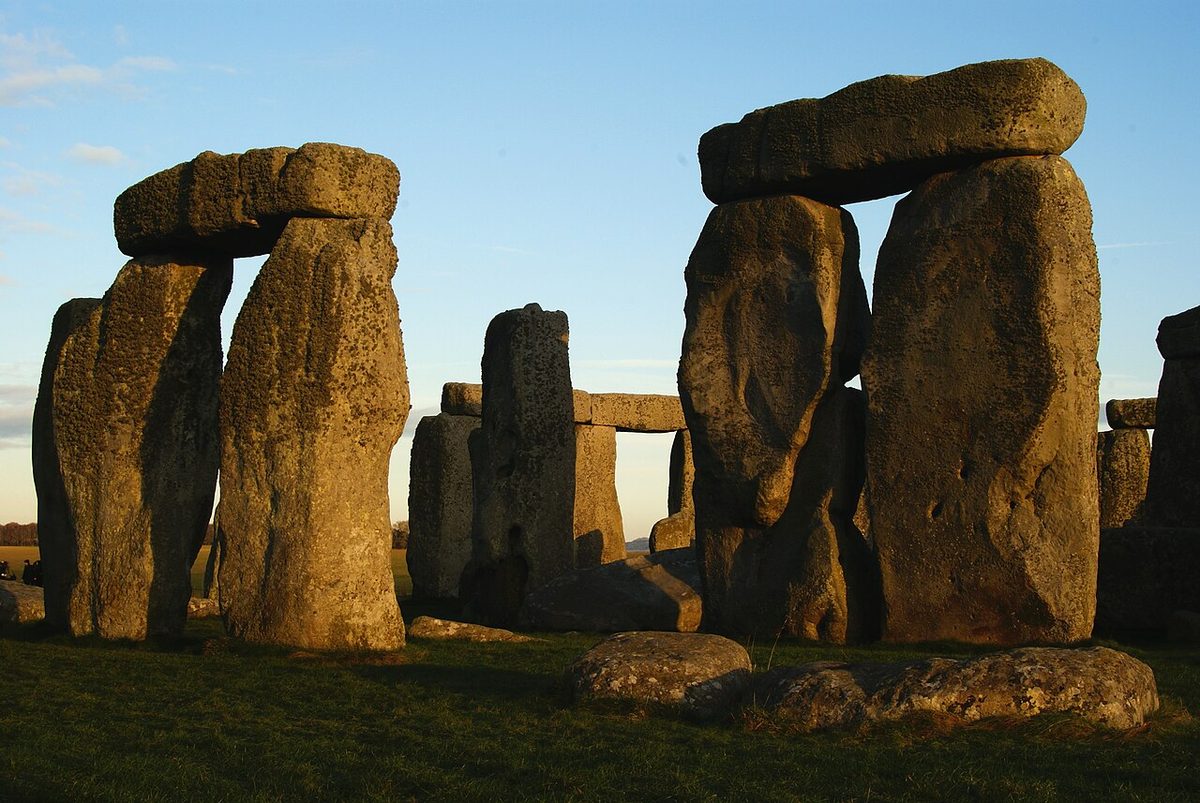
The significance of this discovery goes beyond logistics. It means that Stonehenge's builders maintained contacts with communities living at the other end of Britain , more than ten days' walk or sail away. The Altar Stone was not just a building material: it was a symbol, carrying the power of a distant and perhaps mythical region. Mike Parker Pearson has suggested that the entire monument may represent a "union of the islands": the Welsh bluestones and the Wiltshire sarsens unified around a Scottish stone at the centre.
Astronomical Alignments: Sun and Moon
Stonehenge is famous for its summer solstice alignment: from the centre of the monument, the sun rises exactly along the axis of the avenue at the summer solstice. But this alignment is reversible: at the winter solstice, the sun sets in the same axis, as seen from inside. Which solstice mattered most to the builders? Animal bones at Durrington Walls , mainly pigs , indicate winter feasting, suggesting winter solstice was the season of gatherings. Summer solstice sunrise would then be the secondary direction.
But a discovery published in 2024 complicates , and enriches , this picture. Researchers at Bournemouth University analysed the "Station Stones", four blocks arranged in a rectangle inside the ditch. Their orientation, different from the main solstitial axis, corresponds to specific moments in the lunar cycle. In particular, the two pairs of Station Stones precisely frame the moon's rise and set during the "Major Lunar Standstill" , an 18.6-year cycle during which the moon reaches its maximum and minimum declinations. This alignment only works at Stonehenge's exact latitude: neither further north nor further south would the coincidence between solar and lunar axes function. The site was not chosen at random.
Carvings Hidden by Lichens
Stonehenge's stones are not smooth: they bear carvings. Bronze Age axes have been documented on the sarsens since the 1950s, but their survey remains difficult because lichen covers 23% of the surfaces. A 2025 publication in the Journal of Archaeological Science: Reports used image-processing algorithms (Difference of Gaussians and pseudo-depth mapping) combined with neural networks (MeshNet) to analyse laser scans of the stones. On sarsen 53 alone, the analysis identified 4 new carvings, 10 probable carvings and 9 reclassified ones , with 90.7% accuracy.
A complementary study in Results in Engineering modelled lichen growth and applied numerical simulations to "erase" lichen from the laser scans, revealing hidden surfaces without touching the stones. These non-invasive tools open a new era in the monument's archaeology: it is becoming possible to "see" what the stones have hidden for millennia.
A Prehistoric Feasting Network Across the Island
Stonehenge was not an isolated monument in an empty landscape. It was the heart of a ceremonial territory whose sphere of influence covered all of Britain, and perhaps beyond. A study published in iScience in October 2025 analysed isotopes from animal bones from ritual sites in Wiltshire and the Thames Valley, dated to around 1000, 800 BCE. Pigs came from Scotland, Ireland and Wales , transported alive over hundreds of kilometres for collective feasts, while cattle and sheep were local. Stonehenge and its surroundings were a pilgrimage destination where populations from across the island met to eat, celebrate and perhaps trade.
In November 2025, a publication in Internet Archaeology revealed a new pit system surrounding Durrington Walls, forming what may be the largest ceremonial enclosure ever documented in Britain , 16 man-made pits forming arcs around the hengehengeA Neolithic circular enclosure bounded by a ditch and bank, often associated with standing stones.→.
Persistent Debates
Despite the accumulation of knowledge, several fundamental questions remain open , and actively debated.
The precise origin of the Altar Stone continues to be refined. The Orcadian Basin is vast, and the rock could come from Caithness, Orkney itself, or an intermediate coastal formation. The transport route remains unknown. Some researchers propose a coastal route along eastern England; others envisage a crossing of the Irish Sea from Scotland to Wales, with a final overland haul.
Sarsen origins are the subject of a geochemical controversy between two teams. David Nash (University of Brighton) maintains that West Woods is the primary source; Anthony Hancock and colleagues contest the methods and propose alternative sources. The debate continues in specialist journals.
The monument's exact function remains disputed. Solar temple? Healing sanctuary? Astronomical observatory? Mausoleum? The most honest answer is: probably all of these at once, and differently across its long history. Recent excavations highlight the early funerary dimension (Aubrey Hole cremations), the festive and communal dimension (Durrington Walls and its feasts), and the astronomical dimension (solar and lunar alignments). Stonehenge may have been what a medieval cathedral was for its contemporaries: a place of worship, assembly, symbolic power and memory of the dead.
Sources and References
- Clarke A.J.I., Kirkland C.L. et al. (2024) , A Scottish provenance for the Altar Stone of Stonehenge. Nature, 632, 570, 575. doi
- Clarke A.J.I. & Kirkland C.L. (2026) , Detrital zircon, apatite fingerprinting challenges glacial transport of Stonehenge's megaliths. Communications Earth & Environment, 7(1). doi
- Bevins R.E. et al. (2025) , The enigmatic 'Newall boulder': new data and correcting the record. Journal of Archaeological Science: Reports, 59. doi
- Evans J.A. et al. (2025) , Sequential multi-isotope sampling through a Bos taurus tooth from Stonehenge. Journal of Archaeological Science, 180. doi
- Harding P. et al. (2025) , Earliest movement of sarsen into the Stonehenge landscape. Proceedings of the Prehistoric Society, 91. doi
- Gaffney V. et al. (2025) , The perils of pits: Research at Durrington Walls henge. Internet Archaeology, 69. doi
- Spencer D.E. et al. (2025) , Prehistoric landscape change around the sources of Stonehenge's bluestones. Environmental Archaeology. doi
- Esposito C. et al. (2025) , Diverse feasting networks at the end of the Bronze Age in Britain. iScience, 28(10). doi
- Silva F., Chadburn A. & Ellingson E. (2024) , Stonehenge may have aligned with the moon as well as the sun. The Conversation. lien
- Parker Pearson M. et al. (2024) , Stonehenge and its Altar Stone. Archaeology International, 27(1). doi
Ce site est la meilleure chose que mes enfants m'aient recommandée depuis longtemps.
J'ai réalisé un court documentaire sur les mégalithes britanniques et Stonehenge m'a appris une lecon d'humilité. Les reconstitutions 3D que nous avons faites pour illustrer les phases de construction sur 1 500 ans montrent à quel point ce monument est le résultat d'un projet collectif multigénérationnel. C'est une cathédrale préhistorique au sens propre du terme.
Stonehenge reste le monument mégalithique le plus étudié au monde et pourtant il réserve encore des surprises. Les recherches récentes ont montré que certains des bluestones provenaient de Galles du sud, à plus de 250 km de distance. Comment ces pierres pesant plusieurs tonnes ont été transportées et dressées avec une précision architecturale telle que l'alignement solsticial est parfait reste un défi pour les archéologues.