On the bare chalk of Salisbury Plain, in southern England, a ring of standing stones has defied time for more than four and a half millennia. Stonehenge is neither the oldest nor the largest of Europe's megalithicMegalithA large stone raised or assembled by humans (menhirMenhirA stone erected vertically by humans, standing alone or in rows (alignments), emblem of the Breton Neolithic megalithic tradition. From Breton men (stone) and hir (long).→, dolmenDolmenA megalithic funerary structure made of one or more capstones resting on vertical uprights, often topped by an earth tumulus. From Breton dol (table) and men (stone).→, stone circleStone circleA Neolithic or Bronze Age monument of standing stones set in a ring, often ritual or astronomical in purpose.→), typical of the Neolithic and Bronze AgeBronze AgeA protohistoric period following the Neolithic, defined by bronze metallurgy (a copper-tin alloy) and the rise of the first cities and states; in Egypt it corresponds to the age of the first pyramids.→.→ monuments, but it is unquestionably the most famous and the most baffling. Its silhouette of trilithonsTrilithonAn elementary megalithic structure made of two upright stones supporting a horizontal lintel (from Greek tri-, "three", and lithos, "stone"). At Stonehenge, five great sarsen trilithons formed the central horseshoe.→, two uprights capped by a horizontal lintel, has become a universal icon, endlessly reproduced, mythologised and exploited. Behind the postcard image, however, lies one of the most complex and disconcerting building projects of the global NeolithicNeolithicThe "New Stone Age": a period marked by farming, herding, settlement and pottery, from around 10,000 BC.→: a monument erected, modified, dismantled and rebuilt over nearly fifteen centuries, in which every stone tells a story of transport, engineering and belief1.
This dossier offers a synthesis of what archaeology knows, and still does not know, about Stonehenge. From the genesis of the ritual landscape of Salisbury Plain to the successive phases of construction; from the origin of the great sarsensSarsenA block of very hard silicified sandstone, the remnant of a Cenozoic sedimentary cover scattered across the chalk of southern England. The largest Stonehenge stones are sarsens from West Woods, in Wiltshire.→ of West Woods to the odyssey of the Welsh "bluestones"; from the astonishing 2024 discovery that the Altar Stone in fact comes from Scotland, to the solstitial alignment and the funerary role of the site, we will try to restore a living monument, the fruit of the coordinated labour of thousands of men and women over generations.
Salisbury Plain, a ritual landscape
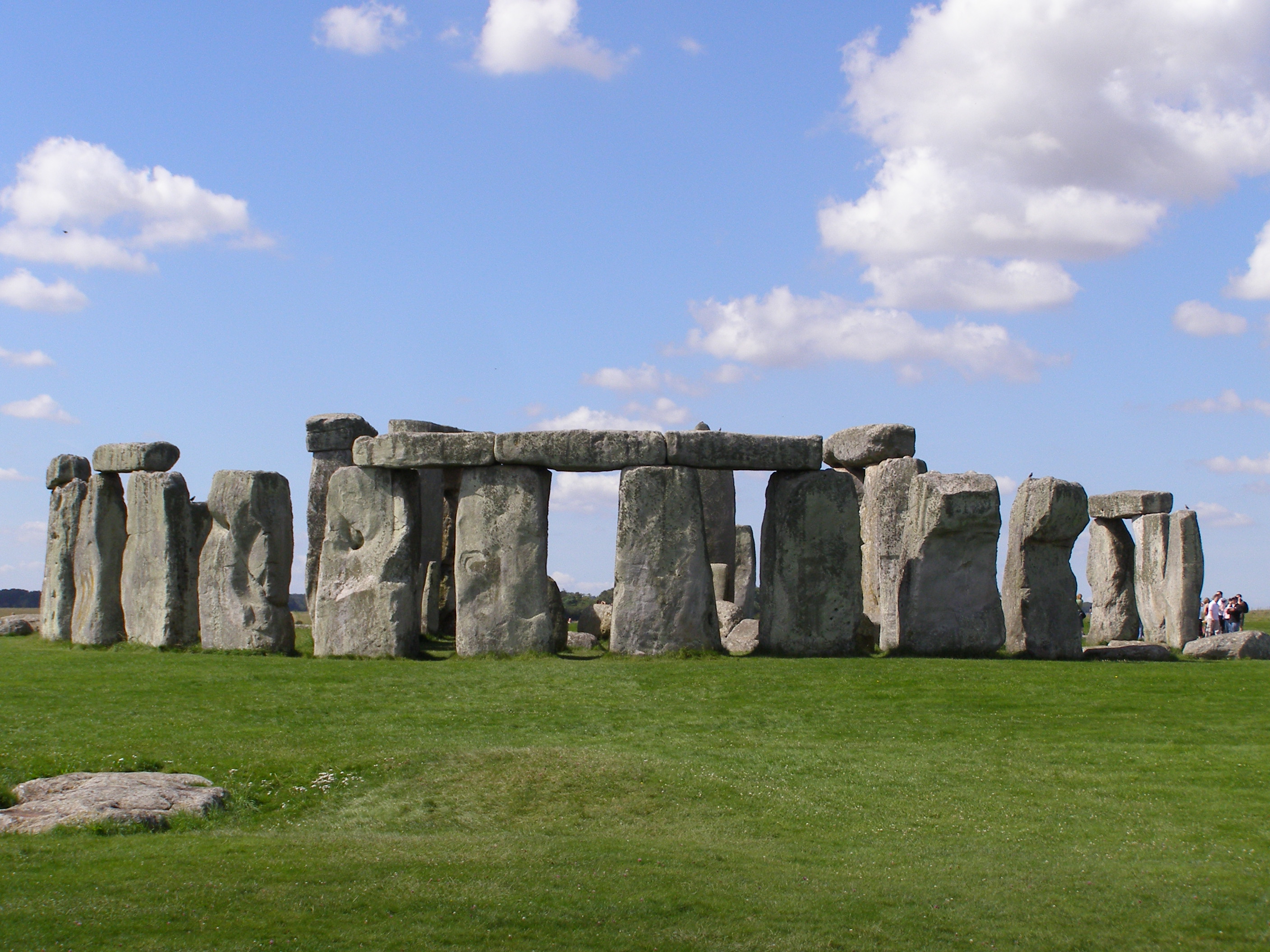
Stonehenge makes no sense in isolation from its territory. The monument is not an object dropped at random onto an empty heath: it is the heart of a vast ceremonial landscape shaped by Neolithic communities over several centuries. Salisbury Plain, in Wiltshire, is a chalk plateau crossed by dry valleys and drained by the Hampshire Avon. Its white chalk, easy to dig with antler picks and flintFlintA hard, brittle siliceous rock, knapped by prehistoric people to produce blades, points and sharp tools.→ tools, offered an ideal medium for the monumental earthworks that characterise the British Neolithic1.
Long before the first stone was raised, the area was already invested with meaning. A few hundred metres from the site of the future circle, archaeologists uncovered, beneath the old visitor car park, a series of large pits that had held enormous pine posts, set up around 8000 BC, in the MesolithicMesolithicThe period between the Palaeolithic and the Neolithic (c. 10,000–6,000 BC in Europe), still based on hunting and gathering.→. These wooden totems, raised by hunter-gatherersHunter-gatherersA way of life based on hunting, fishing and gathering wild resources, without farming or herding; it dominated almost the whole of human history.→ millennia before the Neolithic builders, suggest that the place held a symbolic charge of unsuspected depth, predating the stone monument itself by thousands of years.
In the Neolithic, the plain became covered with monuments. The Stonehenge Cursus, an immense elongated enclosure nearly three kilometres long bordered by ditches, was dug around 3500 BC; it is sometimes read as a "processional avenue" or a consecrated ground whose exact function remains enigmatic. All around lie long barrows, long burial mounds housing collective graves, and, later, hundreds of Bronze Age round barrows. The density of these monuments makes Salisbury Plain one of the most saturated necropolises and sanctuaries of prehistoric Europe. Stonehenge belongs to this web: it is its architectural culmination, the focal point towards which avenues, watercourses and gazes converge.
The geology of the plain itself probably shaped this choice. Beneath the thin layer of topsoil, natural fissures in the chalk surface in places; some of them, near the Heel Stone, appear to be aligned on the solstitial axis even before any human intervention. Several researchers argue that the builders may have "read" in the ground a pre-existing alignment between topography and the path of the sun, and that they chose to raise their monument there, precisely, because nature seemed already to have traced the axis of the sky. Stonehenge would then have been born of the encounter between an astronomical observation and a geological peculiarity, sanctifying a place where an accident of terrain seemed to answer the order of the cosmos.
This embedding within a constructed landscape explains why contemporary archaeology no longer excavates only the circle, but the whole territory. The Stonehenge Riverside Project, carried out in the 2000s, set out precisely to connect the stone monument to the Avon, to neighbouring settlements and to other enclosures, drawing the picture of an integrated ritual complex rather than an isolated object. Stonehenge is no solitary ruin: it is the emerged summit of a world of beliefs.
A building project spanning centuries: the great phases
The most counter-intuitive idea, for the visitor, is that Stonehenge as we see it never existed in a single, finished form. The monument is the product of a sequence of constructions spread over roughly fifteen centuries, from the mid-fourth to the early second millennium BC. Archaeologists conventionally distinguish several major phases, whose dates are continually refined by radiocarbonRadiocarbon (carbon-14)A dating method based on the decay of carbon-14, usable back to about 50,000 years.→1.
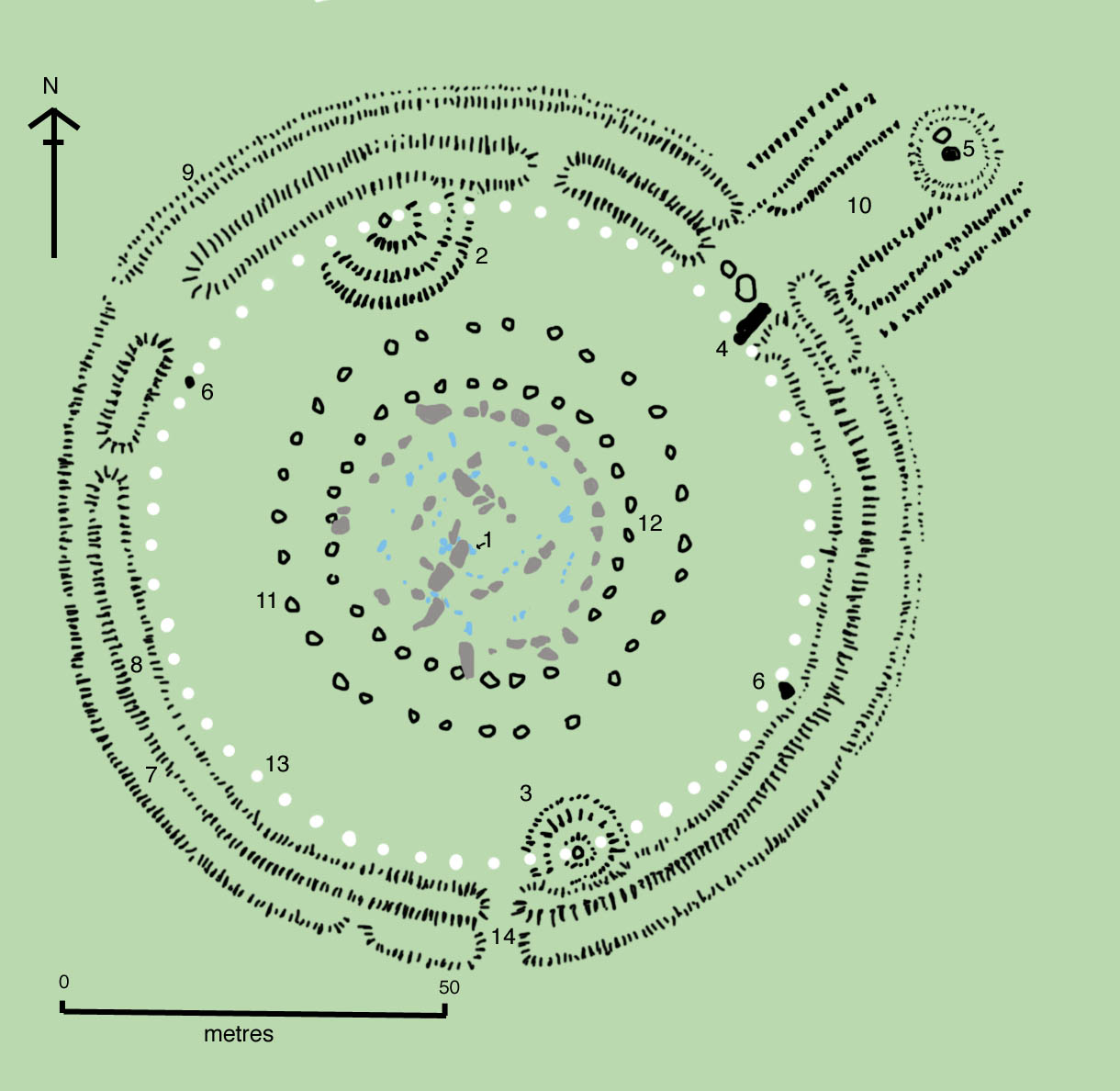
First phase (around 3000 BC): the earthwork monument. Stonehenge began not with stones but with a hengehengeA Neolithic circular enclosure bounded by a ditch and bank, often associated with standing stones.→: a circular enclosure about one hundred metres in diameter, defined by a ditch and a chalk bank. Notably, the main bank lies inside the ditch, an unusual arrangement that gave its name to a whole category of monuments. The digging, carried out with antler picks, some of which were found at the bottom of the ditch and dated, yields the first reliable dates for the site.
It is also at this time that a ring of fifty-six regularly spaced pits was dug just inside the bank: the famous Aubrey Holes, named after the antiquary John Aubrey who spotted them in the seventeenth century. Their function has long been debated. It has been proposed that they held wooden posts, then that they served to raise a first set of bluestones. But their most consistent content is funerary: they contain deposits of human cremations, making Stonehenge, from its very beginning, a place of death as much as a sanctuary.
Second phase (around 2900–2600 BC): timber and the first burials. For several centuries, the enclosure seems to have been dotted with wooden structures, of which only hard-to-interpret post-holes remain. It is during this interval that cremation deposits multiplied, in the Aubrey Holes and in the fill of the ditch. Stonehenge then functioned as a vast cremation necropolisNecropolisA large organised burial ground, a "city of the dead", often spanning several periods.→, perhaps reserved for an elite.
Third phase (from 2600–2500 BC): the arrival of the stones. This is the great transformation. The monument of earth and timber became a monument of stone. The first bluestones were raised, then above all the colossal sarsens that give it its definitive silhouette: an outer ring of thirty uprights capped by a continuous ring of lintels, and, within, five immense trilithonsTrilithonAn elementary megalithic structure made of two upright stones supporting a horizontal lintel (from Greek tri-, "three", and lithos, "stone"). At Stonehenge, five great sarsen trilithons formed the central horseshoe.→ arranged in a horseshoe open to the north-east. The bluestones, moved several times, were finally rearranged into a circle and a horseshoe within the sarsen structure.
The later phases, down to around 1500 BC, mainly saw rearrangements of the bluestones and the digging of two concentric rings of pits, the Y and Z Holes, which never received stones and seem to mark the gradual abandonment of the great architectural project. Stonehenge was therefore not "built": it was conceived, reconceived, undone and remade, like a text continually rewritten by generations that probably did not share exactly the same intentions.
To these major components were added several isolated stones whose roles complete the reading of the monument. At the four cornersFour CornersRegion of the American Southwest where Colorado, Utah, Arizona and New Mexico meet, the cradle of Ancestral Puebloan culture.→ of a rectangle inscribed within the enclosure stood the Station Stones, two of which survive; their arrangement is not accidental, for the sides of this rectangle are themselves oriented on the solstitial risings and settings and on certain extreme positions of the moon, suggesting a deliberate geometric intention. At the north-east entrance, lying across the axis, rests the Slaughter Stone, a great sarsen whose evocative name, coined by modern tradition, corresponds to no proven sacrificial reality: the reddish hue taken by water standing in its hollows is due to iron oxides, not blood. Finally, outside the enclosure, on the Avenue, the Heel Stone marks the solstice horizon. Each of these stones takes part in an overall design in which little, if anything, seems left to chance.
The sarsens: giants from West Woods
The stones that strike the eye first are the sarsens, those massive grey blocks whose largest exceed seven metres in height above ground and weigh twenty, even thirty tonnes. The word "sarsen" denotes an extremely hard silicified sandstone, the remnant of an ancient sedimentary cover that erosion fragmented into scattered blocks across the chalk of southern England. For centuries it was assumed that these giants came from the Marlborough Downs, some thirty kilometres north of the monument, without this being demonstrable.
Proof came in 2020, through a geochemical analysis of unprecedented refinement. By comparing the chemical signature of the monument's sarsens with that of blocks sampled across various areas of southern England, a team established that fifty of the fifty-two surviving sarsens share a single origin: a precise sector of the Marlborough Downs called West Woods, about twenty-five kilometres north of Stonehenge1. The consistency of this signature shows that the builders went to fetch the bulk of their stones from one and the same place, in a concerted and probably fairly brief effort on the scale of the project.
The scale of the workforce is hard to overstate. Beyond the hundreds of haulers needed for a single stone, the project required toolmakers, rope-makers, carpenters to build the lifting frames and sledges, and organisers to feed and house everyone for weeks at a time. Such an undertaking could not have been improvised: it implies a society able to plan ahead, to store surpluses of food, and to summon labour from a wide hinterland. The very fact that the sarsens were brought from a single source at West Woods, rather than gathered piecemeal from the nearest scatters, points to a deliberate, centrally directed decision rather than to opportunistic collection.
The riddle of transport remains. Moving a thirty-tonne block over twenty-five kilometres of undulating terrain, with a Neolithic technology lacking the axled wheel and heavy draught animals, is a feat of organisation. The dominant hypothesis combines wooden sledges, rails or rollers, plant-fibre ropes and massive human force: it is estimated that several hundred people were needed to move a single great stone. Once on site, each sarsen was shaped, hammer-dressed, its faces regularised, then raised into a deep pit packed with blocks and pulled upright.
The shaping of the sarsens represents a colossal expenditure of labour in itself. This silicified sandstone is among the hardest rocks one can work by hand: to regularise a face, the builders struck the surface with sarsen mauls or stone hammers, by pounding, detaching the rock flake by flake. The dressing debris found in quantity around the stones bears witness to this immense shaping effort. Certain faces, notably those turned towards the interior of the monument and towards the solstitial axis, were worked with particular care, smoother and more regular, as if they were meant to be seen, or lit, at the decisive moment of sunrise or sunset.
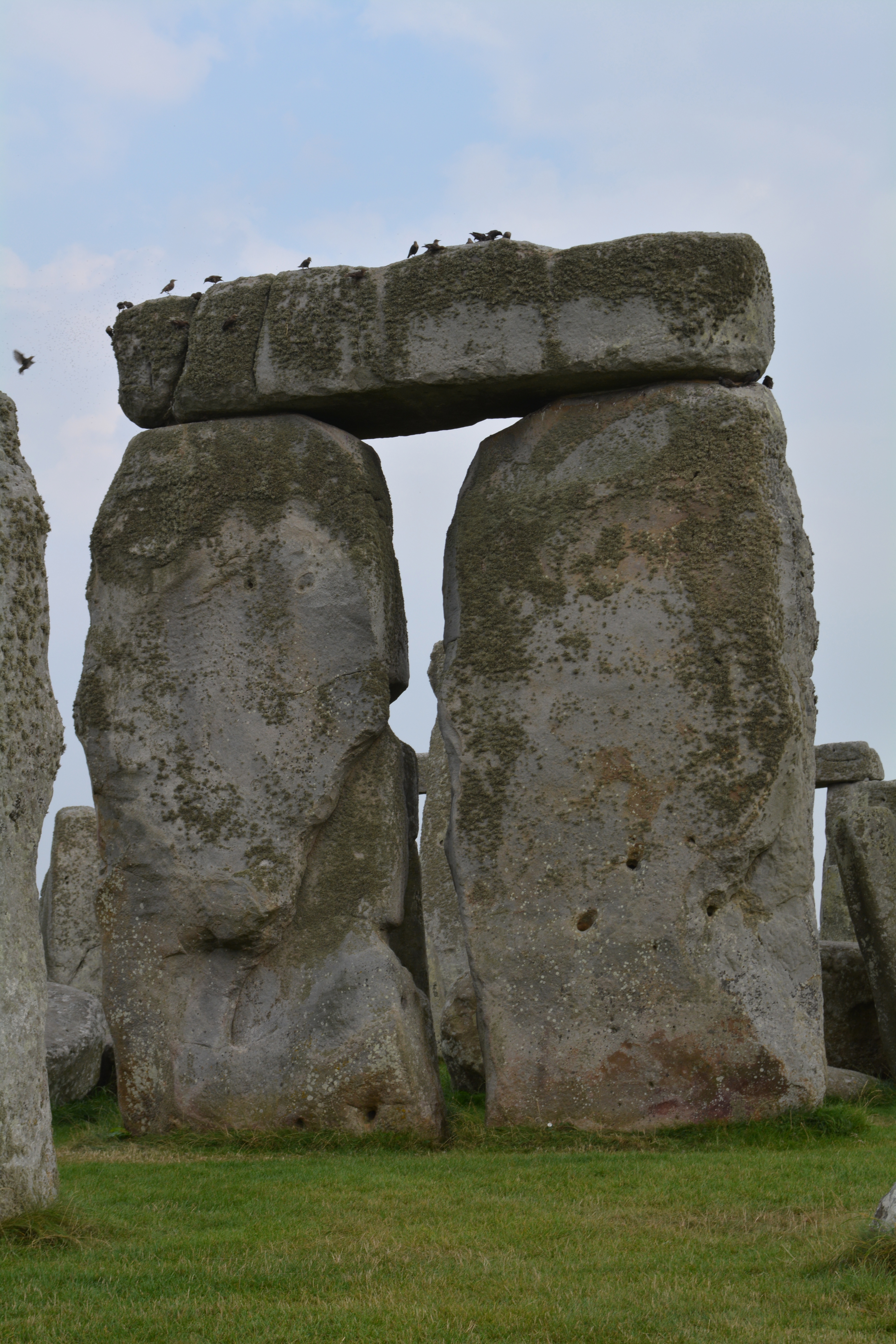
The refinement of the assembly still astonishes engineers. The lintels do not simply rest on the uprights: they are joined by techniques borrowed from woodworking, mortise and tenon joints fixing each lintel onto its pillars, and tongue and groove joints linking the lintels to one another along the ring. The lintels of the outer circle are moreover slightly curved to follow the circumference, and their upper surface is levelled despite the slope of the ground. Stonehenge is not a pile of stones: it is a frame of stone, devised by minds familiar with monumental carpentry.
The bluestones: a Welsh odyssey
If the sarsens impress by their mass, the bluestones fascinate by their journey. Smaller, one to four tonnes on average, these roughly eighty stones, of which about forty survive, are not local at all. As early as the 1920s, the geologist Herbert Thomas identified their origin in the Preseli Hills, in Pembrokeshire, at the south-western tip of Wales, more than two hundred kilometres from Salisbury Plain. It is one of the longest transports of megalithic material known in world prehistoryPrehistoryThe span of human history before the invention of writing, from the Palaeolithic to the Metal Ages, known mainly through material remains.→.
The term "bluestones" in fact groups several rock types: chiefly spotted dolerites, but also rhyolites, tuffs and sandstones. The petrographic and geochemical analyses of recent decades have made it possible to trace them back to precise outcrops. Two of them proved decisive: Carn Goedog, the main source of the dolerites, and Craig Rhos-y-felin, the source of certain rhyolites. At these sites, archaeologists uncovered genuine Neolithic quarries: extraction faces where stones naturally pre-shaped into columns by the cooling of the rock were detached with wedges, around 3400–3200 BC, several centuries before their final erection at Stonehenge.
The lithological diversity of the bluestones is in itself remarkable. The spotted dolerites of Carn Goedog owe their name to the whitish nodules of secondary minerals that stud their dark surface, giving them a characteristic speckled look; it is they that form the bulk of the bluestone circle and horseshoe. Alongside them are finer-grained rhyolites, volcanic tuffs and several sandstones, including the Altar Stone long classified among them. This variety indicates that the bluestones were not taken from a single outcrop but gathered from several sources spread across the Preseli and their surroundings. The range of rocks assembled suggests an intention, perhaps, to bring together representative fragments of a whole massif, like assembling the pieces of a geographical puzzle laden with meaning.
This chronological gap has fed one of the boldest hypotheses of recent archaeology. Some thirty kilometres from Carn Goedog, the site of Waun Mawn has yielded the remains of a dismantled stone circle whose diameter, about one hundred and ten metres, matches that of the ditch of Stonehenge's first phase, and some of whose sockets, left by removed stones, fit the cross-section of a specific Stonehenge bluestone. From this arose the seductive idea that the bluestones first formed a monument in Wales, dismantled and then transported to Salisbury Plain, a veritable relocation of a sanctuary, perhaps linked to the migration of populations. The hypothesis remains debated, but it illustrates the genuinely epic dimension of the bluestones' history.
The mode of transport of these stones over two hundred kilometres has also fuelled debate. An old theory favoured a sea route, along the Welsh and English coasts, before an ascent up the Avon. Recent research leans rather towards an overland transport, by human force and sledges, across Wales and southern England. Whatever the route, the effort was immense, and it attests to the extraordinary attachment these communities feltFeltA non-woven fabric made by pressing and matting wool fibres; steppe nomads used it for rugs, saddles and appliqués, remarkably preserved in the frozen Pazyryk tombs.→ for stones brought from so far away, as if their very provenance constituted an essential part of their power.
The Altar Stone and the Scottish surprise of 2024
At the heart of the monument lies, half-buried beneath two collapsed sarsens, a slab of greenish-grey sandstone nearly five metres long, traditionally called the Altar Stone. Recumbent, crushed under the weight of the fallen giants, it was long grouped for convenience among the Welsh bluestones, because of its sandstone nature. For a century, researchers assumed it too came from south-west Wales, probably from the Old Red Sandstone formation.
In August 2024, a study published in the journal Nature overturned this certainty3. By analysing the age and composition of the Altar Stone's minerals, in particular grains of zircon, apatite and rutile, true geological fingerprints, the researchers found that its signature matched no Welsh source. It pointed to a far more northerly origin: the Orcadian Basin, in north-east Scotland, more than seven hundred and fifty kilometres from Stonehenge2.
The method deserves to be detailed, so well does it illustrate the refinement of modern geochronology. Zircon grains trapped in the sandstone behave like tiny clocks: their uranium and lead content allows their crystallisation to be dated, sometimes to several hundred million years ago. The spread of ages of the Altar Stone's zircons, clustered notably between one and two billion years, draws a fingerprint not found in Welsh sandstones, but closely matching the sandstones of the Orcadian Basin, laid down in the Palaeozoic in northern Scotland. Combined with the analysis of apatite and rutile, this mineralogical signature ruled out a Welsh origin with a high degree of confidence.
The Altar Stone is not Welsh: it comes from north-east Scotland, more than 750 kilometres away. No megalithic material has ever been traced over such a distance in Britain.
The implications are dizzying. Transporting a six-tonne slab over such a distance, around 2600 BC, implied either an overland journey across the whole relief of Britain, judged extremely difficult, or, more probably, a sea transport along the coasts. Such an undertaking presupposes an elaborate social organisation, networks of exchange and communication on the scale of the entire island, and perhaps a capacity for coastal navigation far greater than had been imagined for the late British Neolithic2.
The 2024 discovery transforms the reading of the monument. Stonehenge does not merely aggregate stones from one region: it brings together materials from Wiltshire, Wales and Scotland, as if it were meant to unite symbolically the far corners of Britain in a single place. Some researchers see in this the expression of a political or ceremonial unification of the island's Neolithic communities, sealed by bringing, to a central point, fragments of their respective territories. The Scottish Altar Stone thus becomes the emblem of a monument conceived on the scale of an archipelago.
The solstitial alignment and the astronomy of the monument
If there is one fact on which archaeology agrees, it is the astronomical orientation of Stonehenge. The main axis of the monument, extended by the Avenue, a processional path bordered by ditches that links the circle to the Avon, points to the north-east. In that direction, beyond the enclosure, stands an isolated, leaning stone, the Heel Stone. This axis is aligned on the midsummer sunrise and, in the opposite direction, on the midwinter sunset1.
On the morning of the summer solstice, seen from the centre of the monument, the sun rises approximately above the Heel Stone and casts its first rays along the axis of the horseshoe. Six months later, at the winter solstice, it is the sunset that is framed between the uprights of the largest trilithon, now collapsed. Many researchers believe that it was in fact the winter solstice that was the cardinal moment of the ritual calendar: the symbolic death of the year, the lowest point of the sun, followed by its rebirth. This interpretation accords with evidence of a great winter gathering in the vicinity.
Should we therefore see Stonehenge as an "observatory" in the modern sense? The most ambitious theories of the 1960s, which made the monument a kind of astronomical calculator able to predict eclipses, are now largely abandoned: they rested on multiple alignments, many of which are statistical coincidence. But the fundamental solstitial alignment is robust and indisputable. Stonehenge probably did not serve to "do astronomy": it embodied the solar cycle, materialising in stone the rhythm of the seasons and the eternal return of light. It was less an instrument than a sacralised cosmic clock, a theatre where the course of the sun became ritual spectacle.
It must be stressed how much caution these readings demand. Over five thousand years, the exact position of the solstice sunrise has shifted slightly, because the tilt of the Earth's axis varies slowly; the alignments observed today are thus only an approximation of those observed by the builders. Moreover, the sun did not rise precisely "on" the Heel Stone, but nearby, the disc emerging beside the stone before rising above it. These nuances do not weaken the astronomical intention, manifest as soon as the axis of the monument and that of the Avenue converge on the same point of the horizon; they merely remind us that Stonehenge was conceived by attentive observers of the sky, but operating with the means and conceptions of their time.
This calendrical dimension has enjoyed renewed interest recently. Some researchers have proposed that the sarsen circle, with its thirty uprights, encoded a solar calendar of three hundred and sixty-five and a quarter days, each stone representing one day of a thirty-day month, supplemented by intercalary days. The hypothesis, attractive, remains contested; it nonetheless illustrates the enduring conviction that the geometry of the monument expresses a knowledge of time, inherited from astronomical observations accumulated over generations.
Stonehenge as necropolis: the dead at the heart of the stones
It is often forgotten before the majesty of the trilithons: Stonehenge was, for centuries, one of the largest cremation cemeteries of the British Neolithic. The funerary dimension is no secondary detail; it is consubstantial with the monument. From the first phase, the Aubrey Holes and the ditch received deposits of cremated human bone. Modern excavations and re-examinations estimate that at least several dozen individuals, perhaps on the order of one hundred and fifty to one hundred and eighty people, were buried there after cremationBurialThe intentional deposition of a body, sometimes with offerings; a marker of symbolic behaviourSymbolic behaviourA set of practices (adornment, pigments, art, burial) reflecting symbolic thought; long ascribed to Homo sapiens alone, now attested for Neanderthals too.→.→, over a period of about five centuries, from around 3000 to 2500 BC1.
Who were these dead? Analysis of the remains has yielded a few clues. The buried population includes men, women and children, which rules out the idea of an exclusively male warrior caste. The relative scarcity of burials, against what must have been a numerous regional population, nonetheless suggests a selection: not everyone was entitled to rest among the stones. Stonehenge would have been the final resting place of a particular group, perhaps a lineage or a religious and political elite.
More remarkable still, the analysis of strontium isotopes contained in some remains indicated that several of the deceased had not grown up on the chalk of Wessex, but in regions of different geology, possibly western Britain, even Wales, precisely the region from which the bluestones come. This troubling convergence between the origin of the stones and that of some of the dead reinforces the idea of a deep, perhaps ancestral, link between the Welsh communities and the sanctuary of Salisbury Plain.
Stonehenge thus reveals itself as a monument of the dead as much as of the heavens. The stone circle did not only enclose the course of the sun: it sheltered the ashes of the ancestors, making the place a junction between the cyclical time of the sky and the genealogical time of human lineages. Stone, the material of eternity, suited both the gods of the calendar and the dead one wished to rescue from oblivion.
The builders: social organisation and Durrington Walls
Who built Stonehenge? The answer lies neither with the Romans, nor the druids, nor any visitors from elsewhere, but with late Neolithic British farming communities, able to mobilise a considerable workforce and coordinate it over long periods. The erection of the sarsens in particular demanded the effort of several thousand people, if only to supply, feed and organise the hundreds of arms needed for each lift.
One of the key sites for understanding this society is Durrington Walls, less than three kilometres north-east of Stonehenge, on the bank of the Avon. There, around 2500 BC, lay one of the largest Neolithic settlements known in north-west Europe: a complex of houses with chalk floors, later enclosed within a gigantic henge. Excavations there have uncovered impressive quantities of animal bone, chiefly pigs and cattle, slaughtered for great feasts. Analysis of these remains shows that the beasts were brought from sometimes distant regions of Britain and slaughtered at ages clustered around the winter solstice1.
The picture that emerges is striking: Durrington Walls would have been the place of life and feasting of the builders, while Stonehenge, a few kilometres away, was the domain of the ancestors and the dead. This opposition inspired the hypothesis of a symbolic geography structured by the Avon: a world of timber and the living at Durrington, where a circle of posts, "Woodhenge", also stood, linked by the river to a world of stone and the dead at Stonehenge. The great ceremonies, perhaps wintry, would have seen processions descend the Avenue from the river to the stone circle, in a staging of the transition between life and death.
The isotopic analysis of the animals consumed at Durrington Walls held another surprise. The study of strontium and oxygen contained in the teeth of pigs and cattle indicates that some beasts had grown up far from Salisbury Plain, in regions as distant as Scotland or northern England, before being driven on the hoof to the site to be slaughtered. This implies that the participants in the great feasts themselves came from distant territories, converging on the Stonehenge complex with their herds. The monument thus appears as a gathering point on the scale of Britain, a place where scattered communities periodically reunited, shared banquets and perhaps took part in the building or upkeep of the stones. This convergence of people and beasts echoes, strikingly, that of the stones themselves, brought from Wiltshire, Wales and Scotland.
This logistical scale implies a form of power able to plan, requisition and coordinate. Without writingWritingA system of conventional signs used to fix language or information durably; its appearance (c. 3300 BC) marks, by convention, the end of prehistory.→, without metal, without a state in the modern sense, the Neolithic communities of Britain achieved one of the most impressive collective undertakings of prehistory. Stonehenge is, in this sense, the monumental testimony of a complex society, capable of gatherings on the scale of the archipelago, whose cohesion rested perhaps as much on shared belief as on coercion.
Myths and reception: from druids to pseudoscience
Few monuments have so fed the imagination as Stonehenge, and few have undergone so many fanciful interpretations. The most tenacious associates the site with the druids, priests of the Iron AgeIron AgeThe last period of protohistory (from c. 1200 BC in Europe and the Near East), marked by iron metallurgy and the first kingdoms.→ CeltsCeltsA set of Iron Age peoples sharing related languages and cultures, spread from central Europe to the Atlantic.→. This idea, popularised in the seventeenth and eighteenth centuries by antiquaries such as John Aubrey and above all William Stukeley, is nonetheless chronologically untenable: Stonehenge was already a millennia-old and probably abandoned monument when Celtic societies and their druids appeared, more than two thousand years after the erection of the sarsens. The neo-druidic gatherings held at the site today at the solstice belong to a tradition invented in the modern era, not to a historical continuity.
The Middle Ages had their own legend. In the twelfth century, Geoffrey of Monmouth attributed the erection of the monument to the magician Merlin, who was said to have transported the stones from Ireland by magic. Curiously, this medieval tale preserves a kernel of poetic truth: it places the origin of the stones in the west, beyond the plain, a distant echo, perhaps, of the memory of a real transport of the bluestones from Wales.
In the contemporary period, Stonehenge has become a magnet for pseudoscience: telluric alignments, mysterious energies, and the inevitable hypothesis of extraterrestrial builders, a hackneyed device of a literature that struggles to credit prehistoric societies with their own achievements. These fictions, while they sustain the site's popularity, obscure a far more admirable truth: it was the ingenuity of human Neolithic communities, and not some supernatural wonder, that raised these stones. Archaeology, by patiently restoring the quarries, the transport techniques and the organisation of the worksites, gives Stonehenge back its true grandeur, that, earthly and collective, of its builders.
The monument has also become a stake of memory and appropriation. By turns a British national symbol, a counter-cultural pilgrimage site in the 1970s and 1980s, an object of tension between neo-pagan devotees, heritage managers and law enforcement, Stonehenge crystallises the complex relations contemporary societies maintain with their deep past. Inscribed on the UNESCO World Heritage List since 1986, it is today at once a scientific site, a living sanctuary and a mass tourist attraction.
Conservation and persistent enigmas
Protecting a monument of this importance, subject at once to erosion, footfall and development pressures, is a permanent challenge. The stones themselves, re-erected and consolidated during the twentieth century in campaigns sometimes criticised for their interventionist character, are under constant surveillance. But the most debated threat of recent years concerns the immediate environment of the site: a road-tunnel project intended to bury the very busy road that runs alongside the monument has provoked heated debate, divided between the wish to restore the landscape's tranquillity and the fear of destroying archaeological remains still buried in the plain's soil.
For Salisbury Plain has not yielded all its secrets, far from it. Each geophysical surveyGeophysical surveyTechniques (magnetometry, radar) detecting buried structures underground without digging, by measuring physical anomalies.→ campaign reveals new structures invisible at the surface: pits, enclosures, post alignments. The discovery, a few kilometres away, of a vast ring of giant pits around Durrington has shown that the scale of Neolithic works exceeded anything imagined. The subsoil of the plain remains a largely unread archive.
Even the apparently settled questions retain a margin of uncertainty. The number of stones originally raised, the exact sequence in which the bluestones were rearranged, the precise role of the Y and Z Holes, the identity of the people buried in the Aubrey Holes, all remain partly open, constrained by the limits of what survives and by the disturbances of earlier, less careful excavations. Modern archaeology proceeds less by spectacular revelation than by the patient accumulation of small, well-dated certainties, each of which slightly redraws the picture. The history of Stonehenge research is itself a lesson in scientific humility.
Many enigmas still resist. Why choose to transport stones over hundreds of kilometres when local materials were available? What political organisation made it possible to coordinate such an effort? What was the precise meaning of the ceremonies held there, and the exact sense of the solstitial orientation in the thought of its builders? The 2024 Scottish discovery, by answering one question, the origin of the Altar Stone, has opened a whole field of new questions about the networks that linked the communities of Neolithic Britain3. Stonehenge advances in this way: each answer generates new questions, and the monument, far from freezing into certainty, remains a living focus of research.
Conclusion
Stonehenge is not an unfathomable mystery, but neither is it a fully deciphered book. It is, more precisely, a palimpsest of stone: a monument built, transformed and reinterpreted over nearly fifteen centuries, which condenses in a single place the astronomy, death, engineering, belief and social organisation of a Neolithic world of unsuspected sophistication. Its sarsens from West Woods, its bluestones torn from the Preseli Hills and its Altar Stone risen from northern Scotland tellTellAn artificial mound formed by the accumulation of successive layers of settlement remains at the same spot, typical of the Near East. Each destruction-rebuilding event adds a stratum.→ the story of a prehistoric Britain criss-crossed by networks, capable of mobilising materials and people from the four corners of the island.
Recent advances, the geochemical traceability of the sarsens, the locating of the Welsh quarries, the revelation of the Scottish origin of the Altar Stone, show that the monument continues to answer, in fragments, the questions of researchers. But the essence of its power lies perhaps in what remains out of reach: the thought of the men and women who, without metal or writing, sought to inscribe in stone the course of the sun and the memory of their dead. In this respect, Stonehenge is not merely a relic of the past: it has been, for four and a half thousand years, a question put to humanity about its own capacity to give lasting form to the invisible.
Ce site est la meilleure chose que mes enfants m'aient recommandée depuis longtemps.
J'ai réalisé un court documentaire sur les mégalithes britanniques et Stonehenge m'a appris une lecon d'humilité. Les reconstitutions 3D que nous avons faites pour illustrer les phases de construction sur 1 500 ans montrent à quel point ce monument est le résultat d'un projet collectif multigénérationnel. C'est une cathédrale préhistorique au sens propre du terme.
Stonehenge reste le monument mégalithique le plus étudié au monde et pourtant il réserve encore des surprises. Les recherches récentes ont montré que certains des bluestones provenaient de Galles du sud, à plus de 250 km de distance. Comment ces pierres pesant plusieurs tonnes ont été transportées et dressées avec une précision architecturale telle que l'alignement solsticial est parfait reste un défi pour les archéologues.