In 1969, a few kilometres from Vladimir on the Russian plain, archaeologists carefully uncovered two skeletons placed head to head in a pit dug more than 30,000 years ago. What they found would change our understanding of PalaeolithicPalaeolithicThe oldest and longest period of prehistory (c. 3.3 Ma–12,000 BC), defined by chipped stone tools and a hunter-gatherer way of life.→ humanity: two children, a boy and a girl, buried beneath thousands of ivory beads, surrounded by mammoth-tusk spears and fox-tooth ornaments. Sungir became one of the most spectacular burials ever found in the prehistoric world.
A site discovered by chance
The Sungir site was uncovered in 1955 during clay extraction work on the outskirts of Vladimir, a city roughly 200 kilometres east of Moscow. Systematic excavations began in 1957 under Soviet archaeologist Otto Bader and continued until 1977. They revealed a human occupation dating to between 32,000 and 28,000 years ago, attributed to Homo sapiensHomo sapiensThe present-day human species, which emerged in Africa around 300,000 years ago, the only surviving human lineage after the extinction of Neanderthals and Denisovans.→ of the Upper PalaeolithicUpper PalaeolithicThe final phase of the Palaeolithic (c. 45,000 to 10,000 years ago), marked by Homo sapiens in Europe, art, ornaments and a succession of cultures (Aurignacian, Gravettian, Solutrean, Magdalenian).→, contemporaries of the last great glaciations.
The site first yielded the burialBurialThe intentional deposition of a body, sometimes with offerings; a marker of symbolic behaviour.→ of a man aged around 40 to 50 , a remarkable age for the period. His body was covered in red ochreOchreA red or yellow mineral pigment (iron oxides), used from prehistory for adornment, funerary rites and art.→ and adorned with nearly 3,500 mammoth ivoryMammoth ivoryMammoth tusk worked by Palaeolithic craftspeople to carve figurines, beads, points and ornaments.→ beads arranged in rows on his garments. Ivory bracelets decorated his arms. Already extraordinary, this tomb was merely a foretaste of what excavators would discover a few metres away.
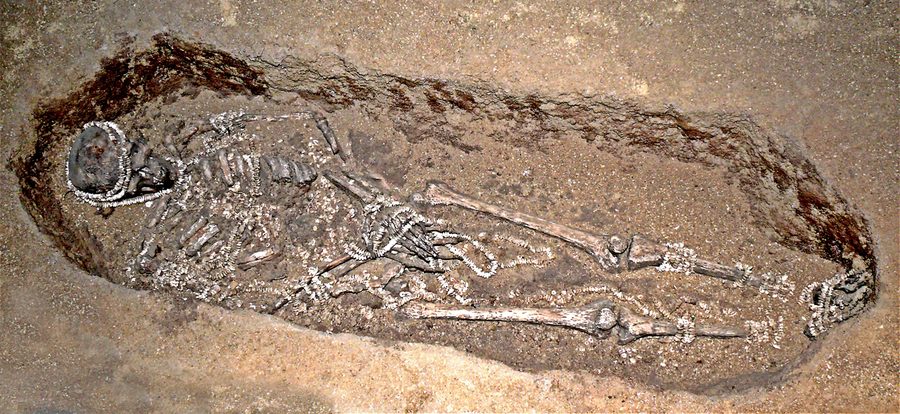
The double children's burial was uncovered in 1969. Two juvenile individuals lay in an elongated pit, their skulls touching: a boy of around 12 to 13 years old (Sungir 2) and a girl of around 9 to 10 (Sungir 3). Their simultaneous interment, head-to-head orientation, and extraordinary wealth of grave goods make this one of the most enigmatic discoveries of the global Palaeolithic.
Thousands of beads for two children
The count is staggering: the boy was accompanied by 4,903 mammoth ivory beads, the girl by 5,274. In total, the double burial contains more than 10,000 beads, with additional beads distributed across other parts of the bodies. Each bead was hand-carved from mammoth ivory, pierced and polished. Experimental archaeology studies estimate that a single bead requires around 45 minutes of work. The manufacture of all the funerary items at Sungir would therefore have required no fewer than 10,000 cumulative working hours.
These beads were not simply scattered ornaments: their arrangement in regular rows on the skeletons allowed archaeologists to reconstruct the clothing worn by the children at the time of burial. A long-sleeved shirt, trousers connected to shoes, and a richly bead-decorated cap formed their funerary attire. The girl also wore a carved ivory pendant in the shape of an animal.
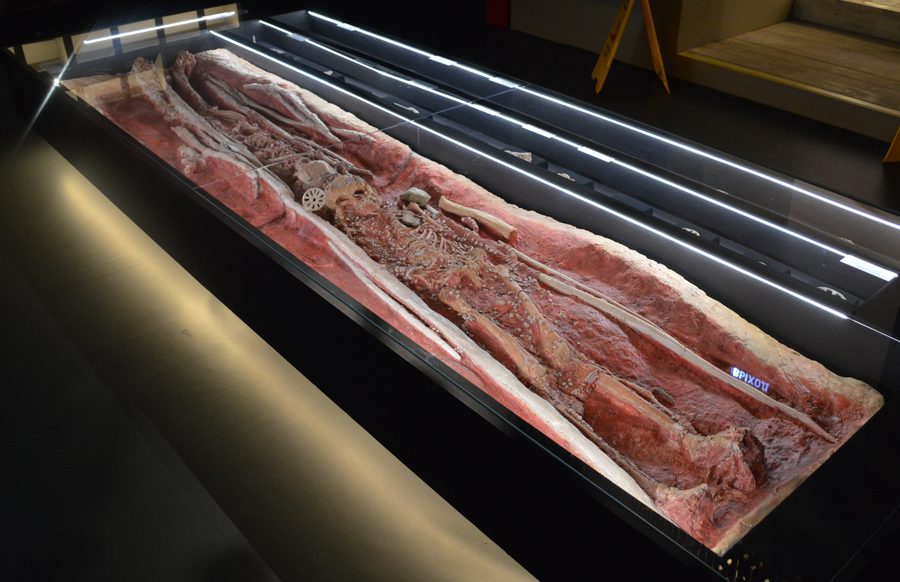
Alongside the children lay exceptional objects: two long spears crafted from carefully straightened mammoth tusks , a technical feat, as ivory is naturally curved , measuring 1.66 and 2.42 metres respectively. Ivory carvings, dozens of perforated fox teeth used as pendants or sewn onto clothing (more than 300 in total), deer antlers and fragments of human bone placed deliberately on the bodies complete the picture.
Exceptional children , or perhaps not
Why were such young individuals given a burial richer even than that of the adult? Two main hypotheses compete.
The first is that of hereditary status: these children were born into an elite family or lineage, their high social rank transmitted from birth regardless of personal achievement. This interpretation implies the existence, 30,000 years ago, of a stabilised and heritable social hierarchy , which would represent one of the oldest known instances of hereditary social stratification in the human species.
The second hypothesis, put forward notably by British anthropologist Paul Pettitt, holds that the Sungir children did not hold a particular status during their lifetime, but that their death in unusual circumstances , ritual sacrifice, simultaneous death, violent or accidental death , warranted an exceptional burial. In this reading, the wealth of the grave goods was a communal response to a death perceived as abnormal, a symbolic way of "compensating" for a life cut short too soon.
Examination of the skeletons adds a further dimension. The boy had abnormally bowed and short femurs, suggesting he suffered from a congenital condition or repeated episodes of severe nutritional stress in early childhood. The girl also shows anomalies consistent with a congenital disease. These physically vulnerable individuals nonetheless survived for several years, implying they were cared for by their group. Their distinctive physical condition may have made them, in the eyes of their contemporaries, bearers of a particular significance , sacred, apotropaic or symbolic.
What Sungir tells us about ourselves
Beyond the hypotheses about the circumstances of their death, the Sungir burials constitute an irreplaceable testimony to the social and spiritual complexity of Upper Palaeolithic Homo sapiens. They attest to a community capable of mobilising considerable resources in service of funerary ritual: thousands of collective working hours, technical mastery of mammoth ivory, an elaborate vestimentary symbolism, and almost certainly a system of beliefs about death and what lies beyond.
Sungir reminds us that our ancestors of the glacial steppeSteppeA vast semi-arid, treeless grassland of Eurasia, suited to nomadic herding and the horse; a corridor for the movement of peoples and technologies in later prehistory.→ were not simply survivors focused on hunting and gathering. They mourned their dead, dressed them with care, and offered them the most precious objects their community could produce. That gesture, repeated across the millennia, still speaks to us today with striking clarity.
Merci pour ces dossiers bien écrits. À mon âge, on apprécie les contenus sérieux et sans chichis.
En lisant ça, j'ai immédiatement pensé aux mécanismes d'échange de Concordia. Le commerce traverse les âges.
Je lis vos articles le soir après le travail. Instructif mais pas épuisant. C'est parfait.