In 1955, workers digging an industrial canal near the city of Vladimir in the Russian plain unearthed human bones and thousands of ivory objects. The site of Sungir, excavated for decades by Soviet and later Russian archaeologists, would prove to be one of the most spectacular PalaeolithicPalaeolithicThe oldest and longest period of prehistory (c. 3.3 Ma–12,000 BC), defined by chipped stone tools and a hunter-gatherer way of life.→ burials ever discovered. Around 30,000 years ago, during the Upper PalaeolithicUpper PalaeolithicThe final phase of the Palaeolithic (c. 45,000 to 10,000 years ago), marked by Homo sapiens in Europe, art, ornaments and a succession of cultures (Aurignacian, Gravettian, Solutrean, Magdalenian).→, anatomically modern humans were burying their dead with a care and richness that challenges our vision of the earliest human societies.
The most striking discovery is that of two children buried head-to-head in the same pit. A boy of around 12 years old and a girl of around 9-10 lay together, covered with more than 10,000 mammoth ivoryMammoth ivoryMammoth tusk worked by Palaeolithic craftspeople to carve figurines, beads, points and ornaments.→ beads. These beads had been sewn onto their clothing — their arrangement in horizontal and diagonal bands can still be reconstructed. The older child also wore hundreds of perforated arctic fox teeth, several ivory bracelets, and spears carved from heat-straightened mammoth tusks: one of them measures 2.4 metres, longer than an adult's height.
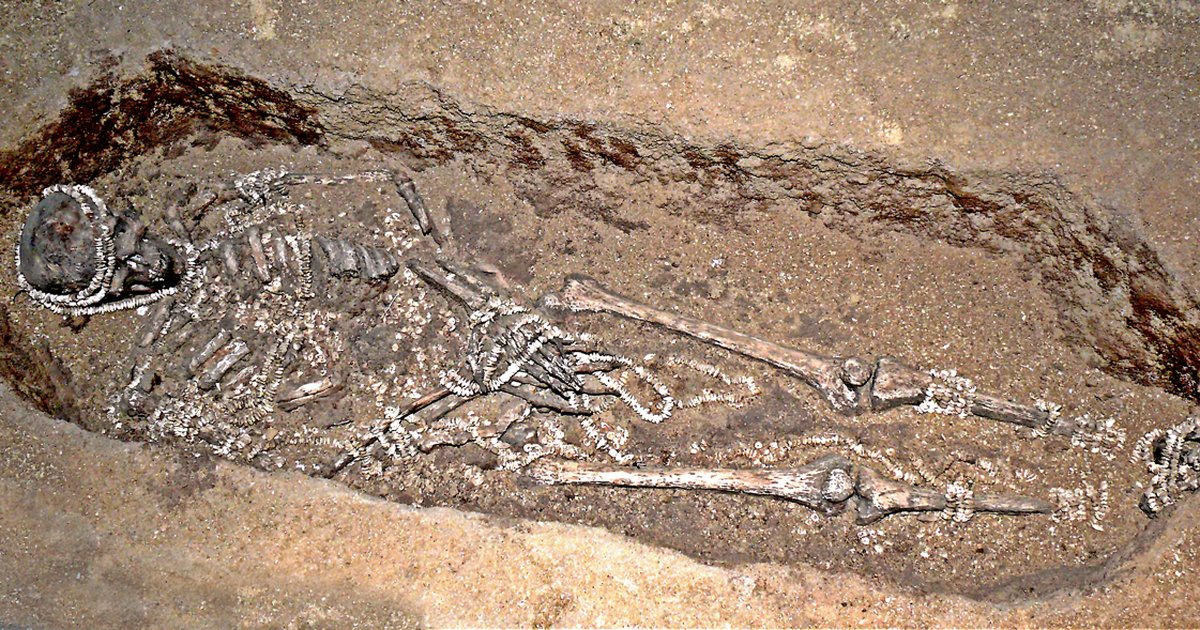
Each ivory bead represented considerable work: modern experiments have shown that about one hour was needed to make a single bead. The 10,000 beads on the two children therefore represented around 10,000 hours of collective work — several years of full-time craft production. This accumulation of wealth and labour around two pre-adult children raises a fundamental question: what was their place in this society? Were they heirs of an elite, individuals endowed with particular symbolic powers, or victims of ritual sacrifice?
Recent genetic and anthropological analyses have brought new insights. The two children were genetically close, possibly siblings. The adult individual discovered separately (Sungir 1, a man in his fifties) showed signs of polyarthritis and had survived several years with this disability, implying he was cared for by his group. Together, these burials paint the portrait of a Palaeolithic society with complex social organisation, specialised production, care for the vulnerable — and a symbolic and spiritual life of a richness long underestimated.
No comments yet. Be the first.