A single tooth, and a frontier pushed back
It took only a handful of teeth, a fragment of frontal bone and a sliver of shinbone to shake an entire chapter of our story. In northern Laos, deep inside a remote cave of the Annamite mountains, these unassuming remains tellTellAn artificial mound formed by the accumulation of successive layers of settlement remains at the same spot, typical of the Near East. Each destruction-rebuilding event adds a stratum.→ a dizzying tale: that of the first Homo sapiensHomo sapiensThe present-day human species, which emerged in AfricaAfricaThe cradle of humankind: the continent where the first hominins appeared, then Homo sapiens around 300,000 years ago, before the expansion to the rest of the world.→ around 300,000 years ago, the only surviving human lineage after the extinction of NeanderthalsNeanderthalsA fossil humanity of Eurasia, robust and cold-adapted, extinct around 40,000 years before present.→ and Denisovans.→ to reach Southeast Asia, tens of thousands of years earlier than anyone had imagined. The site is called Tam Pà Ling, the « grotte des Singes ». It has just established itself as one of the most precious archives of how our neighbouring continent was peopled.
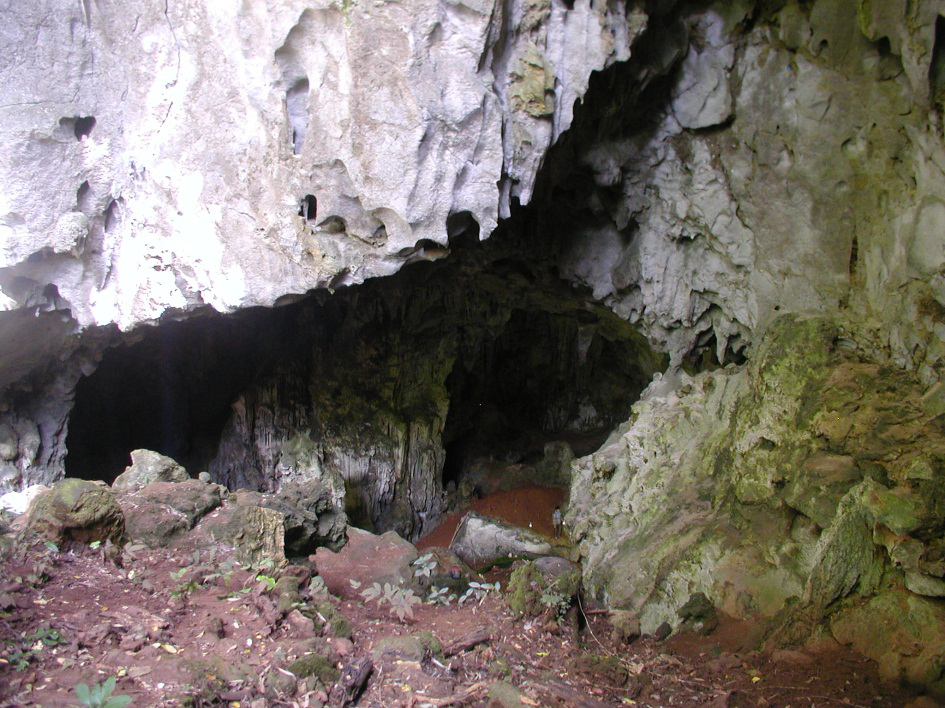
For a long time, it was believed that our species reached the eastern edges of Asia only late, well after its birth in Africa. The fossils of Tam Pà Ling tell a different, older and bolder story. Analysed by an international team and published in Nature Communications in 20231, they place a human presence in the region between roughly 86,000 and 68,000 years ago. It is a range that unsettles the textbooks and revives a debate decades in the making: when, and by which routes, did we leave Africa to conquer the world ?
The Cave of the Monkeys, an archive of 86,000 years
Tam Pà Ling is no spectacular cavern adorned with paintings. It is a modest cavity, perched on the flank of a limestone mountain more than a thousand metres above sea level. Its wealth lies elsewhere : in the ground. Beneath the researchers' feet piles up a sedimentary sequence of remarkable depth, reaching nearly seven metres. Every layer is a page, patiently laid down by the monsoon rains that carried earth and bones, century after century, into the belly of the cave.
This steady accumulation is a boon for science. Unlike many sites where the layers are disturbed, reworked and hard to read, Tam Pà Ling offers a relatively continuous stratigraphyStratigraphyThe study of the superimposed layers (strata) of an archaeological site; each layer corresponds to a phase of occupation and yields a relative chronology.→. The excavations, ongoing since 2009, have advanced slowly, metre by metre, until they crossed a history spanning about 86,000 years. It is this continuity that gives the human fossils drawn from the depths their full value : they are not isolated, floating finds but markers caught within a coherent chronological weave.
The cave has yielded no stone tools, no trace of habitation. The bodies, it seems, arrived swept in by water and sediment rather than laid to rest by the living. That detail matters : it explains why the remains are fragmentary and scattered, and why dating them demands methodical caution. But it also underlines the power of the message. Even without a camp, even without a hearthhearthA combustion structure set on the ground, evidence of the mastery of fire and a marker of how a prehistoric dwelling was organised.→, a few bones are enough to prove that here, more than seventy millennia ago, anatomically modern humans lived and died.
Resolutely modern bones
What exactly does Tam Pà Ling contain ? A set of teeth, a fragment of frontal bone, a piece of tibia. Little enough in appearance, yet each piece has been scrutinised with extreme care. The anatomical traits do not lie : we are indeed looking at Homo sapiensHomo sapiensThe present-day human species, which emerged in Africa around 300,000 years ago, the only surviving human lineage after the extinction of Neanderthals and Denisovans.→, and not at one of the other humanities that then populated Asia, such as the Denisovans or the last representatives of more archaicArchaicRefers to an ancient, now-extinct human population or form (Neanderthals, Denisovans, ghost lineages), as opposed to anatomically modern humans.→ species.
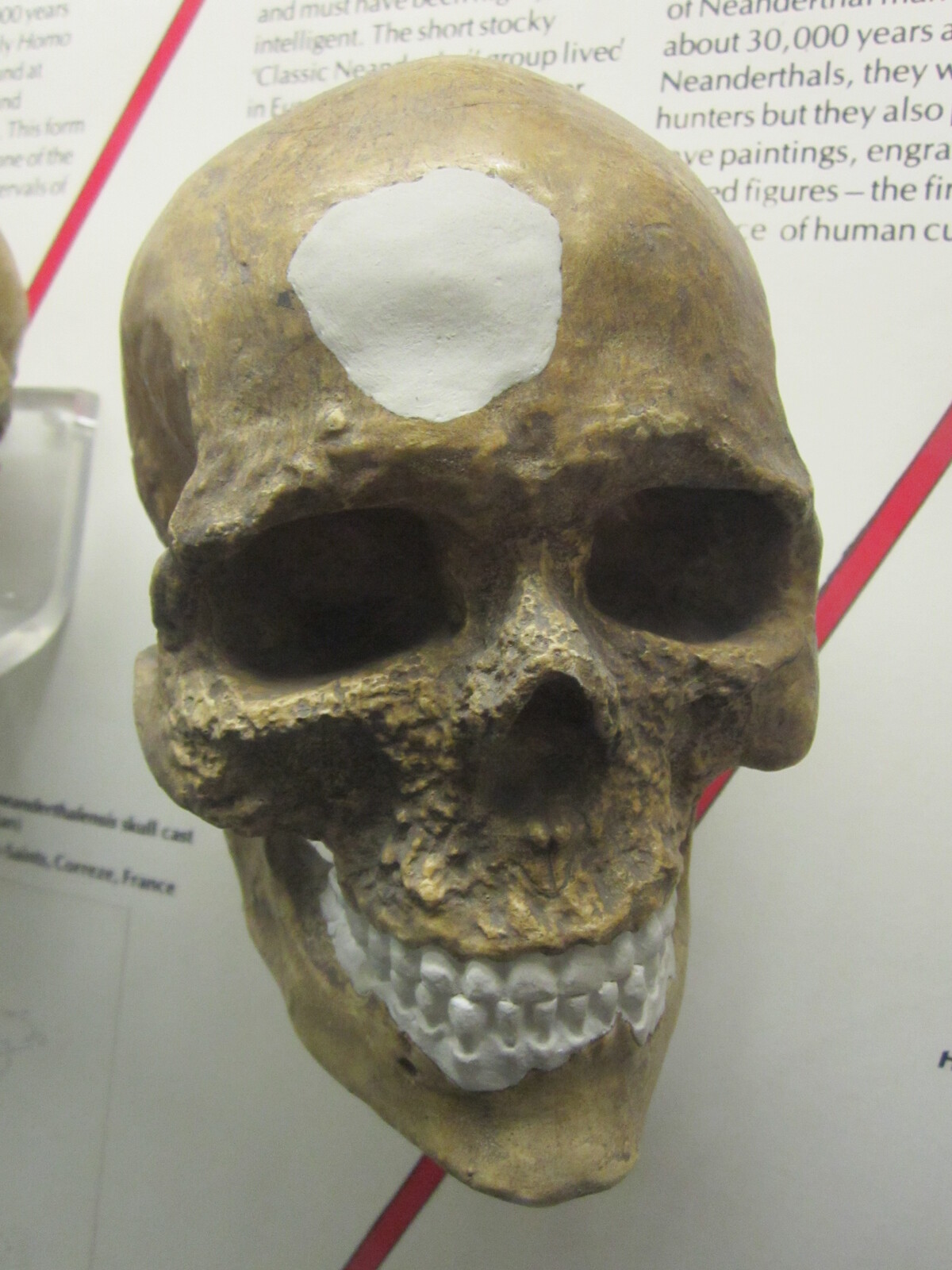
The frontal fragment, in particular, bears our species' signatures : a forehead that rises upright, without the thick bony ridge above the eye sockets that characterises older forms. The teeth, for their part, gave up part of their age thanks to the dating methods applied to the enamel and to the layer in which they lay. It is the dialogue between these modern morphologies and their stratigraphic position that made it possible to build the site's chronological scenario.
The frontal bone points to a human presence going back at least 70,000 years, with a margin of about 3,000 years. Deeper still in the sequence, the tibia fragment pushes the boundary to some 77,000 years, give or take 9,000. These figures, set against what the region was thought to hold, carry the scent of a quiet revolution. They stemstemThe narrowed base of a point, used to haft it onto a shaft or handle.→ not from a flashy discovery but from a slow accumulation of converging clues, patiently checked.
Dating the invisible: luminescence, uranium and enamel
How do you assign an age to bones tens of millennia old, in a cave without charcoal usable by radiocarbon ? The answer lies in a combination of techniques, each shedding light on the others. No single measurement suffices ; it is their cross-checking that gives the conclusion its strength.
The first approach is datation par luminescenceLuminescence datingA method dating the last heating or light exposure of sediments and minerals by measuring energy trapped in the crystal.→. It rests on a subtle principle : grains of sediment, once buried away from light, slowly accumulate energy trapped by the natural radioactivity of the ground. By heating or illuminating these grains in the laboratory, that energy is released as light, and the measured intensity reveals the time elapsed since their last contact with the sun. Applied to the layers of Tam Pà Ling, the method yields the age of the deposit itself, and therefore of everything it holds2.
To this sedimentary clock are added uranium-series dating and electron spin resonance, or ESR, applied to the mammal teeth found in the same levels. Uranium, absorbed over time by enamel and dentine, decays at a known rate, offering a second independent counter. ESR, for its part, measures the defects accumulated in the enamel crystals under the effect of radiation. By combining these different methods, the team was able to bracket the long sequence and give it an overall age spanning about 86,000 years of history3. The conclusion, cautious but firm, places the presence of Homo sapiensHomo sapiensThe present-day human species, which emerged in Africa around 300,000 years ago, the only surviving human lineage after the extinction of Neanderthals and Denisovans.→ in the region between 86,000 and 68,000 years ago.
An earlier exit from Africa
Why do these dates matter so much ? Because they belong to one of prehistoryPrehistoryThe span of human history before the invention of writing, from the Palaeolithic to the Metal Ages, known mainly through material remains.→'s greatest narratives : that of the sortie d'AfriqueOut of AfricaThe dispersals of Homo sapiens out of Africa, including a major expansion c. 70,000 to 60,000 years ago and earlier exits.→. Our species was born on the African continent about 300,000 years ago. The question that divides specialists is not whether we left, but when, and along which routes. For a long time the idea of a late, single dispersal, around 60,000 years ago, held sway. The Laotian fossils argue instead for an older movement.
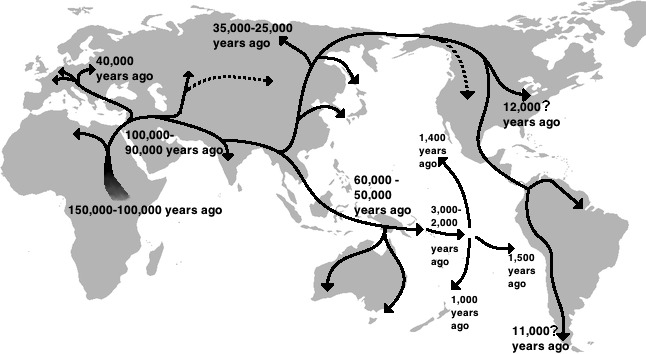
Tam Pà Ling does not speak alone. Its results add to a web of clues scattered across the map of the Old World. In Arabia, tools and traces suggest very ancient human incursions. In the LevantLevantA region of the eastern Mediterranean Near East (Israel, Lebanon, Syria, Jordan), a major crossroads of the first human migrations out of Africa.→, fossils from Israel attest to a presence of our species outside Africa more than a hundred thousand years ago. In China, finally, teeth found in several caves have hinted at an early passage of sapiens into East Asia4. The Cave of the Monkeys fills a missing link between these markers, along the great continental road that, from the Near EastNear EastA region of western Asia (Levant, Mesopotamia, Anatolia, Iran), cradle of the Neolithic revolution, agriculture, the first cities and writing.→ to the Indochinese peninsula, crosses the heart of the continent.
What this whole set sketches is the image of a dispersal less linear than once thought. Rather than a single wave that left late and arrived fast, the data evoke several movements, some perhaps early, of which certain ones may have left no direct descendants in today's populations. Tam Pà Ling documents a very real presence ; it does not, on its own, tell us which branches of this expansion flourished and which died out.
Attested presence versus dispersal scenario
Here we must carefully separate two things that enthusiasm tends to blur. On one side is the attested presence : human bones, dated, in a dated soil. On this point Tam Pà Ling is robust, because its authors took care to multiply the methods and cross-check the results. On the other side is the dispersal scenario, the overall story of routes and migratory waves, which remains a reconstruction, a working hypothesis refined site after site.
Dating isolated fossils is a perilous exercise. A bone is not always the same age as the layer in which it is found : it may have slipped, been reworked, moved within the sequence. The researchers of Tam Pà Ling know these traps and confront them head-on, combining datation par luminescenceLuminescence datingA method dating the last heating or light exposure of sediments and minerals by measuring energy trapped in the crystal.→, uranium series and ESR, and openly discussing the margins of uncertainty. The broad ranges, far from being a weakness, are the sign of methodological honesty. They say : here is what we can affirm, and here is the shadow that remains.
One must also keep in mind a plain fact that carries its full weight here : a single tooth, a single bone fragment can be enough to move a chronological frontier. Not because an isolated fossil settles a debate, but because it proves that a fact existed at least once. If a Homo sapiensHomo sapiensThe present-day human species, which emerged in Africa around 300,000 years ago, the only surviving human lineage after the extinction of Neanderthals and Denisovans.→ lived in Laos more than seventy thousand years ago, then the account of a late and single arrival no longer quite holds. The Asian PaléolithiquePalaeolithicThe oldest and longest period of prehistory (c. 3.3 Ma–12,000 BC), defined by chipped stone tools and a hunter-gatherer way of life.→ reveals itself deeper, more layered, more crowded with possibilities than it used to be written.
What Tam Pà Ling changes for us
Taken up and discussed again in 2026, the Laotian study continues to nourish reflection on our origins. It illustrates beautifully a lesson that prehistory never tires of reminding us : our ancestors were more mobile, more curious, more enterprising than simplified narratives would have us believe. Long before the great painted caverns of Europe, human groups were already making their way through the tropical forests and karst reliefs of Southeast Asia.
For prehistorians, Tam Pà Ling is both an answer and an invitation. An answer, because it firmly anchors an ancient human presence in a region long left in the blind spot of the great syntheses. An invitation, because it calls for other excavations, other datings, other sites capable of confirming and refining the picture. Every cave of the Annamite range may hold its own archive, its own chapter still waiting to be read.
There is, finally, something deeply moving in contemplating these few teeth, this piece of forehead, this fragment of shinbone. Behind the dryness of the figures and the error margins are beings who walked, breathed, crossed mountains and rivers, driven by some unknown longing for elsewhere. The Cave of the Monkeys, in the silence of its sediments, kept their memory for more than eighty thousand years. Today it gives it back to us, and with it a piece of our own story as humans who left Africa never to stop walking again.
Fascinant. Je travaille justement sur ce thème pour mon mémoire et cet article m'apporte un éclairage nouveau.
Je prépare une sortie avec l'association des retraités. Votre dossier sera notre guide de lecture.