A Desert That Was Once a Paradise
Ten thousand years ago, the Sahara was not the arid and inhospitable desert we know today. It was a verdant savanna crossed by permanent rivers, populated by herds of giant buffalo, elephants, giraffes, and hippopotamuses, inhabited by numerous and active human communities whose artists covered rocky walls with thousands of rock paintings and engravings of extraordinary iconographic richness that have survived to our day in remarkable condition. The Tassili n'Ajjer, a sandstone massif in the extreme south of Algeria, preserves in its caves and on its cliffs one of the largest rock art complexes in the entire world: more than 15,000 engravings and paintings spanning a period of more than ten millennia, from the Saharan MesolithicMesolithicThe period between the Palaeolithic and the Neolithic (c. 10,000–6,000 BC in Europe), still based on hunting and gathering.→ to the first centuries of our era, constituting a unique visual archive on the evolution of human societies and Saharan ecosystems through the ages. Inscribed on UNESCO's World Heritage List in 1982, the Tassili n'Ajjer is today recognized as one of the most important and most threatened prehistoric sites on our planet, whose protection requires urgent international mobilization that matches the scale and irreplaceability of the cultural treasure it contains.
The name Tassili n'Ajjer means 'plateau of rivers' in the Tuareg language, a denomination that evokes a climatic past radically different from the present and whose traces are still readable in the topography and geology of the massif even after thousands of years of progressive aridification and landscape change. Located in the Illizi province, at the borders of the Algerian Sahara, this region covering 72,000 square kilometers is dominated by a vast sandstone plateau crossed by deep canyons and narrow gorges carved by fluvial erosion over millions of years, dotted with spectacular rock formations shaped like mushrooms, towers, and arches sculpted by millennia of wind and thermal erosion in the soft sandstones. It is in this lunar landscape of breathtaking beauty that thousands of generations of artists worked, taking advantage of the rock shelters offered by overhangs and natural caves to protect their works from the elements and the scorching sun of the dry periods that progressively took over from the wet climatic phase that had sustained such abundant life in what is now one of the most inhospitable environments on Earth. The exceptional concentration of rock art sites in this region, several thousand decorated panels inventoried to date of which many surely remain to be discovered in the less accessible parts of the massif, testifies to the demographic importance and cultural vitality of the Tassili throughout the 'humid' Saharan period that ended about 5,000 years ago with the progressive desertification that transformed this savanna into a desert that we recognize today.
Before analyzing the rock art itself, it is essential to understand the climatic context in which it was created, which entirely conditions its iconographic interpretation and cultural significance for the historians and paleoanthropologists who study it. The so-called 'Green SaharaGreen SaharaA name for the Sahara during the "African Humid Period" (c. 14,500 to 5,000 years ago), when increased monsoon rainfall sustained lakes, rivers and savannas, making the region habitable before its gradual desiccation.→' or 'Humid Sahara' period, corresponding approximately to the interval between 10,000 and 5,000 BCE, was caused by cyclical variations in the Earth's orbital parameters that modified the seasonal distribution of solar radiation, strengthened the African monsoon, and drove tropical precipitation much deeper northward into the African continent than it penetrates today into the central Saharan regions. Palynological data extracted from lake sediments preserved in ancient depressions of the central Sahara attest to the presence during this period of gallery forests, wooded savannas, and wetlands populated by diverse fauna including giant buffalo, elephants, hippos, crocodiles, water snakes, and hundreds of bird species now absent from the region whose presence we know only from the fossil record and from the art left by their human contemporaries. The Tassili artists painted and engraved this luxuriant nature with a fidelity and precision that makes them precious scientific documents on the biogeography of North AfricaAfricaThe cradle of humankind: the continent where the first hominins appeared, then Homo sapiens around 300,000 years ago, before the expansion to the rest of the world.→ during the HoloceneHoloceneThe current geological epoch, begun about 11,700 years ago at the end of the last ice age; the setting of all post-glacial history.→, usefully complementing the palynological and sedimentological data with a direct visual documentation of the animal species present in the landscape and of their behaviors observed firsthand by eyewitnesses who lived alongside them.
Geography and Landscape of the Tassili
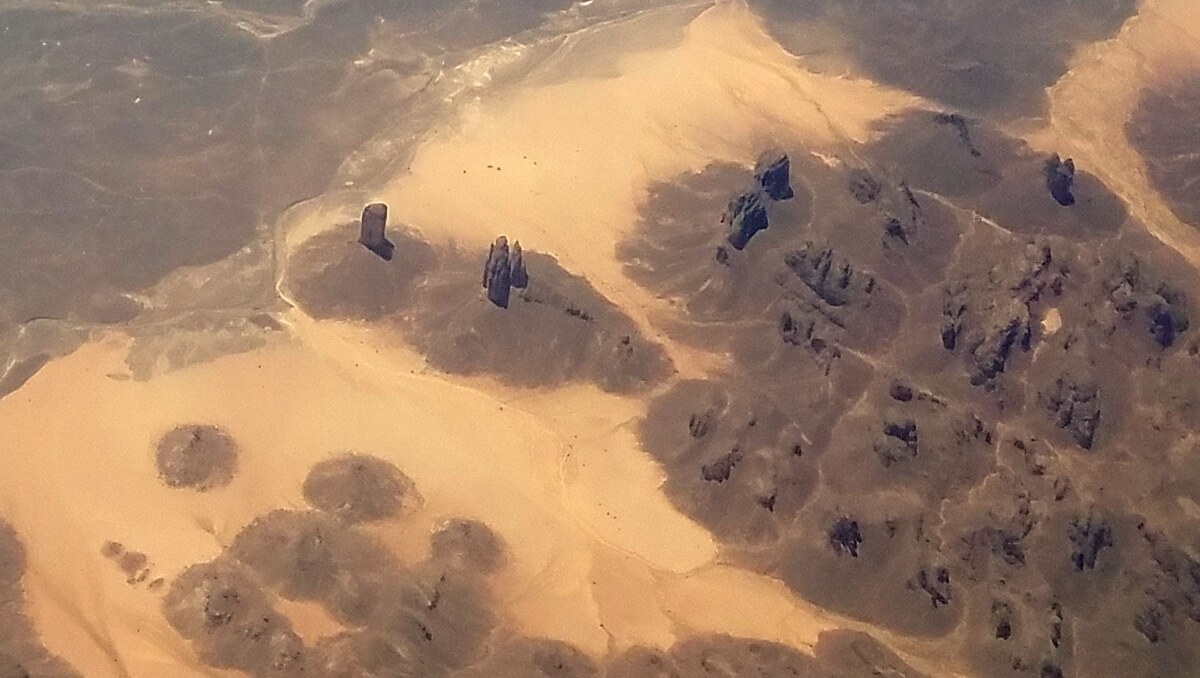
The Tassili n'Ajjer massif forms a sandstone plateau extending about 800 kilometers from northeast to southwest, with altitudes varying from 900 to more than 2,000 meters above sea level in its highest parts that receive slightly more precipitation than the surrounding lowlands. This plateau is composed primarily of Paleozoic sandstones deposited between 400 and 300 million years ago in marine and deltaic environments, then uplifted, eroded, and remodeled by tectonic forces and successive climatic agents over the following geological periods in a long and complex geological history. Differential erosion between more and less resistant sandstone beds produced the spectacular formations characteristic of the Tassili: isolated columns and towers of hard sandstone dominate plains of white sand corresponding to soft sandstone beds completely disaggregated by wind and water action, natural arches of all sizes perforate cornices and cliffs, and narrow gorges cut the plateau into a labyrinth of entangled canyons that create a landscape of extraordinary topographic complexity and richness. It is in this labyrinth that most rock art sites are hidden, protected by the enclosure of the gorges from direct wind erosion and often concealed from view from the wide open spaces of the plateau by the very complexity of the terrain that made them difficult to find and document systematically.
Current climatic conditions at the Tassili are those of a hyperarid desert, with average annual rainfall below 20 millimeters in the lowest parts and a considerable daily temperature range sometimes exceeding 40 degrees between nighttime lows and daytime highs in summer, conditions that challenge any form of complex life. Despite this extreme aridity, a few resilient plant species have survived in the most sheltered corners of the massif, notably the Saharan cypress (Cupressus dupreziana), an endemic relict species of the Tassili of which only a few hundred isolated individuals remain in the deepest gorges where slightly more moisture collects. These millennial cypresses, some individuals reaching several thousand years in age according to dendrological estimates, are direct botanical witnesses to the climatic past of the Tassili, as eloquent in their own way as the rock paintings on the walls of neighboring caves where they have survived against all statistical probability the collapse of their original ecosystem over the past five millennia of progressive desertification. The protection and regeneration of these unique trees constitutes one of the priorities of the Tassili n'Ajjer National Park conservation program, which attempts to combat tourist trampling, wood collection, and camel grazing that threaten the survival of the last Saharan cypresses whose conservation serves as an indicator of the overall health of the park's fragile and unique ecosystem.
Henri Lhote and the Discovery of the World
While the Tassili n'Ajjer had always been known to the Tuareg populations and had been the subject of some mentions in the reports of European travelers and explorers in the nineteenth century, it was the great expedition led by Henri Lhote between 1956 and 1957 that brought it to the attention of the entire world and transformed these painted walls into icons of African prehistoryPrehistoryThe span of human history before the invention of writing, from the Palaeolithic to the Metal Ages, known mainly through material remains.→ recognized and celebrated globally. Lhote, an ethnologist and Saharan explorer trained under the great prehistorian Abbe Henri Breuil who had himself documented the caves of Altamira and Lascaux, had made a first reconnaissance of the Tassili in 1934 and immediately understood the exceptional importance of the rock art sites he had glimpsed in his brief visit to the region. He had to wait more than twenty years and the end of World War II before he could organize the expedition that would make him famous: a team of draughtsmen, photographers, and scientists who spent eighteen months methodically recording the paintings and engravings of the Ajjer region, working in conditions of extreme isolation and heat to copy at full scale the rock art works onto rice papers glued directly onto the walls and then carefully removed for study and archiving. The publication in 1958 of his book 'A la decouverte des fresques du Tassili' (Discovering the Frescoes of Tassili), quickly translated into several languages and accompanied by spectacular color photographs, caused a genuine sensation in the scientific world and among the general public of many countries who had never imagined that such a wealth of prehistoric art existed in the Saharan heart of Africa.
The Lhote expedition produced an unprecedented documentary corpus: more than 800 copies of paintings and engravings, thousands of photographs, and detailed field notes that still constitute an essential reference for researchers specializing in Saharan rock artSaharan rock artThe body of prehistoric engravings and paintings across the Sahara, grouped into major stylistic phases (Wild Fauna, Cattle, Horse, Camel) from the Neolithic to antiquity.→ seven decades after the expedition completed its work. But it also provoked methodological criticisms that have sustained a lasting scientific debate about the limits and risks of manual copying as a rock art documentation method that inevitably introduces human interpretation into the recording process. Some researchers have pointed to inaccuracies in the copies made by Lhote's draughtsmen: simplifications, added interpretations, and sometimes invented elements to complete fragmentary or ambiguous figures, biases inherent to any documentation method that involves subjective visual interpretation on the part of the copyist even when they aim to be as faithful as possible to the original in all its details. These criticisms, which do not diminish the historical and scientific importance of the expedition that brought the Tassili to global attention, contributed to the development of more objective documentation methods such as digital photogrammetry and 3D scanning that today impose themselves as research standards in rock art documentation to minimize interpretive biases in the transcription of works whose interpretation is already difficult enough without the additional layer of distortion introduced by the copyist's own visual assumptions.
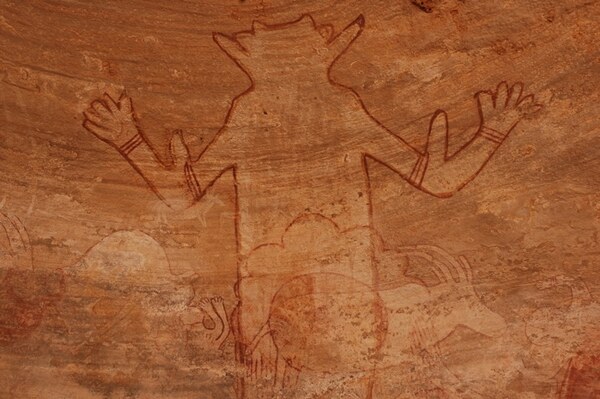
The most famous figure discovered and published by Lhote is undoubtedly the one he called the 'Great God of Sefar', an immense anthropomorphic silhouette several meters tall painted on the wall of a rock shelterRock shelterA shallow cavity at the foot of a cliff or under a rocky overhang, offering natural shelter; a favoured site of prehistoric habitation and rock art.→ in the Sefar sector at the heart of the Tassili massif. With its round, featureless head, its widespread arms, and its morphology ambiguous between the human and the imaginary alien of the science fiction of his era, this figure fed for decades the most fanciful theories about 'astronauts' or 'aliens' who would have visited Earth in the mists of time and inspired prehistoric rock art as a form of communication with descendants they knew would eventually reach the stars. These pseudoscientific theories, popularized by Erich von Daniken in his global bestseller 'Chariots of the Gods' (1968), have no serious scientific basis and have been dismantled one by one by rock art specialists who see in these figures simply representations of supernatural beings or protective spirits within the cosmological system of the Tassili populations of the Round Heads period, a perfectly coherent cultural interpretation consistent with ethnographic data on contemporary or recently documented African hunter-gatherer societies that express similar cosmological concepts through comparable visual vocabularies. This controversy perfectly illustrates the risks of interpreting prehistoric art based on the cultural categories and iconographic references of the modern observer rather than on rigorous archaeological contextual analysis and appropriate ethnographic comparisons drawn from culturally relevant parallels.
The Four Stylistic Periods
Researchers who have systematically studied and analyzed the rock art of the Tassili n'Ajjer have progressively developed a chronological and stylistic classification based on the superimpositions observed when works from different periods overlap on the same panels, on the correspondence between the animal species represented and independent paleoecological data on fauna distributions in the region, and on the few direct datings obtained by radiometric methods applied to the pigments or the desert varnish covering the works. This classification, which is subject to continuous refinement and debate among specialists as new data accumulate, commonly distinguishes four major stylistic periods corresponding approximately to four stages in the cultural and ecological history of the central Sahara over the past ten millennia of human occupation in the region. Each of these periods is characterized by a specific iconographic repertoire, specific execution techniques, and specific representational conventions that reflect the living conditions, economic concerns, and religious beliefs of the populations who produced them in very different ecological and cultural contexts over thousands of years. The succession of these periods on the same walls constitutes a visible cultural stratigraphyStratigraphyThe study of the superimposed layers (strata) of an archaeological site; each layer corresponds to a phase of occupation and yields a relative chronology.→ on many panels where works from different eras overlap, intersect, and interpenetrate in a visual palimpsest that condenses millennia of human history onto a few square meters of sandstone accessible to the modern visitor who knows how to read its layers.
The first period, called 'archaicArchaicRefers to an ancient, now-extinct human population or form (Neanderthals, Denisovans, ghost lineages), as opposed to anatomically modern humans.→' or 'Bubaline' in reference to the giant buffalo (Pelorovis antiquus, formerly classified as Bubalus) that constitutes its dominant iconographic subject, is the oldest and least well dated of the four periods due to the difficulty of directly dating the engravings that dominate this early phase. It is represented primarily by rock engravings executed by abrasion and pecking in soft sandstones and exposed boulders in the open air rather than in protected shelters, which has considerably reduced their state of conservation compared to the paintings of later periods executed under the shelter of overhangs. The animals represented in these ancient engravings include the giant buffalo whose characteristic horns allow certain identification, but also rhinoceroses, elephants, hippos, crocodiles, and many other animals that testify to a Saharan environment still very different from today's, with permanent watercourses and abundant wetland habitats teeming with large fauna. The fauna represented in the archaic period corresponds remarkably well to independent paleoecological data on the environment of the central Sahara during the lower Holocene, between 10,000 and 6,000 BCE, allowing rough chronological placement of this first artistic period within that time frame even in the absence of reliable direct datings on most individual panels.
The Round Heads: The Enigma of the Spirits
The Round Heads period, whose name refers to the characteristic shape of the heads of the human figures represented without facial features and sometimes surmounted by elaborate headdresses or enigmatic appendages, is probably the most mysterious and most debated of the four major artistic phases of the Tassili. Dated approximately between 8,000 and 6,000 BCE based on available datings and stratigraphic observations, it is characterized by an art of remarkable strangeness and originality that stands out clearly from the more naturalistic representational conventions of the other periods and has been the source of the most far-fetched as well as the most interesting scholarly theories about its meaning. The human figures, often large and sometimes colossal like the Great God of Sefar, are characterized by deliberately distorted anatomical proportions, round or ovoid featureless heads, elongated and gracile limbs, complex costumes and ornaments, and mythological or ritual staging that evokes religious ceremonies, shamanic trances, or initiation rituals whose precise meaning escapes us for lack of a directly applicable ethnographic reading key that would allow interpretation without projecting modern categories. The coloring of the works of this period is particularly careful and varied, using a range of pigments from red ochreOchreA red or yellow mineral pigment (iron oxides), used from prehistory for adornment, funerary rites and art.→ to white passing through various shades of brown, yellow ochre, and violet, sometimes applied in several superimposed layers to create modeling and relief effects that give the figures an exceptional presence and visual power that even the untrained eye immediately recognizes as aesthetically deliberate and sophisticated.
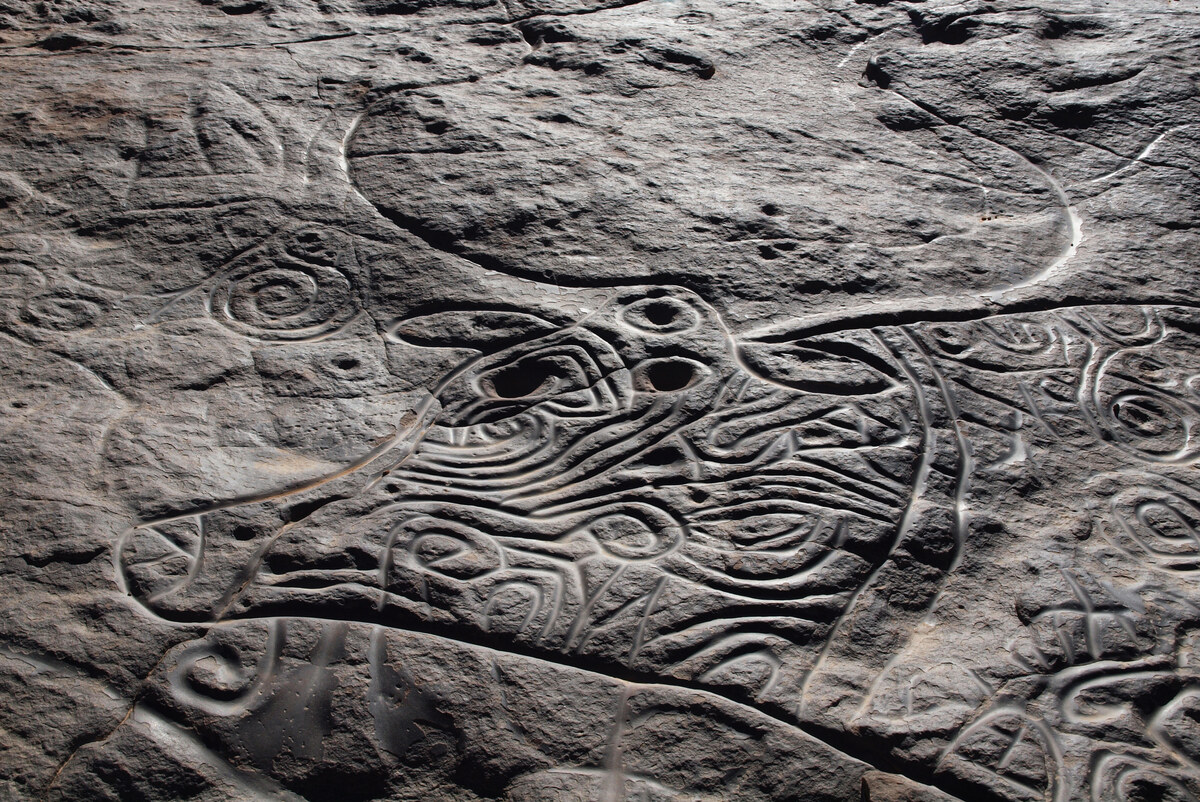
The interpretation of Round Heads figures is the subject of numerous and often contradictory theories in the specialized literature, of which none has gathered definitive consensus given the absence of written documents and directly applicable ethnographic parallels from contemporary or historical societies that could provide a reliable interpretive key. The shamanic theory, which sees in these figures representations of supernatural beings or shamans in states of trance, is perhaps the most widely accepted by contemporary specialists of African rock art, by analogy with interpretations proposed for other African hunter-gatherer rock art traditions, particularly the San art of southern Africa that has been the most intensively studied through the ethnographic approach. This reading is supported by the recurrent presence of geometric motifs that evoke the visual phosphenes characteristic of altered states of consciousness induced by psychoactive plants or non-pharmacological trance techniques such as hyperventilation and sleep deprivation, and by the frequent representation of anthropo-zoomorphic figures in the process of transformation that could illustrate shamanic metamorphoses between the world of humans and the world of animal spirits. Other researchers prefer a more cautious interpretation that recognizes the impossibility of directly transferring interpretive models from one region and culture to another, noting that Round Heads art presents characteristics sufficiently original to suggest that it expresses a cosmological system specific to the Mesolithic Tassili populations for which we do not possess the conceptual keys that would allow confident decoding of its full intended meaning.
The Bovid Period: The Age of the Herders
The Bovid period, dated approximately between 6,000 and 2,000 BCE, marks a fundamental break in the economy and way of life of the Tassili populations of which the rock art provides direct and eloquent testimony that can be read even by non-specialists approaching the panels for the first time. The transition from a hunting and gathering economy to a pastoral economy based on livestock herding, probably cattle and perhaps also ovicaprids according to the herds represented in the art, is the major economic and cultural event of this period that profoundly transforms the social organization, wealth hierarchies, and symbolic representations of Saharan communities who are themselves responding to environmental changes as the Green Sahara begins its long, slow transition toward greater aridity. The rock art of the Bovid period is dominated by pastoral scenes of remarkable realism and iconographic precision: cattle herds with varied coats and characteristic horns of different herded breeds, shepherds guiding their animals, women milking their cows, grazing scenes in grass landscapes that evoke the savannas of present-day sub-Saharan AfricaSub-Saharan AfricaThe part of Africa south of the Sahara; cradle of Homo sapiens, long thought hostile to ancient-DNA preservation because of heat.→. These representations constitute ethnographic documents of inestimable value on the herding practices of NeolithicNeolithicThe "New Stone Age": a period marked by farming, herding, settlement and pottery, from around 10,000 BC.→ Saharan pastoralists, complementing the zooarchaeological and genetic data from contemporary habitat sites to reconstruct the history of animal domestication in North Africa and its relationship with the processes of diffusion of pastoral practices from the Near EastNear EastA region of western Asia (Levant, Mesopotamia, Anatolia, Iran), cradle of the Neolithic revolution, agriculture, the first cities and writing.→ toward the Sahara across the transitional period that separates the end of the Green Sahara from the beginning of the historical arid epoch.
The artistic quality of Bovid period works is often considered the highest of all Tassili periods, with a mastery of anatomical realism, suggested perspective, and the expression of movement that permits zoological and ethnographic restitutions of remarkable precision that have been used by researchers to identify specific cattle breeds and reconstruct the genetic diversification of domestic cattle in North Africa over millennia. The Bovid artists developed sophisticated representational conventions to render spatial depth in scenes with numerous figures, notably through the superimposition of figures and variation of their size according to their presumed distance from the viewer, empirical visual solutions that anticipate certain principles of perspective that Western painting would not formalize until the Italian Renaissance, but developed entirely independently and in a radically different cultural framework by artists who had no knowledge of Mediterranean conventions. The coloring of the cattle represented is particularly precious for zoologists working on ancient cattle genetics: the coat markings, coat patterns, horn shapes, and general body proportions of the animals sometimes allow identification of specific breeds and permit tracing of the history of cattle genetic diversification in North Africa over the centuries and millennia documented by the art. These pictorial data complement in original ways the traditional zooarchaeological data from animal bones found in contemporary habitat sites in the same region, providing information about the phenotypic diversity of ancient herds that bone material alone cannot supply at the individual level of detail available in high-quality rock paintings.
Horses and Camels: A Changing World
The two final periods of Tassili rock art, called the Horse and Camel periods, cover the end of the second millennium BCE to the first centuries of our era, and correspond to the progressive but irreversible aridification of the Sahara that gradually pushed populations northward and southward out of the region as the water sources that had sustained dense occupation dried up over the course of these crucial millennia. The Horse period is characterized by the appearance of the domestic horse in the rock iconography, an animal introduced to the Sahara from North Africa and the Near East through contact with Mediterranean civilizations, and by the representation of two-wheeled chariots pulled by horses that constitute one of the most spectacular and debated iconographic elements of North African rock art and its connections to the ancient Mediterranean world. These chariots, represented in a characteristic 'scooter' or 'flying gallop' perspective that is easily recognizable across hundreds of sites, trace on the rocky walls of the Tassili a map of commercial and military routes that crossed the Sahara from east to west between the Mediterranean basin and sub-Saharan Africa around the first millennium BCE, providing a pictorial complement to the sparse textual data on pre-Islamic trans-Saharan exchanges during this poorly documented period. The geographical distribution of chariot representations across the central and western Sahara effectively outlines a coherent network of tracks that roughly corresponds to the caravan routes documented in subsequent historical periods, suggesting remarkable continuity of trans-Saharan routes over several millennia of trade and human mobility long before the Islamic era caravans that are better documented in written sources.
The Camel period, the most recent of the four major stylistic periods of the Tassili, sees the appearance of the domesticated dromedary in the rock iconography, marking a revolution in transport modes and adaptation to increasing aridity that allowed nomadic populations to maintain their presence in an increasingly desiccated Sahara and keep open the trans-Saharan trade routes that connected the Mediterranean world to sub-Saharan Africa. The dromedary, introduced to North African Sahara from Arabia or the Horn of Africa around the third to second centuries BCE, is represented in this final period in an often schematic and stylized manner, with an artistic quality generally inferior to the great works of earlier periods, perhaps reflecting the adaptation of artistic practices to increasingly mobile and precarious living conditions in an ever more hostile desert where subsistence requirements left less time for the elaborate ceremonial and ritual activities that had sustained the great artistic traditions of earlier millennia. These late works, often neglected in favor of the masterpieces of the Bovid and Round Heads periods, are nonetheless precious testimonies to how Tuareg and other Berber and Saharan groups adapted their cultural practices to the progressive transformation of their environment, maintaining until the early Common Era a rock art tradition that traces an uninterrupted line from the first Mesolithic Saharan artists to the last Tuareg creators of the beginning of our era. Some of these late inscriptions are accompanied by texts in Libyco-Berber, the ancestor of the Tifinagh alphabet used by contemporary Tuareg, which sometimes allow identification of authors or the creation context of these historical works that are already closer to epigraphy than to prehistoric rock art in the strict sense of the term used by archaeologists.
Techniques and Raw Materials
The study of the techniques and raw materials used by Tassili artists constitutes a rapidly developing field of research that mobilizes cutting-edge analytical methods borrowed from chemistry, mineralogy, and nuclear physics to identify pigment constituents, reconstruct preparation and application methods, and in the most favorable cases directly date works by radiometric methods that have been refined significantly in recent decades. The pigments used for the Tassili paintings are primarily mineral pigments whose variety and quality testify to a thorough knowledge of the geological resources of the region and sometimes long-distance procurement of high-quality raw materials from sources tens or even hundreds of kilometers from the sites where they were applied to the rock face. Red hematite, yellow ochres based on goethite, and black manganese compounds constitute the most common pigments, but white pigments based on kaolin or gypsum are also identified, along with violets obtained by mixing red and black, and intermediate color shades produced by the heating and thermal treatment of ferruginous minerals that modify their color through oxidation and crystallization at controlled temperatures. Mastery of these thermal transformations of pigments implies empirical knowledge of the chemistry of ferrous minerals that is not without sophistication for societies without writingWritingA system of conventional signs used to fix language or information durably; its appearance (c. 3300 BC) marks, by convention, the end of prehistory.→ and without metallurgyMetallurgyThe techniques of extracting and working metals (copper, bronze, gold); its rise in the Eneolithic and Bronze Age transformed tools, weapons and social hierarchies.→ in the strict sense, demonstrating once again the depth and complexity of technical knowledge transmission in prehistoric communities through non-literate channels.
The binders used to fix pigments to the walls and ensure the century-long conservation of the works are more difficult to identify analytically but chemical analyses carried out on microsamples of well-preserved paintings have revealed the presence of animal fats, egg white, plant resins, and sometimes honey, all organic binders that have the advantage of drying and polymerizing to form a transparent resistant film that protects the pigment from mechanical erosion and moisture infiltration. The application of paintings was accomplished using various instruments: pads of hair or moss, feathers, hollow reeds used as blowpipes to project powdered pigments onto hands or leaf stencils, and brushes and spatulas of wood or bone finely cut to produce the details and precise lines visible in the most carefully executed works of the Bovid and Round Heads periods. The diversity of application techniques visible across the panels, which varies by period, region, and individual artist, suggests a long tradition of experimentation and oral transmission of methods that was enriched and complexified over the millennia of uninterrupted artistic practice on these same walls by successive generations of artists who had access to the work of their predecessors as a living tradition and a standard to respond to and surpass.
UNESCO and Conservation: Urgency and Challenges
The inscription of the Tassili n'Ajjer on the UNESCO World Heritage List in 1982 constituted a major step in the international recognition of the outstanding universal value of this site, but it did not put an end to the many threats that weigh on its integrity and long-term survival in a world where the Saharan environment is itself undergoing accelerated change due to climateClimateThe long-term average atmospheric conditions of a region; its variations (glaciations, aridifications) shaped migrations, agriculture and the collapse of prehistoric societies.→ shifts. The conservation of rock art in such a challenging environment as the Saharan desert is a considerable technical challenge that mobilizes the best international specialists in rock art preservation, confronted with a multitude of degradation factors of natural and anthropogenic origin that act simultaneously and often synergistically on the works. The daily thermal expansion and contraction of the sandstones under the effect of extreme temperature variations cause micro-fractures that favor scaling and disaggregation of painted surfaces, an inexorable process of physical erosion that climate variations linked to global warming could significantly accelerate in the coming decades as temperatures in the Sahara continue to rise. Water infiltration during the rare torrential rains dissolves soluble salts present in the sandstones that migrate to the surface and crystallize under the paint layers, causing detachments and spalling that can destroy in a few freeze-thaw and wet-dry cycles works preserved for millennia under conditions of relative dryness that are now being disrupted by changing rainfall patterns.
Anthropogenic threats are also very serious and in some cases more immediately urgent than the slow and difficult-to-control natural alteration factors that act progressively over decades and centuries. Unsupervised tourism constitutes the major risk identified by park managers who have documented the damage caused by increasing visitor numbers in a site that was designed to accommodate a fraction of its current annual visitation: visitors who touch the paintings to feel or closely photograph them, who leave smoke traces from their campfires near decorated walls, who engrave their names and dates next to prehistoric works, or who collect rock samples as souvenirs inflict irreversible damage on a fragile and irreplaceable heritage. The great size of the park, 7.2 million hectares, and the considerable logistical difficulties of surveillance in a mountainous desert massif with limited road access make it extremely difficult to monitor visitor behavior across even a small fraction of the known rock art sites even with the current resources of the Algerian parks service that chronically lacks the human and financial means to ensure adequate protection of all known rock art sites throughout the year. Education and awareness-raising among visitors, tourist guides, and local populations remain the most effective instruments in the long term for reducing avoidable damage, complementary to physical access control measures and protective structures at the most vulnerable and most visited sites that are experiencing the greatest pressure from the tourism that has grown substantially since the UNESCO inscription brought the site to global attention.
Conclusion
The Tassili n'Ajjer is far more than an exceptional archaeological site: it is a mirror in which humanity can contemplate its own history across ten millennia, from the first Mesolithic artists who painted the giant buffalo of a still-green Sahara to the last Tuareg calligraphers who inscribed their names in Tifinagh on these same walls a few centuries before our era. The tens of thousands of paintings and engravings preserved in its cliffs and caves constitute a visual archive without equal on the evolution of human societies, Saharan ecosystems, and African artistic traditions over a decisive period in the history of our species, one that saw the end of the great prehistory of nomadic hunter-gatherersHunter-gatherersA way of life based on hunting, fishing and gathering wild resources, without farming or herding; it dominated almost the whole of human history.→ and the emergence of the first semi-sedentary herders who laid the foundations of later North African and sub-Saharan civilizations. This archive is threatened by time, climate, and human behavior, and its protection requires international mobilization that must combine rigorous scientific research, adapted conservation policy, and public education to ensure that future generations can still contemplate the works that Saharan artists entrusted to the memory of the rock millennia ago with a generosity and creativity that never ceases to move and inspire those who make the journey to encounter them in person. The future of the rock art heritage of the Tassili n'Ajjer is a test of our civilization's capacity to care for its most distant and most universal past in a context where conservation resources are always insufficient relative to the scale of the threats facing irreplaceable prehistoric cultural heritage worldwide.
Current research, combining three-dimensional photogrammetry, chemical analysis of pigments, ancient DNAAncient DNAGenetic material preserved in old remains, often degraded, sequenced with cutting-edge techniques.→ sequencingSequencingReading the order of the bases (A, T, G, C) of a DNA molecule; high-throughput sequencing reads millions of fragments in parallel.→ of prehistoric populations from the region, and the most recent paleoclimatological studies, opens fascinating perspectives on the understanding of this exceptional heritage and its place in the broader story of human cultural evolution and the response of human societies to major environmental change. In the years to come, researchers hope to be able to directly date an increasing number of works by radiometric methods, reconstruct with greater precision the climatic history of the region including its local variability, and understand the social and cultural mechanisms that favored the creation of this remarkable art in the context of the dramatic transition between a humid Sahara and an arid Sahara that was one of the most transformative environmental changes experienced by any human population in the Holocene period. The Tassili n'Ajjer has not yet revealed all its secrets: new rock art panels are still regularly discovered in the least accessible parts of the massif by researchers willing to undertake the challenging logistics of fieldwork in the central Sahara, and ongoing analyses of already-known works continue to produce results that renew our understanding of the cultural history of the prehistoric Sahara and its connections to broader processes of cultural and biological evolution across the African continent. Each year of rigorous research and effective conservation is a year won for the understanding of this exceptional human testimony that the Tassili artists bequeathed to us across the millennia with a generosity and creativity that speak directly across the vast distance of time to anyone who takes the time to look carefully at what they left behind on the sandstone walls of this ancient plateau.
No comments yet. Be the first.