An Israeli cave that upends the story of our origins
In central Israel, at the heart of the Levant, a small limestone cavity has yielded one of the most unsettling records of recent prehistoryPrehistoryThe span of human history before the invention of writing, from the Palaeolithic to the Metal Ages, known mainly through material remains.→. At Tinshemet Cave, archaeologists have uncovered five human burials some 110,000 years old. They are the first interments of this period to be excavated in more than half a century, and they tellTellAn artificial mound formed by the accumulation of successive layers of settlement remains at the same spot, typical of the Near East. Each destruction-rebuilding event adds a stratum.→ a story once thought impossible: that of NeanderthalsNeanderthalsA fossil humanity of Eurasia, robust and cold-adapted, extinct around 40,000 years before present.→ and Homo sapiensHomo sapiensThe present-day human species, which emerged in Africa around 300,000 years ago, the only surviving human lineage after the extinction of Neanderthals and Denisovans.→ who, far from merely crossing paths, shared the very same gestures to honour their dead.1
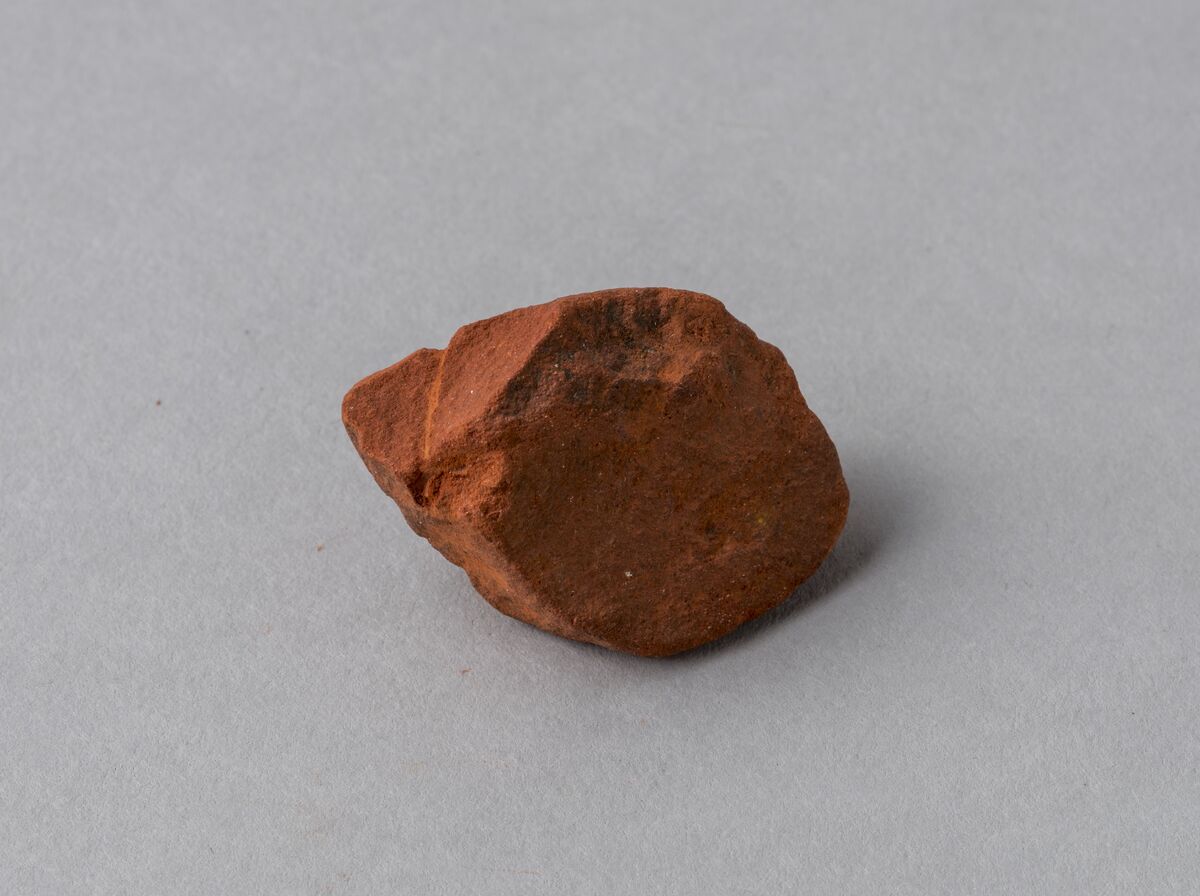
The bodies lay folded upon themselves, in a foetal position, surrounded by red ochre, stone tools and the remains of large game. Nothing about this arrangement is accidental: everything points to a deliberate, repeated, codified act. Published in 2025 in the journal Nature Human Behaviour, the study led by Yossi Zaidner's team offers a radically new reading of the relationships between the human groups that peopled the Near EastNear EastA region of western Asia (Levant, Mesopotamia, Anatolia, Iran), cradle of the Neolithic revolution, agriculture, the first cities and writing.→ at that time. Where scholars once imagined two lineages foreign to one another, it draws a world of exchange, contact and mutual borrowing. Dated to the middle phase of the Levantine Middle PalaeolithicPalaeolithicThe oldest and longest period of prehistory (c. 3.3 Ma–12,000 BC), defined by chipped stone tools and a hunter-gatherer way of life.→, between 130,000 and 80,000 years ago, these graves sit at a pivotal moment when several forms of humanity shared the same corridor between AfricaAfricaThe cradle of humankind: the continent where the first hominins appeared, then Homo sapiens around 300,000 years ago, before the expansion to the rest of the world.→ and Eurasia.
Five graves, one shared ritual
The most striking feature of Tinshemet lies in the number and concentration of the burials. Five interments gathered in a single place is no longer an isolated practice: it is the sign of a space dedicated to the dead, almost a cemetery before the word existed. The clustering suggests that these populations returned to the same spot, generation after generation, to lay their departed to rest according to shared rules.2
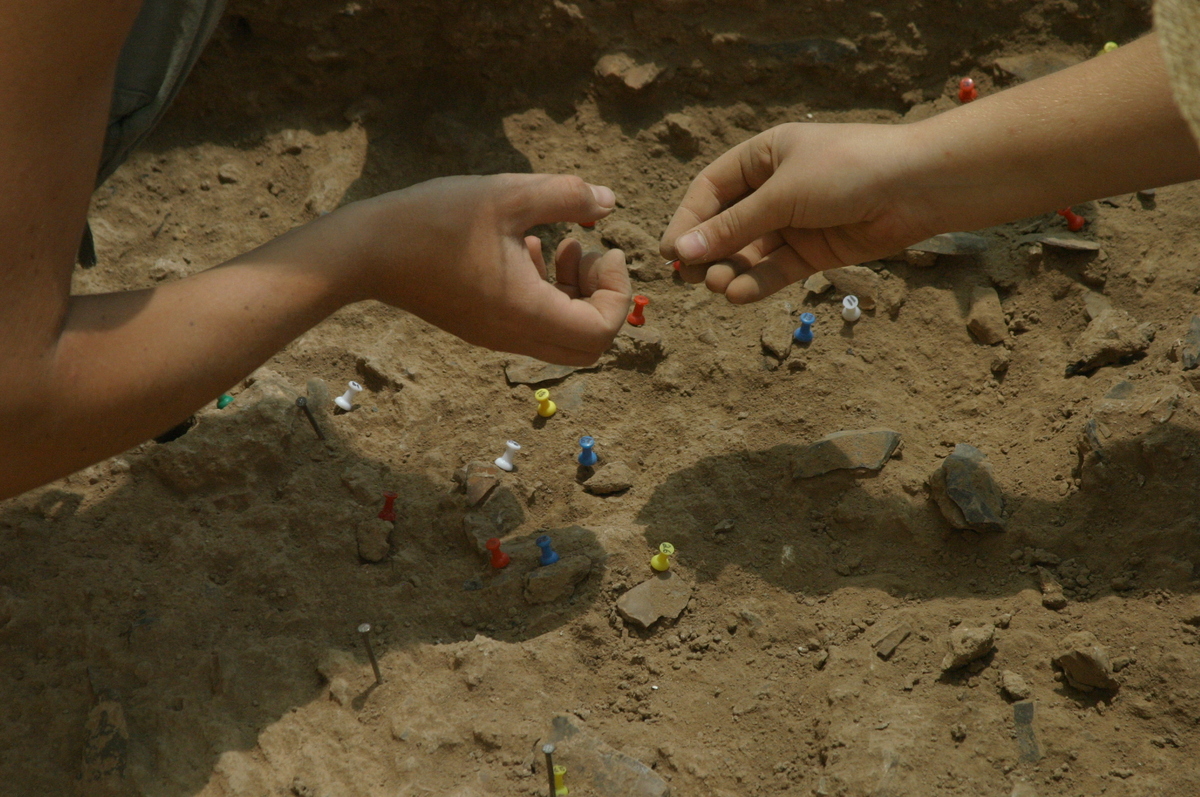
The foetal position of the bodies, applied systematically, deserves attention. Folding a corpse requires care, time and intent. This gesture is in no way utilitarian: it reflects a cultural choice, transmitted and reproduced. Combined with the repeated presence of pigments and offerings, it forms a genuine funerary grammar. In other words, the people of Tinshemet did not simply remove the dead from the world of the living; they treated them according to a shared, meaning-laden protocol. This regularity is precisely what distinguishes a cultural practice from the mere abandonment of a body. The choice of a single site, revisited over time, even hints at a memory of place: they knew where the ancestors lay, and there they brought the newly dead. Such spatial continuity is among the strongest signs of an already complex social organisation.
Ochre, a colour for the invisible
On nearly every body and object, one substance recurs: red ochre. This mineral pigment, rich in iron oxides, was ground and then applied with an abundance that astonishes researchers. Its heavy presence cannot be reduced to some practical use or accidental decoration; it signals a powerful symbolic intent.3
What did this colour mean to people living 110,000 years ago? No one can say for certain, and the authors refrain from concluding. Several avenues coexist: body decoration marking membership of a group, a signal of social status, or the expression of beliefs turned towards an afterlife. Red, the colour of blood and life, may have embodied a form of continuity beyond death. These hypotheses remain open, yet they converge on a single conclusion: at Tinshemet, death was thought of in symbolic terms, and that thought was made visible through colour. The funerary practice thus becomes a rare window onto the mental life of these vanished populations. It should be stressed that ochre is not naturally available in such quantities on the spot: gathering it, sometimes far afield, and then preparing it, implies deliberate effort, yet another sign that this red mattered to the living well beyond mere utility.
Neanderthal and sapiens: neighbours, but above all partners
The real twist at Tinshemet concerns the identity of those who rest there. The Levant of that era was a zone of contact between Neanderthals, arriving from Europe and western Asia, and Homo sapiens, coming from Africa. That the two lineages had coexisted in the region was already known. What Tinshemet reveals is that they did not merely coexist at a distance: they interacted, sharing techniques, ways of life and, as we now know, funerary customs.4
The authors speak of a behavioural uniformity across Homo groups. The phrase is a strong one. It means that, in this territory and at this moment, the boundaries we draw between species blur in favour of shared behaviours. Making the same tools, hunting the same game, burying the dead in the same way: all are signs of a social world in which biological identities mattered less than shared ways of doing things. Caution, however, remains in order. Assigning each skeleton precisely to Neanderthal or sapiens stays delicate, so mixed, and sometimes intermediate, are the remains of the LevantLevantA region of the eastern Mediterranean Near East (Israel, Lebanon, Syria, Jordan), a major crossroads of the first human migrationsMigrationsLong-distance movements of populations; a major driver of human history (the exit from Africa, the peopling of continents, Neolithic and steppe expansions).→ out of AfricaOut of AfricaThe dispersals of Homo sapiens out of Africa, including a major expansion c. 70,000 to 60,000 years ago and earlier exits.→.→. What matters here is not the label on each individual, but the finding that identical behaviours cut across distinct groups. The question is no longer who invented the rite, but how it could have become shared.
The unexpected gesture: to bury together, to think together
What Tinshemet brings to light is a gesture unexpected at this scale: burying the dead with ochre and offerings, in a ritual manner, and doing so on both sides of the boundary between species. The funerary rite was not the property of a single people; it circulated, was learned, and passed on through encounters.
Such sharing implies regular, peaceful contact, or at least sustained enough for practices as intimate as the treatment of the dead to pass from one group to another. One can picture meetings around common hunting grounds, exchanges of know-how, perhaps unions. Genetic data gathered elsewhere indeed confirm interbreedingInterbreedingGenetic mixing between human populations or species; between Neanderthals and Homo sapiens it left 1 to 2% of Neanderthal DNA in non-Africans.→ between Neanderthals and sapiens. Tinshemet adds to this picture the dimension of the sacred: these populations shared not only genes and tools, but also a way of giving meaning to death. Burial, a highly symbolic act, here becomes proof of a deep cultural porosity. To bury one of the dead according to the other's rules is to recognise a shared portion of humanity; it is, in a sense, the opposite of the supposed strangeness between these two lineages.
What Tinshemet changes for human history
The significance of the site reaches far beyond its five graves. For a long time, the dominant narrative pitted a crude Neanderthal against a creative sapiens, as though behavioural modernity had been the preserve of our species alone. Tinshemet weakens that view. In the Middle Palaeolithic Levant, symbolic behaviours were not the privilege of one lineage: they emerged, spread and stabilised within a network of interacting groups.
Yet it is worth keeping a cool head. Five burials, spectacular though they are, do not close the debate; they open it. Future excavations, analyses of the bones and close study of the pigments will clarify who was buried there and how. But the direction is clear: the story of our origins looks less like a tree with cleanly separated branches than like a fabric of interwoven threads. Neanderthals and Homo sapiens appear within it as actors on the same cultural stage, exchanging techniques, customs and beliefs. By restoring life to these five departed souls laid down in ochre, Tinshemet Cave reminds us that humanity, from its most ancient forms, was built as much through encounter as through lineage.
La façon dont vous reliez l'objet à son contexte humain est exactement ce qu'on cherche en médiation.