It is one of the most closely guarded wonders in world archaeology. The mausoleum of Qin Shi Huang, the first emperor of China, rises as an artificial hill some forty kilometres east of Xi'an, in Shaanxi province. Since its partial discovery in 1974 and the progressive revelations of its surroundings, this funerary complex has fascinated researchers as much as it has intimidated them. For although the terracottaTerracottaClay shaped and then hardened by firing; the material of pottery, bricks and figurines, ubiquitous since the Neolithic.→ warriors who guard it are now known worldwide, the burialBurialThe intentional deposition of a body, sometimes with offerings; a marker of symbolic behaviour.→ chamber itself -- buried beneath a forty-metre earthen mound -- has never been opened. And for very good reasons.
This dossier examines the history of this unique monument, the scientific, technical and ethical reasons why archaeologists refuse to excavate it, and the hypotheses -- sometimes vertiginous -- about what it might contain.
Qin Shi Huang: the man who unified China
Before becoming an archaeological mystery, the mausoleum of Qin Shi Huang reflects a political and personal ambition of extraordinary scope. Born in 259 BCE under the name Ying Zheng, this prince of the State of Qin ascended to the throne at thirteen. What could have been a regency became, through exceptional political and military intelligence, one of the great enterprises in human history.
In less than twenty-five years, he subdued one by one the six rival kingdoms that divided China: Han, Zhao, Wei, Chu, Yan and Qi. In 221 BCE the reunification was complete. Ying Zheng then took a new title, forged for the occasion: Huangdi, the August Emperor. He called himself Qin Shi Huang, the "First August Sovereign of the Qin", signalling by this title his intention to inaugurate a lineage that would last ten thousand generations.1
His fifteen-year reign was a period of exceptional density. He standardised weights and measures, writingWritingA system of conventional signs used to fix language or information durably; its appearance (c. 3300 BC) marks, by convention, the end of prehistory.→ systems, axle widths and coinage -- reforms that established Chinese unity far beyond his death. He built a network of imperial roads, created a postal system, and initiated the first sections of a great wall in the north to contain nomadic incursions. At the same time, he censored and burned books, had Confucian scholars buried alive, and centralised power in a way that anticipates the modern state by two millennia.
The historian Derk Bodde, one of the foremost Western scholars of the Qin period, describes Qin Shi Huang as the most consequential figure in Chinese history -- the one without whom nothing that came after would have been possible. This appreciation is not universal: within China itself, the first emperor has long been seen as tyrant as much as unifier. Mao Zedong, who readily recognised himself in this formidable predecessor, partially rehabilitated him in the twentieth century. Today his image still oscillates between nation-builder and bloodthirsty despot.
This paradox finds its echo in his tomb: the man who burned the books and knowledge of his predecessors may have preserved, in the darkness of a sealed chamber, documents we will never know if we do not dare to open what he himself designed to be impenetrable.
The construction of a century
From 246 BCE -- the very year of his accession -- the construction of his mausoleum began. He was thirteen years old. The construction would last thirty-eight years and mobilise, according to historical sources, as many as seven hundred thousand workers, craftsmen and prisoners. It is one of the largest construction projects in human history.
The chosen site lay at the foot of Mount Li, on the Wei plain. The location was deliberate: according to Chinese geomancy, hills to the north and waterways to the south confer on a place the harmonious energy suited to great dwellings, including those of the afterlife. From 246 BCE, tens of thousands of hands attacked the rock and the earth.
The principal historical source is Sima Qian, who wrote his Shiji (Records of the Grand Historian) about a century after the emperor's death. He describes a funerary complex of staggering scale: the central mound originally stood one hundred and twenty metres high (only forty remain today, erosion and pillaging having reduced its stature), and the outer perimeter measured more than six kilometres in circumference.2
Archaeological excavations since the 1970s have begun to confirm and nuance these accounts. The funerary complex covers an area of approximately fifty-six square kilometres -- larger than the city of Paris within its ring road. Two nested rectangular enclosures are visible, along with hundreds of subsidiary pits containing horses, exotic birds, terracotta musicians, officials and acrobats. At the centre rises the mound, at the summit of which the tree of immortality may once have been cultivated.
The logistics of this construction are staggering. Building materials -- fired bricks, timber, bronze, jade -- were brought from distant provinces. Thousands of forges ran continuously to produce the necessary metallic components. Craftsmen worked under penalty of death if they revealed the site's secrets. According to Sima Qian, those involved in installing the interior mechanisms were walled alive inside to preserve secrecy. Recent excavations have uncovered, near the complex, mass cemeteries where thousands of workers who died during construction lie buried -- victims of the gruelling work and catastrophic sanitary conditions.
The sophistication of Qin engineers deserves particular mention. The drainage system of the funerary complex, partially identified by geophysical surveys, reveals a remarkable mastery of hydraulic engineering. Ceramic pipes, retention basins and drainage channels organise underground water around the central chamber. This infrastructure, designed to last indefinitely, has evidently fulfilled its purpose since the chamber appears intact more than two thousand years later.
The terracotta army: an accidental discovery
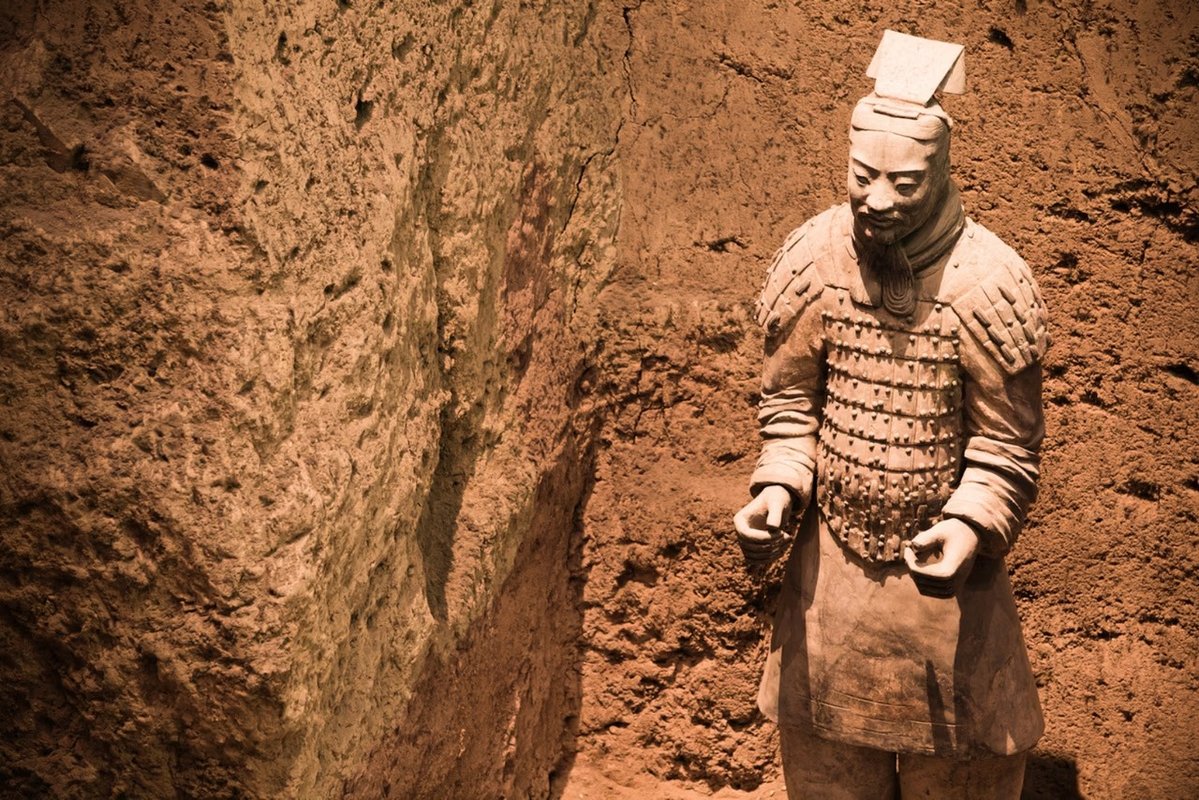
On 29 March 1974, farmers digging a well in a field near the commune of Lintong struck pottery fragments and bronze shards. They initially took these objects for old roof tiles and set them aside. It was only with the arrival of the first archaeologists that the scale of the discovery began to emerge: beneath their feet lay one of the largest armies ever created by human hands -- but an army made of clay.
The subsequent excavations revealed three main pits, covering a total area of twenty thousand square metres. Pit 1, the largest, measures two hundred and thirty metres long and contains more than six thousand infantry soldiers arranged in close formation, like an army on the march. Pit 2 houses cavalry, kneeling archers and chariots. Pit 3, smaller, appears to be the command headquarters with high-ranking officers and command chariots.3
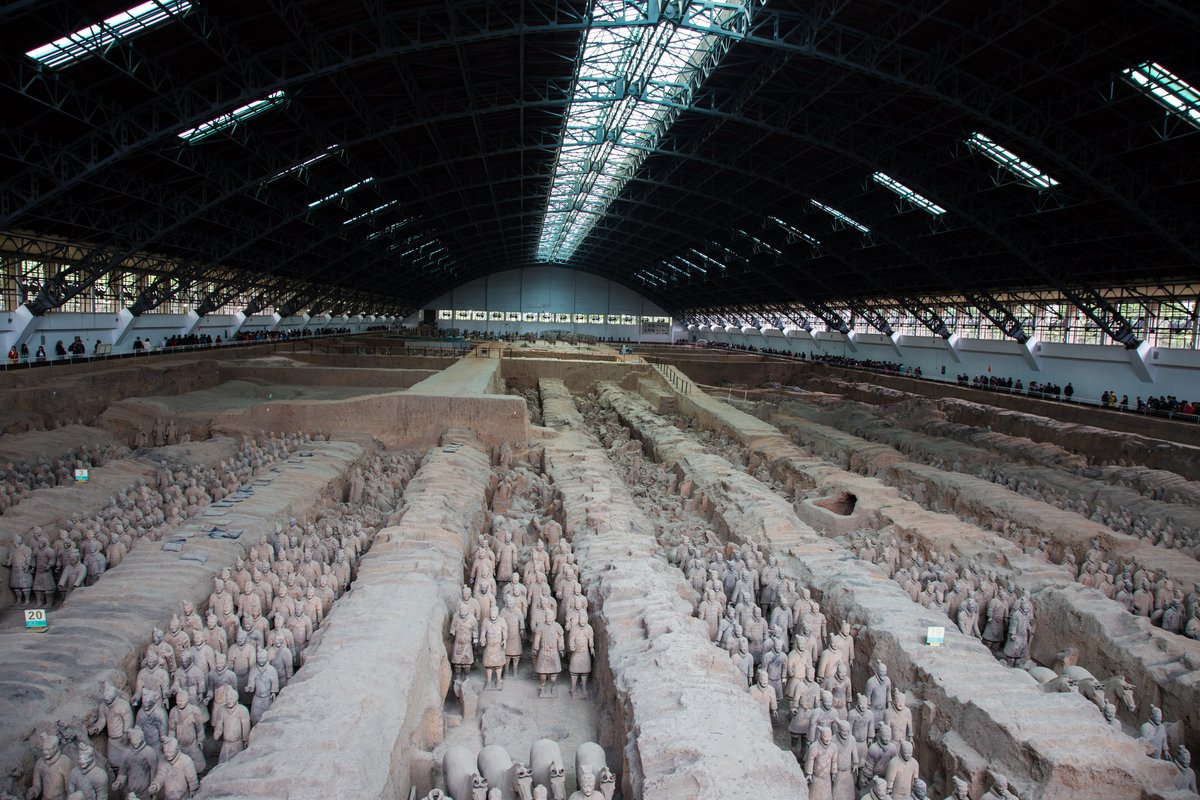
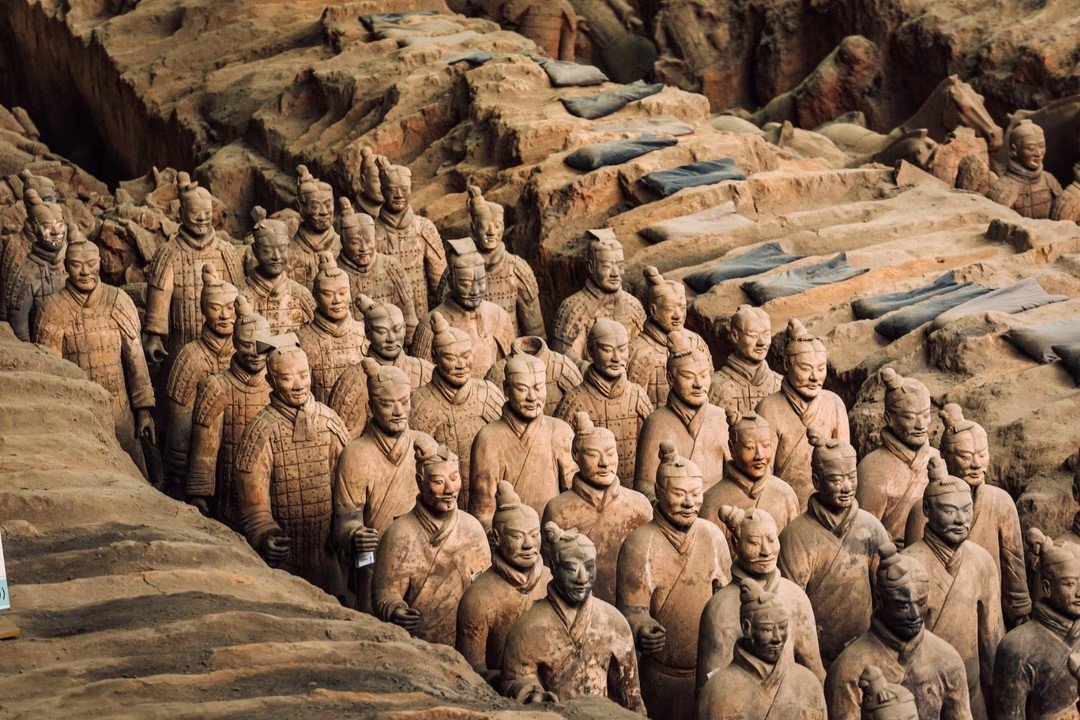
In total, the terracotta army comprises approximately eight thousand soldiers, six hundred horses and one hundred chariots. Each warrior is life-size -- standing between 1.75 and 1.90 metres depending on rank -- and each face is unique. This spectacular individualisation has been the subject of much scholarly debate. Were these portraits of real soldiers of the imperial army? A deliberate effort to create a form of ritual individuality for each guardian of the afterlife? Uniforms, hairstyles and postures vary by rank and function, suggesting that craftsmen conformed to a precise military hierarchy.
But perhaps even more striking than the army's scale is what it has lost. When discovered, these warriors were covered in vivid paint -- reds, greens, blues, purples -- that made them appear startlingly alive. On contact with air, these pigments deteriorated within minutes, leaving behind the grey tone of bare clay we see today. This irreversible disappearance is one of the most painful and instructive lessons for archaeologists contemplating the opening of the burial chamber.
Research teams have since worked to understand and prevent this phenomenon. Franco-Chinese and Sino-German teams have identified the pigments used -- primarily organic lacquers as a base layer, then mineral colours -- and developed in-situ consolidation techniques capable of stabilising existing pigments before they evaporate. These advances, though real, do not yet solve the problem at the scale that would be necessary to approach the central burial chamber.
Since 1974, excavations in the terracotta army pits have never ceased. Thousands of warriors have been discovered, reassembled from their fragments and displayed in the pits themselves. But only a fraction of the total surface area has been excavated. Significant zones have been deliberately left intact, preserved for future generations who may have even better techniques. This philosophy of preventive conservation is characteristic of the contemporary Chinese archaeological approach.
The burial chamber: what the ancient texts say
Sima Qian's Shiji devotes several passages to describing Qin Shi Huang's burial chamber. His account, written around a century after the emperor's death, is both fascinating and difficult to evaluate: is it a faithful testimony or a narrative embellished by decades of legend? Recent archaeological discoveries paradoxically tend to vindicate him on several essential points.2
According to Sima Qian, the burial chamber reproduces the Chinese Empire in miniature. The ceiling is adorned with representations of the constellations, inlaid with precious stones imitating stars. On the floor, the great rivers and seas of the realm are reproduced in liquid mercury, kept in motion by hydraulic mechanisms to simulate the flow of currents. Whale oil lamps burned to provide indefinite light. At the centre of this miniature universe, the emperor rests in a bronze sarcophagus.
The chamber is further protected by automatic crossbows programmed to fire on anyone who tries to cross the thresholds. These mechanical devices, wound since two millennia, would still be in working order -- or so archaeologists fear. This aspect of Sima Qian's account is particularly difficult to verify, but also particularly troubling.
Other contemporary or near-contemporary sources complete this picture. Han-period texts mention that the burial chamber was equipped with a mobile ceiling system designed to crush intruders. Administrative documents from the Qin period, found in other contexts, refer to "engineers of the inner chamber" whose functions remain partially obscure but suggest considerable technical complexity.
What is striking about Sima Qian's description is the cosmological vision it reveals. The burial chamber is not simply a resting place: it is a parallel universe, a miniature copy of the earthly kingdom in which the emperor could continue to reign after his death. The celestial ceiling with its stars, the mercury rivers on the floor, the lamps imitating the sun -- all together compose an artificial cosmos designed to receive the imperial soul for eternity. This funerary worldview is typical of Qin-Han cosmology, but carried here to an unprecedented scale.
Mercury: when legend becomes scientific data
For a long time, Sima Qian's account was treated with a degree of academic condescension. Mercury rivers kept in motion by hydraulic mechanisms for two thousand years? That belonged more to legend than to reality. Then science intervened.
In 2020, a study published in Nature changed the situation dramatically. Researchers measured mercury concentrations in the soil around the central mound using non-invasive geochemical techniques. The results were unambiguous: mercury concentrations beneath and around the mound are abnormally high -- up to a thousand times natural background levels. Scientists estimate that the burial chamber could contain "100 tonnes or more" of mercury.4
This discovery has two major implications. First, it confirms that Sima Qian was not lying: there is indeed, beneath the mound, a massive quantity of mercury consistent with his description of liquid rivers. Second, it creates a formidable practical problem: how does one excavate a space containing such a quantity of an extremely toxic, room-temperature volatile metal without endangering archaeologists and the surrounding environment?
Gaseous mercury is a severe neurotoxin. Prolonged exposure causes irreversible damage to the nervous system, tremors, cognitive disorders and, at high doses, death. Mercury chloride, which can form through chemical reactions in a subterranean environment, is even more dangerous. The prospect of opening a chamber potentially containing one hundred tonnes of such compounds represents a biological hazard of a scale that current technology cannot reliably manage.
The spatial distribution of mercury also reveals precious information about the internal structure of the chamber. Concentrations are not uniform: they trace zones of greater intensity that could correspond to the "rivers" described by Sima Qian. Geochemical analysis thus allows an approximate map of the chamber's interior to be drawn without setting foot inside. This is a perfect illustration of what non-invasive archaeology can achieve when it asks the right scientific questions.
Why not open the tomb: the reasons for reasoned caution
The question recurs regularly in the media and at scientific conferences: why, with modern techniques, are archaeologists not proceeding to open the burial chamber? The answer is multifaceted, and each of its components illustrates a different aspect of contemporary archaeology.
The first reason is technical. Opening a burial chamber of this size -- estimates place it some thirty metres below the surface, with walls several metres thick -- without damaging its contents is a considerable challenge. Outside air, with its variations in temperature, humidity and oxygen, is the primary enemy of organic materials and pigments. The example of the terracotta warriors is there to remind us that this danger is very real: the colours disappeared within minutes. What would happen to textiles, wood and organic materials that might be found inside?
The second reason is chemical. One hundred tonnes of mercury represents an environmental and health hazard that current technologies do not allow to be managed safely. Before entering, one would need to design mercury vapour extraction and neutralisation systems of absolute reliability. These systems do not yet exist, at least not in a form applicable at the necessary scale.
The third reason is ethical and political. China regards the mausoleum site as a national heritage of exceptional importance. Chinese authorities and national cultural bodies have explicitly decided not to excavate the burial chamber until the technologies necessary for the complete preservation of its contents are available. This is a position of wisdom that has achieved consensus in the international archaeological community.5
The fourth and final reason is strategic. Non-invasive exploration technologies are advancing at a sustained pace. Each passing year allows us to learn more about the chamber's interior without opening it. And each passing year also allows the technologies to mature that will one day make possible a complete, clean and carefully documented excavation. Opening the chamber today would not only be risky for its contents, but would also deprive future generations of the possibility of doing so under better conditions.
The 1956 disaster: the lesson of the Wanli tomb
Chinese archaeologists have not forgotten the painful precedent of 1956. That year, researchers opened the Dingling, the mausoleum of the Ming Emperor Wanli, who died in 1620. It was the first imperial Chinese tomb scientifically excavated. The results were catastrophic.
On contact with air, silk textiles -- some of extraordinary quality and beauty -- began to disintegrate within hours. Lacquered wood, organic materials and pigments suffered irreversible deterioration. The conservation techniques available in 1956 were wholly inadequate to meet this challenge. An inestimable part of China's imperial historical heritage disappeared before the eyes of helpless researchers.
This traumatic episode has marked generations of Chinese archaeologists. It became the standard reference in any discussion about the advisability of opening Qin Shi Huang's tomb. If the tomb of a Ming emperor, far more recent, proved so destructive to open, what would happen with the burial chamber of Qin Shi Huang -- twice as old and infinitely more complex? The lesson of the Dingling has become something close to dogma in Chinese archaeological circles: do not open what you cannot preserve.
Technologies that probe without touching
The exploration of Qin Shi Huang's mausoleum has become a testing ground for the most advanced technologies in non-invasive archaeology. Since the 1980s, successive generations of researchers have applied increasingly sophisticated detection methods to the site.
Ground-penetrating radar (GPR) maps underground structures at several metres' depth by emitting electromagnetic waves and analysing their echoes. Successive campaigns have precisely delineated the outline of the central burial chamber, identified the presence of several antechambers, detected hydraulic conduits and large empty spaces.4
Electrical and electromagnetic prospecting has identified conductivity anomalies consistent with the presence of large quantities of metal -- mercury, but also bronze. Geochemical soil analyses, including the 2020 publication, have mapped mercury distribution across the entire mound. The distribution is not uniform: it corresponds to what could indeed be miniaturised river courses, further reinforcing Sima Qian's description.
More recent technologies, such as portable X-ray tomography and X-ray fluorescence, allow the chemical composition of materials to be analysed through thicknesses of soil and stone without direct sampling. High-resolution satellite imagery, coupled with digital terrain models, has revealed the complete three-dimensional structure of the funerary complex. And multispectral camera-equipped drones have mapped the total extent of the site, uncovering previously unknown subsidiary pits.
One of the most promising advances is muography -- the use of cosmic muons, subatomic particles that penetrate matter far more easily than X-rays, to produce "X-rays" of enormous structures. Muography was used successfully to image the interior of Egyptian pyramids and revealed an unknown chamber inside the Pyramid of Khufu in 2017. Chinese and international teams are studying the possibility of applying this technique to Qin Shi Huang's mound to obtain a detailed three-dimensional image of the burial chamber without touching it.
The traps: myth or reality?
The automatic crossbows described by Sima Qian were long regarded as a metaphor or rhetorical exaggeration designed to deter potential looters. The question of their actual reality is more complex than it appears.
Ancient texts describe trigger mechanisms placed at thresholds, calibrated to fire automatically on anyone attempting to enter. The China of the Qin period had a complete mastery of bronze metallurgyMetallurgyThe techniques of extracting and working metals (copper, bronze, gold); its rise in the Eneolithic and Bronze Age transformed tools, weapons and social hierarchies.→ and an ancient tradition of precision crossbow manufacture. Mechanically straightforward bronze trigger devices could have been designed to function without human intervention. Qin-period mechanical crossbows have been found in other archaeological contexts in near-functional condition, attesting to the sophistication of the era's weaponsmithing.1
Is it possible that these mechanisms are still functional two thousand two hundred years later? Experts are divided. Bronze resists corrosion well in a dry, sealed environment. Bowstrings or leather tendons, however, would almost certainly have disintegrated over time, rendering the bows inoperable. But bronze springs might theoretically retain residual tension. Caution is warranted.
What is certain is that the burial chamber was designed as an impregnable space. The multiplicity of enclosures, the depth of burial, the mass of the mound above, and the security devices described in historical sources together form a defensive system intended to deter any intruder. Whether these defences remain active today is one reason why no archaeologist has attempted a forced opening.
The question of traps also raises a more general methodological point. In the archaeology of royal sites, caution is not merely a virtue: it is a professional necessity. From Theban tombs in Egypt to Khmer temples in Cambodia, the history of archaeology is punctuated by accidents caused by unpredictable defence mechanisms, unstable structures or toxic atmospheres. The unique combination of potentially volatile mercury, hypothetical mechanical traps and a structure more than two millennia old fully justifies a particularly conservative approach.
The immortality paradox: the mercury that killed the emperor
There is in the story of Qin Shi Huang a tragic irony that no historian misses: the man who filled his tomb with mercury to symbolise the rivers of his empire was probably dying from it. Obsessed with the prospect of his own disappearance, the emperor actively sought formulas for immortality. He dispatched expeditions to the legendary islands of Penglai, Fangzhang and Yingzhou, said to harbour the secrets of eternal youth. He summoned alchemists and magicians, financing them generously in exchange for pills and elixirs.
These elixirs very often contained mercury and arsenic, regarded in the Taoist pharmacopeia of the period as purifying and life-giving substances. The idea that heavy metals, by their density and permanence, could transmit these properties to the human body was widespread in ancient China as in other civilisations. Taoist alchemy made mercury -- called "silver water" -- the quintessential active principle of spiritual and physical transformation. Qin Shi Huang consumed it regularly, on the advice of his court physicians.1
The symptoms of chronic mercury poisoning -- extreme irritability, violent mood swings, paranoia, tremors, cognitive decline -- correspond quite closely to what ancient texts describe of the emperor's personality in the final years of his reign. His death in 210 BCE at the age of forty-nine, during an inspection tour of his empire, has been attributed by modern historians to a combination of factors, of which chronic mercury poisoning is probably among the most significant.
He may thus have been killed, in an irony history loves to produce, by the very substance he had chosen to symbolise his eternal kingdom and protect him in the afterlife. The same substance that may still course through the pseudo-rivers of his burial chamber two millennia after his death.
After Qin Shi Huang: the collapse and the fate of the mausoleum
The emperor's death in 210 BCE was followed by the rapid collapse of the Qin dynasty. His son and successor, Qin Er Shi, proved unable to govern the immense and unstable empire he had inherited. Popular revolts, fuelled by the inhuman conditions imposed on workers at the great imperial construction projects, erupted as early as 209 BCE. In 206 BCE, the capital Xianyang was sacked and burned by the armies of Liu Bang, future founder of the Han dynasty.
According to historical sources, the general Xiang Yu attempted to loot Qin Shi Huang's mausoleum during the sacking of the capital. Contemporary accounts speak of a fire that reportedly burned for three months. But the texts suggest that his forces were unable -- or unwilling -- to penetrate the central burial chamber. What they did plunder was a considerable number of objects from subsidiary pits. Traces of looting and fire have been found in several archaeological pits around the mound, including bronze weapons recovered by looters to be melted down and reused.3
The central burial chamber itself appears to have been spared. For two thousand two hundred years, it has waited. Thick walls, drainage ditches, vaulted ceilings, protection systems: the construction appears to have been designed to last indefinitely. And it has kept its promise through the turbulences of Chinese history -- dynasty succeeding dynasty, Mongol invasions, communist revolution, the frantic modernisation of the twentieth century.
What might be discovered?
This is the question everyone asks, and the one scientists carefully avoid formulating in terms of certainties. Hypotheses abound, grounded in Sima Qian's descriptions, analogies with other Chinese royal tombs of the period, and data collected through non-invasive explorations.
At a minimum, we expect to find the emperor's sarcophagus -- perhaps in bronze, perhaps in jade, perhaps both. We expect significant quantities of bronze, gold, silver and jade, materials associated with imperial status. We expect the emperor's personal effects -- his swords, his seals, his instruments of government. We expect representations of his empire -- maps, models, miniatures.
Above all, we expect inscriptions and texts. The idea that the burial chamber might contain documents written on silk, bamboo or wood, preserved by the dry and sealed atmosphere of the space, fascinates historians. Texts we do not know, laws, speeches, correspondence, copies of burned books -- the chamber could be a library as much as a funerary palace. The supremely tragic irony would be that this man who burned knowledge to maintain his power may have preserved, involuntarily, copies of that same knowledge in his own funerary dwelling.
Analogies with other major funerary sites are instructive. The Han-period Tomb No. 1 at Mawangdui, excavated in the 1970s, revealed textiles, wooden figurines and lacquerware in a remarkable state of preservation. The tomb of Marquis Yi of Zeng (fifth century BCE) contained musical instruments, weapons, bronzes and texts in perfect condition. These precedents -- for less ambitious and less deep tombs -- suggest that Qin Shi Huang's chamber could harbour treasures of incalculable value.3
The political and national dimension
The question of opening Qin Shi Huang's tomb is not purely scientific. It is also profoundly political. In China, the mausoleum site is a national symbol of the first importance, a pivot of national historical identity. The first emperor unified China -- national unification is one of the founding principles of the People's Republic -- and his mausoleum is the architectural emblem of that unification.
This symbolic dimension directly influences scientific decisions. No Chinese government can politically afford to have a poorly executed opening of the tomb be a visible failure. Prudence is therefore not merely an academic virtue: it is also a political necessity. Chinese authorities have clearly indicated that the decision to open -- or not to open -- the burial chamber belongs to the Chinese state and to it alone. Requests from foreign researchers to participate or to accelerate excavations have been politely but firmly rebuffed.
There is also an international cultural policy dimension. China is a signatory to the UNESCO World Heritage Convention, which requires the preservation of sites on the World Heritage List -- the Mausoleum of Qin Shi Huang and the Terracotta Army have been listed since 1987. UNESCO explicitly encourages non-invasive approaches and preventive conservation. This international pressure reinforces the already cautious position of the Chinese authorities.
The future: when will the tomb be opened?
The question recurs, and China's official responses have been consistent: not until the technologies permitting complete preservation are available. This has been the position of Chinese cultural authorities since the 1980s, and it has not changed. It was reaffirmed recently in response to requests from some foreign researchers wishing to accelerate excavations.5
This caution is deeply rooted in the collective memory of the Chinese archaeological discipline. The 1956 opening of the Dingling was a disaster that marked generations of Chinese archaeologists who, since then, have systematically applied the precautionary principle to all royal sites.
Technology is advancing, however. Controlled-atmosphere preservation systems, which maintain an excavated space in an oxygen- and humidity-free environment, are improving steadily. Ultra-high-resolution three-dimensional scanning methods now allow every detail of an object to be captured before it deteriorates on contact with air. Mercury vapour neutralisation systems are the subject of active research, notably linked to the needs of the chemical industry and contaminated mining sites.
A collaborative Sino-European research programme, including conservation teams from the Sorbonne, the Politecnico di Torino and several Chinese universities, is working specifically on the techniques needed for a possible excavation. Short-term objectives include the development of a large-scale portable controlled-atmosphere system and in-situ applicable methods for stabilising organic pigments. The long-term objective is to make possible an excavation of the burial chamber under the best possible preservation conditions.
The most optimistic estimates speak of two to three decades before the technologies are mature. The most cautious speak of half a century. But what seems certain is that the opening of Qin Shi Huang's tomb is not a question of if, but of when. And that when, for the first time in 2,200 years, seems to belong to our era rather than to an indeterminate future.
In the meantime, every new technology, every probe sent into the earth, every geochemical analysis teaches us a little more about what has waited, in the dark, for two thousand two hundred years. Perhaps the jade stars on the ceiling still shine for no one. Perhaps the mercury rivers still flow in silence beneath the plains of Shaanxi. And perhaps, in a bronze sarcophagus, the remains of China's first unifier wait for the moment when human skill is sufficient to discover them without destroying them.
Comparable sealed tombs: what other cultures did
The deliberate sealing of an imperial burial is not unique to the Qin dynasty. Around the world, ancient cultures devised elaborate measures to render their most sacred funerary spaces permanently inaccessible. Comparing these cases illuminates the specific challenge posed by the mausoleum of Qin Shi Huang and the choices facing contemporary archaeologists.
In Egypt, the Valley of the Kings was conceived precisely as an impregnable burial ground: tombs were cut deep into the limestone cliffs, filled and sealed, then the entrance concealed. The strategy failed spectacularly -- nearly every tomb was robbed in antiquity, many within a few centuries of their construction. The one exception that survived largely intact, Tutankhamun's tomb (KV62), owed its preservation to the accident of being buried under debris from a later construction. Its opening in 1922 by Howard Carter's team, while revolutionary, also caused significant damage to organic materials that four thousand years of sealed conditions had preserved.
In Mesoamerica, the tomb of Pakal the Great at Palenque, discovered in 1952, offers another parallel. Sealed in 683 CE within the Temple of the Inscriptions, it had remained undisturbed for thirteen centuries. Its discovery required the excavation of a hidden staircase that archaeologists found only by interpreting a detail in the floor. The contents -- a jade sarcophagus, a mosaic death mask, hundreds of jade objects -- were extraordinarily well preserved. But Palenque's tomb was orders of magnitude smaller and chemically less complex than Qin Shi Huang's mausoleum. Its successful excavation cannot simply be extrapolated to the Chinese case.
The closest modern precedent for the scale of challenge posed by the Qin mausoleum is perhaps the untouched Macedonian royal tomb at Aigai (Vergina) in Greece, opened in 1977 by the archaeologist Manolis Andronikos. Believed to contain the remains of Philip II, father of Alexander the Great, the tomb yielded extraordinary gold objects, weapons and organic materials including wooden furniture and ivory carvings. But even this tomb, sealed since 336 BCE, was a modest-sized vault. Its successful excavation under controlled conditions required meticulous preparation and still cost some organic materials their integrity.
What distinguishes the mausoleum of Qin Shi Huang from all these precedents is not merely its age, though that is considerable, nor its size, though that too is exceptional. It is the combination: a structure of extraordinary complexity, built at unprecedented scale, filled with known chemical hazards and possible mechanical traps, and embedded in a political and cultural context that makes any failure potentially catastrophic. No existing playbook from the archaeology of sealed tombs adequately addresses all these variables simultaneously.
This is why the mausoleum of Qin Shi Huang is, in a very real sense, a unique problem in the history of human archaeology. It demands unique solutions. And those solutions -- technological, chemical, logistical, political -- are still being invented. The decades ahead will determine whether the science catches up with the ambition of opening, without destroying, one of humanity's greatest unsolved mysteries.
Sources
Bodde, D., China's First Unifier: A Study of the Ch'in Dynasty, Brill, 1938.
Sima Qian, Shiji (Records of the Grand Historian), transl. B. Watson, Columbia University Press, 1993.
Portal, J., The First Emperor: China's Terracotta Army, Harvard University Press, 2007.
Futura Sciences, "Pourquoi les archeologues refusent toujours d'ouvrir ce tombeau vieux de 2 000 ans", 2024. futura-sciences.com
Li, X. et al., "Geochemical anomalies of mercury in the soil of the Mausoleum of Qin Shi Huang", Nature, 2020.
No comments yet. Be the first.