The necropolisNecropolisA large organised burial ground, a "city of the dead", often spanning several periods.→ of Saqqarah, located some thirty kilometres south of Cairo, is one of the vastest and richest burialBurialThe intentional deposition of a body, sometimes with offerings; a marker of symbolic behaviour.→ grounds of the ancient world. For decades, successive archaeological expeditions have revealed exceptional treasures: tombs of high officials, cat mummies, funerary papyri, polychrome statues. In September 2026, a new discovery was added to this long list: the tomb of a man named Sekhentio-Ptah, a high official of the Egyptian Old KingdomOld KingdomThe first great period of unified pharaonic Egypt (c. 2700-2200 BC, 3rd-6th Dynasties), the golden age of the great pyramids and of a strongly centralised state.→, whose titles make him one of the most intriguing figures of the pharaonic bureaucracy. "Keeper of the secrets of royal decrees" -- a title that, beneath the pyramids of Egypt's golden age, spoke volumes about the weight of knowledge and discretion in the service of the sovereign.
Saqqarah: Necropolis of the Old Kingdom Officials
To grasp the significance of this discovery, it must be placed in the context of Saqqarah and the Old Kingdom. The necropolis, whose history stretches back to the earliest Egyptian dynasties (around 3100 BCE), was the preferred burial site for administrative and religious elites for nearly three millennia. It houses the famous Step PyramidStep pyramidEgypt's first great stone monument, raised for King Djoser at Saqqara by Imhotep (Third Dynasty), by stacking diminishing mastabas.→ of Djoser, built around 2650 BCE by the architect Imhotep, along with dozens of other pyramids and hundreds of mastabas -- those flat rectangular tombs characteristic of the Old Kingdom.
The Old Kingdom, spanning the Third to Sixth Dynasties (approximately 2686-2181 BCE), corresponds to the apogee of Egyptian pyramid construction and the establishment of a sophisticated state apparatus. The great pyramids of Giza -- those of Khufu, Khafre, and Menkaure -- date from this period, as do the pyramids at Saqqarah that succeeded those of the Fourth Dynasty. It was within this context of a powerful, centralised pharaonic monarchy that Sekhentio-Ptah lived, his tomb now unearthed in the so-called "Bubasteion" sector of Saqqarah.
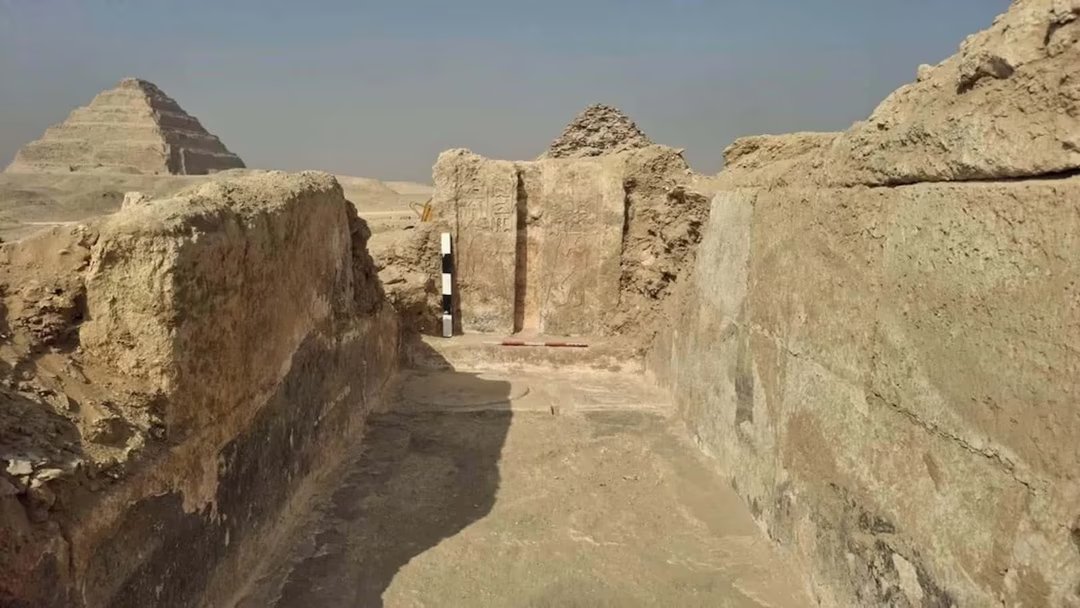
Sekhentio-Ptah lived in all likelihood between the end of the Fifth and the beginning of the Sixth Dynasty, around 2350-2300 BCE -- some 4,350 years ago. This dating, proposed by Egyptologist Ann Macy Roth of New York University, rests on the style of the tomb's architectural elements, particularly the workmanship of the "false doors" that constitute one of its most important features.
The Titles of Sekhentio-Ptah: Anatomy of Administrative Power
What immediately distinguishes Sekhentio-Ptah from the thousands of other Old Kingdom officials whose tombs have been uncovered at Saqqarah is the singularity of his official titles. Hieroglyphic inscriptions recorded by archaeologists from the Egyptian Ministry of Tourism and Antiquities reveal at least three, sketching the profile of a man at the heart of the royal administration's machinery.
The first title, "Overseer of all the King's Works", designated a function of coordination and supervision of major royal construction projects -- pyramids, temples, palaces. This type of position existed in several variants within the Old Kingdom administration and implied detailed knowledge of the human and material resources available to the pharaohPharaohThe title of the ruler of ancient Egypt, regarded as a living god guaranteeing cosmic order (Maat), supreme head of state, army and worship.→. It was not the highest title that could exist -- the vizierVizierThe highest official of the Egyptian state after the pharaoh (Egyptian "tjaty"): effectively a prime minister directing administration, justice, the treasury and public works in the king's name.→, or "tjaty", occupied the summit of the state apparatus -- but it was a position requiring considerable trust on the part of the sovereign.
The second title, "Overseer of Royal Documents", places Sekhentio-Ptah within the senior administration of royal scribes. Ancient Egypt relied on a remarkably efficient written bureaucracy: land surveys, tax schedules, lists of workers assigned to state construction sites, inventories of royal granaries -- everything was recorded on papyrus or clay tablets. Supervising these documents meant occupying a strategic position within the pharaonic state.
But it is the third title that captured the imagination of the media and the public: "Keeper of the Secrets of Royal Decrees". A formulation that evokes, to modern ears, something midway between a private counsellor and a shadow archivist. Ann Macy Roth, a specialist in Old Kingdom Egypt, tempers this image: this was probably not a pharaoh's spy, nor an intelligence agent in the modern sense. By supervising royal documents and the scribes who drafted them, Sekhentio-Ptah simply had access to confidential information -- budgets, political decisions, diplomatic correspondence -- whose disclosure could have harmed the crown. Such titles were relatively common among senior scribes of the Old Kingdom, but they nevertheless reveal an exceptional social status and position of trust.
The False Doors: Symbolic Passages Between Worlds
Among the architectural and funerary elements that furnished Sekhentio-Ptah's tomb, two "false doors" attracted the archaeologists' attention. These structures, characteristic of Old Kingdom funerary architecture, are among the most eloquent expressions of the Egyptian conception of death and the afterlife.
A false door is a structure carved in stone (or, in less wealthy tombs, painted onto plaster) that mimics the form of a door without serving a practical function: it does not open and leads nowhere. Its role is entirely symbolic and ritual. In Egyptian funerary theology, death is not an end but a transformation: the deceased's "ka" -- his vital double, his spiritual force -- continues to exist in the tomb and can circulate between the world of the dead and that of the living in order, above all, to receive the offerings deposited by descendants.
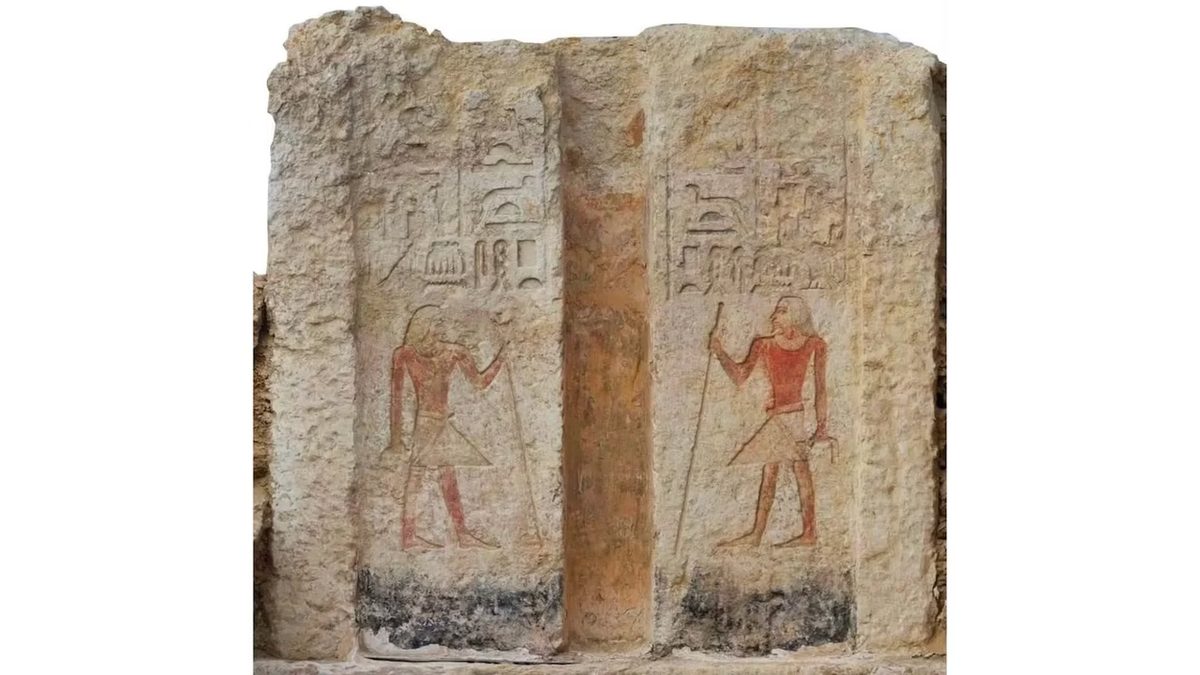
The false door is precisely the crossing-point for this ritual back-and-forth. It is the place where the living deposit their food offerings -- bread, beer, meats, oils -- and where the deceased's ka comes to "nourish" itself from the essence of these deposits. In practice, the offering service was carried out by funerary priests, contracted (and financed from the revenues of the deceased's estate) to perform these rites in perpetuity. The presence of two false doors in Sekhentio-Ptah's tomb is an additional indicator of his rank: the tombs of ordinary officials generally contained only one.
The style of these false doors is precisely what allowed Ann Macy Roth to date the tomb. Stylistic characteristics -- proportions, relief treatment, disposition of inscriptions -- evolved noticeably from one period to another and allow Egyptologists to assign a tomb to a specific dynasty, or even to part of a dynasty, with remarkable precision given the antiquity of the documents.
The Offering Table, Ushabtis, and Falcon Statue
Beyond the false doors, Sekhentio-Ptah's tomb yielded a particularly rich set of funerary furnishings. An offering table -- a flat surface on which food offerings and libations were placed -- was found, along with a basin for purification rites. These two elements are the basic fittings of a well-equipped Old Kingdom tomb.
More striking is the number of ushabtis discovered: more than a hundred of these small funerary figurines were found in the burial. Ushabtis (sometimes called "shabtis" or "shawabtis" in earlier periods) are statuettes approximately 10 to 20 centimetres high, generally in wood, faience, or limestone, representing the deceased wrapped in mummyMummyA body preserved from decay, naturally (cold, aridity, peat) or artificially; the frozen Pazyryk kurgans yielded natural mummies with tattooed skin.→ bandages, often holding agricultural tools. Their role, in Egyptian funerary theology, was to perform in place of the deceased the chores that might be imposed on them in the afterlife -- ploughing fields, carrying sand, irrigating land. Each ushebti was supposed to "answer" (the meaning of the word in ancient Egyptian) on behalf of the dead when the gods called souls for the work of the other world.
The abundance of these figurines -- more than a hundred -- raises a chronological question. In the Old Kingdom, ushabtis were not yet systematically included in funerary furnishings; they became truly common only from the Middle Kingdom (around 2055-1650 BCE) onwards. The presence of so many ushabtis in Sekhentio-Ptah's tomb therefore suggests that the burial may have been reused and augmented in later periods -- a hypothesis confirmed by other evidence.
A wooden statue of a falcon was also discovered. The falcon is the sacred animal of Horus, the solar god with falcon eyes whose divine name was carried by every living pharaoh. Its presence in a funerary context could evoke royal protection, the deceased's union with the solar cycle, or simply the care taken by pious descendants in equipping the tomb spiritually.
A Tomb Probably Reused Across the Ages
The chronological diversity of the funerary furniture found in Sekhentio-Ptah's tomb -- Old Kingdom elements (false doors, offering table) alongside more numerous ushabtis and potentially later cartonnage fragments -- led archaeologists to consider a well-documented hypothesis in Egyptology: the reuse of ancient burial chambers.
The reuse of tombs was a common practice throughout ancient Egyptian history. When families could no longer maintain the ritual upkeep of a burial, or when abandoned tombs were rediscovered by later generations, they could be reoccupied by new occupants. In some cases, the tomb was partially modified to accommodate the new owner; in others, successive burials were simply superimposed, creating heterogeneous funerary assemblages that can perplex archaeologists.
The mummy of Sekhentio-Ptah himself has not been formally identified among the remains found in the tomb. Some of the objects discovered may belong to individuals buried in the same sepulchre long after the Old Kingdom official's death. Further analyses -- particularly of the cartonnage fragments and human bones -- may make it possible to distinguish the different phases of occupation of the tomb.
The Bubasteion: A Quarter of Saqqarah Under the Sign of Bastet
Sekhentio-Ptah's tomb is located in the so-called "Bubasteion" sector of Saqqarah, an area that takes its name from Bastet, the cat-headed goddess associated with protection, fertility, and motherhood. This sector is particularly well known to Egyptologists for the richness of its finds: it houses thousands of cat mummies, offered as votive gifts to Bastet's temples, as well as official tombs from various periods.
The discovery of Sekhentio-Ptah's tomb is a further reminder that Saqqarah has not yet revealed all its secrets. The vast necropolis, only a fraction of which has been excavated with modern methods, continues to surprise archaeologists with each new season. It also reminds us that the Egypt of the Old Kingdom was not only that of the pyramid-building pharaohs: it was also that of the thousands of officials, scribes, architects, and administrators without whom the pharaonic state could not have functioned -- men like Sekhentio-Ptah, "keeper of secrets", whose tomb still whispers, four millennia later, the weight of confidence and royal service.
No comments yet. Be the first.