Roughly eleven thousand years ago, as the last glaciers retreated and the great megafauna edged toward extinction, human groups already roamed South America from end to end. They left no walls and no monumental tombs, but a discreet and eloquent signature: stone points knapped with remarkable skill. Two traditions dominate this founding moment. On the coastal desert of northern Peru, the PaleoamericansPalaeoindianRefers to the earliest human cultures of the Americas at the end of the Pleistocene, big-game hunters, including ClovisClovisA Palaeoindian culture of North America (c. 13,000 years ago), recognizable by its fluted stone points; long believed the oldest on the continent, no longer so.→ and Folsom.→ of the Paijanian tradition shaped long stemmed points, thin as needles. Elsewhere, from the Ecuadorian highlands to the far reaches of Patagonia, other groups knapped the famous fishtail points, also called Fell points. These objects, tiny on the scale of history, are today our finest witnesses to the conquest of a continent.
A Continent Conquered at the End of the Ice
The peopling of South America remains one of the most debated chapters in world prehistoryPrehistoryThe span of human history before the invention of writing, from the Palaeolithic to the Metal Ages, known mainly through material remains.→. For a long time, the reigning dogma held that the first Americans were the hunters of the Clovis culture in North America, around 13,000 years before present. Tom Dillehay's excavations at Monte Verde, in southern Chile, shattered that consensus: the site yields human remains firmly dated to about 14,500 years, earlier than Clovis, including marine algae carried up from the coast.7 This antiquity, at first met with skepticism, is now accepted by the scientific community.
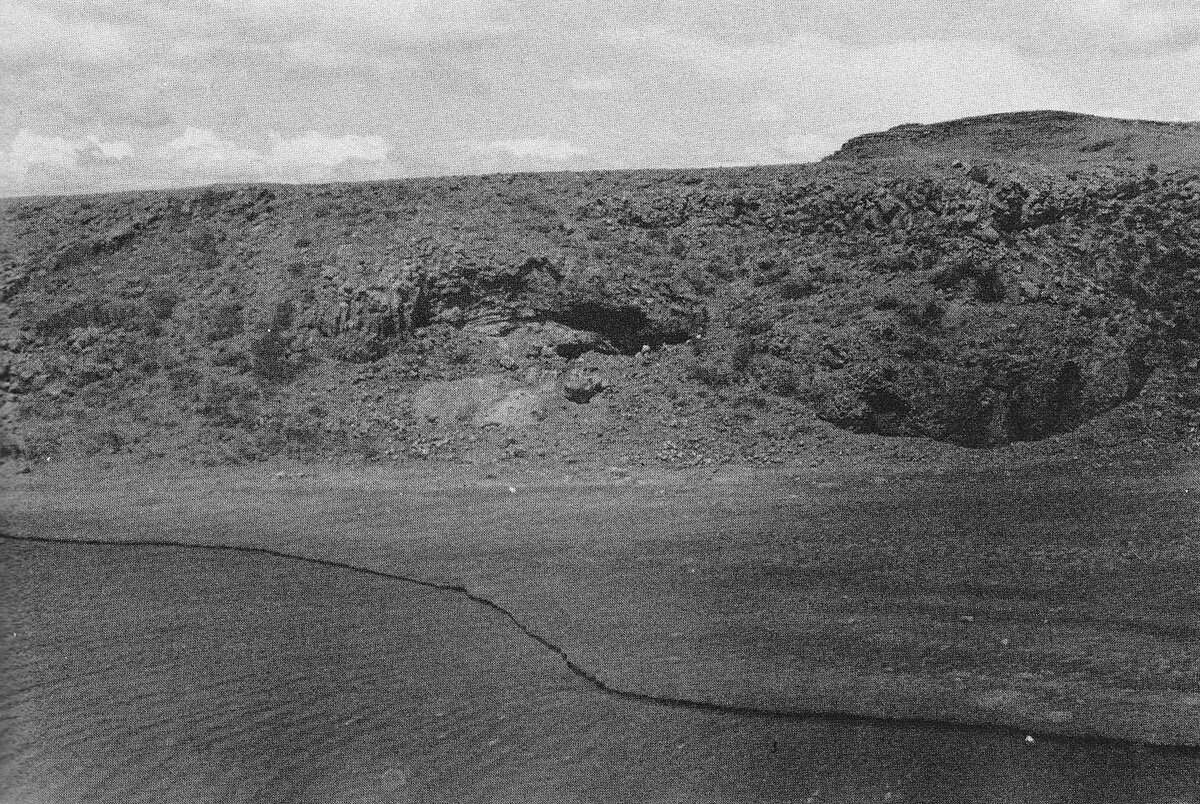
How did these populations reach the continent's far south so quickly? The Pacific coastal routePacific coastal routeThe hypothesis of a migration along the deglaciated Pacific coast (the 'kelp highway'), exploiting marine resources; favoured for the earliest arrivals.→ hypothesis, popularized as the "kelp highway," proposes that groups equipped with small watercraft skirted the shoreline, exploiting resource-rich kelp forests at a time when the interior remained partly blocked by ice. The productivity of these coasts would have allowed a rapid southward advance, from the Bering Strait to Patagonia. The debate pits supporters of a single, late entry against defenders of older and multiple migrationsMigrationsLong-distance movements of populations; a major driver of human history (the exit from Africa, the peopling of continents, Neolithic and steppe expansions).→. In this shifting landscape, the Peruvian Paijanian and the fishtail points offer two solid chronological and technical anchors, set at the heart of the transition between the PleistocenePleistoceneThe geological epoch of the great ice ages (c. 2.6 Ma–11,700 BP), spanning most of human prehistory.→ and the HoloceneHoloceneThe current geological epoch, begun about 11,700 years ago at the end of the last ice age; the setting of all post-glacial history.→.
The Paijanian: Fishers on the Coastal Desert
On Peru's north coast, between the valleys of the Jequetepeque, Cupisnique, Chicama and Moche rivers, stretches an arid desert where archaeology has revealed one of the oldest cultures in South America. First described in the 1940s by the Peruvian archaeologist Rafael Larco Hoyle from the Pampa de los Fósiles site, the Paiján culture owes its scientific recognition to the meticulous work of the French prehistorian Claude Chauchat, who recorded dozens of open-air sites: camps, knapping workshops and quarries.1 The complex is now dated to roughly 13,000 to 10,000 calibrated years before present, broadly 11,000 to 8,000 years in uncalibrated ages.6
The Paijanian environment was harsh: sparse vegetation, small animals (rodents, lizards, land snails). But the ocean, then some fifteen kilometers farther out than today because of a lower sea level, offered a decisive resource. In 1975, at the Pampa de los Fósiles, Claude Chauchat uncovered the skeletons of a teenager about twelve or thirteen years old and of a young woman about twenty-five, buried in a layer of ash and dated to 10,200 ± 180 years before present: these are the oldest known human remains in Peru.1 A French-Peruvian team, pairing Chauchat with the bio-anthropologist Jean-Paul Lacombe, documented some ten burials linked to this tradition, opening a rare window onto these first inhabitants.
The Paiján Point: A Needle of Stone
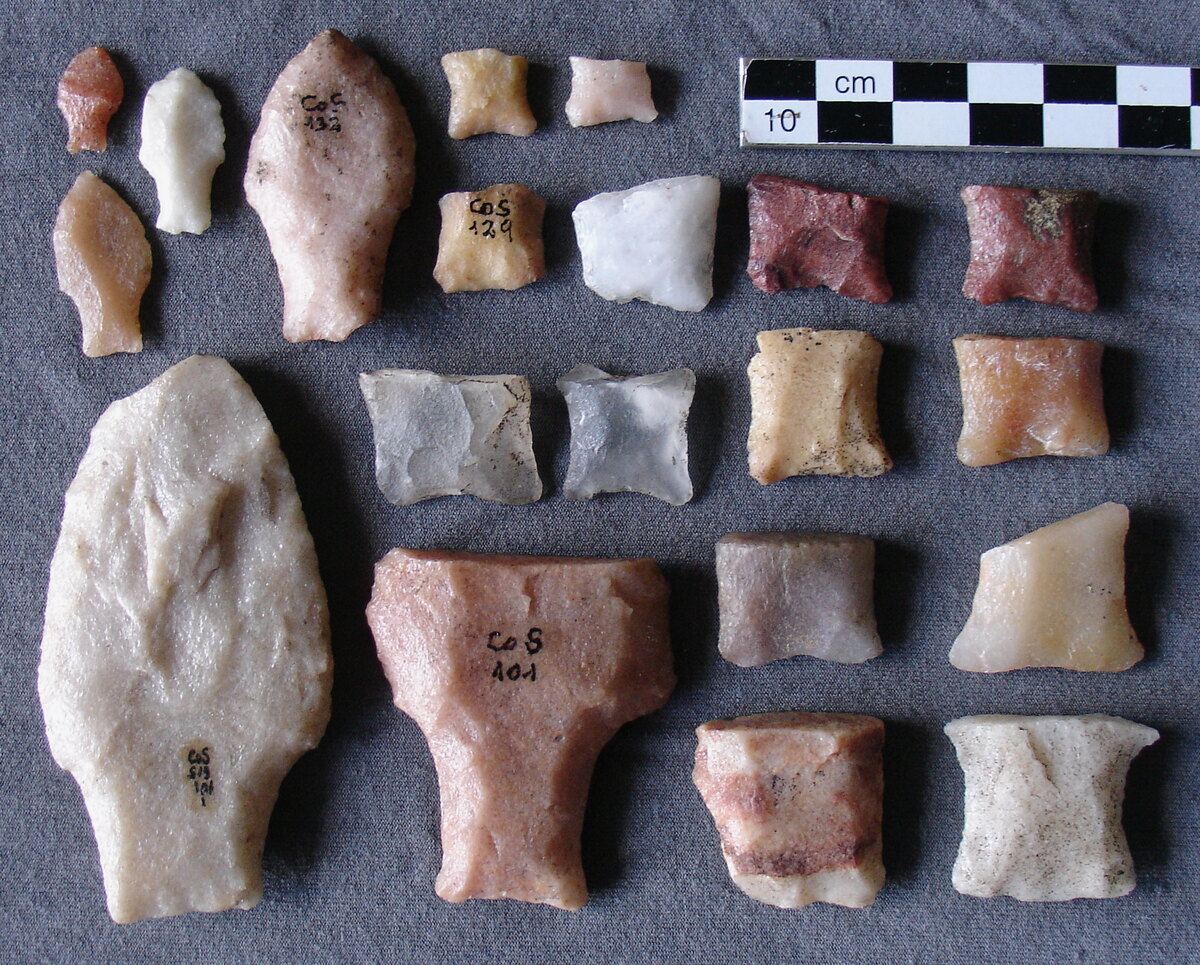
The signature of the Paijanian is its projectile point. Long, with a pronounced stemstemThe narrowed base of a point, used to haft it onto a shaft or handle.→, it tapers into an extraordinarily fine tip, almost a needle. Archaeologists distinguish several classes: lanceolate, triangular, intermediate and miscellaneous, according to where the maximum width falls on the body of the piece. Manufacture relied on careful knappingknappingThe set of operations for fracturing a stone block to extract flakes or blades.→ and bifacialbifaceA stone tool knapped on both faces to obtain a regular shape and cutting edges.→ shaping, working preforms down until this distinctive point emerged. The rest of the toolkit fills out the picture of an active daily life: single and double side-scrapers, unifacesunifacesA stone tool retouched on one face only.→ retouched on a single face, borers, and above all denticulates with thick, steep edges, which are very abundant.1
But what was this strange stone needle used for? The absence of large terrestrial fauna among the food remains of the campsites, combined with the highly unusual shape of the points, led researchers toward an appealing hypothesis: fishing. An experimental replication program for Paiján points, carried out on the north Peruvian coast, tested both their manufacture and their function. The results suggest that these points, hafted onto hollow shafts of reed or cane, served as harpoons to spear medium to large marine fish.2 Paijanian sites have indeed yielded fish remains, along with land snails and lizards, confirming a mixed economy oriented toward the sea and the desert's micro-resources. The Paijanian thus appears as an early coastal adaptation, far removed from the image of the big-game hunter alone.
Fishtail Points: The Signature of a Continent
At the other end of the geographic and functional spectrum lie the fishtail points. Their name comes from their silhouette: broad shoulders, a constricted stem and a flaring base evoking a fish's tail fin. It was the American prehistorian Junius Bird who defined them, under the name "Fell points," from his excavations at Cueva Fell (Fell's Cave), in the far south of Chilean Patagonia, near the Strait of Magellan.3 That site was the first to demonstrate a final-Pleistocene human occupation in South America.
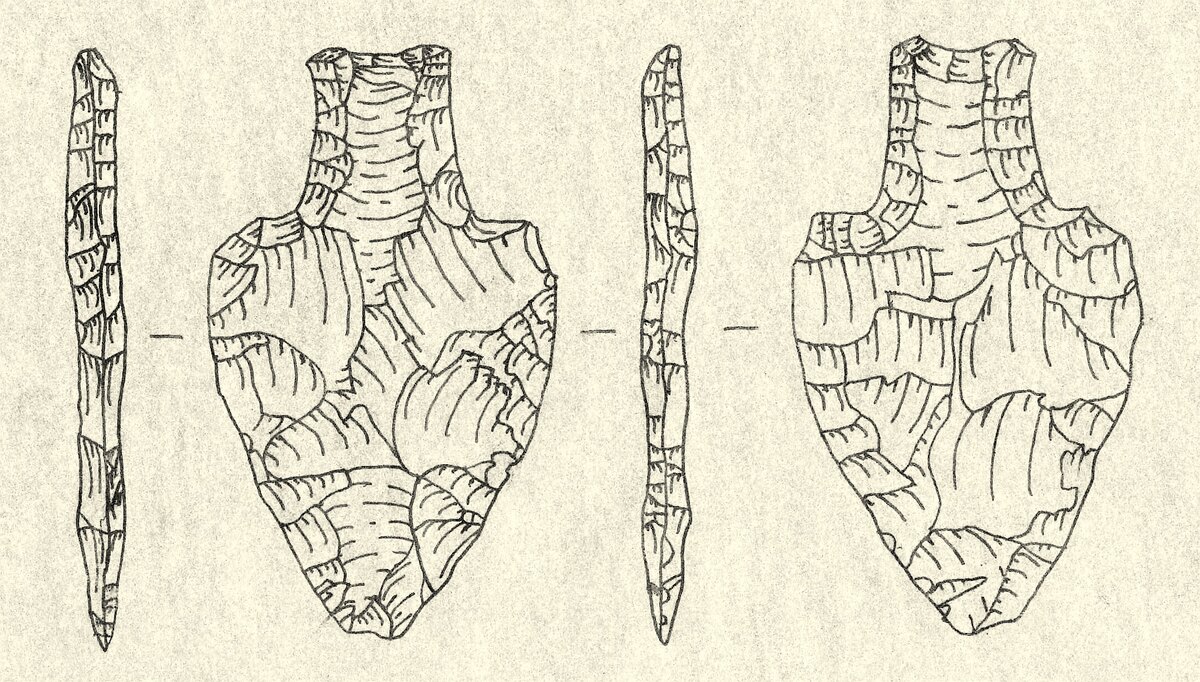
These points are the oldest widespread lithic style of the subcontinent, contemporary in its early phases with the use of Clovis points in North America.4 Their distribution is astonishing: the Pampas and Patagonia yield the greatest numbers, but they also occur in the Andes, as far north as Ecuador (the emblematic El Inga site), in Venezuela, in Uruguay, and across nearly all of Brazil, from the south up to the states of Mato Grosso, Goiás, Amazonas and Bahia.8 Technically, they were thinned bifaciallybifaceA stone tool knapped on both faces to obtain a regular shape and cutting edges.→, through a combination of percussion and pressure flakingpressure flakingA finishing technique that detaches thin flakes by pressing with a tool, without percussion.→, and often (though not always) show a basal flute recalling Clovis points. In Uruguay, knappers favored silcrete; in the Argentine Tandilia range, local quartzite. Like Clovis groups, these peoples sometimes carried raw material hundreds of kilometers, in one case nearly 480 km from a source, a sign of extreme mobility and perhaps of exchange between groups.4
Hunters of Big Game and the End of a World
If the Paijanians fished, the bearers of fishtail points hunted, and hunted big. These points were hafted onto darts, probably thrown with a spear-thrower, and reworked after use into burins or knives. They have been found in direct association with a now-extinct megafaunaMegafaunaThe very large animals (mammoths, giant ground sloths, etc.) of the Pleistocene, most of which became extinct at the end of the last ice age.→, notably the horse Hippidion. At the Piedra Museo site in Argentine Patagonia and at Cueva del Medio in southern Chile, bones of Hippidion saldiasi bearing butchery marks lie alongside Fell points, together with remains of guanacos and giant ground sloths such as Mylodon.4
The debate over the role of these hunters in the extinction of South America's megafauna is heated. A landmark study showed that the peak abundance of fishtail points coincides with the proposed interval for the disappearance of most of the continent's large mammals, suggesting that human hunting may have played a causal role.5 Tellingly, fishtail points vanish after the extinction, replaced by styles better suited to smaller prey. At the Paso Otero 5 site in the Pampas, Fell points are associated with burned bones of giant ground sloths (Megatherium, Lestodon, Glossotherium), glyptodonts, Toxodon and Macrauchenia. Direct associations remain rare, however, and some researchers argue for a scenario in which climateClimateThe long-term average atmospheric conditions of a region; its variations (glaciations, aridifications) shaped migrations, agriculture and the collapse of prehistoric societies.→, as much as the spear, hastened the end of these giants.
Two Technical Worlds, One Horizon
The Paijanian and the fishtail points form a striking contrast: on one side a stone needle for harpooning fish on a coastal desert, on the other a stocky, fluted blade for felling wild horses and ground sloths on the grassy plains. Yet these two technical worlds belong to the same chronological horizon, that of the Pleistocene-Holocene transition, and both attest to a fine capacity for adaptation to radically different environments. Far from a uniform peopling, Paleoamerican South America reveals itself as a mosaic of regional traditions.
This diversity can be read even in contact zones. At the Pampa Lechuza site, on the coastal desert of south-central Peru, researchers have recently identified the coexistence of fishtail points (including a quartz-crystal specimen) and Paiján-type technologies, in levels of the Pleistocene-Holocene transition. This overlap suggests a scenario of Andean peopling more intricate than once thought, in which the two traditions may have crossed paths or even interacted. The question of origins remains open: do fishtail points derive from North American Clovis points, as some suggest, or from local and Central American ancestors, a hypothesis defended notably by Hugo Nami?4
Dating and Debate: Reading Time in Stone
The chronology of these traditions remains an open field. For fishtail points, two models compete: a short chronology, tightened between 12,800 and 12,200 years before present, and a long chronology, stretched from 13,500 to 10,200 years.5 The redating of Fell's Cave, led by Michael Waters and colleagues using refined radiocarbon methods, played a key role in recalibrating the place of these points in time.3 On the Paijanian side, the sequence has been refined: the early phases show large bands moving between the coastal plain and the Andean slopes, while the late phases, dated between 11,200 and 9,600 calibrated years, reveal smaller and less mobile groups.6
According to Tom Dillehay, this reduction in mobility may be explained by the ameliorating Holocene climate, which increased the availability of wild plants and animals and reduced the need for long-distance movement. These fine adjustments, legible in the shape of the points and the layout of the camps, show that the first South Americans were not mere passing pioneers but societies capable of reinventing their way of life in step with ecological change. From the Paiján desert to the steppes of Fell, the lithic traditions of the late Pleistocene and early Holocene remain our most reliable guides for reconstructing this epic. Every recovered point, whether a fisher's needle or a hunter's blade, is a fragment of story wrested from the silence of stone.
Je vais utiliser cet article comme document-source en classe. La clarté de l'écriture est rare.
Les images de cet article m'inspirent vraiment. L'iconographie préhistorique est une mine.