Deep within a cave in the French Pyrenees, two bison sculpted in clay some 14,000 years ago remain frozen in their original posture. The Tuc d'Audoubert cave, nestled beneath the Volp massif in Ariège, houses one of the most extraordinary three-dimensional artworks of the entire Paleolithic era. These sculptures were only discovered in 1912, when the three sons of Count Henri Bégouën entered the underground network by boat.1
The cave is part of the Trois-Frères complex, a network of communicating cavities that rank among the best-documented paleolithic sanctuaries in Europe. Reaching the bison chamber requires navigating more than a kilometer of winding passages, crossing a submerged siphon, and climbing a rocky chimney. This extreme difficulty of access suggests the site held particular sacred significance for the magdalenianMagdalenianThe last great Upper Palaeolithic culture (c. 17,000–12,000 BC), the peak of cave art (Lascaux).→ artists who created these works.
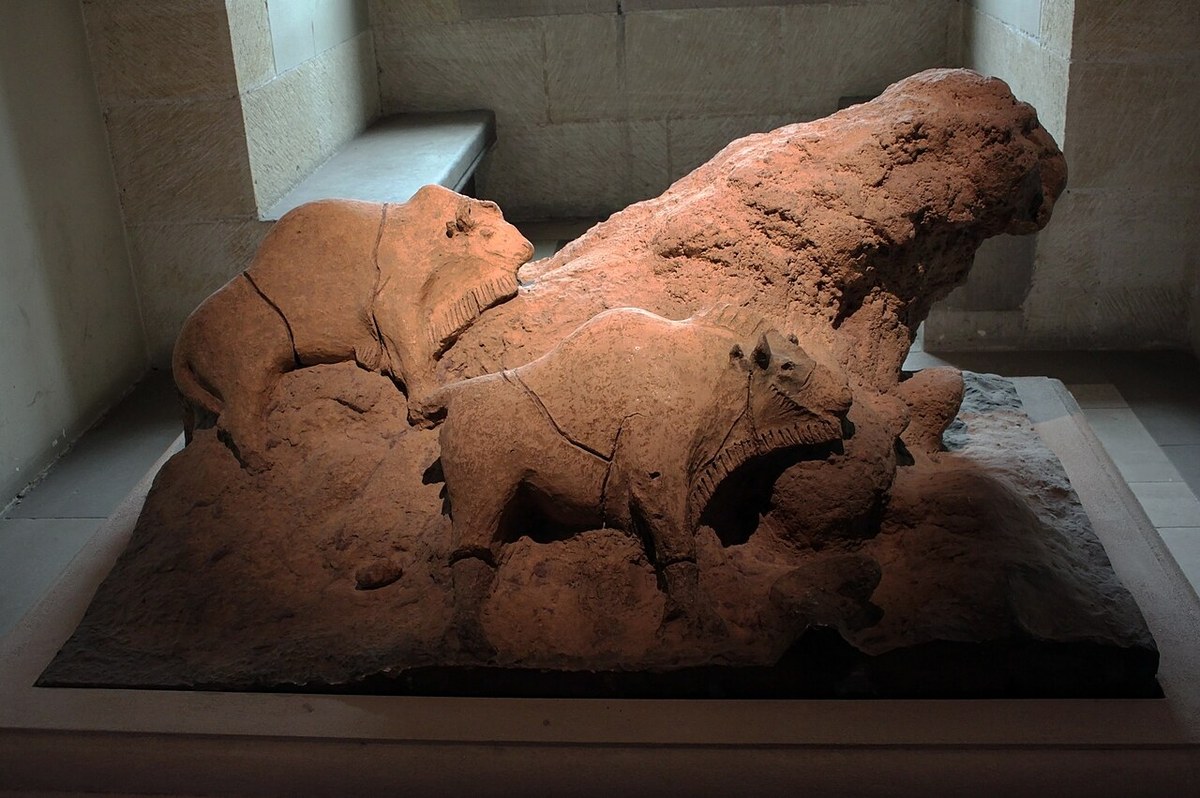
The two animals are sculpted in high relief against a rock. The female, the larger of the two, measures 63 centimeters in length; the male is slightly smaller at 61 centimeters. Their bodies are rendered with remarkable precision: one can distinguish the dorsal hump, nostrils, beard, and even the hooves. The raised tail suggests sexual behavior or agitation. A third, unfinished bison lies on the ground nearby, bearing witness to the creative process.
The Magdalenian artists worked the clay with bare hands, as evidenced by fingerprints still visible on the sculpture surfaces. They also used bone tools to refine certain details. What particularly impresses researchers is the exceptional technical mastery required to model such large volumes in clay without the material collapsing under its own weight.
Hundreds of human footprints have been recovered from the chamber floor, including those of children. These tracks, preserved in hardened clay, indicate the cave welcomed an entire community, not merely adult specialists. Several heel prints are planted deep into the floor, as though people had pivoted on the spot during a dance or ritual.2
Radiocarbon analysis of charcoal scattered through the cavern has dated the main occupation to between 13,500 and 14,000 years ago. At that time, southwestern Europe was inhabited by groups of hunter-gatherersHunter-gatherersA way of life based on hunting, fishing and gathering wild resources, without farming or herding; it dominated almost the whole of human history.→ who practiced an elaborate [[cave art|form of art]] both on open surfaces and deep within caves. The steppeSteppeA vast semi-arid, treeless grassland of Eurasia, suited to nomadic herding and the horse; a corridor for the movement of peoples and technologies in later prehistory.→ bison (Bison priscus) depicted here was the emblematic animal of their symbolic world.
The Tuc d'Audoubert cave remains inaccessible to the general public, protected by the Bégouën family who still own it. Only researchers with special authorization may enter. This protection has preserved intact unique vestiges that illuminate our understanding of spirituality and creativity among [[Upper Paleolithic]] humans.
No comments yet. Be the first.