On October 22, 1972, a 22-year-old excavator operator named Raycho Marinov was digging a trench near the Black Sea coast in Varna, Bulgaria, when his machine pulled up something unusual. He gathered the objects (bracelets, a breastplate), put them in a shoebox, and went home. A few days later, he called the local archaeological museum. That simple gesture would open one of the most significant discoveries in human history. The site, which became known as the Varna ChalcolithicChalcolithicThe "Copper Age": a transition between the Neolithic and the Bronze Age, marked by the first copper objects (Ötzi's era).→ NecropolisNecropolisA large organised burial ground, a "city of the dead", often spanning several periods.→, contains the oldest gold jewelry ever found in a tomb: pieces nearly 6,600 years old, predating Egypt's pyramids and Mesopotamia's ziggurats.1
An Exceptional Necropolis From the Copper Age
Excavations led by Mihail Lazarov and Ivan Ivanov from 1972 to 1991 uncovered 294 graves. Radiocarbon dating places the burials between 4,600 and 4,200 BCE, during the ChalcolithicNeolithicThe "New Stone Age": a period marked by farming, herding, settlement and pottery, from around 10,000 BC.→ period, also known as the Copper Age, roughly a thousand years before Egypt's first dynasties. Of those graves, 62 contained gold objects. In total, more than 3,000 gold artifacts were recovered, with a combined weight of six kilograms. This represents the oldest known evidence of gold craftsmanship in human history.2
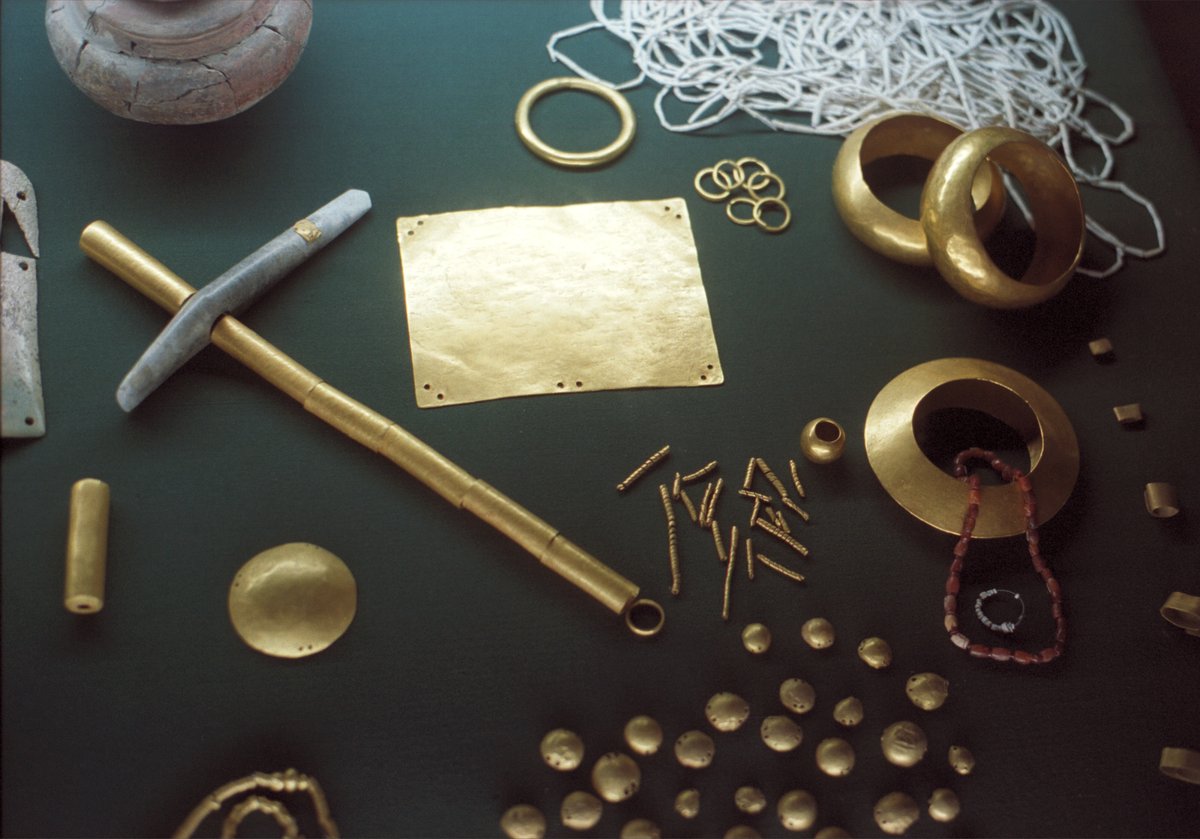
The distribution of that gold is striking. Just four graves (numbers 1, 4, 36, and 43) concentrated more than five kilograms of the total six. That is more than all gold objects from the same era found anywhere else in the world combined. Vladimir Slavchev, curator at the Varna Archaeological Museum, compared these gold-laden elites to "the Copper Age equivalent of the wealthiest one percent." The site thus stands as a prototype of the first formalized social hierarchies in Europe, predating the Sumerian and Egyptian civilizations by at least half a millennium.
One caveat worth noting: a tiny bead discovered in 2016 at another Bulgarian site may be slightly older than the Varna objects, but its dating remains uncertain. The Varna jewelry remains, to this day, the most complete and best-documented corpus of the oldest gold in human history.
Grave 43: One Man and His Extraordinary Gold
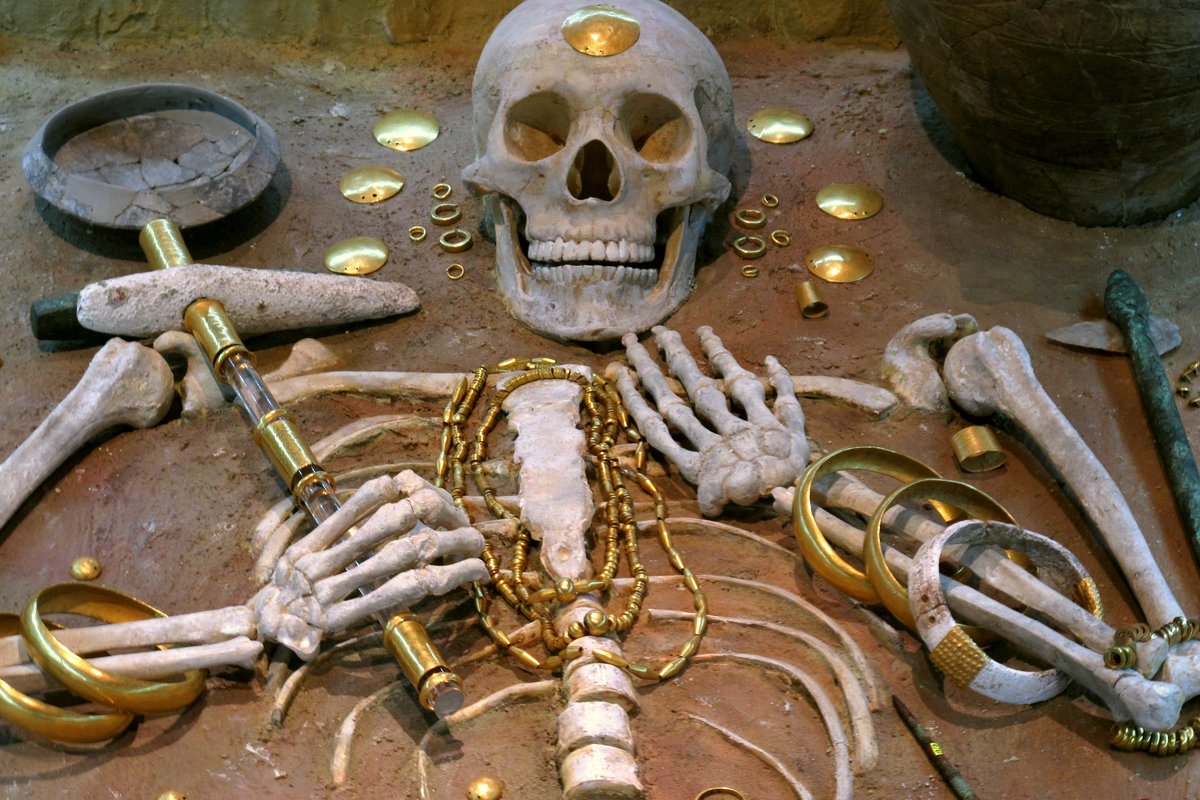
Among all the burials in the necropolis, Grave 43 stands apart. It held the skeleton of a tall man, more than 60 years old, buried with 990 individual gold objects weighing 1.5 kilograms in total, nearly a third of all the gold at the site. His burialBurialThe intentional deposition of a body, sometimes with offerings; a marker of symbolic behaviour.→ included bangles, beaded necklaces, a gold-sheathed axe handle, a 16-inch flintFlintA hard, brittle siliceous rock, knapped by prehistoric people to produce blades, points and sharp tools.→ blade, and one object with no parallel anywhere in world archaeology: a solid gold penile sheath, positioned near his pelvis.3
Modern genetic analyses have identified the man's paternal haplogroup (Y-DNADNAThe molecule carrying genetic information, used to reconstruct kinship between species.→ T-M184) and his maternal haplogroup (mitochondrial DNA U2). A 2024 isotopic study of carbon and nitrogen ratios from 60 Varna burials shed further light on how these people actually lived. The data revealed significant variation in diet according to social status: elite burials show dietary patterns consistent with greater access to animal protein, while lower-status graves reflect plant-dominant diets. The hierarchy at Varna was not merely symbolic -- it was metabolic.
Who exactly was this man? Hypotheses oscillate between a political leader and a master metalsmith. In proto-historic societies, mastery of a rare skill -- such as transforming a precious metal -- could confer status equivalent to political power. The Varna Museum of Archaeology describes the necropolis as "a prototype of social and political structure," representing the earliest known evidence of formalized class stratification on the European continent.
The Birth of Prestige and Social Hierarchy
Why did gold emerge as a status marker here, in the Balkans, 6,600 years ago? Archaeologists point to a context of converging innovations: the development of unprecedented mining and metallurgical techniques, the rise of long-distance trade around the Black Sea and eastern Mediterranean, and the consolidation of prosperous sedentary agricultural communities capable of supporting specialized craftspeople.
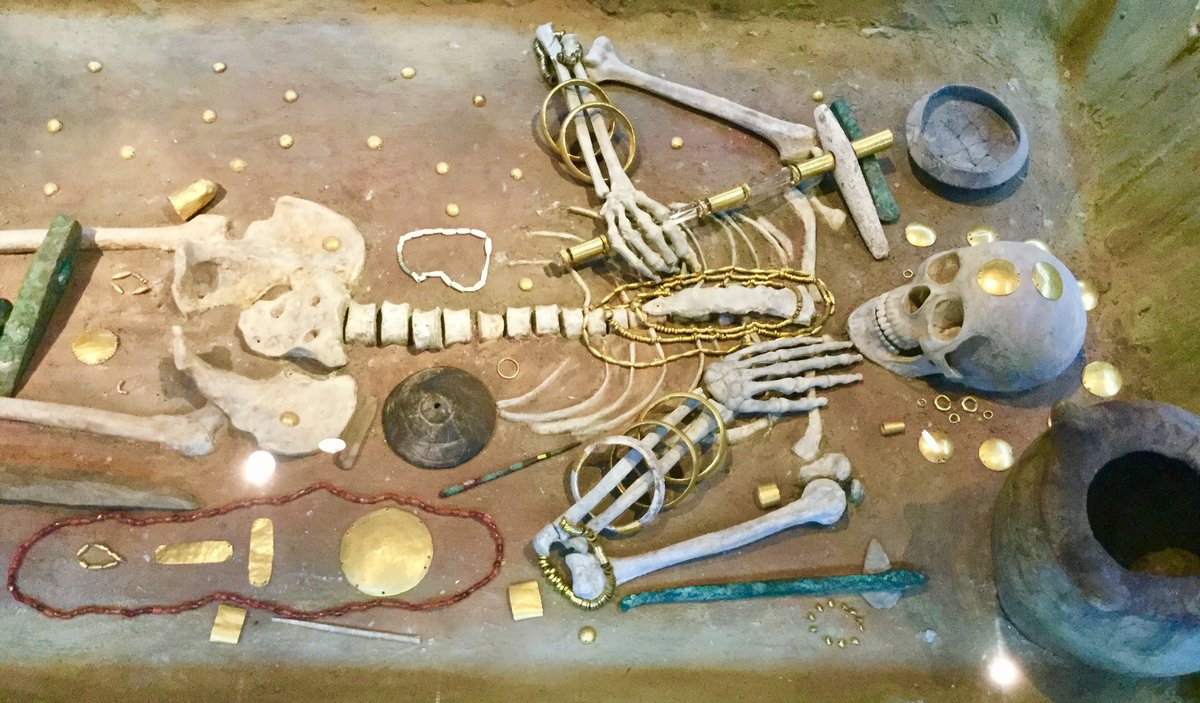
The gold of Varna was not simply a sign of material wealth. It embodied a sacred status, a prerogative of leaders or holders of specialized knowledge. The fact that graves without skeletons -- so-called "symbolic" graves -- also contained considerable quantities of gold (Grave 36, a symbolic tomb, held more than 850 gold items) suggests that the precious metal played a ritual role as much as an ostentatious one. Gold imposed itself as a universal language of power, long before the first writingWritingA system of conventional signs used to fix language or information durably; its appearance (c. 3300 BC) marks, by convention, the end of prehistory.→ systems.
The British archaeologist Sir Colin Renfrew, one of the world's leading authorities on prehistoryPrehistoryThe span of human history before the invention of writing, from the Palaeolithic to the Metal Ages, known mainly through material remains.→, was among the first to grasp the significance of this discovery: "The oldest gold treasure in the world was not found in Sumer or Egypt. It was found in northeastern Bulgaria." That sentence alone summarizes the shift in perspective that Varna has imposed on our understanding of civilization's origins.
An Excavation Still in Progress
Approximately 30% of the Varna Necropolis remains unexcavated. Work halted in 1991 and only resumed in 2021 under the auspices of the Varna Regional Museum of History. Archaeologists are targeting full excavation of the site's eastern section by the end of 2026. What remains buried in this unexplored third could still alter our understanding of this society and its funerary practices.
Each additional grave is a window into the mechanisms of emerging social stratification, the distribution of resources, and beliefs about the afterlife. The Varna Necropolis is not simply the world's oldest gold treasure: it is one of the rare places where we can observe, in physical matter, the earliest signs of what would become the fundamental structures of all human civilizations -- power, privilege, and death.
Ce point mériterait une nuance, mais l'ensemble est rigoureux pour du grand public. Bon travail.
Je montre ces articles à mes apprentis. La continuité entre les premiers outils et nos techniques est frappante.
J'ai recommandé ce site à trois collègues. On en parle maintenant pendant les pauses.