They fit in the palm of a hand. A few centimetres of ivory, limestone or fired clay, shaped as much as forty thousand years ago, and yet these small female figures rank among the most debated objects in all of prehistoryPrehistoryThe span of human history before the invention of writing, from the Palaeolithic to the Metal Ages, known mainly through material remains.→. We call them "Venuses": a convenient name, inherited from the nineteenth century, that already says a great deal about how modern societies have looked at them. From the Venus of Hohle Fels, unearthed in the Swabian Jura, to the Venus of Willendorf, the Austrian icon of Ice Age statuary, by way of the Lady of Brassempouy, the Venus of Dolní Věstonice and that of Laussel, these statuettes trace a symbolic geography running from the Atlantic to the Russian plain. To understand the PalaeolithicPalaeolithicThe oldest and longest period of prehistory (c. 3.3 Ma–12,000 BC), defined by chipped stone tools and a hunter-gatherer way of life.→ Venuses is to question one of the oldest figurative traditions of humankind, and with it the birth of a shared symbolic thought.
The stakes go far beyond aesthetic curiosity. These objects raise dizzying questions: why did human groups separated by thousands of kilometres and millennia represent the female body according to such similar conventions? What did these figures mean to those who made and carried them? And to what extent have our own assumptions, about fertility, beauty, the sacred, the role of women, distorted the way we read them? None of these questions admits a final answer. That is precisely what makes the Venuses a privileged ground for observing the methods, the hopes and the blind spots of prehistoric research.
The word "Venus": a stubborn anachronism
Let us begin with the name, for it is not innocent. None of these figures has, of course, the slightest connection with the Roman goddess of love. The term appears in the second half of the nineteenth century, when the first female statuettes were discovered in the rock shelters and caves of France. In 1864, the Marquis Paul de Vibraye named a small ivory figure found at Laugerie-Basse the "Vénus impudique", the immodest Venus, in ironic antithesis to the Venus pudica of ancient statuary, whose hands conceal her nudity. The learned sarcasm hardened into a scientific category: throughout the twentieth century, "Venus" designated the whole body of female representations in Ice Age portable artPortable artTransportable art objects (figurines, engravings on bone or ivory), such as the Palaeolithic Venuses.→.
The trouble is that the word carries an entire imaginary world, that of ideal beauty, of the goddess, of female sexuality as seen by nineteenth-century men. Applied to objects tens of thousands of years old, it projects an alien frame of reference onto unknown cultures. Many prehistorians today prefer to speak of "female figurines" or "Palaeolithic female statuettes", judged more neutral. Others keep the term "Venus" for convenience and tradition, while flagging its conventional character. This terminological debate is not a quarrel over words: it reminds us that to name is already to interpret, and that prehistory is always read through the spectacles of the age that studies it.
To call these figures "Venuses" is to impose on them, retrospectively, a mythology that did not yet exist. The word tells us more about its inventors than about its objects.
We must also beware of a misleading homogenisation. To speak of "the Venuses" in the plural suggests a single, coherent category, almost an artistic school. Yet the figures grouped under this label span nearly twenty-five thousand years and cover an entire continent. Between the Hohle Fels statuette and the much later figures of the Russian plain there is as much temporal distance as between ourselves and the beginning of the Upper PalaeolithicUpper PalaeolithicThe final phase of the Palaeolithic (c. 45,000 to 10,000 years ago), marked by Homo sapiens in Europe, art, ornaments and a succession of cultures (Aurignacian, Gravettian, Solutrean, Magdalenian).→. Gathering all this under a single word is practical, but potentially blinding. The diversity of materials, styles and contexts invites us to speak of traditions, in the plural, rather than of one unified phenomenon.
Hohle Fels, the oldest
If we seek a chronological starting point, it lies in a cave of the Swabian Jura, in south-western Germany. In 2008, the team led by archaeologist Nicholas Conard uncovered, in the AurignacianAurignacianThe earliest culture of the European Upper Palaeolithic (c. 43,000–33,000 BC), tied to the arrival of Homo sapiens and the first artworks.→ layers of the Hohle Fels cave, a small mammoth-ivory figure broken into six fragments. Once reassembled, it measures barely six centimetres. Published in the journal Nature in 2009 [s1], the Venus of Hohle Fels immediately became the oldest indisputable figurative representation of the human body known to date, dated to at least thirty-five to forty thousand years.
The figure is strikingly expressive. The breasts are voluminous, thrust forward; the belly is pronounced, the hips broad, the vulva explicitly indicated. The slender arms fold over the torso, the hands resting above the belly. In place of the head, the artist carved a small, carefully perforated ring, a sign that the object was worn as a pendant, suspended from a cord. The wear on this ring suggests prolonged use. Far from being a mere icon to contemplate, the Venus of Hohle Fels was an object handled, carried, perhaps worn against the body.
The context of this discovery is essential. The Swabian Jura has yielded, in the same Aurignacian levels, an exceptional set of ivory portable art objects: animal figurines, birds, horses, and above all the famous lion-men, composite beings blending human and feline traits. Hohle Fels itself also produced one of the oldest known bone flutes. This concentration makes the region one of the earliest documented centres of figurative art. The Venus is not an isolated object there but an element of an already rich symbolic repertoire, fashioned by the first anatomically modern hominids settled in Europe.
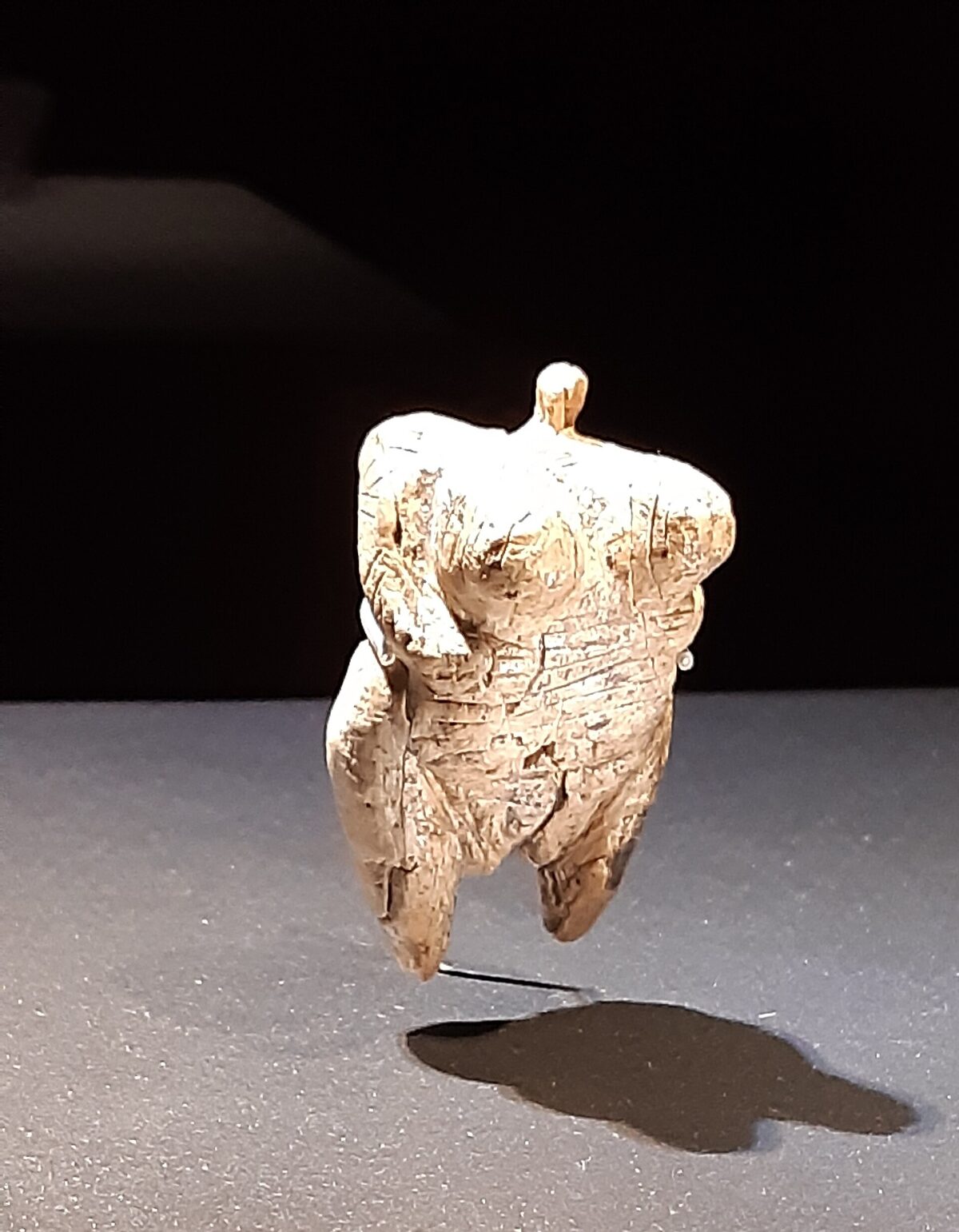
The dating of Hohle Fels has major consequences for our understanding of the emergence of art. It shows that, from their arrival in Europe, Aurignacian groups already possessed the capacity and the desire to represent the human body in a codified manner. The technical sophistication, working hard ivory, perforation, polishing, implies a transmitted skill, hence an earlier tradition whose first stages may escape us. Art is not born in Europe; it arrives there with populations already carrying an elaborate symbolic thought, of which the Venuses are one of the most striking expressions.
Willendorf, the GravettianGravettianAn Upper Palaeolithic culture (c. 33,000–21,000 BC) spanning from the Atlantic to Siberia, famous for its ivory female figurines ("Venuses") and, at Dolní Věstonice, the oldest fired ceramics.→ icon
If Hohle Fels is the oldest, the Venus of Willendorf is without doubt the most famous. Discovered in 1908 on the banks of the Danube, in Lower Austria, during excavations along a railway line, this statuette of oolitic limestone, about eleven centimetres high, has become the universal emblem of Ice Age art. Dated to around thirty thousand years, it belongs to the Gravettian, a period that sees female figurines multiply across Europe.
The Venus of Willendorf concentrates all the traits that have fed the interpretation of these objects. The breasts are enormous, the belly prominent, the buttocks and thighs massive; the pubic triangle is clearly engraved. The slender arms rest on the chest. The face is absent: the head is entirely covered with a network of concentric ridges, long interpreted as a plaited hairstyle or headdress, sometimes as a stylised representation of hair. The feet are not depicted, as is often the case in this tradition: the figure does not stand on its own, suggesting that it was meant to lie down, to be held, or to be set into a support.
For a long time, the source of the stone was unknown. A study published in 2022 in Scientific Reports [s3] renewed the question by analysing the microstructure of the statuette's oolitic limestone through micro-tomography. The researchers compared its mineralogical signature with samples from deposits across Europe. Their conclusion is spectacular: the stone most probably came not from the immediate surroundings of Willendorf, but from a region hundreds of kilometres away, perhaps from northern Italy, south of the Alps, or from the east of present-day Ukraine.
If the Willendorf stone crossed the Alps, then the statuette itself, or the raw material to carve it, travelled hundreds of kilometres, evidence of human networks of an unsuspected scale.
This finding transforms the reading of the object. It implies that either the finished statuette or the limestone block intended for carving was transported over very long distances, probably across several generations of seasonal movement. The Venus of Willendorf ceases to be a strictly local production and becomes the material witness of exchange networks and mobility covering a large fraction of Gravettian Europe. The journey of the stone tells a human story of circulation, contact and transmission that far exceeds the mere question of the figure's religious or symbolic meaning.
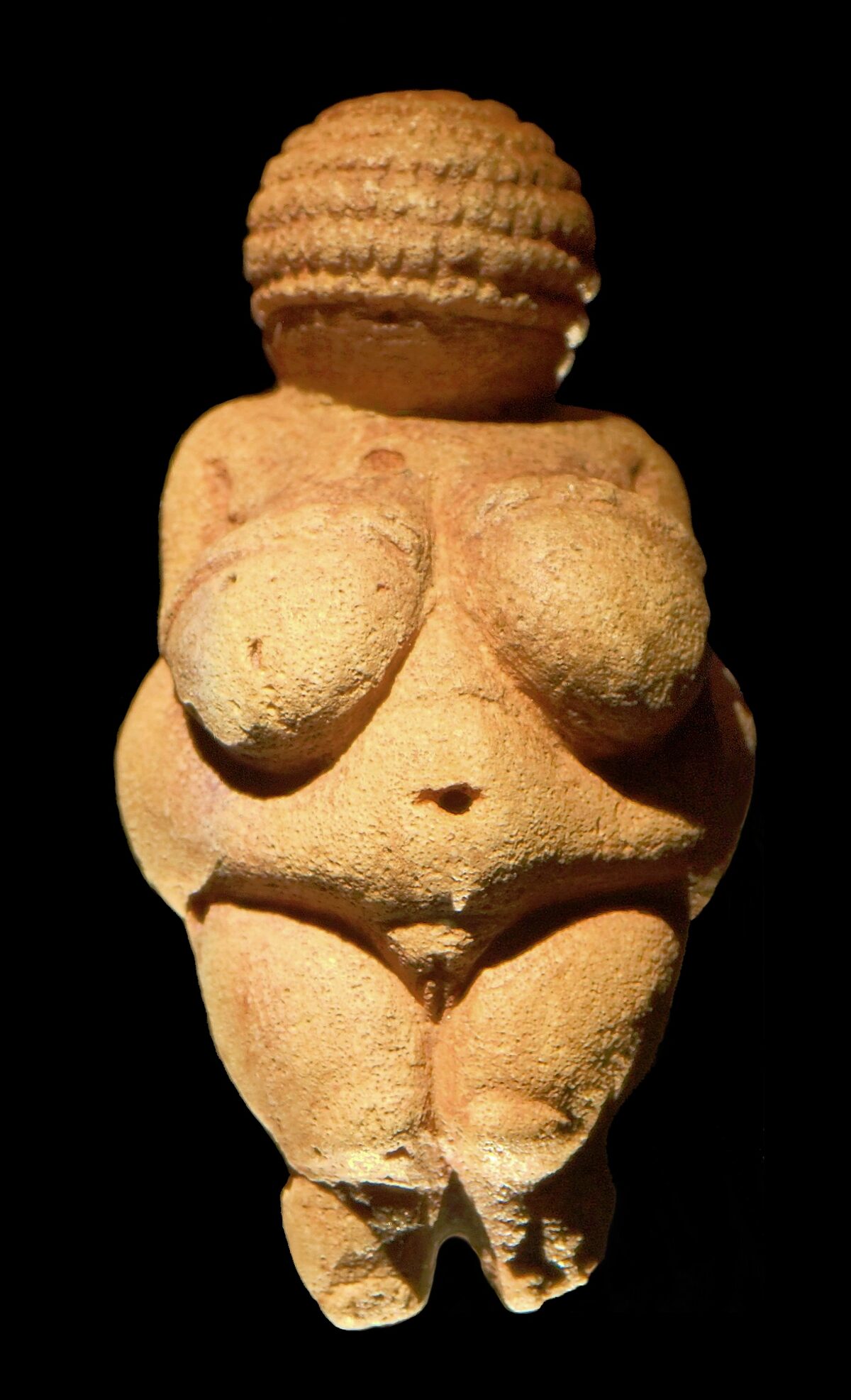
The Venus of Willendorf has also enjoyed a second life, that of cultural icon. Reproduced endlessly, it has become a visual shorthand for "prehistory" and "primordial femininity". This fame has a downside: by being detached from its archaeological context, it has accumulated modern meanings, fertility symbol, mother goddess, "original" bodily ideal, that are in no way attested for the period of its manufacture. The history of its reception has thus become a textbook case of contemporary projections onto the deep past.
A continent-wide phenomenon
Hohle Fels and Willendorf are not exceptions. The European Upper Palaeolithic has yielded several hundred female figurines, distributed from the Pyrenees and south-western France to the Russian plain and Siberia. This geographical spread, over thousands of kilometres, is one of the most baffling aspects of the phenomenon. How are we to explain that, at the heart of the last glacial period, distant groups shared the same figurative repertoire?
The Lady of Brassempouy, discovered in the Landes region in 1894, offers a striking counterpoint to the opulent figures. This small ivory head, barely a few centimetres high, is one of the oldest realistic representations of a human face. The forehead, nose and brow ridges are finely modelled; a grid of crosshatched lines evokes a hairstyle or a net. The lower part of the face, by contrast, is barely sketched: neither mouth nor chin clearly marked. This figure shows that the Venus tradition is not limited to anonymous bodies: some Gravettian artists also sought to individualise the face, opening the debated possibility of portraiture.
Further east, the Moravian site of Dolní Věstonice, in the present-day Czech Republic, has yielded one of the most important discoveries in all of prehistory: the oldest known ceramic. Long before the invention of utilitarian pottery in the NeolithicNeolithicThe "New Stone Age": a period marked by farming, herding, settlement and pottery, from around 10,000 BC.→, the Gravettian hunters of this site, around twenty-six to twenty-nine thousand years ago, modelled clay and fired it in hearths. Among the thousands of fired-clay fragments are animal figurines and the famous Venus of Dolní Věstonice, a female statuette with ample forms. Analysis has shown that some of these figures bear fingerprints, and that many shattered during firing, perhaps intentionally, the thermal shock being part of the ritual gesture.
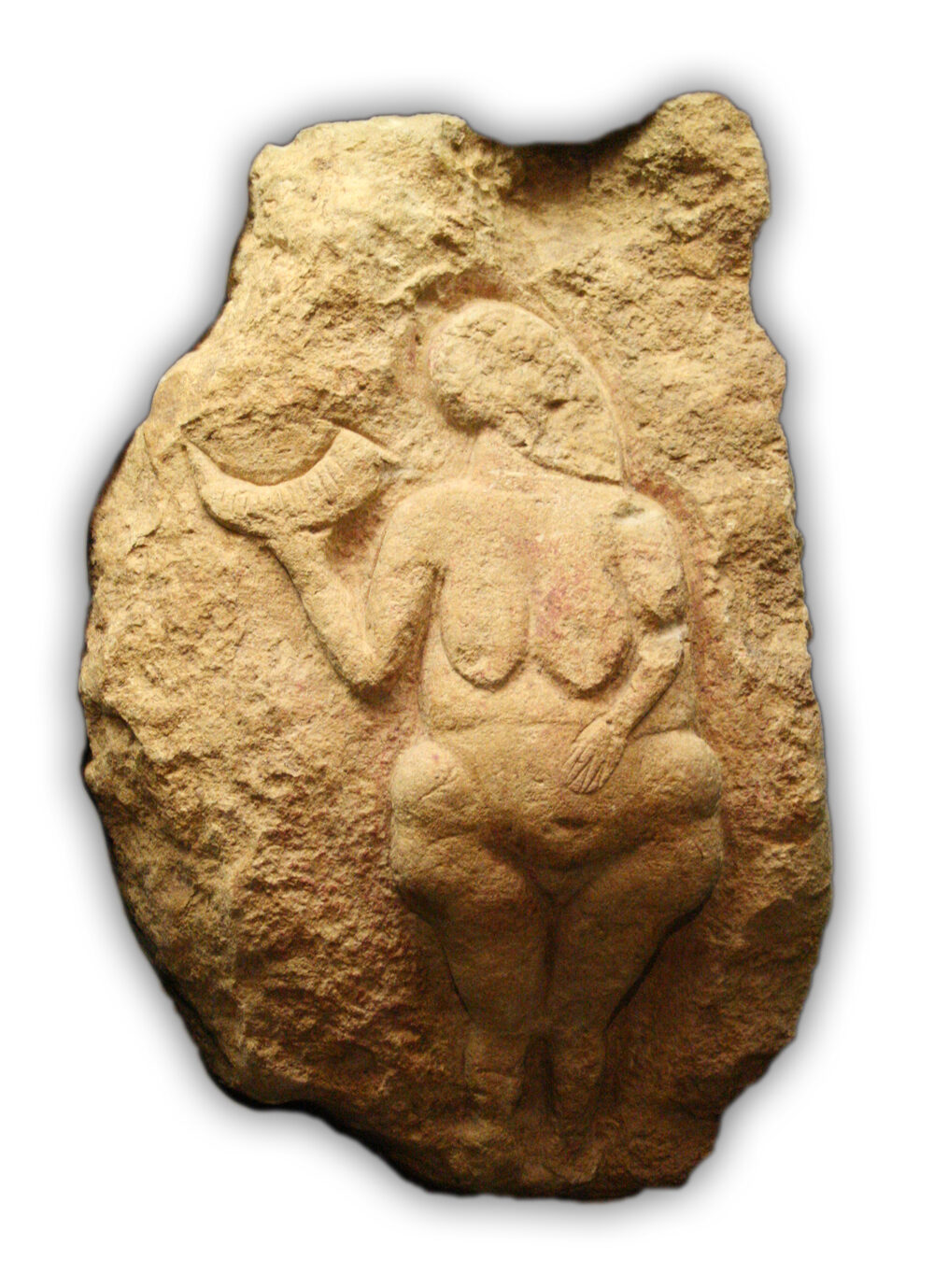
To the south-west, in the Périgord, the Venus of Laussel introduces yet another variant. It is no longer a portable statuette, but a bas-relief carved directly into a limestone block that adorned a large rock shelterRock shelterA shallow cavity at the foot of a cliff or under a rocky overhang, offering natural shelter; a favoured site of prehistoric habitation and rock art.→. The figure, about fifty centimetres high, holds in its raised right hand a curved bison horn engraved with thirteen incisions. With its left hand, it points to its belly. Traces of red ochreOchreA red or yellow mineral pigment (iron oxides), used from prehistory for adornment, funerary rites and art.→ survive on its surface. This "Venus with a horn" illustrates the slender but real transition between portable and monumental art, and has fed countless hypotheses about possible lunar, calendrical or hunting symbolism.
Mention must finally be made of the Venus of Lespugue, discovered in 1922 in the Haute-Garonne. Carved from mammoth ivory, about fifteen centimetres high, it pushes Gravettian stylisation to its limit: the volumes of the body, breasts, belly, buttocks, thighs, are organised into symmetrical lozenges of an almost abstract geometry. At the back, fine striations descend from the buttocks, interpreted as the representation of a flexible garment, perhaps a skirt of plant fibres. Lespugue testifies to a technical virtuosity and a formal sophistication that forbid us to reduce these objects to mere naïve offerings.
Materials and techniques: ivory, limestone, clay
The diversity of materials employed is in itself rich with lessons. Mammoth ivory dominates in the northern and eastern regions, where these great proboscideans were hunted or their tusks recovered. Working ivory is a demanding operation: the material is hard, dense, prone to splitting along its concentric laminae. The sculptor had to rough out the block, shape it by abrasion and scraping with flintFlintA hard, brittle siliceous rock, knapped by prehistoric people to produce blades, points and sharp tools.→ tools, then polish the surface, sometimes to a silky sheen. The perforation of suspensions, as at Hohle Fels, added a further difficulty. Each ivory statuette thus represents hours, even days, of patient work.
Limestone, as at Willendorf or Laussel, allows another relationship with the material. Softer, it lends itself to direct carving and the engraving of fine details, but it is also more fragile and heavier. The choice of a specific oolitic limestone, sometimes transported from afar, shows that craftsmen selected their materials with care, perhaps for their colour, their grain or their meaning. The presence of red ochre on several figures, Laussel, Willendorf, suggests that they were originally coloured, which radically changes the image we have of them: vivid, red objects, and not the bare grey surfaces we contemplate today.
The fired clay of Dolní Věstonice opens a third path, technologically revolutionary. To master the transformation of raw clay into a hard, durable material through heat presupposes an empirical understanding of material properties that would not be reinvested in utilitarian production for millennia. That this major pyrotechnic innovation was first mobilised to make figurines, and not vessels, says a great deal about the place of the symbolic in the priorities of these societies. The most advanced technique of the time was placed at the service of the image, not the tool.
These technical choices are never neutral. The material, its provenance, its treatment, its colour all contribute to the meaning of the object. A mammoth-ivory Venus incorporates something of the animal from which it comes; a Venus of limestone brought from afar carries the memory of a journey; a fired-clay Venus condenses the mastery of fire. The material is not a mere support: it is, perhaps, an integral part of the message.
Shared stylistic conventions
Beyond their diversity, the Palaeolithic Venuses present striking regularities that have fed the idea of a common "canon". The recurrence of these traits over thousands of kilometres is the central argument in favour of the existence of a shared figurative tradition.
First trait: the accentuation of sexual and reproductive characters. Breasts, belly, hips, buttocks and the pubic region are almost systematically amplified, sometimes to the point of hypertrophy. Conversely, the elements judged less significant are neglected. Second trait: the reduction or absence of the face. Many figures have no facial features, the head being smooth, covered with motifs, or simply absent. Brassempouy is in this respect an exception. Third trait: the atrophy of the extremities. Slender arms folded over the chest, hands barely indicated, legs ending in a point with no real feet. The figure does not stand by itself.
This formal grammar has often been described as the projection of a particular point of view. Researchers have noted that the silhouette of the Venuses, seen from above, resembles what a woman would perceive looking down at her own body: prominent breasts and belly in the foreground, legs receding in foreshortening, face invisible. This "self-portrait" hypothesis suggests that some figurines might have been made by women representing themselves, which would radically reverse the traditional scheme of a male art contemplating the female body.
Seen from above, the silhouette of a Venus matches exactly what a woman sees of her own body when she looks down. What if some of these figures were self-portraits?
We must nonetheless beware of the "canon" effect. The regularity we perceive is partly an artefact of our gaze, which retains resemblances and erases discrepancies. The figurines in fact display great variability: sizes, proportions, the presence or absence of engraved garments, postures, treatment of the heads. Some are so schematic as to be barely identifiable as female. The "Venus type" is as much an analyst's construction as a prehistoric reality, and caution requires that we not crush this diversity beneath a single model.
Interpretations: from the sacred to the social
What did these figures mean? The question has haunted research for more than a century, and each generation has answered in its own way, often revealing as much its own preoccupations as those of the Palaeolithic. The main hypotheses can be grouped into a few broad families.
The oldest and most tenacious is that of fertility. The accentuation of reproductive organs and of forms associated with motherhood naturally suggested that these objects were linked to reproduction, pregnancy, the perpetuation of the group. In hunter-gatherer societies where demographic survival was precarious, propitiatory figurines intended to favour births would have had a vital function. This reading, attractive as it is, nevertheless remains a deduction from form, with no direct evidence of a ritual use linked to fertility.
A variant enjoyed immense success in the twentieth century: that of the mother goddess. Some wished to see in the Venuses the first deities of humankind, witnesses of a primordial religion centred on a great goddess of Earth and life, and of a matriarchal social organisation. This hypothesis, championed by certain currents of twentieth-century archaeology, appealed far beyond scholarly circles. It suffers, however, from a major flaw: nothing in the archaeological context allows us to assert the existence of a pantheon or an organised cult. The mother goddess is a retrospective projection that says more about modern expectations than about Palaeolithic beliefs.
Other, more recent avenues shift the analysis from the religious to the social. Some have proposed seeing them as amulets or apotropaic objects, worn on the person for protection, the Hohle Fels suspension points in this direction. Others read them as markers of identity or network: objects whose shared style attested membership of an extended community, or even facilitated exchange between distant groups. Still others speak of social codes: teaching aids, markers of female life cycles, or elements of a symbolic communication system whose key escapes us. The self-portrait hypothesis, already mentioned, belongs to this same desire to restore to women a role as agents, and not merely as objects of representation.
None of these interpretations exhausts the phenomenon, and it is likely that none is universally true. Over twenty-five thousand years and an entire continent, the same form may have covered very different meanings according to place and period. The trap would be to seek THE single key. Methodological wisdom invites us rather to acknowledge the plurality of possible functions and the irreducible share of the unknown.
Feminist and historiographical critiques
For some decades, a critical current has profoundly renewed the way we look at the Venuses, by questioning not only the objects but the researchers themselves. Gender studies have shown how far the interpretation of these figures had been shaped by male assumptions. Described as "obese", "steatopygous", "erotic" or "grotesque", reduced to their sole reproductive or sexual function, they were long read through the prism of modern male desire, projected onto a silent past.
This critique operates on several levels. On vocabulary first: to call these bodies "obese" imports a contemporary medical and aesthetic judgement utterly foreign to glacial societies. On function next: to assume that these objects served the visual pleasure of men amounts to reproducing a scheme in which women are objects and men subjects. On producers finally: nothing establishes that Palaeolithic artists were exclusively men, and the self-portrait hypothesis reminds us that women may have been the authors of these figures.
For a century, the Venuses were described in the vocabulary of modern desire and aesthetic judgement. Feminist critique has shown that this frame said more about the scholars than about prehistory.
The historiographical dimension of this critique is essential. It does not merely propose new interpretations: it brings to light the way in which science itself is situated, shot through with the values and blind spots of its time. The history of the Venuses then becomes a mirror held up to the discipline, inviting it to greater reflexivity. To recognise that the "mother goddess" or the "erotic Venus" are first of all products of the modern gaze does not disqualify the inquiry; it makes it more lucid. Interpretive caution, far from being a surrender, is a scientific requirement.
Portable art and parietal art: two regimes of the image
The Venuses belong to portable art, that is, art carried on transportable objects, as opposed to parietal art, fixed on the walls of caves. This distinction is not a mere classificatory convenience: it points to two regimes of the image, two ways of inscribing the symbolic in the world.
Parietal art, the great painted and engraved ensembles of the caves, is by nature monumental and collective. It is set in particular places, sometimes hard to reach, and overwhelmingly favours animals: horses, bison, aurochs, mammoths. Human figures there are rare and often schematic. Portable art, by contrast, is intimate, individual, manipulable. It can be held, carried, worn on the person. And it is precisely there, in this portable art, that the human body, and singularly the female body, occupies a leading place. This distribution is not trivial: it seems that glacial societies reserved certain images for certain supports.
The Venus of Laussel stands precisely at the point of contact between these two worlds. Carved in bas-relief on a block of a rock shelter, it partakes both of portable statuary, by its subject and treatment, and of parietal art, by its anchoring in the rock and its scale. It reminds us that the boundary between the two regimes was porous, and that Palaeolithic artists played with supports as much as with forms.
To think portable art and parietal art together allows us to grasp the scope of the Palaeolithic symbolic system. On one side, underground sanctuaries peopled with animals; on the other, personal objects in which the female body predominates. Between these two poles circulated meanings we can only glimpse. The Venuses are but one piece of a larger apparatus, of which the decorated caves are the other side.
Networks, mobility and symbolic thought
What the Venuses say most surely concerns not their precise meaning, but the organisation of the societies that produced them. The diffusion of a coherent figurative repertoire on a continental scale, over millennia, implies remarkable social and cognitive conditions.
First, the existence of contact and exchange networks over very long distances. The journey of the Willendorf stone, the circulation of ivory, the diffusion of stylistic conventions: everything indicates that Upper Palaeolithic groups were not isolates, but nodes of an extended social fabric. Objects, raw materials, techniques and, with them, ideas and images circulated over hundreds of kilometres. The Venuses are the material imprint of this ancient connectivity, far earlier than anything we ordinarily associate with the globalisation of cultures.
Second, a fully constituted symbolic thought. To represent the human body according to shared conventions, to charge an object with transmissible meanings, to wear it on the person, to carry it, even to destroy it ritually: all this presupposes a mind capable of abstraction, symbolisation and social convention. The Venuses testify that, from the beginning of the Upper Palaeolithic, humans thought in symbols and shared these symbols on a large scale. They are, in this respect, a window onto the birth of culture in the full sense.
This perspective shifts the centre of gravity of the inquiry. Rather than seeking to pierce a hidden and probably multiple meaning, we can read the Venuses as the trace of a social functioning: connected, mobile communities sharing a language of forms. The power of these figures then lies less in what they "meant" than in what they prove: the existence, tens of thousands of years ago, of a human world already woven of relationships and signs.
Conclusion: the irreducible share of mystery
At the end of this journey, from the Pyrenees to the Danube and from the Swabian Jura to Moravia, one certainty remains: we do not know, and will probably never know, what the Palaeolithic Venuses meant exactly to those who created them. No written source, no direct testimony will come to decide between the goddess, the amulet, the self-portrait or the social marker. This ignorance is not a failure of research; it is the very condition of a dialogue with a radically other past.
What we do know, however, is considerable. We know that, from their settlement in Europe, modern humans represented the female body according to elaborate conventions. We know that this tradition was maintained and diffused across an entire continent and over millennia. We know that materials were chosen with care, sometimes transported from very far, and that the most advanced technique of the time, the firing of clay, was first placed at the service of the image. We know, finally, that these objects were embedded in extended human networks and in a fully developed symbolic thought.
The Palaeolithic Venuses look at us across forty thousand years. They remind us that humanity has, from its beginnings, feltFeltA non-woven fabric made by pressing and matting wool fibres; steppe nomads used it for rugs, saddles and appliqués, remarkably preserved in the frozen Pazyryk tombs.→ the need to shape images, to charge them with meaning and to share them. In this, they are not only the oldest figurative works of the human body: they are the sign that symbolic thought, the network and the need to represent are as old as our species itself. And that is perhaps their deepest message, the one that survives all our interpretations.
Chronology and geography of a long tradition
To gauge the scale of the phenomenon, we must place it within the weave of deep time. The tradition of female figurines extends across most of the Upper Palaeolithic, from the Aurignacian to the final phases of the Gravettian and beyond. Hohle Fels and the other ivories of the Swabian Jura open the sequence some forty thousand years ago. Then comes, around thirty to twenty-five thousand years ago, the great Gravettian horizon, which sees the number of figurines explode and their distribution extend eastward. It is from this period that Willendorf, Lespugue, Brassempouy, Dolní Věstonice, Laussel and dozens of other pieces date.
This eastward extension is one of the most remarkable aspects. The sites of the Russian plain, such as Kostienki, Gagarino or Avdeevo, have yielded entire series of female ivory figurines, sometimes grouped by the dozen within dwelling structures. In Siberia, the site of Mal'ta has produced statuettes that prolong the tradition to the confines of Asia. From one end of this immense area to the other, common conventions recur, despite marked local variations. This geographical continuity, over nearly five thousand kilometres, is without equivalent in known prehistoric art and constitutes in itself a major enigma.
How are we to explain such coherence over such distances? Several factors may have played a part. The high mobility of hunter-gatherer groups, compelled by resources and the glacial climateClimateThe long-term average atmospheric conditions of a region; its variations (glaciations, aridifications) shaped migrations, agriculture and the collapse of prehistoric societies.→ to roam vast territories, favoured contact. The exchange networks of raw materials, flint, shells, amber, ivory, were so many channels for the diffusion of ideas and forms. Finally, seasonal aggregations, during which several bands gathered at certain favourable places, may have served as crucibles where shared conventions were elaborated and transmitted. The Venuses would then be the visible product of this intense human circulation.
Contexts of discovery and possible functions
The meaning of an object is read as much in its context as in its form. Yet the conditions of discovery of the Venuses vary considerably, and these variations are instructive. Some figurines have been found in domestic contexts, inside or in the immediate vicinity of dwelling structures, sometimes associated with hearths. Others come from more specific deposits, which could suggest an intentional setting-aside, or even a deliberate burialBurialThe intentional deposition of a body, sometimes with offerings; a marker of symbolic behaviour.→. At Dolní Věstonice, the dimension of fire, the firing of the clay, the shattering of the figurines in the heat, suggests a ritual gesture in which destruction was perhaps part of the meaning.
These differences of context forbid any single conclusion. A figurine integrated into the daily life of a camp does not necessarily have the same function as an object deposited apart or destroyed by fire. It is entirely possible that these statuettes fulfilled multiple, superimposed roles: personal object and identity marker, support of beliefs and social instrument, protective amulet and exchange gift. The search for a single function is doubtless vain; functional plurality is more in keeping with what we observe in human societies, where the same object may accumulate several meanings.
The wear of certain figures provides a further clue. Suspensions polished by friction, as at Hohle Fels, testify to prolonged use, repeated handling, contact with the body. These objects were not mere images to be looked at from afar: they were touched, carried, transmitted. This tactile dimension, often neglected in favour of visual analysis, is nonetheless essential. A Venus is held in the hand; its very smallness invites intimate contact. Perhaps we should imagine them not as displayed idols, but as portable companions, charged with a presence that the rubbing of fingers maintained over the years.
The contribution of analytical sciences
The study of the Venuses has been profoundly renewed by the methods of the physical and chemical sciences. The example of Willendorf is emblematic: it is micro-tomography, a non-destructive three-dimensional imaging technique, that made it possible to characterise the microstructure of the limestone and propose a distant provenance. Without these tools, the journey of the stone would have remained unsuspected. Likewise, the analysis of ochre traces, the study of manufacturing marks under a binocular microscope, and radiocarbon dating of the associated layers have transformed a discipline long confined to stylistic description into a science of material investigation.
These approaches shift the questions. Where once one wondered above all about meaning, one can now reconstruct the operational sequences: where the material came from, how it was worked, with what tools, in how much time, by how many hands. One can detect fingerprints on the fired clay, spot reworkings and repairs, identify pigments. This archaeology of the gesture restores to the Venuses their density as manufactured objects, wrenched from the abstraction of the icon to become once more products of human labour, inscribed in precise techniques and know-how.
There is a general methodological lesson here. Faced with a silent past, symbolic interpretation will always remain conjectural; but material analysis produces solid, cumulative knowledge. To know that the Willendorf stone travelled, that the clay of Dolní Věstonice was fired intentionally, that the Hohle Fels suspension was long worn: these are facts, not hypotheses. The most fruitful research on the Venuses is doubtless that which, renouncing any definitive piercing of their meaning, sets out to reconstruct, fragment by fragment, the concrete history of their making and use.
Reception, museums and the modern afterlife
The history of the Venuses does not end with their discovery; it continues in the museums, the textbooks and the popular imagination that have made them universal. Few prehistoric objects have been reproduced so often, on postcards, in advertisements, on book covers and even on stamps. This iconic status is a double-edged inheritance. On one hand, it has given the Palaeolithic a familiar face and brought the deep past into ordinary culture. On the other, it has frozen a handful of pieces, Willendorf above all, into clichés, detached from the hundreds of other figurines and from the archaeological contexts that alone give them meaning.
Displayed in glass cases in Vienna, Bordeaux, Brno or Saint-Germain-en-Laye, the Venuses are also caught in the politics of heritage. Each nation claims its own as a treasure of its soil, even though the very stone of Willendorf may have crossed several modern borders before it was carved. The figures have been mobilised by movements as diverse as feminist spirituality, neo-pagan cults of the goddess and nationalist celebrations of ancestral roots. None of these uses tells us anything about the Palaeolithic; all of them tellTellAn artificial mound formed by the accumulation of successive layers of settlement remains at the same spot, typical of the Near East. Each destruction-rebuilding event adds a stratum.→ us a great deal about the needs of the present. To study the reception of the Venuses is therefore to study ourselves, our anxieties and our desires projected onto figures that can no longer answer back.
This long afterlife is not merely an anecdote. It is part of the object. A Venus is at once a Gravettian artefact and a modern sign, and the historian of prehistory must hold both together. The most honest account is one that distinguishes clearly between what the archaeological record allows us to assert and what later ages have added. Between these two layers lies the whole difficulty, and the whole fascination, of the Palaeolithic Venuses.
Je galère à relier toutes les périodes en cours. Cet article m'aide vraiment à y voir plus clair.
Je suis passé 3 heures sur la chrono-carte ce soir. C'est rare qu'un site me fasse ça.
Ce site m'a réconcilié avec la préhistoire que j'avais mal comprise à l'école. Un vrai plaisir.
Les Vénus paléolithiques sont un sujet visuellement fascinant pour un documentaire. La diversité de leurs formes, de la mince Vénus de Brassempouy à la généreuse Vénus de Willendorf, pose des questions sur la signification de la féminité pour ces populations. J'ai réalisé un court-métrage sur les répliques de ces statuettes dans les musées européens et la reaction des visiteurs est toujours très forte.
Les statuettes féminines du Paléolithique supérieur, dites Vénus, sont parmi les objets symboliques les plus discutés de la préhistoire. Leur interprétation comme idoles de fertilité, auto-représentations féminines ou standards de beauté a varié au fil des théories. Ce qui est certain, c'est qu'elles témoignent d'une pensée symbolique développée et d'une circulation d'idées sur de longues distances au Gravettien.