Houses on the water
Some seven thousand years ago, on the shores of the great Alpine lakes, NeolithicNeolithicThe "New Stone Age": a period marked by farming, herding, settlement and pottery, from around 10,000 BC.→ farmers conceived the idea of raising their homes above the water on wooden piles driven into the lake sediments. Known as pile dwellings or lake dwellings - from the Latin palus (pile) and fittus (planted) - these constructions would survive the millennia as exceptionally well-preserved remains, and today form one of Europe's richest archaeological heritages.1
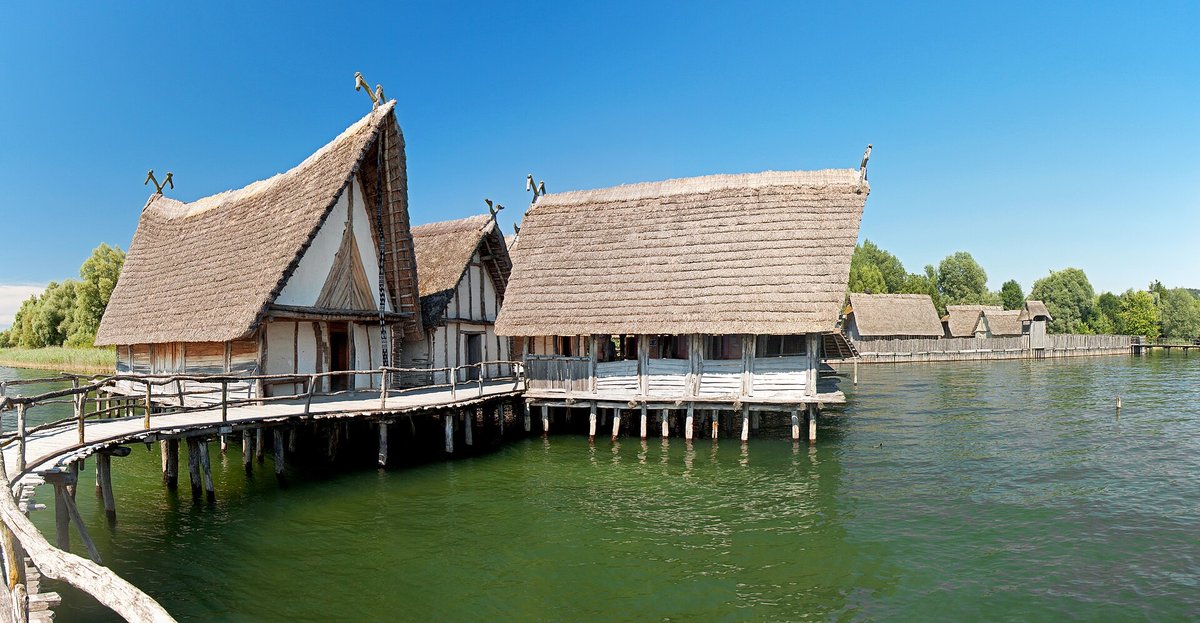
The reason for the enduring scientific fascination is straightforward: the water and mud in which the piles rested preserved organic materials that would normally have perished within decades. Construction timber, plant fibers, seeds, insects, food remains - all biological archives that on an ordinary terrestrial site would have been reduced to nothing. This exceptional preservation offers a direct window into the daily lives of our farming ancestors of the fourth and fifth millennia BCE, in a level of detail that few other archaeological site types can match.
A chance discovery that made history
The history of research on pile dwellings begins in the winter of 1853-1854, during an exceptional drought that caused Swiss lake levels to fall unusually low. On the shores of Lake Zurich, workers digging to widen a harbor uncovered rows of blackened piles and strange objects: ceramics, flintFlintA hard, brittle siliceous rock, knapped by prehistoric people to produce blades, points and sharp tools.→ tools, animal bones. The naturalist Ferdinand Keller was called in. He published a report in 1854 interpreting these remains as vestiges of ancient villages built over the water, modeled on contemporary stilt villages of New Guinea.2
The discovery triggered a genuine archaeological fever. Within a few decades, hundreds of similar sites were identified on Swiss, Bavarian, Austrian, Italian and French lakes. Amateur divers, collectors and enthusiastic archaeologists explored these submerged deposits, sometimes without great methodological rigor. Thousands of objects were brought to the surface and entered European museum collections. Keller's interpretation - houses truly built over the water - remained dominant for over a century, before being questioned when more rigorous stratigraphic excavations allowed the romantic picture to be significantly nuanced.
Architecture and construction: an ingenious adaptation
Pile dwellings were not built in a uniform way. Archaeologists distinguish several construction types depending on local environment and period. Some villages were indeed built over the water, on raised platforms supported by dozens or even hundreds of piles. Others stood on the marshy bank, in the lake's fluctuation zone, protected from seasonal flooding by their stilts. Still others combined both approaches depending on local topographic constraints.2
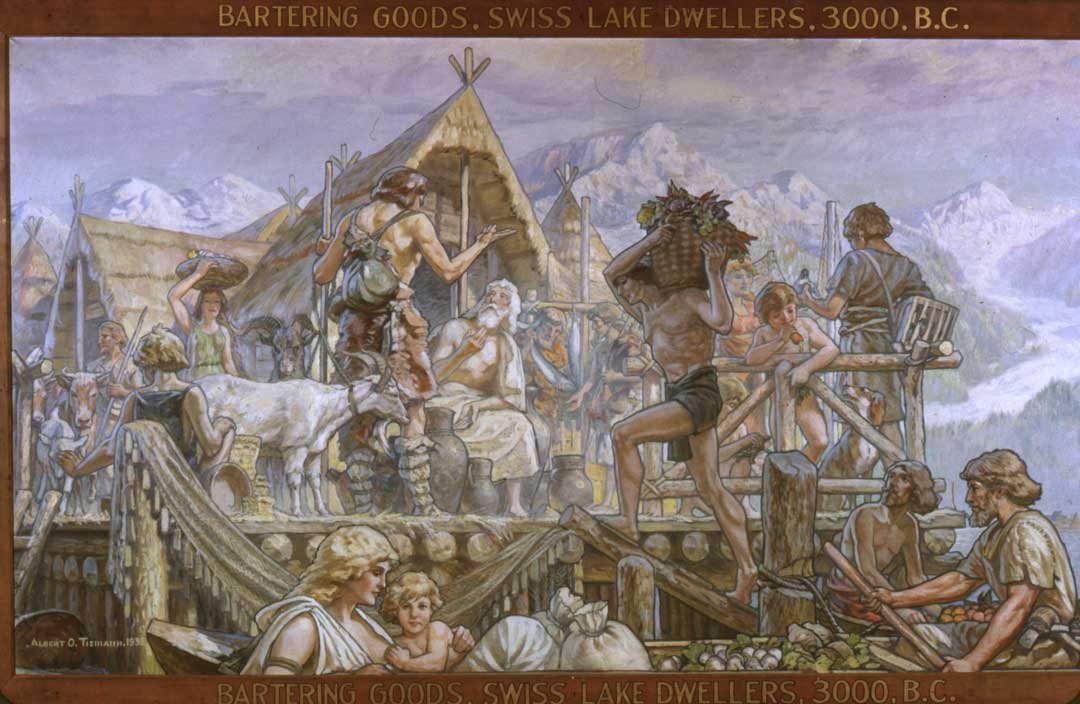
The piles themselves were made from various species - oak, ash, alder, fir - depending on their function and local availability. Foundation piles could measure several meters in length and were driven in by wooden mallets. Dendrochronological analyses have shown that villagers regularly replaced their piles, rebuilt their homes after fires or floods, and that some sites were occupied for several centuries, sometimes discontinuously. The houses themselves were rectangular timber-framed constructions with wattle-and-daub walls, ranging from 20 to 80 square meters in area. A village could comprise a handful to several dozen dwellings, housing between fifty and a few hundred people.
Daily life by the lake
The extraordinary preservation of organic remains makes it possible to reconstruct with unusual precision the diet and daily activities of pile dwelling inhabitants. Cereal farming occupied a central place: emmer wheat, einkorn, barley and millet have been found in large quantities, as carbonized or even fresh seeds. Apples, pears, plums, hazelnuts and acorns supplemented plant resources, testifying to intensive exploitation of the surrounding forest environment.1
Animal husbandry played an essential complementary role. Cattle, pig, sheep and goat bones attest to developed domestic herding. The surrounding forest was regularly hunted: red deer, roe deer, wild boar, beaver and bear featured on the menu. The lake itself was a primary food resource: dozens of fish species have been identified among the remains, along with fish traps, bone hooks and even fragments of fishing nets preserved in the mud. This dietary diversity reflects communities particularly well adapted to their amphibious environment, drawing on aquatic, forest and agricultural resources alike.
Textiles were produced on site: loom weights, spindles and even fragments of linen fabric have been found in good condition. Hand-made pottery featured geometric decorations and forms characteristic of each period and region. Copper and then bronze working appeared around 2500 BCE: axes, pins, bracelets and daggers in copper alloy testify to active exchange with Bronze Age cultures developing simultaneously in other parts of Central Europe.
The debate over the nature of the constructions
In the 1970s and 1980s, archaeologists began to challenge the romantic image of houses floating above the lake. Precise stratigraphic excavations, notably in Switzerland, showed that occupation levels often corresponded to periods of low lake levels. The villages may therefore have been built on temporarily exposed banks, and inundated during exceptional floods - which would explain the accumulation of lacustrine sediments around and under the structures.
This revision, sometimes caricatured as the "terrestrial theory," was itself nuanced by later research. By combining paleoecologyPalaeoecologyThe study of past ecosystems and their relations with the environment, reconstructed from fossils, DNADNAThe molecule carrying genetic information, used to reconstruct kinship between species.→ and sediments.→, fine sediment analysis and dendrochronology, researchers showed that reality was probably far more diverse than any single model could capture: some sites were indeed built over the water, others on wet banks, others still on artificially created islands. Geographic and temporal variability is great, and it would be simplistic to reduce all pile dwellings to a single construction model.3
A World Heritage beneath the lake surface
In 2011, UNESCO inscribed the "Prehistoric Pile Dwellings around the Alps" on its World Heritage List, bringing together 111 sites across six countries: Switzerland, Austria, France, Germany, Italy and Slovenia. The inscription recognizes the outstanding universal value of these deposits, offering an unparalleled testimony to the agricultural societies of European prehistoryPrehistoryThe span of human history before the invention of writing, from the Palaeolithic to the Metal Ages, known mainly through material remains.→ between 5000 and 500 BCE, and highlights the cultural diversity of sites belonging to distinct but regularly interacting archaeological cultures.
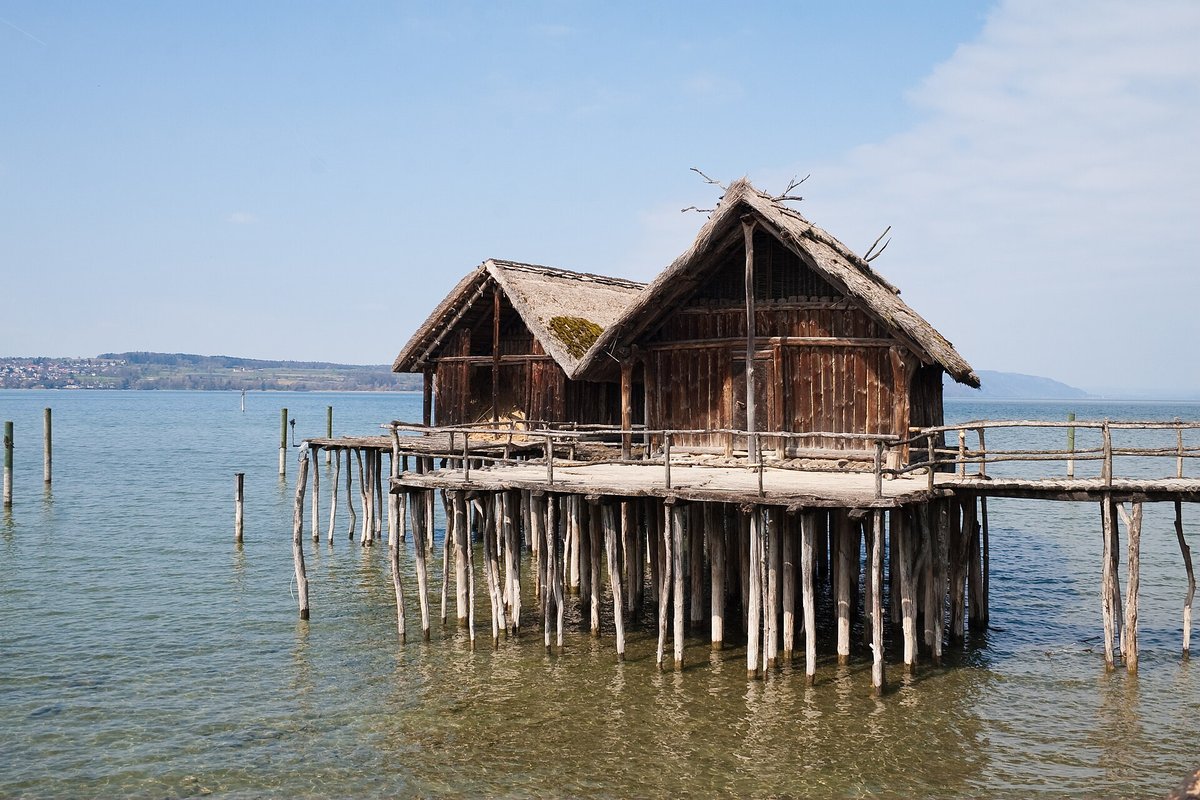
Protecting these sites is a permanent challenge. Lake level fluctuations, pleasure boating, port construction, groundwater pumping and climateClimateThe long-term average atmospheric conditions of a region; its variations (glaciations, aridifications) shaped migrations, agriculture and the collapse of prehistoric societies.→ change all threaten these irreplaceable sedimentary archives. When wood dries out through falling water table levels, it disintegrates within decades. Underwater archaeologists regularly monitor the most endangered sites, and three-dimensional photogrammetric mapping allows precise records of remains before their potential disappearance. Analysis of ancient DNAAncient DNAGenetic material preserved in old remains, often degraded, sequenced with cutting-edge techniques.→ extracted from seeds, bones and even sediments opens new perspectives on the populations who inhabited these villages: their origins, their migrationsMigrationsLong-distance movements of populations; a major driver of human history (the exit from Africa, the peopling of continents, Neolithic and steppe expansions).→ across Neolithic Europe, their kinship relationships and their genetic exchanges with other contemporary communities.4
No comments yet. Be the first.