In the southern Sinai Peninsula, several hundred kilometres from the Nile Delta, a granite wall of the Wadi Khamila bears an engraving five thousand years old. A team from the University of Bonn and the Egyptian Ministry of Tourism and Antiquities, led by Egyptologist Ludwig D. Morenz, has identified on this rock a scene of military domination that researchers believe constitutes the oldest known representation of an act of Egyptian conquest on foreign territory. The study was published in the journal Antiquity in 2026.1 It reveals that Egyptian expansion beyond the Nile Valley was already organised, structured and staged ideologically well before the First Dynasty.
A scene of submission engraved in granite
The composition, pecked into the hard rock, depicts two figures in an explicit relationship of dominance. In the upper position, a standing individual extends his arms forwards in a posture of power. In the lower position, a naked man kneels, his arms bound behind his back, an arrow driven into his body. The staging leaves no ambiguity: this is an execution or forced submission, represented according to a visual grammar that Egypt would maintain and codify for three millennia -- the posture of the victor dominating the prostrate vanquished, found on the Narmer Palette, the reliefs of Sekhemkhet and the pylons of Ramesside temples.
What makes this engraving exceptional is its date. The carving technique, the form of associated hieroglyphs and the stratigraphyStratigraphyThe study of the superimposed layers (strata) of an archaeological site; each layer corresponds to a phase of occupation and yields a relative chronology.→ of neighbouring inscriptions allow researchers to place it at the end of the 4th millennium BC, around 3100 BC -- an era that immediately precedes or follows the unification of Egypt under Narmer. Next to the domination scene, a boat is depicted at reduced scale but in identifiable form. This motif, associated everywhere in Egyptian art with elites and royal power, reinforces the interpretation of a deliberate and staged political act.2
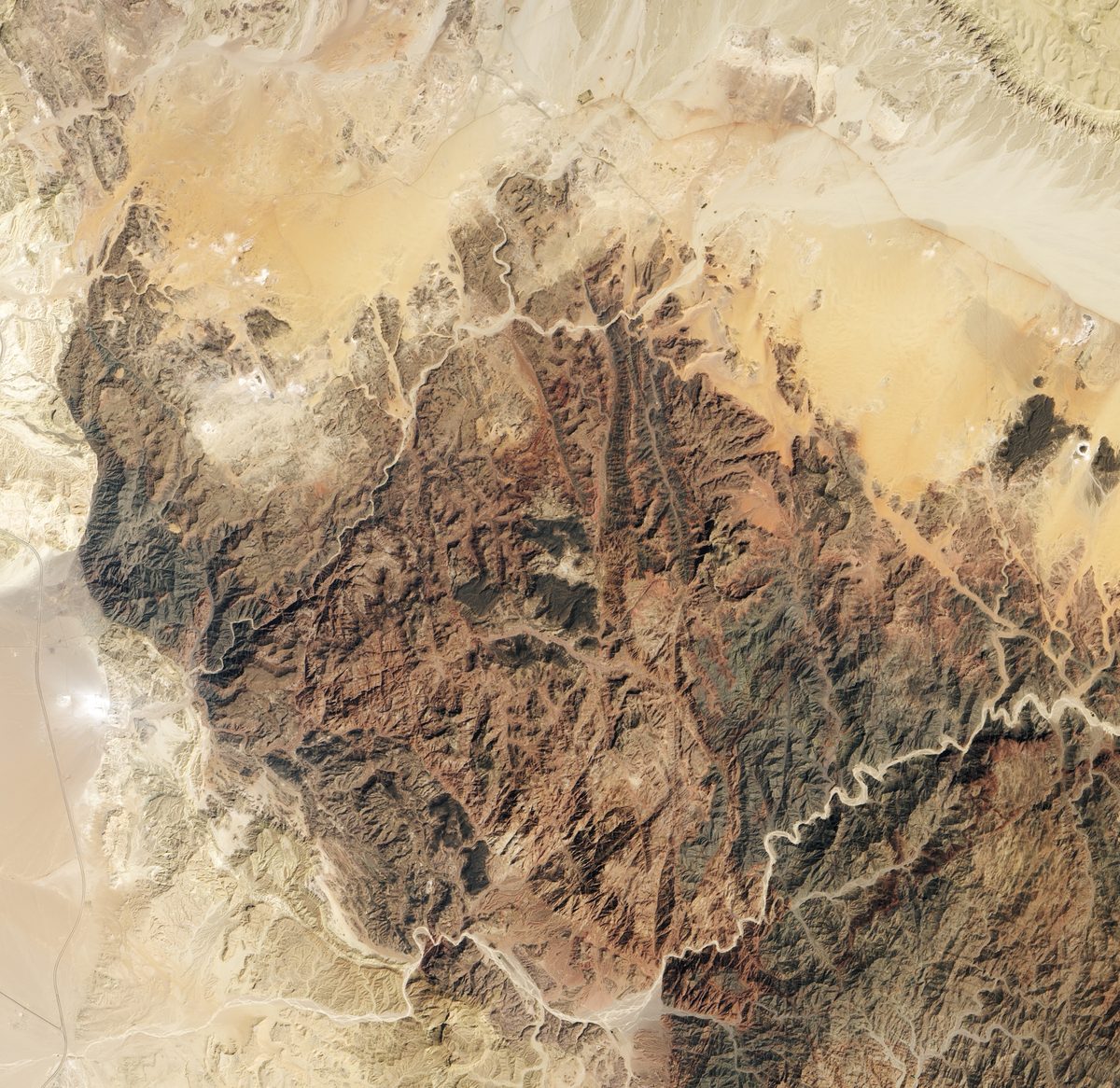
The god Min, lord of the copper region
Above the engraved scene, hieroglyphs identify the name of the god Min, accompanied by the title "lord of the copper region". This detail is fundamental to understanding the significance of the carving. Min is not a secondary deity: he is one of the oldest in Egypt, attested since the PredynasticPredynasticThe period of Egypt before unification (c. 3100 BCE) and the First Dynasty, marked by the Naqada cultures and the gradual emergence of the state.→ period, associated with fertility, the desert, caravan routes and mineral wealth. His earliest known representation is a colossus from Hierakonpolis, carved around 3300 BC -- one of the oldest examples of monumental sculpture in Egypt.
The association of Min with mines and expeditions into the eastern desert and Sinai is documented from the beginning of the 3rd millennium. He is invoked on inscriptions at Wadi Maghara, Wadi Ameyra and Serabit el-Khadim -- sites of copper and turquoise mines in the southern Sinai frequented by royal Egyptian expeditions. His presence at Wadi Khamila, before the First Dynasty, suggests that this cult was already linked to the legitimation of mining expeditions before the formation of the pharaonic state proper.
The invocation of Min in this context fulfils a precise ideological function: it anchors the violence of conquest within a divine will. The killing or submission of the captive is not merely an act of force but the accomplishment of a sacred mission, placed under the authority of a deity whose domain includes the very resources being exploited. This legitimation mechanism -- violence + the sacred = territorial right -- would be one of the most constant tools of pharaonic ideology for thirty centuries.3
Copper and turquoise: the economic stakes of penetrating the Sinai
Why such distant expeditions, so costly in logistical terms? The answer is economic. The southern Sinai contains two strategic raw materials for predynastic and protodynastic Egypt: copper and turquoise. Copper is the most important metal of the nascent Bronze AgeBronze AgeA protohistoric period following the Neolithic, defined by bronze metallurgy (a copper-tin alloy) and the rise of the first cities and states; in Egypt it corresponds to the age of the first pyramids.→ -- used to make tools, weapons and prestige objects. Turquoise, an intense blue-green semi-precious stone, is one of the most prized ornamental stones in Egyptian art, worn by elites and deposited in royal tombs.
The richest deposits in the Sinai are found in the region of Serabit el-Khadim and Wadi Maghara, about a hundred kilometres north of Wadi Khamila. To reach them from the Nile Delta, expeditions used the sea -- boat to the site of present-day Suez -- then continued on foot or with pack animals through the desert's natural corridors. The presence of a boat engraved beside the domination scene at Wadi Khamila is therefore not incidental: it recalls that the entire enterprise rested on an elaborate maritime and overland logistics system organised from the Nile Valley.4
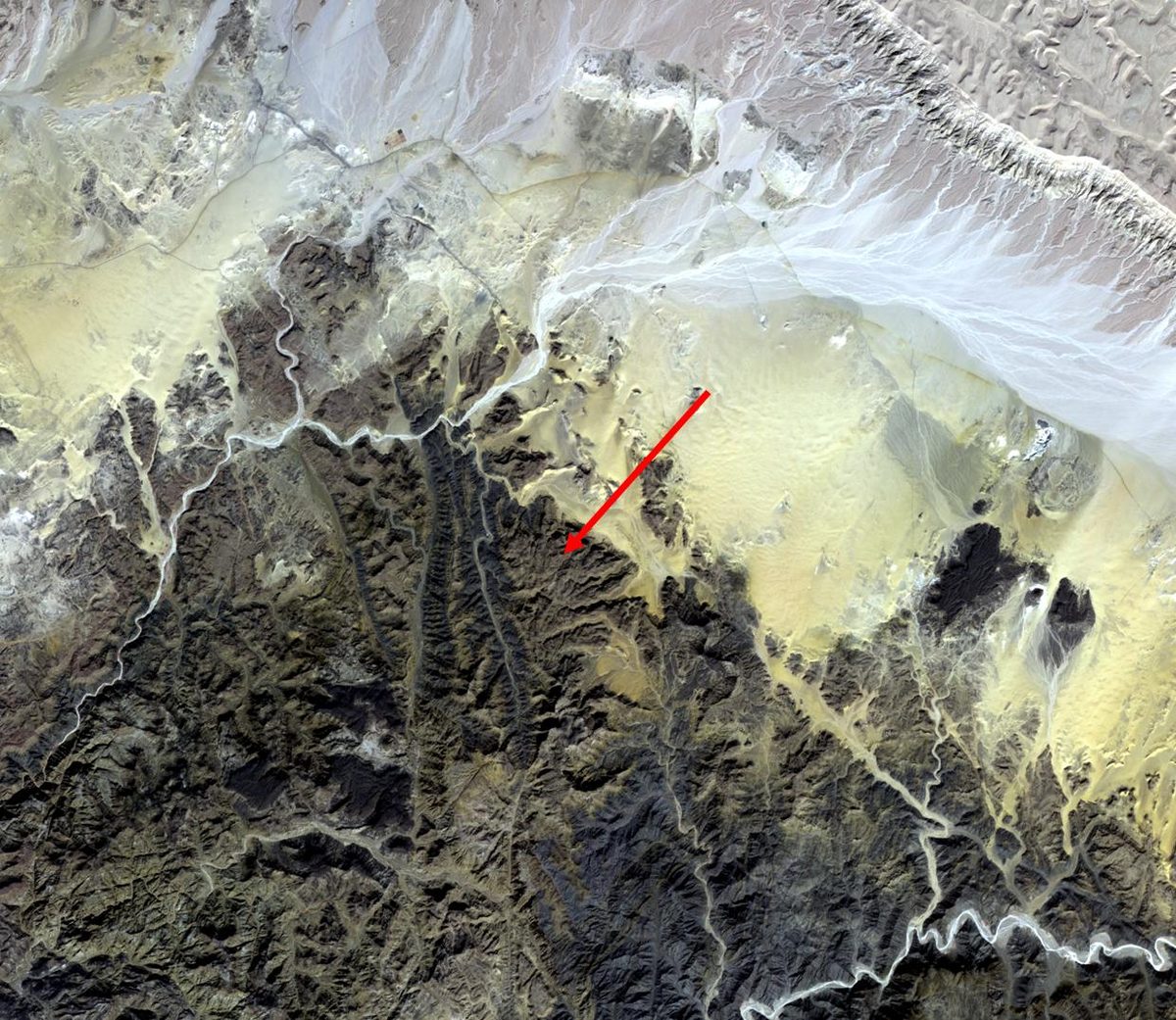
A network of predynastic rock inscriptions in the Sinai
The Wadi Khamila engraving is not an isolated case. Since the 1990s, archaeologists have gradually uncovered a network of rock art sites in the southern Sinai testifying to structured Egyptian presence well before the first dynasties. Wadi Ameyra, excavated by a Belgian mission, has yielded inscriptions attributable to the Naqada II-III period (3500-3100 BC), showing boats, animals and proto-hieroglyphic signs. Wadi Maghara, known since the 19th century for its royal reliefs of the 1st and 2nd Dynasties, has been found to contain older layers whose chronology remains to be established.
The discovery at Wadi Khamila fits within this growing cartography and confirms that the Sinai was a zone of organised Egyptian penetration at the end of the 4th millennium. What changes with this new engraving is the explicitly military and ideological dimension of the scene: it is not merely a passage marker or a sign of ownership but a deliberate staging of power, engraved in hard granite rock that was meant to last -- and has indeed lasted five thousand years.
The iconographic grammar of domination
One of the most significant contributions of Morenz and colleagues' study is to show that the posture of domination depicted at Wadi Khamila anticipates the iconographic grammar that would become the universal visual code of pharaonic power. The "smiting scene" -- the king striking a kneeling prisoner or seizing him by the hair -- appears on the Narmer Palette around 3100 BC, on the ceremonial maceheads of Scorpion II, on the pylons of Ramesses II at Abu Simbel, on the walls of the Macedonian temples of Philae. For three millennia, this image remained the most immediately legible sign of Egyptian royal authority.
The fact that it appears on foreign territory, engraved in the rock of a Sinai wadi by a predynastic expedition, shows that this iconography is not merely ornamental: it is functional. It serves to inscribe domination in the landscape, to make it visible to local populations and to the agents of the nascent state, to materialise a territorial claim in a physical space. The rock engraving is here the equivalent of a flag planted in coveted territory -- but engraved for eternity in granite.5
No comments yet. Be the first.