Eight Thousand Years On, the Savannah Still Carves Its Ghosts
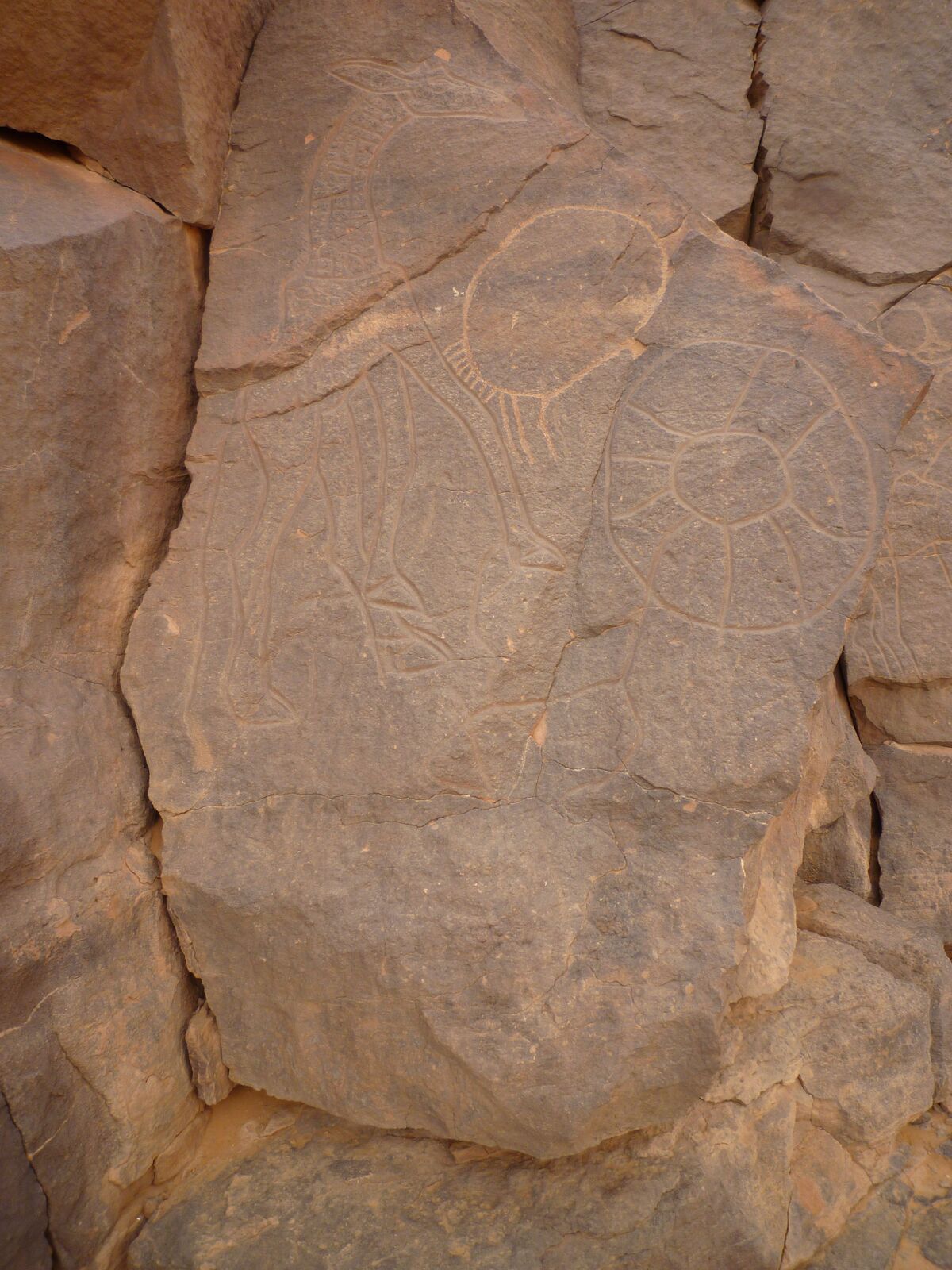
About eight thousand years ago, a man knelt on a slab of sandstone, a flake of flintFlintA hard, brittle siliceous rock, knapped by prehistoric people to produce blades, points and sharp tools.→ in his hand, and set about bringing a giraffe to life in the rock. Not painting it, not sketching it: carving it, polishing it, wresting it from the mineral matter with a patience we can scarcely imagine today. When he had finished, the animal's long neck rose toward a sky that, in those days, still let rain fall on the Sahara. That sky is empty now, the savannah is gone, and yet the giraffe is still there. It gazes at us from the bed of a dried river in the southwest of Libya, in a place whose name few travelers ever pronounce: the Wadi Mathendous.
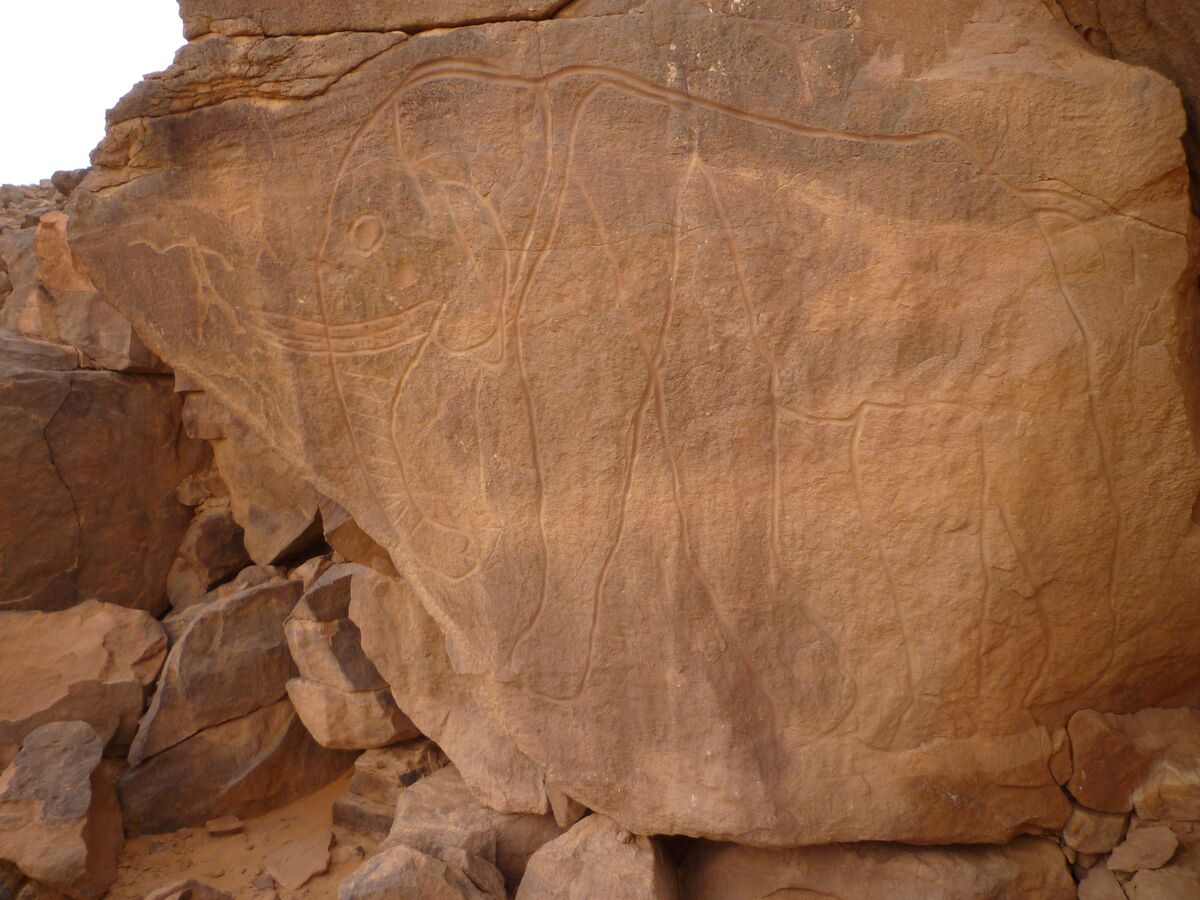
That name is written in several ways, Mathendous, Mathendush, Mathendus, depending on transcriptions from Arabic and the maps of the explorers. It refers to a prehistoric wadi, that is, an ancient watercourse now run dry, cut into the escarpment of the Messak Settafet, in the Fezzan, the vast desert region of southwestern Libya. We are here at roughly 25.76 degrees of north latitude and 12.17 degrees of east longitude, in the district of Wadi al-Hayaa, hundreds of kilometers from any major town. Nothing in the present landscape suggests that this place was once one of the greatest art workshops of humankind. And yet, for kilometers on end, the sandstone walls and boulders are covered with petroglyphsPetroglyphAn engraving made on a rock surface by pecking, incising or abrading, as opposed to rock painting; a form of prehistoric art found on every continent.→, those images carved into stone that make up one of the richest and oldest collections in all of Saharan rock artSaharan rock artThe body of prehistoric engravings and paintings across the Sahara, grouped into major stylistic phases (Wild Fauna, Cattle, Horse, Camel) from the NeolithicNeolithicThe "New Stone Age": a period marked by farming, herding, settlement and pottery, from around 10,000 BC.→ to antiquity.→.
The Wadi Mathendous is no isolated curiosity. It belongs to an immense whole, that of the Messak, a plateau that prehistorians regard as a genuine conservatory of the graphic memory of the Sahara. On its rocks, generations of artists piled up tens of thousands of images over the course of millennia. The traveler who reaches Mathendous therefore does not merely discover a few fine carvings: he enters a library of stone, leafed through by wind and sun, in which part of the history of African human societies can be read at a decisive turning point, the moment when they ceased to be exclusively hunters and became herders as well.
What strikes one immediately is the technical quality. The oldest carvings at the site are not simple superficial incisions. They display a deep relief, with polished contours, obtained through long and methodical work on the rocky surface. This mastery makes the Wadi Mathendous one of the best places in the world to observe what specialists call the "wild fauna" style‘Wild Fauna’ styleThe earliest style of Saharan rock art, marked by large animal figures cut in deep relief with flint tools.→, considered the oldest style of Saharan rock art. To understand this style is already to begin to understand the site, and behind it, an entire submerged world.
There is, in the mere existence of these carvings, something that unsettles our ordinary relationship to time. Eight thousand years is a figure the mind struggles to grasp. It is several times the age of the oldest pyramids of Egypt, long before the invention of writingWritingA system of conventional signs used to fix language or information durably; its appearance (c. 3300 BC) marks, by convention, the end of prehistory.→, before the first cities. When the giraffe of Mathendous was carved, none of the civilizations whose history we learn in school existed yet. And yet, what we feel before it is nothing like abstract knowledge: it is an immediate, almost familiar emotion, the one always aroused by the trace left by a human hand. These artists are not so foreign to us. They saw, they chose, they composed. They had, like us, the desire to depict the world around them.
A Wadi in the Fezzan: Geography of a Forgotten Masterpiece
To locate the Wadi Mathendous, one must first picture the Fezzan, that desert vastness occupying the southwest of present-day Libya. It is a land of sand, stone, and wind, punctuated by oases and rocky plateaus that break the monotony of the expanses. Among these features, the Messak forms a long sandstone escarpment running from northeast to southwest. It is generally divided into two parts: the Messak Settafet, called the "black Messak" because of the dark patina of its rocks, and the Messak Mellet, the "white Messak." It is in the first, the Messak Settafet, that the Wadi Mathendous is cut.
A wadi is the bed of an intermittent watercourse. In deserts, these valleys are most often dry, but they preserve the memory of a time when water once flowed through them. The Wadi Mathendous is precisely one of these witnesses: its course, its banks, the very shape of its bed tellTellAn artificial mound formed by the accumulation of successive layers of settlement remains at the same spot, typical of the Near East. Each destruction-rebuilding event adds a stratum.→ us that it was once watered. Prehistorians speak of a "prehistoric wadi" because its hydraulic activity dates back to very remote periods, to millennia when the climateClimateThe long-term average atmospheric conditions of a region; its variations (glaciations, aridifications) shaped migrations, agriculture and the collapse of prehistoric societies.→ of the region bore no resemblance to today's aridity. Along this bed, and on the boulders that border it, the carvings are concentrated.
The site's position is no accident. Wadis, even when dry, remain natural routes of movement in the desert: one finds there a little more vegetation, a little more shade, sometimes water retained in the subsoil. People and animals traveled along them. It is therefore hardly surprising that prehistoric artists chose these walls as their medium: they lay along the paths of passage, at eye level, and the polished sandstone offered an ideal surface for carving. The MessakMessakA sandstone plateau in Libya's Fezzan (Messak Settafet and Messak Mellet), among the richest concentrations of rock engravings in the Sahara.→ as a whole thus functions like a gigantic open-air gallery, of which the Wadi Mathendous is one of the most famous rooms.
The sandstone, the reigning material of the Messak, also plays a decisive role. This sedimentary rock, formed by the compaction of ancient sands, has a moderate hardness and a homogeneous texture that make it an ideal medium for carving. It yields to a harder stone tool while retaining the clean trace of the gesture. Over time, its surface becomes covered with a dark patina, a natural varnish made of minerals, which darkens over the millennia. This patina is precious to prehistorians: depending on how far a carving has been re-patinated, they can estimate its relative age, for a fresh incision appears light against the dark rock, then slowly darkens as the patina covers it once more.
The isolation of the place must be stressed. We are not dealing here with a developed, signposted site, protected by fences and watched over by guards. The Wadi Mathendous must be earned: one has to cross the desert to reach it, and this remoteness was long its best protection. But isolation is a double-edged sword, for it also makes the site vulnerable, difficult to monitor, exposed to looting and to damage. We shall return to this. For now, let us keep this in mind: in one of the most inhospitable regions of the planet, human beings left behind, eight thousand years ago, one of the most formidable bodies of imagery in the prehistoryPrehistoryThe span of human history before the invention of writing, from the Palaeolithic to the Metal Ages, known mainly through material remains.→ of the whole world.
The Green Sahara: When the Desert Was a Savannah
To understand the Wadi Mathendous, one must forget the desert. One must mentally erase the dunes, the burning scree, the bare horizon, and replace them with something wholly different: grass, watering places, trees, and herds. For between roughly 10,000 and 6000 BCE, much of the present-day Sahara was not a desert. It was a savannah crossed by permanent lakes and rivers, covered by vegetation abundant enough to feed large wild animals. Scientists call this episode the African Humid Period, and for the general public one readily speaks of the Green SaharaGreen SaharaA name for the Sahara during the "African Humid Period" (c. 14,500 to 5,000 years ago), when increased monsoon rainfall sustained lakes, rivers and savannas, making the region habitable before its gradual desiccation.→.3
This climatic shift is no reckless hypothesis: it rests on a convergence of evidence. Sediment cores taken from the bottoms of lakes and oceans, fossil pollen, remains of aquatic fauna found in the middle of the desert, all indicate that a far wetter period reigned over the Sahara for several millennia. This humidity was linked to variations in the Earth's orbit that strengthened the African monsoon and drove it far to the north, watering regions that are today among the driest on the globe. At the Wadi Mathendous itself, one still finds remains of petrified forests, fossilized tree trunks that testify, in their mineral way, that trees once grew here.
In this verdant Sahara lived a fauna that we associate today with sub-Saharan AfricaSub-Saharan AfricaThe part of Africa south of the Sahara; cradle of Homo sapiens, long thought hostile to ancient-DNA preservation because of heat.→. Giraffes browsed the crowns of acacias, elephants moved in herds, rhinoceroses and hippopotamuses frequented the watering places, crocodiles lurked in the rivers, big cats hunted in the tall grass. It is precisely this bestiary that the carvings of the Wadi Mathendous restore to us, with a fidelity that has documentary value. Where the geologist reads the rock, the archaeologist reads the image: both tell the same story, that of a green world now vanished.
This fauna belonged not merely to the savannah as we imagine it. The Green Sahara offered a mosaic of environments: grassy plains, forest galleries along the watercourses, wetlands, lakes as vast as inland seas. Each of these environments sheltered its own species. Hippopotamuses and crocodiles required abundant, permanent water; giraffes and elephants, trees and pastures; the big cats, game plentiful enough to feed them. The mere presence of all these animals on the walls of the Wadi Mathendous is enough to reconstruct, in negative, a complete landscape, rich and diverse, at the very antipodes of the present desert. The carvings are, in this respect, a kind of involuntary ecological archive, a snapshot of the biodiversity of a Sahara that no one ever photographed.
Then came the drying. Around 6000 BCE, and more markedly in the millennia that followed, the monsoon retreated, the rains grew rare, the lakes evaporated, the savannah shrank. The Sahara gradually became once more the desert we know. This desiccation was not a sudden cataclysm but a long process, punctuated by fluctuations, which forced people and beasts to move, to adapt, or to vanish. The carvings of the Wadi Mathendous stand at the heart of this climatic history: they are the images of a world that was about to die, made perhaps without their authors suspecting the scale of the change underway.
The "Wild Fauna" Style: The Oldest Writing in Stone
When one seeks to bring order to the immense corpus of Saharan rock art, it is traditionally divided into great stylistic phases that succeed one another in time. The oldest is that of the wild fauna, sometimes called the Bubaline period, after a large extinct buffalo that appears in it. Then come the Bovidian, or pastoral, period, marked by the omnipresence of domestic cattle, then the Caballine period, in which the horse and the chariot appear, and finally the Cameline period, that of the camel, which accompanies definitive aridity. Each phase reflects a state of the climate, the fauna, and the human economy.1
The Wadi Mathendous is a privileged place to observe the first of these phases, that of the wild fauna. The carvings of this style are recognizable by several traits. First, they depict almost exclusively large wild animals: it is a bestiary of the bush, before the massive arrival of domestic herds. Second, they display a remarkable technique: a deeply incised line, often polished, which gives the contour a striking sharpness and relief. This patient polishing, obtained with flint tools, distinguishes the oldest carvings from the quicker, more superficial incisions of later periods.
The virtuosity of these artists commands admiration. On hard rock, without metal, with only flakes of stone as instruments, they managed to convey the movement of a running animal, the curve of a neck, the power of an animal mass. Some carvings reach considerable dimensions and unfold across entire panels. In them one senses an accomplished artistic intention, a shared graphic convention, handed down from generation to generation. This is not the work of isolated fumbling, but that of a mature tradition, equipped with its codes and its masters.
Assigning a precise date to these works is difficult, for stone cannot be dated the way charcoal can. Prehistorians reason by cross-checking: superimpositions of carvings, patina of surfaces, comparison with datable remains found nearby, coherence with the environmental context. These methods lead to placing the wild fauna style in the Neolithic, around 6000 BCE, that is, about eight thousand years ago. One must guard against any excessive precision: we are speaking of a chronological horizon, not a date accurate to the century. But the order of magnitude is solid, and it is enough to make one's head spin.
A Bestiary of Stone: Giraffes, Elephants, and Cattle
Let us now enter into the detail of what one sees at the Wadi Mathendous. The first feeling, as one moves along the panels, is one of a prodigious animal abundance. The carvings form a veritable inventory of the fauna of the Green Sahara. One recognizes giraffes, often the most spectacular of the figures, with their inimitable silhouette; massive elephants; aurochs and cattle, including a "cow" particularly famous among specialists; rhinoceroses; hippopotamuses; crocodiles; wild asses or onagers. A fennec, the little sand fox, and lizards complete this catalog, proof that the engravers observed the modest creatures as attentively as the giants.2
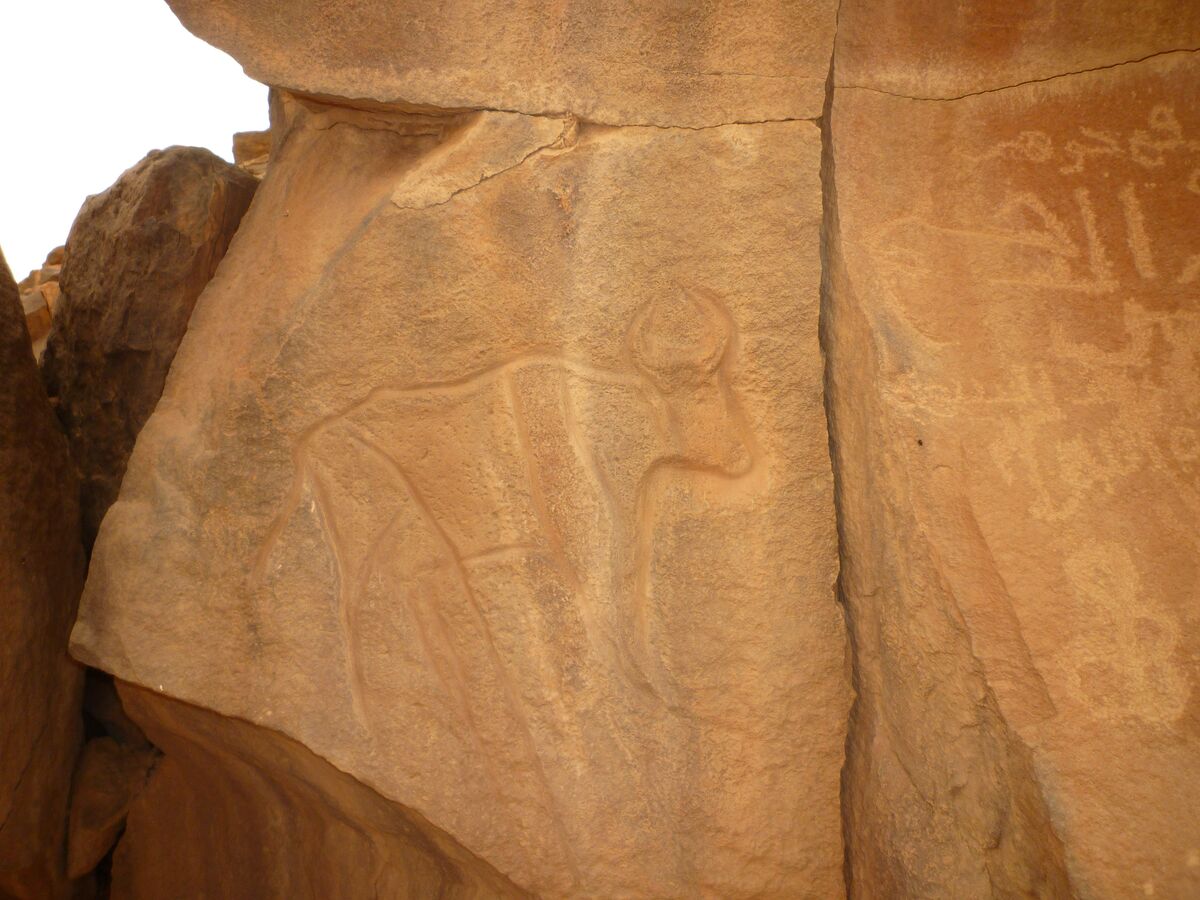
Among the carved animals is a species now extinct: a long-horned buffalo, known to scientists as the ancient buffaloAncient buffalo (Bubalus antiquus)A large, long-horned wild buffalo, now extinct, that roamed the green Sahara and features among the animals of the Wild Fauna style.→, written Bubalus antiquus, sometimes Buffalus antiquus. This extinct animal is a precious marker: its presence on the walls attests that the artists lived at a time when it still populated the region, which helps to anchor the carvings in a high antiquity. The ancient buffalo is not merely a decorative motif: it is a graphic fossil, a species we might not know of at all without these images that fixed it in stone.
The giraffe deserves a special mention. It is, in all of Saharan rock art, one of the most frequent and most successful motifs. Its morphology, with that outsized neck and those slender legs, lends itself admirably to carving and allows for elegant compositions. At the Wadi Mathendous, giraffes abound, sometimes isolated, sometimes in groups, occasionally treated with an attention to detail that extends to the rendering of the coat. We do not know the precise meaning that the artists attached to them, but their recurrence suggests that they held an important place in the imagination of these societies.
This bestiary also says something about the relationship between people and their environment. To depict an animal is already to have observed it at length, to have memorized its bearing, its gait, its characteristic attitude. The engravers of Mathendous were connoisseurs of the fauna, doubtless in part hunters, able to distinguish one species from another and to render its most significant features with a sure line. This intimacy with the animal world is that of societies who lived in direct and permanent contact with nature, and for whom each beast represented in turn a threat, a prey, a resource, or a partner. The carvings are not naive illustrations: they are the product of a naturalist's knowledge accumulated over generations.
One must resist the temptation to interpret everything. Faced with such a bestiary, the modern mind immediately looks for a meaning: hunting ritual, animal cult, mapping of resources, mythological narrative. All these hypotheses have been proposed, and none can be dismissed out of hand. But the honest truth is that we largely do not know why these images were made. What we do know is what we see: a people who knew the animals of their world intimately, to the point of reproducing them with an accuracy of observation that, for its part, is beyond dispute.
The Cats of Mathendous: The Mystery of the "Fighting Cats"
If one had to keep only a single image from the Wadi Mathendous, many would choose without hesitation the famous panel of the cats, often nicknamed the "fighting cats." It consists of two large feline figures reared up face to face, in a posture that evokes combat or confrontation. The scene is striking in its vigor, in the tension that seems to run through the bodies, in the elegance of the lines. It is one of the most reproduced and most commented-upon carvings in the whole Sahara.4
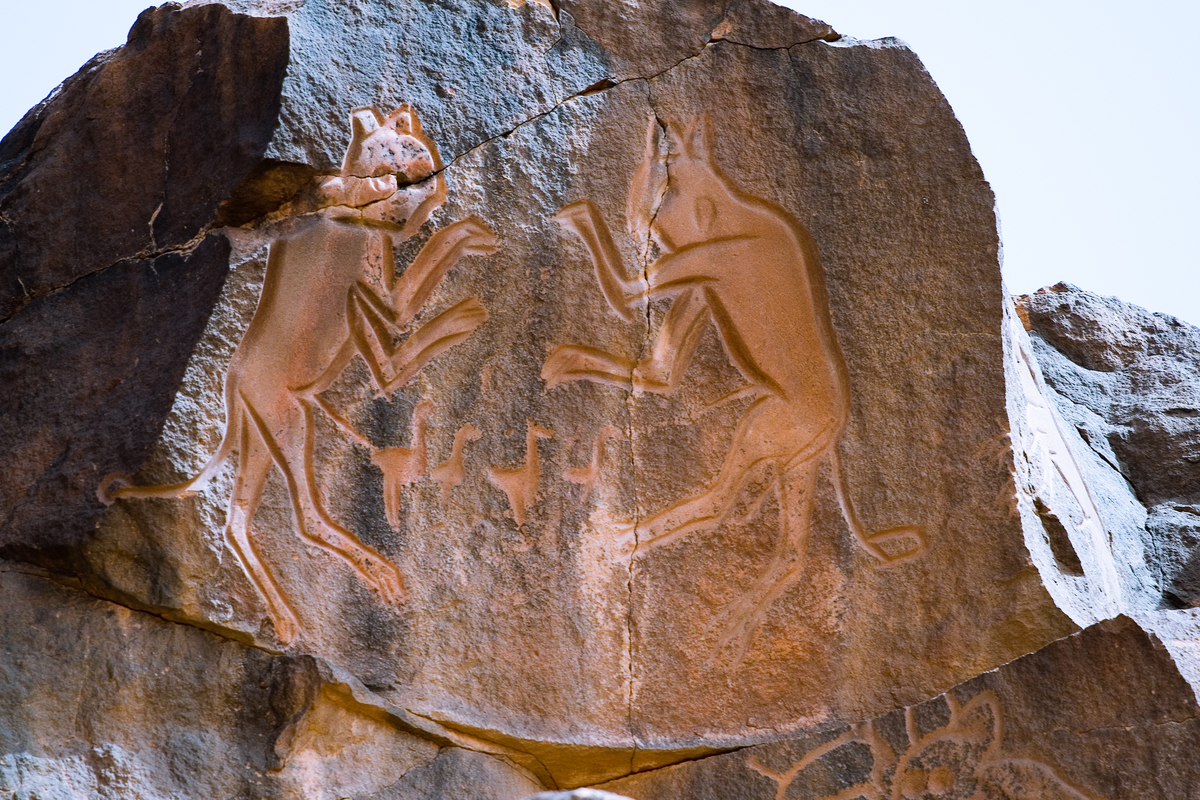
What exactly do these felines represent? The question remains open. They might be great cats, lions or other predators of the savannah, caught in a territorial confrontation. Some have seen in them a mythological scene, a symbolic struggle between powers, or even a representation with cosmological meaning. The nickname of "cats" must not mislead: these are imposing creatures, treated with the same monumental care as the other large animals of the site. The familiar designation comes from their bearing, not their actual size.
The very popularity of this panel raises a methodological question. By dint of being reproduced, commented upon, and foregrounded, it ends up eclipsing the rest of the site and imposing a ready-made reading. The nickname "fighting cats" is convenient, but it fixes an interpretation, that of combat, whereas the posture of the two figures could just as well evoke a display, a dance, a ritual dialogue, or a scene whose meaning remains wholly closed to us. To name is already to interpret, and the history of rock art is strewn with these convenient labels that steer the gaze without our noticing. The good observer learns to distrust them, to return to the bare image, to look before concluding.
This panel illustrates to perfection the difficulty of interpreting rock art. We see a scene, we sense an action, we feel an emotion, but we have no text, no testimony, no key with which to decipher its exact meaning. The prehistoric artist wanted to tell us something, and that something eludes us. What remains is the formal power of the work, its capacity to reach us across the millennia, to make us feel, before two cats of stone, an emotion that has no age.
Here, perhaps, lies the true lesson of the cats of Mathendous. Rock art is not merely a documentary source for reconstructing fauna or climate. It is also an aesthetic encounter. These anonymous engravers, whose names we shall never know, were artists in the full sense of the word, able to compose, to stylize, to dramatize. In looking at them, we do not merely study the past: we hold a dialogue with creators who, eight thousand years before us, were already seeking to give form to the world.
The Reign of Disproportion: Giant Beasts, Tiny People
One stylistic trait of the Wadi Mathendous never fails to intrigue visitors: the lack of proportion. The animals are often depicted at an outsized scale, while the human figures, when they appear, are tiny. A hunter can be reduced to a silhouette a few centimeters high at the foot of a giraffe that dominates the entire panel. This contrast is clearly not clumsiness: it is too systematic, too deliberate, to be accidental. It reflects a choice, a convention, whose meaning partly eludes us.
Several explanations have been proposed. The most seductive, and the most often cited, sees in this disproportion the expression of a psychological balance of power: the wild animals would be depicted large because they inspired fear, respect, a form of sacred dread. Prehistoric humans, vulnerable in the face of great cats and pachyderms, would thus have translated into stone their own smallness before animal power. The hypothesis is beautiful, coherent, almost self-evident. But it must be said clearly: it is only an interpretation. In truth, we do not know why the artists proceeded in this way.
Other avenues exist. The great size of the animals could signal their economic or symbolic importance, according to a logic in which dimension represents rank rather than actual measurement, as in many other artistic traditions of the ancient world. The smallness of the humans could on the contrary reflect a narrative choice, the human being merely a secondary element in a scene centered on the animal. Or again, the disproportion could have no symbolic meaning at all and result simply from an inherited graphic convention, applied without its authors ever raising the question of realism.
This debate, insoluble as things stand, illustrates a golden rule of the archaeology of art: one must rigorously separate what one observes from what one supposes. That the animals are depicted larger than the humans is a fact, verifiable by anyone who looks at the panels. That this reflects fear or respect is a hypothesis, seductive but unprovable. The right use of these carvings consists in admiring the fact while keeping the interpretation at a prudent distance. It is at this price that one honors both scientific rigor and the mystery of these works.
From Hunters to Herders: The Great Neolithic Transition
The carvings of the Wadi Mathendous do not merely tell of a fauna: they tell of an economy, and even of an economic transformation among the most decisive in human history. In the Neolithic, the societies of North AfricaAfricaThe cradle of humankind: the continent where the first hominins appeared, then Homo sapiens around 300,000 years ago, before the expansion to the rest of the world.→ were living through a turning point: they were gradually ceasing to depend solely on hunting and gathering in order to adopt animal husbandry. The domestication of livestock, cattle in particular, transformed the relationship between people and their environment. The Sahara, then verdant, offered ideal pastures for these first herds.
This transition can be read in the carvings themselves. Alongside the wild animals of the oldest style, there appear, in the later phases, depictions of domestic cattle. On the walls of the Messak, one thus sees two worlds coexisting: that of the hunt, with its giraffes and elephants, and that of herding, with its cows and flocks. This coexistence is not only chronological, it is also economic: the Neolithic pastoral societies did not give up hunting or gathering. They combined resources, integrating husbandry into a broader and more flexible subsistence system.
The domestication of livestock in North Africa is a fascinating and still-debated chapter of prehistory. For a long time, it was supposed that domestic animals and husbandry techniques had come from the Near EastNear EastA region of western Asia (Levant, Mesopotamia, Anatolia, Iran), cradle of the Neolithic revolution, agriculture, the first cities and writing.→, cradle of the Neolithic revolutionNeolithic revolutionThe shift from hunter-gatherer societies to farming and settled life (c. 10,000 BCE in the Near East), giving rise to villages and then cities.→. More recent research has qualified this picture, showing the possibility of local dynamics and of a Neolithization with many faces. Without settling this specialists' debate, let us note that the Green Sahara was one of the great theaters of this adventure, and that its carvings constitute one of its most eloquent visual archives.
Cattle, in these pastoral societies, were surely more than a source of meat, milk, and hides. In many herding cultures of Africa and elsewhere, the herd is also a measure of wealth, a marker of social status, a currency of exchange and alliance, sometimes a partner in ritual life. It is reasonable to suppose that the cattle carved on the rocks of the Messak carried a comparable weight of meaning, though we must again be careful not to project onto the Neolithic the customs of later or living peoples. What can be said is that the passage from the wild animal to the domestic beast was not merely a change of diet: it was a transformation of the entire relationship between humans and the living world, a new way of possessing, of accompanying, and of representing animals.
One must measure what this implies. In looking at a bovine engraving at the Wadi Mathendous, we contemplate not merely a fine animal: we witness one of the founding moments of human history, that in which our ancestors were learning to live with herds, to manage a living capital, to modify the landscape through grazing. The artists who carved these cows were recording, without knowing it, a revolution. Their images are economic documents as much as aesthetic ones, snapshots of a world in the act of tipping from one way of life toward another.
Exploring, Comparing, Understanding: The Sahara of the Pioneers
The Wadi Mathendous did not reveal itself on its own. It took explorers, scientists, and travelers venturing into these vast spaces to locate, record, photograph, and publish these carvings. The history of the discovery of Saharan rock art is an epic in its own right, marked by notable figures who, over the course of the twentieth century, gradually revealed to the world the scale of this treasure. Without their work, the Wadi Mathendous would have remained a secret of the desert, known only to a few nomads.
Among the great names, that of Henri Lhote stands out. This French ethnographer and explorer devoted part of his life to the Sahara and contributed greatly to making its rock art known, notably that of the Tassili n'Ajjer, in neighboring Algeria. His expeditions, his recordings, and his publications left a lasting mark on the public and aroused considerable interest in these works. Not far from the Messak, in the Acacus massif, also in Libya, the work of the Italian archaeologist Fabrizio Mori made a major contribution to knowledge of the art and prehistory of the region, with a scientific rigor that set a standard.
Comparison between sites is a precious tool. The Tassili n'Ajjer, the Acacus, the Messak, and other ensembles form a vast network of testimonies that illuminate one another. The styles recur from one massif to another, with local variants, which allows prehistorians to establish relative chronologies, to identify influences, to reconstruct traditions. The Wadi Mathendous takes on its full meaning within this network: it is not an isolated anomaly but a link in a graphic culture that extended over thousands of kilometers and thousands of years.
Justice must also be done to the first witnesses, those who, long before the scientists, knew these carvings: the local populations, nomadic and settled, who lived in contact with the desert. For them, the images of the Messak were not a discovery but an element of the familiar landscape, sometimes surrounded by stories and traditions. The European explorers did not, strictly speaking, reveal the Wadi Mathendous; they brought it into the field of Western science, documented it according to its methods, connected it to a global corpus. This distinction matters: it reminds us that knowledge of a site is always built upon prior knowledge, and that the inhabitants of a region are often its first guardians.
This collective dimension of the research deserves to be underlined. The study of Saharan rock art is a patient, international, cumulative labor, which advances through meticulous recordings, through the confrontation of data, through methodical debate. Nothing in it is ever definitively settled: each new campaign, each new technique of analysis can refine or correct what is known. It is this methodological humility that gives the discipline its strength, and that should inspire our own gaze upon carvings many of whose secrets remain inaccessible to us.
A Heritage in Peril: Conservation, Looting, and War
Admirable as they are, the carvings of the Wadi Mathendous are fragile, and their future is not assured. A rock-art heritage exposed in the open air, on accessible rocks, in a politically unstable region, accumulates every risk factor. The conservation of these works is today a major challenge, and a source of serious concern for all those who grasp the irreplaceable value of what the Messak has preserved over the millennia.
The threats are many. There are first the natural forms of damage: wind erosion, temperature variations, the slow but relentless action of the climate that, in the long run, effaces the reliefs. There are then the human forms of damage, often faster and more brutal: graffiti, removal of engraved blocks, thefts destined for the antiquities market, harm linked to industrial activity or to the exploitation of resources in the region. A fragment of engraved rock torn from its context loses the essential of its scientific value, and forever deprives humanity of a link in its memory.
To these threats is added, for Libya, the context of the conflicts that have convulsed the country. Political and security instability makes the monitoring of sites difficult, discourages scientific missions, and leaves the field open to looters. A site as isolated as the Wadi Mathendous is particularly vulnerable in these conditions: no permanent guard watches over its walls, and the remoteness that once protected it turns against it when the institutions capable of defending it are weakened. The preservation of this heritage therefore also depends, tragically, on stability and peace.
Faced with these challenges, cultural recognition plays a role. To make these carvings known, to document them, to inscribe them in the collective memory is already to contribute to their protection. One may recall in this regard a symbolic gesture: in 1978, the Libyan postal service devoted an issue of five stamps to the carvings of the Wadi Mathendous, released from the first of January. A postage stamp is a modest object, but it carries far: it circulates an image, it affirms a pride, it inscribes a site in the national heritage. This kind of recognition, combined with efforts at scientific documentation and with international awareness, remains one of the best bulwarks against oblivion and destruction.
Listening to the Voices of Stone: What Mathendous Bequeaths Us
At the end of this journey, let us return to the giraffe of the opening, to that man kneeling on his slab of sandstone, eight thousand years before us. What remains of him? We know nothing of his name, his language, his beliefs, the color of his days. And yet, something of him reaches us: his gesture, his gaze upon the world, his will to fix in stone an image that mattered to him. The Wadi Mathendous is that above all: an immense conversation across time, in which mute voices continue to address their figures to us.
What these voices tell us is, first, the memory of a lost world. A Green Sahara, peopled with giraffes and elephants, furrowed with rivers and fringed with forests, where people hunted and then learned to raise herds. That world has vanished, effaced by the drying, but its images remain, more durable than the savannah itself. The carvings are, in a sense, more faithful than the natural archives: they show us not only which animals lived there, but how human beings saw them, ranked them, magnified them.
What these voices teach us, next, is the proper measure of our knowledge. We know the location of the site, the nature of the carved animals, the great phases of Saharan rock art, the context of the Green Sahara and its drying, the order of magnitude of the datings. But we still do not know the essential of their meaning: why these images, why this disproportion, why these confronted felines. This zone of shadow is not a failure, it is an invitation: to prudence, to humility, to the patient pursuit of research.
There is, finally, in the Wadi Mathendous, a lesson of fragility and responsibility. What eight thousand years have spared, a few decades of neglect could destroy. To protect these carvings, to document them, to make them known without delivering them up to looting, is our duty toward those who created them and toward those who will come after us. For if the savannah has vanished, if giraffes no longer browse the acacias of the Fezzan, these carved silhouettes remain, patient and proud, crossing the millennia to remind us that this desert, one day, was alive. It is up to us to see that they cross the millennia to come as well.
Un immense merci pour ces fenêtres ouvertes sur le passé le plus lointain.