A meeting pinned to the Zagros Mountains
Where, exactly, did the last NeanderthalsNeanderthalsA fossil humanity of Eurasia, robust and cold-adapted, extinct around 40,000 years before present.→ cross paths with the first Homo sapiensHomo sapiensThe present-day human species, which emerged in AfricaAfricaThe cradle of humankind: the continent where the first hominins appeared, then Homo sapiens around 300,000 years ago, before the expansion to the rest of the world.→ around 300,000 years ago, the only surviving human lineage after the extinction of Neanderthals and Denisovans.→ to leave Africa? The question has haunted palaeoanthropologyPalaeoanthropologyThe science that studies human evolution from the fossil remains of hominins (bones, teeth, footprints) and their context, to reconstruct our biological origins.→ ever since genetics confirmed, some fifteen years ago, that these two lineages had not merely met but had shared offspring. A study published in 2024 in the journal Scientific Reports offers an unprecedented spatial answer: the most probable zone of contact and interbreedingInterbreedingGenetic mixing between human populations or species; between Neanderthals and Homo sapiens it left 1 to 2% of Neanderthal DNADNAThe molecule carrying genetic information, used to reconstruct kinship between species.→ in non-Africans.→ would lie in the Zagros Mountains, the long range that runs across the Iranian plateau, from western Iran to northern Iraq and south-eastern Turkey1. Rather than digging one more site, the researchers reasoned at the scale of the landscape, asking where, between 120,000 and 80,000 years before present, the two populations were most likely to have lived side by side.
The result is not a cross on a treasure map. It is a probability, an area where ecological conditions made coexistence plausible. This nuance is crucial, and we will return to it, because it separates a solid hypothesis from direct proof. Yet the contribution of the study lies precisely in this shift of the question: for a long time the debate asked whether Neanderthals and modern humans had mixed. The answer today is yes, without ambiguity. The new frontier is to know where it played out, and why in that particular place rather than elsewhere along the vast arc of the LevantLevantA region of the eastern Mediterranean Near East (Israel, Lebanon, Syria, Jordan), a major crossroads of the first human migrations out of Africa.→ and the Middle East.
How an ecological model points to a territory
The method has a technical name: ecological niche modelingEcological niche modellingA method reconstructing the environments favourable to a species (climateClimateThe long-term average atmospheric conditions of a region; its variations (glaciations, aridifications) shaped migrations, agriculture and the collapse of prehistoric societies.→, terrain) to map where it could have lived or met another.→, coupled with a geographic information system. The idea is to reconstruct, for each species, the envelope of environmental conditions within which it is able to live, then to project that envelope onto a map. In concrete terms, the researchers gathered the known archaeological sites where traces of each of the two populations have been found, then associated with each of these points a set of climate and terrain variables: mean temperature, seasonal range, rainfall, altitude, slope, exposure. From these data, an algorithm learns to recognise the kind of environment each lineage frequented.
Once these two niches are defined, the decisive operation consists in overlaying them. Where the two envelopes overlap, a shared territory takes shape, a space where both Neanderthals and Homo sapiensHomo sapiensThe present-day human species, which emerged in Africa around 300,000 years ago, the only surviving human lineage after the extinction of Neanderthals and Denisovans.→ could find the means to subsist. It is this zone of overlap, computed for the window between 120,000 and 80,000 years, that points overwhelmingly toward the Zagros Mountains and the foothills that border them2. The range indeed offered a rare diversity: well-watered valleys, permanent springs, tiered reliefs that multiplied the available niches and made it possible to follow game through the seasons.
It is worth stressing what makes this approach distinctive. It does not rest on the discovery of a hybrid fossil nor on a new deposit, but on the cross-referencing of data already available, reread through the lens of ecology. The flip side, as we shall see, is that the model predicts a potential rather than an established fact.
The Zagros, a crossroads of migration routes
If the Zagros stands out, it is no accident of calculation: the range occupies a strategic position in the geography of the great human migrationsMigrationsLong-distance movements of populations; a major driver of human history (the exit from Africa, the peopling of continents, Neolithic and steppe expansions).→. On leaving Africa, populations of Homo sapiens followed corridors constrained by the sea, the deserts and the mountains. First the Levant, then the Iranian plateau, form the obligatory bottleneckBottleneckA sharp, temporary reduction in a population's size that lastingly impoverishes its genetic diversity.→ through which those seeking to reach Central Asia, the Indian subcontinent or the Far East had to pass. The Zagros rises in the very middle of this passage, like a natural tollgate between the west and the east of the continent.
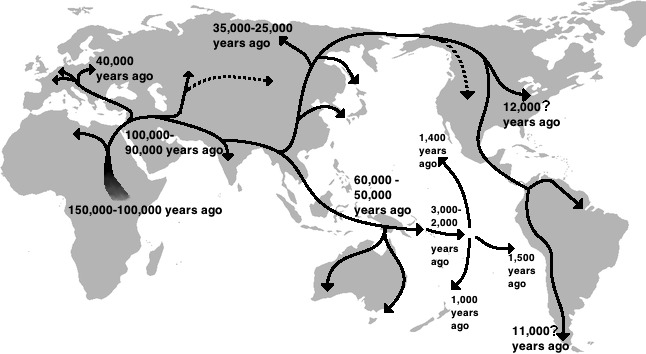
The Neanderthals, for their part, had long occupied western Eurasia, right up to the edges of that same plateau. The two worlds therefore touched precisely there. The Zagros was not a mere frontier to be crossed: it was a place of residence, a reservoir of habitable valleys where groups could remain for generations. This combination of a pivotal position and habitability makes it an ideal candidate for a prolonged coexistence, the necessary condition for an interbreeding that leaves a lasting genetic trace.
This reading also sheds light on why the genetic mixing seems to have concentrated in a relatively ancient window. Before the two lineages diverged definitively along their separate trajectories, they shared, somewhere on this plateau, the same horizon of mountains. The Zagros would thus have played the role of a common waiting room, where the history of our species and that of our cousins briefly merged.
The field evidence: Shanidar and Bawa Yawan
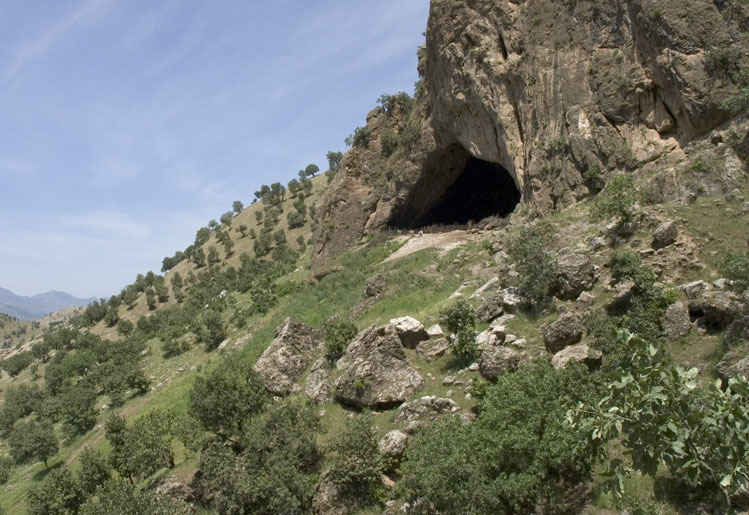
A model, however elegant, is only worth something if it meets the ground. And the designated region is far from empty of remains: on the contrary, it harbours some of the most famous Neanderthal sites of the Near East. Shanidar Cave, in northern Iraq, on the edge of the Zagros, has yielded since the 1950s several Neanderthal skeletons, some of which have fed the debate on the care of the injured and the funerary gestures of this lineage.
More recently, the Bawa Yawan rock shelterRock shelterA shallow cavity at the foot of a cliff or under a rocky overhang, offering natural shelter; a favoured site of prehistoric habitation and rock art.→, in the Iranian Zagros, has provided a precious clue: a milk toothmilk toothA deciduous, temporary tooth that forms in childhood before being replaced by a permanent one; its enamel records the very first years of life.→ attributed to a Neanderthal child, dated to around 65,000 years, associated with MousterianMousterianThe stone-tool industry typical of Neanderthals, based on the Levallois flaking technique.→ tools, the stone industry characteristic of the Neanderthals3. The joint presence of a human remain and a coherent toolkit firmly anchors the Neanderthal occupation of the massif. These discoveries do not by themselves prove interbreeding, but they confirm that the Neanderthals were very much at home in the zone the model designates, which was not a given and reinforces the plausibility of the whole.
The picture nonetheless remains incomplete on the side of the modern humans of that very ancient period, whose remains in the region are rarer and more debated. This is one of the reasons the study stays cautious: it shows that the stage was set and that one of the two actors was present, without being able to film the scene of the encounter itself.
What genetics already says about interbreeding
The fact of interbreeding itself is no longer a matter of hypothesis. Since the sequencingSequencingReading the order of the bases (A, T, G, C) of a DNA molecule; high-throughput sequencing reads millions of fragments in parallel.→ of the Neanderthal genome, we know that every human of non-African ancestry carries in their DNA a fraction inherited from our vanished cousins, on the order of one to two per cent of the genome4. These segments are not mere curiosities: some influence immunity, metabolism, pigmentation or the response to altitude.
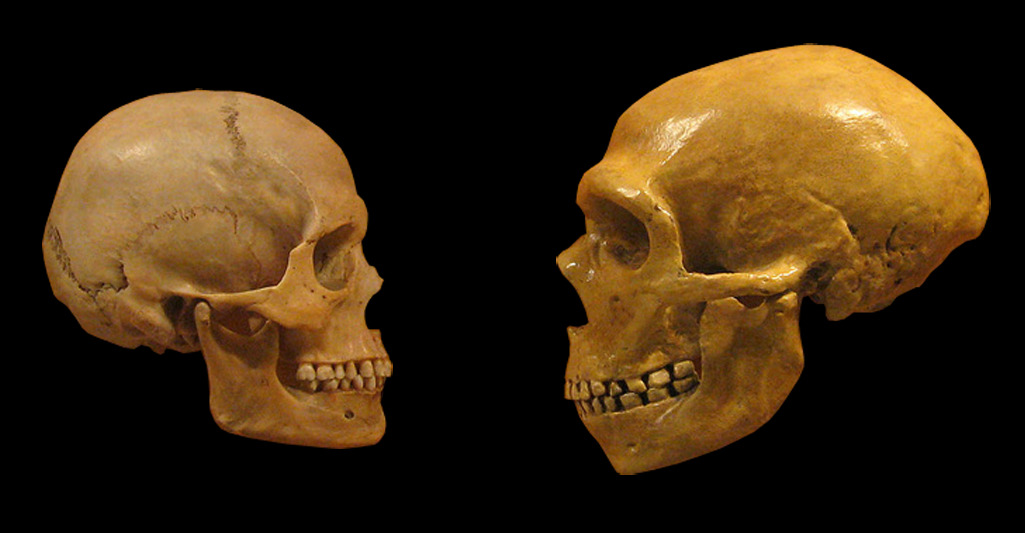
This genetic signature also fixes a chronology. The main episode of mixing dates back, according to estimates drawn from ancient DNAAncient DNAGenetic material preserved in old remains, often degraded, sequenced with cutting-edge techniques.→, to a period between roughly 50,000 and 60,000 years ago, but older and more discreet exchanges have left their imprint, including in the reverse direction, from Homo sapiens toward certain Neanderthal populations. The window of 120,000 to 80,000 years studied for the Zagros belongs to this layered history, made of multiple contacts rather than a single founding event. Anatomically, the two lineages remained clearly distinct: the Neanderthal, stocky, with an elongated skull, a sloping forehead surmounted by a powerful ridge above the orbits, a face projected forward; Homo sapiens, more gracile, endowed with a high, vertical forehead and a jutting chin. This morphological difference did not, however, prevent fertility between the two groups, evidence of their great biological closeness.
Where, not whether: the reach and the limits of the study
It bears repeating clearly what this research establishes and what it does not. It does not demonstrate that a meeting took place in the Zagros; it shows that, if one looks for the most probable place of such a contact given ecological constraints, that is where the clues converge. The distinction between the where and the whether is the heart of the matter. Interbreeding, as we said, is a genetic given. Its location, on the other hand, remains an inference, a model of probability and not the written record of an event.
The limits stemstemThe narrowed base of a point, used to haft it onto a shaft or handle.→ first from the input data. Reconstructing climates a hundred thousand years old carries a margin of uncertainty, and the known archaeological sites reflect the history of excavation as much as the real distribution of populations: one mostly finds where one has looked. A poorly explored area may therefore be under-represented in the model without this meaning it was deserted. Moreover, the ecological niche describes a potential for habitat, not a human presence attested at every moment. The overlap of two niches indicates that both populations could have been there, not that they actually crossed paths on a given date.
The approach nonetheless has a virtue that few results offer: it is testable. By designating a precise region, it guides the excavations to come and provides a prediction that the field will be able to confirm or refute. If future deposits in the Zagros were to yield, within the right chronological window, remains of both lineages or even an interbred individual, the hypothesis would gain in solidity. Failing that, the model would have to be refined or shifted. This is how a science advances: not through definitive certainties, but through proposals precise enough to be put to the test.
What it changes for the story of human settlement
By placing the cursor on the Zagros, the study offers a finer geography of our origins. It reminds us that the expansion of Homo sapiens out of Africa was not a triumphal march across empty lands, but a passage through landscapes already peopled by other humans, with whom our ancestors shared valleys, resources and, on occasion, descendants. The Iranian plateau, so often left in the shadow of the Levant and Europe in the classic narratives, here recovers the central place that its geography assigns it: a crossroads, a threshold between worlds.
This perspective also invites us to rethink the very notion of a frontier between human species. Where one imagined watertight lineages, abruptly replacing one another, a more porous picture emerges, made of neighbourhoods, coexistences and mixings. The Zagros, with its caves and shelters that no doubt still hold part of this memory, becomes a privileged laboratory for testing these ideas. The coming excavation campaigns in the region will tellTellAn artificial mound formed by the accumulation of successive layers of settlement remains at the same spot, typical of the Near East. Each destruction-rebuilding event adds a stratum.→ whether the map drawn by the model meets the ground it claims to describe. In the meantime, the study will have had the merit of turning an intuition into a precise hypothesis, and of reminding us that the history of our species was written, in part, in the shadow of a Middle Eastern mountain range.
Ce site me permet de donner de la profondeur historique à mes parties. Vraiment précieux.
Ce qui me plaît c'est que vous citez vos sources. Je peux vérifier par moi-même.