Human origins and evolution
7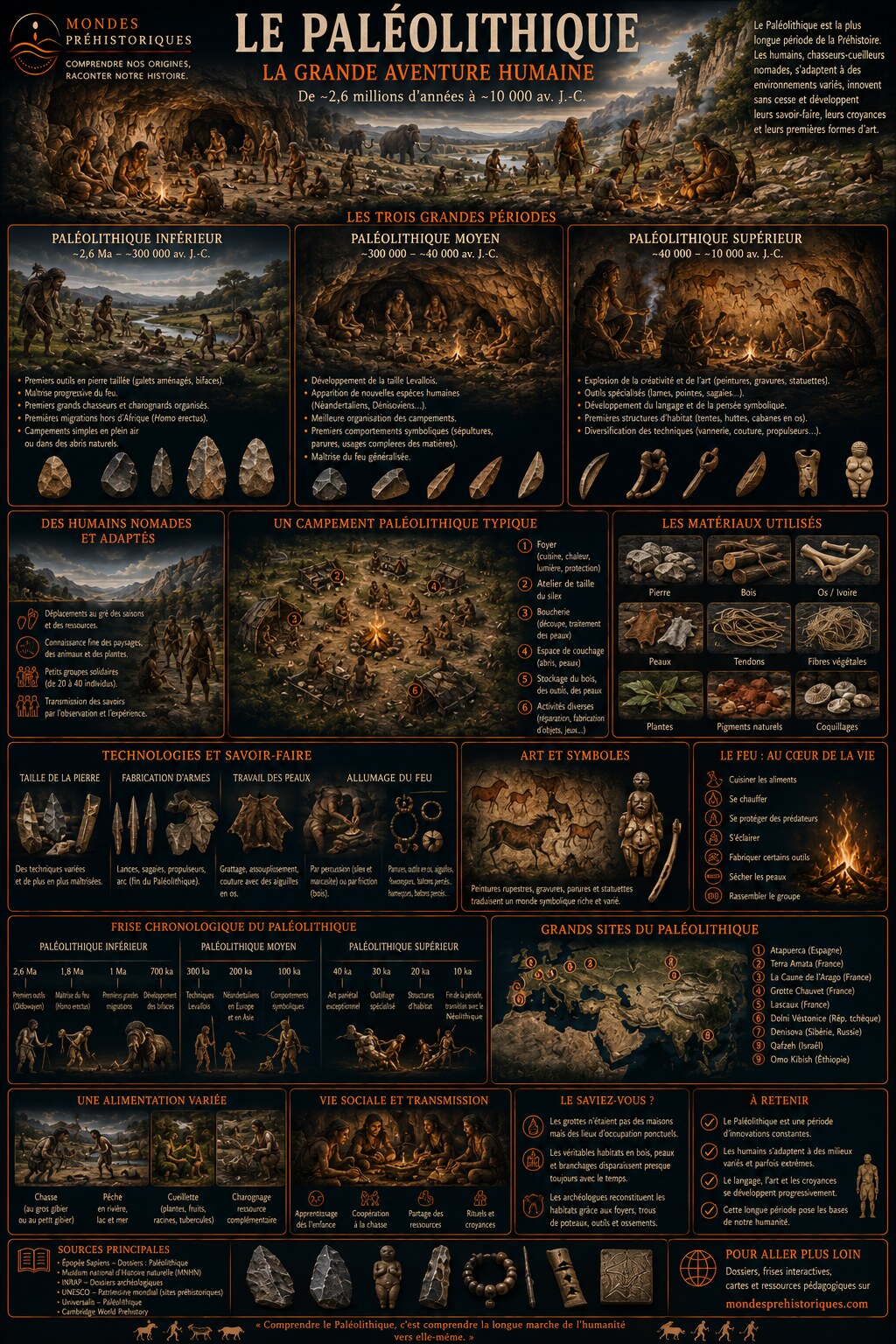
The Palaeolithic - The Great Human Adventure
A comprehensive overview of the human Palaeolithic adventure, from ~3.3 million years ago to the end of the Pleistocene: the major periods, species, tools, art and the expansion out of Africa.
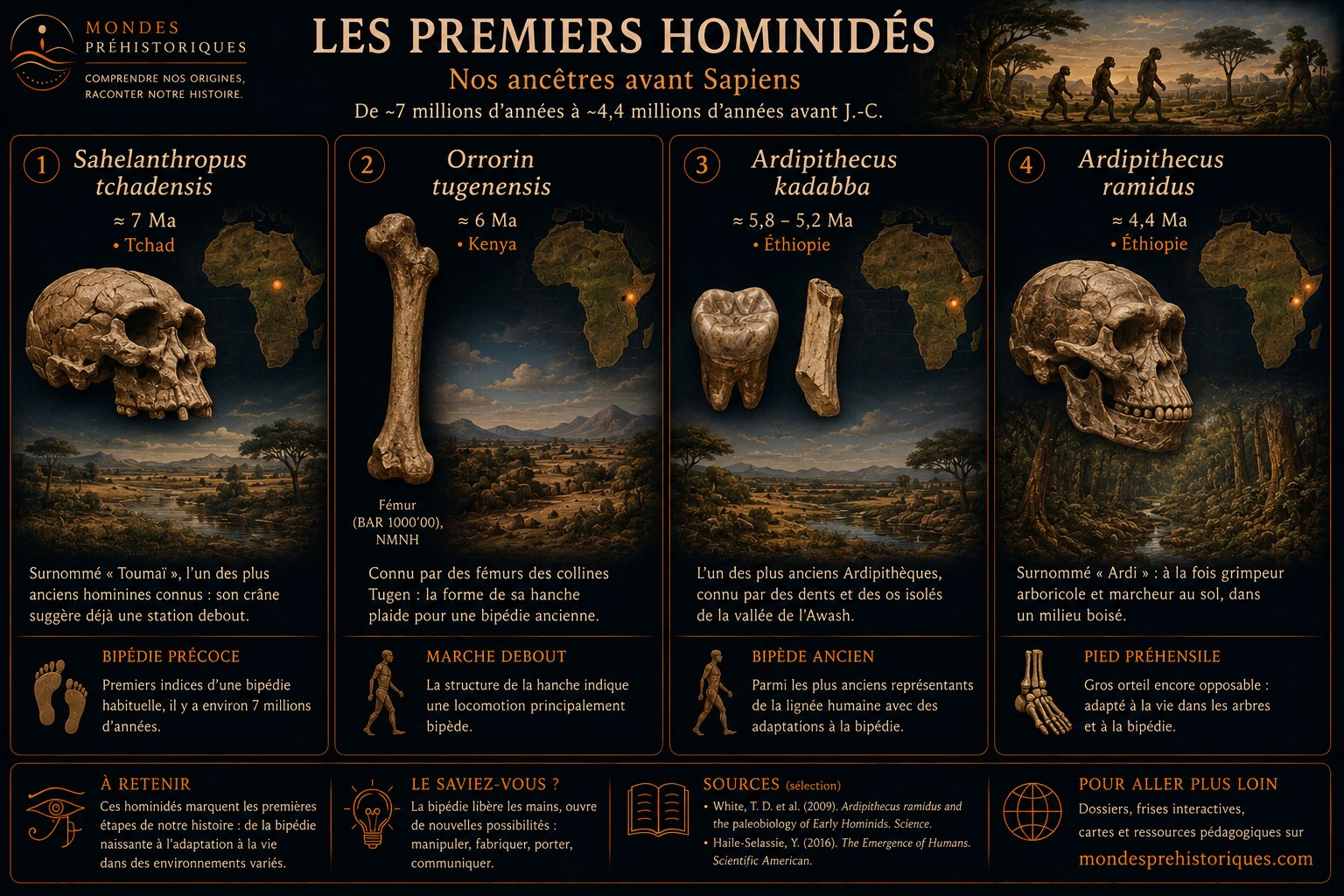
The First Hominins
Our ancestors before Sapiens, from ~7 million to ~4.4 million years ago: Sahelanthropus tchadensis (Toumai), Orrorin tugenensis, Ardipithecus kadabba and Ardipithecus ramidus. The first steps toward bipedalism, fossil by fossil.
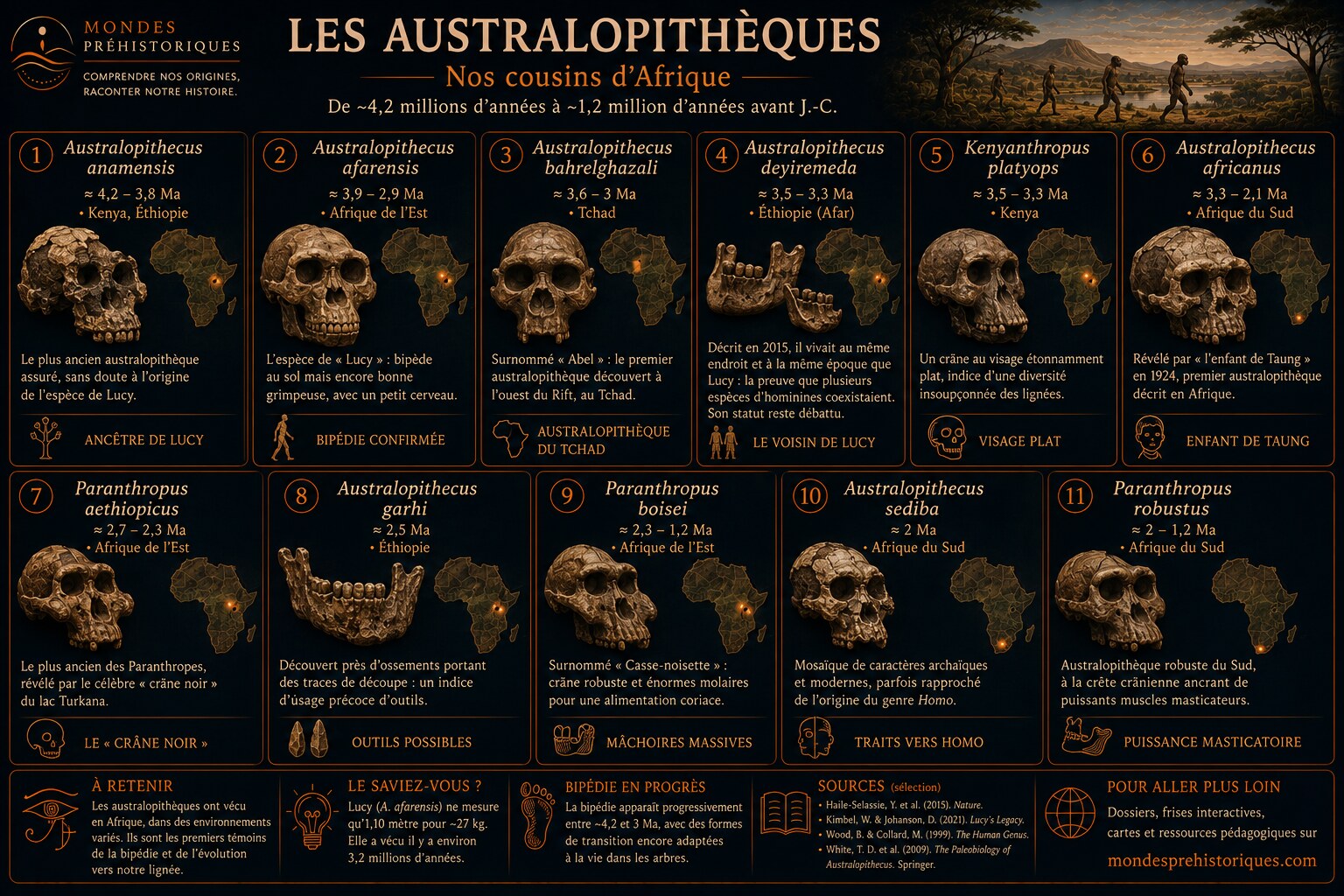
The Australopithecines
Our African cousins, from ~4.2 to ~1.2 million years ago: 11 species presented (anamensis, afarensis known as Lucy, africanus, sediba, Paranthropus boisei and robustus...), with their skulls, distribution and contribution to the story of bipedalism.
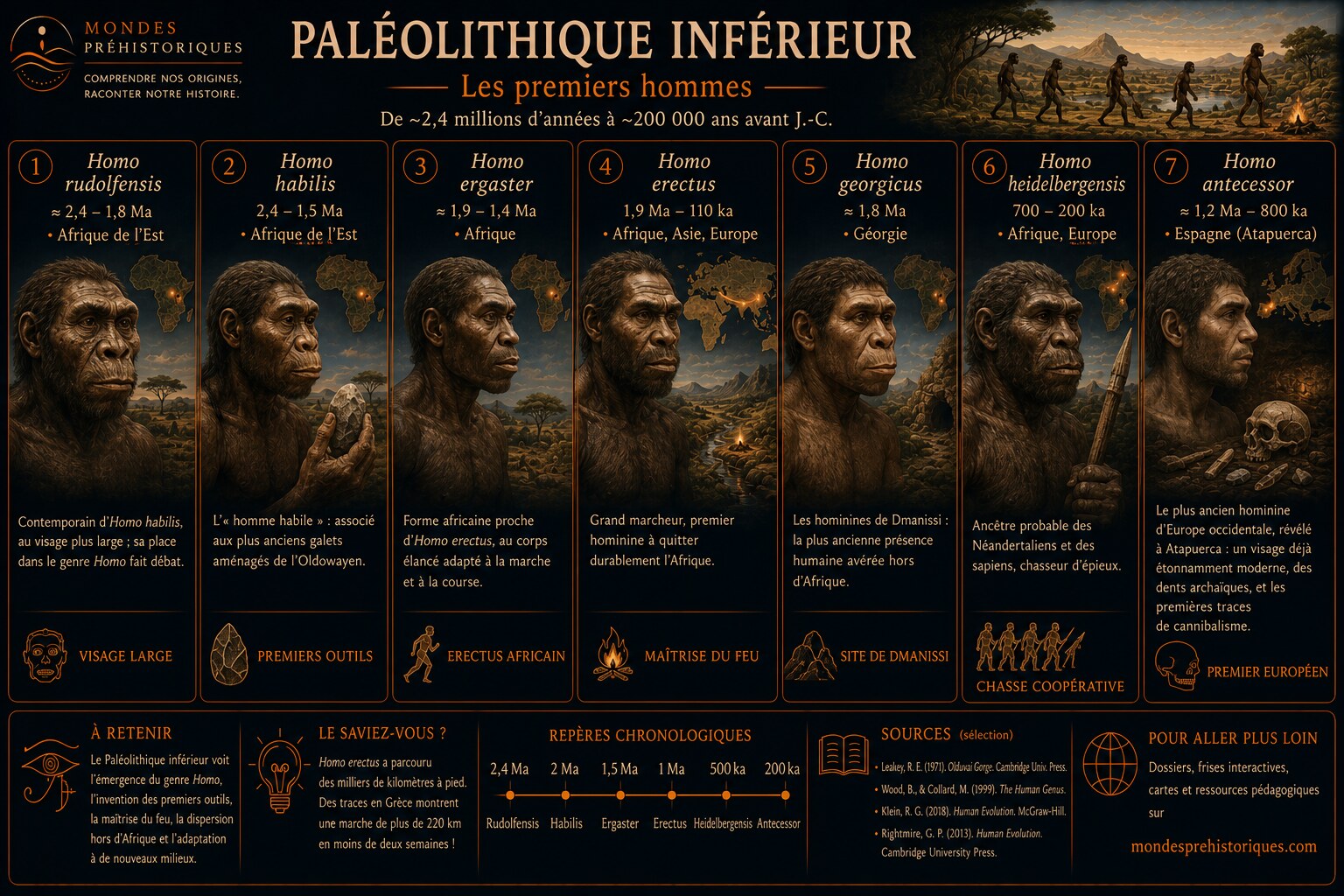
The Lower Palaeolithic
The first humans, from ~2.4 million to ~200,000 years ago: Homo rudolfensis, habilis, ergaster, erectus, georgicus, heidelbergensis and antecessor. The first tools, mastery of fire and the exit from Africa.
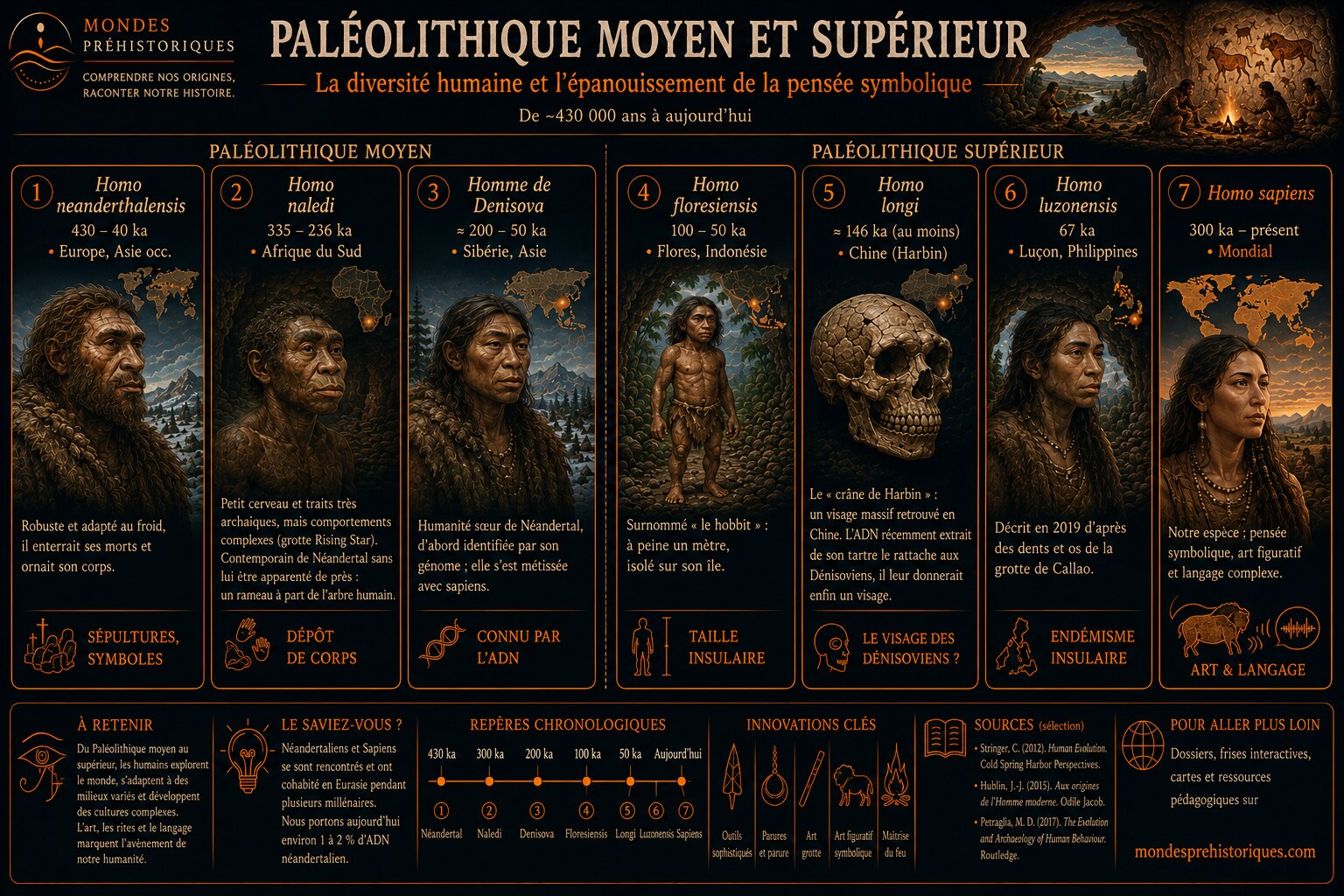
Middle and Upper Palaeolithic
Human diversity and the flowering of symbolic thought, from ~430,000 years ago to today: Neanderthals, Homo naledi, Denisovans, floresiensis, longi, luzonensis and sapiens. Burials, ornaments, art and language.
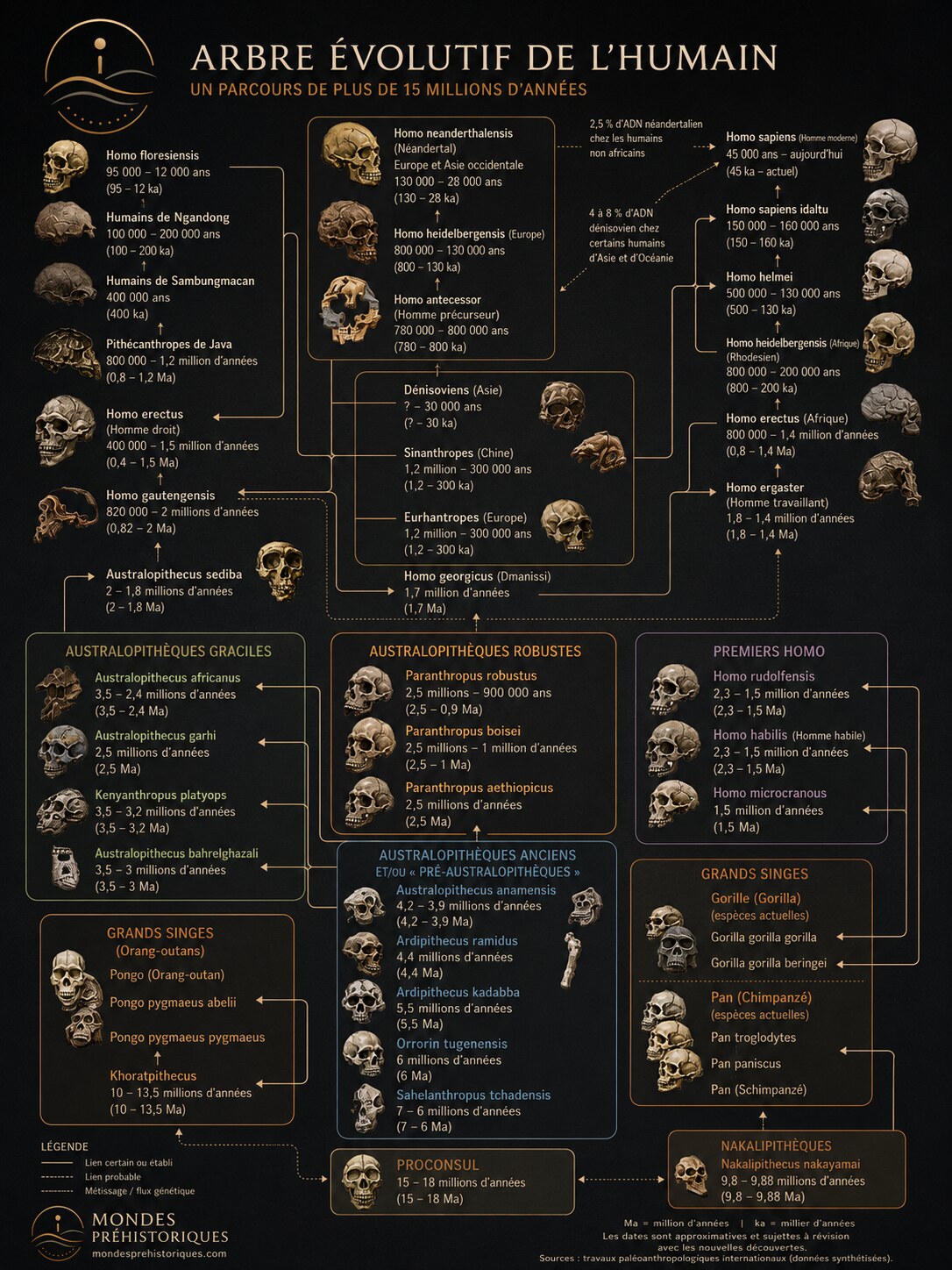
Human Evolutionary Tree
Illustrated phylogeny of the genus Homo and our hominin ancestors: from Australopithecus afarensis to Homo sapiens, via Homo habilis, Homo erectus and Homo neanderthalensis. The major branches of our evolutionary history at a glance.
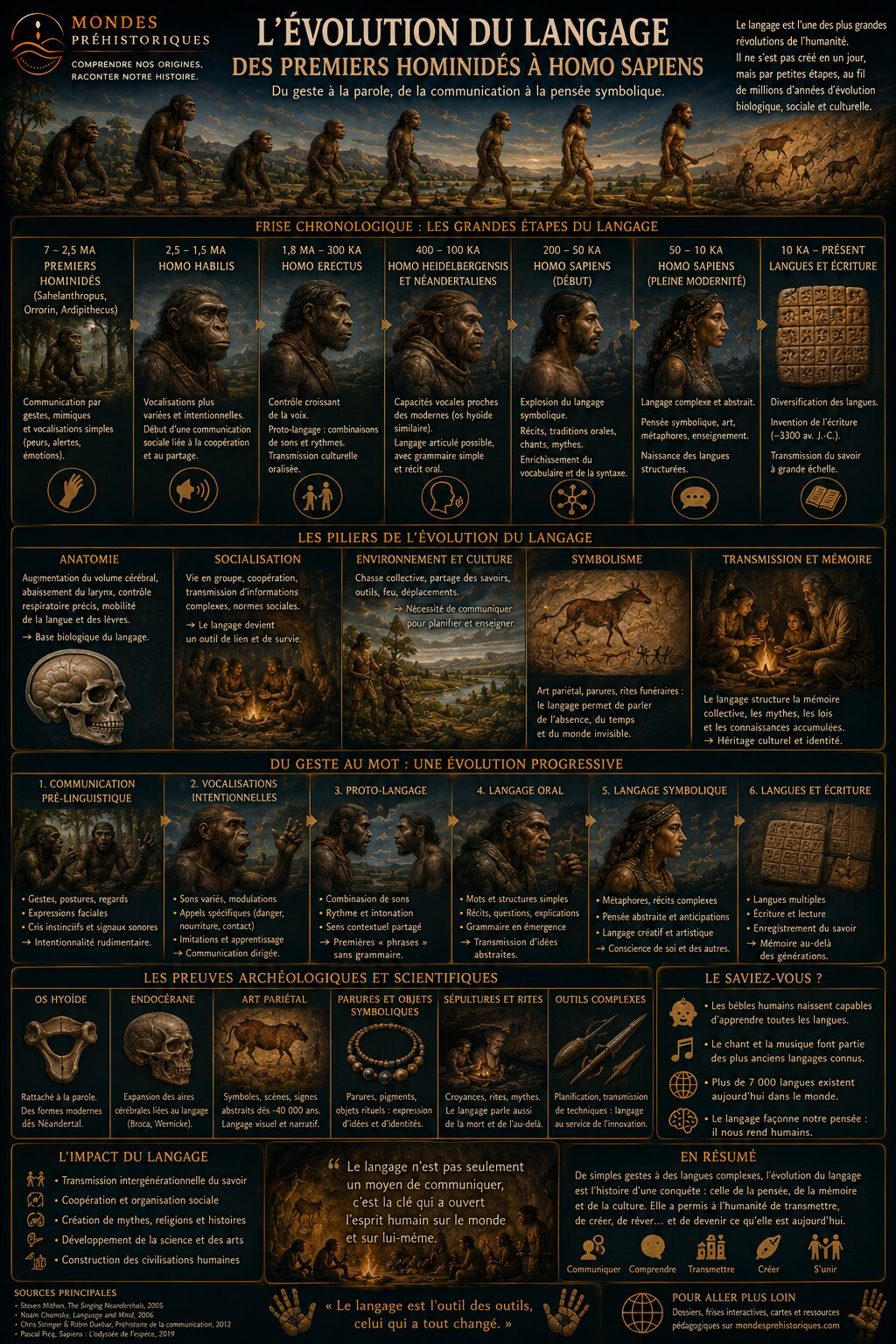
The Evolution of Language
From the first hominin vocalisations to articulate language: the Kebara hyoid, the FOXP2 gene, hypotheses on the origin of language and links with cave art and symbolic behaviour.
Prehistoric life and techniques
8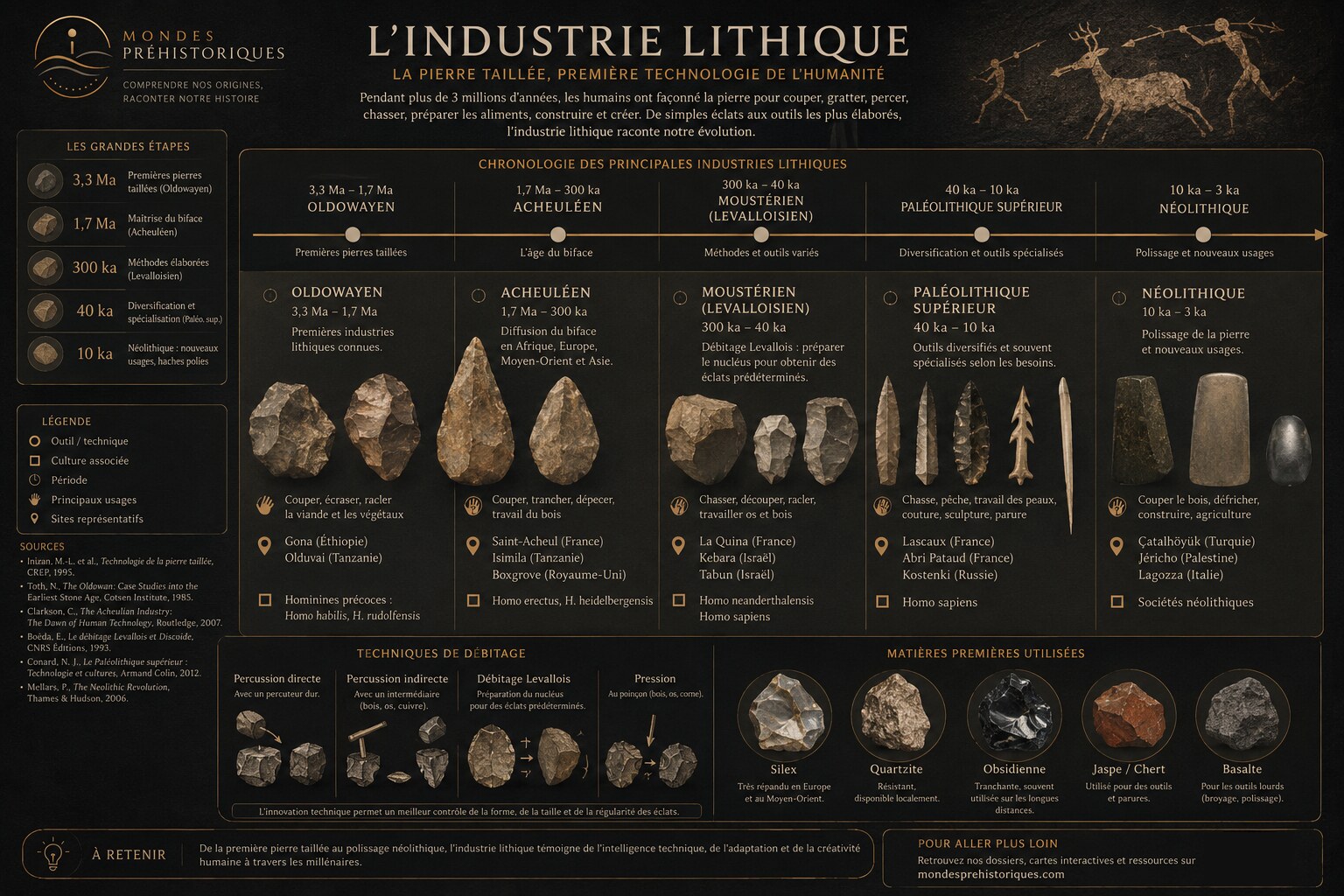
Lithic Industry
Illustrated overview of major stone-knapping traditions from the Early Palaeolithic to the Bronze Age: Oldowan, Acheulean, Mousterian, Gravettian and beyond. A visual guide to understanding the evolution of lithic techniques and cultures over 3 million years.
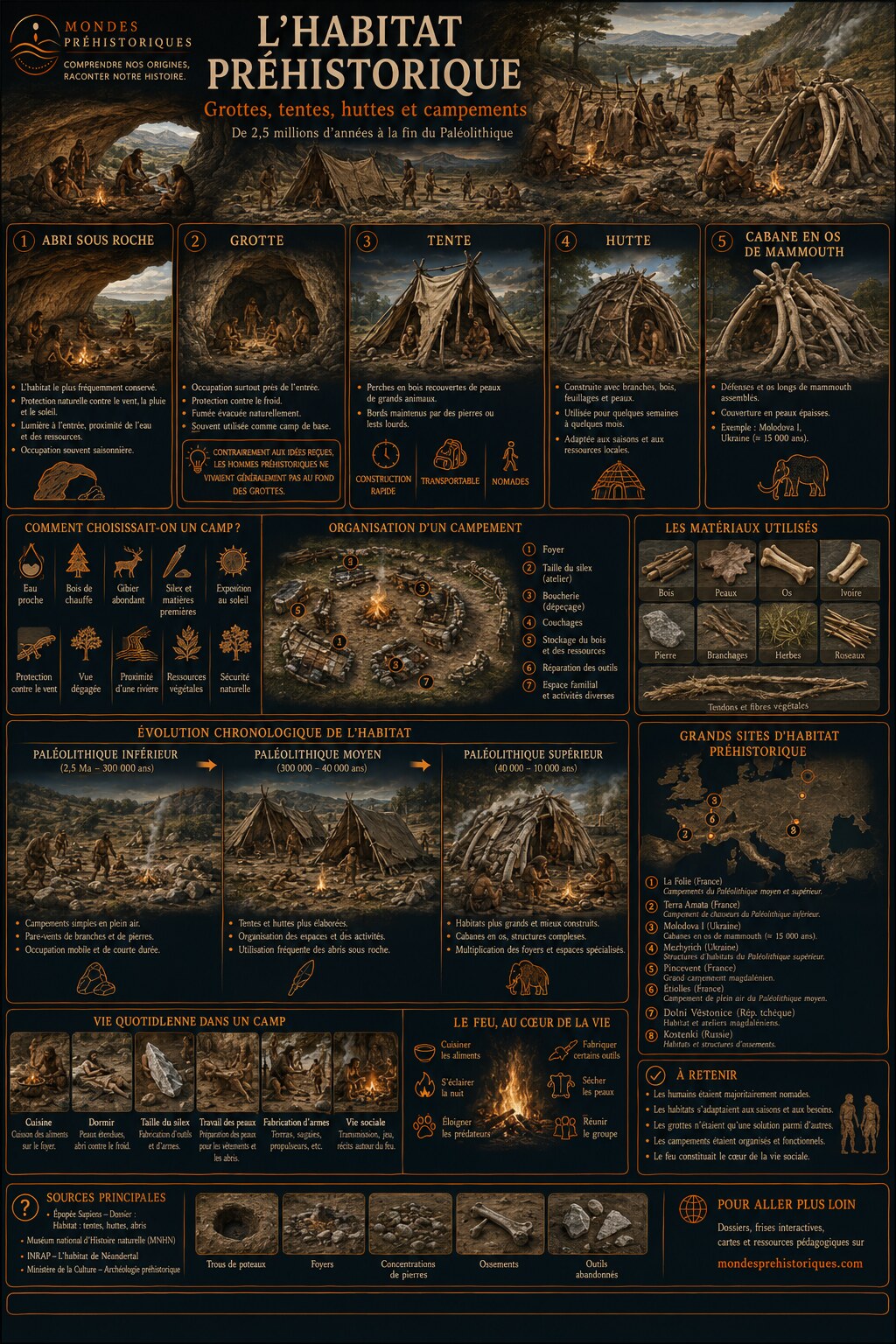
Prehistoric Dwellings
Caves, tents, huts and camps, from 2.5 million years ago to the end of the Palaeolithic: the five main dwelling types, how a camp was organised, the materials used and the major sites (Terra Amata, Molodova, Mezhyrich, Dolni Vestonice).
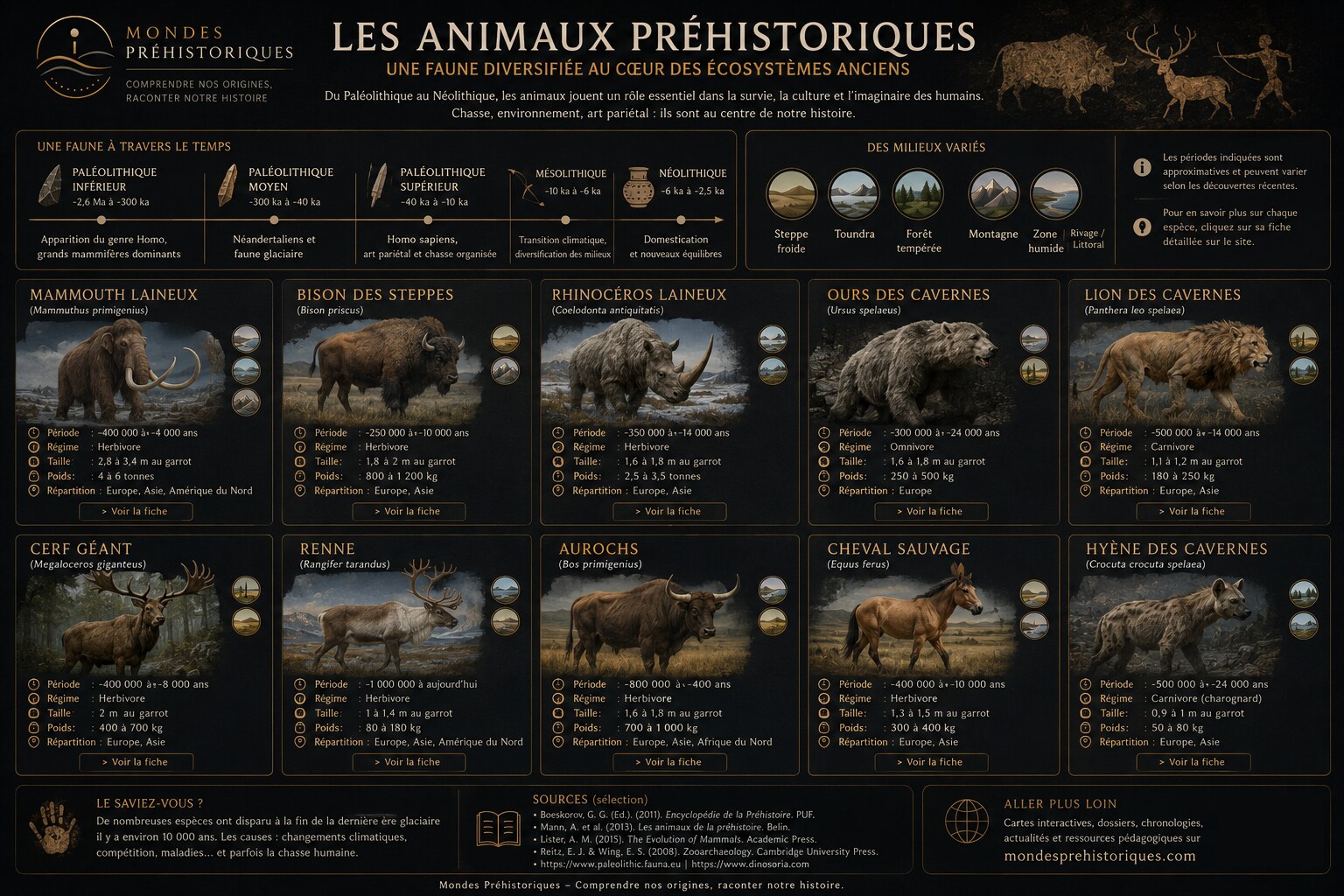
Prehistoric Animals
Visual guide to iconic prehistoric megafauna: woolly mammoths, woolly rhinoceroses, saber-toothed cats, megaloceros and other extinct species. Each species is presented with its key characteristics and time period.
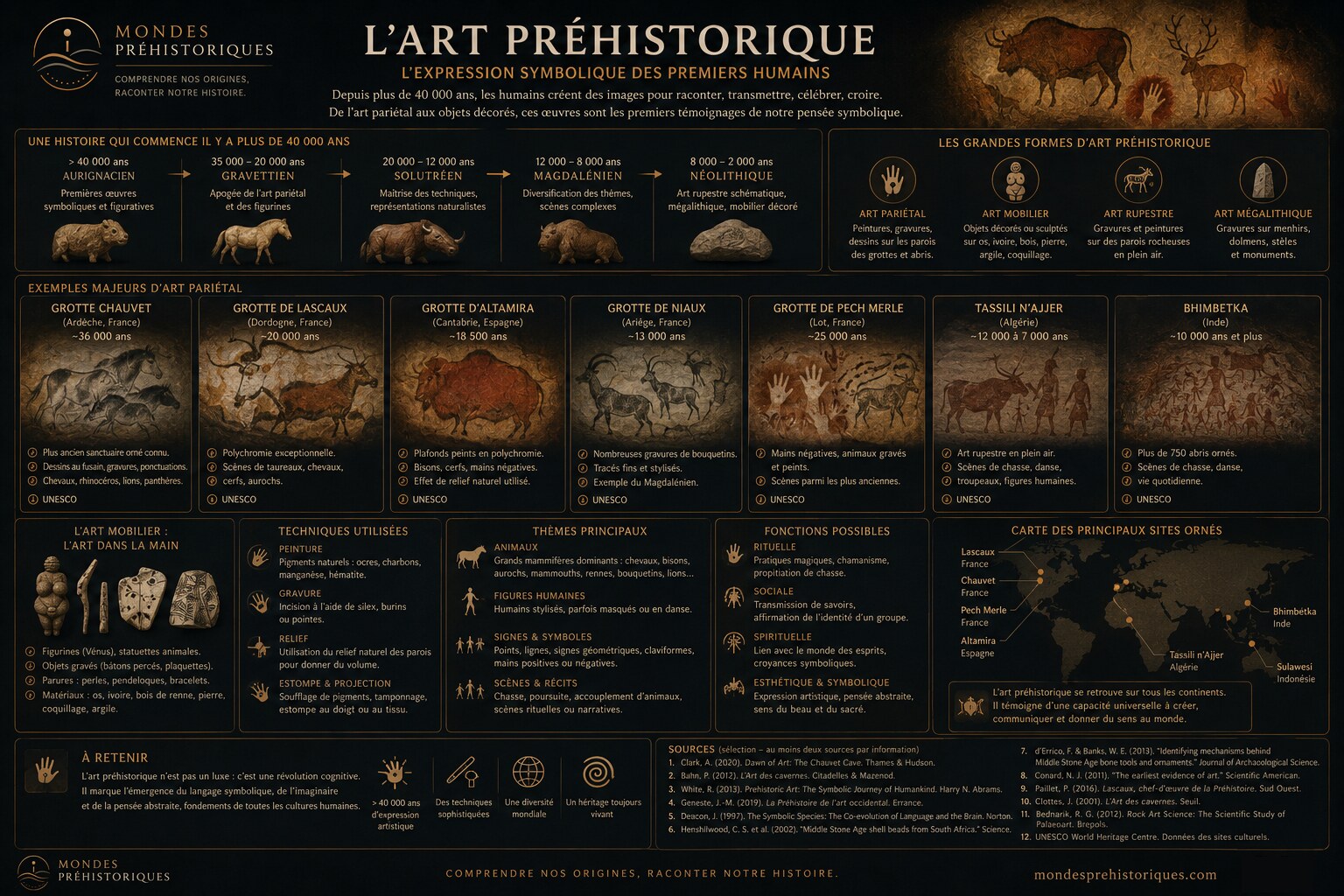
Prehistoric Art
Map and typology of major prehistoric rock art sites: cave paintings, engravings, Venus figurines and portable art. From the caves of Chauvet and Lascaux to Altamira, a panorama of humanity's earliest artistic expressions.
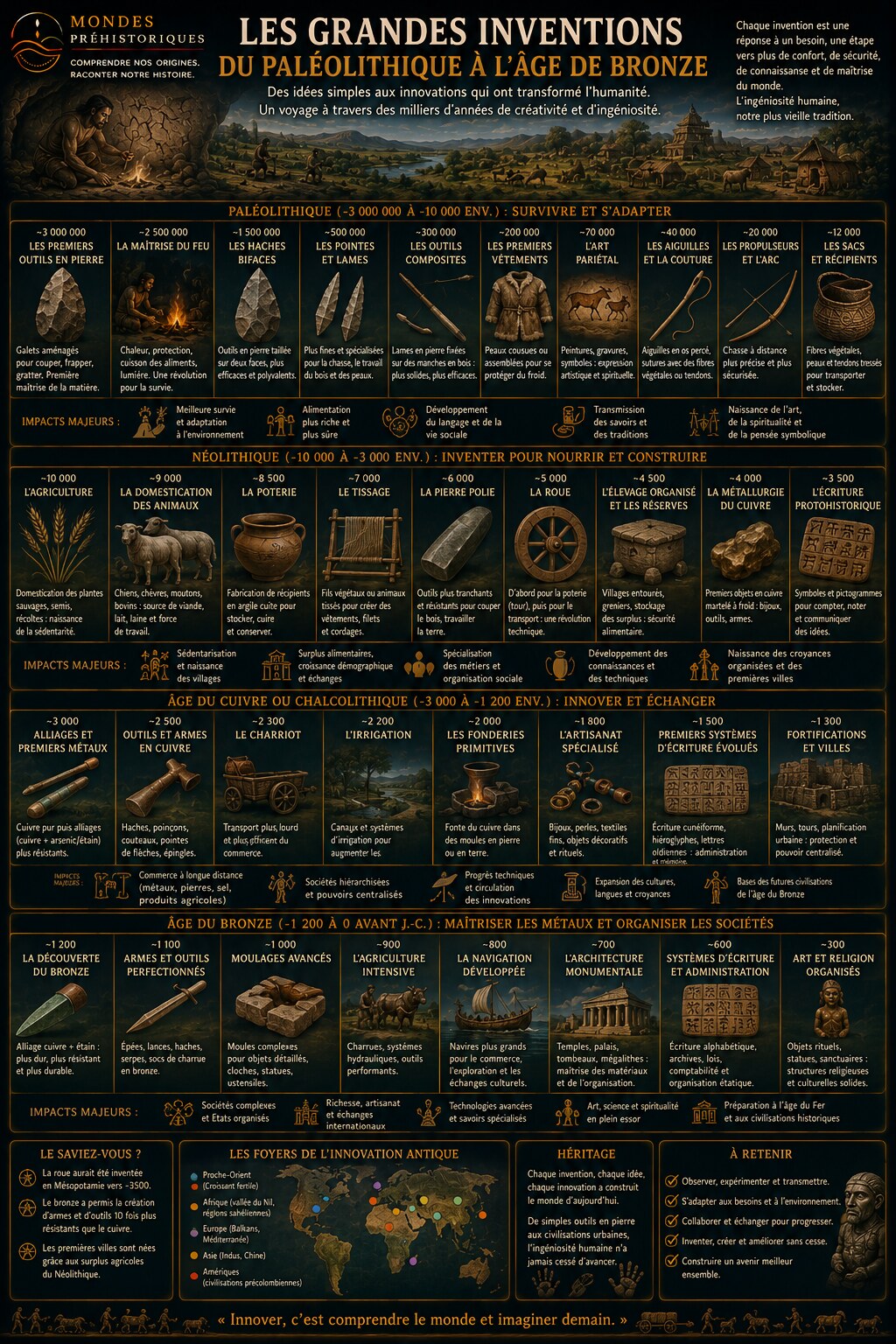
Great Inventions from the Palaeolithic to the Bronze Age
The technological innovations that changed the world, from flint knapping to metallurgy: tools, the wheel, writing, metals, farming, pottery and much more. A timeline of humanity's greatest firsts.
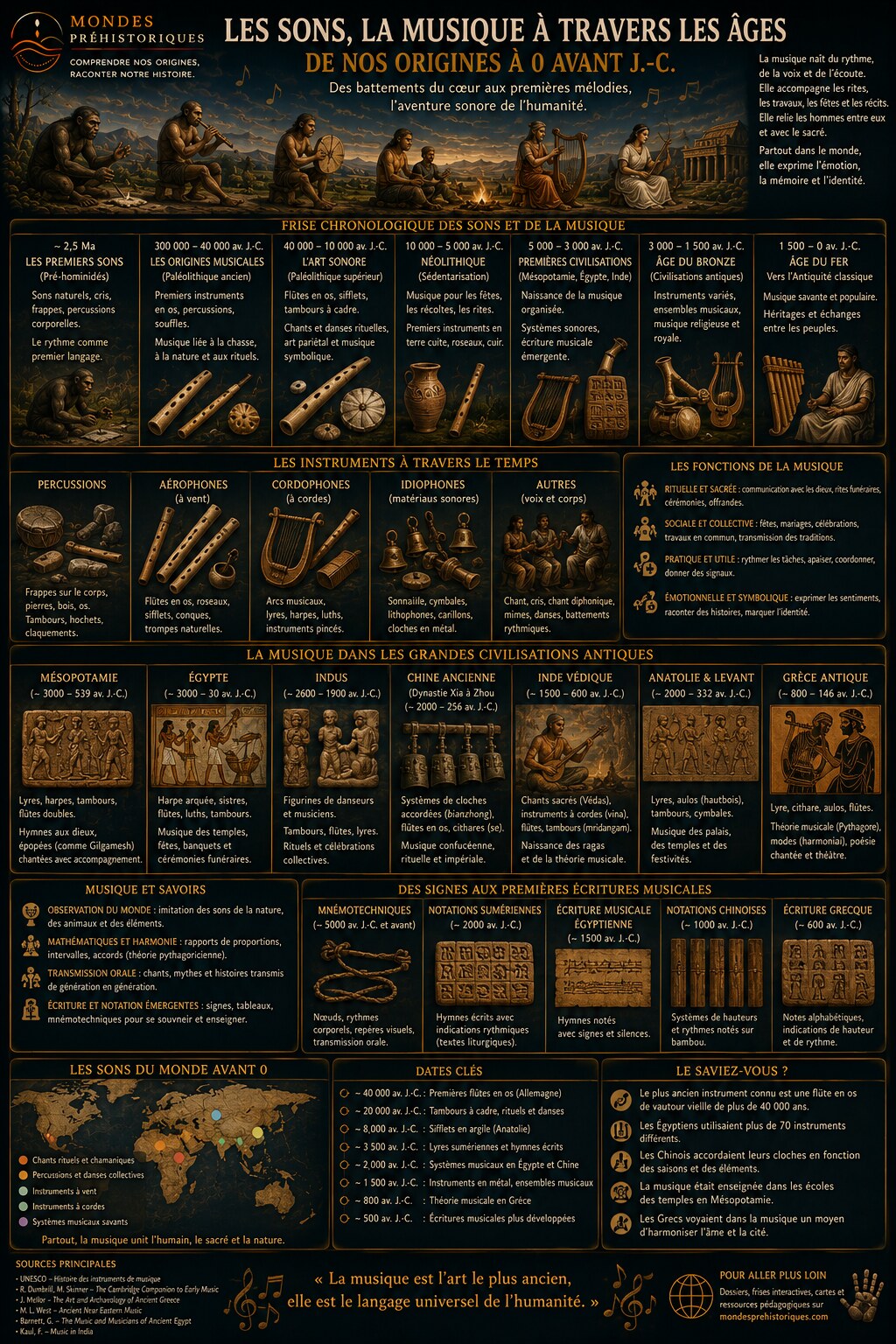
Sound and Music Through the Ages
From the first bone flutes 60,000 years ago to the instruments of Antiquity: percussion, strings and winds, with the main prehistoric musical sites (Hohle Fels, Divje Babe, Isturitz).
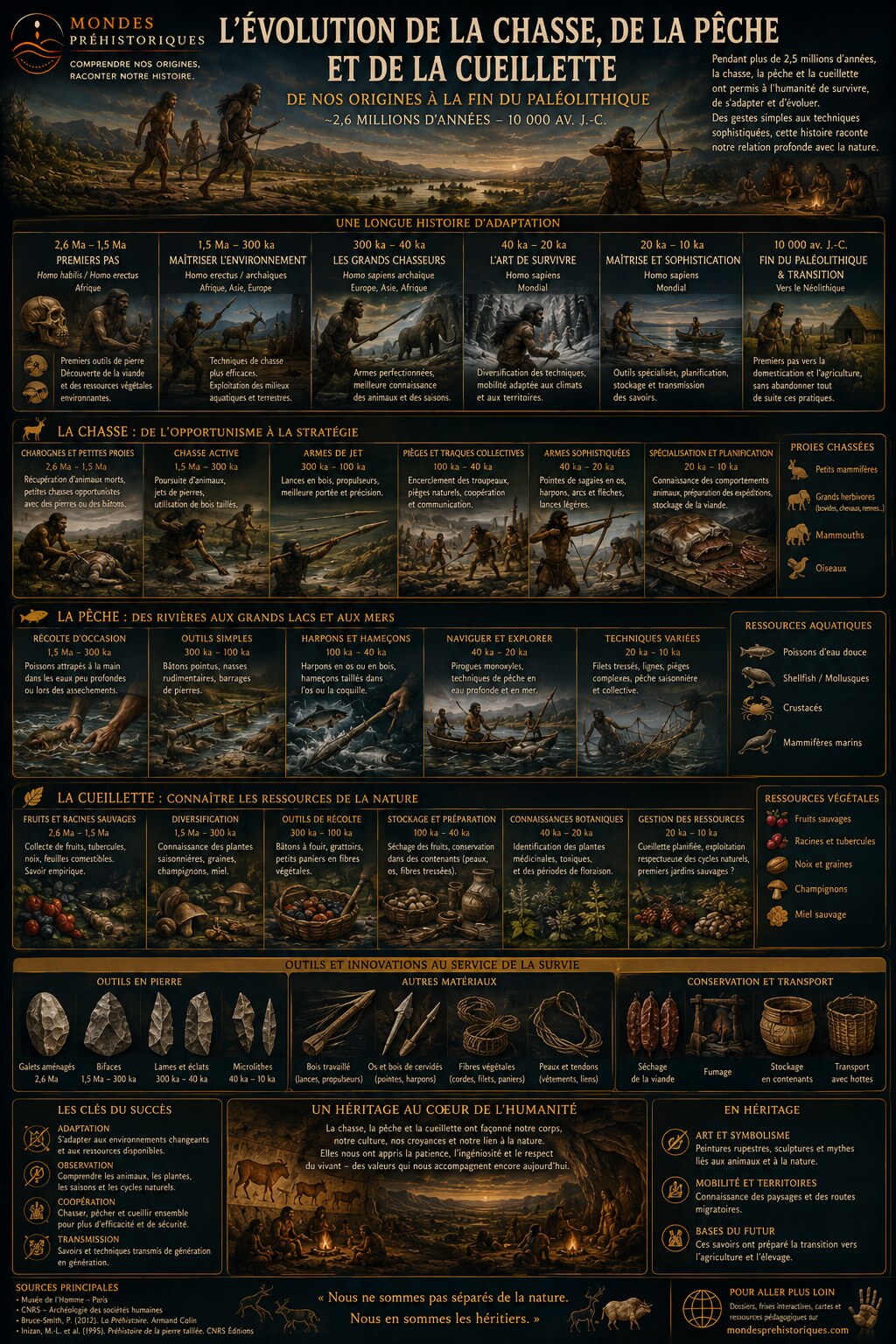
The Evolution of Hunting, Fishing and Gathering
Subsistence strategies from the Palaeolithic to the Neolithic: hunting and trapping techniques, fishing, plant gathering and the gradual transition to farming.
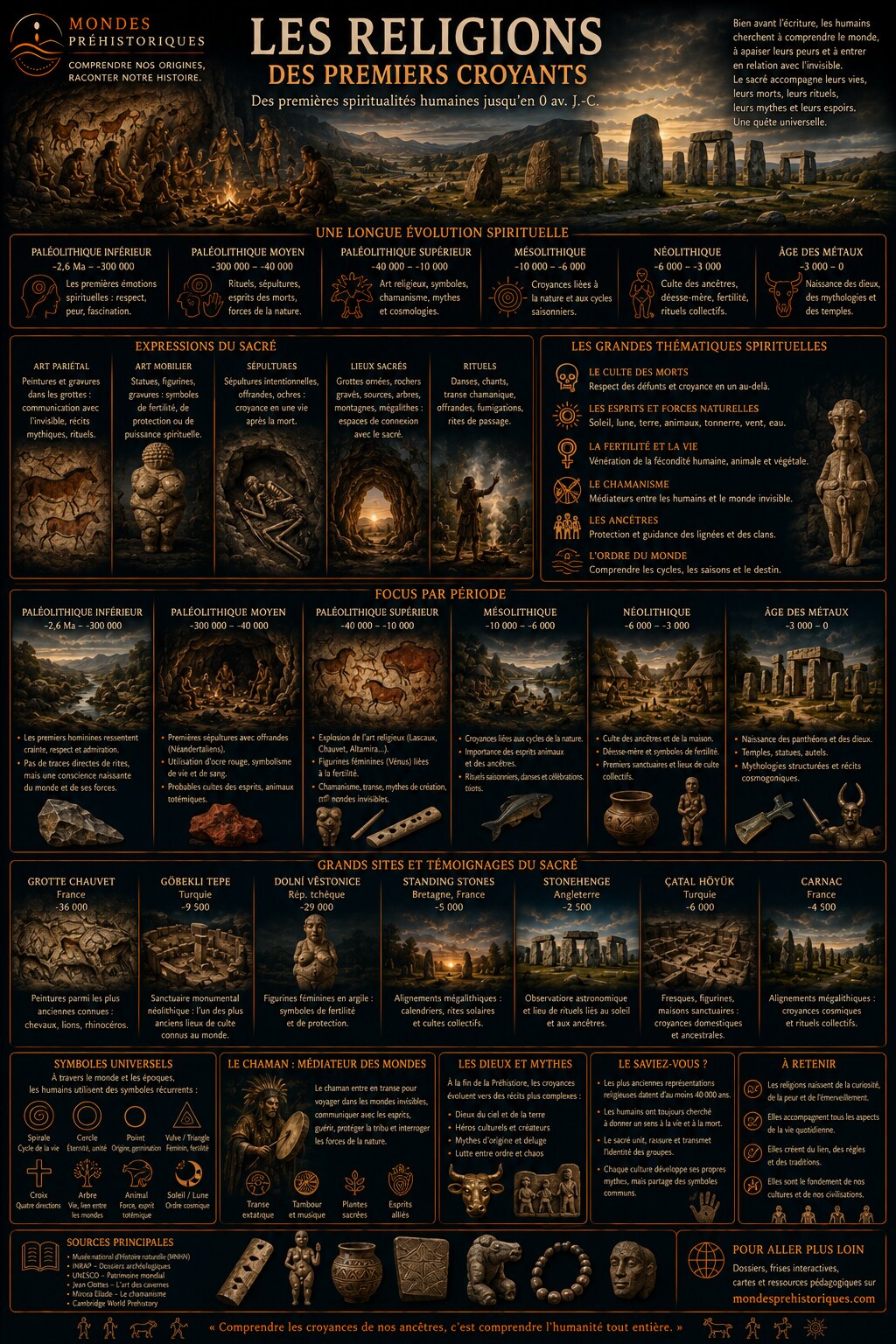
Religions of the First Believers
From the first Neanderthal burials at Shanidar to Bronze Age rites: burials, totems, Venus figurines, sanctuaries and the emergence of religious thought in Prehistory.
Neolithic and megaliths
3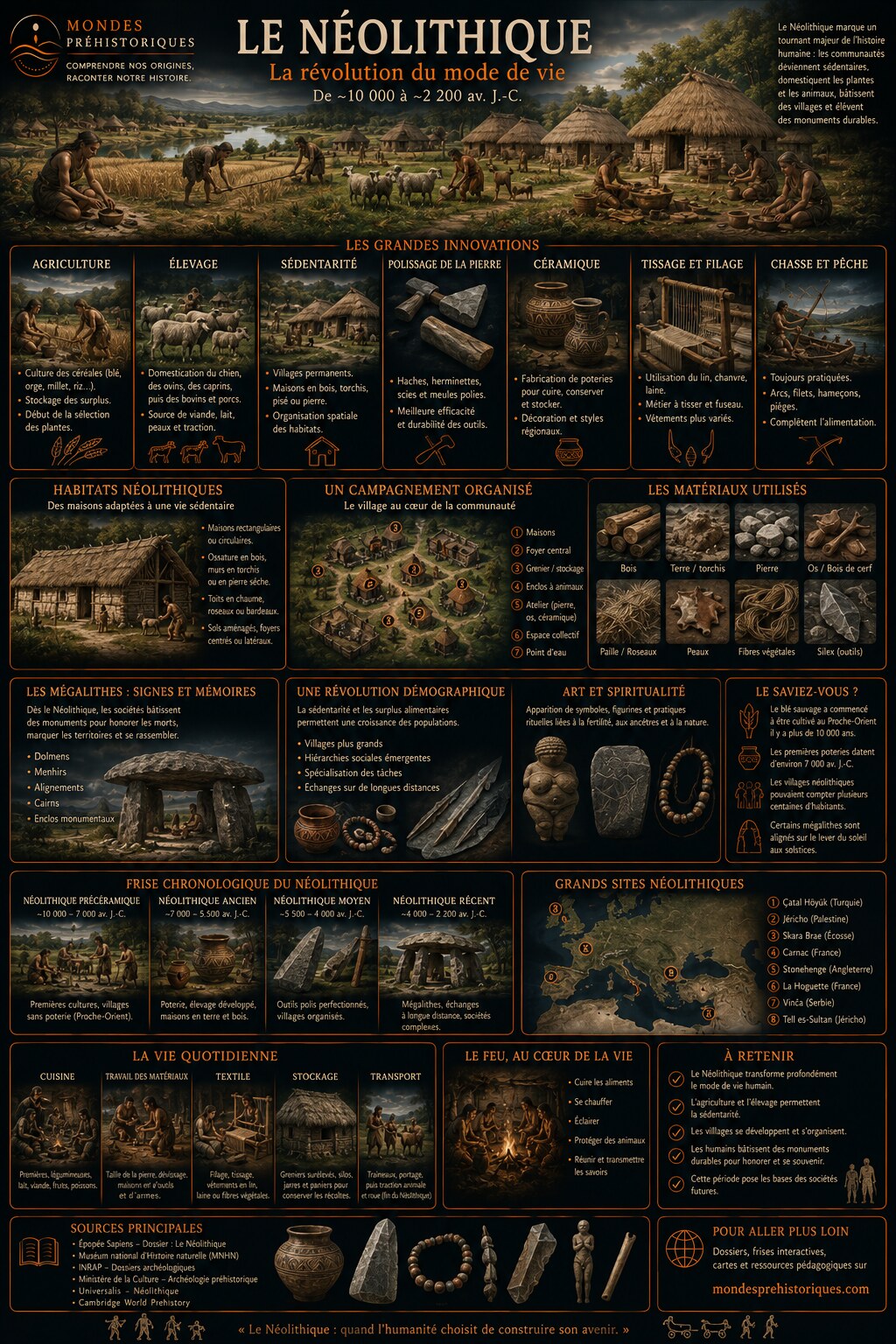
The Neolithic
The Neolithic revolution, from ~12,000 to ~2,000 BC: plant and animal domestication, the first villages and towns, pottery, stone polishing and the rise of settled societies.
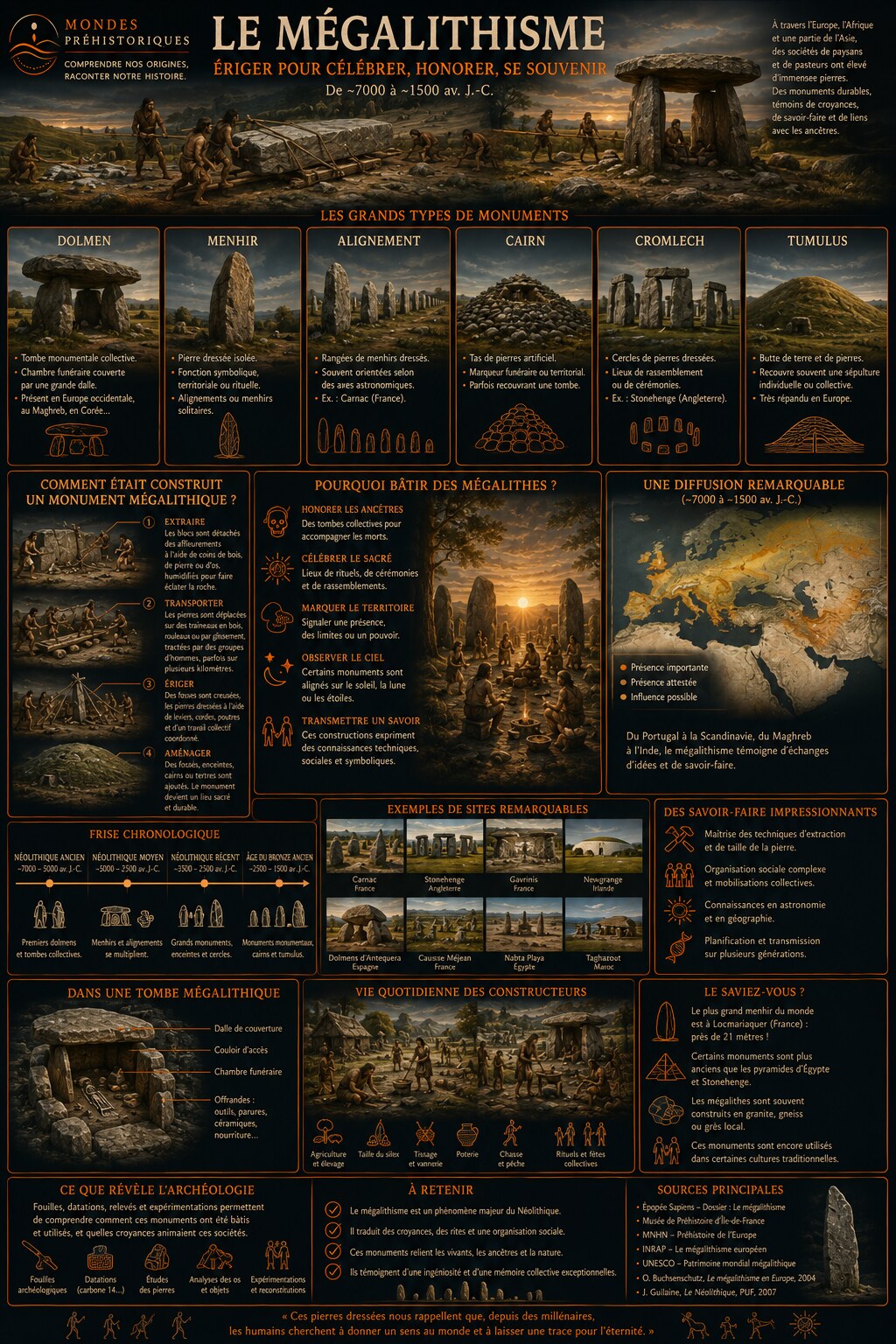
Megalithism
Raising stones to celebrate, honour and remember, from ~7000 to ~1500 BC: dolmens, menhirs, alignments, cairns, cromlechs and tumuli. How these stones were quarried, moved and raised, why, and where (Carnac, Stonehenge, Gavrinis, Newgrange).
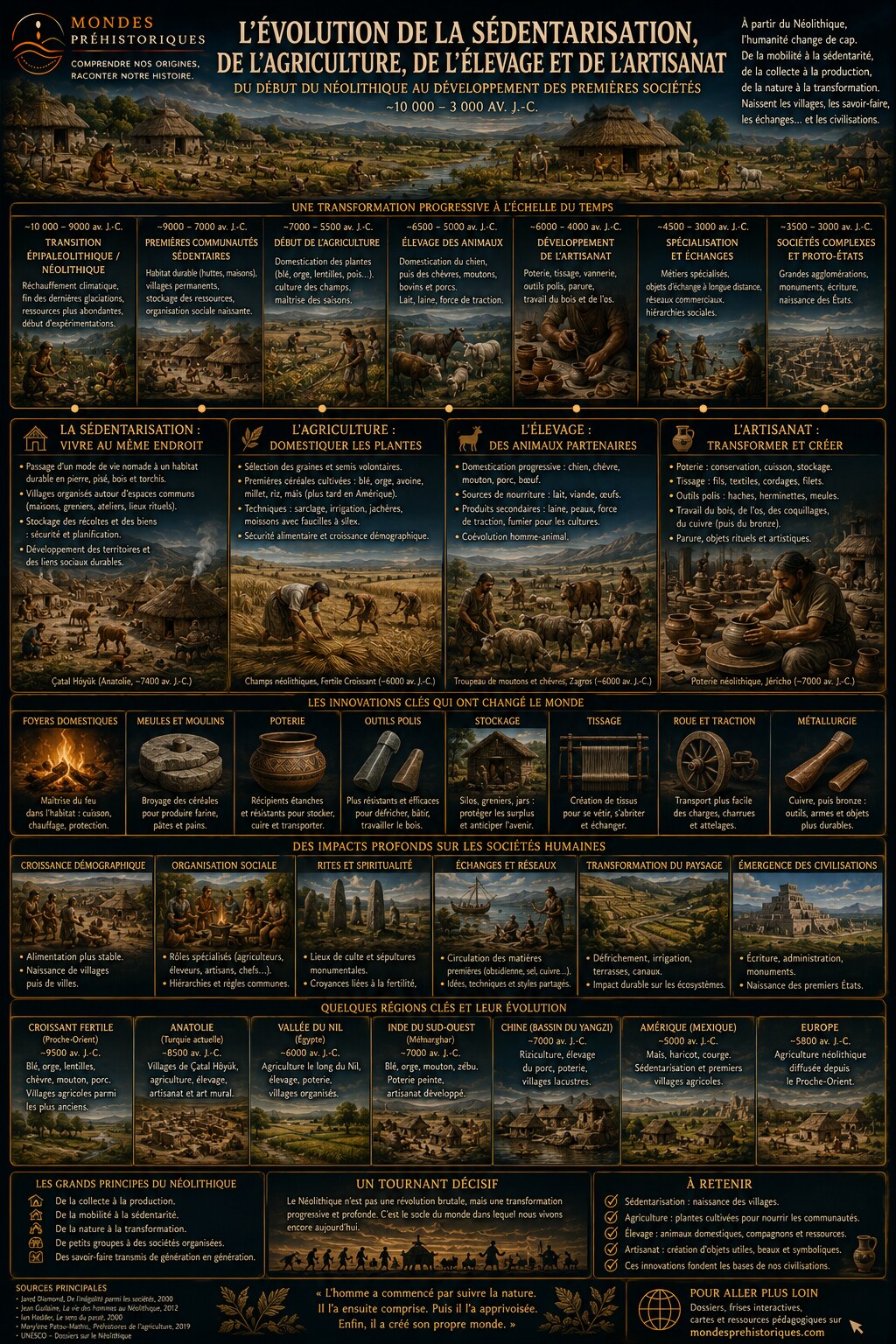
The Evolution of Settlement, Agriculture and Herding
From seasonal camp to permanent village: how humanity gradually adopted farming, herding and craft production to transform its relationship with space and time.
First civilisations
6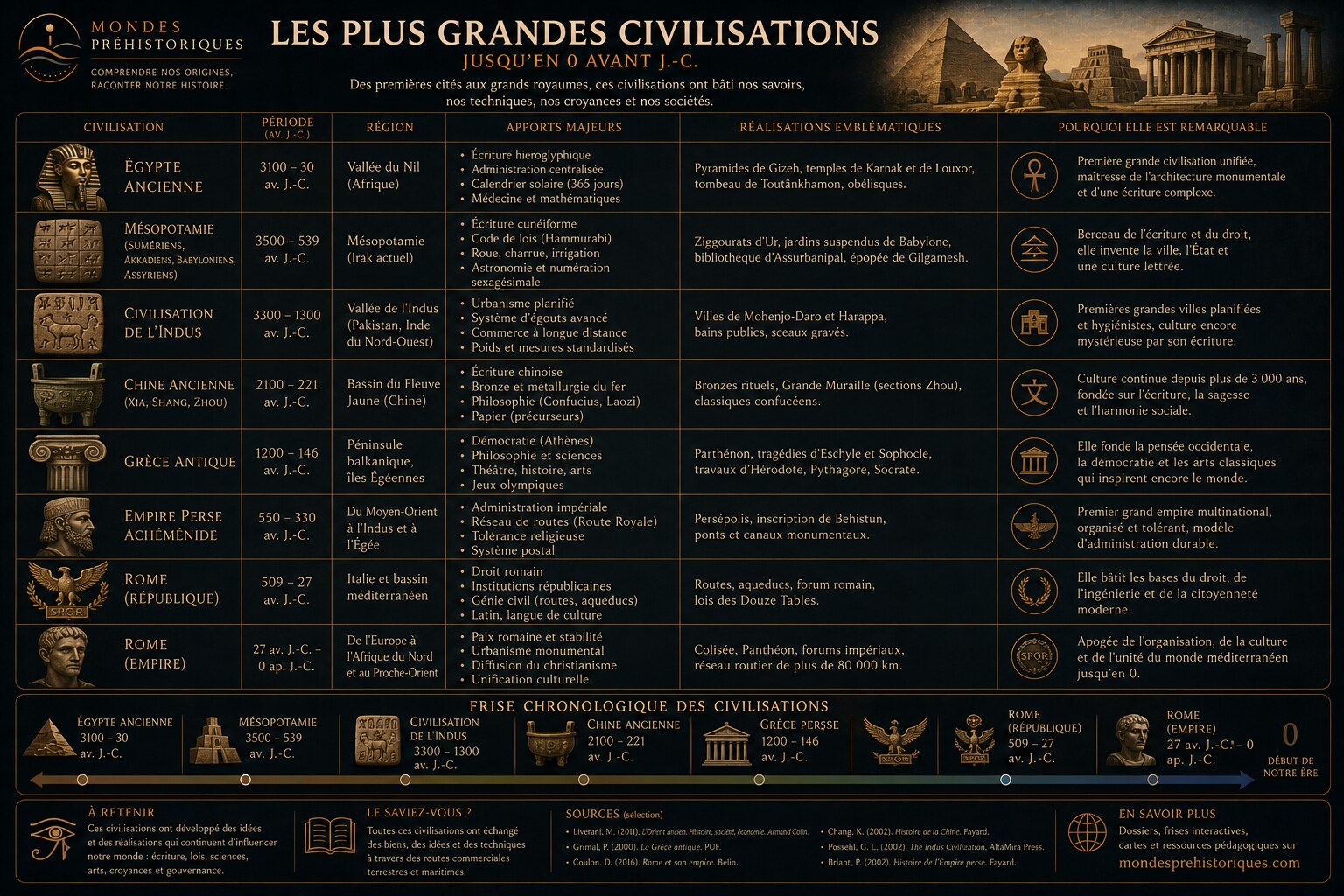
The Greatest Civilisations
Comparative table of the great civilisations up to 0 BC: Egypt, Mesopotamia, the Indus, China, Greece, Persia and Rome. Period, region, major contributions and iconic achievements, with a synthesis timeline.
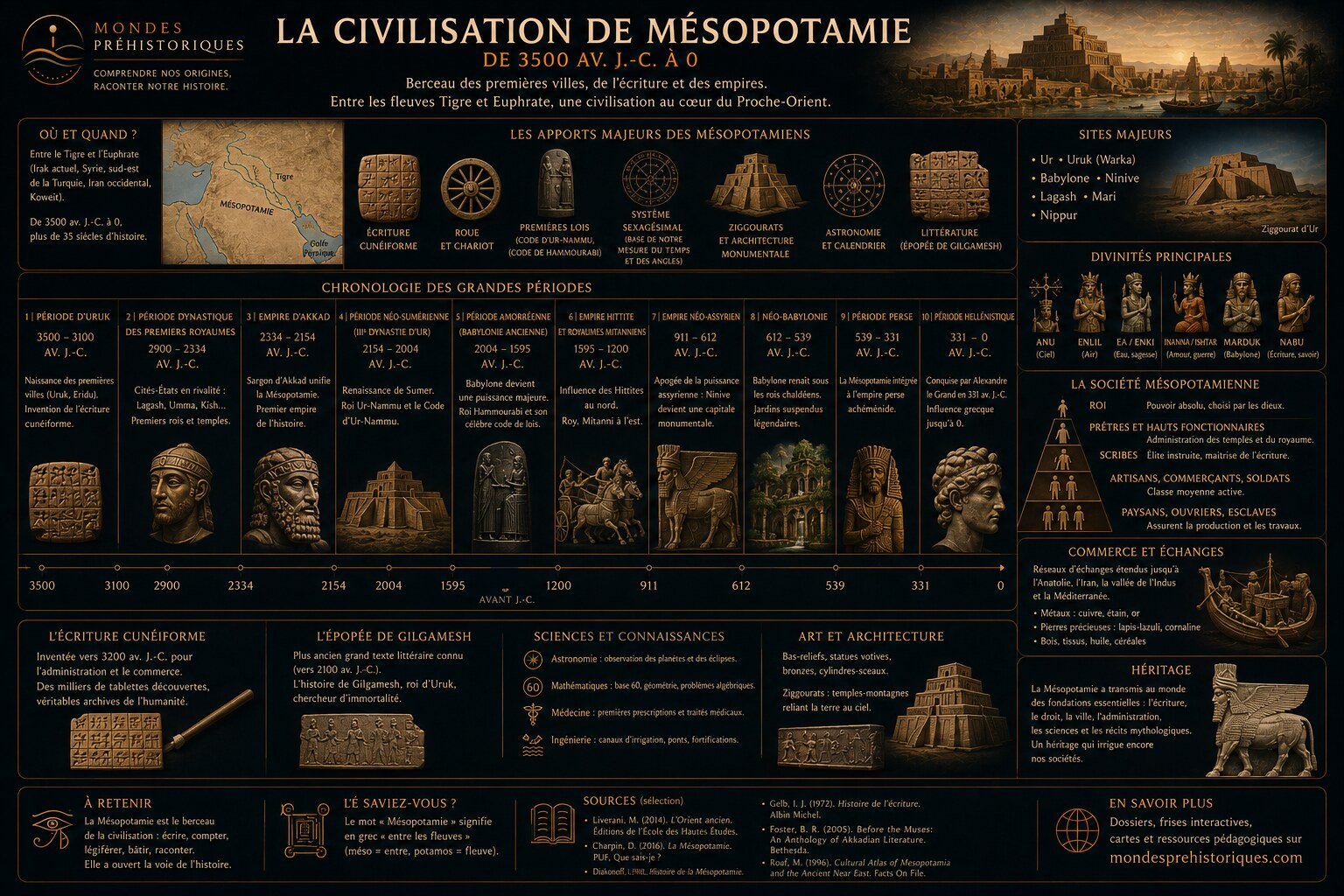
The Mesopotamian Civilisation
From 3500 BC to 0, between the Tigris and the Euphrates: cuneiform writing, the wheel, the first law codes, ziggurats and the Epic of Gilgamesh. A ten-period chronology, deities, society and legacy.
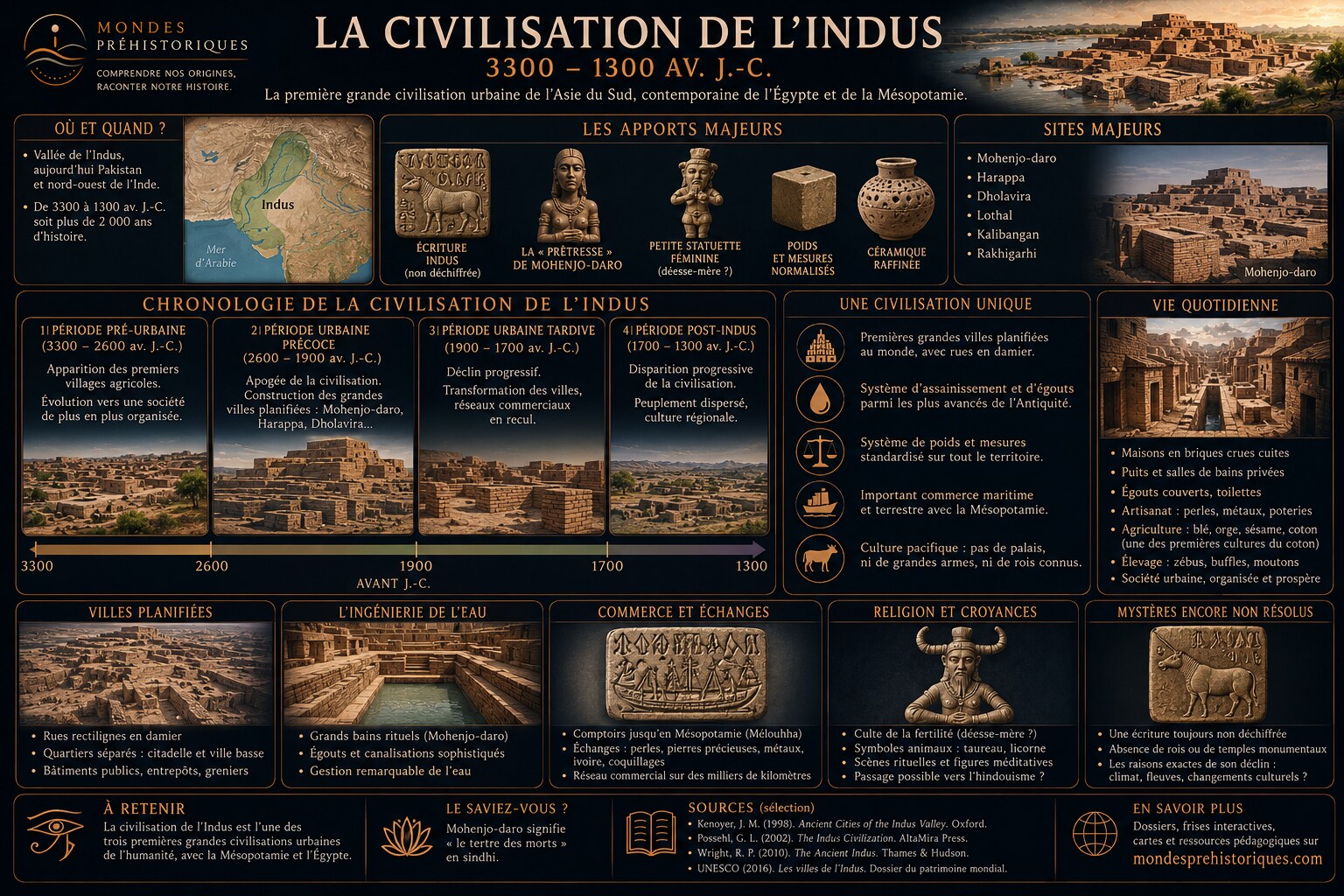
The Indus Civilisation
3300 to 1300 BC, South Asia's first great urban civilisation: grid-planned cities, sewers and ritual baths, standardised weights, a still-undeciphered script. Mohenjo-daro, Harappa, Dholavira.
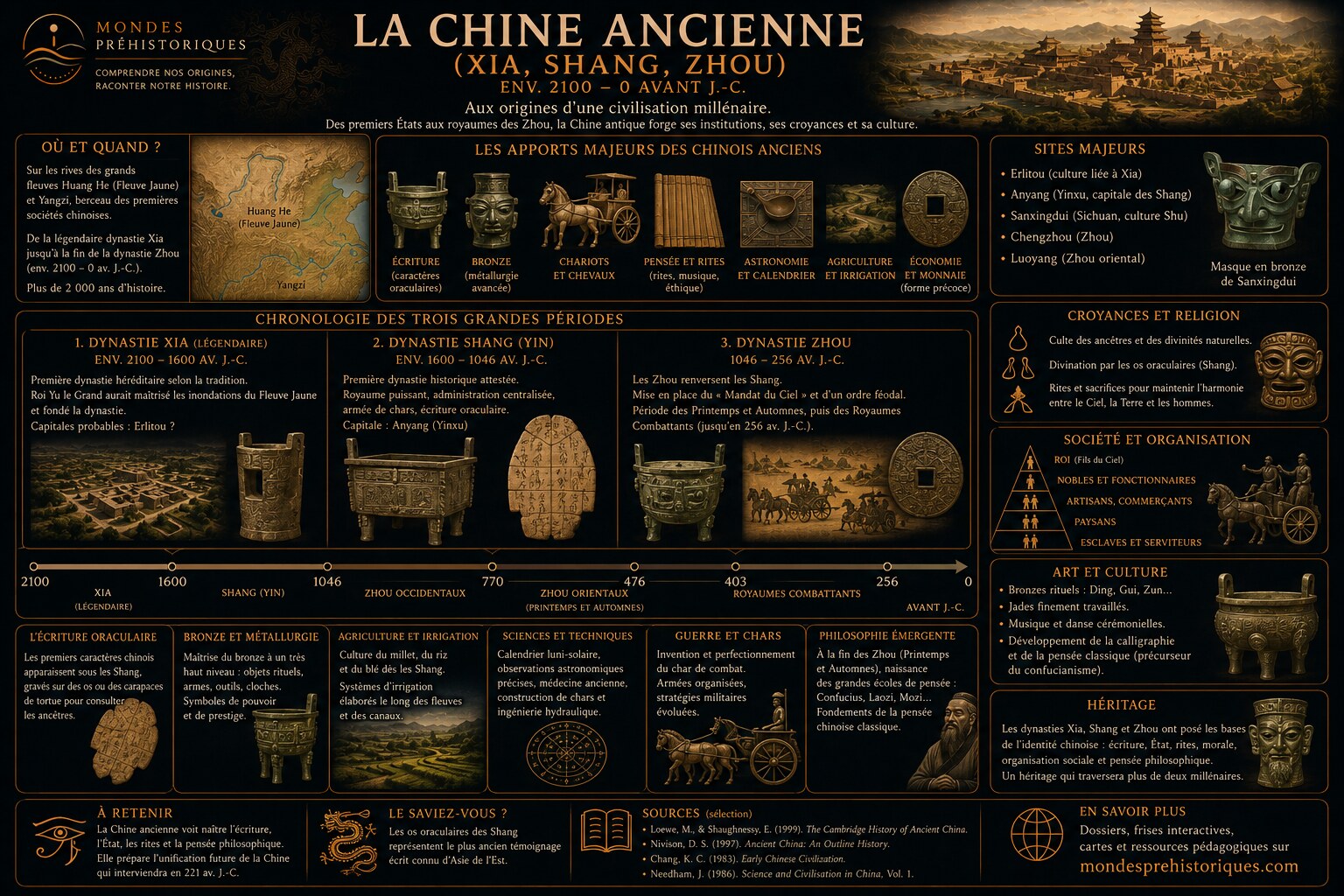
Ancient China (Xia, Shang, Zhou)
About 2100 to 0 BC, at the roots of a millennia-old civilisation: oracle bones and the birth of writing, ritual bronzes, chariots, irrigated farming and the emergence of classical thought.
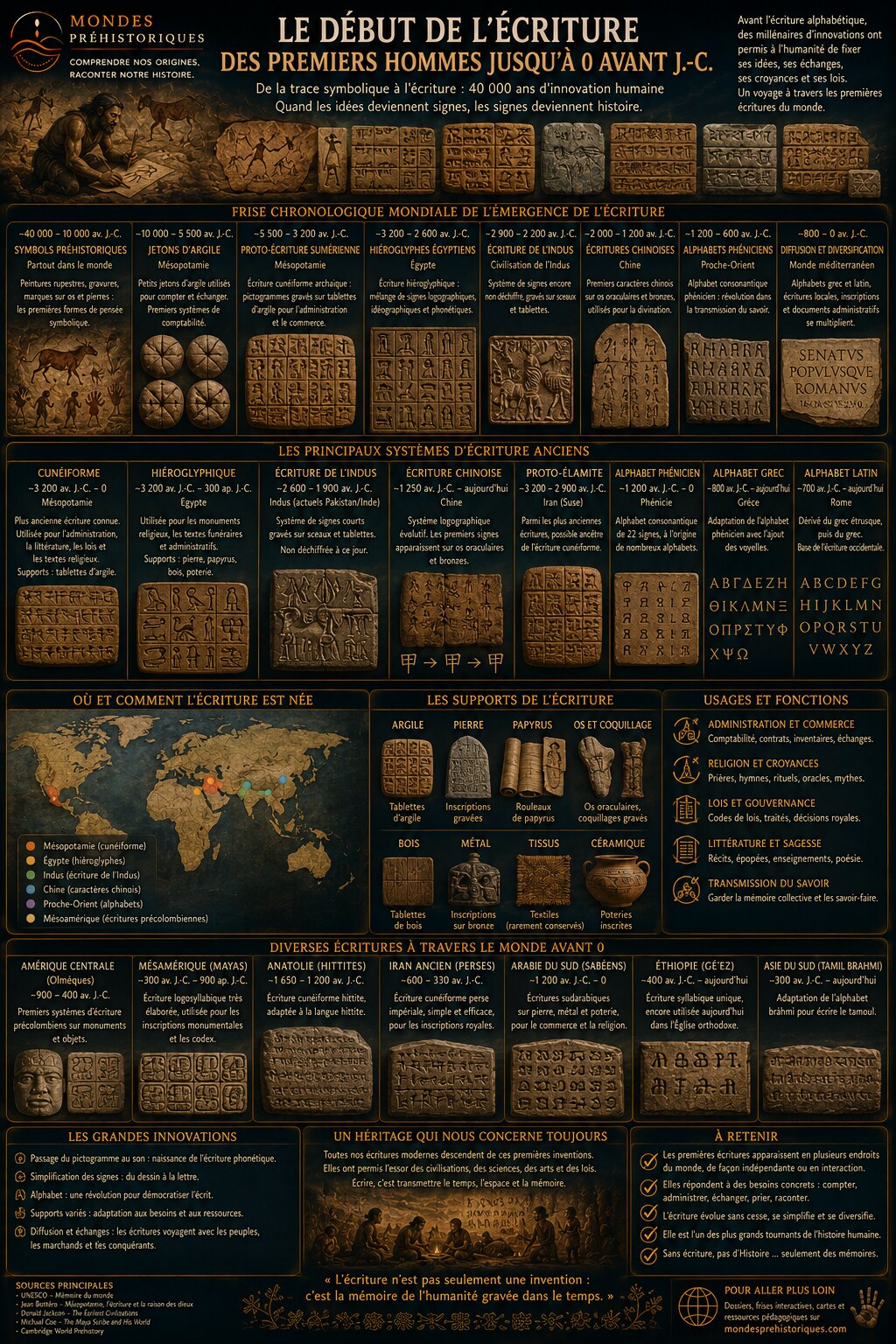
The Origins of Writing
From the first Sumerian pictograms to the Phoenician alphabets: cuneiform, hieroglyphs, the Indus script, Linear B and other systems. Their origins, decipherment and legacy for modern writing.
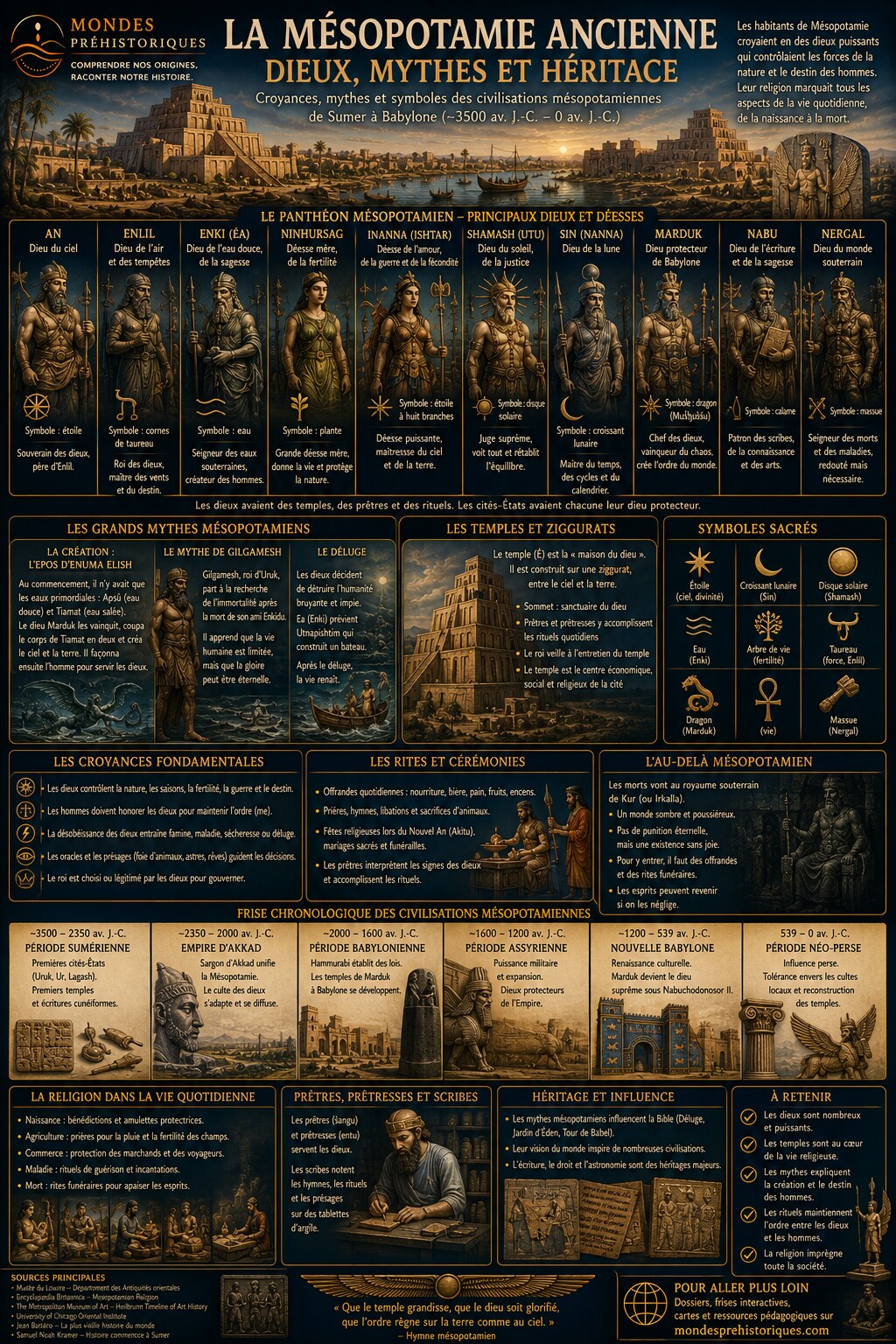
Ancient Mesopotamia - Gods, Myths and Legacy
The Mesopotamian pantheon and the mythology that shaped the West: Marduk, Ishtar, Enlil, the Epic of Gilgamesh, the Flood and creation of the world. The legacy of Sumer and Babylon on the world's major religions.
Ancient Egypt
4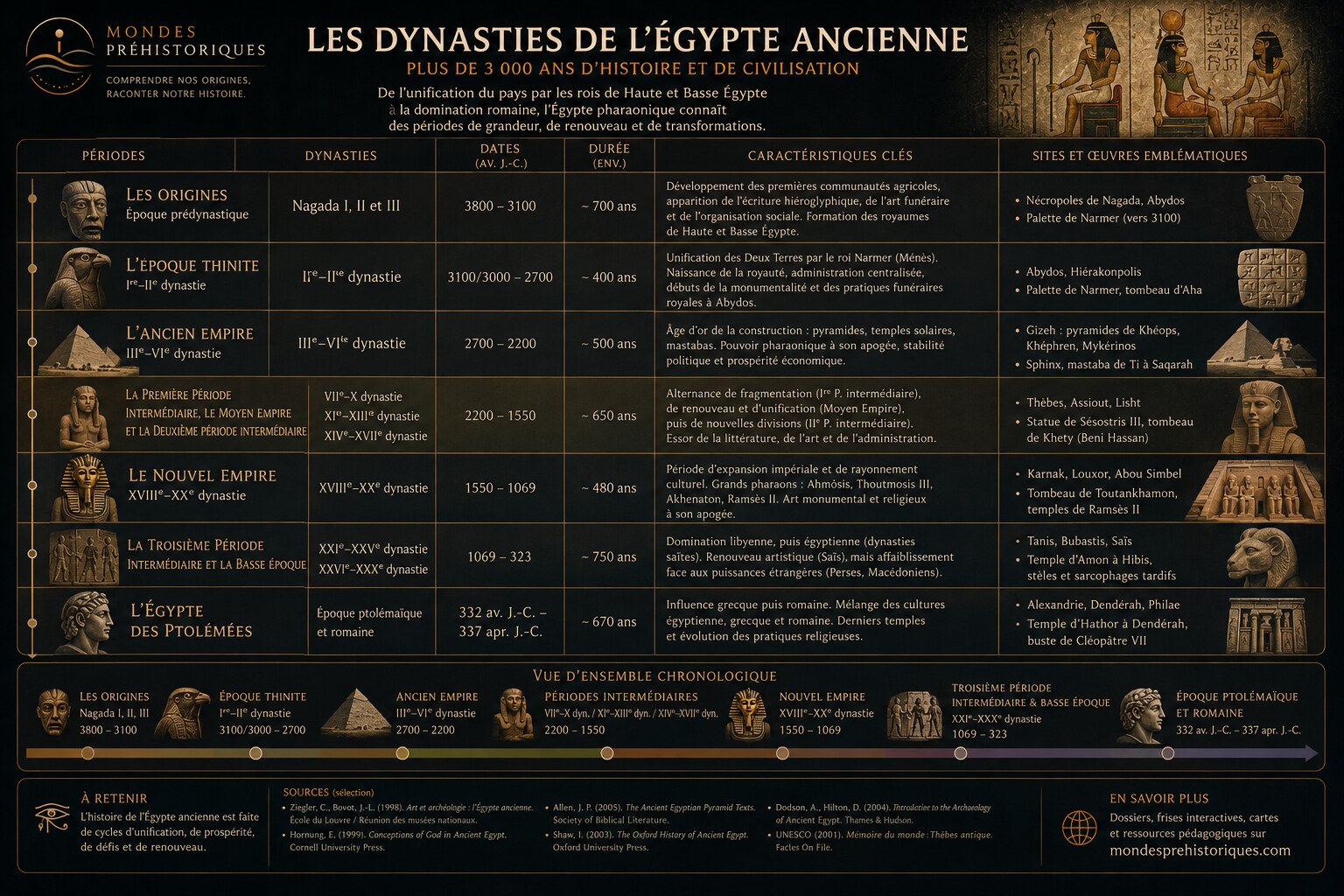
The Dynasties of Ancient Egypt
More than 3,000 years of history in a single table: from the predynastic Naqada period to Ptolemaic Egypt, with the dynasties, dates, key features and landmark sites of each period.
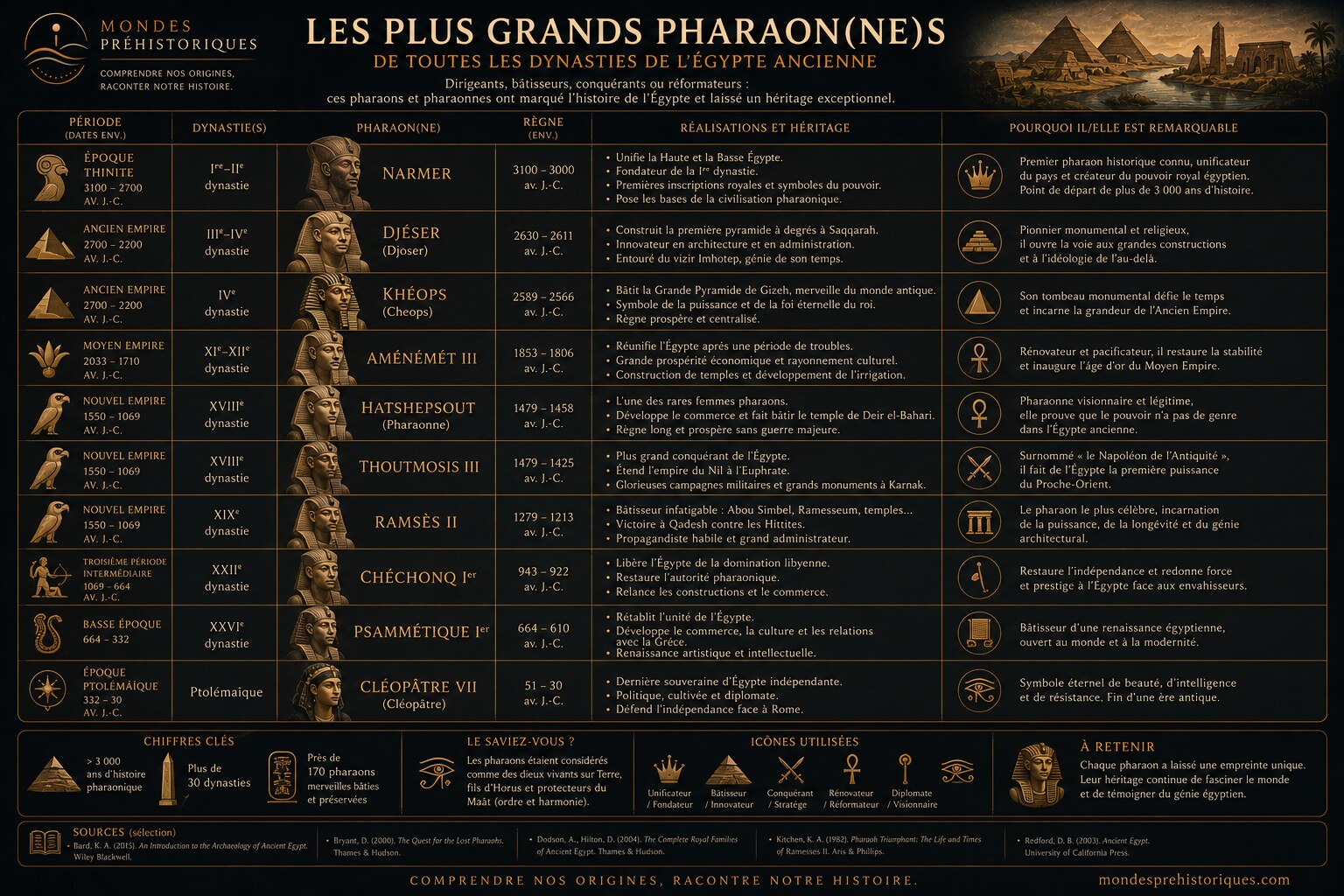
The Greatest Pharaohs
Ten rulers who shaped Egypt, from Narmer to Cleopatra VII, including Djoser, Khufu, Hatshepsut, Thutmose III and Ramesses II: reign, achievements, legacy and why they are remembered.
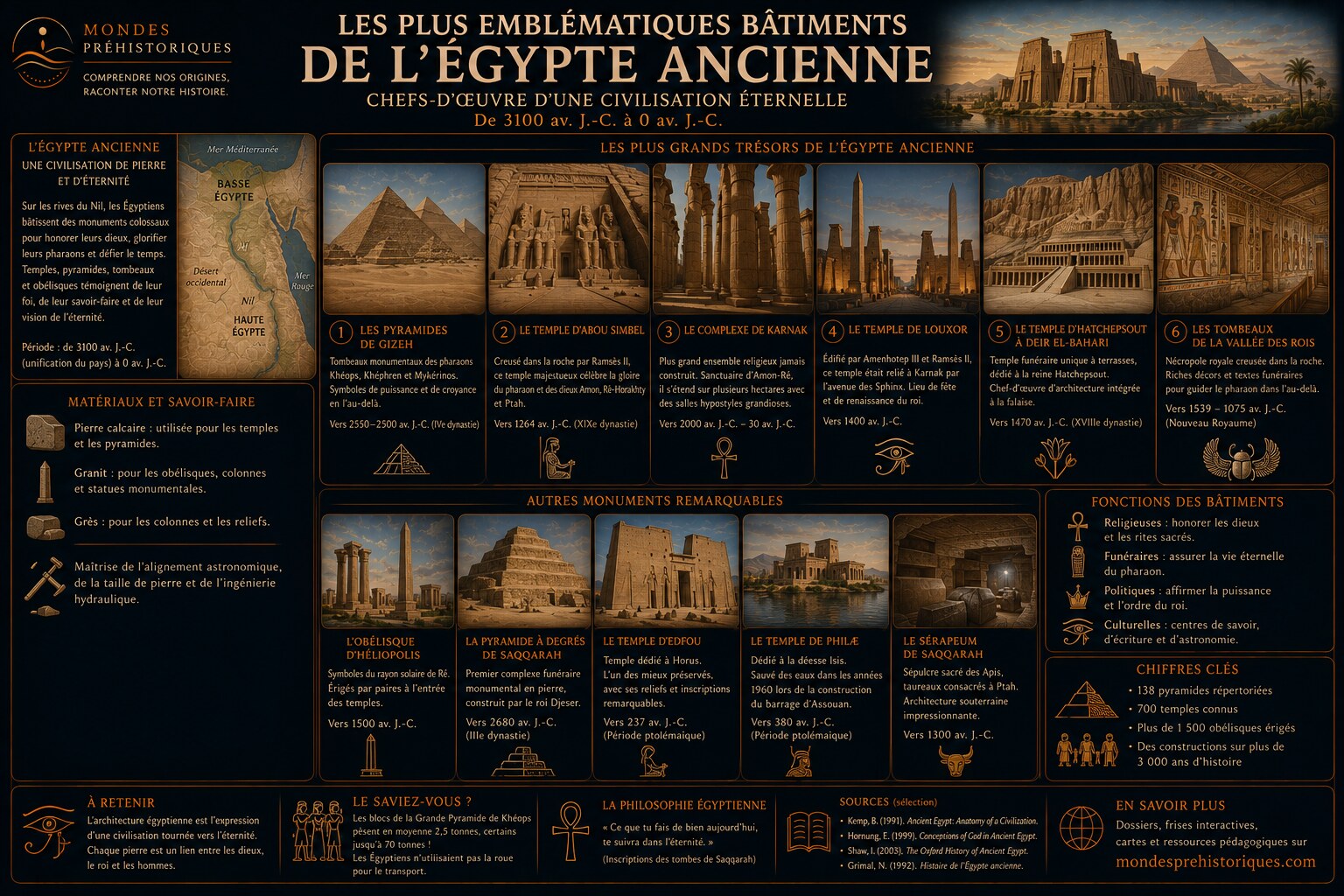
Iconic Buildings of Ancient Egypt
From 3100 BC to 0: the Giza pyramids, Abu Simbel, Karnak, Luxor, Deir el-Bahari and the Valley of the Kings. Materials, craftsmanship, building functions and key figures of Egyptian architecture.
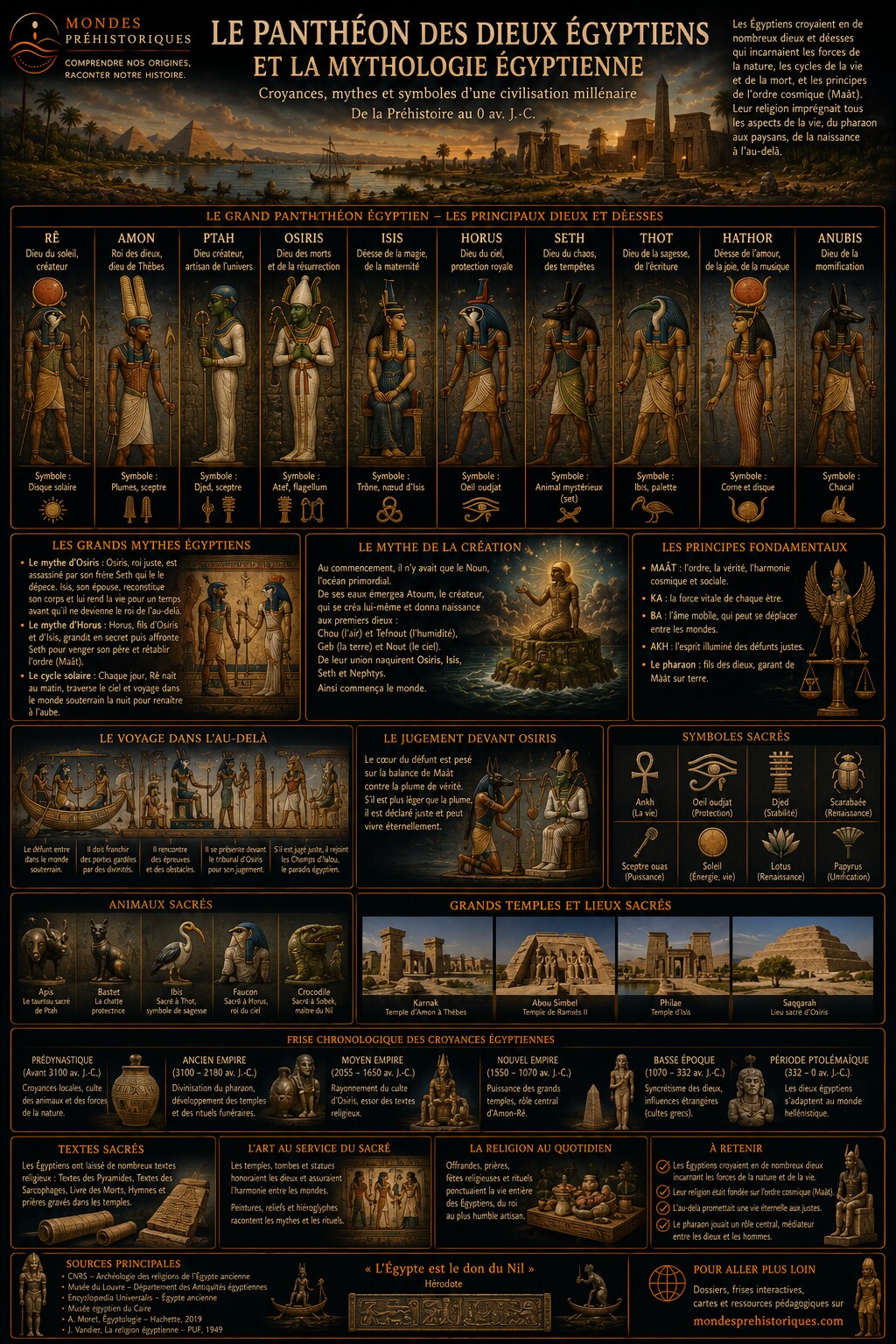
The Egyptian Pantheon and Mythology
Ra, Osiris, Isis, Horus, Seth, Anubis and the great gods of ancient Egypt: their attributes, founding myths, funerary rituals and the legacy of this age-old religion on the Western world.
Ancient worlds: Greece, Persia, Rome
9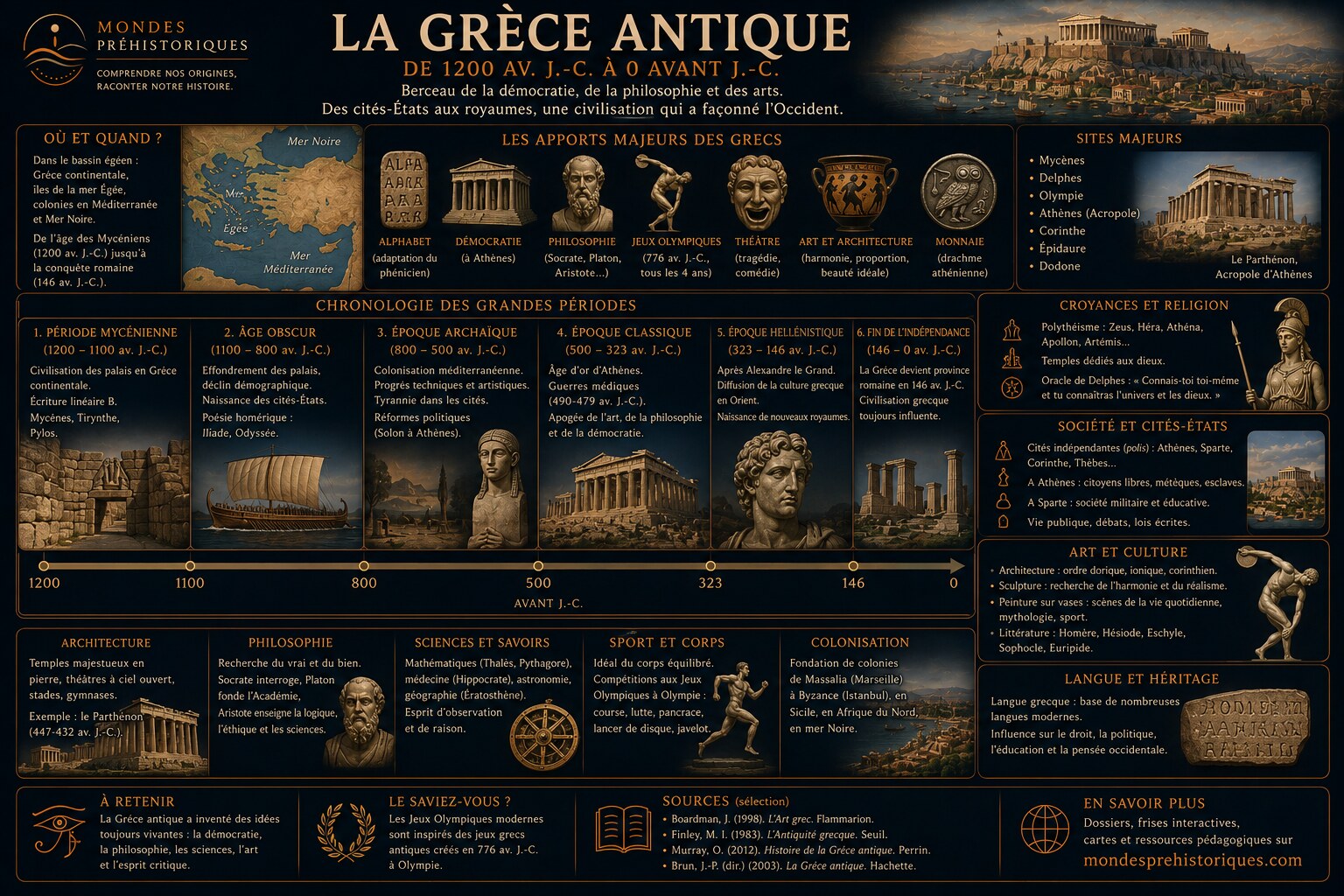
Ancient Greece
From 1200 to 0 BC, the cradle of democracy, philosophy and the arts: from the Mycenaean palaces to the Roman conquest, in six major periods, with the city-states, beliefs, art and legacy.
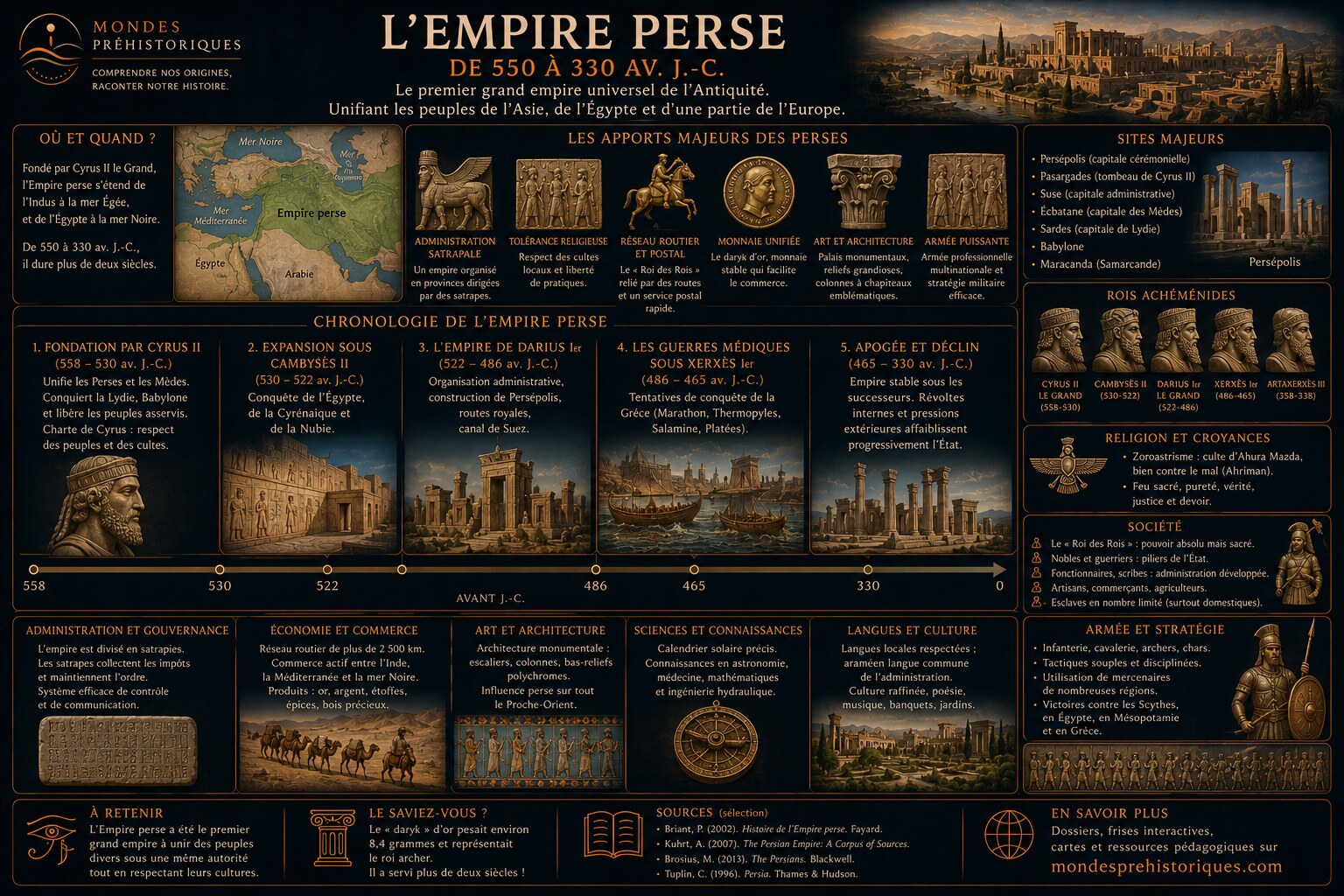
The Persian Empire
From 550 to 330 BC, antiquity's first universal empire: satrapal administration, religious tolerance, the Royal Road and postal service, from Cyrus II to its fall before Alexander.
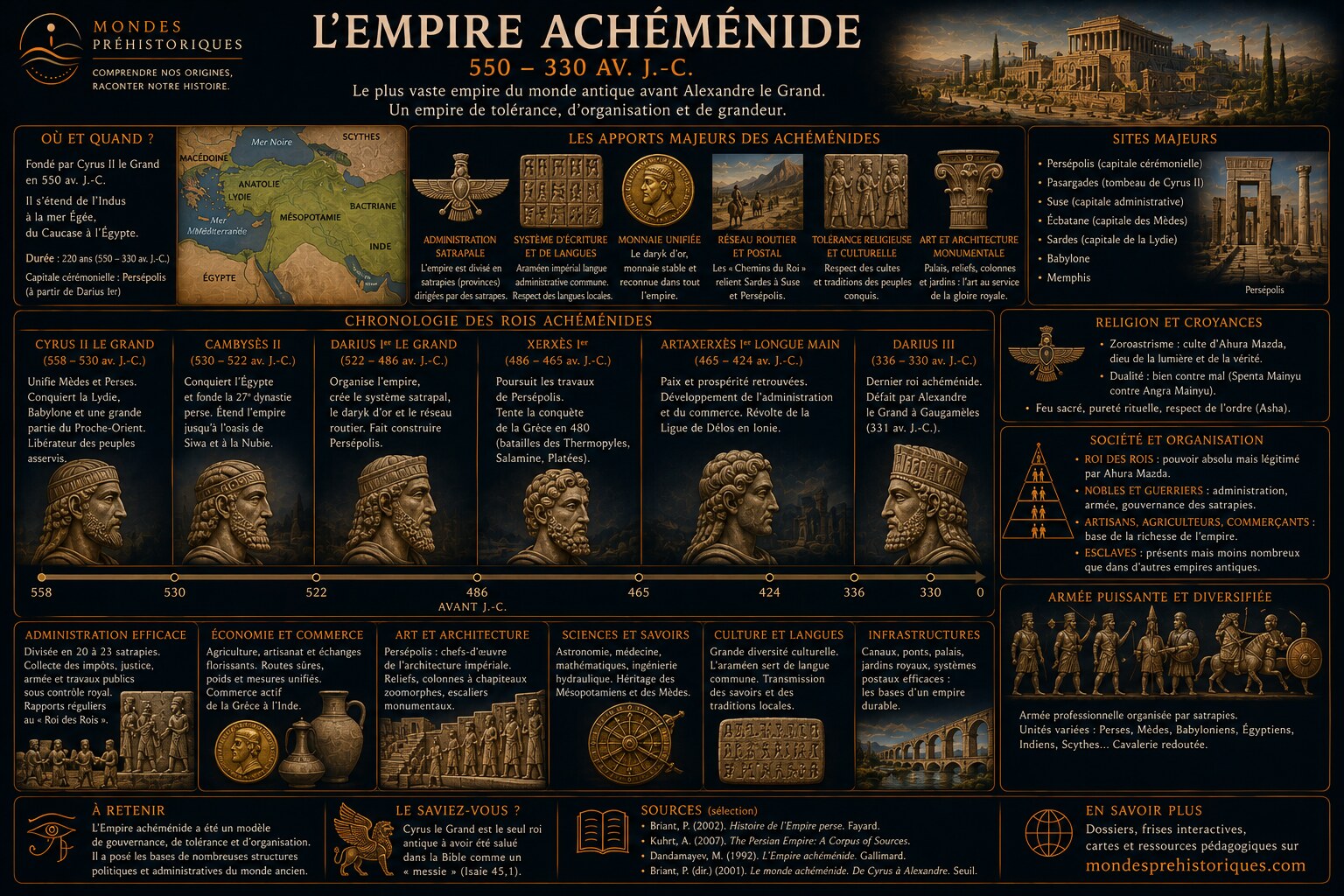
The Achaemenid Empire
550 to 330 BC, the largest empire of the ancient world before Alexander: the six great kings from Cyrus II to Darius III, the satrapy system, Persepolis, Zoroastrianism and a multinational army.
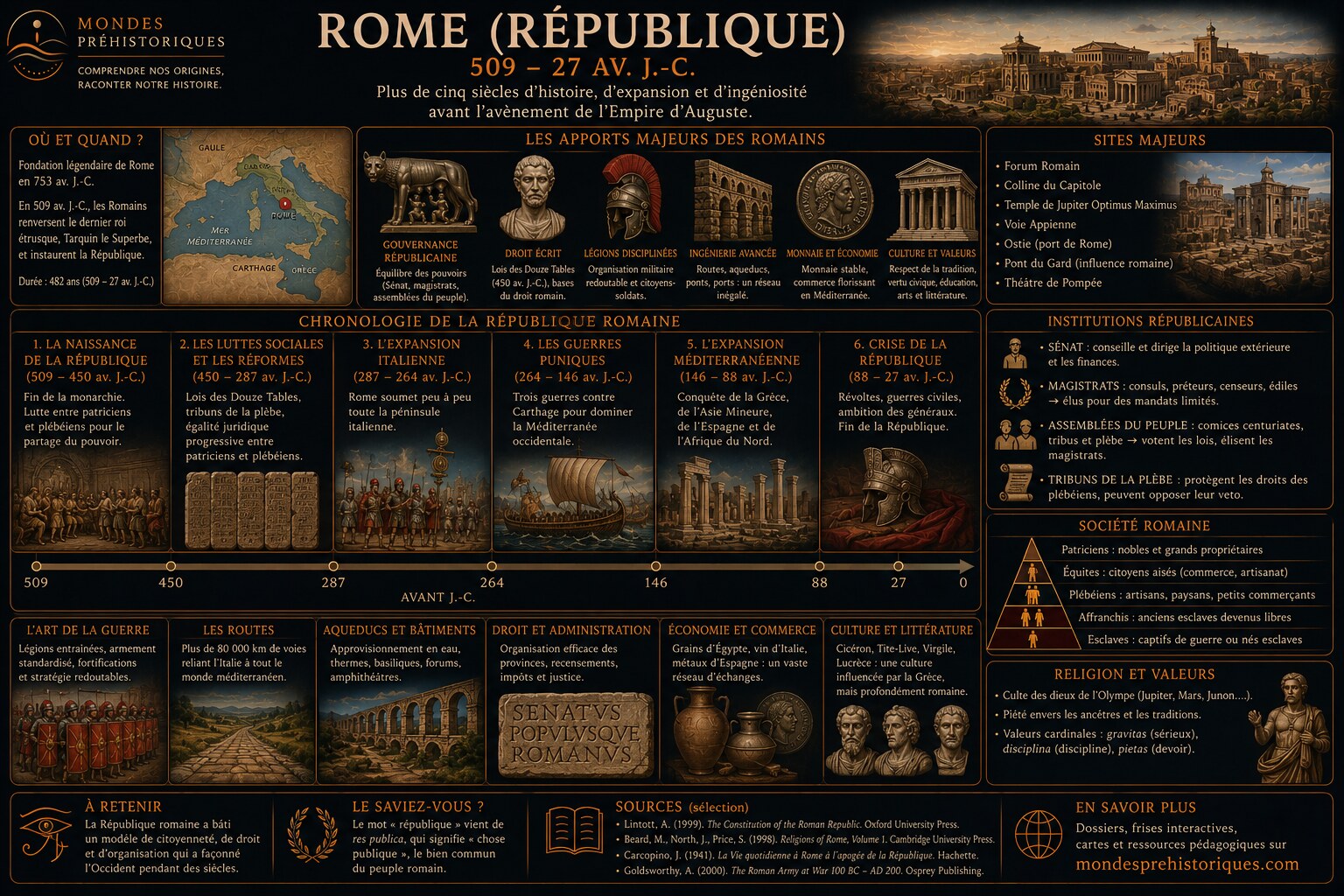
Rome (Republic)
509 to 27 BC: five centuries of expansion and ingenuity. Republican institutions, social struggles, the Punic Wars, roads and aqueducts, society and values, up to the final crisis.
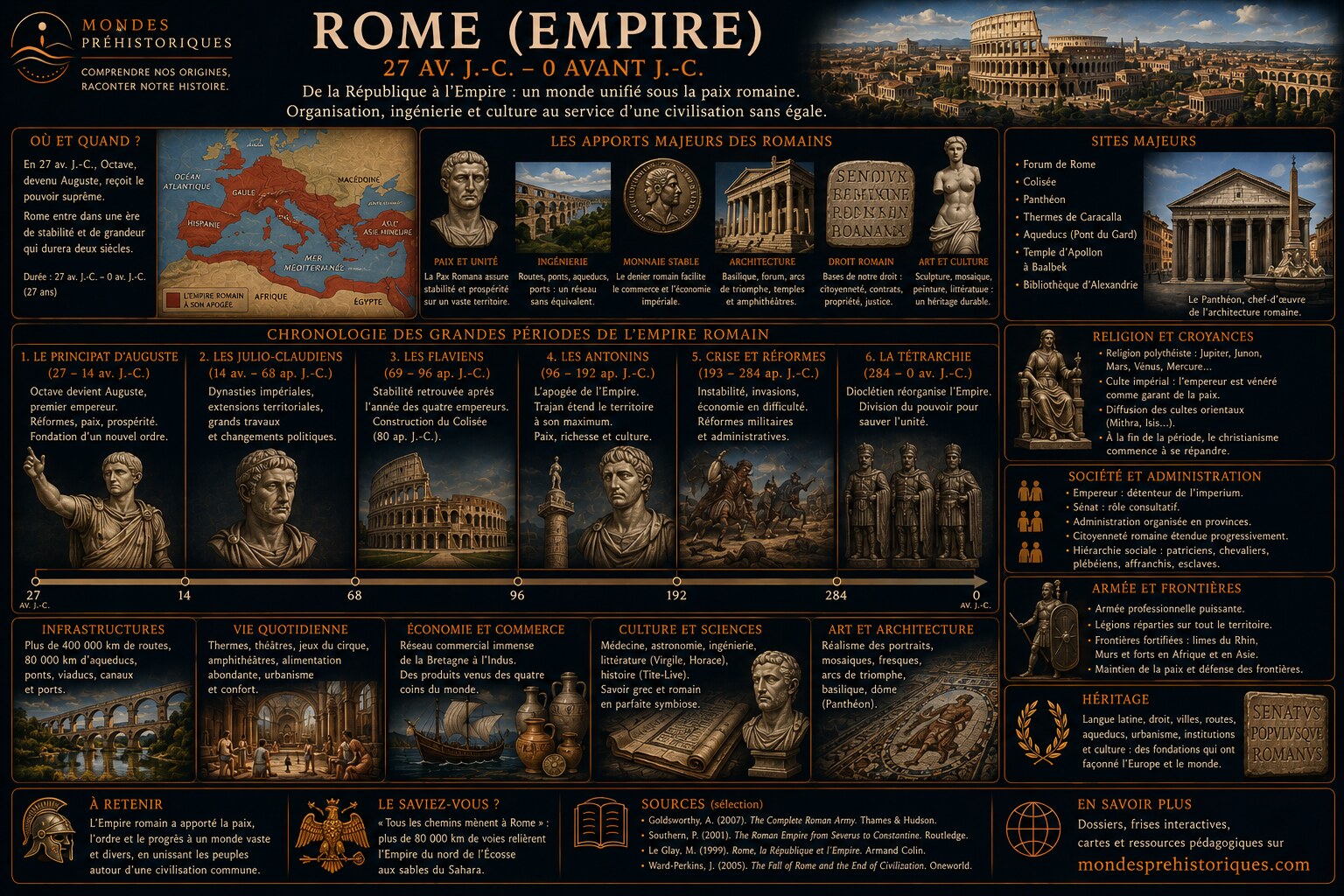
Rome (Empire)
From 27 BC to the threshold of our era: the Roman peace, engineering, law and architecture serving a unified world. A chronology of the imperial periods, society, army and legacy.
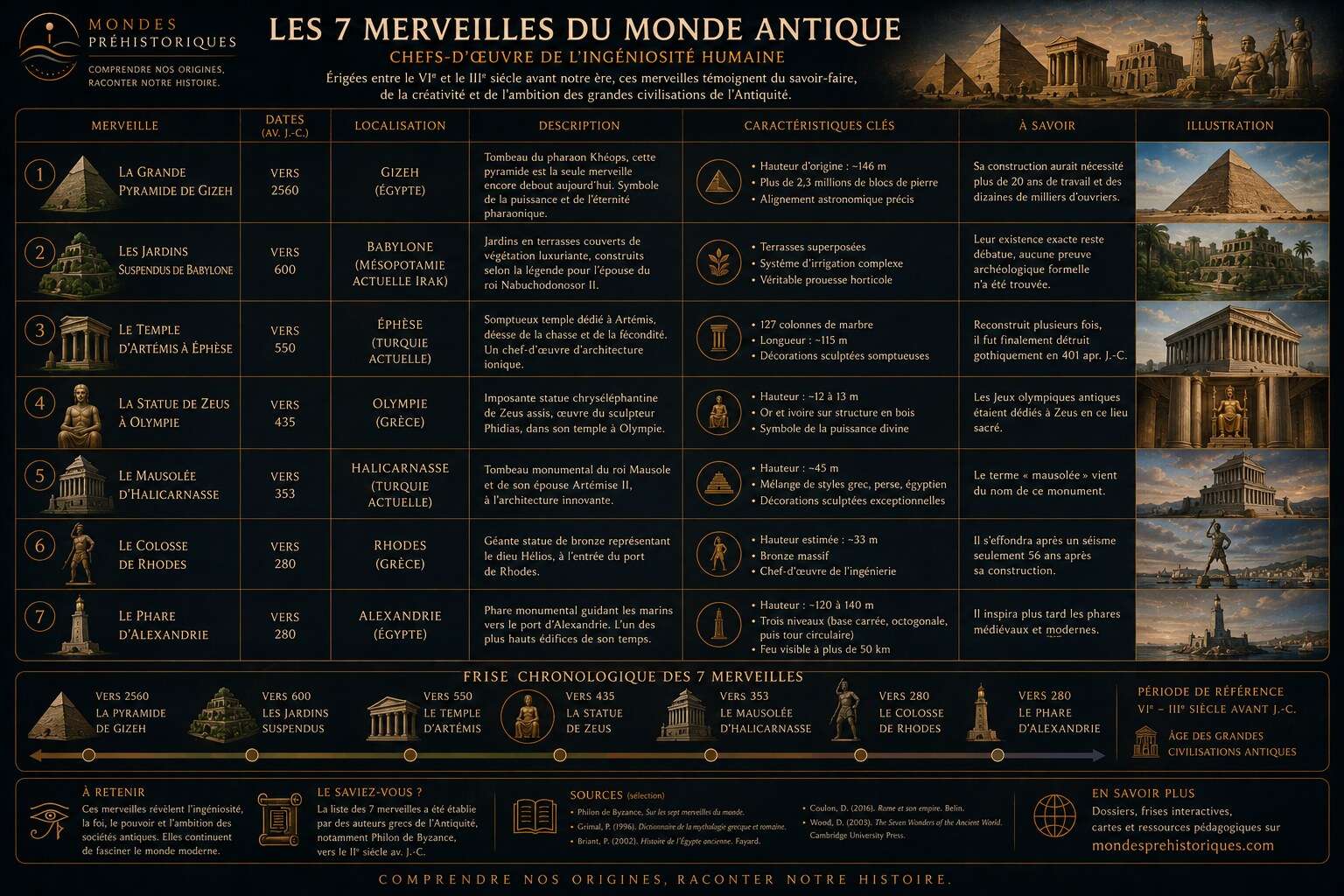
The 7 Wonders of the Ancient World
Built between the 6th and 3rd centuries BC: the Great Pyramid of Giza, the Hanging Gardens, the Temple of Artemis, the Statue of Zeus, the Mausoleum at Halicarnassus, the Colossus of Rhodes and the Lighthouse of Alexandria.
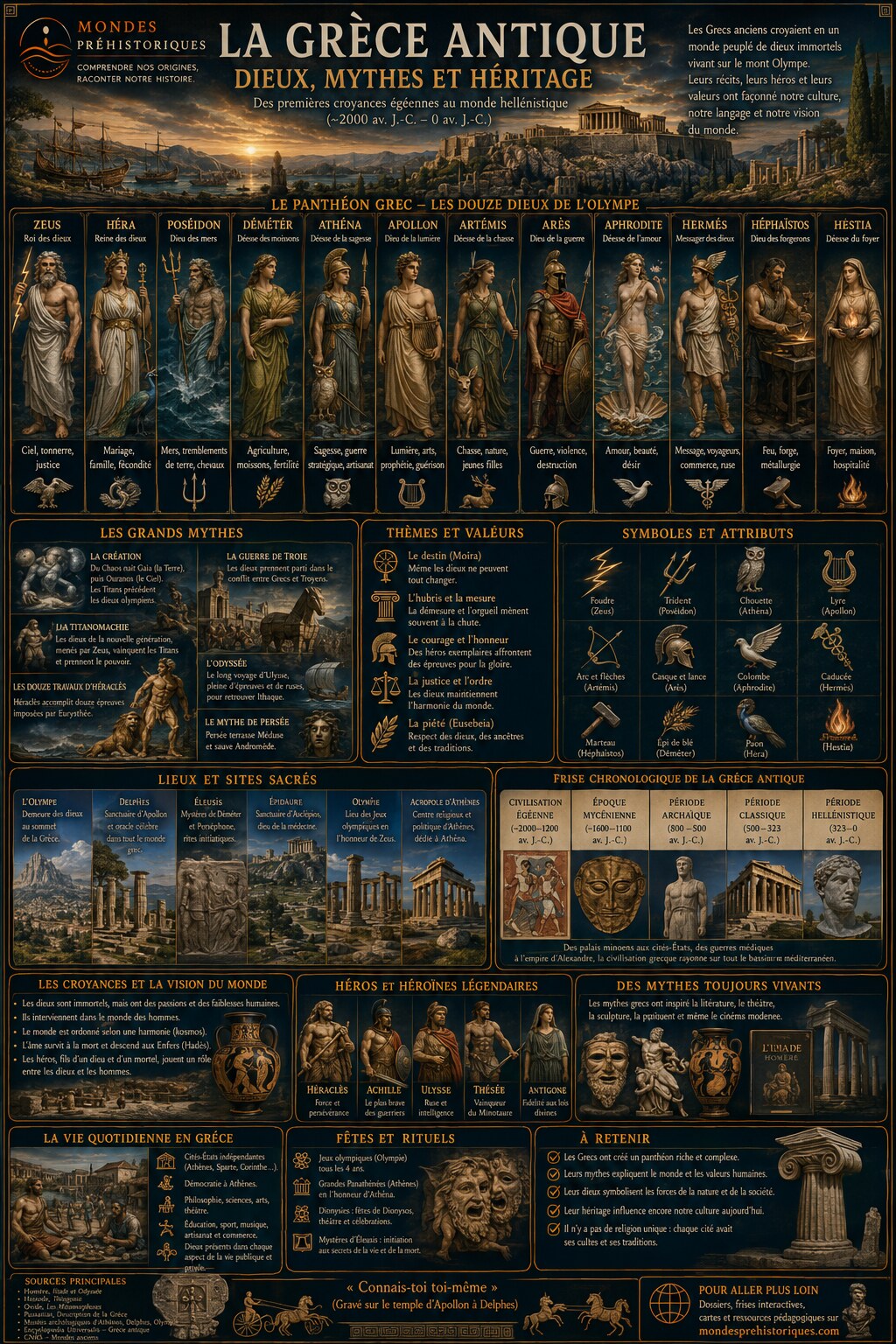
Ancient Greece - Gods, Myths and Legacy
The twelve Olympians, heroes, creatures and great epics: Zeus, Athena, Apollo, Heracles, Odysseus, the Minotaur and their influence on Western art, philosophy and culture.
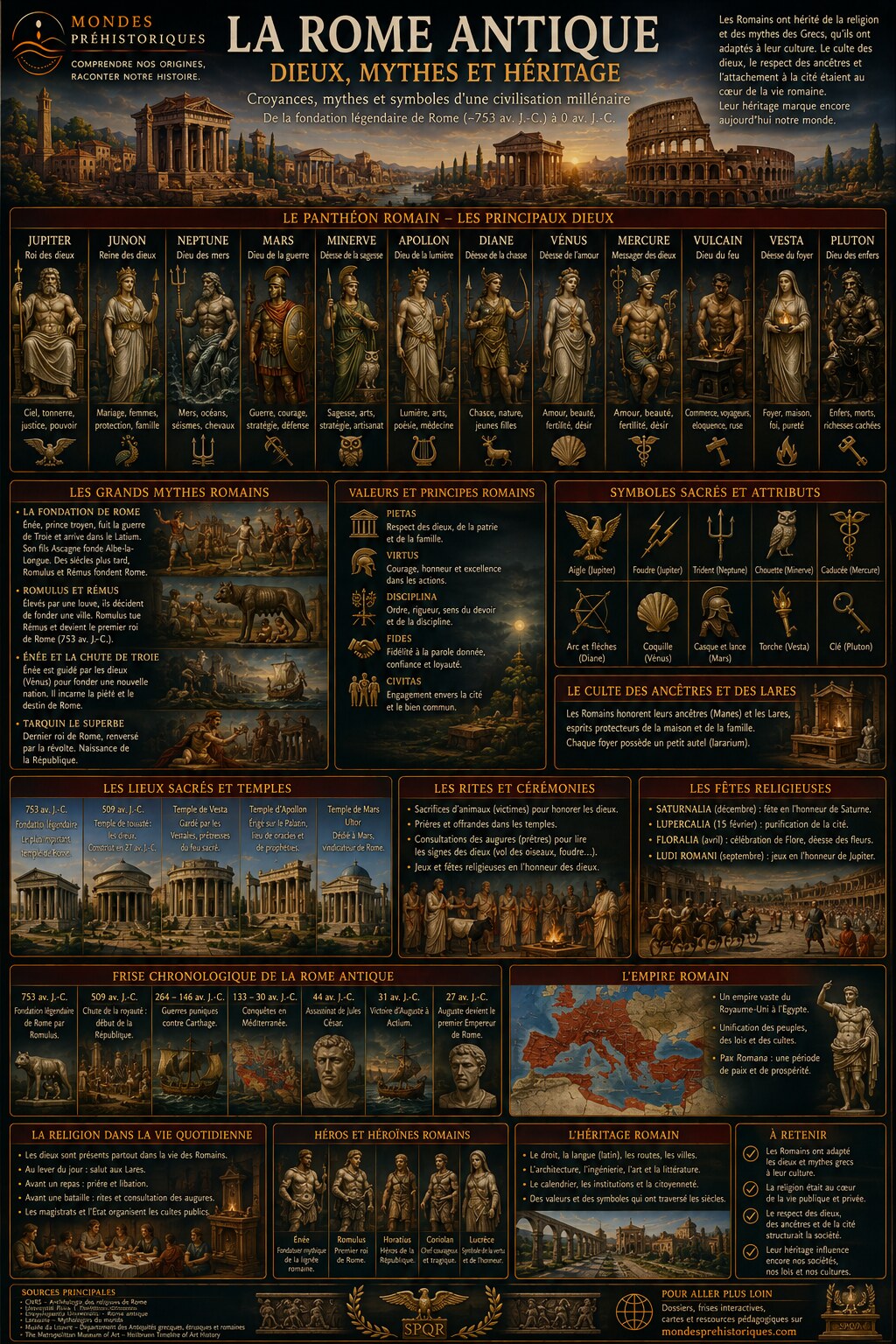
Ancient Rome - Gods, Myths and Legacy
The Roman pantheon and its Greek equivalences, the founding myths: Jupiter, Juno, Mars, Venus, Romulus and Remus, Virgil's Aeneid and the legacy of Rome's religion on early Christianity.
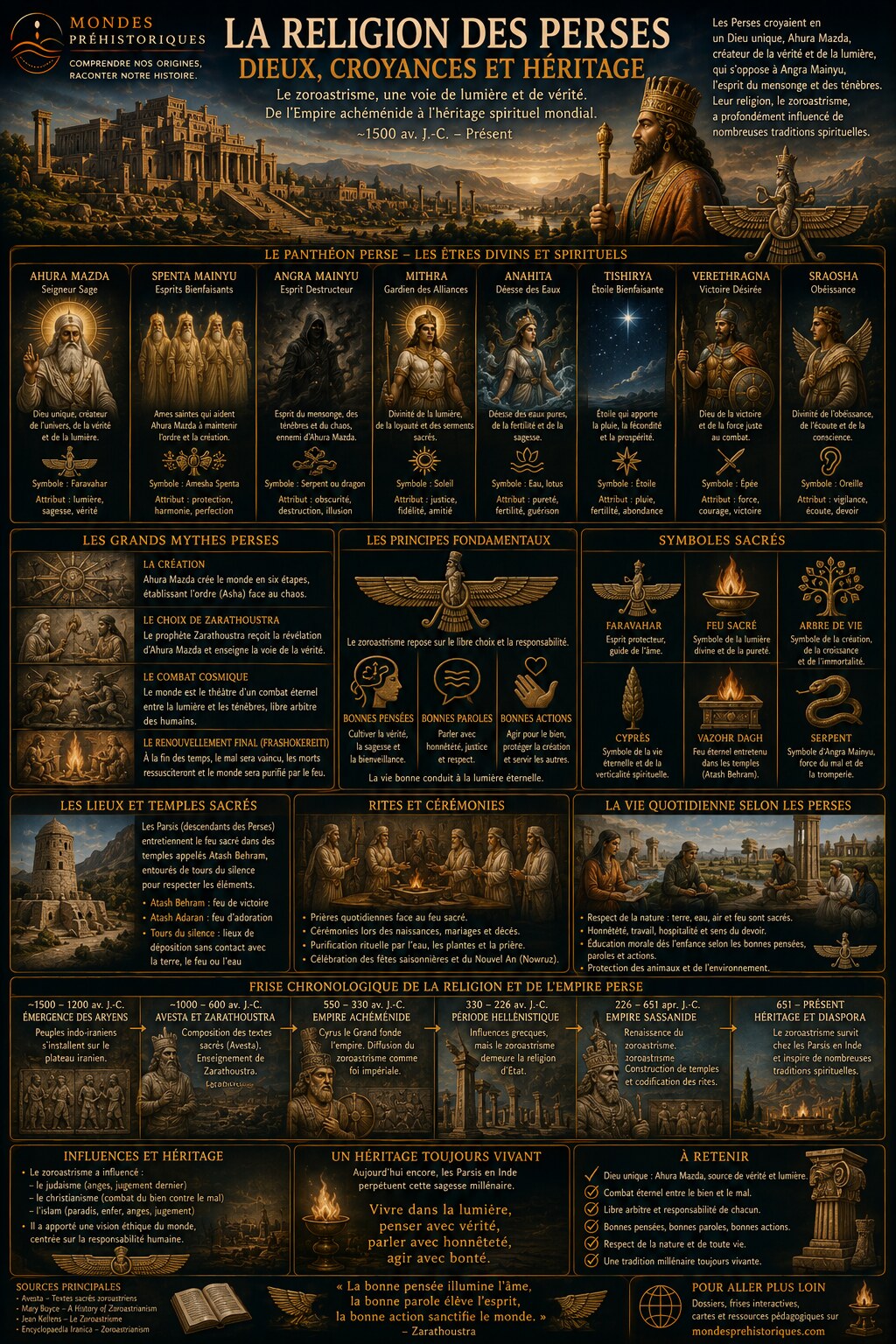
Persian Religion - Gods, Beliefs and Legacy
Zoroastrianism: Ahura Mazda against Ahriman, the battle between light and darkness, the magi, the sacred fire rituals and the far-reaching influence on Judaism, Christianity and Islam.
Americas and Africa
3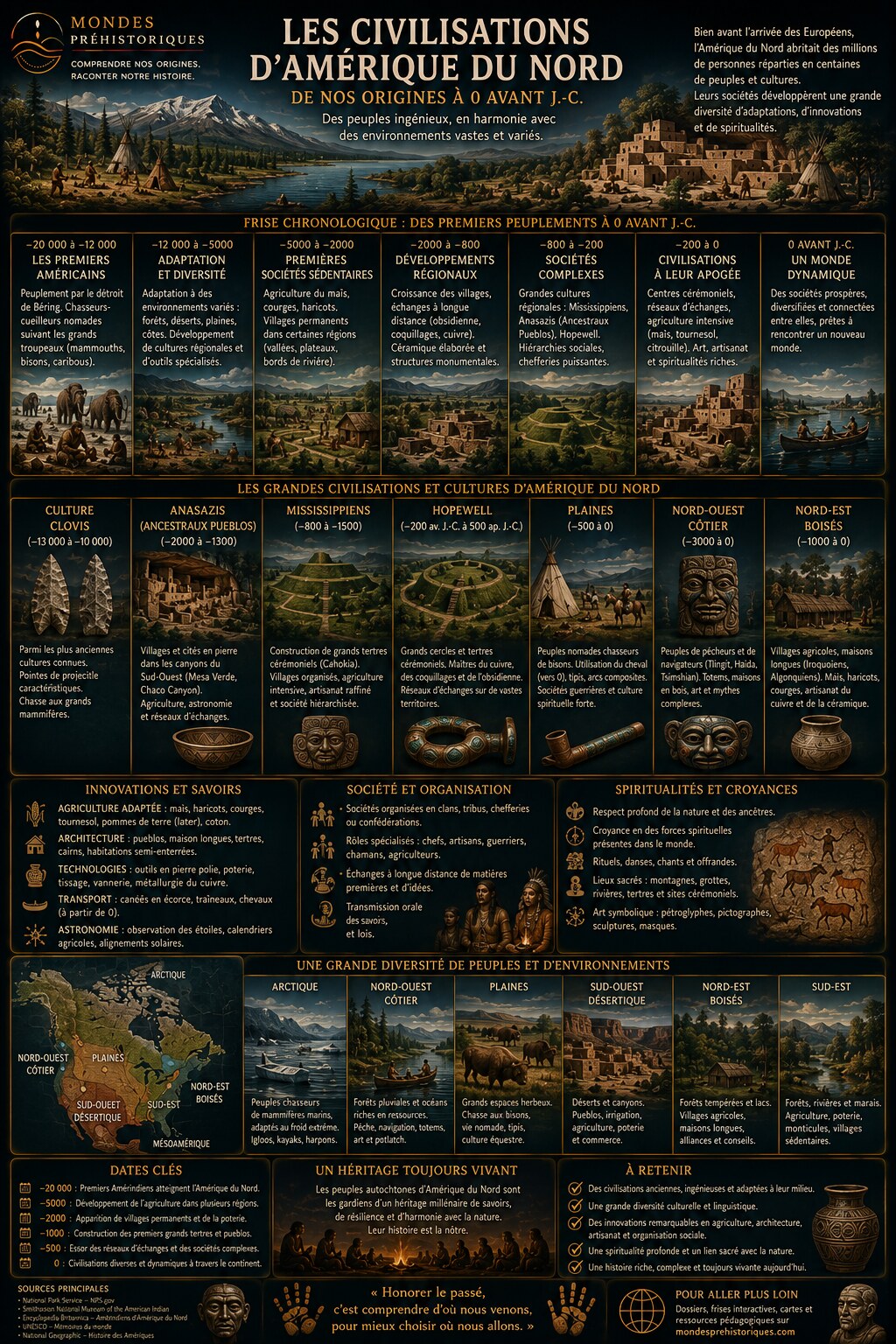
Civilisations of North America
From Clovis hunters to great ceremonial centres: Anasazi/Puebloans, Mississippians, Cahokia, Hopewell, Great Plains cultures and Northwest Coast civilisations. North America long before Christopher Columbus.
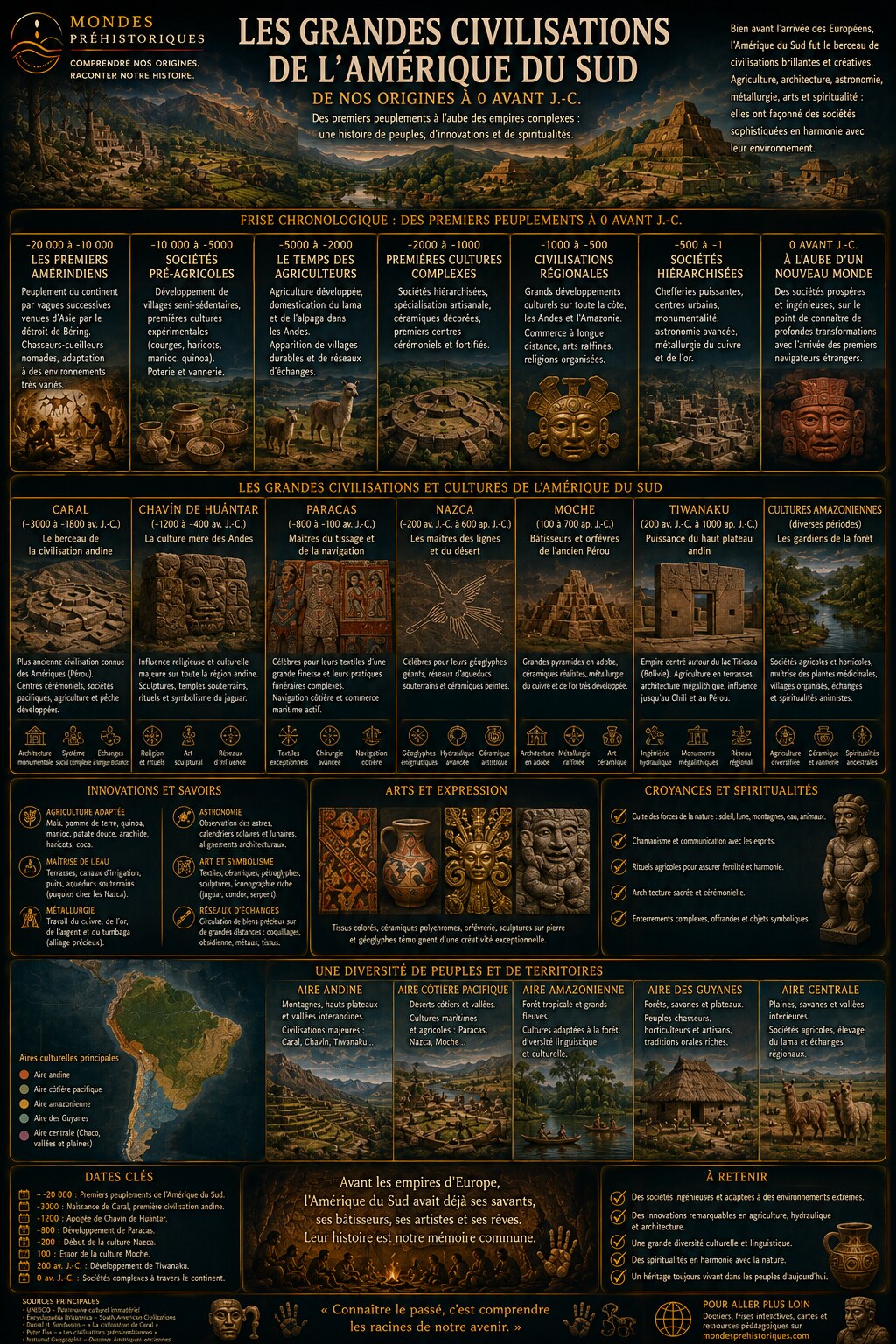
The Great Civilisations of South America
From the Chavin to the Incas, via Tiwanaku, the Wari, the Moche, the Chimu and Norte Chico: civilisations that built empires, roads and monuments long before the arrival of Europeans.
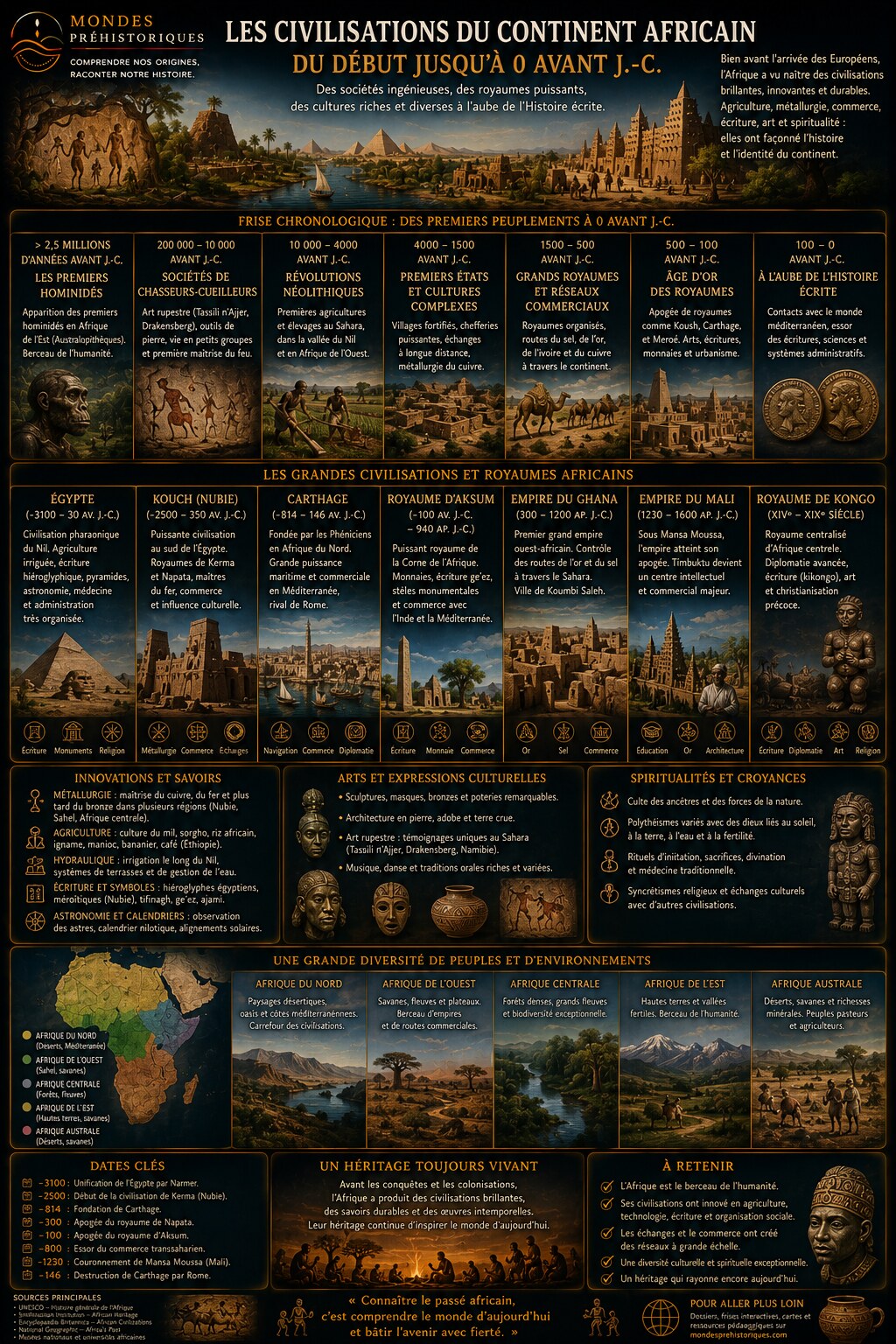
Civilisations of the African Continent
Beyond Egypt: Nubia/Kush, Aksum, Mali, Ghana, Songhai, Carthage, Zimbabwe and the kingdoms of sub-Saharan Africa. The great African powers too often overlooked in school textbooks.
Timelines
1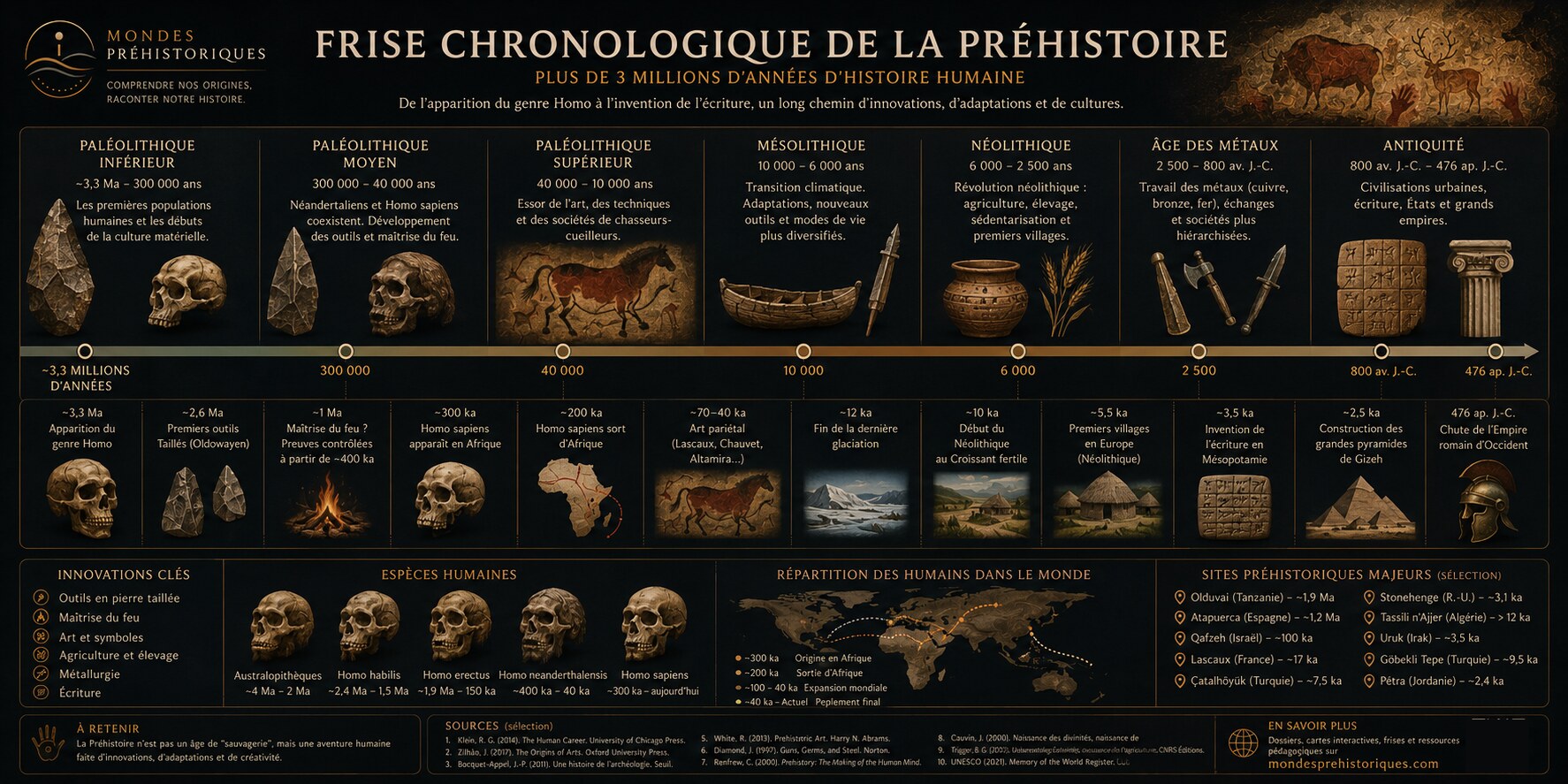
Prehistoric Timeline
Complete visual timeline of Prehistory: from Ardipithecus ramidus 4.4 million years ago to the first civilizations. All the major milestones of the human adventure placed on a clear, documented timeline.
Download all infographics for free
Create a free account to download all our infographics in high resolution.
Create a free accountAlready have an account? Log in