Wood is the great absentee of prehistoryPrehistoryThe span of human history before the invention of writing, from the Palaeolithic to the Metal Ages, known mainly through material remains.→. Yet it was used for almost everything: heating, hunting, digging, building, carrying, cooking. But it rots within a few years, and usually all that remains are knapped stones, as if our ancestors had lived on flintFlintA hard, brittle siliceous rock, knapped by prehistoric people to produce blades, points and sharp tools.→ alone. At the Abric Romaní, a rock shelterRock shelterA shallow cavity at the foot of a cliff or under a rocky overhang, offering natural shelter; a favoured site of prehistoric habitation and rock art.→ in Catalonia, nature made an exception. Lime-laden water wrapped the wooden objects left behind by Neanderthals and then moulded them in stone before they vanished. A study published on 10 October 2026 in the journal Science Advances catalogues these wooden ghosts: spears, a club, digging sticks, bark trays and hut poles.12
The study, led by Palmira Saladié of the Catalan Institute of Human PalaeoecologyPalaeoecologyThe study of past ecosystems and their relations with the environment, reconstructed from fossils, DNA and sediments.→ and Social Evolution (IPHES-CERCA) and Rovira i Virgili University, with colleagues including Gema Chacón and Josep Vallverdú, offers a rare picture of NeanderthalNeanderthalsA fossil humanity of Eurasia, robust and cold-adapted, extinct around 40,000 years before present.→ daily life in all its perishable detail.1
A shelter at the foot of a travertine cliff
The Abric Romaní opens at Capellades, some sixty kilometres west of Barcelona, at the foot of a cliff of travertine, a rock formed by limestone dissolved in spring water and redeposited. The site has been known since the early 20th century and systematically excavated since 1983, initially under the direction of Eudald Carbonell. More than forty years of fieldwork have uncovered a sequence of deposits some twenty metres thick, covering most of the late Middle PalaeolithicPalaeolithicThe oldest and longest period of prehistory (c. 3.3 Ma–12,000 BC), defined by chipped stone tools and a hunter-gatherer way of life.→Middle PalaeolithicA Palaeolithic period (c. 300,000 to 40,000 years ago) associated mainly with Neanderthals and early Homo sapiensHomo sapiensThe present-day human species, which emerged in Africa around 300,000 years ago, the only surviving human lineage after the extinction of Neanderthals and Denisovans.→, marked by Levallois tools.→.1
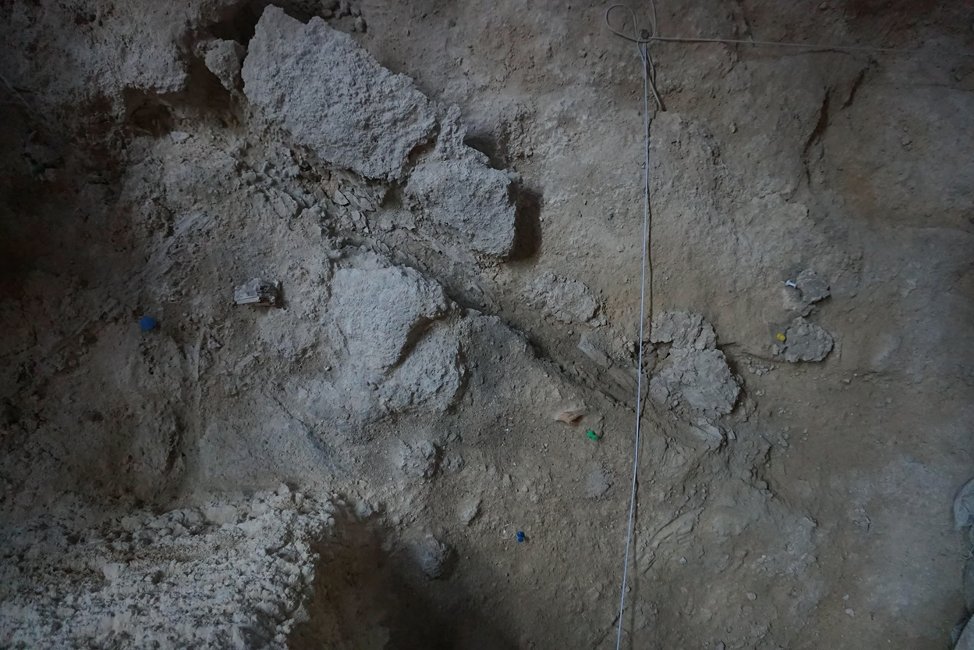
The sixteen archaeological levels studied range from about 62,000 to 40,000 years ago. For more than twenty millennia, Neanderthal groups returned to camp beneath this shelter, lighting fires, butchering prey and knappingknappingThe set of operations for fracturing a stone block to extract flakes or blades.→ flint.12 But what makes the Abric Romaní unique in the world is the way it preserved wood.
Stone moulds around vanished wood
Over the millennia, water rich in calcium carbonate trickled across the floor of the shelter. Whenever it covered a discarded piece of wood, whether a branch, a log or a tool, it deposited a mineral crust around it. The wood eventually decayed, but the crust remained, preserving its exact shape as a hollow. Some of these natural moulds are so precise that they retain traces of the wood's cellular structure, allowing the tree species to be identified.13
Other pieces survived because they had been charred, in a hearth or after being discarded, often together with their own impression. In all, the researchers analysed 597 wood remains. The vast majority is ordinary wood: trunks, branches, twigs, roots and above all firewood. Scots pine dominates, accounting for more than 90% of the charcoal identified in the hearths.1 But among these hundreds of remains, thirteen pieces from eight levels bear unmistakable signs of manufacture or use.
Two spears for hunting deer
The most spectacular objects come from level R, the oldest excavated. They are two spears. The first is 2.45 metres long, the second 1.99 metres, preserved in three fragments. Lying near the longer one were the remains of red deer, including three skulls of adult males with their antlers still attached.1
According to the researchers, the longer spear was probably a thrusting weapon, designed to strike at close range rather than to be thrown.2 It is a reminder that Neanderthals often hunted at close quarters, a risky practice reflected in the many fractures found on their skeletons. These spears add to the small corpus of Palaeolithic wooden weapons, dominated by the famous SchöningenSchöningenGerman site that yielded eight wooden throwing spears about 300,000 years old, among the oldest known wooden weapons.→ spears in Germany and the fire-hardened sticks of Poggetti Vecchi in Italy, around 170,000 years old.1
An "extraordinary" club
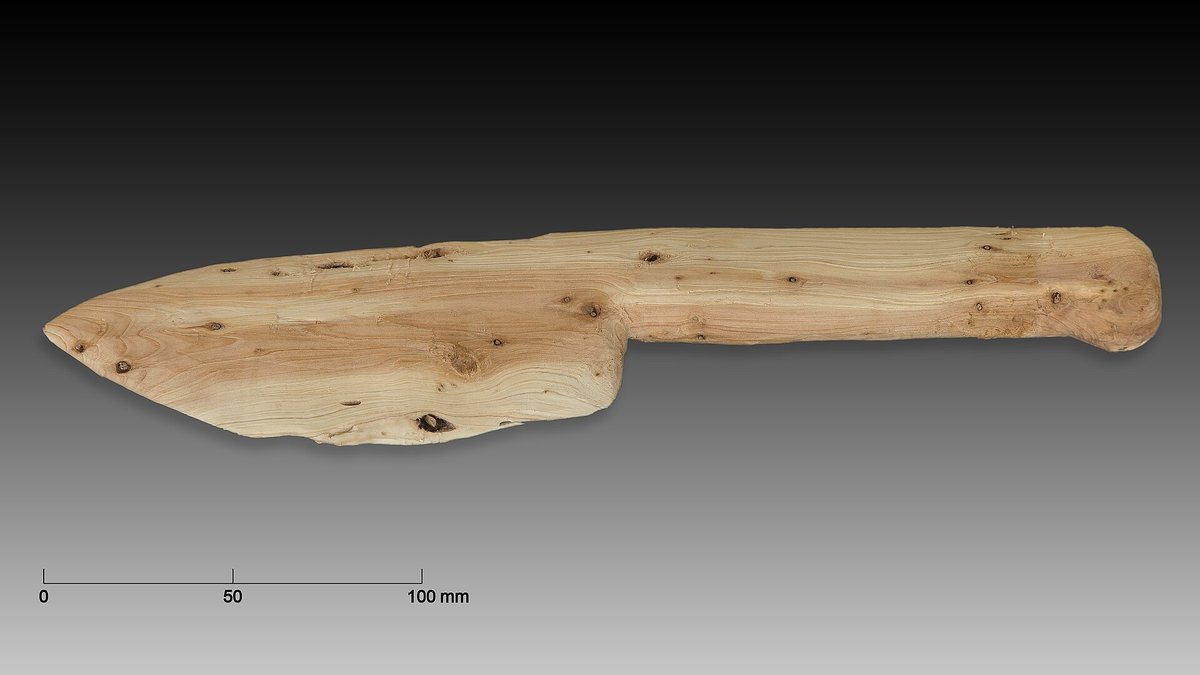
Level P yielded a more puzzling piece. Carved from a single piece of wood, it has a handle about 16 centimetres long and a widened, asymmetrical, half-moon-shaped end. Scraping marks show that it was deliberately shaped. It also bears burn marks, probably acquired after it was discarded.1
What was it for? The researchers are unsure. It could have been a club used to finish off prey, a hammer for working other materials, or even an object with symbolic value. "It is an extraordinary piece," says Palmira Saladié.2 Clubs are almost unknown in the Middle Palaeolithic: the wood they were made of has nearly always vanished without trace.
Bark trays by the fire
The excavations also revealed everyday objects no one would ever have expected to find. In levels H and O, four charred fragments of bark, flattened or slightly concave, lay close to the hearths. For the researchers, these may have been trays or shallow containers, used to keep food off the ground, to hold plant foods or honey, or to handle ash.12
These containers were made from the more flexible bark of juniper, whereas Scots pine was preferred for fuel and for sturdy tools.2 Neanderthals therefore knew the properties of different woods and chose them according to purpose, as a craftsman would. Other small objects, awls for piercing soft materials and small wooden pellets, complete the inventory.
A kitchen, a sleeping area, shelters
The wood of the Abric Romaní reveals not only tools but also how space was organised. In level I, two sticks crossed above a hearth may have formed a small raised structure, a kind of grill or rack for smoking meat.12
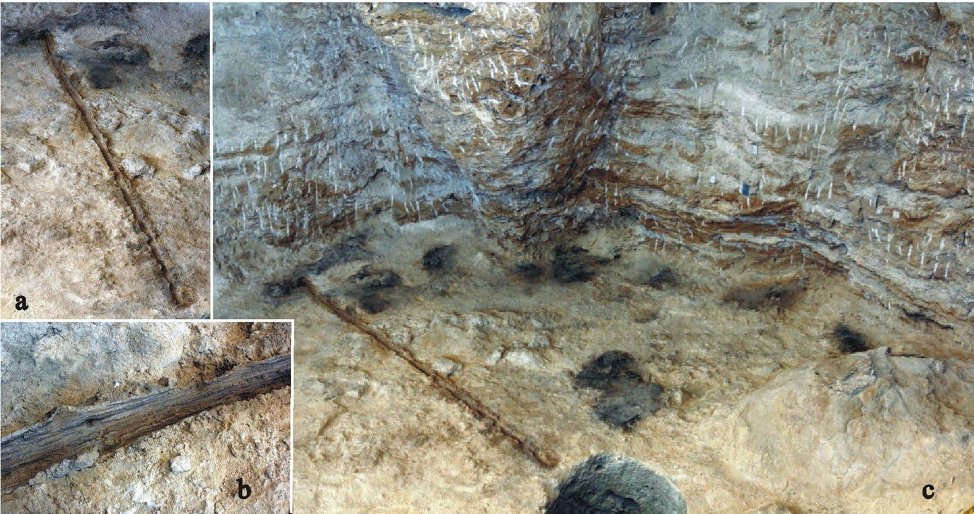
In level N, a long pole 5.10 metres in length, carefully stripped of its branches, was surrounded by five small hearths. The researchers see it as the support for a windbreak or light shelter, perhaps a tripod structure, protecting a resting area where each person had their own small fire.12 The idea of a space set aside for sleeping, furnished with individual hearths and wooden partitions, conveys a domestic life far more structured than Neanderthals were long given credit for.
Finally, several thick, pointed sticks from levels J and O may have served as digging sticks, used to unearth roots and tubers or to dig hearth pits. The researchers remain cautious, however: the shape of these objects does not always allow them to decide between several possible uses.1
A pine forest around the shelter
The wood found at the Abric Romaní also tells the story of the landscape. The overwhelming dominance of Scots pine, both in the hearths and among the tools, indicates that the shelter was surrounded by open conifer woodland, typical of the cooler phases of the last glacial period in north-eastern Iberia. Juniper, a hardy shrub of open ground, completed the scene.1
For the Neanderthals of Capellades, this forest was a larder, a fuel store and a workshop. Every level of the shelter bears witness to this intimate relationship with trees: wood was burned in quantity, weapons and utensils were shaped, structures were built. It was an economy entirely turned towards the forest, of which flint alone gave no hint.
This dependence on wood may also explain why Neanderthals returned to the Abric Romaní again and again over twenty thousand years. A sheltered spot with water close at hand and an abundant supply of timber was a precious resource in a landscape where winters could be harsh. Each return left new layers of ash, bone, stone tools and, occasionally, the precious imprints of wooden objects that make the site so exceptional today.
What flint does not tellTellAn artificial mound formed by the accumulation of successive layers of settlement remains at the same spot, typical of the Near East. Each destruction-rebuilding event adds a stratum.→ us
For archaeologists, the Abric Romaní is a lesson in humility. At most Palaeolithic sites, Neanderthal life is reconstructed from knapped stones and animal bones, the only remains to have withstood time. Yet stone tools were probably only a small part of their equipment. Wood was used to make handles, weapons, containers and structures. Without it, our picture of these societies is inevitably incomplete.
The Capellades finds echo those from other exceptional sites. At Kalambo Falls in Zambia, logs joined together at least 476,000 years ago form the oldest known wooden structure. At Aranbaltza in the Basque Country, a Neanderthal digging stickdigging stickPointed wooden tool used to dig the ground to extract roots, tubers or small animals.→ has been dated to around 90,000 years ago.1 And in Greece, at Marathousa 1Marathousa 1Open-air Palaeolithic site in the Megalopolis basin, Greece, on the shore of an ancient lake, where the oldest handheld wooden tools were found.→, 430,000-year-old wooden tools were recently identified. Piece by piece, these discoveries reveal a true wood culture, as old as stone knapping itself.
Craftsmen attentive to their material
What the Abric Romaní objects show above all is the finesse of Neanderthal know-how. Choosing pine for its rigidity and juniper for its flexibility, stripping and straightening a pole more than five metres long, carving a club from a single block, shaping and pointing a spear nearly two and a half metres long: all this implies an intimate knowledge of the forest and a mastery of techniques handed down from generation to generation.12
These craftsmen used stone tools to work the wood, but also fire, which hardens a point or makes scraping easier. Their camps now appear as carefully arranged places, where people cooked, slept, repaired weapons and stored food. It is a picture far removed from the caricature of a brutish being long attached to Neanderthals.
The Abric Romaní has probably not yet given up all its secrets. Its travertine deposits, which froze the most fragile traces of Neanderthal life for tens of thousands of years, are still being excavated. Every new impression may reveal an unsuspected object and add to this rare inventory of the wooden world of our vanished cousins.
No comments yet. Be the first.